Category Archives: Physics

Quantum Mechanics I: Interference

A bunch of people have been asking me about the interpretation of QM.  Now, every interpretation of QM predicts (or claims to predict) the same experimental results in any experiment (or at least, any realistically feasible experiment).  Otherwise they wouldn’t be rival interpretations, they would be rival theories, and we would just do an experiment to see who is right.

So before discussing what QM actually means, it’s good to get the ground rules down—the ones that all physicists agree are the right ones to use to predict the results of actual experiments.

Let’s suppose we’re doing a physics experiment, which I am going to describe in an extremely abstract way, because that’s the kind of person I am.  A (somewhat idealized) way to describe a certain class of experiments is as follows:  We start out by preparing the initial configuration of the apparatus to be in some particular configuration (or “state”), let’s call it A.  For example, we start with a radioactive atom.  We can let the experimental apparatus evolve on its own, isolated from the rest of the world, until it reaches some final configuration.  Then we look inside, e.g. 10 minutes later, and check what the current state of the experiment is.  Perhaps the atom has now decayed into something else.  Let’s call this final configuration B.

Several aspects of this description are clearly idealizations.  There are always some limitations in our ability to control and/or know the initial condition A; the system is never going to be completely isolated from the rest of the world no matter how hard I try.  And in some experimental setups this may be a good thing—that is, we may want to deliberately reach in to measure and/or adjust the system, part way through its “time evolution”.  (Unlike biologists, we physicists use the word evolution any time anything changes!)   And, at the end of the process, we’re never going to be able to measure the final outcome with perfect precision either.

But I’m a theorist so I can ignore the messiness of real life, whenever it pleases me to do so.

Now if the laws of physics were deterministic (and if we know what they are, and we know the initial state completely precisely…) then in principle we could simply solve all of the relevant equations and find out what exactly the final state would be.   So after 10 minutes, any given A will become some particular B with probability 1.

(In practice, this calculation is often impossible because of phenomena like chaos where (in some systems, not others) the final outcome depends very, very sensitively on the initial conditions.  For chaotic systems, you need to know the initial conditions to exponential precision in order to predict the future.   This is why we can’t predict the weather accurately for more than about a few days out, because the number of digits accuracy you’d need to measure things to is proportional to the number of days!)

But the actual laws of physics are stranger than that.  They are not deterministic.  I think I’ve read that some Philosophers of Science claimed that Determinism was an important assumption underlying the possibility of doing Science at all.  Well, Determinism is false, and yet we scientists still have jobs.  I know, 20-20 hindsight, but it was still a dumb thing to say (if anyone in fact ever said it, which I haven’t done the research to confirm…).

So let’s try again.  Once again, we’ll set up our experiment in a particular initial state A.  But now, there are several possible final states B, B’, B” etc.  Let’s suppose we want to calculate the probability for some specific one: B.  So the sane, sensible way of doing this, would be to think of all the different ways that A could evolve in time to become B.  To actually do calculations, you apply the rules of probability theory:

NORMAL PROBABILITY THEORY:

  • For any particular process by which A can evolve to B (a history), we survey all the events which happened in that history, and calculate the probability of each individual event (using our knowledge of the laws of physics, as worked out from experiment or theory)  Then we multiply those probabilities to calculate the probability of that particular history.
    .
  • If there is more than one distinct history going from A to B, then we add up the probabilities of each history (since each of them are separate possible ways to get B), to get the total probability of observing B.
    .
  • At the end of the day, the probabilities for all possible final outcomes should add up to 1.

Note that, since probabilities are between 0 and 1, multiplying them makes them smaller, as befits situations where multiple unlikely things need to happen to get from A to B.  On the other hand, adding them makes them bigger, as makes sense if there’s more than one way for something to happen.

This is the sort of probability theory which would make sense a priori to our rational minds.  The kind from which you can prove sensible results like Bayes’ theorem.  But the universe doesn’t really work that way either!

One way to think about QM is that it’s like a Behind the Looking Glass version of probability theory, where things almost work like how you expect them to, but not quite.  The basic weird idea of quantum mechanics that instead of assigning each path from A to B a probability (which is a real number between 0 and 1) you assign to each path an amplitude (which is a complex number whose absolute value is less than or equal to 1).

A complex number can be thought of as just a vector lying in a two-dimensional plane.  In order to specify it, you need to know how long it is (the “absolute value” of the complex number) and what direction it points in (the “phase” of the complex number).  Of course, if the absolute value is zero, then the phase is meaningless, since the complex number is just 0.

In QM, the absolute value squared of an amplitude represents the probability for an event to happen.  This is called the Born rule, and it is the necessary interface for getting actual predictions about the world out of the theory.

So let’s suppose you have two different possible ways to go from A to B.  (A classic example is the double slit experiment, where a particle passes through a screen which has two holes in it, and then reaches one of several possible locations on the detector.)

If the two possible histories have the same phase, then they constructively interfere and the probability of B happening is more than you would expect, from adding up the probabilities of the two histories.  On the other hand, if the two possible histories have opposite phases, then they destructively interfere, and the final probability is less than you would expect.  In fact, if the amplitudes are equal and opposite, then the total probability of getting to B is exactly 0!

(More generally, amplitudes constructively interfere if they are at an acute angle in the complex plane, and destructively interfere if they are at an obtuse angle.  For right angles, the Pythagorean Theorem + the Born Rule tells you that you get the naive expected answer from just adding up the probabilities.)

So, to summarize, instead of doing the thing that makes sense, you do this instead:

QUANTUM PROBABILITY THEORY:

  • For any particular process by which A can evolve to B (a history), we survey all the events which happened in that history, and calculate the amplitude for each individual event (using our knowledge of the laws of physics, as worked out from experiment or theory.)  Then we multiply those amplitudes to calculate the probability of that particular history.
    .
  • If there is more than one history going from A to B, then we add up the amplitudes of each history (since each of them are separate possible ways to get B), to get the total probability of ending up at B.
    .
  • The probability of observing B is given by taking the absolute value squared of the total amplitude.  Unlike amplitudes, this is always a real number between 0 and 1.  Also, the laws of physics are chosen so that, at the end of the day, the probabilities of all possible final outcomes still add up to 1.  (This requirement is called unitarity).  QM may be weird, but it’s not that weird.

(You may wish to go back and compare this, point by point, with the Not-Batshit-Crazy-Probability-Theory earlier in the post.)

So, if you have a system with N different initial states (and therefore N possible final states), you can specify the time evolution over any given time \(t\) by writing all of the possible transition amplitudes from each possible initial state A, A’, A”… to B, B’, B”… in an N x N matrix \(U(t)\), with complex numbers in each slot.  If you know about the math of matrices, this matrix is required to be unitary: \(UU^\dagger = U^\dagger U = I\).  That’s what enforces unitarity, the rule that probabilities add to 1 no matter which state you start with.

Now, if you wanted to know which specific states are allowed, or which specific unitary matrix to use, then you need to specify a particular quantum mechanical theory, e.g. a harmonic oscillator, or Quantum Electrodynamics., or the Standard Model.  QM is a framework for constructing theories, not a specific theory.  Just like Newton’s Law \(F = ma\), or the rules of classical physics, are a general framework; only experiments can tell you which particular forces actually exist in Nature.

In the next post of the series, I’ll spell out some of the implications of this framework, and then maybe I’ll be in a position to talk about interpretation.
God and Time III: General Relativity

Imagine if somebody said that only one height exists at once—whichever elevation you happen to be in at the moment, only things at that elevation really existThe moles in the ground are can be asserted to be “below”, but that just means that they used to exist when you were in your basement.  And the birds in the trees are “above” you, but that just means that they will exist after you indulge your habit of climbing to the attic.

(Unlike the case of time, I can go either up or down, but who cares?  Time may flow like a river, but space flies like a bumblebee, wobbling around in random directions.)

This is clearly uncommonly silly, and there are several retorts one might make to it.  If the ground beneath us doesn’t exist, then what on earth is holding us up and supporting us?

Also, there is no such thing as a perfectly flat human being.  Your brain occupies several different planes of elevation at once, and there is no good reason to think that any horizontal slice of your brain would be capable of thinking, independently of all the other slices.

Another possible retort would be to critique the language, and say that there is really no meaning to it.  If I say that the birds will exist after I go into the attic, I am implicitly and illegitimately assuming that my attic exists, and that I can therefore go up to it.  But if I really took my philosophy completely seriously, I would have to believe that the attic doesn’t exist either.  To say that up exists upwards is a circular definition, which can hardly console us if things that are up do not exist in the first place.

But if none of these “philosophical” arguments are persuasive, I can always crack out the “Argument from Geophysics”.  Our most advanced scientific theories suggest that the world is in fact round.  It turns out that up and down are relative concepts, you see.  In Australia, they fall in a different direction than we do.  What they call down is different from what we call down.  The actual laws of physics are rotationally symmetric.  There is a symmetry which mixes up the up-down axis with the right-left axis and the forwards-backwards axis.  We can call “down” the direction which points to the Earth, but the earth is a contingent object which might not have existed.  Out in space, there is no reason to adopt a geocentric coordinate system.

And certainly, if we start doing theology, it would be presumptuous to think that the God who created the whole universe, all the stars and galaxies, is confined to existing at some particular elevation.  Whatever limitations we may ascribe to created beings, we should not ascribe them to the unlimited Creator, who made them all out of nothing.

(Some ideas, e.g. the idea that God is a really old man with a long white beard who lives in the sky, really do become ridiculous when you consider the size and proportions of the Universe as discovered by modern Science.  But garden variety Internet Atheists are always trying to manufacture this feeling artificially, in situations where it’s a non sequitur.  If you can’t tell the difference between Classical Theism and belief in a sky-fairy or an invisible garage dragon, that shows your intellectual limitations, not mine.)

This analogy summarizes the previous posts in this series, only I was talking about Time instead of Height:

God and Time I: Metaphysics
God and Time II: Special Relativity

It turns out that there is also a “rotational symmetry” so to speak (called a Lorentz boost) which mixes Space and Time.  It works a little bit differently from a regular rotation, since it involves rotating along hyperbolas instead of circles.  Mathematically, it’s just a matter of throwing in a minus sign.  A result of this is that there is a lightcone which is unaffected by the symmetry transformation.  Some pairs of points are timelike separated (one point can affect the other) and others are spacelike separated (neither can affect the other), but there is no such thing any more as simultaneity.  From the perspective of somebody who is stationary, time goes slower for somebody who is moving; this is called “time dilation”.

But in General Relativity, things get more wild, since space and time can themselves be affected by the behavior of matter.  Thus the distances and durations become a function of where and when you are.  Time runs slightly slower near the earth than it does in outer space.  (Believe it or not, this is why things fall down.  An object in free-fall always takes the path which maximizes the amount of time to get from point A to point B.  This is a compromise between SR and GR time dilation effects.)

In Special Relativity, space and time are a unity, but they have a fixed geometry.  The distances and the times are the same regardless of what matter does.  They are unaffected, and therefore they might possibly (by a Materialist, not by a Classical Theist) be taken to be a fundamental, necessary, and immutable feature of reality, which limits other entities but is not itself affected by them.

In General Relativity, by contrast, the spacetime metric \(g_{ab}\) not only affects matter, it is in turn affected by matter.  This implies that the causal structure  (which tells you which points can affect which other points by signals) is itself causally affected by stuff.  So we learn that the particular geometry of spacetime is a contingent, mutable feature of reality.

From a philosophical point of view, the Absolute Spacetime of Newton (or Special Relativity) was never very satisfying.  Even if it is Absolute, an empty Spacetime can hardly itself be the source of all that is real.  Thus there must also be some other principles besides those of space and time, threatening an unparsimonius proliferation of fixed principles.  It has seemingly arbitrary features, and yet if it is really immutable and necessary it is difficult to explain it in terms of other things, other than just God’s will.  Many philosophers such as St. Leibnitz and Mach rejected absolute spacetime, and tried to reduce it to the status of merely relative data relating various material objects.  Newton and his followers, on the other hand, tried to identify Space and Time with the necessary attributes of God, his Immensity and Eternity, but this doesn’t work very well theologically.

Einstein was influenced by Mach in the creation of GR, but it doesn’t really meet Mach’s original aspirations since spacetime is still a reality independent of matter in his theory.  Mach would have said that spacetime has no independent reality; that it is just a way of keeping track of the relationships between material objects.  (He thought that the water would run to the sides of a rotating bucket only because the bucket was rotating compared to the distant stars).  But in GR, it is possible to have a geometry apart from any matter, e.g. empty Minkowski space, or a spacetime with gravitational waves.

There is indeed a sense in which the curved spacetime of GR is relational—there is no absolute fixed coordinate system to measure everything else by.  Thus it is only meaningful to  measure the locations and times and velocities of objects relative to other objects, indeed unlike SR we must even specify a specific path through spacetime between the two objects, in order to meaningfully compare them.  But, even though GR is relational, the spacetime metric \(g_{ab}\) is itself one of the entities which may be used to construct relational observables.

Thus I would say that Spacetime in GR is neither absolute in the Newtonian sense (more fundamental than matter), nor relative in the Leibnitz/Machian sense (less fundamental than matter), but rather has the same status as matter.  It is real in the same concrete, tangible way that a rock or a tree is real.  It is one of several different fields in Nature, all with equal status, all capable of affecting and being affected.

As some physicist I can’t track down right now (Carlo Rovelli?) once said, if an intense gravity wave passed by and destroyed your house, you would think of it as being just as real as any other kind of matter.

Now, if Spacetime (and therefore Time) is real in the same sense that a rock or a tree are real, that meas that it is also a contingent, created being.  Time is just one of the many things that God has created.  But the Creator, blessed be he, is not dependent on rocks or trees for his existence.  He is not measured or parcelled out by units of space, therefore he is also not measured by time.  Time is just something he created, which need not have existed.  Before they were created, and afterwards, he exists just the same as he ever was.  He is the Absolute, the Fundamental Reality which everything else depends on, but which does not itself depend on anything.  God’s divine attributes (his necessity, eternity, and unity) imply that he cannot change with time, nor can he consist of distinct parts at each time.  He is the Alpha and the Omega, the Beginning and the End!

But I digress, since I was planning to discuss the Scriptures in the next post.  This one is supposed to be about how GR makes it even harder to say that God is in Time.  I’ve already talked about the contingency of the spacetime geometry.  Now let’s talk about the arbitrariness of selecting what you mean by a single moment of time.

In SR, there is still a preferred notion of “simultaneity” if you pick a particular reference frame.  I drew a picture of that in the previous post:

Here Sue and Martha don’t agree on whether \(p\) or \(q\) came first.  But maybe Sue is objectively right and Martha objectively wrong?  Somebody could still argue that there is a special inertial frame of reference with respect to which God happens to exist.  In other words, God has no position, and yet he has a velocity?  He is not an idol, a piece of wood or stone carved into an anthropomorphic form.  Why should he be limited in this way.

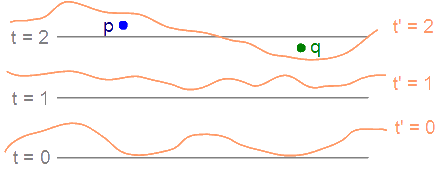
But in GR, spacetime is curved, and there are no inertial coordinate systems defined on the whole spacetime.  You can divide Spacetime into Space and Time in any way you like, using wiggly surfaces (although one might want to restrict to surfaces which are everywhere spacelike).  For example, the relationship between 2 coordinate systems could look like this:


In GR is not always any particular connection between a given coordinate system and a given observer, so I have not drawn Sue and Martha in this picture, but I have still drawn the spacelike separated points \(p\) and \(q\) which are in an ambiguous time relation.  (Since spacetime is 4 dimensional, the time slices I’ve drawn actually represent 3 dimensional surfaces.)

Of course, nothing stops you from choosing a funky coordinate system in Newtonian mechanics or SR either.  For example, it is often convenient to choose a rotating frame of reference to follow a rotating body such as the Earth.  Or a coordinate system which tracks an accelerating observer.  (Many pop descriptions of GR give the false impression that you need GR to describe accelerating coordinate systems; this is obviously false since objects can accelerate even in Newtonian mechanics, and nobody can prevent you to choosing coordinates however you like no matter what the correct theory of physics is.)

The difference in GR is that none of the coordinate choices are particularly nice or special.  It looks from the picture above like the gray coordinate system is nicer than the apricot one, but that’s just because your computer screen is flat.  On a typical curved spacetime, all time slices are bent in one place or another.  Thus, instead of having a 3 parameter family of “nice” time slices, we have an infinite dimensional family.  (The details depend on which particular curved spacetime we have.)

Do we really want to say that God’s experience of time depends on making an arbitrary choice about how to respond to the gravitational field of each and every star?  An choice which, from the perspective of physics, is a completely meaningless choice of coordinate system?  God’s perspective on the universe should not be more provincial and limited than the perspective of a mere physicist such as myself.  The Glory of Israel does not change, so why does he need a time coordinate?

Now it is true that on some specially nice spacetimes, there is a naturally nice choice of time coordinate.  For example in an FRW expanding universe, there is a “cosmic time” coordinate which tracks the overall size (the “redshift factor”) of the universe.  Some philosophers, such as St. William Lane Craig, have suggested that God’s “time” might simply be this “cosmic time”.

But this is a misunderstanding of the physics of our universe.  The FRW metric is a just an approximation to reality.  It describes a universe which is completely uniform (the same in everywhere) and isotropic (the same in every direction).  This is a very good approximation on large distance scales (billions of light years), but on shorter distance scales (e.g. the solar system, or the milky way, or your living room) you may have noticed that matter is not distributed uniformly.  It comes in clumps, and each of these clumps has a gravitational field which distorts the spacetime metric, making the FRW metric no longer correct.  On a lumpy spacetime, the notion of “cosmic time” is not well-defined.

With sufficient effort, one might be able to define a different time coordinate which is well defined.  Perhaps the maximum proper time since the Big Bang, or something.  But reformulating GR in a way that makes special reference to such quantities spoils the beauty of Einstein’s theory.  It is ugly.  As for a blind and lame theory like that, I hate it in my soul.  Why should our physical theory describing gravitation get uglier when we describe how it relates to God?

The closest thing I know about to an elegant reformulation of GR with a special time coordinate is called “shape dynamics”.  (I say know about, since I don’t understand it).  Apparently this is equivalent to GR in a coordinate system where you pick your time slices to be CMC (“constant mean curvature”) slices.  I won’t explain that right now, except to say that the soap films in your bubble bath are also CMC surfaces.  But given a GR spacetime metric, there might be many possible choices of CMC slicings, or none.  So the equivalence to GR is not complete.

It is of course always possible that a new theory of physics (such as Hořava gravity) might reimpose something like absolute time.  But I wouldn’t count on it.

I think this is a good illustration of the point I made in Models and Metaphysics:

But it seems to me that the correct view is in the middle, that Physics has some bearing on Metaphysics but it doesn’t fully determine it.

There are always going to be ways to force physics into being compatible with an A-theory metaphysics of time, but it doesn’t look elegant or pretty.  The B-theory seems to fit much more naturally.  Physics can’t usually rule out metaphysical ideas, but it can make them look a lot clunkier.

But in this case, physics isn’t telling us anything we couldn’t have learned from good philosophical theology.  Or from scriptural exegesis—which will be the subject of my next post in this series.

Next: Impassibility and the Bible

Rainbow Gravity

In the past week, I received two emails from some folks concerned that a speculative physics proposal called “rainbow gravity” eliminates the Big Bang and hence the beginning of the universe.  They are worried that this undermines Christianity.  Presumably if two different people living in different countries took the trouble to email me about it, there are hundreds of people out there, equally worried about it, who didn’t bother to email me.

*          *          *

Now I already wrote a big long series about whether the universe began and I don’t want to repeat everything again.  But let me say a bit more about the virtue of faith as it relates to scientific inquiry.  As a scientist I think it is a real shame if, when Christians learn about Way Cool New Science, their first instinct is to doubt their faith and wonder if the new stuff undermines what they believe about God.

I think it’s a lot healthier to be able to learn new and amazing things about the world—the world that God created—without worrying that every new discovery will undermine your religious beliefs and make it so you have to be an atheist.  I would like to propose that it is a virtue for a Christian be able to learn new things about the world, and to keep an open mind towards new discoveries without continually engaging in the torture of nagging doubt and worry, so that scientific discovery starts seeming like a hostile force.  That is not the confidence which comes from faith.  A happily married wife shouldn’t spend all her time worrying (without good cause) that her husband is cheating on her whenever he goes off on a business meeting.

Even if it were established that there was time before the Big Bang, that would not establish that God did not create the universe.  Perhaps the beginning of the universe was in fact a long time before what we think of as the Big Bang.  Or perhaps we need to be flexible about what we mean by creation, and say that God created a universe which goes back infinitely in time.

Don’t get me wrong; I am an evidentialist.  I think people should only believe in things for which there is enough evidence, and that merely being consistent with the scientific data is not (by itself) strong evidence.  But I also think that there’s more than one type of evidence, since we have the historical records of Christ and the inner testimony of God’s Spirit to help us.  Your personal relationship with Christ obviously does not consist primarily of speculation about what happened (or didn’t happen) before the Big Bang.  If Christianity is important enough to worry about, that’s because it’s relevant to your personal life, not just to scientific questions.

If you are solidly rooted in Christ then you don’t have to be ”tossed back and forth by the waves, and blown here and there by every wind of teaching” (Eph. 4:14).  That in turn gives one the ability to explore new knowledge with a feeling of freedom and security (and paradoxically this probably puts you in a better position to know whether Christianity is true or not, then constantly worrying about it all the time would).

But is rainbow gravity in fact Way Cool New Science?  Let’s explore and see.

*          *          *

My correspondents were concerned by an article by Sarah Knapton which appeared in two slightly different forms in the National Post and Telegraph.  These in turn appear to mostly be cannibalized versions of this Phys.org article, which in turn describes the article “Absence of Black Holes at LHC due to Gravity’s Rainbow” by Ahmed Farag Ali, Mir Faizal, and Mohammed M. Khalil.

However, there is nothing about the Big Bang in these last two links, so Knapton must have done some some additional investigation.  It is true that Faizel also wrote another article suggesting that rainbow gravity might avoid the Big Bang.  (But more likely she got this information from a Scientific American blog article based on arXiv:1308.4343).

Knapton’s article belongs to a long and venerable tradition of journalists taking the marginal, speculative ideas and making it sound like they are taken seriously by the scientific community.  She states that

Scientists at Cern in Switzerland believe the particle accelerator, which will be restarted this week, might find miniature black holes at a certain energy level.

This could prove the controversial theory of “rainbow gravity” which suggests that the universe stretches back in time infinitely with no singular point where it started, and so no Big Bang. The theory was postulated to reconcile Einstein’s theory of general relativity, which controls very large objects, and quantum mechanics, which affects the tiniest building blocks of the universe. It takes its name from a suggestion that gravity’s effect on the cosmos is felt differently by varying wavelengths of light.

This makes it sound like Ali, Faizal, and Khalil are located at CERN (which they are not), that many researchers at CERN take the idea of rainbow gravity seriously, and that there is some sort of epic “controversy”-battle taking place between those who believe it and those who don’t.  But the reality on the ground is that most particle physicists and quantum gravity researchers probably haven’t even had this idea show up on their radar screen.  (Now the multiverseThat rises to the level of being controversial.)

Sentences like:

Scientists believe they could find the first proof of alternative realities that exist outside ou[r] own universe.

make it sound as if the scientific community takes something seriously, when actually it just means that somebody (with a science job) wrote a article (with equations) proposing it—and that they have at least one coauthor, since the noun “scientists” is plural!

The Scientific American article is a bit better.  It correctly states that

The idea is not a complete theory for describing quantum effects on gravity, and is not widely accepted.

but then immediately thereafter we have the inevitable “at least 2 scientists are willing to indulge in speculation” construction:

Nevertheless, physicists have now applied the concept to the question of how the universe began, and found that if rainbow gravity is correct, spacetime may have a drastically different origin story than the widely accepted picture of the big bang.

Unfortunately, these types of inflated articles make it difficult for non-scientists to tell which new ideas in science are actually taken seriously or not.  How can non-scientists tell whether something is legit?  The fact that the article made it through the peer-review process of a top journal?  (Hold on for a moment while I stop laughing.)  While peer-review tends to filter out the worst crackpots, quite a few lemons still manage to get through.  Conversely, good articles are frequently rejected, although this is mitigated by the tactic of simply submitting to enough journals that one of them accepts it—but this tactic is also open to authors of bad papers!

What makes good science is observational support, elegance, precise models, and so on.  Unfortunatly non-scientists usually have to take the word of the scientific community about the extent to which any given proposal meets these tests.

(Honestly, given the awfulness of pop-science venues in this respect, I would say if you aren’t a scientist, it’s probably best not to take any new scientific idea you read in the news all that seriously, at least not until you find out that a broad cross-section of the relevant experts believe in it.  It’s a better use of your time to learn about the Way Cool Old Science which has already been established!)

The main trouble with “Absence of Black Holes” is that it’s a combination of two different speculative ideas (each with individual problems), and together they become even worse.  I don’t want to call this paper crackpot exactly, but let’s just say that it has a very, very small probability of being correct.  The main ingredients are:

1) Rainbow gravity (which seems to have originated from something called “Doubly Special Relativity”) is an idea based on very speculative quantum gravity models suggesting Special Relativity should be modified for particles with energy very close to the Planck scale, \(10^{16}\) TeV, when quantum gravity effects become important.  The idea is that the spacetime seen by different particles should depend on how energetic those particles are.

Unfortunately nobody knows how to make this model into a mathematically consistent field theory (like every other successful fundamental theory to date).  So they just make crude approximations, like proposing that the geometry felt by a particle at a given spacetime position depends on its energy, by means of a function \(f(E)\) (which they just make up rather than actually deriving it honestly from any deeper theory).

But simultaneously measuring (a) energy-momentum and (b) spacetime position conflicts with the Heisenberg Uncertainty Principle, so this is hard to reconcile with quantum mechanics even though it was inspired by quantum gravity.  It seems that these theories would have to be fundamentally nonlocal.

2) Large Extra Dimensions.  The idea here is that there are additional dimensions, besides the usual 4 spacetime dimensions we see.  One has to explain why we can’t see these dimensions normally; in this particular approach one says that ordinary matter fields are stuck on a 4 dimensional membrane and that only gravity can propagate in the extra dimensions.

This has the effect of strengthening gravity at short distances, and could conceivably even lower the Planck scale to smaller values, perhaps even to a few TeV.  Of course it was no conicidence that people were most interested in models in which the Planck scale was moved to energies accessible to the LHC, thus making people excited by the possibility of seeing things like quantum black holes experimentally!  (Nobody gets a Nobel prize for saying that we will never observe quantum gravity effects because the energy scales are much too high.)  This was also an extremely speculative idea, and what’s more, after turning on the LHC we haven’t yet seen any black holes or anything like that.

The sane conclusion to draw, of course, is that probably there are no large extra dimensions (or if there are, the Planck scale is still considerably above what we can see).  These authors instead propose that if rainbow gravity is also true, the minimum size of black holes might be bigger, explaining why we haven’t seen them yet.

I was going to write a more detailed critique, but I find that Sabine Hossenfelder has already done most of the work for me.  She writes that:

In rainbow gravity the metric is energy-dependent which it normally is not. This energy-dependence is a non-standard modification that is not confirmed by any evidence. It is neither a theory nor a model, it is just an idea that, despite more than a decade of work, never developed into a proper model. Rainbow gravity has not been shown to be compatible with the standard model. There is no known quantization of this approach and one cannot describe interactions in this framework at all. Moreover, it is known to lead to non-localities with are ruled out already. For what I am concerned, no papers should get published on the topic until these issues have been resolved.

Rainbow gravity enjoys some popularity because it leads to Planck scale effects that can affect the propagation of particles, which could potentially be observable. Alas, no such effects have been found. No such effects have been found if the Planck scale is the normal one! The absolutely last thing you want to do at this point is argue that rainbow gravity should be combined with large extra dimensions, because then its effects would get stronger and probably be ruled out already. At the very least you would have to revisit all existing constraints on modified dispersion relations and reaction thresholds and so on. This isn’t even mentioned in the paper.

That isn’t all there is to say though. In their paper, the authors also unashamedly claim that such a modification has been predicted by Loop Quantum Gravity, and that it is a natural incorporation of effects found in string theory. Both of these statements are manifestly wrong. Modifications like this have been motivated by, but never been derived from Loop Quantum Gravity. And String Theory gives rise to some kind of minimal length, yes, but certainly not to rainbow gravity; in fact, the expression of the minimal length relation in string theory is known to be incompatible with the one the authors use. The claims that this model they use has some kind of derivation or even a semi-plausible motivation from other theories is just marketing. If I had been a referee of this paper, I would have requested that all these wrong claims be scraped.

I also briefly looked at the other article by Faizel about avoiding the Big Bang, and it seemed just as ad hoc as any of the other papers on this subject, and I wasn’t convinced it makes sense.  I don’t think we should expect to find any pots of gold at the end of this particular rainbow.

God and Time II: Special Relativity

Despite what people seem to think, there are very few controversies in Theology where there is decisive evidence coming from Physics (leaving aside some real doozies such as Young Earth Creationism).  But the question of whether God is in Time is one of them.

In the previous post I argued that God must perceive Time as it really is.  But our conception of Time has been modified radically as a result of Einstein’s theories of Relativity.  It starts out with Special Relativity, and becomes even more extreme with General Relativity.

The first thing to notice is that our usual division of time into Past, Present, and Future—which I tacitly accepted when discussing the metaphysical problems of the A-theory (a.k.a. Presentist) idea that only the Present really exists—seems to be totally wrong.  Instead you have to think about spacetime, and it is unclear what we even mean by referring to the “Present”.  As I said in one of my earliest posts:

We’re used to dividing up time into three parts relative to ourselves: past, present, and future. The present is just an infinitesimal sliver, so in a sense this division is into two parts: points to the past have \(\Delta t < 0\) compared to you, while points to the future have \(\Delta t > 0\) compared to you.

However, special relativity tells us you have to chop up spacetime in a more complicated way.  Bearing in mind that you each live in a particular place as well as a particular time, you can chop up spacetime into three different regions.  The future is points that are timelike separated to you and have \(\Delta t > 0\); these are the points of spacetime that you can affect.  The past is points that are timelike but have \(\Delta t < 0\); these are the points that can affect you.  Then there is elsewhere, the points that are spacelike separated.  These points can neither affect, nor be affected, by each other.  The three regions are separated by the “light cone”, which consists of the points that you could send a lightray to (or from).  I’m too lazy to draw a picture right now, but you can see a pretty good explanation here

If we treat time as a metaphysically fundamental quality, and say that things at the present moment of time really exist, really we are saying that anything which is simultaneous to my present experience exists.  But the concept of “simultaneous” is rendered problematic in Special Relativity.

That is because there exists a symmetry of spacetime, called a Lorentz boost, which mixes up the time and space coordinates.  (The Lorentz boost corresponds to changing the speed of the “reference frame” in which you are viewing the system.  You can always transform to a frame in which a given object’s center of mass is at rest.)

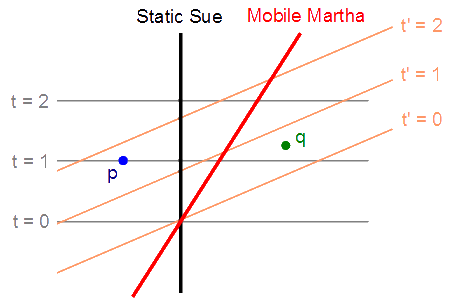
Here is an spacetime diagram of two frames of reference, one in which “Static Sue” is at rest, and the other in which “Mobile Martha” is at rest (despite their names, there’s no actual objective fact about which one of them is moving):

Here the vertical axis is time and the horizontal axis is one of the dimensions of space.  The horizontal grey lines indicate Sue’s notion of simultaneity, and the diagonal peach lines represent Martha’s notion of simultaneity.  Their relative velocity is about half the speed of light, which would travel at approximately 45° had I drawn any light in this picture (I chose not to draw any light because, sadly, both ladies are blind).  Sue and Martha’s reference frames do not agree about which of the two events \(p\) or \(q\) occurred first.

In particular, as long as two points \(p\) and \(q\) are spacelike separated, by acting with this symmetry you can always choose for their time coordinates to have any of the 3 temporal relations: \(t(p) > t(q)\), \(t(p) = t(q)\), or \(t(p) < t(q)\).  Since nothing can travel faster than light, no causal signals can go between the points \(p\) or \(q\) anyway, so the order doesn’t really matter.

(Nor can we say that if \(p\) exists, everything spacelike separated to \(q\) exists simultaneously.  For “simultaneous” is supposed to be a transitive relation.  If \(p\) is simultaneous with \(q\), and \(q\) is simultaneous with \(r\), then \(p\) and \(r\) should also coexist simultaneously.  But in Special Relativity every pair of spacetime points share a common point they are both spacelike to.  This idea would thus make all spacetime points simultaneous.)

And yet, for some reason, in the very same 20th century in which Physics got rid of the idea of the Present moment, some revisionist theologians decided to propose a more limited, anthropomorphic deity who changes with time, or who doesn’t know the future.  Either because they wrongly believe divine foreknowledge conflicts with free will, or because they believe that the Bible teaches this, or because they subscribe to more radical process theology ideas…

But if:

1) God is omnipresent (so he does not pick out a particular point in space), and
2) The Lorentz boost is a valid symmetry of reality, then inevitably:
3) God is omnitemporal.

There are only a few possible rebuttals.  One is to hope that relativity turns out to be wrong in this respect.  There are a few very speculative quantum gravity ideas about this (e.g. Hořava gravity), but none of them are extremely promising.

A second is to say that God just breaks this symmetry, he “picks out a particular reference frame” and that’s just that.  Well, in addition to being ugly to theoretical physicists such as me, it seems bizarre that God, who transcends the universe and created it, would need to break a law of nature of that he created just in order to relate to the universe.  (It’s not like not we’re talking about a miracle here, we’re just talking about the way in which God coexists with the universe at every moment.) God relates to the universe by creating it as it is, and by knowing it as it is—which means that there should be no reason to break any symmetries in describing how God relates to the universe, if our best model of how the universe is preserves those symmetries.

A third approach might be to bite the bullet and say that God exists in space as well as time.  Maybe there is one version of God (or should I say “a god”?) existing at each spacetime point, and each god knows only the things in the past lightcone of that point.  So God can’t send signals faster than light or know what’s going on in the Andromeda Galaxy right now (for any reference frame’s definition of “right now”).  But what a needless limitation!  I could throw out a prooftext here, but I’m supposed to be saving the Scriptures for the next post.  Instead I will confine myself to pointing out that this view has serious issues concerning the divine unity as well as omniscience and omnipotence.  Is it really necessary for the Blessed Creator to chop himself up into pieces, just in order to create the spacetime continuum?  This seems to tend more towards a Pantheistic view in which the God creates the universe out of his body, then a Monotheistic view in which he creates freely like a novelist inventing a story.

One reader (who subscribes to the “Open Theism” view that God does not know the future) suggests that perhaps God exists in all reference frames.  But this makes no sense to me.  We cannot say that God exists in all reference frames simultaneously, since we need to first pick a reference frame to say what we mean by simultaneous!  Indeed, this view does not really give a well defined answer to the question of what knowledge God has access to at any given moment.  If I, sitting in a particular place and time, pray to God to intervene at some other point, which is spacelike separated to me, can he base his answer on things taking place in the Andromeda Galaxy, or not?  This model would imply that there are infinitely many versions of God at a single spacetime point, each with different knowledge and powers.  That’s even more complicated than the previous supposal.  Which version of God gets to decide what happens at that point, and why can’t they just all communicate with each other?  This view seems more problematic than any of the others.

So, to conclude, Special Relativity seems to strongly suggest that if God has no definite position in Space, he must also not be in Time.  Now we have Spacetime, and we ought to be able to translate what we say about God into that language somehow, unless we think that our theological expressions should be immune to progress in the Sciences.  But here it is traditional theology, not revisionist modern theology, which fits the data better.

(Although this raises certain questions about other theological entities, such as angels or heaven, which are often conceived of as being in time, but not space.  Or at least not in our space… but of course we don’t really know much about what these entities are really like.  Although God transcends all understanding, in certain respects we know a lot less about these created entities than we know about God, because (a) there are no metaphysical arguments that they have to exist, and (b) we interact with them less frequently.)

I’ve decided to save General Relativity and other physics considerations for another post.

Next: General Relativity

Did the Universe Begin? X: Recapitulation

from http://www.xkcd.com/1352/.

We have now come to the end of my series about whether or not the universe had a beginning.  This is part of a longer series dissecting the debate between St. William Lane Craig and Sean Carroll.  I started out with some general reflections on the debate:

Thoughts on the Carroll-Craig Debate
God of the Gaps
  (see also: Gaps at the Dinner Table)

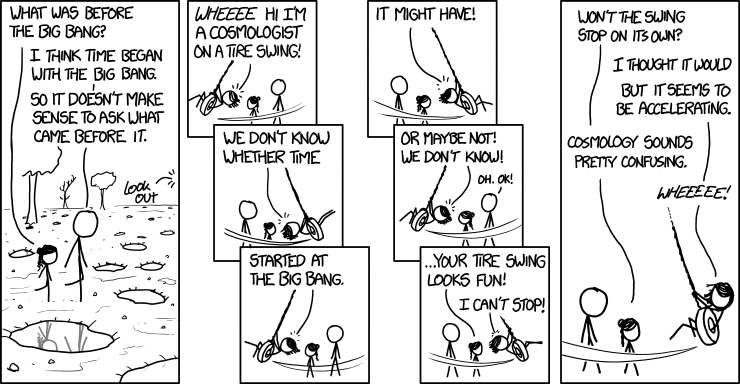
Then I started talking specifically about possible evidence from physics for and against the universe having a beginning.  For ease of understanding I’m going to label each main new argument with FOR or AGAINST to define its main orientation, but the posts also deal with the various counterarguments (that’s the tire swing going back and forth above…). I’ve provided an executive summary of each of these posts, so that you can easily see the main thrust of what I said.  Minus all the caveats, hedging, and detailed explanations my scientific training tends to encourage.

(I’ve heard that politicians hate talking to scientists because, like the Elves in Tolkien, we seldom give a straight answer to a question.  In scientific cultures, we show “sincerity” by discussing all the problems and caveats with our ideas, whereas in political circles this sounds like insincere waffling designed to please too many people…)

Did the Universe Begin? I: Big Bang Cosmology (FOR, as far as it goes…)
– the classical Big Bang Model predicts an initial singularity where time began
– tentative because quantum effects were important and invalidate our usual geometrical notions
– also tentative because we don’t really know how inflation began

Did the Universe Begin? II: Singularity Theorems (FOR)
– classical General Relativity theorems by Hawking and Penrose
– assumptions of Hawking theorem invalid during inflationary epoch
– Penrose theorem says that if space is infinite, there was a beginning
– Penrose theorem invalid in quantum situations, but my work suggests that it might be extendable to quantum gravity, if horizons always obey the 2nd law of thermodynamics.

Did the Universe Begin? III: BGV Theorem (FOR)
– if the universe has a positive average expansion, then “nearly all” geodesics cannot be extended infinitely to the past
– implies that inflation had to have a beginning in time, at least in some places
– can evade theorem by a “bouncing” cosmology where the universe contracts and then expands

Did the Universe Begin? IV: Quantum Eternity Theorem (AGAINST)
– if the usual rules of QM hold at all times, you can calculate what the state would be at any time to the past or future.
– in realistic cosmologies the energy is probably either zero or undefined, making the theorem inapplicable.

Did the Universe Begin? V: The Ordinary Second Law (FOR)
– given reasonable assumptions, 2nd law of thermodynamics requires a beginning
– most plausible way to evade this is to postulate that the “arrow of time” reverses
– such models would have a “thermodynamic beginning” but no “geometrical beginning”

Did the Universe Begin? VI: The Generalized Second Law (FOR)
– second law of thermodynamics also seems to apply to cosmological horizons
– can be used like ordinary 2nd law to argue for beginning
– can also be used as singularity theorem (see II above)
– this closes certain loopholes, but if the universe is finite and the arrow of time reverses, a bounce may still be possible.

Did the Universe Begin? VII: More about Zero Energy
– a more technical explanation of why the energy of the universe can be zero

Did the Universe Begin? VIII: The No Boundary Proposal (AGAINST/FOR)
– a beautiful set of speculative ideas which unify the “laws of physics” with the “initial conditions”, by providing a rule for what the state of the universe is.
– contrary to popular conceptions, the Hartle-Hawking proposal has no beginning in time
– the Vilenkin tunnelling proposal is similar in spirit but does have a beginning.
– unclear whether these proposals are well defined, and Hartle-Hawking appears to give wrong predictions.

Did the Universe Begin? IX: More about Imaginary Time
– a more technical explanation about the notion of imaginary time used by Hartle-Hawking

If you put all of the physics information together, the conclusion I would draw is that: We don’t know for sure whether the Universe began, but to the extent that our present-day knowledge is an indicator, it probably did.  However, as Carroll correctly says, we can also construct models where it doesn’t have a beginning.  Taking into account known results from geometry and thermodynamics, the most plausible such models are 1) spatially finite, and 2) have a reversal of the arrow of time (e.g. the Aguirre-Gratton model).

I also noted that models like AG still have a low entropy “initial condition” somewhere in the middle of time.  One might think that this type of “thermodynamic beginning” still calls out for some type of explanation.

Then I wrote a more theologically-oriented post about whether the Hartle-Hawking no boundary proposal leaves any room for God to have created the universe:
Fuzzing into Existence
– short answer: yes, if you think of God as a storyteller, not a mechanic.

I also discussed the possibility of Reparameterizing Time; is it even meaningful to ask whether time is infinite or finite when you can change coordinate systems?  In this post I also argued that the main theological question of whether the universe needs an explanation seems to me much the same whether the universe has finite or infinite time.

Now, let me make another observation about the tire swing.  Although the weight of the evidence is that the universe probably had some sort of beginning—and even more likely that there was some sort of low entropy “initial condition” even if geometrically time stretches past before that—this cannot be said to be certain.  There is always the possibility that new scientific data or methods could radically change our picture of the very, very early universe.  Similarly, while a finite past seems more in accordance with traditional Christian theology than an infinite past, there appears to be no strictly logical connection between the two ideas, once the act of Creation is viewed in a more timeless, “authorial” way.  Thus one might conceivably have a theist who thinks time is infinite, or an atheist who thinks time was finite.

Should the argument for God’s existence really rest on such a slender foundation as the ultimate decision of physicists about Big Bang Cosmology?  Well, one thing is clear.  In ages past it didn’t depend on it.  Obviously, Sts. Abraham and Sarah, David and Solomon, the prophets and apostles, and all the men and women who followed in their footsteps up through the 19th century, including eminent scientists such as St. Faraday and St. Maxwell: these cannot have believed in God because of the Big Bang Theory, because—guess what?—nobody knew about it yet!  What does the Bible say about these people?

Now faith is confidence in what we hope for and assurance about what we do not see.  This is what the ancients were commended for.  By faith we understand that the universe was formed at the word of God, so that what is seen was not made out of what was visible.  (Hebrews 11:1-3)

Our belief that God is the Creator does not depend on the vicissitudes of scientific progress, the swinging back and forth of the tire swing (or is it accelerating?)  It doesn’t matter, because in this case we have a more certain source of knowledge than Science.

By faith!  The skeptic may scoff here, and say that faith is belief without evidence, but that is not the definition used in the passage above.  It says that faith is confidence about what we hope for, but do not see.  Unless we identify sight (conceived broadly as anything which can be directly experienced in terms of our 5+ senses) with evidence (things which allow us to conclude something about the world)—an identification which would incidentally also make Science impossible—the passage does not say that the ancients were commended for believing without evidence.  But the example of the biblical heroes does give some pointers about what type of evidence was relevant to them.

The ancients did not believe that God was the Creator because they had a detailed scientific theory about where it comes from.  (Indeed, if we take our minds off Genesis for a moment and read the Wisdom literature of the Bible: Job and Psalms and Ecclesiastes and Proverbs, the Scriptures seem to emphasize more our lack of knowledge about the details of creation, then any detailed programme of events…)  On the contrary, the ancient Jews and Christians knew God, by personal acquaintance as it were, and therefore knew him to be creative and powerful, mighty in word and deed.  Thus they could take him at his word that he is the Creator of all that we see.

The glory of Creation does indeed point to the glory of the Creator, so that it is possible for ordinary human reasoners to come to know that there is a Creator intellectually.  But this sort of Theism, by itself, isn’t what Christians mean by faith.  Once we come to know God personally, we learn the more important fact that we can trust him, and know with confidence that there is nothing in existence which does not depend on him.

And therefore, although we see in this world visible things emerging from other visible, material things, we know that ultimately their origin comes from “God’s invisible qualities—his eternal power and divine nature” (Rom 1:20).  He created everything through his Word, Jesus Christ, from whom we have come to know what God is like.  This way of knowing does not seem to depend very strongly on the details of past, present, or future scientific knowledge.

One could definitely argue that the Bible teaches that there was a Beginning (whatever this means from God’s perspective).  For example, the quotation above from Hebrews speaks of the formation of the visible universe.  But whether or not this fact has been revealed by God, it is not obvious to me that the most important theological aspects of Creation really depend essentially on time being finite, or even well-defined.  (Admittedly, if you believe that time is infinite, it might be easier to slip into a false notion whereby matter exists independently of God, who is merely the Chief Organizer of the cosmos.  That would be a heresy—a false belief which may seriously obstruct your ability to relate to God or others properly—but it does not follow necessarily from time being infinite.)

The main point of the doctrine of Creation, I think, is that God is real, and that everything else is derived from his power and will.  We know this doctrine is true because we know God.  Not because of the Big Bang, as natural as it is to connect the two ideas.