
Category Archives: Links

Book by St. Tom Rudelius (and me, a bit)

So my friend St. Tom Rudelius is a physicist who works on string theory, QFT, and early universe cosmology (e.g. the theory of inflation).  He is also a brother in Christ who I have had the privilege to both mentor, and learn from.

He has just written a book about his conversion to Christ (it’s a pretty interesting story, involving rather more “polygraph tests” than this sort of story usually involves) and also his experiences as a Christian in academia.  The book, which was just released today, is called:
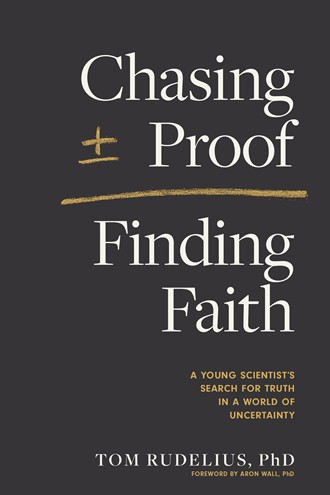


I was asked by the publisher to include an excerpt from the book to help promote it.  Completely disregarding their proposed selections, I have chosen one of the later chapters of the book, after he’s already become a Christian:

People often ask me what it’s like to be a person of faith in the field of science. It’s a hard question to answer, because my experiences have varied widely.

Sometimes, physicists will ridicule religion. Once, while visiting the University of Texas to give a talk on my research, I went to lunch with a number of physicists, including the late Nobel laureate (and outspoken atheist) Steven Weinberg. Unaware of my religious leanings, Weinberg began the lunch with a pointed question toward the antievolution movement: “Do all these people who reject evolution also reject cosmology?”

I thought about explaining the difference between young earth creationists and old earth creationists, but ultimately held my tongue.

Sometimes, physicists simply steer clear of religious topics. One day when I was a postdoc at the Institute for Advanced Study in Princeton, the man whose donations to the Institute helped pay my salary came to have lunch with Ed Witten—quite possibly the greatest living theoretical physicist, if not the smartest man on earth—and me. A quick online search had made the donor aware of my religious views, so he spent the entire lunch asking me (very respectfully) about my opinions on religion and politics. It was probably the most stressful conversation I’ve ever had—talking about Jesus and Donald Trump with the smartest man alive and the man who paid my salary.

During the entire conversation, Ed Witten was surprisingly quiet. His only remark came when we were discussing God’s miraculous intervention. “I think a lot of people wish God would intervene more often,” he said.

Sometimes, physicists respect religion. Several of my colleagues have expressed admiration for my religious faith, or religious faith in general, though they themselves do not have any religious convictions.

Sometimes, physicists embrace religion. I don’t know very many Christians in my field, but whenever I meet one, I feel an immediate kinship. Our scientific drive for knowledge pushes us to learn as much as we can about the physical universe, and as Christians that same drive pushes us to learn as much as we can about God. The result is a common language of science, theology, and philosophy not so different from the “twin telepathy” my brother and I have shared since childhood. Though sometimes it is discouraging that so few of my colleagues embrace religious faith, it is encouraging—perhaps even more so—that the ones who do are so strong in their faith and so capable of defending it intellectually.

In much of the world, there is intense animosity, and sometimes even violence, between people of differing religious faiths. Perhaps it’s because we religious physicists represent a minority in our world, but I’ve certainly never felt anything like that from my Jewish, Muslim, and Hindu colleagues. And I hope they’ve never felt anything like that from me. Rather, there seems to be a sense of solidarity among religious scientists. Though there are important differences between our faiths, there’s an even deeper sense of mutual respect among us: I’ve probably received more comments of admiration regarding my faith from Jewish colleagues than I have from Christian ones, and a Muslim colleague once told me that my public interviews and articles on science and God had strengthened his own faith.

On the whole, though, I can say with certainty that I have never felt persecuted or personally attacked for my faith. There are places in the world where Christians are suffering for their faith. But America is not one of those places. I can go to church, pray, read my Bible, and even write books like this one without fear of losing my job. Some of my colleagues may not agree with my faith, but fortunately my success in physics depends on my ability to do physics, not on how I worship in my free time.

Though science and faith are often viewed as enemies, I can also say I have felt less hostility toward religious faith in the upper echelons of physics than at the lower levels, or in the soft sciences or humanities. Anthropology, history, and religious studies departments are famously dismissive of Christianity—a trend many of my Christian friends and I experienced during the course of our university studies.

One of my friends who studied chemistry at Princeton had a high school science teacher who forced the class to learn the definition of a so-called scientific theory—an explanation for some natural phenomenon supported by a vast body of evidence—to refute the common creationist retort that “evolution is only a theory.” But when he got to college, my friend soon realized that such definitions are nonsense: In practice, scientists use the term theory to describe many different things. Some theories, like quantum field theory, are among the best tested phenomena in all of science. Other theories, like string theory, lack any experimental verification whatsoever.

My high school physics teacher—who was one the best and most important teachers I ever had—occasionally made snide remarks about religion. Yet at Cornell, Harvard, and Princeton, I met several religious physics professors. One professor even suggested to his class that God might be the best explanation after all for the fine-tuning of the universe for intelligent life—and he wasn’t even a theist.

Now, it’s also true that most of my extraordinarily brilliant colleagues do not embrace religion. But I’ve found that their reasons are generally quite ordinary. If you ask the average atheist why he or she doesn’t believe in God, you’ll probably get some version of the problem of evil: “If God is all-powerful, all-knowing, and all-loving, why do evil and suffering exist?” If you ask one of the world’s most brilliant scientists why they don’t believe in God, you’ll probably hear the exact same thing.

That’s not to say that the problems of evil and suffering are easy for theists to deal with. It’s simply that the most brilliant minds don’t have a huge advantage over others when it comes to questions of faith. We all have basically the same questions, objections, and doubts. In my experience, the ones who find answers to these questions are typically those who need answers the most. Personally, before Steve’s conversion and subsequent conversations with me, I never felt much need for religion, as I was generally able to get by on my intelligence alone. Perhaps other scientists feel similarly.

Finally, I have found that most scientists—even nonreligious ones—believe in some sort of power greater than ourselves. It’s very common to hear physicists refer to Nature as a sort of placeholder god. For example, Ed Witten once said in an interview, “If I knew how Nature has done supersymmetry breaking, then I could tell you why humans had such trouble figuring it out.” There is a widespread acknowledgment that Nature has chosen a particular way for our universe to be, and it could have chosen something different.

What’s the difference between this Nature and the God (capital G) I believe in? I think the biggest difference is simply that Nature doesn’t really care much about the affairs of humanity, whereas God does. Most everyone would agree that Nature has a preference for order, simplicity, and beauty, but many balk at the suggestion that it would concern itself with the affairs of one particular species on one little insignificant planet. We humans are, to quote astronomer Carl Sagan, nothing but “a mote of dust in the morning sky.” [1] Why would God care about us?  

[1] Carl Sagan, Cosmos (New York: Random House, 1980).

To this, I like to point out that size is not a very good measure of value. I care more about the life of a baby than I do about most galaxies. I care more about the ten-nanometer transistors that make my computer work than I do about distant stars. And even as someone who studies black holes and the big bang for a living, I find nothing more incredible about the cosmos than the fact that it somehow birthed intelligent, conscious beings like us.

Ultimately, one can choose to view the size of our universe as a sign of our insignificance, or one can choose to view it as a sign of the great significance of its creator—a creator whose attention is not divided, who built and sustains the intricate workings of the cosmos, yet who simultaneously cares enough about humanity to become a human himself, to experience pain, suffering, and death so that we could have life.

Perhaps you noticed that my name is also on the front of the book, in much tinier yellow letters at the bottom.  (Or more likely, you didn’t and are even now scrolling back to see if my claim is true.)  This is because I was asked by St. Tom to write a foreword to his book.  (And not only that, I did.)  My foreword begins as follows:

Foreword

(from this formative experience with the publishing world, I have learned that the word has an “e” in it) but after that it goes on to say:

The book you are holding is a remarkable one. There are lots of books out there promoting Christianity, by a type of person you might call salesmen. The goal of a salesman is to produce a watertight and squeaky-clean argument, to convince you that only one position is intellectually respectable, and fully capable of servicing your needs. He is afraid to admit any weakness in his arguments. He is afraid that if he talks honestly about his own doubts and struggles, his audience will take it as a reason to reject the product he is promoting. If you want a book like that, I suggest you look elsewhere. My friend Tom is not a salesman. But he is a person who cares deeply about what is real, both in scientific and religious contexts. And because of this, he is also unafraid to share his spiritual doubts and struggles, both before and after he became convinced that Christianity is objectively true.

After that, the foreword includes eleven more juicy paragraphs, and importantly the only way to read them (if you don’t know about libraries) is by buying the book.  You can do this by clicking on one of the following links:

Amazon

ChristianBook

Tyndale

Target

That’s right, you can now buy the equivalent of one of my blog posts, at the same store you can get detergent and kid’s T-shirts from!  But, you should probably also buy the book to read an interesting and sincere account from Tom, about his obstacles coming to Christ and his emotional struggles with faith afterwards.

Now, you are going to buy the book at any time in the future, it would probably be helpful to Tom if you would buy it ASAP, for example TODAY, so it can go into the early sales figures that make the industry decide whether this book is hot stuff or not.  Sorry, I don’t make the rules of worldly success in the publishing industry, that’s just how it goes.

Having said that, some of you may be tempted to write comments asking, well when are you (Aron Wall, PhD) going to write your own book about Sciencey-and-Religiony stuff, and not just a foreword or backewards glued onto somebody else’s book?

Well, as you can probably tell from my recent blog performance: I’m just way too busy (with mentoring PhD students and postdocs, parenting my 2 & 4 year olds, quantizing gravity, and doing faculty busywork) to get any useful writing done, for the most part.  Nevertheless, you should expect some book about the Fine Tuning Argument for God and/or the Multiverse to appear under my name (as well as that of my coauthors, philosophers John Hawthorne and Yoaav Isaacs), some time in the next oh 1-50 years from now.  Just thought I’d give you a heads-up about that since a file looking deceptively like a rough draft basically already exists, more or less.  Mostly less.

(If any skeptical promotion committees are reading this post, I promise I spent very few of my months working on the Fine Tuning book, and any deficit of actual physics papers is explained by the other stuff in my life…)

Anyway, life is short so don’t save your money for a book that might or might not come out in the next couple of years.  Instead BUY TOM’S BOOK NOW (if you feel led to do that) and trust that you’ll have the spare change to buy mine later.

[Disclaimer: I understand that I will be receiving a free copy of Tom’s book in the mail.  But it will come too late to change my opinion of the book—I will always think of Tom’s manuscript primarily as a Word file.  I’m sure the publishers put a lot of effort into making it look like a real book; but I’m sorry, that’s just the way it is.]

Out with the Old Random Links

Since it’s now 2019, it’s a good time to clear out some random links I’ve got bookmarked to show you.  Here they are:

♦  You can’t take an introductory psychology course without hearing about Zimbardo’s “Stanford Prison Experiment”, but in fact many aspects were faked.  Part of the scam is that the experiment went so “badly” that it would be unethical for any other researchers to repeat it—but not so badly that it couldn’t still be used to catapult himself to perpetual fame and glory.

♦  The hot new result in biology is “epigenetics”, the idea that (modifying the standard Darwinian picture) the experiences of one generation can affect which genes are expressed in the next generation.  You’d never guess from the wild news coverage of this that the phenomenon has never been convincingly demonstrated in human beings.

♦  Martin Gardner’s attack on Karl Popper.

♦  Llamas, the secret bioweapon for producing vaccines that work on all types of flu?  I’m putting a question mark on this, only because 90% of the amazing news stories about medicine don’t pan out somehow.  I wish journalists would write more news stories about the things researchers discovered 10 years ago that are now definitely curing lots of people…

♦  Potoooooooo, a famous race horse and stud.  Pronounced POT-EIGHT-OHS.

♦  Rithomachy, the medieval arithmetic battle board game, was apparently nearly as popular as Chess for a few centuries.

♦  An illustrated history of the American Revolution by a Japanese book in 1861… in which the Founding Fathers battle various giant beasts.

♦  Bitcoin is currently using half a percent of the world’s electricity.  Perhaps we shouldn’t be squandering the planet’s resources on a mindless race to manufacture currency that doesn’t actually produce anything valuable?

[UPDATE 2/7/19: here’s a possible rebuttal of the guy whose blog apparently started this ecological alarm.  Haven’t put in enough work to figure out who’s right here, but until then I’m taking these articles with a grain of salt.    If anyone knows more about this I’d be grateful if they weigh in.]

♦  In other cryptocurrency news: The (arguably unconstitutionally appointed) Acting Attorney General was previously involved in a scam to try to trick people into buying time travel cryptocurrency.  Unbelievable!  As if an AG disbelieving in Marbury vs. #@*$^&! Madison weren’t bad enough.  (I knew about the UConn crackpot from when I decided not to apply to a faculty position there, but I had no idea these threads were connected…)  Apparently it really is important to educate the public about why time travel is worth talking about but not really worth investing your retirement savings in.

♦  The Sabbath as a radical act of protest against being treated as a slave by the economic system.

♦  The Graphing Calculator Story, another radical act of protest… in favor of voluntarily working without pay?  Hilarious.

♦  As for involuntary servitude, a cynical take on schooling: Part I, Part II.  As a lazy bright kid who didn’t do most of the homework I was assigned despite significant feelings of guilt, I 100% endorse these posts (except I disagree with the bit opposing standardized tests, and have some reservations about the section labelled “foreign kids”).

♦  Why state educational ratings are measuring the wrong thing.  As a libertarian magazine, Reason has its own biases, but it seems quite reasonable that we should control for different state populations, and shouldn’t count money spent on education (which is a cost) as if it were an educational outcome (a benefit).  Don’t forget to click on the plot that shows their new rankings.

♦  How the US Educational system does math word problems completely wrong, by a mathematician from Russia.  Come on, folks!

♦  I’ve heard several times before that there are different potentially valid models of how to look at mental illness, but I think a few paragraphs in the middle of this blog post give a particularly striking answer for what makes a “spiritual model” different from other approaches, namely that it actually engages with—even when it does not agree with—the content of mental issues in a way other approaches do not.  (I don’t have any reason to think the author is a Christian, but I still found this helpful.)

Oh, and Ivy League schools should stop discouraging people from being supportive to students with mental illnesses!

♦  This account of fixing an issue causing depression is also somewhat interesting, although I’m not sure how well the method would work on everybody…

♦  St. Shamus Young has an interesting series about procedural world-building that I think is pretty cool; his autobiography/conversion-story is also worth reading through.  Not for the slow of connections, though.

♦  An interview with a Christian neuroscientist at Stanford, St. William Newsome.

♦  Here’s a brain viewer that’s supposed to show you how different parts of the brain are mapped out, but I’m not sure my own brain is capable of handling the web interface.  Let me know if anyone figures out how to actually extract useful information from this.

♦  A side effect of people becoming less religious is we start treating political cults as if they were a religious identity.

♦  St. Ben Sasse, Senator from Nebraska and St. John’s College graduate, had some balanced remarks about the MeToo movement during the recent confirmation fight.

♦  Tips for more productive and realistic political conversations.

♦  The Believing Game, another conversational tool for identifying certain sorts of truths.

♦  A while back I gave some advice about how to read the Bible.  The same guy also asked about Church History, and I put off answering because I thought I might write a whole blog post on the subject.  Ha!  My actual recommendation is to start by reading The Lion Handbook on the History of Christianity.  Then, if you are curious about some particular great Christian of the past, find a translation and start reading their work for yourself.  If it doesn’t speak to you, pick something else.

♦  You know how in the Bible, when the king Jeroboam split Israel off from the southern kingdom of Judah, he set up an alternative system of worship involving a sycretistic hybrid religion where YHWH was worshipped in the form of golden calves?  [If the answer is no, click on the first link in the previous item.]  Well, archaeologists have recently found a payrus with some creepy alternative psalms from the Northern Kingdom religion.  Although there are parallels to the Biblical Psalms, in these psalms YHWH is worshipped alongside other Middle Eastern Gods, and may be identified with a “Bull”.  He is also portrayed as being satiated by bowls of sacrificial blood.  I think most Christians don’t realize how a lot of the biblical Psalms (like #50) are polemics against this sort of crass religion.

♦  One of my ancestors, the Rev. Aron Wall, helped lead a group of Mennonites from the Ukraine to the United States.  I’m staring right now at a photograph of him and his wife that is hanging on our mantelpiece, and he looks almost exactly the same as in the photograph I just linked to.  The Mennonites weren’t originally from the Ukraine either; as Anabaptists (the more radical wing of the Reformation) they had been persecuted by both Protestant and Catholic countries in Central Europe.

♦  The Biodeterminist Guide to Parenting, by popular blogger Scott Alexander, one of the few people I trust to summarize the actual scientific evidence in a suitably tongue-in-cheek manner.

♦  Recently I’ve been commenting sometimes on Scott’s blog Slate Star Codex.  Readers of this blog may be interested in my Ask Me Anything which mostly turned into an argument about the evidence for Christianity.

I’ve also been having some interesting conversations with a guy who is summarizing the beliefs of secular biblical critics about the Bible; this spans many threads but you can find most of them by tracing back links from the index post for the Torah /”Deuteronomistic History”, the index post for the Prophets, and the most recent post of his ongoing series on the Writings [I may update this with the Index post later.] You can find out why scholars believe the Documentary Hypothesis, and more about why I’m skeptical of such hypotheses.

Have a blessed 2019, everyone!

Science and Sin: Random Links

Even though I haven’t been blogging much recently, I’ve still been accumulating a large number of links, far too many for one sitting.  I’ve noticed that they all seem to mostly belong to two categories: Science or Sin.  So that tells you which things I find interesting.  Here they are:

♦  This tool will tell you immediately whether your email address has been compromised by any known data breaches.

♦  “Molecular Dynamics” is the name of computer simulations to describe the behavior of atoms in motion.  Instead of reading the rest of the links, you should try out this online Interactive MD simulator.  (The name is a bit of a misnomer, since in this case there are no molecules, just `atoms’ interacting with a force law which is attractive when the atoms are a bit close, but repulsive when they get very close.)  Despite the fact that it has only 2 space dimensions, there is still a clear distinction between solid, liquid, and gas phases (except above the critical point, where the atoms are too crowded for there to be a sharp distinction between liquid and gas).  See if you can adjust the pressure and temperature so that solid, liquid, and gas phases all simultaneously coexist!

♦  Galileo: the first science publicist?

♦  Although the Catholic Church may have had some temporary hangups about Heliocentrism, it seems the Church has never had any problems with String Theory.  In 1277, the Bishop of Paris condemned as heretical the propositions that God “could not make more than three dimensions of space simultaneously” and that God “could not make several universes”.  To be clear, it’s OK not to believe in extra dimensions or universes, but if you think they couldn’t have existed, then you are telling God what he can and can’t do, and that puts you in the same geometrically-misguided camp as the Spherical Heretics.

♦  Haven’t checked how good it is, but here’s some interesting looking online math and science tutorials at brilliant.org.

♦  Apparently scientists found (in an asteroid) some diamonds which could only have been formed in a planet bigger than Mercury but smaller than Mars.  Of which there are currently none in our Solar System.  But one of the things I learned in Graduate Mechanics (see also #3 here) is that the Solar System is surprisingly unstable over periods of many millions of years.  You might think that the small gravitational effects of planets on each other would be more or less random.  But if any two of the orbits happen to synch up into a small whole-number ratio (e.g. 3:2) then these small effects happen in a consistent way each cycle.  Sometimes they accumulate, causing large changes to the system (e.g. a planet may be ejected from the Solar System).

♦  Around 49 million years ago, a bunch of freshwater Azolla fern blooms sank down to the bottom of the Arctic Ocean and sequestered about 80% of the CO2, causing the planet to shift from a “greenhouse Earth state, hot enough for turtles and palm trees to prosper at the poles, to the icehouse Earth it has been since.”

In other news, we are now dumping large quantities of CO2 into the atmosphere.  Every time you take a breath, you are getting about 40% more CO2 in your lungs than people got before the Industrial Revolution.  (By the way, there’s a name for the political philosophy that we shouldn’t allow random large changes to the world because of the risk of unintended consequences.  It’s called conservativism.)  Here’s one good solution.  Sometimes, my fellow conservatives, we need to allow a small change to prevent an even bigger change.  :-)

♦  …or I guess we could try to stop supervolcanos instead.

♦  This is not really a political blog, but I hope nobody thinks I don’t condemn all the bad things just because I don’t talk about them much.  I continue to believe that we should not have elected President Trump, that as citizens we ought to speak respectfully about the President (no matter who fills the office), and that one of the things we should respectfully say is that he’s done some incompetent and immoral things.  As one little example of the latter, consider the pardon of Joe Arpaio several months ago.  (The guy who wrote the editorial is some kind of socialist, but facts is facts.)  On the whole, I’m pleasantly surprised by how little he’s been able to implement his specific political agenda, but I would prefer to have a President who doesn’t systematically undermine his own Cabinet members whenever they try to do anything useful.

♦  If we don’t like judges reinterpreting the Constitution, then there’s a case for reforming Article V to make it easier for people to change it when there is enough popular consensus.

♦  Since the US justice system is almost entirely based on plea bargains, it’s worth knowing that there are countries like Germany that manage to avoid it entirely.  Not sure it is possible with our judicial system though.

♦  What is the most effective means of dealing with people with reprehensible political opinions?  Is it punching Nazis, like Captain America?  Is it mockery?  How about something with a proven track record—befriending people who think they hate you?  The last link is about St. Daryl Davis, a black musician who talks to KKK members, and has numerous KKK robes in his closet given to him by people who he convinced to leave the organization.

♦  People often assume that people mostly only believe in religions because they were raised in them.  They also often assume (perhaps because of their social circles) that deconversion from religion is common while conversion is quite rare.  Actually, both events are quite frequent.  In the USA, the statistics seem to say that religiously unaffiliated people are actually more likely to convert to a religion, than religious people are to become unaffiliated:

“Paradoxically, the unaffiliated have gained the most members in the process of religious change despite having one of the lowest retention rates of all religious groups. Indeed, most people who were raised unaffiliated now belong to a religious group.  Nearly four-in-ten of those raised unaffiliated have become Protestant (including 22% who now belong to evangelical denominations), 6% have become Catholic and 9% are now associated with other faiths.”  (page 2 of Pew link)

Of course “unaffiliated” is not necessarily the same thing as atheist (although probably most “unaffiliated” households at least do not provide strong social pressure to believe in God or any particular religion.)

♦  James Mellaart (1925-2012) was one of the great archaeologists of the 20th century (or so it seemed); he made several major finds but had a tendency to be involved in controversy over the acquisition of artifacts.  But recently it was revealed that he engaged in a course of systematic fraud that casts doubt on his entire career.  This is the guy who popularized the idea of a prehistoric Mother Goddess religion, although this had been disconfirmed by scholarship long before the discovery of his wrongdoing.

♦  Also from St. Brandon Watson’s blog, one of the best answers I’ve ever seen to the rather silly Argument from Lots of Space that some atheists use.

♦  A radio debate between St. Luke Barnes (whose book I mentioned here and here) and Sean Carroll, about whether Naturalism or Theism best explains the universe.

♦  The Stanford Encyclopedia of Philosophy article on Cosmology is pretty good as these things go.

♦  Stanford researchers on the analogue of dark matter in biology: 99 percent of the microbes inside of you are unknown to Science.

♦  Speaking of Stanford, it seems that St. Jane Stanford — the cofounder and architectural designer of The Leland Stanford Jr. University, named after her scholarly son who died at the age of 15 before he could attend college — was murdered, quite possibly by the first President of the University (whom she intended to fire, before her sudden death by strychnine poisoning).  Fun fact, when this story was told to me at a dinner party, two other people shared accounts of academic poisoning scandals, e.g. the time Oppenheimer tried to poison his tutor at Cambridge (but he changed his mind before it was too late).

♦  Passing from the 6th commandment “Thou shalt not murder”, to the 4th commandment to keep the Sabbath (including allowing your servants to rest): Just-in-Time Scheduling is the oppressive practice of telling part-time workers at the last minute what their hours are, based on obscure computer algorithms.  Without of course paying them for the hours they had to set aside for work, but didn’t end up being assigned to.  This makes it difficult for workers in the retail industry to regularly attend church, attend to children, or indeed have any kind of outside life.

This is bad and it should stop.  “You shall not oppress a hired servant who is poor and needy, whether he is one of your countrymen or one of your aliens who is in your land in your towns” (Deut 24:15).  If anyone reading this happens to be complicit, then “Look! The wages you failed to pay the workers who mowed your fields are crying out against you.  The cries of the harvesters have reached the ears of the Lord Almighty” (James 5:4).  So repent from your wicked deeds, turn to the Lord and seek forgiveness!

♦  Apparently the literary trope of intimidating the natives by predicting an eclipse you just happen to know is scheduled to occur soon, actually happened once, although the instigator was a crackpot who didn’t know how to calculate the radius of the Earth correctly, and was incidentally a tyrannical oppressor himself…

♦  An interesting article by Catholic apologist St. Jimmy Akin on whether the Exodus happened (readers can compare to my own take here).  Fun quote:

If you read the military records left by Egyptian pharaohs, guess what! They never lost a battle! (Though we do sometimes read about them “winning” battles progressively closer and closer to home as their armies were forced to retreat.)

♦  A nice review of St. David Bentley Hart’s new translation of the New Testament.  It’s pretty cool but one thing it is definitely not is letting the New Testament speak for itself apart from an agenda, since Hart is very opinionated about a few very specific topics.

One notable eccentricity is he bends over backwards to translate in a way which allows for (but does not require) belief in universal salvation, generally by translating αἰώνιος as something like “in the Age” where other translations say “eternal”.

Less defensibly, St. Hart (who is Eastern Orthodox) also claims that the Protestant belief in salvation apart from works has no basis in the text, and fights against it by translating ἔργα (which is a fairly generic term for doings or deeds) throughout St. Paul’s letters as “observances” rather than “works”.  E.g. Hart translates Gal 2:16 as “A human being is vindicated not by observances of the Law but by the faithfulness of the Anointed One Jesus” (click on the link to compare to other translations).  Hart claims that St. Paul “rejected only the notion that one might be `shown righteous’ by `works’ of the Mosaic Law—that is, ritual `observances’ like circumcision and keeping kosher” (from the Preface).

However, the `Jewish rituals’ interpretation of ἔργα (works) and νόμος (law)—while within the possible scope of meaning in certain contexts—fails to make sense of several key passages in Romans.  For example, in Romans 2:14, when the Gentiles are a “law to themselves”, this clearly refers to their conscience rather than to Jewish ritual.  Or in 4:6, when St. Paul writes that “David says the same thing when he speaks of the blessedness of the one to whom God credits righteousness apart from works” (NIV), is it really plausible that King David’s song about forgiveness is about the blessing of not having to obey Jewish ritual law anymore?  Isn’t it more likely about him being forgiven for an ethical breach, like maybe sleeping with Bathsheba and murdering her husband?  Or in 7:7, the “law” which Paul says he was condemned by is “Do not covet”, which highlights an ethical problem, not a ceremonial one!

Inconsistently, St. Hart retains the traditional translations of ἔργα as “works” and πίστις as “faith” in the famous passage in James 2:24 which says that “a human being is made righteous by works, and not by faith alone”!  However, this apparent contradiction is to be resolved theologically, I do not believe that a translator should put his thumb on the scale by rendering the exact same contrasting pair of words differently in these verses, to support a preferred theological agenda.  (Less importantly, it seems that if he is going to write “Logos” in the opening of John, it would have been nice to also use it in passages like James 1:18, “He chose to give us birth through the word of truth…” where λόγος seems to have a similarly expansive meaning.)

♦  Is Critical Thinking Epistemically Responsible?
Yes, Critical Thinking Is Epistemically Responsible!

♦  Teaching people lists of fallacies is insufficient for critical thinking, because almost all supposed “fallacies” become legitimate arguments in certain circumstances, and only careful thinkers can tell the difference.

♦  On being an informed media consumer, with reference to the mythology from Genesis of the Tower of Babel.  The final conclusion is a bit exaggerated, but makes an interesting point.

♦  One more reason to engage in critical thinking: the mindless, uncritical use of a single statistical method throughout the social and medical sciences.

♦  But the education grant world is even worse.  Where worse means not just being incapable of distinguishing between succeeding at one’s goal and the strategy you choose to implement it, but also horribly racist things like assuming children must be in greater need of “help” just because they are black and poor, and therefore putting them in remedial math classes (without ever checking their math ability) where they aren’t taught appropriately.

♦  If you’d like to send money to a good cause where rational people actually check to make sure that it is highly effective at helping people, then please consider the charities endorsed by GiveWell, a nonprofit that does just this.  Not surprisingly, the best bang for the buck is spending money in 3rd world countries, usually for public health.

(GiveWell only rates secular charities.  If you want to give effectively to Christian evangelism then I personally recommend either Wycliffe Bible Translators or the Jesus Film.)

Random Linkiness

It’s been a while since I’ve done one of these…

My bookmarks folder wasn’t backed up when my laptop was stolen in March, so I lost a bunch of links, but I remembered some of the really cool stuff from before:

♦  It turns out that if you expose a synthetic diamond to radioactivity, it generates an electrical current.  Diamond is also pretty good at shielding certain kinds of radioactive rays.  So scientists at the University of Bristol are proposing to convert radioactive waste into diamond batteries, as shown in this video.  The batteries generate a very small amount of power, but would last for thousands of years, and would be safe to use e.g. inside of humans as pacemakers.  So apparently that sci-fi trope about using diamonds to generate power will be right after all!

♦  A searchable database of classical oaths, which I found from the author Jo Walton’s website.

♦  Why Our Children Don’t Think There Are Moral Facts.

I’ve thought for a long time that the curriculum about Facts vs. Opinions harms critical thinking far more than it hurts it.  Is something a “fact” (rather than an “opinion”) because it is objectively true?  Or decisively proven?  Because it is uncontroversial to a certain community, or can be used in an essay (aimed at a particular audience) as ammunition to support a conclusion?  Because it has to do with tangible, physical reality, rather than being a normative judgement like morality or aesthetics?

(For example, the Resurrection of Jesus is a fact in the sense that it is claimed to be about objective physical reality, it is a fact in the sense that it actually occurred, but it is certainly not an opinion shared by everybody and when talking to people outside of the Church, it is indeed the sort of opinion which requires backing up with other, less controversial, facts.  Admittedly, as St. N.T. Wright says [pdf lecture], this is kind of a category-bending “fact”, but there are plenty of other examples I could have used as well.)

“Well, you can’t expect elementary school students to understand subtle distinctions like the ones you’ve just distinguished!”  But these are completely different meanings of the word, related only by metaphorical similarity!  That’s like saying that you shouldn’t expect children to understand the fine distinction between breaking a glass and breaking the law.

And now for some bookmarks on the new laptop:

♦  Math with Bad Drawings, a blog by a math teacher sharing math [facts?/opinions?]

♦  Did you know that the world’s richest dog inherited his wealth from another dog?

♦  Meet St. John Mitchell, the clergyman who in addition to many other scientific accomplishments wrote the first paper about black holes, entitled by the impressively long title:

“On the Means of Discovering the Distance, Magnitude, &c. of the Fixed Stars, in Consequence of the Diminution of the Velocity of Their Light, in Case Such a Diminution Should be Found to Take Place in any of Them, and Such Other Data Should be Procured from Observations, as Would be Farther Necessary for That Purpose. By the Rev. John Michell, B. D. F. R. S. In a Letter to Henry Cavendish, Esq. F. R. S. and A. S.”

♦  A blog post about some recent developments in black hole information theory, which happens to mention my work with some guys at Harvard about how to make a traversable wormhole!

♦ If you want to make your own black hole, check out this astonishingly black paint, which you can buy for a reasonable price.

♦  I’ve also been profiled by a journalist at HubPages (St. Joel Furches).  Oh, and I won a prize a while back.

♦  The fake history of Giordano Bruno, martyr for “Science!”?

♦  A sermon by a Coptic priest with a more legitimate claim than Cosmos to speak for martyrs.

♦  Speaking of dealing with grief over death, here is a tearjerking interview with a woman about coping with life after her son committed suicide.  I listened to it on Good Friday this year.  (Note: this is a Catholic radio show, so Protestant viewers may need to screen out all the remarks about how being Catholic is so very Catholic and have we mentioned that we’re Catholic?)

Blog post on the same site: A Meditation On The Shocking Idea That Maybe Were Actually Not Just Lazy Whiners.

♦  Deconstructing the Documentary Hypothesis.  (Again, Roman Catholic site with various other polemics I don’t endorse, but we’re pretty much on the same team when it comes to the Old Testament having a basis in historical reality.)

♦  As for the New Testament, here’s your periodic reminder that there are really easy ways to distinguish the historically authentic texts about Jesus from the rest.

♦  My Bionic Quest for Boléro, a story about what it takes to get a deaf person able to appreciate classical music again.  I highly recommend you listen to the musical piece in question while reading the article.

♦  Here is what a low-trust society looks like: Poor Russian Families Berate a Store Owner for Handing Out Free Bread.  It’s also an image or an icon of how human beings treat God.  So now you know what it looks like from the other side.

Conciliar Post

Conciliar Post is a group blog whose goal is to publish meaningful dialogue between members of different Christian traditions.

My wife’s friend St. Elizabeth, who is an Orthodox Christian, connected me with the organizers of CP, and I am pleased to announce that a (slightly revised) version of my blog post Seeking Church Unity will be appearing at CP, in two parts:

Seeking Church Unity, Part 1
Seeking Church Unity, Part 2

If all goes well, I will also be writing brand new blog posts for CP in the future.  Likely they will all be posts related to theological topics, with low physics content.

I’ve also added CP to the sidebar.  Enjoy!