
Category Archives: Reviews

Book by St. Tom Rudelius (and me, a bit)

So my friend St. Tom Rudelius is a physicist who works on string theory, QFT, and early universe cosmology (e.g. the theory of inflation).  He is also a brother in Christ who I have had the privilege to both mentor, and learn from.

He has just written a book about his conversion to Christ (it’s a pretty interesting story, involving rather more “polygraph tests” than this sort of story usually involves) and also his experiences as a Christian in academia.  The book, which was just released today, is called:
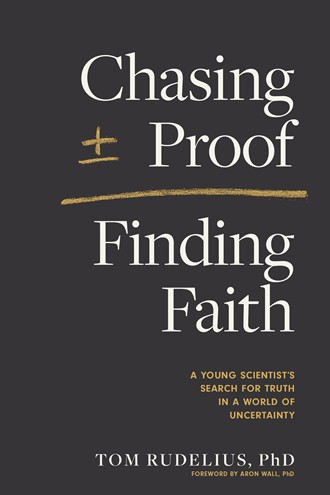


I was asked by the publisher to include an excerpt from the book to help promote it.  Completely disregarding their proposed selections, I have chosen one of the later chapters of the book, after he’s already become a Christian:

People often ask me what it’s like to be a person of faith in the field of science. It’s a hard question to answer, because my experiences have varied widely.

Sometimes, physicists will ridicule religion. Once, while visiting the University of Texas to give a talk on my research, I went to lunch with a number of physicists, including the late Nobel laureate (and outspoken atheist) Steven Weinberg. Unaware of my religious leanings, Weinberg began the lunch with a pointed question toward the antievolution movement: “Do all these people who reject evolution also reject cosmology?”

I thought about explaining the difference between young earth creationists and old earth creationists, but ultimately held my tongue.

Sometimes, physicists simply steer clear of religious topics. One day when I was a postdoc at the Institute for Advanced Study in Princeton, the man whose donations to the Institute helped pay my salary came to have lunch with Ed Witten—quite possibly the greatest living theoretical physicist, if not the smartest man on earth—and me. A quick online search had made the donor aware of my religious views, so he spent the entire lunch asking me (very respectfully) about my opinions on religion and politics. It was probably the most stressful conversation I’ve ever had—talking about Jesus and Donald Trump with the smartest man alive and the man who paid my salary.

During the entire conversation, Ed Witten was surprisingly quiet. His only remark came when we were discussing God’s miraculous intervention. “I think a lot of people wish God would intervene more often,” he said.

Sometimes, physicists respect religion. Several of my colleagues have expressed admiration for my religious faith, or religious faith in general, though they themselves do not have any religious convictions.

Sometimes, physicists embrace religion. I don’t know very many Christians in my field, but whenever I meet one, I feel an immediate kinship. Our scientific drive for knowledge pushes us to learn as much as we can about the physical universe, and as Christians that same drive pushes us to learn as much as we can about God. The result is a common language of science, theology, and philosophy not so different from the “twin telepathy” my brother and I have shared since childhood. Though sometimes it is discouraging that so few of my colleagues embrace religious faith, it is encouraging—perhaps even more so—that the ones who do are so strong in their faith and so capable of defending it intellectually.

In much of the world, there is intense animosity, and sometimes even violence, between people of differing religious faiths. Perhaps it’s because we religious physicists represent a minority in our world, but I’ve certainly never felt anything like that from my Jewish, Muslim, and Hindu colleagues. And I hope they’ve never felt anything like that from me. Rather, there seems to be a sense of solidarity among religious scientists. Though there are important differences between our faiths, there’s an even deeper sense of mutual respect among us: I’ve probably received more comments of admiration regarding my faith from Jewish colleagues than I have from Christian ones, and a Muslim colleague once told me that my public interviews and articles on science and God had strengthened his own faith.

On the whole, though, I can say with certainty that I have never felt persecuted or personally attacked for my faith. There are places in the world where Christians are suffering for their faith. But America is not one of those places. I can go to church, pray, read my Bible, and even write books like this one without fear of losing my job. Some of my colleagues may not agree with my faith, but fortunately my success in physics depends on my ability to do physics, not on how I worship in my free time.

Though science and faith are often viewed as enemies, I can also say I have felt less hostility toward religious faith in the upper echelons of physics than at the lower levels, or in the soft sciences or humanities. Anthropology, history, and religious studies departments are famously dismissive of Christianity—a trend many of my Christian friends and I experienced during the course of our university studies.

One of my friends who studied chemistry at Princeton had a high school science teacher who forced the class to learn the definition of a so-called scientific theory—an explanation for some natural phenomenon supported by a vast body of evidence—to refute the common creationist retort that “evolution is only a theory.” But when he got to college, my friend soon realized that such definitions are nonsense: In practice, scientists use the term theory to describe many different things. Some theories, like quantum field theory, are among the best tested phenomena in all of science. Other theories, like string theory, lack any experimental verification whatsoever.

My high school physics teacher—who was one the best and most important teachers I ever had—occasionally made snide remarks about religion. Yet at Cornell, Harvard, and Princeton, I met several religious physics professors. One professor even suggested to his class that God might be the best explanation after all for the fine-tuning of the universe for intelligent life—and he wasn’t even a theist.

Now, it’s also true that most of my extraordinarily brilliant colleagues do not embrace religion. But I’ve found that their reasons are generally quite ordinary. If you ask the average atheist why he or she doesn’t believe in God, you’ll probably get some version of the problem of evil: “If God is all-powerful, all-knowing, and all-loving, why do evil and suffering exist?” If you ask one of the world’s most brilliant scientists why they don’t believe in God, you’ll probably hear the exact same thing.

That’s not to say that the problems of evil and suffering are easy for theists to deal with. It’s simply that the most brilliant minds don’t have a huge advantage over others when it comes to questions of faith. We all have basically the same questions, objections, and doubts. In my experience, the ones who find answers to these questions are typically those who need answers the most. Personally, before Steve’s conversion and subsequent conversations with me, I never felt much need for religion, as I was generally able to get by on my intelligence alone. Perhaps other scientists feel similarly.

Finally, I have found that most scientists—even nonreligious ones—believe in some sort of power greater than ourselves. It’s very common to hear physicists refer to Nature as a sort of placeholder god. For example, Ed Witten once said in an interview, “If I knew how Nature has done supersymmetry breaking, then I could tell you why humans had such trouble figuring it out.” There is a widespread acknowledgment that Nature has chosen a particular way for our universe to be, and it could have chosen something different.

What’s the difference between this Nature and the God (capital G) I believe in? I think the biggest difference is simply that Nature doesn’t really care much about the affairs of humanity, whereas God does. Most everyone would agree that Nature has a preference for order, simplicity, and beauty, but many balk at the suggestion that it would concern itself with the affairs of one particular species on one little insignificant planet. We humans are, to quote astronomer Carl Sagan, nothing but “a mote of dust in the morning sky.” [1] Why would God care about us?  

[1] Carl Sagan, Cosmos (New York: Random House, 1980).

To this, I like to point out that size is not a very good measure of value. I care more about the life of a baby than I do about most galaxies. I care more about the ten-nanometer transistors that make my computer work than I do about distant stars. And even as someone who studies black holes and the big bang for a living, I find nothing more incredible about the cosmos than the fact that it somehow birthed intelligent, conscious beings like us.

Ultimately, one can choose to view the size of our universe as a sign of our insignificance, or one can choose to view it as a sign of the great significance of its creator—a creator whose attention is not divided, who built and sustains the intricate workings of the cosmos, yet who simultaneously cares enough about humanity to become a human himself, to experience pain, suffering, and death so that we could have life.

Perhaps you noticed that my name is also on the front of the book, in much tinier yellow letters at the bottom.  (Or more likely, you didn’t and are even now scrolling back to see if my claim is true.)  This is because I was asked by St. Tom to write a foreword to his book.  (And not only that, I did.)  My foreword begins as follows:

Foreword

(from this formative experience with the publishing world, I have learned that the word has an “e” in it) but after that it goes on to say:

The book you are holding is a remarkable one. There are lots of books out there promoting Christianity, by a type of person you might call salesmen. The goal of a salesman is to produce a watertight and squeaky-clean argument, to convince you that only one position is intellectually respectable, and fully capable of servicing your needs. He is afraid to admit any weakness in his arguments. He is afraid that if he talks honestly about his own doubts and struggles, his audience will take it as a reason to reject the product he is promoting. If you want a book like that, I suggest you look elsewhere. My friend Tom is not a salesman. But he is a person who cares deeply about what is real, both in scientific and religious contexts. And because of this, he is also unafraid to share his spiritual doubts and struggles, both before and after he became convinced that Christianity is objectively true.

After that, the foreword includes eleven more juicy paragraphs, and importantly the only way to read them (if you don’t know about libraries) is by buying the book.  You can do this by clicking on one of the following links:

Amazon

ChristianBook

Tyndale

Target

That’s right, you can now buy the equivalent of one of my blog posts, at the same store you can get detergent and kid’s T-shirts from!  But, you should probably also buy the book to read an interesting and sincere account from Tom, about his obstacles coming to Christ and his emotional struggles with faith afterwards.

Now, you are going to buy the book at any time in the future, it would probably be helpful to Tom if you would buy it ASAP, for example TODAY, so it can go into the early sales figures that make the industry decide whether this book is hot stuff or not.  Sorry, I don’t make the rules of worldly success in the publishing industry, that’s just how it goes.

Having said that, some of you may be tempted to write comments asking, well when are you (Aron Wall, PhD) going to write your own book about Sciencey-and-Religiony stuff, and not just a foreword or backewards glued onto somebody else’s book?

Well, as you can probably tell from my recent blog performance: I’m just way too busy (with mentoring PhD students and postdocs, parenting my 2 & 4 year olds, quantizing gravity, and doing faculty busywork) to get any useful writing done, for the most part.  Nevertheless, you should expect some book about the Fine Tuning Argument for God and/or the Multiverse to appear under my name (as well as that of my coauthors, philosophers John Hawthorne and Yoaav Isaacs), some time in the next oh 1-50 years from now.  Just thought I’d give you a heads-up about that since a file looking deceptively like a rough draft basically already exists, more or less.  Mostly less.

(If any skeptical promotion committees are reading this post, I promise I spent very few of my months working on the Fine Tuning book, and any deficit of actual physics papers is explained by the other stuff in my life…)

Anyway, life is short so don’t save your money for a book that might or might not come out in the next couple of years.  Instead BUY TOM’S BOOK NOW (if you feel led to do that) and trust that you’ll have the spare change to buy mine later.

[Disclaimer: I understand that I will be receiving a free copy of Tom’s book in the mail.  But it will come too late to change my opinion of the book—I will always think of Tom’s manuscript primarily as a Word file.  I’m sure the publishers put a lot of effort into making it look like a real book; but I’m sorry, that’s just the way it is.]

Capturing Christianity discussion

A few years ago I wrote a series of blog posts (starting here) discussing the debate between Sean Carroll and St. William Lane Craig.

Well, last week I was invited to St Cameron Beruzzi’s internet show Capturing Christianity, along with fellow guests Sts. Luke Barnes and Ronald Cram, to give further comments about the debate.

You can still watch it by following this link.  The whole thing is about 2 1/2 hours long.

Sean Carroll and the Afterlife

A while back, a reader of my blog asked me to respond to the following video in which Sean Carroll discusses why he doesn’t believe in the afterlife:

Sean Carroll On Death And The Afterlife

[Please note that, as a matter of policy I will not review or respond to ideas that are encapsulated in videos, unless there is a text transcript.  I made an exception for this particular person, as a very special favor which is not to be repeated…]

I replied more or less as follows:

Dear _____,

I’m familiar with Sean Carroll’s arguments and while I understand that they may be intimidating, he’s leaving out something pretty important here.  Namely God.

Of course Carroll is an atheist and so he doesn’t believe in God.  But we Christians do think there is evidence for God and miracles from e.g. the Resurrection of Jesus.  Even Carroll admits that sufficiently powerful evidence could change the conclusion that QFT is a complete description of nature.  He just hasn’t yet understood that that this evidence does in fact exist, in the form of the historical documentary evidence for miracles.  This of course requires us to believe that, contrary to what Carroll said, sometimes things outside of our current understanding of physics do affect the human world.  But that’s not as implausible as he makes out, since it often happens in Science that a theory is very accurate in certain circumstances, except in rare situations where it completely fails due to interaction with new kinds of things.  If the new thing was just new kinds of QFT particles, then it couldn’t really work (for all the reasons Carroll mentioned), but if it is something like God, that would not fall under the purview of QFT!

Now while Carroll has defended his Atheism elsewhere, this particular debate was about life after death, not Atheism.  For the purposes of this debate, he’s basically just assuming that Materialism is true, and that therefore the only way there could be life after death is if the information in our brain was preserved by some physical mechanism.

Now I actually agree with him that it is very implausible, if Materialism is true, for there to be any physical mechanism which preserves our mind after death!  So nothing he said bothers me.  Because I don’t think that the reason we will live forever is because we have some magical soul-particles in our brain (not yet discovered in the laboratory) which happen to have the property of being immortal.

Instead I think the reason we will live forever is that God loves us and that he’s promised to do it.  So at the end of time, when Jesus comes back, God will raise us from the dead in new physical bodies, and if that violates the current laws of physics that’s okay by him.  (If he wants to copy our information into some other format to keep us self-aware in between the time of our death and Resurrection, he can do that too!  The New Testament suggests that probably something like this is the case, but it puts a lot more emphasis on the Resurrection of our bodies when Jesus returns.)

I also think that Carroll is more confident than he should be that the Laws of Physics can explain why physical systems are conscious.  The so called “Hard Problem of Consciousness” is an extremely deep philosophical puzzle, and even many atheistic philosophers (like David Chalmers or Thomas Nagel) think that there is a mystery here which is very hard to explain on a purely reductionistic materialistic worldview.  While this is a very interesting topic (which suggests that, at some level, Materialism is wrong about some deeply important things), I think it is hard to really prove for sure that this would imply anything about life after death.  Traditionally, many theistic philosophers have tried to prove the Immortality of the Soul through philosophical reasoning, based on facts about the supposed immateriality of the mind, but the Philosophy of Mind is sufficiently confusing I don’t think this is the best way forward.

I would instead focus on the fact that God has promised, in the Bible, to raise human beings from the dead and made an advance demonstration of this with Jesus.  Our confidence that he keeps his promises (a.k.a. “faith”) is based primarily on our relationship with him and not based on the kinds of pro and con arguments which were made in this debate.  I think our confidence that we will live forever is going to be proportional to our love and knowledge of God, so if you find yourself having difficulty believing in Heaven, the solution is not to directly try to believe in that harder (in isolation from other things) but rather to meditate further on your relationship with Jesus, and then the afterlife issue will straighten itself out automatically.  That’s not to say that what we believe about the afterlife isn’t important, but only that it follows from a correct understanding of who God is.

Blessings,
Aron

Black Swans

A reader asks:

After a lot of reading, I’ve come to realize that the Bayes factor for the resurrection is quite high that if the event in question wasn’t a supernatural occurrence, no rational person would think that the event did not occur. However, I’ve stumbled upon an argument by a philosopher who argues against the resurrection argument by using bayes theorem as well.

I’ve included a link of a debate where he presented his arguments in a long mathematical form in case you wanted to refer to it, but the gist of his argument is that the prior probability of God raising Jesus from the dead is always going to be magnitudes lower than that of God *not* raising Jesus from the dead. He is a theist himself, so he argues that he does’t follow Hume in his argument against miracles, but rather he claims to be making an argument from natural theology: Every experimental confirmation of a scientific theory that we observe counts as evidence of the fact that God created and ordered the world in an orderly and causally closed way and does not intervene. In another presentation, he puts forth a statistical inference of this sort(I didn’t copy and paste it so it might be a flawed syllogism, but I think it captures the gist of what he’s saying):

(1) For every dead person, 99.9999…% of the time God does not intervene

(2) Jesus died

(3) Therefore, we can be 99.9999….% certain that God did not intervene in Jesus’ death

He argues that for every instance of a “miracle” being reported, we have experimental confirmations of the laws of nature of a much higher frequency. So, he concludes from all of this that the prior probability that God would raise Jesus from the dead is so astronomically low that however high our Bayes factor is *for* the resurrection, the prior improbability of God wanting to intervene with the laws of nature is always going to be much higher such that the posterior probability (or final probability) of the resurrection is always going to be really low.

This argument is unlike any other because it doesn’t assume naturalism, in fact it assumes theism. It doesn’t assume that God cannot or could not have raised Jesus from the dead, but that it is highly improbable that God would have intervened.

As a scientist, what do you think of this argument (Since your career involves seeing confirmations of God’s love for order in the universe everyday?)

https://www.youtube.com/watch?v=XCCmDqQ7qgI
[Dr. Robert Cavin vs. St. Calum Miller]

(He presents his argument from the 14th minute to the 30 minute mark)

What do you think of this argument?

(1) For every American citizen who lives during a presidential election, 99.9999…% of the time they do not become President.
(2) St. Barack Obama was a living American citizen in 2008.
(3) Therefore, we can be 99.9999….% certain that Barack Obama did not become President of the United States.

Clearly there is something wrong with this argument.  What’s wrong with it is that Obama is not a randomly selected [or typical] citizen.  He belonged to a special class of people who is unusually likely to become President (a Senator, a charismatic speaker, wanted to become president, went on to receive the nomination of a major party…).  Since we have additional information, it is fallacious to use the background rate to decide the chances of him becoming President.  [And of course, we also have excellent posterior evidence, coming from the period after the election, that he did in fact become President.]

In the same way, Jesus is not a randomly selected human being.  He was a person who claimed to be the Jewish Messiah and the Son of God, fulfilled certain prophesies, did other miracles, and so on.  So the prior probability that God will dramatically intervene shortly after Jesus’ death, is a lot larger than the probability that he will dramatically intervene when one of my uncles dies.  (Although, actually God DOES plan to raise 100% of human beings from the dead when Jesus returns, the difference in the case of Jesus is that he did it right away.)

The reasonable question is, what is the prior probability that God would make some special person to be the Messiah and raise that person from the dead?  (Just like, we could ask what is the probability that any person becomes President.)  Once we believe that somebody is going to be President, or that somebody is going to be the Messiah, we shouldn’t be all that surprised to learn that any one particular person turns out to be President, or the Messiah, so long as they are qualified for the position.)

The argument in the video is even more fallacious.  First of all, I should say you should be VERY SUSPICIOUS of any person who starts their argument by making concessions that huge to the other side. Factors of \(10^{297}\) are ridiculous numbers that should never be thrown around in almost any real life situations, and if he concedes something that ridiculous to his opponent, he ought to be guaranteed to lose, plain and simple.  He’s like a stage magician who makes a big show of how he’s blindfolded and his hands are tied behind his back and so on.  You can be very sure there’s a trick somewhere, and that all that patter is there to distract you from the way he actually does the trick.

(The other guy, St. Calum Miller, is also making a fallacy, when he quotes a liklihood factor of \(10^{43}\) for the Resurrection; this number incorrectly assumes that the evidence from each apostle’s testimony counts independently.  The odds of a group conspiracy to lie are certainly bigger than \(10^{-43}\), which is an astronomically tiny number.  No real historical event is ever that certain.  That being said, he’s right that the evidence for the Resurrection is extremely strong, as far as historical evidence goes!  It’s just that nothing in life is really that certain.)

By the way, Cavin is derisive about St. Craig Keener’s statement that there are a hundred million miracle reports, but this is not actually all that silly of a number.  If 2% of the world’s population claims to have seen a miracle, that’s 140 million right there, assuming none of the events are redundant.  So I don’t think this claim can be dismissed quite so easily.

Anyway, in his argument, Cavin compares the likelihood ratios of L (the laws of nature are always valid), M (at least once, God acts miraculously), and ~(M v L) (neither one is true).  The last comes in because L and M are not exhaustive, since there might be neither laws of nature nor divine interventions.

The actual fallacy in his argument is displayed on the slides at the 33:45 mark of the video.  He claims that ~M (i.e. not M, which would include both L and ~(M v L)), because it is maximally unspecific and does not necessarily predict that there are any laws of nature at all, is disconfirmed every time anything happens in accordance with a natural law.  Then he claims that M, because it only adds to ~M the claim that at least one miracle happens, is at least as bad off as ~M!

But this is clearly quite absurd.  Not even the most ardent believer in the supernatural thinks that every time I drop a ball, there is a 50% chance that it will miraculously fall up instead of down.  Not even the most tempestuous skeptic really halves their chance that God does miracles, every single time they see a ball drop!

Obviously, miracles don’t happen all the time.  What Christians actually believe is:

M’: the usual laws of Nature are almost always valid, but on rare occasions (especially at important moments in salvation history) God intervenes to perform miracles.

(By important moments in salvation history, I mean things like: critical events in ancient Israel, the ministry of Jesus and the Apostles, times when missionaries preach the Gospel to a group of people for the first time, or sometimes for the conversion of a particular individual.  Aside from this, sometimes God heals people in answer to prayer and so on, but my point is that miracles are not randomly tossed into history like darts shot into a dartboard; they tend to happen in specific kinds of situations.)

Now M’ clearly does predict that balls will normally fall down.  So it is just as good as L (the laws of nature always hold) for purposes of everyday life.  So his huge probability factor of \(2^{gazillion}\) goes away.  But M’ is better than L in situations like Jesus’ ministry, where there is significant historical evidence that miracles really occurred.

Incidentally, this implies that he was quite wrong to rank the probability of ~M (no miracles) so low.  Even though it is a very unspecific hypothesis, we shouldn’t consider randomly selected examples of ~M, instead we should focus on whatever are the most plausible versions of ~M.  And clearly, the most plausible versions of ~M are scenarios where the laws of nature are followed, at least most of the time.  In fact, the most plausible version of ~M is L.  Thus he is guilty of a clear-cut violation of the laws of probability theory here, since he simultaneously argues that ~M is very improbable, and L very probable, even though L actually implies ~M!  This is an example of the Conjunction Fallacy:

https://en.wikipedia.org/wiki/Conjunction_fallacy

Had St. Miller realized this, he could have totally eviscerated Cavin’s argument in a couple seconds, in a way that would have been completely humiliating and decisive.  However as far as I can tell (I skimmed through his remarks very quickly) he mostly just ignored that argument and presented the positive case for the Resurrection.

Similarly, the most plausible version of M is not a scenario where God intervenes half the time we do a science experiment (I agree THAT is ruled out), instead it is a scenario along the lines of M’ or similar.

To give another illustration, consider the famous proposition

W: All swans are white.

For a long time, Europeans noticed that every swan they ever looked at was white.  You could take this as huge experimental confirmation for W.  Every time you look at a swan, W predicts it is white and therefore is confirmed by a factor of at least 2 over ~W (and that’s if there was only one other color besides white), which says the swan could be any color.  Since there were millions of observations of white swans, doesn’t this mean that W is a gazillion times more probable than ~W?

And yet, there are black swans!
https://en.wikipedia.org/wiki/Black_swan

The fallacy is to assume that the most plausible version of ~W is that each individual swan’s color is random.  In fact all the swans in Europe are white; the black swans are not only rarer, they live in Australia.  So it is no surprise the Europeans didn’t notice them until they came to Australia.  So actually ~W was almost as good of a theory as W, aside from being slightly more complicated.

As a scientist, what do you think of this argument (Since your career involves seeing confirmations of God’s love for order in the universe everyday?)

That is indeed the exact point.  We worship a God who loves order, and therefore he does not do miracles haphazardly.  No scientific experiment can ever be evidence against miracles, unless you have some theological reason to believe that God would have been likely to intervene in that particular experiment.  For most experiments, the opposite is true—it would frustrate the ability of his creatures to learn about the world, without providing any particular benefit.

(I am assuming here that the goal of the particular experiment was not specifically to look for evidence of God, as in e.g. prayer experiments.  In that case, we all know that God does not usually respond to challenges to show his existence by striking a nearby tree with a lightning bolt.  The fact that he doesn’t do that may be evidence against a certain sort of deity, but even there I don’t see what is gained by dressing up the challenge with a veneer of science, when the whole point is simply to challenge God to act.)

Note: I only answered this question as a special favor to the particular reader in question.  I hate watching long web videos, and I tried to watch as few seconds of this one as I possibly could, to answer the question accurately!  I much prefer to interface with texts, which can be read at the speed I want, and then quoted accurately using the copy-and-paste function!

[Edit: In an earlier version of this blog post I misspelled the name “Cavin”; I apologize for this mistake.  Also, I would like to make it clear that, except in the portions of this blog post where I respond directly to the video debate, I am responding to the arguments as presented by my interlocutor, without asserting that it is necessarily an accurate summary of Cavin’s position.

A few other changes made after the fact are in square brackets.]

Rainbow Gravity

In the past week, I received two emails from some folks concerned that a speculative physics proposal called “rainbow gravity” eliminates the Big Bang and hence the beginning of the universe.  They are worried that this undermines Christianity.  Presumably if two different people living in different countries took the trouble to email me about it, there are hundreds of people out there, equally worried about it, who didn’t bother to email me.

*          *          *

Now I already wrote a big long series about whether the universe began and I don’t want to repeat everything again.  But let me say a bit more about the virtue of faith as it relates to scientific inquiry.  As a scientist I think it is a real shame if, when Christians learn about Way Cool New Science, their first instinct is to doubt their faith and wonder if the new stuff undermines what they believe about God.

I think it’s a lot healthier to be able to learn new and amazing things about the world—the world that God created—without worrying that every new discovery will undermine your religious beliefs and make it so you have to be an atheist.  I would like to propose that it is a virtue for a Christian be able to learn new things about the world, and to keep an open mind towards new discoveries without continually engaging in the torture of nagging doubt and worry, so that scientific discovery starts seeming like a hostile force.  That is not the confidence which comes from faith.  A happily married wife shouldn’t spend all her time worrying (without good cause) that her husband is cheating on her whenever he goes off on a business meeting.

Even if it were established that there was time before the Big Bang, that would not establish that God did not create the universe.  Perhaps the beginning of the universe was in fact a long time before what we think of as the Big Bang.  Or perhaps we need to be flexible about what we mean by creation, and say that God created a universe which goes back infinitely in time.

Don’t get me wrong; I am an evidentialist.  I think people should only believe in things for which there is enough evidence, and that merely being consistent with the scientific data is not (by itself) strong evidence.  But I also think that there’s more than one type of evidence, since we have the historical records of Christ and the inner testimony of God’s Spirit to help us.  Your personal relationship with Christ obviously does not consist primarily of speculation about what happened (or didn’t happen) before the Big Bang.  If Christianity is important enough to worry about, that’s because it’s relevant to your personal life, not just to scientific questions.

If you are solidly rooted in Christ then you don’t have to be ”tossed back and forth by the waves, and blown here and there by every wind of teaching” (Eph. 4:14).  That in turn gives one the ability to explore new knowledge with a feeling of freedom and security (and paradoxically this probably puts you in a better position to know whether Christianity is true or not, then constantly worrying about it all the time would).

But is rainbow gravity in fact Way Cool New Science?  Let’s explore and see.

*          *          *

My correspondents were concerned by an article by Sarah Knapton which appeared in two slightly different forms in the National Post and Telegraph.  These in turn appear to mostly be cannibalized versions of this Phys.org article, which in turn describes the article “Absence of Black Holes at LHC due to Gravity’s Rainbow” by Ahmed Farag Ali, Mir Faizal, and Mohammed M. Khalil.

However, there is nothing about the Big Bang in these last two links, so Knapton must have done some some additional investigation.  It is true that Faizel also wrote another article suggesting that rainbow gravity might avoid the Big Bang.  (But more likely she got this information from a Scientific American blog article based on arXiv:1308.4343).

Knapton’s article belongs to a long and venerable tradition of journalists taking the marginal, speculative ideas and making it sound like they are taken seriously by the scientific community.  She states that

Scientists at Cern in Switzerland believe the particle accelerator, which will be restarted this week, might find miniature black holes at a certain energy level.

This could prove the controversial theory of “rainbow gravity” which suggests that the universe stretches back in time infinitely with no singular point where it started, and so no Big Bang. The theory was postulated to reconcile Einstein’s theory of general relativity, which controls very large objects, and quantum mechanics, which affects the tiniest building blocks of the universe. It takes its name from a suggestion that gravity’s effect on the cosmos is felt differently by varying wavelengths of light.

This makes it sound like Ali, Faizal, and Khalil are located at CERN (which they are not), that many researchers at CERN take the idea of rainbow gravity seriously, and that there is some sort of epic “controversy”-battle taking place between those who believe it and those who don’t.  But the reality on the ground is that most particle physicists and quantum gravity researchers probably haven’t even had this idea show up on their radar screen.  (Now the multiverseThat rises to the level of being controversial.)

Sentences like:

Scientists believe they could find the first proof of alternative realities that exist outside ou[r] own universe.

make it sound as if the scientific community takes something seriously, when actually it just means that somebody (with a science job) wrote a article (with equations) proposing it—and that they have at least one coauthor, since the noun “scientists” is plural!

The Scientific American article is a bit better.  It correctly states that

The idea is not a complete theory for describing quantum effects on gravity, and is not widely accepted.

but then immediately thereafter we have the inevitable “at least 2 scientists are willing to indulge in speculation” construction:

Nevertheless, physicists have now applied the concept to the question of how the universe began, and found that if rainbow gravity is correct, spacetime may have a drastically different origin story than the widely accepted picture of the big bang.

Unfortunately, these types of inflated articles make it difficult for non-scientists to tell which new ideas in science are actually taken seriously or not.  How can non-scientists tell whether something is legit?  The fact that the article made it through the peer-review process of a top journal?  (Hold on for a moment while I stop laughing.)  While peer-review tends to filter out the worst crackpots, quite a few lemons still manage to get through.  Conversely, good articles are frequently rejected, although this is mitigated by the tactic of simply submitting to enough journals that one of them accepts it—but this tactic is also open to authors of bad papers!

What makes good science is observational support, elegance, precise models, and so on.  Unfortunatly non-scientists usually have to take the word of the scientific community about the extent to which any given proposal meets these tests.

(Honestly, given the awfulness of pop-science venues in this respect, I would say if you aren’t a scientist, it’s probably best not to take any new scientific idea you read in the news all that seriously, at least not until you find out that a broad cross-section of the relevant experts believe in it.  It’s a better use of your time to learn about the Way Cool Old Science which has already been established!)

The main trouble with “Absence of Black Holes” is that it’s a combination of two different speculative ideas (each with individual problems), and together they become even worse.  I don’t want to call this paper crackpot exactly, but let’s just say that it has a very, very small probability of being correct.  The main ingredients are:

1) Rainbow gravity (which seems to have originated from something called “Doubly Special Relativity”) is an idea based on very speculative quantum gravity models suggesting Special Relativity should be modified for particles with energy very close to the Planck scale, \(10^{16}\) TeV, when quantum gravity effects become important.  The idea is that the spacetime seen by different particles should depend on how energetic those particles are.

Unfortunately nobody knows how to make this model into a mathematically consistent field theory (like every other successful fundamental theory to date).  So they just make crude approximations, like proposing that the geometry felt by a particle at a given spacetime position depends on its energy, by means of a function \(f(E)\) (which they just make up rather than actually deriving it honestly from any deeper theory).

But simultaneously measuring (a) energy-momentum and (b) spacetime position conflicts with the Heisenberg Uncertainty Principle, so this is hard to reconcile with quantum mechanics even though it was inspired by quantum gravity.  It seems that these theories would have to be fundamentally nonlocal.

2) Large Extra Dimensions.  The idea here is that there are additional dimensions, besides the usual 4 spacetime dimensions we see.  One has to explain why we can’t see these dimensions normally; in this particular approach one says that ordinary matter fields are stuck on a 4 dimensional membrane and that only gravity can propagate in the extra dimensions.

This has the effect of strengthening gravity at short distances, and could conceivably even lower the Planck scale to smaller values, perhaps even to a few TeV.  Of course it was no conicidence that people were most interested in models in which the Planck scale was moved to energies accessible to the LHC, thus making people excited by the possibility of seeing things like quantum black holes experimentally!  (Nobody gets a Nobel prize for saying that we will never observe quantum gravity effects because the energy scales are much too high.)  This was also an extremely speculative idea, and what’s more, after turning on the LHC we haven’t yet seen any black holes or anything like that.

The sane conclusion to draw, of course, is that probably there are no large extra dimensions (or if there are, the Planck scale is still considerably above what we can see).  These authors instead propose that if rainbow gravity is also true, the minimum size of black holes might be bigger, explaining why we haven’t seen them yet.

I was going to write a more detailed critique, but I find that Sabine Hossenfelder has already done most of the work for me.  She writes that:

In rainbow gravity the metric is energy-dependent which it normally is not. This energy-dependence is a non-standard modification that is not confirmed by any evidence. It is neither a theory nor a model, it is just an idea that, despite more than a decade of work, never developed into a proper model. Rainbow gravity has not been shown to be compatible with the standard model. There is no known quantization of this approach and one cannot describe interactions in this framework at all. Moreover, it is known to lead to non-localities with are ruled out already. For what I am concerned, no papers should get published on the topic until these issues have been resolved.

Rainbow gravity enjoys some popularity because it leads to Planck scale effects that can affect the propagation of particles, which could potentially be observable. Alas, no such effects have been found. No such effects have been found if the Planck scale is the normal one! The absolutely last thing you want to do at this point is argue that rainbow gravity should be combined with large extra dimensions, because then its effects would get stronger and probably be ruled out already. At the very least you would have to revisit all existing constraints on modified dispersion relations and reaction thresholds and so on. This isn’t even mentioned in the paper.

That isn’t all there is to say though. In their paper, the authors also unashamedly claim that such a modification has been predicted by Loop Quantum Gravity, and that it is a natural incorporation of effects found in string theory. Both of these statements are manifestly wrong. Modifications like this have been motivated by, but never been derived from Loop Quantum Gravity. And String Theory gives rise to some kind of minimal length, yes, but certainly not to rainbow gravity; in fact, the expression of the minimal length relation in string theory is known to be incompatible with the one the authors use. The claims that this model they use has some kind of derivation or even a semi-plausible motivation from other theories is just marketing. If I had been a referee of this paper, I would have requested that all these wrong claims be scraped.

I also briefly looked at the other article by Faizel about avoiding the Big Bang, and it seemed just as ad hoc as any of the other papers on this subject, and I wasn’t convinced it makes sense.  I don’t think we should expect to find any pots of gold at the end of this particular rainbow.