A few years ago I wrote a series of blog posts (starting here) discussing the debate between Sean Carroll and St. William Lane Craig.
Well, last week I was invited to St Cameron Beruzzi’s internet show Capturing Christianity, along with fellow guests Sts. Luke Barnes and Ronald Cram, to give further comments about the debate.
You can still watch it by following this link. The whole thing is about 2 1/2 hours long.
Everyone seemed to love the panel discussion on “Is time travel possible?”, featuring Veritasium‘s Derek Muller as host; and Nima Arkani-Hamed, Daniel Harlow, Daniel Jafferis, and myself as panelists. We had a lot of fun with it, but also there’s some profound physics involved, in what one might have thought was a pretty flippant choice of topic. So without further ado, here it is:
(Back up to 7:55 if you want to hear all the introductions to the event at the beginning.)
After our panel there were two others on “What are the limits of Science” and “Is there life in the Universe”, recorded in the same video. There were a lot of interesting people on these panels, although I don’t think the conversations cohered quite as well as ours did, perhaps because they involved people from different disciplines.
In the second panel, Andrei Linde is a fun speaker, but I think he overplayed how much we currently know for sure about the early universe after inflation happened. There are a lot of mysteries between the time inflation ended (about \(10^{-35}\) seconds after the Big Bang by his reckoning) and the time of the Higgs Phase Transition (about \(10^{-12}\) seconds, which corresponds to the highest energy scale we can measure at the LHC). Between these times there are a lot of mysteries, like what process produced more matter than antimatter, as needed for any matter to exist today. I also wish he’d mentioned Cosmic Variance, a pretty obvious Limit on Science in his field.
Gary Ruvkin, the guy who thinks life on earth came from outer space was also kind of interesting. Apparently after about a billion years of nothing, life shows up on Earth and it’s already pretty complicated. So maybe it came from elsewhere? The downside of this hypothesis, he said wittily, is that it “only buys you another 10 billion years” to evolve life (going back to the Big Bang). Since this is a physics and theology blog, I’ll mention that even though I generally think that Darwinian evolution suffices to explain the evolution of complex life from simpler life, it does seem bewildering how something as complicated as the first cell might have arisen naturally, without a miracle. But just because I can’t imagine it doesn’t necessarily mean it couldn’t have happened by some natural process. As a theist I am philosophically open to both supernatural and natural explanations, both of which are ultimately due to the Creator of all things.
That third panel should really have been: “Is there other life in the Universe”, otherwise I think the question is pretty easy. This panel includes Jocelyn Bell Burnell who received a special Breakthrough prize this year for her revolutionary discovery of pulsars. Scandalously, the Nobel was given to her advisor but not to her; either because of sexism, or because of a bias against graduate students, or some combination thereof.
This seems like a good time to mention that, if I understand the history correctly, it was Daniel Jafferis’ grad student Ping Gao who had the original idea to try to make a traversable wormhole in AdS/CFT. (Although as the 3rd person to join the collaboration, I can’t speak to the exact division of labor between Ping and Dan.) Now the New Horizons prize was awarded for our lifetime of work so far, and not just for this one article, so I’m not saying that Ping should have been eligible for this particular prize. But I do think it’s important for people to acknowledge junior collaborators, and not just assume the senior people did all the best work. So thanks Ping!
[Apparently I misunderstood the history, and is was Daniel who had the original idea and assigned it to Ping as a project. I apologize for the mistake, but of course I’m still grateful to Ping for his hard work and insights!]
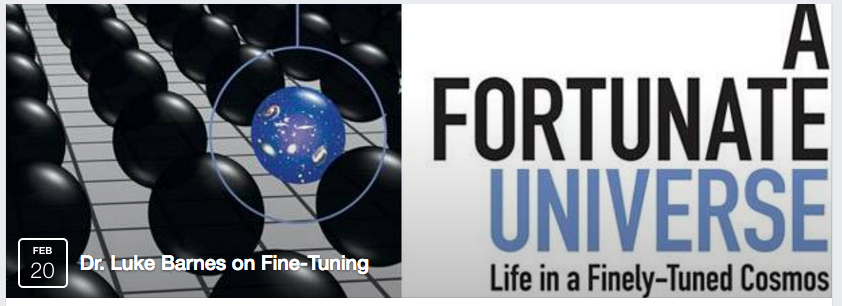
I was asked by Ratio Christi—a group at Rutgers that I’ve spoken to a coupletimes in the past—to advertise the talk above. It will be on Feb 20th at 7pm, at the New Brunswick Theological Seminary. See this post on their Facebook page for more details.
It will be by (St?) Luke Barnes, a cosmologist who recently coauthored a book with Geraint Lewis, about the Fine Tuning of the Laws of Nature to permit live. I advertised their book on spec, before I read it, at the end of my own talk on Fine Tuning. I knew it was going to be worth reading because of the high quality of commentary on Luke’s blog, Letters to Nature. Luke is not afraid to critique foolish comments made by people on both sides, and his honesty in presenting the data is impeccable.
Over the holidays I read his book and wrote extensive notes in it (I never write in books!) and I will be posting a review of the book when I get around to it.
If anyone here decides to go, I’m sure you won’t regret it. Unfortunately I won’t be there since I have a prior commitment in India.
Part I: The physics of constants and units Part II: How physicists diagnose fine-tuning Part III: Some examples of fine tuned constants Part IV: My own take on proposed explanations
Regrettably there was no recording, so those of you who weren’t there won’t get the benefit of the marathon Q&A session. I try to put a lot of words on my slides, so hopefully most of them will be at least somewhat self-explanatory without me talking over them. (I assumed the audience was already familiar with scientific notation…)
If you want to know more about the fine tuning of constants of Nature you could check out Luke Barnes’ blog or order his book. Or, if you are thirsting for a few more details about the “renormalization group flow” you could start with John Baez’s explanation.
Some of you may recall that last February I gave a talk on Science and the Resurrection to Ratio Christi, an apologetics club that meets at Rutgers University in New Brunswick.
Well, this Monday (the 26th) I’m giving a talk on “Explanations for Fine Tuning”:
Were the laws of physics selected to produce life? This talk will
describe several examples of fundamental physics parameters which seem to be “fine-tuned”, i.e. taking on special values that permit life to exist. We can use techniques from modern particle physics, such as the “renormalization group flow”, to help decide which claims of fine-tuning are real, and which are only apparent. Some examples, such as the Cosmological Constant Problem, seem very unlikely to have any normal scientific explanation. I will argue that the only plausible solutions involve God or a multiverse.
Any of you who are in the area are welcome to attend. This one is at 9 pm at the College Ave Student Center, room 411C. For more details, see their Facebook page. Please note that the location and time are different from my previous talk.