
Category Archives: Theology

For the Love of God!

A reader who goes by the name of Petronius Jablonski—I suppose I should call him St. Petronius—has been vigorously arguing against Free Will in the comments to my recent post about Special Relativity, beginning with this comment:

Thanks for the lucid sketch of A Theory & B Theory. You have a knack for writing about philosophical head-scratchers in plain English. I envy your students. (Consider something book-length. A Christian physicist should have no trouble finding an agent.)

We should add free will to the list of controversies in Theology where there is decisive evidence coming from Physics. Isn’t the B Theory a stunning depiction of Divine Determinism? God creates this massive, amber-like slab of past, present, & future, all parts of which are equally “real.” How could any single detail have been otherwise unless God made it differently?

Far from being incompatible with Christian theology, this takes St. Paul at his word: Why does God hold us accountable and punish us if we have no free will? This is what Romans 9:19 is asking. St. Paul puts the question into the mouth of an imaginary disputant after stating that God has mercy on some (Moses and Jacob) and hardens others (Esau and Pharoah). His answer does not mention free will, middle knowledge, or allowing evil in the best possible world. The answer is the single most terrifying thing in any of the world’s religions: Who are you to ask? God creates some men to be vessels of wrath, others to be vessels of mercy. The purpose is to demonstrate His power. Reality is not about us or our standards. We have no inalienable right to free will (only the Prime Mover has that). God, like a potter making different vessels for different reasons, has the absolute right to make whatever He wants for whatever reason He wants. (Ouch! This is so harsh, but there you have it.) https://www.biblegateway.com/verse/en/Romans%209:19

Note the explicit denial that moral responsibility requires the capacity to do otherwise. “Why does He still find fault? Who can resist His will?” = It’s not fair that God judges us because we couldn’t do otherwise! St. Paul’s answer chills the blood. Damnation isn’t about people abusing their free will; it’s how God shows His power and mercy to the Elect (in the same way He demonstrated His power by hardening Pharoah’s heart and then destroying him). Again, ouch, but that’s what it says. For some, the appeal of Christianity is that it takes determinism seriously.

I await your book on physics & the B theory of time supporting the plain teaching of Romans 9. This would be a bestseller. ;o)

Thanks for your pre-order of a book I haven’t agreed to write, but I don’t think it will say what you hope it will say…

You’re mistaken that the B-theory implies Determinism.  From the statement:

(1) The past, present, and future are all equally real,

it is simply not possible to derive the statement

(2) Nothing could have been otherwise,

by any logical argument, not without smuggling in premises that are far more substantive than (1) is.

Most of these premises, ironically, involve smuggling in A-theoretic presuppositions about the nature of the past.  An A-theorist might believe that “The past is unchangeable, but the future is still open”, but B-theorist can hardly uncritically accept either statement as it stands.  Why should we adopt the first statement and not the second?  Instead let us say that all time is as contingent as the future, as real as the present, and as definite as the past.

Your “massive, amber-like slab” is more poetic metaphor than physics.  If we want to go by what Physics says, we have to take into account Quantum Mechanics as well as Relativity, and this seems to indicate that if we turned the clock back and re-did the experiment, so to speak, we would not get the same outcome a second time.  Physics can only make probabilistic predictions.  I claim that, having the exact same motivations and neural structures at 12:00 pm, and fixing my perceptual experiences after that, there are still multiple possible things I might decide to do at 12:01 pm.  There is no infinite regress, unless we assume that what I choose to do at an instant must be determined by who I am at that instant.

Also, if it were true that the B-theory conflicts with Free Will, then this would imply that God also has no Free Will, since he himself exists eternally.  Thus your claim that the B-theory supports Calvinism is self-contradictory.  Similarly for arguments based on a supposed infinite regress.  These arguments against Free Will could also be applied to God, if they were really valid.

Now onto your theological claims.  I notice that in your various comments you only cite the Scriptures that support your claims, while ignoring those scriptures that might tell against you (e.g. Romans 11 a couple of chapters later).  Romans 9 is indeed in the Bible (as are the other verses you cite in a later comment I didn’t quote) but you have misunderstood it entirely.  It’s funny how Calvinists take St. Paul’s series of rhetorical questions as if they were straight-up assertions, but ignore his quite explicit statement that God “wants all men to be saved and to come to a knowledge of the truth” (1 Timothy 2:4).   But if we are going to get our theology out of rhetorical questions, how about these ones:

“Do I take any pleasure in the death of the wicked? declares the Sovereign Lord. Rather, am I not pleased when they turn from their ways and live?….Repent! Turn away from all your offenses; then sin will not be your downfall. Rid yourselves of all the offenses you have committed, and get a new heart and a new spirit. Why will you die, people of Israel? For I take no pleasure in the death of anyone, declares the Sovereign Lord” (Ezekiel 18:23,30-32).

or the question asked by Abraham:

“Will not the Judge of all the earth do right?” (Genesis 18:25).

You see that St. Abraham had full confidence that God would act in a way that he, a mere human being, could understand as being just and righteous.  Abraham’s faith was credited to him as righteousness, and God accepted his request.

Or if you prefer the metaphor of the Potter and the Clay, perhaps you can read the passage which St. Paul got it from, about how human choices can avert God’s intentions and plans:

Then the word of the Lord came to me.  He said, “Can I not do with you, Israel, as this potter does?” declares the Lord. “Like clay in the hand of the potter, so are you in my hand, Israel.  If at any time I announce that a nation or kingdom is to be uprooted, torn down and destroyed, and if that nation I warned repents of its evil, then I will relent and not inflict on it the disaster I had planned.  And if at another time I announce that a nation or kingdom is to be built up and planted, and if it does evil in my sight and does not obey me, then I will reconsider the good I had intended to do for it.  Now therefore say to the people of Judah and those living in Jerusalem, ‘This is what the Lord says: Look! I am preparing a disaster for you and devising a plan against you. So turn from your evil ways, each one of you, and reform your ways and your actions.’ ” (Jeremiah 18:5-11).

If you look at the context of Romans 9, you will see that St. Paul is imagining an Jewish interlocutor who can’t accept God’s choice to temporarily set aside Israel in the propagation of the Gospel, and to choose the Gentiles instead.  (Notice that Scripture never actually says that Esau and Pharaoh were damned, that’s not the point of the passage.)  His rebuke of the insolent question makes sense in this context.  But the actual reason for God’s decision does indeed have something to do with Israel’s choices, since Paul gives a reason for their failure to be saved: “Why not? Because they pursued it not by faith but as if it were by works” (9:32).  Furthermore God’s ultimate purpose in all this is to save the world: “For God has bound all men over to disobedience so that he may have mercy on them all” (11:32).  As the Gospel of St. John states:

“For God so loved the world that he gave his one and only Son, that whoever believes in him shall not perish but have eternal life.  For God did not send his Son into the world to condemn the world, but to save the world through him.” (John 3:16-17)

Is the God you believe in the same God who left the 99 sheep in the sheep fold to seek the one sheep who was lost?  “In the same way your Father in heaven is not willing that any of these little ones should perish” (Matt. 18:14).  The God who searched through the house for the one lost coin; the loving father who rescued the prodigal son?  Who commanded us to love our enemies, because that’s what he himself does (Matt. 5:44-45)?  Who loved his enemies so much that he sent Jesus to die for the sins of the whole world?  If not, then apparently you are worshipping a different God and a different Jesus.

One more proof-text.  It is this one:

Bear in mind that our Lord’s patience means salvation, just as our dear brother Paul also wrote you with the wisdom that God gave him.  He writes the same way in all his letters, speaking in them of these matters.  His letters contain some things that are hard to understand, which ignorant and unstable people distort, as they do the other Scriptures, to their own destruction. (2 Peter 3:15-16).

This warning label is also in the Bible!  St. Peter identifies the true meaning of Paul’s message (“our Lord’s patience means salvation”), and then advises people to watch out lest tricky theological topics such as predestination paint a false picture of God, a false picture which he says is capable of destroying you spiritually!  (Some would argue that if God hates certain people, why shouldn’t we hate them too?  In this way it is possible to damn yourself using ideas that were falsely wrested from Scripture.)  So apparently we ought to be careful when deciding what the “plain teaching” of Paul’s letters is.  At least, that’s the plain teaching of this passage.

I don’t claim to be “neutral” or “unbiased” in my interpretation of these particular Scriptures, any more than anyone else is.  How could I possibly be unbiased, when you are saying such terrible things about our Father in heaven?  The doctrine that God is good is more fundamental even than the doctrine that the Scriptures are inspired.  So that if it were necessary to choose between them (which it is not!) one should certainly pick the former over the latter.  This is the faith of Abraham, who lived before any part of our current Bible was written.

The Bible may appear to support both sides of this issue, but I have an interpretive key, namely God is love and in him there is no darkness at all and that it is not presumptuous to teach children to sing Jesus loves me this I know, for the Bible tells me so.  These are a foundation for sound, correct doctrine, unlike “plain reading” which immediately runs into difficulties here since many of the plain readings appear to conflict.  There is indeed an important spiritual truth to be found in Romans 9 and every other verse you have quoted, but it is not found in any opinion that makes God out to be morally monstrous.

As you say, this fatalistic doctrine “chills the blood”, and “it also repels” you.  There is a good reason for that—the reason is that it is wrong!  “The letter kills, but the Spirit gives life (2 Cor 3:6)”  If you have any guidance from the Holy Spirit at all, trust your instinct that God is good, not just powerful:

One thing God has spoken, two things have I heard: That you, O God, are strong, and that you, O Lord are loving (Psalm 62:11-12).

God is more loving than you can imagine—and also more powerful, since he is capable of making creatures with real freedom and responsibility.
God and Time II: Special Relativity

Despite what people seem to think, there are very few controversies in Theology where there is decisive evidence coming from Physics (leaving aside some real doozies such as Young Earth Creationism).  But the question of whether God is in Time is one of them.

In the previous post I argued that God must perceive Time as it really is.  But our conception of Time has been modified radically as a result of Einstein’s theories of Relativity.  It starts out with Special Relativity, and becomes even more extreme with General Relativity.

The first thing to notice is that our usual division of time into Past, Present, and Future—which I tacitly accepted when discussing the metaphysical problems of the A-theory (a.k.a. Presentist) idea that only the Present really exists—seems to be totally wrong.  Instead you have to think about spacetime, and it is unclear what we even mean by referring to the “Present”.  As I said in one of my earliest posts:

We’re used to dividing up time into three parts relative to ourselves: past, present, and future. The present is just an infinitesimal sliver, so in a sense this division is into two parts: points to the past have \(\Delta t < 0\) compared to you, while points to the future have \(\Delta t > 0\) compared to you.

However, special relativity tells us you have to chop up spacetime in a more complicated way.  Bearing in mind that you each live in a particular place as well as a particular time, you can chop up spacetime into three different regions.  The future is points that are timelike separated to you and have \(\Delta t > 0\); these are the points of spacetime that you can affect.  The past is points that are timelike but have \(\Delta t < 0\); these are the points that can affect you.  Then there is elsewhere, the points that are spacelike separated.  These points can neither affect, nor be affected, by each other.  The three regions are separated by the “light cone”, which consists of the points that you could send a lightray to (or from).  I’m too lazy to draw a picture right now, but you can see a pretty good explanation here

If we treat time as a metaphysically fundamental quality, and say that things at the present moment of time really exist, really we are saying that anything which is simultaneous to my present experience exists.  But the concept of “simultaneous” is rendered problematic in Special Relativity.

That is because there exists a symmetry of spacetime, called a Lorentz boost, which mixes up the time and space coordinates.  (The Lorentz boost corresponds to changing the speed of the “reference frame” in which you are viewing the system.  You can always transform to a frame in which a given object’s center of mass is at rest.)

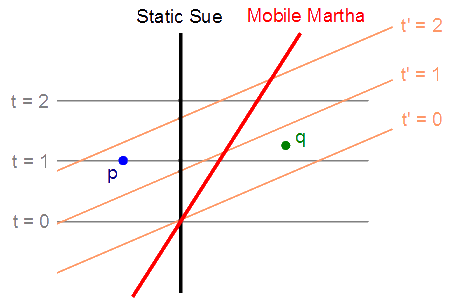
Here is an spacetime diagram of two frames of reference, one in which “Static Sue” is at rest, and the other in which “Mobile Martha” is at rest (despite their names, there’s no actual objective fact about which one of them is moving):

Here the vertical axis is time and the horizontal axis is one of the dimensions of space.  The horizontal grey lines indicate Sue’s notion of simultaneity, and the diagonal peach lines represent Martha’s notion of simultaneity.  Their relative velocity is about half the speed of light, which would travel at approximately 45° had I drawn any light in this picture (I chose not to draw any light because, sadly, both ladies are blind).  Sue and Martha’s reference frames do not agree about which of the two events \(p\) or \(q\) occurred first.

In particular, as long as two points \(p\) and \(q\) are spacelike separated, by acting with this symmetry you can always choose for their time coordinates to have any of the 3 temporal relations: \(t(p) > t(q)\), \(t(p) = t(q)\), or \(t(p) < t(q)\).  Since nothing can travel faster than light, no causal signals can go between the points \(p\) or \(q\) anyway, so the order doesn’t really matter.

(Nor can we say that if \(p\) exists, everything spacelike separated to \(q\) exists simultaneously.  For “simultaneous” is supposed to be a transitive relation.  If \(p\) is simultaneous with \(q\), and \(q\) is simultaneous with \(r\), then \(p\) and \(r\) should also coexist simultaneously.  But in Special Relativity every pair of spacetime points share a common point they are both spacelike to.  This idea would thus make all spacetime points simultaneous.)

And yet, for some reason, in the very same 20th century in which Physics got rid of the idea of the Present moment, some revisionist theologians decided to propose a more limited, anthropomorphic deity who changes with time, or who doesn’t know the future.  Either because they wrongly believe divine foreknowledge conflicts with free will, or because they believe that the Bible teaches this, or because they subscribe to more radical process theology ideas…

But if:

1) God is omnipresent (so he does not pick out a particular point in space), and
2) The Lorentz boost is a valid symmetry of reality, then inevitably:
3) God is omnitemporal.

There are only a few possible rebuttals.  One is to hope that relativity turns out to be wrong in this respect.  There are a few very speculative quantum gravity ideas about this (e.g. Hořava gravity), but none of them are extremely promising.

A second is to say that God just breaks this symmetry, he “picks out a particular reference frame” and that’s just that.  Well, in addition to being ugly to theoretical physicists such as me, it seems bizarre that God, who transcends the universe and created it, would need to break a law of nature of that he created just in order to relate to the universe.  (It’s not like not we’re talking about a miracle here, we’re just talking about the way in which God coexists with the universe at every moment.) God relates to the universe by creating it as it is, and by knowing it as it is—which means that there should be no reason to break any symmetries in describing how God relates to the universe, if our best model of how the universe is preserves those symmetries.

A third approach might be to bite the bullet and say that God exists in space as well as time.  Maybe there is one version of God (or should I say “a god”?) existing at each spacetime point, and each god knows only the things in the past lightcone of that point.  So God can’t send signals faster than light or know what’s going on in the Andromeda Galaxy right now (for any reference frame’s definition of “right now”).  But what a needless limitation!  I could throw out a prooftext here, but I’m supposed to be saving the Scriptures for the next post.  Instead I will confine myself to pointing out that this view has serious issues concerning the divine unity as well as omniscience and omnipotence.  Is it really necessary for the Blessed Creator to chop himself up into pieces, just in order to create the spacetime continuum?  This seems to tend more towards a Pantheistic view in which the God creates the universe out of his body, then a Monotheistic view in which he creates freely like a novelist inventing a story.

One reader (who subscribes to the “Open Theism” view that God does not know the future) suggests that perhaps God exists in all reference frames.  But this makes no sense to me.  We cannot say that God exists in all reference frames simultaneously, since we need to first pick a reference frame to say what we mean by simultaneous!  Indeed, this view does not really give a well defined answer to the question of what knowledge God has access to at any given moment.  If I, sitting in a particular place and time, pray to God to intervene at some other point, which is spacelike separated to me, can he base his answer on things taking place in the Andromeda Galaxy, or not?  This model would imply that there are infinitely many versions of God at a single spacetime point, each with different knowledge and powers.  That’s even more complicated than the previous supposal.  Which version of God gets to decide what happens at that point, and why can’t they just all communicate with each other?  This view seems more problematic than any of the others.

So, to conclude, Special Relativity seems to strongly suggest that if God has no definite position in Space, he must also not be in Time.  Now we have Spacetime, and we ought to be able to translate what we say about God into that language somehow, unless we think that our theological expressions should be immune to progress in the Sciences.  But here it is traditional theology, not revisionist modern theology, which fits the data better.

(Although this raises certain questions about other theological entities, such as angels or heaven, which are often conceived of as being in time, but not space.  Or at least not in our space… but of course we don’t really know much about what these entities are really like.  Although God transcends all understanding, in certain respects we know a lot less about these created entities than we know about God, because (a) there are no metaphysical arguments that they have to exist, and (b) we interact with them less frequently.)

I’ve decided to save General Relativity and other physics considerations for another post.

Next: General Relativity

God and Time I: Metaphysics

I’ve been asked to write about the relationship between God and Time.  I believe that God is not a part of Time, that he is eternal and unchanging, and that therefore he knows (what we consider to be) past, the present, and the future equally.  I believe that there are good reasons to believe this coming from 3 different fields of study: 1) metaphysics, 2) physics, and 3) biblical theology.

(Of course, it is also true that the Son of God

came down from heaven and was incarnate by the Holy Spirit and of the Virgin Mary, and was made man.  He was crucified for us under Pontius Pilate, suffered [παθόντα, which can also mean “was passively acted upon”] and was buried.  On the third day…

In other words, he united himself to a human being who was, like us, part of the flow of time.  In this sense, God is in Time, but to allow this to be truly and properly a life-giving paradox, we need to assert that it was the Eternal and Immortal who suffered and died for us.  The more we anthropomorphize the divine nature, the less significant is the Incarnation.)

In order to address this question, we need to know two things: what is Time and who is God?  To some extent we can begin to explore the metaphysics of Time without discussing who God is, although eventually we must place every created thing in the context of the One who created it.

So let’s start with Time.  There are two main views on this, which are rather boringly called the A-theory and the B-theory (although there are variants I won’t consider).  This is, as far as I can tell, due to a 1908 article by the philosopher John McTaggart arguing for the Unreality of Time.  McTaggart was basically a Hegelian mystic and yet, despite the later backlash against Hegel in the subsequent era of Logical Positivism, this paper has became one of the foundational articles for contemporary Analytic Philosophy!

(Recently I’ve been reading the records of the Oxford Socratic Club, a club for debate between Christians and Atheists/Agnostics, of which St. Lewis was President, whose Digest has recently become available from Lulu thanks to St. Joel Heck.  The talks were given around the time of WWII, which was a particularly interesting time for Philosophy since it was during the overlap period when both Idealism and Logical Positivism were taken seriously.)

Anyway, the A-theory (a.k.a presentism) claims that time flows from the past to the future, in such a way that neither the past and future really exist, but only the present moment is real.  However, the past was real and the future will be real, since time is really flowing from past to future.

The B-theory (a.k.a. eternalism) claims that all times (past, present, and future) exist equally, and that the word “present” is like the word “here”, an index to refer to the location of the speaker within the timestream.  Thus, there is no objective fact about which time is really “present”, any more than there is an objective fact about whether “here” is located in the USA or Australia.

One of my commenters explained the difference in this way:

The first is called the A-theory, or tensed time. Only the present is real; the past and future do not exist. The second is called the B-theory, tenseless time, the block view of timespace, or Minkowski or Minkowskian spacetime. All of time—past, present, and future—is complete and actual in this view. In some unperceived way, all of time is occurring now.

I mostly agree with this statement (although I’m not sure what “complete” means) but take issue with the last sentence.  The B-theorist would not say that all of time is literally now anymore than we would say that all places are here.  The past indeed exists, but does not exist “in the present” because for an A-theorist that means “at the same time as the speaker is located.”

Really what that last sentence does is explain the B-theory view in terms of the A-theory view.  According to the A-theory view, only the Present moment is real.  Saying “all times exist now” is really shorthand for “The B-theorist ascribes to the Past and Future the same type of reality which the A-theorist only ascribes to the Present.”

Can we return the compliment and describe the A-theory in terms of the B-theory?  Actually we cannot.  If all you have are B-theory ideas, there is no way to make the A-theory clear.  If an A theorist says that the past does not yet exist, the B-theorist will translate “does not yet exist” to “exists at a moment \(t_1\) previous to the current moment \(t_2\)”, and if he says that the future is going to exist, she translates this to mean just that the future is in the future!

In this sense the A-theory contains a vicious circle in it, as pointed out by McTaggart (although I don’t agree with his conclusion that time is therefore “unreal”).  When we say that a physical object is changing or flowing, this means that it changes with respect to time, that if we plotted it out on a graph, there would be a physical parameter \(x\) such that the time derivative is nonzero: \(dx / dt \ne 0\).  When we say that time itself is flowing, either we mean \(dt / dt = 1\) (time goes at one second per second) which is a trivial calculus tautology which says nothing, or we mean that it is flowing with respect to some other meta-time coordinate.  But that’s absurd, if we can only explain time with respect to a deeper time.  (And if that deeper time “really flows” we will need a 3rd timestream to parametrize that, and so on.)

It’s like those time travel stories where somebody goes back and changes the past.  But if you think about it, that’s a crazy contradiction.  Time just is the way we parametrize change.  The moments of time cannot themselves change or flow in the same way that things change or flow, since there is no other timestream to parametrize their change.  (Well, maybe in science fiction there is, but in the real world there’s no reason to postulate this.)

We can put it another way.  The A-theorist maintains that the past and future do not exist.  But if this is true, it is impossible to distinguish it from a radical presentism in which one maintains that only the present moment will ever exist.  Suppose that right now (e.g. 9:18 pm March 2, 2015) is the only instant that will ever exist.  The past is just a delusion of our memory, and the future is a just delusion of anticipation.  None of it is real.  Clearly an absurd form of skepticism.  But really, the A-theory implies this.  For it says that the future exists only in the future and that the past exists only in the past and that both of these are forms of nonexistence.  So the future does not really exist, and neither does the past.  No amount of protesting about the fact that the future is going to exist or the past having existed implies anything about it actually ever existing, unless you secretly smuggle in the B-theory view that these modalities refer to ways of existing.

One might worry, though, that the B-theory is radically foreign to our own experiences.  Whatever we say philosophically, isn’t it obvious if we inspect our own conscious experiences that it feels as if time is ever flowing and changing?  Each moment is so slight that we hardly grasp it before the next is upon us.

I admit that this worry has some psychological tug on me, but in the end I don’t think it implies the A-theory.  After all, it also feels as if my own experiences are more real than the experiences of others, and that here (wherever I am) is more real than there (wherever I am not) but these things I am happy to discount as illusions, without incorporating them into my metaphysics.  Furthermore, my brain cannot really detect a single instant: it takes a second or two for me to consciously process my sensory data.  Thus what I experience as now is always really a moment that has a finite amount of thickness in time.  If only the a single instant existed at once, that sliver would actually be too small for any conscious experiences to fit inside of it.  But if more than one instant can exist, it is simplest to say that they all exist, but that my self simply does not experience them all together in one lump.

Thus I conclude that only the B view makes logical sense.  Some might say that this means Time is an illusion; but I would instead say I am asserting that all of Time is real.

Now if God is omniscient, then he experiences everything as it actually is.  But we have seen that the idea that time itself “flows” and “changes” (as opposed to saying that things change with respect to time), makes no sense.  If the B-theory is correct, then God must experience it as being correct, that is he must himself be eternal and unchanging.

But this is also what we would conclude if we instead started with the nature of God as understood by classical theism.  Here, you will recall, God is conceived of as the fundamental being whose existence is explains everything else.  As I argued before, the fundamental reality, however we conceive of it, must be eternal:

If the fundamental entities are necessary, then it stands to reason that they are also eternal, since something that exists necessarily cannot come into being, or cease to be, or indeed change in any way.  They must just exist timelessly.  Besides which, if they explain what happens at all moments of time, it doesn’t seem plausible that they should only exist for certain moments of time.  For similar reasons, one can argue that the fundamental entities can’t be limited to just one region of space.  Their influence must be present everywhere.

For God to be in Time, would mean that there is a part of God which changes and develops and changes, even if it is only the part that observes “what time is it right now”.  But that would mean that God is actually divided into pieces, some of which (the past versions of God) help to explain others (the future versions of God).  This is inconsistent with the unity and eternity which befits the divine nature, which is fully real and cannot pass away like shifting shadows.

This is why proponents of Classical Theism have generally maintained that Time, rather than being some Metaphysical Ultimate, is actually part of created reality.  It exists contingently as part of the physical world, because God created it.  This view was developed by Philo, St. Augustine and others, but in the next post two posts we shall see that it is also supported by modern physics: especially Einstein’s theories of Relativity.  Then in the third last post posts I will argue that the view that God is eternal and unchanging is also to be found in the Bible.

Next: Special Relativity

Chalcedon

A reader writes in with the following questions concerning the Incarnation:

1. Since Jesus was a Jew (born of a Jewish mother, Mary), and Jesus Christ is one of the 3 persons of the Trinity, is God a Jew? But God is spirit. I am not sure if there is a difference between the Son (before creation) and the Son who later took human form in a Jew named Jesus. In other words, the Son was eternal (part of the Trinity) but Jesus was not. The Son – who is neither male nor female but spirit being God – became flesh, a Jewish rabbi.

2. In Matthew 24:36 Jesus says: “But of that day and hour no one knows, not even the angels of heaven, but My Father only.” Why wouldn’t the Son know if he’s an equal person in the Trinity? Again, I’m tempted to think this is Jesus the man who is speaking, and not God the Son (who must know when he would return, or else is not omniscient).

I do realise the Trinity is ultimately a mystery in the Christian faith, but I’d like to hear what you think about these two questions. Aside from these questions, I have no problem with the Christian understanding of a personal God in the life of Jesus..

You’re in good company. This is actually the exact question of Christology which started being controversial in the 400’s, the century following the adoption of the Nicene creed by the Councils of Nicea and Constantinope (known as the 1st and 2nd Ecumenical Councils). Once it was settled that Christ is God (contrary to the heretical teaching of Arius), the next question to work out is the relationship between the divine and the human in Christ.

Catholic, Orthodox, and Protestant Christians are all agreed about the answer, which is that Christ has two different natures (divine and human) but these natures are united in one person and one being, the Christ.

The controversy started as a result of Nestorius, who claimed that there were two separate persons in Christ, a divine person united to a human person.  He was unwilling to say that Mary was the Theotokos (God-bearer) but preferred the term (Christ-bearer). This was condemned as heretical by the Third Ecumenical Council of Ephesus.  Nestorius went over to the Assyrian Church of the East (which exists to this day and is neither Catholic nor Protestant nor Orthodox).

Then later there were the Monophysites/Miaphysites who said that Christ had just one nature, which was both human and divine. This was condemned at the Fourth Ecumenical Council of Chalcedon [pronounced with a hard “Ch”, like “Christ”] in the year 451 AD.  However, the Coptic Church and others didn’t agree with this, and so there was a schism between them and the (not-yet-divided) Catholic/Orthodox church, which exists down to the present day.

In retrospect, it is not so clear that these other groups were quite so heretical as they were made out to be.  Unlike the controversy with the Arians, it is a bit hard to be sure when the two groups actually disagree, and when they were just using different language for the same thing. But I believe that the Chalcedonian language is, at the very least, the most clear and accurate way to describe the union of the divine and human natures in Christ.

The complete Chalcedonian Formula is as follows:

“Therefore, following the holy fathers, we all with one accord teach men to acknowledge one and the same Son, our Lord Jesus Christ, at once complete in Godhead and complete in manhood, truly God and truly man, consisting also of a reasonable soul and body; of one substance with the Father as regards his Godhead, and at the same time of one substance with us as regards his manhood; like us in all respects, apart from sin; as regards his Godhead, begotten of the Father before the ages, but yet as regards his manhood begotten, for us men and for our salvation, of Mary the Virgin, the God-bearer [Theotokos]; one and the same Christ, Son, Lord, Only-begotten, recognized in two natures, without confusion, without change, without division, without separation; the distinction of natures being in no way annulled by the union, but rather the characteristics of each nature being preserved and coming together to form one person and subsistence, not as parted or separated into two persons, but one and the same Son and Only-begotten God the Word, Lord Jesus Christ; even as the prophets from earliest times spoke of him, and our Lord Jesus Christ himself taught us, and the creed of the fathers has handed down to us.”

Applying this to your question, we see that Jesus possessed BOTH the attributes of divinity (eternal, omniscient, sexless, etc.) and the attributes of (a particular) human nature (Jewish, born of Mary, male, limited, etc.), but without sin, having a complete human body and soul. Since the divine nature is eternal, immutable and cannot change, we cannot say that God was transformed into a human being, but must instead say that he assumed or took on human flesh.  “Not by conversion of the Godhead into flesh; but by assumption of the Manhood by God”, says the (so-called) Athanasian Creed.

However, there is just one person—the divine Son of God, Second Person of the Trinity—who is and does both of these sets of things.  (Without this, the Atonement wouldn’t work, because in order to be saved we need for God to have fully shared in our human afflictions.) As a result, it is also correct to say that God was Jewish, and that he suffered and died on the Cross, or that Mary was the Mother of God, or (going in the other direction) that the human being Jesus pre-existed, was begotten by the Father before time began, and that through him all things were made; so long as we remember that that we are speaking of the experiences of the united person who has both natures, and not attributing properties of one nature to the other nature.  This way of speaking is called communicatio idiomatum, i.e. the “communication of attributes”, and you can find articles by both Catholics and Protestants online, explaining it.

Your second question was about Christ’s knowledge.  The divine nature of God the Son is omniscient and eternal, and therefore the divine nature of Christ must know when he will return.  However, his human nature started out ignorant and could learn things, as we know from Luke 2:52: “Jesus grew in wisdom and stature”, and also from Hebrews, when it says that Jesus was made like us in every way (sin excepted).  But we cannot divide the human and divine natures, so it is also true that “God the Son”, the divine person, experienced what it is like to possess human ignorance.

Thus God the Son could both know and not know the same thing at the same time.  How is this possible?  I think it helps to remember that any time we know something, we know it in a particular way. For example, you can know something intuitively but not logically, or vice versa, or both ways simultaneously.  The divine nature knows things by being the perfect being; the human nature knows things by forming neural connections in the brain that somehow represent or imitate the behavior of the things we know.  Jesus did both.

One analogy I find a bit useful is that of roleplaying where you pretend to be a character in a fictional universe.  It is possible for a situation to arise when the person playing the game knows something the character doesn’t know.  But now imagine that the universe the character lives in is real, not pretend and that you experience fully everything the character experiences (including what it feels like to be ignorant).  That would be a little like what happened with the Incarnation, I guess.

The Trinity and the Incarnation are great mysteries, so our language and analogies must necessarily break down in certain ways. But that doesn’t mean we can’t make an effort to make our language as un-misleading as possible.

Did the Universe Begin? X: Recapitulation

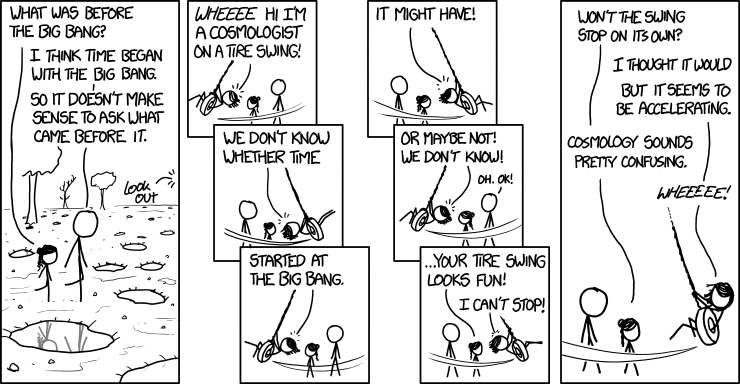
from http://www.xkcd.com/1352/.

We have now come to the end of my series about whether or not the universe had a beginning.  This is part of a longer series dissecting the debate between St. William Lane Craig and Sean Carroll.  I started out with some general reflections on the debate:

Thoughts on the Carroll-Craig Debate
God of the Gaps
  (see also: Gaps at the Dinner Table)

Then I started talking specifically about possible evidence from physics for and against the universe having a beginning.  For ease of understanding I’m going to label each main new argument with FOR or AGAINST to define its main orientation, but the posts also deal with the various counterarguments (that’s the tire swing going back and forth above…). I’ve provided an executive summary of each of these posts, so that you can easily see the main thrust of what I said.  Minus all the caveats, hedging, and detailed explanations my scientific training tends to encourage.

(I’ve heard that politicians hate talking to scientists because, like the Elves in Tolkien, we seldom give a straight answer to a question.  In scientific cultures, we show “sincerity” by discussing all the problems and caveats with our ideas, whereas in political circles this sounds like insincere waffling designed to please too many people…)

Did the Universe Begin? I: Big Bang Cosmology (FOR, as far as it goes…)
– the classical Big Bang Model predicts an initial singularity where time began
– tentative because quantum effects were important and invalidate our usual geometrical notions
– also tentative because we don’t really know how inflation began

Did the Universe Begin? II: Singularity Theorems (FOR)
– classical General Relativity theorems by Hawking and Penrose
– assumptions of Hawking theorem invalid during inflationary epoch
– Penrose theorem says that if space is infinite, there was a beginning
– Penrose theorem invalid in quantum situations, but my work suggests that it might be extendable to quantum gravity, if horizons always obey the 2nd law of thermodynamics.

Did the Universe Begin? III: BGV Theorem (FOR)
– if the universe has a positive average expansion, then “nearly all” geodesics cannot be extended infinitely to the past
– implies that inflation had to have a beginning in time, at least in some places
– can evade theorem by a “bouncing” cosmology where the universe contracts and then expands

Did the Universe Begin? IV: Quantum Eternity Theorem (AGAINST)
– if the usual rules of QM hold at all times, you can calculate what the state would be at any time to the past or future.
– in realistic cosmologies the energy is probably either zero or undefined, making the theorem inapplicable.

Did the Universe Begin? V: The Ordinary Second Law (FOR)
– given reasonable assumptions, 2nd law of thermodynamics requires a beginning
– most plausible way to evade this is to postulate that the “arrow of time” reverses
– such models would have a “thermodynamic beginning” but no “geometrical beginning”

Did the Universe Begin? VI: The Generalized Second Law (FOR)
– second law of thermodynamics also seems to apply to cosmological horizons
– can be used like ordinary 2nd law to argue for beginning
– can also be used as singularity theorem (see II above)
– this closes certain loopholes, but if the universe is finite and the arrow of time reverses, a bounce may still be possible.

Did the Universe Begin? VII: More about Zero Energy
– a more technical explanation of why the energy of the universe can be zero

Did the Universe Begin? VIII: The No Boundary Proposal (AGAINST/FOR)
– a beautiful set of speculative ideas which unify the “laws of physics” with the “initial conditions”, by providing a rule for what the state of the universe is.
– contrary to popular conceptions, the Hartle-Hawking proposal has no beginning in time
– the Vilenkin tunnelling proposal is similar in spirit but does have a beginning.
– unclear whether these proposals are well defined, and Hartle-Hawking appears to give wrong predictions.

Did the Universe Begin? IX: More about Imaginary Time
– a more technical explanation about the notion of imaginary time used by Hartle-Hawking

If you put all of the physics information together, the conclusion I would draw is that: We don’t know for sure whether the Universe began, but to the extent that our present-day knowledge is an indicator, it probably did.  However, as Carroll correctly says, we can also construct models where it doesn’t have a beginning.  Taking into account known results from geometry and thermodynamics, the most plausible such models are 1) spatially finite, and 2) have a reversal of the arrow of time (e.g. the Aguirre-Gratton model).

I also noted that models like AG still have a low entropy “initial condition” somewhere in the middle of time.  One might think that this type of “thermodynamic beginning” still calls out for some type of explanation.

Then I wrote a more theologically-oriented post about whether the Hartle-Hawking no boundary proposal leaves any room for God to have created the universe:
Fuzzing into Existence
– short answer: yes, if you think of God as a storyteller, not a mechanic.

I also discussed the possibility of Reparameterizing Time; is it even meaningful to ask whether time is infinite or finite when you can change coordinate systems?  In this post I also argued that the main theological question of whether the universe needs an explanation seems to me much the same whether the universe has finite or infinite time.

Now, let me make another observation about the tire swing.  Although the weight of the evidence is that the universe probably had some sort of beginning—and even more likely that there was some sort of low entropy “initial condition” even if geometrically time stretches past before that—this cannot be said to be certain.  There is always the possibility that new scientific data or methods could radically change our picture of the very, very early universe.  Similarly, while a finite past seems more in accordance with traditional Christian theology than an infinite past, there appears to be no strictly logical connection between the two ideas, once the act of Creation is viewed in a more timeless, “authorial” way.  Thus one might conceivably have a theist who thinks time is infinite, or an atheist who thinks time was finite.

Should the argument for God’s existence really rest on such a slender foundation as the ultimate decision of physicists about Big Bang Cosmology?  Well, one thing is clear.  In ages past it didn’t depend on it.  Obviously, Sts. Abraham and Sarah, David and Solomon, the prophets and apostles, and all the men and women who followed in their footsteps up through the 19th century, including eminent scientists such as St. Faraday and St. Maxwell: these cannot have believed in God because of the Big Bang Theory, because—guess what?—nobody knew about it yet!  What does the Bible say about these people?

Now faith is confidence in what we hope for and assurance about what we do not see.  This is what the ancients were commended for.  By faith we understand that the universe was formed at the word of God, so that what is seen was not made out of what was visible.  (Hebrews 11:1-3)

Our belief that God is the Creator does not depend on the vicissitudes of scientific progress, the swinging back and forth of the tire swing (or is it accelerating?)  It doesn’t matter, because in this case we have a more certain source of knowledge than Science.

By faith!  The skeptic may scoff here, and say that faith is belief without evidence, but that is not the definition used in the passage above.  It says that faith is confidence about what we hope for, but do not see.  Unless we identify sight (conceived broadly as anything which can be directly experienced in terms of our 5+ senses) with evidence (things which allow us to conclude something about the world)—an identification which would incidentally also make Science impossible—the passage does not say that the ancients were commended for believing without evidence.  But the example of the biblical heroes does give some pointers about what type of evidence was relevant to them.

The ancients did not believe that God was the Creator because they had a detailed scientific theory about where it comes from.  (Indeed, if we take our minds off Genesis for a moment and read the Wisdom literature of the Bible: Job and Psalms and Ecclesiastes and Proverbs, the Scriptures seem to emphasize more our lack of knowledge about the details of creation, then any detailed programme of events…)  On the contrary, the ancient Jews and Christians knew God, by personal acquaintance as it were, and therefore knew him to be creative and powerful, mighty in word and deed.  Thus they could take him at his word that he is the Creator of all that we see.

The glory of Creation does indeed point to the glory of the Creator, so that it is possible for ordinary human reasoners to come to know that there is a Creator intellectually.  But this sort of Theism, by itself, isn’t what Christians mean by faith.  Once we come to know God personally, we learn the more important fact that we can trust him, and know with confidence that there is nothing in existence which does not depend on him.

And therefore, although we see in this world visible things emerging from other visible, material things, we know that ultimately their origin comes from “God’s invisible qualities—his eternal power and divine nature” (Rom 1:20).  He created everything through his Word, Jesus Christ, from whom we have come to know what God is like.  This way of knowing does not seem to depend very strongly on the details of past, present, or future scientific knowledge.

One could definitely argue that the Bible teaches that there was a Beginning (whatever this means from God’s perspective).  For example, the quotation above from Hebrews speaks of the formation of the visible universe.  But whether or not this fact has been revealed by God, it is not obvious to me that the most important theological aspects of Creation really depend essentially on time being finite, or even well-defined.  (Admittedly, if you believe that time is infinite, it might be easier to slip into a false notion whereby matter exists independently of God, who is merely the Chief Organizer of the cosmos.  That would be a heresy—a false belief which may seriously obstruct your ability to relate to God or others properly—but it does not follow necessarily from time being infinite.)

The main point of the doctrine of Creation, I think, is that God is real, and that everything else is derived from his power and will.  We know this doctrine is true because we know God.  Not because of the Big Bang, as natural as it is to connect the two ideas.