Category Archives: Theological Method

Construct your own Cosmological Argument

First read this piece by St. Feser:
So you think you understand the Cosmological Argument?

about the traditional structure of Cosmological Arguments, rebutting several popular misconceptions.

Now take the following argument scheme, making suitable choices as needed:

  1. (Major Premise) Every [thing/event] with property X needs a [cause/explanation/reason] outside of itself to [cause/explain/be the reason of it]
    .
  2. (Minor Premise) There is at least one [thing/event] with property X.
    .
  3. (Inductive Principle) You have a choice…
    A.  argue that an infinite regress of [causes/explanations/reasons] for the X’s is unreasonable, OR
    B. argue that such an infinite causal chain would itself have property X, OR
    C.  argue that the entire set of X’s taken together (which might, depending on X, include the entire physical universe we know and love) has property X.
    .
  4. (Conclusion) Tracing back the [causes/explanations/reasons] back to their ultimate origin, we find that there is [one/at least one] thing which does not have property X, which, taken [singly/together], [causes/explains/gives the reason for] all the things which do have property X.
    .
  5. (Atheist Baiting) Add the famous words: “And this all men call God”.  Works best if ~X is a traditional divine attribute, or even better if you can collect several such ~X’s and can argue that they all refer to one and the same Exalted Being!

For example, in the debate, St. Craig’s kalam argument used “comes into existence” as X, and then used a lumping strategy (3C) to talk about the universe as a whole and ask whether it had a cause.  This form of the Cosmological Argument ended up being strongly dependent on what the Science of the Big Bang actually shows, but most forms don’t really depend that strongly on Science.

Other traditional X’s include “changing with time”, “contingent” (something that might or might not exist), “composite”, and some other possibilities mentioned in the link above.   The idea is that there are some features of objects which make us seek out causes for them, for example if an object is composed of several disparate objects, we naturally want to know what brought them together.  Depending on what you pick for X, the Cosmological Argument may be more or less plausible.

You will also want to consider what type of causal concept you want to include in your argument.  A key question is how we know there is such a thing as causation?  If it is primarily for empirical reasons, then presumably we know about it through some type of inductive* argument from experience, in which case we could wonder how applicable it will be in unusual situations.  On the other hand, if it is primarily motivated by reason, through analyzing what types of explanations would make sense of the universe, it may be less dependent on observation.  Or perhaps the truth is somewhere in the middle.

[* Footnote: I somewhat regret using the term “inductive” here, given my previous usage of “Inductive Premise” to label premise 3.  In both cases one is moving from specific applications to more general applications, but for premise 3 I had in mind something closer to mathematical induction, a step which (given the right background premises) is logically necessary, whereas in the paragraph directly above, I am referring to something more like scientific induction, where if you observe something happening enough times you guess that maybe it always happens that way.]

Another thing to figure out is what types of entities are connected by cause-effect relationships.  Does a cause have to determine the effect with certainty, or is it sufficient if it in some way produces it?  For example, if we want to argue that all contingent things were caused by something which is necessary, this is a contradiction in terms unless a necessary thing can produce contingent things, i.e. if causes don’t have to be deterministic.  A related question: when we talk about causes, are we primarily talking about beings causing things to happen (a.k.a. agent-causation), or states of affairs causing things to happen (a.k.a. event-causation), or both?

Regarding step (5), note that excessively glib atheist baiting obscures the fact that nearly everyone should accept some type of Cosmological Argument, even if they don’t necessarily take it to a Theistic conclusion!  If you are going to talk about causes/explanations/reasons AT ALL (and I really don’t see how to avoid this) then you really need an account concerning the domain to which the concept is applicable.  And then it is an interesting fact, that either you must accept infinite or circular chains of [causation/explanation/reasons] or you end up going outside the domain to something else which is different.

This type of reasoning should be interesting, even if you are an atheist.  The trouble is, if people only encounter Cosmological Arguments in the context of Theism, then Atheists adopt an argumentative approach where they just feel the need to poke a few holes in the arguments and then retreat to where they were before.  This doesn’t do justice to the fact that there are numerous X’s for which the argument’s premises are at least plausible, even for people who don’t start out committed to any particular religious doctrine.

For example, Carroll himself gives an account of the scope of causation when he says:

Why should we expect that there are causes or explanations or a reason why in the universe in which we live? It’s because the physical world inside of which we’re embedded has two important features. There are unbreakable patterns, laws of physics—things don’t just happen, they obey the laws—and there is an arrow of time stretching from the past to the future. The entropy was lower in the past and increases towards the future. Therefore, when you find some event or state of affairs B today, we can very often trace it back in time to one or a couple of possible predecessor events that we therefore call the cause of that, which leads to B according to the laws of physics. But crucially, both of these features of the universe that allow us to speak the language of causes and effects are completely absent when we talk about the universe as a whole. We don’t think that our universe is part of a bigger ensemble that obeys laws. Even if it’s part of the multiverse, the multiverse is not part of a bigger ensemble that obeys laws. Therefore, nothing gives us the right to demand some kind of external cause.

There seem to be some question-begging moves in this paragraph, but leave that aside.  My point is that Carroll gives a positive account of when he thinks makes the notion of [cause/explanations] make sense.  He endorses a version of (1) whereby the concept of causation makes sense if (a) there are laws of nature, understood as unbreakable regularities, and (b) there is a thermodynamical arrow of time whereby entropy increases, making a distinction between the past and the future.  (Since causes normally precede effects, but the laws of physics don’t strongly distinguish between the two directions of time except through thermodynamics, it seems clear that the arrow of time has to play some role in distinguishing causes from effects in physics.)

He also allows (2) that this concept—though not fundamental in his opinion—nevertheless makes sense for certain particular cases.

Then for (3) he allows us to lump together the universe taken as a whole, but claims that this whole does not meet his criterion (1).  He thus comes to an object—the whole universe, apparently—for which, in his view, it wouldn’t make sense for it to have a cause (4), although he does not identify it with God (5).  Thus his reasoning has an implicit atheist version of the Cosmological Argument behind it.  Though one can certainly question whether the metaphysical assumptions behind this claim are right.

But it’s just possible you came here hoping, not to construct your own Cosmological Argument, nor to deconstruct Carroll’s, but instead to find out what I think about it, something which you may think I have postponed saying for quite long enough.  Well, it just so happens that I’ve written a 16,000 word essay on the Cosmological Argument and related topics, and will be posting it in installments over the course of the next few weeks.

Explanation needed

I’ve been discussing Sean Carroll’s claim that:

The demand for more than a complete and consistent model that fits the data is a relic of a pre-scientific view of the world. My claim is that if you had a perfect cosmological model that accounted for the data you would go home and declare yourself having been victorious.

In my last post, Models and Metaphysics, I tried to argue that there are substantive philosophical questions about causality which Carroll is dismissing unduly as pre-scientific.

But in this post, I thought I’d give a concrete example of a situation where we would not declare victory and go home, even with a complete and consistent model of the universe.  While at some point fairly soon I’d like to give my own take on the Cosmological Argument, my counterexample in this post isn’t going to depend on any seriously heavy-duty metaphysics.  Instead I’d like to try to focus on something fairly quantitative and precise, something  “rational almost to the verge of rationalism“, in short, an argument that even someone steeped in scientism could love.

Let’s imagine that in the future, we come up with a seeming Theory of Everything™ which explains almost everything about the world.  Every single physical phenomenon which has ever been observed has now been explained by a simple equation.  Let us stipulate that the initial state of the universe is itself determined by these equations, leading to a cosmology consistent with what we observe.  If you like, we can also pretend that no supernatural events have ever been verified, and that (after the Great Riot of 2438 C.E., when all the metaphysicians and philosophers were confined to the tops of their Ivory Towers and forbidden to communicate with the ordinary citizens outside) we have all agreed not to inquire to closely into the question of why certain physical states of the brain correspond to conscious experiences.  It is indeed a great triumph for the Scientific Method.

There’s one catch.  The remaining (non-meta)physicists tell us that there is one universal constant of nature in the theory, designated by a capital alpha \(A\), whose numerical value needs to be fixed before any predictions can be made.  This constant is dimensionless, meaning that all the units cancel out, so that it isn’t measured in meters per gram, or joule-seconds, or anything like that, but is just a real number.  For example, it might be the ratio of two things with the same units.  Because this constant \(A\) is dimensionless, it’s numerical value is independent of the choice of units used to measure this parameter.

(In real life there are currently about 26 or so dimensionless constants in the Standard Model plus General Relativity—not counting inflation or dark matter—the most famous of these constants being the fine structure constant, which is approximately \(1/137.036\ldots\).)

Since the equations work equally well no matter what the value of \(A\) is, we have no choice but to do experiments to see what its value is.  Let us suppose (rather unrealistically) that the scientists have measured this parameter to 800 decimal places, and that—lo and behold!—the answer is exactly$$A = \frac{2\pi}{7}.$$No one knows why, that’s just the way things are. 

(Note: this situation is different from the usual Fine-Tuning Argument, because I am not supposing that there is any reason why life requires the constant to take on this precise value.)

I submit to you that, notwithstanding the fact that this TOE™ gives a complete description of everything in the universe, we ought not to declare victory and go home.  Because it is plain as day that this number \(2\pi / 7\) requires some sort of explanation which has not yet been given.  In other words, we don’t just demand that our models completely explain the data.  We also demand that they be complete in the sense of providing explanations for anything which seems to require an explanation.

True, \(2\pi / 7\) is not an extremely complicated number; in most computer languages one can write a fairly short computer program that spits out this number.  But I didn’t become a physicist in order to compress my sense-data into as few bits of information as possible; WinZip does a better job of data compression than I ever could.  I became a physicist in order to understand how and why the world works the way that it does.

So I wouldn’t be completely satisfied with this TOE™ as it stands, even though it would be a big improvement on our current best theories of physics.  Instead I would start asking naïve questions like:

“Why is there a \(2\pi\) in the formula for \(A\), given that we all know that \(2\pi\) is the ratio between a circle’s circumference and its radius?  Where do circles come into it?”

and

“What’s so special about \(7\)?  Is this just a random whole number that was pulled out of a hat?!?  Why is the denominator even an integer at all?  What is \(7\)—a sufficiently awkward prime that it seldom comes up in physics formulae—doing in the most fundamental equation of the universe?”

Now I don’t know whether all of these mutterings about sevenths of circles would get me shoved up a Tower or not.  But I am convinced that this question would be meaningful, that it must have an answer, and that any red-blooded human being with basic curiosity about the world should hope to find the answer.

Or, to speak in Bayesian terms, nearly all of my prior probability would be placed on there is an explanation for this odd fact that I don’t know yet, and nearly none on this is just an inexplicable basic fact about the universe which has no explanation at all.  I’m not sure how to convey this intuition to you if you don’t already share it.  But it seems to me that basic inexplicable facts about the universe shouldn’t fall into patterns which seem to indicate the existence of a deeper layer of reality, unless there actually is a deeper layer of reality behind the shadows we see on the cave wall…

“What’s that? Yes officer, I was just headed for that Tower over there right now!  Please don’t let me trouble you any further.  No, I just stepped out for a moment.  Yes.  Look I’m heading back right now.  See?”

Of course, just because I would think that there must be an explanation, doesn’t mean that we would ever find out what that explanation is.  Life can be a bummer that way:

All this I have proved by wisdom.
I said, “I will be wise”;
But it was far from me.
As for that which is far off and exceedingly deep,
Who can find it out?
(Ecclesiastes 7:23-24)

I would be potentially open to any explanation involving either “natural” or “supernatural” elements, so long as it in fact explained the parameter.

Of course, if the explanation involved more ad hoc elements than the thing being explained, then that would raise questions about whether it was really the best or simplest explanation.  And even if I thought of a good explanation, I might wonder if there were some other equally good explanation. Or conversely, I might not be able to think of any good explanation at all.  So at the end of the day I might have to be an agnostic about what type of explanation should be considered.

But that wouldn’t change the fact that I’d think there’d be one.

Models and Metaphysics

In my previous posts about the Carroll-Craig debate, I’ve been skirting around the edges of an important claim by Carroll which summarizes the main reason he doesn’t buy the Cosmological Argument.  That’s because I was focusing on the question of whether the universe had a beginning.  Now I want to grapple with his more philosophical claim.

Carroll says this:

So, I think I can make these points basically by following Dr. Craig’s organization starting with the kalam cosmological argument, and unlike what he said I should be doing I want to challenge the first of the premises: If the universe began to exist it has a transcendent cause. The problem with this premise is that it is false. There’s almost no explanation or justification given for this premise in Dr. Craig’s presentation. But there’s a bigger problem with it, which is that it is not even false. The real problem is that these are not the right vocabulary words to be using when we discuss fundamental physics and cosmology. This kind of Aristotelian analysis of causation was cutting edge stuff 2,500 years ago. Today we know better. Our metaphysics must follow our physics. That’s what the word metaphysics means.

[Well, many scholars think that Aristotle’s book on causation/God was called Metaphysics because it was the book immediately following his Physics in the traditional order of the canon.  But perhaps Carroll knows this and is simply introducing his thesis in a joking way…]

And in modern physics, you open a quantum field theory textbook or a general relativity textbook, you will not find the words “transcendent cause” anywhere.  What you find are differential equations.

[Of course, because QFT and GR concern the interactions between various material entities (excitations of fields).  Their interactions (i.e. their causal relationships) are indeed described by differential equations.  And therefore the subject matter does not concern transcendental or ultimate causes, any more than economics or psychology textbooks discuss the weak force.  What he really ought to say to make his argument, is that the term “cause” does not appear in many modern physics textbooks (apart from the use to mean “logically implies”) due to its lack of usefulness in specifying the precise form of the laws of physics.

It is, however, a separate question whether concepts of causation are implicit in the fact that some particular differential equation holds.  It does not seem outrageous to state that the state of the fields at a given point are caused by the state of the fields just beforehand in the past lightcone; indeed this concept is called causality in contemporary physics.  This concept may indeed be different in some ways from traditional philosophical ideas of causality, but it is not sheerly different, and there is room for argument about the precise relationship between these ideas of causation.  Carroll continues:]

This reflects the fact that the way physics is known to work these days is in terms of patterns, unbreakable rules, laws of nature. Given the world at one point in time we will tell you what happens next. There is no need for any extra metaphysical baggage, like transcendent causes, on top of that. It’s precisely the wrong way to think about how the fundamental reality works. The question you should be asking is, “What is the best model of the universe that science can come up with?” By a model I mean a formal mathematical system that purports to match on to what we observe. So if you want to know whether something is possible in cosmology or physics you ask, “Can I build a model?” Can I build a model where the universe had a beginning but did not have a cause? The answer is yes. It’s been done. Thirty years ago, very famously, Stephen Hawking and Jim Hartle presented the no-boundary quantum cosmology model.

[See here for my discussion of the claim that the Hartle-Hawking model leaves no room for a Creator.]

The point about this model is not that it’s the right model, I don’t think that we’re anywhere near the right model yet. The point is that it’s completely self-contained. It is an entire history of the universe that does not rely on anything outside. It just is like that. The demand for more than a complete and consistent model that fits the data is a relic of a pre-scientific view of the world. My claim is that if you had a perfect cosmological model that accounted for the data you would go home and declare yourself having been victorious.

Carroll seems to be saying that the ability to construct a mathematically precise and consistent model of the universe is the only important criterion for the fundamental laws of physics, aside from fitting the data.  Presumably he would add something about simplicity if we were considering two rival models which both accounted for the same data, but I think he doesn’t mention that since his primary concern is saying what counts as a possible model according to the contemporary set of informal procedures that cosmologists use, rather than asking how we decide between models once we have them.

This is probably the most important claim that Carroll made during the debate.  I appreciate the fact that he was able to state his view in such a clear and accessible way.  Now, there is one important point in which I agree with Carroll, and one important way in which I disagree.

I agree that Modern Science has involved some shifts in how we think about causation in the physical universe.  This shift, which occurred sometime around the beginning of the 20th century (give or take a couple hundred years) involved a move away from mechanistic notions of causation, towards more abstract mathematical models.  As a characteristic example, in the 19th century it was presumed that light waves couldn’t exist unless they were supported by a medium, called the luminiferous aether.  When Einstein developed special relativity, he showed that no such aether was necessary.  If you can write down a satisfactory equation for the way the electromagnetic field propagates, there’s no need to ask questions like “In what medium does it propagate?”  (Of course, this philosophical point could have been made in the time of St. Maxwell as well, but it wouldn’t have been as compelling then, since before Einstein’s theory of relativity an aether was needed to preserve the principle of relativity).

Another example concerns normal forces of the sort that prevent two solid bodies from occupying the same space.  A premodern physicist would have said that solid bodies have a property of solidity or massiness which, using our everyday intuitions, prevents two bodies from occupying the same position.  In Lucretius’ atomic theory, the atoms were in solid shapes like billiard balls (but not necessarily round) which excluded each other due to their solidity.  Very different was St. Roger Joseph Boscovich‘s 1763 proposal that atoms are merely mathematical points exerting force on other mathematical points.

In modern physics, there’s nothing inherently wrong in general with two objects occupying the same position, since you can write down equations in which this is allowed.  The default, in the absence of interactions, is for two bodies to pass right through each other.  That this does not occur for real solid bodies is due to a combination of electromagnetic forces and the Pauli exclusion principle for electrons.†

So I agree with Carroll that there have been changes in our attitude to causality in Physics.  Now let’s see whether this should change our views about Metaphysics.  As a reminder, Metaphysics is the branch of philosophy which studies the fundamental nature and relationships between various beings (abstracting from the particular descriptions of the particular things as studied by more specialized fields like Physics or Biology).  It asks questions like these:

Do individual things have a particular essence or nature which does things? 
In what sense does causality exist, and if so what kinds are there? 

Is there really a physical universe?
Are there really minds?
Can everything be reduced to physics, or
can everything be reduced to mental properties, or are these two independent realities, or are they both dependent on something else?
In what sense do mathematical entites like “7” or “isoscoles triangles” exist?
In what sense does morality exist?

Does some type of God exist, and if so what is he/she/it like?
What are the relationships between these different types of existence?
 
Do the “holes” in doughnuts really exist, or are they merely the absence of doughnut?
Are the questions I just asked even meaningful, or are some of them silly word games?

(The subset of questions about what exists are also sometimes also called Ontology.  In case you’re wondering, analytic philosophers really do debate the one about holes.  Personally I consider the one about God to be more important.  But I figured that given my last question, I needed to include at least one question which I consider to be a silly word game…)

Now, these questions raise some difficult and contentious issues, and philosophers have been debating them for thousands of years.  But rather then tackle them head-on, let’s ask to what extent developments in Physics and other Sciences help answer these questions.

There are two opposite extreme approaches one might take:

1.  One is the view that our Metaphysics should essentially follow immediately from our Physics.  Once we learn from experiment what specific Laws of Physics are true, that tells us everything we need to know about Metaphysics.  People with this view tend to be scientistic and dismissive of philosophical arguments.  (You might think from the quotation above that this is Sean Carroll’s view, that once we work out the correct physical model there are no more interesting questions to ask.  But in fact his view is more subtle, since he acknowledges that there are interesting philosophical questions not obviously resolved by Science.)

2. The opposite extreme would be to say that developments in Physics have little or no bearing on Metaphysics.  For example, there are modern day followers of St. Thomas Aquinas (typically but not always Roman Catholics) who believe that something similar to Aristotle’s metaphysical views follow necessarily, given that the world is rationally explicable at all, and that the very possibility of doing Science depends implicitly on accepting them.  In this view, the basic concepts of metaphysical reality such as substance/accident or act/potency are written in stone, although identifying the particular “substances”‡ which actually exist, and their properties, depends on empirical Science.  One such philosopher is St. Ed Feser, whose blog is on my sidebar.  (I recently read his book Scholastic Metaphysics in which he presents his arguments for this position.  On a first pass, I found it serious and interesting but ultimately unconvincing, though giving my reasons would take this post too far afield.)

But it seems to me that the correct view is in the middle, that Physics has some bearing on Metaphysics but it doesn’t fully determine it.  Physical models and metaphysical views have, not a 1-to-1 relationship, or even a 1-to-many relationship, but a many-to-many relationship!

People who agree on the Laws of Physics (to the extent that we are able to discover them at present) can still have radical disagreements about Metaphysics.  Of these metaphysical views, some seem irrational and silly, like the Monadic view that all distinctions are illusory and that only one thing exists.  But it seems to me that there are several possible reasonable (i.e. non-crazy) views.  So even after we agree on a single physics model, multiple metaphysical views can be reasonable.  The variety of interpretations of Quantum Mechanics is one prominent example.  Choosing between these interpretations requires philosophical arguments; doing an experiment is not enough.

On the other hand, it seems rather unlikely that the philosophical considerations by themselves are sufficient to pin down an exact Metaphysics either.  That would be to say that every single view about the nature of Being, besides one, can be decisively refuted by philosophical arguments.  That would seem to me almost as surprising as a claim that the Laws of Physics can be deduced from pure Reason.  There are just too many possible sets of belief, and logical consistency plus noncraziness is too weak of a constraint.  (Especially since our notion of noncraziness needs to be flexible enough to include things like interpretations of QM and the mind-body problem, where nearly all views seem “crazy” in one way or another.)

Given that there are multiple possible views about Metaphysics, we need all the help we can get to choose one.  So it would be absurd not to rely on Physics to some extent, especially as it impinges on relevant questions.  How could anyone have an informed position on the nature of time without thinking about what General Relativity says about spacetime?  But we also need to recognize that Physics is not enough, and that abstract arguments about what “makes sense” are also called for.  Even together these are not sufficient to bring all reasonable Philosophers into agreement.

That means that Carroll is moving much too quickly when he says that “This kind of Aristotelian analysis of causation was cutting edge stuff 2,500 years ago. Today we know better. Our metaphysics must follow our physics.”

If there are multiple possible metaphysical views, then we can’t just dismiss the views of Aristotle (or whoever) just for being old, without carefully thinking about their compatibility with Modern Science.  Maybe people switched to modern views because of updates in physical knowledge (some of which, like Determinism, may themselves be out of date!).  Or maybe they changed because of philosophical arguments, in which case we need to check whether those arguments are good or bad.  Or maybe the old views simply became unfashionable.  Most likely, it was some combination of these four causes, and we need to be careful!  As St. Lewis writes concerning Owen Barfield:

In the first place he made short work of what I have called my “chronological snobbery”, the uncritical acceptance of the intellectual climate common to our age and the assumption that whatever has gone out of date is on that account discredited.  You must find out why it went out of date.  Was it ever refuted (and if so by whom, where, and how conclusively?) or did it merely die away as fashions do?  If the latter, this tells us nothing about its truth or falsehood.  From seeing this, one passes to the realization that our own age is also a “period”, and certainly has, like all ages, its characteristic illusions.  They are the likeliest to lurk in those widespread assumptions which are so ingrained in the age that no one dares to attack or feels necessary to defend them.

While I don’t accept St. Feser’s arguments that Aristotelianism is compulsory, I think that studying it is a useful antidote to thinking that there’s only one possible view.  Certain aspects of modern thought might be unreasonable inheritances from the Enlightenment, or from Positivism.  The easiest way to notice that we are making unnecessary presuppositions, is by comparison to what previous thinkers have thought.  If we dismiss previous metaphysical views out of hand, that makes it hard to notice our own modern blindness towards certain issues and problems.

We need to be especially careful given the tendency for theories to be expressed in the language of the existing philosophical structures.  This can cause us to think that those theories depend on a certain Metaphysics, when really they don’t.  Just because theologians expressed Trinitarian doctrines using Aristotelian terminology, or early 20th century physicists expressed QM using Positivist concepts, doesn’t necessarily mean that these ideas can’t be transplanted to certain other systems.

Aristotelianism became unpopular long before QM was discovered.  But suppose that somehow the medieval European or Muslim world had discovered QM.  I bet that their “interpretations” would have been radically different from anything we have now, even if the mathematics which they developed ultimately turned out to be equivalent to ours (as happened to Heisenberg and Schrödinger)!

None of what I have said here is a positive argument for Theism.  It is merely my attempt to sweep away Carroll’s strong claim that once we have a physical model, all of our work is done and there is no place to ask further metaphysical questions.  On the contrary, we can continue to ask questions, and we can judge possible answers to those questions by whether they make logical or intuitive sense to us.

Perhaps at the end of the day, a person might conclude that the certain questions about the origin of the Universe are meaningless, or that that they are meaningful but that Theism is not the correct answer to them.  But that has to come after considering the merits of different rival views, not beforehand.

Notes:
† The Pauli exclusion principle forbids two fermions from occupying the same state, which sounds a bit like the principle that solid objects cannot occupy the same space, except that:

(i) “state” refers not just to position but rather to all properties including both position and velocity (to the extent that both can be simultaneously measured in Quantum Mechanics).

(ii) It follows from a much more abstract mathematical principle, which I will cite without explaining, that identical types of fermions (e.g. electrons) have antisymmetric wavefunctions.  This means that the complex number describing the quantum mechanical amplitude for one electron to be in position \(x\) and the other in position \(y\) is minus the amplitude for the first to be at \(y\) and the other at \(x\).  This is called Fermi-Dirac statistics.

(iii) It doesn’t apply to bosons, which have symmetric wavefunctions.  Therefore you can have a bunch of identical bosons in the same state, as in lasers or Bose-Einstein condensates.

‡ “Substance” is a technical term in Aristotelian metaphysics.  It means an individual entity which possesses existence independently, as opposed to an “accident” which “inheres” in a substance and can be changed without affecting the underlying nature of the thing in question.  Sort of like the difference between nouns and adjectives.  Not to be confused with the more recent chemical notion of substances.  This confusion of terminology causes great misunderstanding when Roman Catholics try to explain their doctrine of transubstantiation to modern people!

Did the Universe Begin? X: Recapitulation

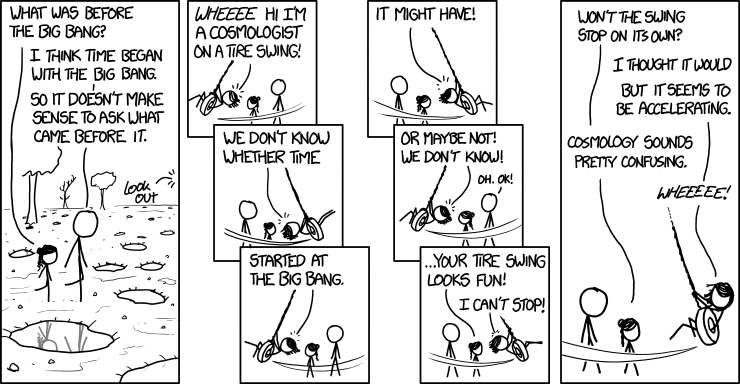
from http://www.xkcd.com/1352/.

We have now come to the end of my series about whether or not the universe had a beginning.  This is part of a longer series dissecting the debate between St. William Lane Craig and Sean Carroll.  I started out with some general reflections on the debate:

Thoughts on the Carroll-Craig Debate
God of the Gaps
  (see also: Gaps at the Dinner Table)

Then I started talking specifically about possible evidence from physics for and against the universe having a beginning.  For ease of understanding I’m going to label each main new argument with FOR or AGAINST to define its main orientation, but the posts also deal with the various counterarguments (that’s the tire swing going back and forth above…). I’ve provided an executive summary of each of these posts, so that you can easily see the main thrust of what I said.  Minus all the caveats, hedging, and detailed explanations my scientific training tends to encourage.

(I’ve heard that politicians hate talking to scientists because, like the Elves in Tolkien, we seldom give a straight answer to a question.  In scientific cultures, we show “sincerity” by discussing all the problems and caveats with our ideas, whereas in political circles this sounds like insincere waffling designed to please too many people…)

Did the Universe Begin? I: Big Bang Cosmology (FOR, as far as it goes…)
– the classical Big Bang Model predicts an initial singularity where time began
– tentative because quantum effects were important and invalidate our usual geometrical notions
– also tentative because we don’t really know how inflation began

Did the Universe Begin? II: Singularity Theorems (FOR)
– classical General Relativity theorems by Hawking and Penrose
– assumptions of Hawking theorem invalid during inflationary epoch
– Penrose theorem says that if space is infinite, there was a beginning
– Penrose theorem invalid in quantum situations, but my work suggests that it might be extendable to quantum gravity, if horizons always obey the 2nd law of thermodynamics.

Did the Universe Begin? III: BGV Theorem (FOR)
– if the universe has a positive average expansion, then “nearly all” geodesics cannot be extended infinitely to the past
– implies that inflation had to have a beginning in time, at least in some places
– can evade theorem by a “bouncing” cosmology where the universe contracts and then expands

Did the Universe Begin? IV: Quantum Eternity Theorem (AGAINST)
– if the usual rules of QM hold at all times, you can calculate what the state would be at any time to the past or future.
– in realistic cosmologies the energy is probably either zero or undefined, making the theorem inapplicable.

Did the Universe Begin? V: The Ordinary Second Law (FOR)
– given reasonable assumptions, 2nd law of thermodynamics requires a beginning
– most plausible way to evade this is to postulate that the “arrow of time” reverses
– such models would have a “thermodynamic beginning” but no “geometrical beginning”

Did the Universe Begin? VI: The Generalized Second Law (FOR)
– second law of thermodynamics also seems to apply to cosmological horizons
– can be used like ordinary 2nd law to argue for beginning
– can also be used as singularity theorem (see II above)
– this closes certain loopholes, but if the universe is finite and the arrow of time reverses, a bounce may still be possible.

Did the Universe Begin? VII: More about Zero Energy
– a more technical explanation of why the energy of the universe can be zero

Did the Universe Begin? VIII: The No Boundary Proposal (AGAINST/FOR)
– a beautiful set of speculative ideas which unify the “laws of physics” with the “initial conditions”, by providing a rule for what the state of the universe is.
– contrary to popular conceptions, the Hartle-Hawking proposal has no beginning in time
– the Vilenkin tunnelling proposal is similar in spirit but does have a beginning.
– unclear whether these proposals are well defined, and Hartle-Hawking appears to give wrong predictions.

Did the Universe Begin? IX: More about Imaginary Time
– a more technical explanation about the notion of imaginary time used by Hartle-Hawking

If you put all of the physics information together, the conclusion I would draw is that: We don’t know for sure whether the Universe began, but to the extent that our present-day knowledge is an indicator, it probably did.  However, as Carroll correctly says, we can also construct models where it doesn’t have a beginning.  Taking into account known results from geometry and thermodynamics, the most plausible such models are 1) spatially finite, and 2) have a reversal of the arrow of time (e.g. the Aguirre-Gratton model).

I also noted that models like AG still have a low entropy “initial condition” somewhere in the middle of time.  One might think that this type of “thermodynamic beginning” still calls out for some type of explanation.

Then I wrote a more theologically-oriented post about whether the Hartle-Hawking no boundary proposal leaves any room for God to have created the universe:
Fuzzing into Existence
– short answer: yes, if you think of God as a storyteller, not a mechanic.

I also discussed the possibility of Reparameterizing Time; is it even meaningful to ask whether time is infinite or finite when you can change coordinate systems?  In this post I also argued that the main theological question of whether the universe needs an explanation seems to me much the same whether the universe has finite or infinite time.

Now, let me make another observation about the tire swing.  Although the weight of the evidence is that the universe probably had some sort of beginning—and even more likely that there was some sort of low entropy “initial condition” even if geometrically time stretches past before that—this cannot be said to be certain.  There is always the possibility that new scientific data or methods could radically change our picture of the very, very early universe.  Similarly, while a finite past seems more in accordance with traditional Christian theology than an infinite past, there appears to be no strictly logical connection between the two ideas, once the act of Creation is viewed in a more timeless, “authorial” way.  Thus one might conceivably have a theist who thinks time is infinite, or an atheist who thinks time was finite.

Should the argument for God’s existence really rest on such a slender foundation as the ultimate decision of physicists about Big Bang Cosmology?  Well, one thing is clear.  In ages past it didn’t depend on it.  Obviously, Sts. Abraham and Sarah, David and Solomon, the prophets and apostles, and all the men and women who followed in their footsteps up through the 19th century, including eminent scientists such as St. Faraday and St. Maxwell: these cannot have believed in God because of the Big Bang Theory, because—guess what?—nobody knew about it yet!  What does the Bible say about these people?

Now faith is confidence in what we hope for and assurance about what we do not see.  This is what the ancients were commended for.  By faith we understand that the universe was formed at the word of God, so that what is seen was not made out of what was visible.  (Hebrews 11:1-3)

Our belief that God is the Creator does not depend on the vicissitudes of scientific progress, the swinging back and forth of the tire swing (or is it accelerating?)  It doesn’t matter, because in this case we have a more certain source of knowledge than Science.

By faith!  The skeptic may scoff here, and say that faith is belief without evidence, but that is not the definition used in the passage above.  It says that faith is confidence about what we hope for, but do not see.  Unless we identify sight (conceived broadly as anything which can be directly experienced in terms of our 5+ senses) with evidence (things which allow us to conclude something about the world)—an identification which would incidentally also make Science impossible—the passage does not say that the ancients were commended for believing without evidence.  But the example of the biblical heroes does give some pointers about what type of evidence was relevant to them.

The ancients did not believe that God was the Creator because they had a detailed scientific theory about where it comes from.  (Indeed, if we take our minds off Genesis for a moment and read the Wisdom literature of the Bible: Job and Psalms and Ecclesiastes and Proverbs, the Scriptures seem to emphasize more our lack of knowledge about the details of creation, then any detailed programme of events…)  On the contrary, the ancient Jews and Christians knew God, by personal acquaintance as it were, and therefore knew him to be creative and powerful, mighty in word and deed.  Thus they could take him at his word that he is the Creator of all that we see.

The glory of Creation does indeed point to the glory of the Creator, so that it is possible for ordinary human reasoners to come to know that there is a Creator intellectually.  But this sort of Theism, by itself, isn’t what Christians mean by faith.  Once we come to know God personally, we learn the more important fact that we can trust him, and know with confidence that there is nothing in existence which does not depend on him.

And therefore, although we see in this world visible things emerging from other visible, material things, we know that ultimately their origin comes from “God’s invisible qualities—his eternal power and divine nature” (Rom 1:20).  He created everything through his Word, Jesus Christ, from whom we have come to know what God is like.  This way of knowing does not seem to depend very strongly on the details of past, present, or future scientific knowledge.

One could definitely argue that the Bible teaches that there was a Beginning (whatever this means from God’s perspective).  For example, the quotation above from Hebrews speaks of the formation of the visible universe.  But whether or not this fact has been revealed by God, it is not obvious to me that the most important theological aspects of Creation really depend essentially on time being finite, or even well-defined.  (Admittedly, if you believe that time is infinite, it might be easier to slip into a false notion whereby matter exists independently of God, who is merely the Chief Organizer of the cosmos.  That would be a heresy—a false belief which may seriously obstruct your ability to relate to God or others properly—but it does not follow necessarily from time being infinite.)

The main point of the doctrine of Creation, I think, is that God is real, and that everything else is derived from his power and will.  We know this doctrine is true because we know God.  Not because of the Big Bang, as natural as it is to connect the two ideas.

Different Views about Time

Updated to ask readers more directly for their thoughts, if you have any…

A random thought.  Suppose we ask whether the world has a Beginning or an End, or whether it is eternal is one or both directions.  It seems like there are 5 possible views, which I will name by association to various cultural groups who supposedly have had these views:

  1.  Norse view: the world began, and it will end.
  2.  Greek view: time is infinite in both directions
  3.  Hindu view: time goes in a circle
  4.  Hebrew view:  the world began, but it will never end.
  5.  Nobody ever: time had no beginning, but it will still end!

I find it interesting that the first four views all have some intuitive appeal, to different people, but the fifth view just seems horribly wrong and perverse!  Why do you suppose that is?

My best guess is that there’s is a certain obvious symmetry to treating the past and future in the same way, which makes views (1-3) seem reasonable.  And there is also an argument that the past is not like the future, but if so it had better be like (4) rather than like (5)!  I guess we all know deep down (it’s really the Second Law of Thermodynamics) that it makes sense for the universe to start from a simple initial condition and then develop complexities from there.  But if we have to deal with infinite regresses AND we don’t even get an eternal universe out of it, that seems a bridge too far… but if anyone has any further thoughts on this, I’d be interested.

My cultural names are a brutal oversimplification, and you shouldn’t take my assigning these views to different cultures too literally.  For one thing, there were lots of different Greeks and there are lots of different Hindus who believe all sorts of different things.  For another, there is a conceptual difference between the world—in the sense of an ordered cosmology with a history—beginning, and time (a much more abstract notion) having a beginning. It takes a certain amount of intellectual sophistication to think about the latter question.

Norse mythology begins with fire and ice swirling around a bottomless pit for aeons; it is only later that a bit of fire strikes a bit of ice and spontaneously generates a giant and a cow, from whom later the jotun and gods emerge by various removes.  (As you can see, the Norse were ultimately Materialists even about their so-called divinities.)  At the end, the cruel jotun defeat the merry gods and the world is destroyed, plunging back into chaos.  So it’s not really clear that time has a beginning or end, just that the story has a beginning and an end.

The Hebrews had the notion of divine Creation in Genesis 1:1 and elsewhere, but it is controversial whether Genesis 1:1 actually teaches the creation ex nihilo of later theology.  St. Augustine is usually credited with the idea that there was not even time before creation, but in fact Philo, a 1st century Hellenistic Jew, got there first.

Similarly, our current best “concordance cosmology” appears to begin with an initial singularity, but has no end in time.  (Well, really we should talk about spacetime, which allows time to end in some places, e.g. inside black holes, but not others.)  This appears at first sight to be like the Hebrew view.  At late times the universe expands exponentially forever, thinning matter out to a very cold but finite temperature.  This is in accordance with the Generalized Second Law of Thermodynamics, which tells us that the universe will reach a boring maximum entropy state at late times.   Thus, the story ends at finite time, and we really have the heroic defiance against inevitable destruction, as in the Norse view.

Even in Hebrew cosmology, there is that little matter of the whole universe being destroyed and then recreated again:

“See, I will create
new heavens and a new earth.
The former things will not be remembered,
nor will they come to mind.
But be glad and rejoice forever
in what I will create,
for I will create Jerusalem to be a delight
and its people a joy.
I will rejoice over Jerusalem
and take delight in my people;
the sound of weeping and of crying
will be heard in it no more.

Never again will there be in it
an infant who lives but a few days,
or an old man who does not live out his years;
the one who dies at a hundred
will be thought a mere child;
the one who fails to reach a hundred
will be considered accursed.
They will build houses and dwell in them;
they will plant vineyards and eat their fruit.
No longer will they build houses and others live in them,
or plant and others eat.
For as the days of a tree,
so will be the days of my people;
my chosen ones will long enjoy
the work of their hands.
They will not labor in vain,
nor will they bear children doomed to misfortune;
for they will be a people blessed by the Lord,
they and their descendants with them.
Before they call I will answer;
while they are still speaking I will hear.
The wolf and the lamb will feed together,
and the lion will eat straw like the ox,
and dust will be the serpent’s food.
They will neither harm nor destroy
on all my holy mountain,”
says the Lord.  (Isaiah 65:17-25)

It’s really this “new heavens and new earth” that will last forever.  Christianity is about Death and Resurrection, both for the universe and for each person.  Science can get us as far as the doomed-to-die bit, but it can’t get us any farther.  That is Law, the rest is Grace, revealed in Jesus Christ.