Category Archives: Theology

God and Time V: Foreknowledge from Scripture

Continuing from where we left off from last time

3. God knows the future

Another set of biblical passages indicate that God knows the future, not just the past or present.  Leaving aside the passages which teach the general doctrine that God knows everything, there are many which explicitly refer to his knowledge of things to come.

The most obvious examples are all the Messianic prophecies which predicted the coming of Jesus, but there are many other examples such as the prediction in the Torah and almost all the pre-exilic prophets that Israel would sin, go into exile, and then be restored.

Sometimes individuals are predicted by name, hundreds of years in advance.  For example, the prediction in 1 Kings 13:2 that Jeroboam’s idolatrous altar would be destroyed by King Josiah, hundreds of years later (2 Kings 23:15).  Or the prediction by Isaiah concerning the rule of King Cyrus, the Persian monarch who brought Israel back from exile.  [Update: apparently “Cyrus” was actually a generic name for Persion rulers, meaning Lord.  However, this is still an noteworthy prediction since at the time of Isaiah, the Persian empire was not a dominant power in the Middle East.]  The context of the surrounding passage compares God to idols and false gods, and in many passages describes God’s ability to predict the future as a key divine attribute which distinguishes him:

I am God, and there is no other;
I am God, and there is none like me.
I make known the end from the beginning,
from ancient times, what is still to come.   (Isaiah 46:9-10)

Another striking example is Daniel chapter 11, which gives a blow-by-blow account of the diplomatic relationships between the Ptolomies in Egypt and the Selucids in Syria (poor Israel being wedged right in between, geographically), for hundreds of years up to the time of Antiochus IV Epiphanes, the evil king who outlawed Judaism and desecrated the Temple, whose defeat is celebrated by the Jewish festival of Hanukkah.

(These prophecies are so clear, that atheists have no choice but to postulate that these books were actually written after the events in question.  So scholars decide that Daniel wasn’t written by Daniel in the 6th century BC, but actually by some anonymous person in the Greek dominated period of the 2nd century.  Even though, oddly, there are no Greek loan words in the book besides the musical instruments.  And the second half of Isaiah was written by somebody else (Deutero-Isaiah) after the return from captivity, notwithstanding the significant literary similiarities between the first and second halves of the book.  And the Torah was patched together by several sources during the Babylonian captivity, and somehow the Jews forced their bitter enemies, the Samaritans, to accept this document as the legitimate Torah.

I can understand why an unbeliever would bite these bullets; what I don’t understand is why educated Jews and Christians have a tendency to automatically defer to the results of scholarship, even those based on explictly anti-religious assumptions.  Just because you’re not a fundamentalist, doesn’t mean you have to unquestioningly swallow everything the other side throws at you!)

In the New Testament, Jesus makes many prophecies about the future.  Humanly speaking, his knowledge of the future was limited in comparison with his Father’s unlimited knowledge (Mark 13:32).  Nevertheless, he had sufficient access to the divine foreknowledge, that he predicted the circumstances of his Crucifixion and Resurrection, the destruction of the Temple, that Judas would deny him, and that St. Peter would deny him, among other things.

There are also various statements in which God asserts that he knows somebody in their mother’s womb, including perhaps details of their future calling in life.  The most striking is David’s statement, in a song on the theme of God’s omniscience, who writes that

Before a word is on my tongue
you, Lord, know it completely.  (139:4)

No wait, that may be relevant but I actually meant to quote this one:

Your eyes saw my unformed body;
all the days ordained for me were written in your book
before one of them came to be. 
(Psalm 139:16 NIV; some translations differ)

See also Jeremiah 1:5Isaiah 49:1, and Galatians 1:15.  Oh, and also Romans 9:10-13.

This brings us to the ever-so-slightly controversial topic of predestination.  I’d actually like to sidestep the usual debate about this.  Regardless of whether St. Calvin and his followers’ terrible assertions are in fact correct, it is pretty clear that there is a word (προορίζω) in the New Testament which is translated by the English word “predestination”.  So all biblical theologies agree that there is such a thing as predestination, which ought to involve, at a bare minimum, God knowing in advance something about what is going to happen.  Indeed, St. Paul bases God’s predestination quite explicitly in his ability to have foreknowledge about what is going to happen:

And we know that in all things God works for the good of those who love him, who have been called according to his purpose.  For those God foreknew he also predestined to be conformed to the image of his Son, that he might be the firstborn among many brothers and sisters.  And those he predestined, he also called; those he called, he also justified; those he justified, he also glorified.  (Romans 8:28-30)

And he is not afraid to talk about all those in the Church were predestined by God, chosen in Jesus Christ:

Praise be to the God and Father of our Lord Jesus Christ, who has blessed us in the heavenly realms with every spiritual blessing in Christ.  For he chose us in him before the creation of the world to be holy and blameless in his sight. In love he predestined us for adoption to sonshipthrough Jesus Christ, in accordance with his pleasure and will—to the praise of his glorious grace, which he has freely given us in the One he loves.  (Ephesians 1:3-5)

Note that the “time” during which this predestination occurs is before creation.  It did not happen in time, but in eternity, which is outside of time.

Once you accept that God knows the future, a lot of the reasoning about how God somehow has to “be in time to be in relationship to us” and be “responsive to our choices” and “learn what we will do” or whatever is undermined.  God was already in relationship to us, knowing all about us and calling us, before the first star began to shine!  I don’t see why God would need to “change” in response to our actions, if he already knew in advance what we were going to do.

At the level of practical theology, it is comforting to know that God already knows the future and that he isn’t just guessing what he needs to do to accomplish his purposes in our lives.  Also, if God knows the future, then it follows that it is reasonable to pray for a favorable outcome concerning events which took place in the past, since when that event was occuring, God already knew that we would pray.  (Here I am assuming there is no weird time travel paradox where we would pray for X to happen only if X did not occur; if so we may be out of luck!  Also, I don’t think it’s reasonable to pray for things not to happen that we know did happen.  We are not asking God to change the past like a time traveller, but rather to take into account our present-day preferences back when he first created it.)

4. Supposed counterexamples

Now open theists deny that God has the power to predict the future, at least whenever it involves the free choices of human beings.  This is partly based on a philosophical belief, not derived from the Bible, that God foreknowing the future is inconsistent with free will.  (I think this reasoning involves a logical fallacy, but the important thing for now is that it is not an argument spelled out Scripture.  There are passages which may apprently seem to minimize or deny our free will in the light of God’s sovereignty, and there are passages which teach the truth of human free will, but there are none which say that we can be free only if God is ignorant of what we will do.)

Many of the prophecies of the future in part 3 seem to involve events that would normally be considered free choices of human beings, assuming we have free will at all.  And, it is easy to see that any small free-will decision I make, by the “butterfly effect”, will eventually have a major (usally accidental) impact on the course of the whole world.  In fact, none of us would exist if our parents and ancestors had made even slightly different free will choices.  Hence, if God cannot predict what people will do, it seems unlikely that he would have any ability to foreknow individual human beings in advance.

Some open theists say that God overrides human free will just in these special cases of prophecy, in order to get the outcome he wants.  Leaving aside the unparsimoniousness of this theory—once we admit that God knows some things in the future, it is much simpler to say that he knows them all—it’s extremely ironic that this theory, which is supposed to preserve free will, only works by denying the existence of free will in salvation history whenever the rubber hits the road!

For those of us who are not Calvinists, this would also raise very difficult questions about e.g. Judas’ betrayal.  St. John’s Gospel tells us that “Jesus had known from the beginning which of them did not believe and who would betray him” (6:64).  He predicted Judas’ betrayal in advance, and claims it was forshadowed one thousand years earlier by David in Psalms 41 and 55, presumably based on his own experience of being betrayed by a close friend.  (I take very seriously the ability of Jesus to find typological meanings in the Old Testament Scriptures which are not necessarily clear to the rest of us.)  Since being Judas was worse for him than not being born, this would raise serious questions about God’s justice, had Judas not chosen freely to be the kind of person he was.  (Presumably Jesus would not have picked him, if he had not had the potential to become a Holy Apostle!)

Back when I was arguing about open theism with St. Dennis Jensen in this thread, he brought up the scene where God (or rather the “angel of the Lord”, but in the Torah this usually refers to a manifestation or vision which speaks directly on behalf of God) says

Now I know that you fear God, because you have not withheld from me your son, your only son.  (Genesis 22:12)

Supposedly, this implies God did not know it before.  That might be a valid Gricean implication if this were the only verse we were working with, but I think it’s pretty weak sauce as a counter-argument to the enormous wealth of texts explictly talking about God’s foreknowledge of future events.  It seems reasonable to me that the function of the “now” modifier is simply to anchor God’s knowledge to the actual event that he knew.   In other words, I read this as saying: As a result of you doing this, I know (and knew, but that is besides the point so I won’t mention it) that you are the kind of person who would choose to do this.  God knows that Abraham would sacrifice Isaac because he actually (almost) did so.  Had God not tested Abraham, there would have been no fact of the matter about whether or not he would have done it.  God knows X because X is true, and “now” is when X occurs, so it is natural to associate God’s knowledge with “now”, even if his knowledge of it is in another sense eternal.

Also, I can’t help but notice that the book of Genesis uses quite a lot of anthropomorphisms in general, including when speaking of God’s omnisicence.  Remember, this is the same text that says things like

But the Lord came down to see the city and the tower the people were building.  (11:5)

and

“The outcry against Sodom and Gomorrah is so great and their sin so grievous that I will go down and see if what they have done is as bad as the outcry that has reached me.  If not, I will know.”  (18:20-21)

What these passages lack in theological sophistication, they more than make up for in vividness of language.  Indeed, they may be taken to teach an important truth, that God’s knowledge is not passive observation-from-afar, but rather a living and active presence, keen to work justice and mercy in the earth.  But since open theists still believe that God fully knows the present, it seems that they too will have to take these passages nonliterally, just as much as the classical theist.  So why can’t 22:12 be the same way?

In the Divine Foreknowledge: Four Views book, the Openness guy (St. Gregory Boyd) highlights the passage in Jeremiah where God says

 They have built the high places of Topheth in the Valley of Ben Hinnom to burn their sons and daughters in the fire—something I did not command, nor did it enter my mind.  (Jer 7:31 + parallel passages)

This could just mean that it didn’t ever enter God’s mind to command that the Israelites sacrifice their children.  (I know we just did the story of Abraham and Isaac, but that was a special test of faith and a sign, not a ritual to be imitated by future generations.  And, since God called it off, it seems to me that part of the function of the story is to indicate that God doesn’t actually want or need child sacrifice!)  But even if we interpret this phrase “enter my mind” more broadly, it could just be a vivid way to refer to God’s shock and horror that the Israelites would do such a thing.  A similar thing can be said about this more obviously problematic passage:

Have you seen what faithless Israel did?  She went up on every high hill and under every green tree, and she was a harlot there.  “I thought, ‘After she has done all these things she will return to me’; but she did not return.  (Jer 3:7)

Here we have God indicating that he had certain expectations, phrased as if they were beliefs, which were not fulfilled.  But this can be taken as a poetic way to describe God’s frustration.  In the same book, St. David Hunt (the guy I agree with), draws this analogy:

Learning that my best philosophy student has plagiarized his term paper, I exclaim, “I can’t believe it!”  This “can’t believe” must be distinguished from the ignorance I was in before the facts came out; it’s a disbelief that’s possible even when I know the truth.  I’m simply dumbfounded that someone with such ability, who did not need to plagiarize in order to write an “A” paper, would stoop to cheating.  God must be similarly frustrated that his chosen people, on whom he lavished so much attention, would betray him.  “It would never cross my mind that someone with all your advantages would do such a thing,” he might say; and he might say it even though he knew from all eternity what they would do.  (p. 51 in my paperback edition)

I’ve mentioned before that I agree with the title of St. John Sander’s Openness book The God who Risks, but I don’t agree with most of the contents.  Sanders claims that passages where God speaks in conditional language, like when he says “if you do A, then B will happen, but if you do A’, something else will happen”, suggests that God doesn’t know the future.  I can’t agree with this argument.  God can have plenty of reasons to make conditional statements to us human beings, even if he knows perfectly well what will happen.

Indeed, in Deuteronomy, God lays out conditional blessings for keeping the Torah, and conditional curses for disobeying, shortly before predicting which of the two outcomes would in fact occur!  This does not mean that there was no point in telling them what would happen in the event that they obeyed.  As it was indeed in their power to do.  (Or was it?)  In any case the blessings were hardly given in vain, given that some generations heeded the Lord more than others, and received part of the blessing during that time, before the inevitable happened.

None of us temporal creatures wish to be punished for a sin before we even decided to commit it.  So if God wants to warn us off doing something, he had better phrase it conditionally, as “IF you sin, THEN bad consequences will happen.”  Even if he knows we will, as a matter of fact, disobey, a flat prediction to that effect isn’t usually the right way to motivate us to not do it.  Indeed, in the absence of a warning, the nature of the decision itself becomes psychologically different.  In some cases, people will do what is right only because they were warned about being punished if they didn’t.

So it makes sense for God to state his relationship to us in conditional terms, and to wait until we actually sin in order to punish us.  (Or he may wait even longer, since he is slow to anger, patient and longsuffering.)  Similarly, it makes sense for him to display his wrath towards sin until such time as we repent, and then afterwards restore us to favor.  Even if he knows we will eventually repent, it does us no good to receive his blessings until we are ready for them.

Even though God knows what will happen, he also knows what could have happened.  So when, in certain biblical texts God says that “perhaps” the Israelites will repent (even though they didn’t) this need not mean that he was caught short.  Instead it could refer to the fact that the intervention might have been capable, given the situation, of causing them to repent.

I think also explains all the passages in point 1 about God repenting and changing his mind.  Even if God is eternal and knows the future, we are finite creatures.  I agree that God must adapt some effectively temporal game-theoretic strategies in order to relate to temporal creatures.  I deny that he has to somehow strip himself of his eternal existence or foreknowledge in order to do this!

No matter what we say about God and Time, there are going to be some passages which post theological challenges.  Some of them may require some creative interpretation, to harmonize with the rest of the Bible.  But it seems to me much easier to explain the passages involving God repenting or coming to know things, in terms of the eternal view, then to explain why a God limited to the present would be spoken of as changeless and knowing the future.

And we haven’t yet gotten to the best proof-texts yet!  To be continued…

Next: Eternity in Holy Writ
God and Time IV: Impassibility and the Bible

For my previous posts arguing that God is not temporal: I: Metaphysics, II: Special Relativity, and III: General Relativity.

In the next few posts, we’ll examine the Scriptural arguments for this position.  While I don’t think it’s illegitimate to use arguments from Natural Theology in situations where the Bible is ambiguous, in the Bible we have revelation from God himself.  Since God knows who he is far better than we ourselves know it, we have reason to trust this source the most.

On the other hand, it is equally obvious that the Bible often speaks of God in metaphorical language.  All Theology involves some metaphors, necessarily so given that much of it is speaking about invisible realities which no one has seen.  But unlike academic theology, the Bible generally tends to use more “earthly” or “poetic” metaphors, especially in the Hebrew Scriptures.  For example, the Bible often speaks of God as if he had human bodily parts. Let me digress on this topic for a while, since it illustrates some of the relevant principles when interpreting the Bible.

Begin digression

Now as Christians we know that (apart from the Incarnation), God has no body.  To say God does have a bodily form is a heresy (i.e. a misunderstanding of the faith capable of doing spiritual damage), going by the name of Anthropomorphism.  Now Anthropomorphism is obviously false at a philosophical level—how could the creator of all physical things have had a human shaped body?  We may be made in the image of God, but to think that God is in our image is a pagan crudity, as though God were on the same level as the all-too-human immortal creatures described by Homer.

Although Anthropomorphism is philosophically absurd, it can also be seen to be false from a purely scriptural analysis.  That is, there are clues in the text that this kind of metaphor isn’t supposed to be taken literally.

For example, several passages say that God delivered Israel from Egypt “with a mighty hand and an outstretched arm” (Deut. 5:15) [Click on the link and scroll down to see the cross-references in the right margin].  That this is intended as a metaphor is clear from the fact that the narrative portions of the Torah explain in detail the process of how the Exodus occurred, and none of the mighty miracles that dispersed Israel involved God literally smacking things around, or pointing, with a giant arm.  It is a metaphor for strength and command.  (To say that the ancient Hebrews didn’t understand it was a metaphor is absurd.  If they didn’t understand metaphors, they wouldn’t have been able to consistently come up with such good ones!  It’s Modern Americans who seem to have trouble understanding metaphors.)

Or, instead of saying that God is omniscient, they might say that “the eyes of the Lord roam throughout the earth” (2 Chronicles 2:9 + cross-references).  If you think this means that the Hebrew prophets thought God was literally shaped like a human being, go to Zechariah 4:10 and you may learn something surprising about just how many eyes God has.  And don’t forget his wings! (Psalm 91:4 + cross-references).

Or they might say that God spoke to Moses “face to face, as a man speaks to his friends” (Exodus 33:11), yet this is clearly not meant literally, since later in the same chapter God tells him that “you cannot see my face, for no one may see me and live” (Exodus 33:20).

(So instead God covers him with his “hand” and he sees his “back”.  But if the face is nonliteral, these obviously cannot be literal either.  One of the numerous pastors in my ancestry used to say that this meant that God showed him, not his essence, but what he had done since creation, in which God’s glory is reflected as through a darkened mirror.)

While God might occasionally show the likeness of a bodily form in temporary visions of God (known as theophanies), for example in Exodus 24:1-11 or Daniel 7 or Luke 3:21-23, this does not prove that God actually literally looks like a really old man (or like a dove).  It only means that God chose to represent himself like that temporarily, accommodating himself to our weakness and limited understanding, in order to make a limited point.

In addition to pointing out that these passages make little sense on a literal interpretation, one may also point to broader Scriptural principles.  Most notably, even the earliest Hebrew Scriptures express an absolute abhorrence of idolatry, of any attempt to portray the divine in the image of any created thing:

You saw no form of any kind the day the Lord spoke to you at Horeb out of the fire. Therefore watch yourselves very carefully,  so that you do not become corrupt and make for yourselves an idol, an image of any shape, whether formed like a man or a woman, or like any animal on earth or any bird that flies in the air, or like any creature that moves along the ground or any fish in the waters below.  And when you look up to the sky and see the sun, the moon and the stars—all the heavenly array—do not be enticed into bowing down to them and worshiping things the Lord your God has apportioned to all the nations under heaven.  But as for you, the Lord took you and brought you out of the iron-smelting furnace, out of Egypt, to be the people of his inheritance, as you now are.  (Deut. 4:15-20)

While Solomon tells us that “The heavens, even the highest heaven, cannot contain you.  How much less this temple I have built!”  (1 Kings 8:27).  God cannot have a shape unless there is some kind of space that he can be enclosed inside of, but no such space exists.

In the New Testament, St. John says that (except for the Son) “no one has ever seen God” (John 1:18).  And St. Paul speaks of “God, the blessed and only Ruler, the King of kings and Lord of lords, who alone is immortal and who lives in unapproachable light, whom no one has seen or can see” (1 Tim 6:15-16).  These passages also indicate that the theophanies in the Old Testament cannot be taken as a literal depiction of God’s likeness.

End digression

Now, I doubt any of my readers are tempted to think that God literally has a body (unless there are some Mormons lurking!)  So why am I going on and on about this?  Because I think the same situation applies, more or less, to the question of whether God is in Time.

“Open Theist” theologians, who believe God doesn’t know the future perfectly, and that his knowledge and relationships change with time, will typically argue like this: the Bible teaches that there exists a personal, relatable God, but then later it was quickly contaminated by Greek philosophical ideas from Platonism, which portrayed God as being some timeless, impassible abstraction; so we need to reject all that and get back to the inspired Scriptures in order to get back to the real conception of God.  In other words, all the Christian theologians got it wrong from the 2nd to the 19th century, and we are only now getting it right.

One problem with this, is that the supposed “corruption” of theology by Platonism had already happened to parts of Judaism before the New Testament was being written, and some biblical texts already show signs of trying to explain Jesus in terms of these Greek ideas.  For example, the concept of λογος (God’s word/reason holding the universe together) was borrowed by St. John straight from Platonic and Stoic philosophers, even if he uses it in a new way, to talk about the Son’s role in the universe prior to the Incarnation.  So if we go all Platonism = bad and try to remove it entirely from Christian theology, we’ll have to remove some parts of the Bible too!

Anyway, the God of Classical Theism, according to Christians, is a personal, relatable God.  He just had to take some extraordinary measures, such as the Incarnation of the Son and the Indwelling of the Holy Ghost, in order to be related to us in the way which he wanted.

OK, let’s analyze the Scriptures now, starting with the ones which pose the greatest difficulty for my position, namely:

1. God changes his mind

So I agree that there are a bunch of biblical passages in which God talks as if he were temporal and could change.  For example, there are the passages in which God says he “regrets” having done certain things, for example, creating humans (in the account of the Flood) or choosing Eli’s family for the High Priesthood, or making Saul king.  That is because they disobeyed him and became wicked.  And God reserves the right to adjust his plan accordingly:

This is the word that came to Jeremiah from the Lord: “Go down to the potter’s house, and there I will give you my message.” So I went down to the potter’s house, and I saw him working at the wheel. But the pot he was shaping from the clay was marred in his hands; so the potter formed it into another pot, shaping it as seemed best to him.

 Then the word of the Lord came to me.   He said, “Can I not do with you, Israel, as this potter does?” declares the Lord. “Like clay in the hand of the potter, so are you in my hand, Israel.  If at any time I announce that a nation or kingdom is to be uprooted, torn down and destroyed, and if that nation I warned repents of its evil, then I will relent and not inflict on it the disaster I had planned.  And if at another time I announce that a nation or kingdom is to be built up and planted, and if it does evil in my sight and does not obey me, then I will reconsider the good I had intended to do for it.  (Jeremiah 18:1-10)

Does this mean that God’s promises are always tentative, and that everything could be revoked if we all become sufficiently bad?  No.  Why not?  Because about some things, God has promised that he will never change his mind, no matter what we do or how wicked people become!  In addition to his promise to eventually restore the nation of Israel, there are also explicitly unconditional covenants with Noah, with David, and also with Levi.  (This last passage presents a bit of a theological problem if taken too literally, since the New Testament is quite clear that sacrifices are no longer called for, in light of the sacrifice of Jesus on the cross.  These promises are ultimately fulfilled in the New Covenant, through our faithful High Priest who cannot die or have his office revoked.)

This seems to be God’s modus operendi when he interacts with several of the greatest figures of the Old Testament: 1) selection by God, 2) a trial period of testing to see if the person selected is willing to put their faith in God’s purposes, sometimes resulting in 3) an everlasting and unconditional covenant building on God’s favor towards that person.  The wicked may be cut off from the benefits of the convenant, but they cannot by their wickedness annul God’s faithfulness towards Abraham, Isaac, and Jacob.

A second Scriptural theme is God changing his mind in response to intercession.  In typical examples, God threatens people with some kind of punishment, and then one of his saints or prophets pleads with him—or a priest makes atonement by offering sacrifice—and he relents from what he was planning to do.

The most famous example here is St. Abraham pleading on behalf of the Sodomites; I guess this wasn’t exactly successful since in fact there weren’t ten righteous men in the city, so God destroyed it after all.  But it’s a proof of concept, since if there had been that many righteous people, God would certainly have spared the city.  (And don’t tell me that Abraham was asking for the impossible since “no one is righteous, not even one”.  That’s true, but if God can condescend to use our language when he speaks to us, then he also knows who is righteous by ordinary human standards.)   And don’t forget that Lot and his two daughters were rescued by angels, which still went part of the way towards granting what Abraham was hoping for.

Another dramatic example is St. Moses’ intercession on behalf of his people.  Not once but twice, God tells Moses that he is going to destroy the entire nation of Israel for their sins, and start over with him!  But Moses refuses to accept this plan; instead he pleads with God for the idolatrous and ungrateful people, even for those who wanted to kill him, and the Lord listens to him.

The Torah contains many other examples of punishments which are remitted in response to intercession.  In one particularly dramatic example, the people rise up against Sts. Moses and Aaron and the Lord tells him to “Get away from this assembly so I can put an end to them at once.”  Moses’ response?

Then Moses said to Aaron, “Take your censer and put incense in it, along with burning coals from the altar, and hurry to the assembly to make atonement for them. Wrath has come out from the Lord; the plague has started.” So Aaron did as Moses said, and ran into the midst of the assembly. The plague had already started among the people, but Aaron offered the incense and made atonement for them. He stood between the living and the dead, and the plague stopped.  (Num 16:46-48)

So what does this mean?  Is God less merciful than Moses was?  No, but he wanted Moses to acquire a Christlike character, in which Moses internalized God’s love for his people, and was willing to stand up even to God on their behalf.

Shocking as it seems, God actually encourages this.  He really does think it is worthwhile to conform his own actions to our limited, human sense of justice.  And it isn’t just Moses, it can be you too!  If you have a real relationship with God, seeking his will and his justice; then simply by asking for it, you might be able to stand in the gap to spare those whom God would otherwise punish, and save those who might otherwise be lost.  It is an astonishing privilege which we could never have presumed to expect from the Lord of the Universe!  But everything in the Bible encourages us to view our relationship with God and other people in these terms.  The difference is, Abraham prayed that God would spare the city for the sake of ten righteous people in Sodom, but I am more presumptuous still, and pray that God would save even a tenth of a righteous person, among those he has given me to care about.

Here are some other notable examples of God “changing his mind” in the Old Testament.  (In the Gospels and Acts, the examples of individuals obtaining grace and mercy through interceding before Christ are too numerous to mention.  There are also some striking promises concerning intercessory prayer in the New Testament.)

Thus we conclude that there is a sense in which God is capable of changing his response to human beings, based on what those human beings in fact do.

2. Yet God does not change

But side by side with this, we find passages which indicate that God does not change his mind.  One particularly striking example of this comes in 1 Samuel 15.  In the very same chapter (!) where God says that “I regret that I have made Saul king, because he has turned away from me and has not carried out my instructions,” St. Samuel also says that

He who is the Glory of Israel does not lie or change his mind; for he is not a human being, that he should change his mind.  (15:29)

which is in turn an allusion to Numbers 23:19 in the Torah, a passage in which king Balak tries to hire the pagan prophet Balaam to curse Israel; but in vain, since God had determined to bless them.

In other words, Saul (or Balak) should not think that God changes his mind in the same way that human beings do.  God’s purposes are certain and secure; he cannot be wheedled or manipulated.  His decisions are final, unless he himself, in his eternal counsels, allows men to intercede.  (Here we see, as often happens, that the Bible includes both sides of a paradox, while limited human theologies often attempt to include only one or the other.)

Some more passages about God not changing:

“I, YHWH, do not change. So you, the descendants of Jacob, are not destroyed.” (Malachi 3:6)

Some might suggest that this passages only means that God’s purposes do not change, but that other aspects of God may be capable of change.  But the literal meaning of the passage refers specifically to the Lord; the statement about Jacob’s descendents are an additional implication.  In other words, God’s purposes follow from his nature.  If this is fixed, the purposes are also fixed.  Similarly, in the New Testament St. James informs us that:

Every good gift and every perfect gift is from above, and comes down from the Father of lights, with whom is no variableness, neither shadow of turning.  (James 1:17)

This beautiful passage is noteworthy for its strong denial that even the “shadow” of change can affect God.  There is not even a hint of inconstancy or variation in the divine being, and this is why his gifts are good and perfect.

Similarly, the letter to the Hebrews quotes Psalm 102:25-27 and applies it to Jesus.  Speaking about his eternal divine nature, it says that

“In the beginning, Lord, you laid the foundations of the earth,
and the heavens are the work of your hands.
They will perish, but you remain;
they will all wear out like a garment.
You will roll them up like a robe;
like a garment they will be changed.
But you remain the same,
and your years will never end.”
(Hebrews 1:10-12)

and later, it adds that

Jesus Christ is the same yesterday and today and forever.
(Heb 13:8)

Taken together, these passages can reasonably be taken to imply that God is immutable, which means, incapable of change.  This implies that he is also impassible (incapable of suffering “passion”).  It may be helpful to note that “passion” is one of those words whose meaning has changed subtly with time—it originally meant being acted upon passively by feelings, thus God has no “moods” or impulsive “reactions”, so that he isn’t carried away by emotions in the same way that we are.

(One time, I heard someone preach—she was normally the children’s pastor, but she was “filling in” at the pulpit—that since God is personal, we should ask him how his day has been, and find out whether he is in a good or a bad mood before petitioning him for what we need.  I was astonished by the crudity of this conception of the divine nature.)

The traditional theology of “impassibility” has often been questioned, in light of the fact that the Bible also portrays a “living” God who is capable of being both pleased and grieved by what happens in the world.  And, however literally we take the biblical statements about God’s changelessness, no Christian has ever denied that God is omniscient—that he knows everything taking place in the world, including contingent facts, even though it is tricky to see how this knowledge can be reconciled with his immutability.   (For example, here you can see St. Thomas Aquinas with his hands full trying to explain how God can know everything in the world, simply as a side effect of knowing his own unchanging nature.)

I discussed this issue a bit in Does God Need a Brain, in which I argued that God knows things in a different way than we do, a way which does not actually require him to change.   I would say that God is so living and complete that he doesn’t need to change in order to respond to everything perfectly.  God’s being is so full that it is already a perfectly responsive answer to whatever the thing is.  Whatever exists, exists in relation to God, and God by the very act of creating it is in relation to it, and knows it perfectly.  Without changing, he nevertheless enters into relationship with each thing that exists.

Although he has no emotions in the literal sense, he nevertheless has something which is analogous to our emotions, namely his holy and active benevolent will, which is full of love for us, and therefore vehemently opposed to sin and whatever else is against our being the saints that he calls us to be.

But how then, do we reconcile this idea of God with the first set of Scriptures I mentioned?  When faced with an apparent conflict between different biblical teachings, we have several tools for trying to interpret them.

For example, we can compare to other things we know from good science and philosophy (bearing in mind that these are incomplete).  All truth is God’s truth, and he speaks through Creation as well as through the Inspiration of the Scriptures.  Thus, we should not interpret Genesis 1 in a way that is clearly incorrect given the fossil record, and we may take into account things like Relativity when asking about God and Time.

We may also ask and hope that the Holy Spirit will guide us in helping the Scriptures meet our spiritual needs.  As a corollary to this, we should consider how the saints in the past (remember that they were guided by the Holy Spirit just as much as we are) interpreted those passages.  As a Protestant, I don’t believe that Christian tradition is infallible, but that doesn’t mean it can’t be helpful.  Scripture can and must be used to critique tradition whenever it departs from the Gospel truths.  But we also have to remember that a lot of what we call “tradition” is just the record of how people in the past processed the Scriptures.  The Bible didn’t just fall straight out of heaven into St. Gutenberg’s press.  The saints of old read the same Bible that we do, and they thought that what they read was consistent with asserting that God is impassible.

Thirdly, we should read each passage in the light of the whole Bible, in other words to “let Scripture interpret Scripture”.  This is a good and important technique, although it is abused quite often.  One way to abuse it goes like this:  whichever passages seem to agree with your theology, you call these “key verses” and “a central teaching” and “biblical doctrine”.  Then, when faced with a verse which seems to disagree with your theology, you call this an “obscure”, “problematic”, or “difficult” passage which therefore needs to be “put in context”.  This means comparing it to the verses you agree with, and noting that those verses are more powerful and important.  Once the difficult passage is reinterpreted in a way which agrees with the “central message” of the Bible, you have successfully neutralized those verses.  This gives you the right to disregard them (in any context other than explaining why they don’t mean what they appear to) at which point they cease to play any positive role in constructing your theology.

For example, I have heard Protestant sermons on James 2:24, and read Catholic sermons on Matthew 23:9, in which the pastor very eloquently and persuasively criticized the “wrong” interpretation of the verse—the interpretation that contradicts their own theology—and then totally forgot their obligation to make the verse relevant to the lives and hearts of the congregation.  Once the verse was defanged so that it could no longer be a weapon on the other side, it was useless to them.  This is the sure sign that (contrary to their own protestations) the theology of these individuals was not based on the whole Bible, but only part of it.

(I read somewhere on a Christian blog, but I can’t find it anymore, that getting your theology from the Bible is like trying to reassemble a disassembled watch.  Some theologies are better than others—the watch is either ticking or it isn’t—but if there are any pieces left over when you’re done, then you know that your understanding of the original design is incomplete!)

I don’t want to do this to the passages which assert that God “repents” and “changes his mind”.  I think that they teach important spiritual truths about God, truths which we could not have obtained otherwise.  We need to leave room for paradox in our biblical understanding of God.  Unless we blasphemously claim to understand God as well as he understands himself, this is inevitable.

Nevertheless, I also think that we have excellent scriptural reasons to think that the passages about God repenting are anthropomorphisms, that they cannot be taken literally.  But this will require discussing two other biblical attributes of God, his foreknowledge and his eternity.

Next: Foreknowledge from Scripture 

God’s will

Aron,
How is it possible that God is in control of all things and their will is always done, assuming that we are free?

Kevin

First, why are we free in the first place?  Because God wants us to be free, and he always gets what he wants!  (Unless he wants something else more which conflicts with it; then he gets that instead.)

Some theologians distinguish between God’s permissive will and his perfect will.  If God wants you to freely choose to love him.  Since he wants you to be free, that means his permissive will involves creating a world in which you are allowed to love other things instead of him, and even to become enslaved by these things and lose your freedom for a time.  So our Father permits people to love e.g. pornography and greed, but his perfect will is that we should turn to him and become pure and holy through his Son Jesus Christ.  God “wants all men to be saved and to come to a knowledge of the truth.” (1 Tim 2:4)

So there is one sense in which God’s will is always done—nothing happens unless he permits it to happen, according to his wisdom in accomplishing his ultimate goals.  But that does not mean he is equally pleased by everything that happens.  “Do I take any pleasure in the death of the wicked? says the Lord YHWH.  Rather, am I not pleased when they turn from their wicked ways and live?” (Ez 18).

Hence we need to pray every day that “your will be done”, because our Father has freely chosen (it is his absolute, iron will) that some graces will be given only when we ask for them, and cooperate with the lavish grace which has already been given, before we even knew to ask.

In the end times, after Jesus comes back, God’s kingdom will come and so his perfect will is going to extend throughout the entire universe, just as it is now in heaven.  But even then, there will be some rebels who refuse to give up their hatred and pride, who will end up being excluded from the Lord’s perfect will, because he permits them to be the kind of person they want to be, instead of the kind of person he wants them to be (Rev 22:15).  So God will not, in fact, get every single thing he wants.

Yet he is clever enough to work everything which happens towards the final blessedness of those who love him, according to his plan from before time began.  “For those whom he foreknew, he also predestined to become conformed to the image of his Son” (Rom. 8:29).

God and Time III: General Relativity

Imagine if somebody said that only one height exists at once—whichever elevation you happen to be in at the moment, only things at that elevation really existThe moles in the ground are can be asserted to be “below”, but that just means that they used to exist when you were in your basement.  And the birds in the trees are “above” you, but that just means that they will exist after you indulge your habit of climbing to the attic.

(Unlike the case of time, I can go either up or down, but who cares?  Time may flow like a river, but space flies like a bumblebee, wobbling around in random directions.)

This is clearly uncommonly silly, and there are several retorts one might make to it.  If the ground beneath us doesn’t exist, then what on earth is holding us up and supporting us?

Also, there is no such thing as a perfectly flat human being.  Your brain occupies several different planes of elevation at once, and there is no good reason to think that any horizontal slice of your brain would be capable of thinking, independently of all the other slices.

Another possible retort would be to critique the language, and say that there is really no meaning to it.  If I say that the birds will exist after I go into the attic, I am implicitly and illegitimately assuming that my attic exists, and that I can therefore go up to it.  But if I really took my philosophy completely seriously, I would have to believe that the attic doesn’t exist either.  To say that up exists upwards is a circular definition, which can hardly console us if things that are up do not exist in the first place.

But if none of these “philosophical” arguments are persuasive, I can always crack out the “Argument from Geophysics”.  Our most advanced scientific theories suggest that the world is in fact round.  It turns out that up and down are relative concepts, you see.  In Australia, they fall in a different direction than we do.  What they call down is different from what we call down.  The actual laws of physics are rotationally symmetric.  There is a symmetry which mixes up the up-down axis with the right-left axis and the forwards-backwards axis.  We can call “down” the direction which points to the Earth, but the earth is a contingent object which might not have existed.  Out in space, there is no reason to adopt a geocentric coordinate system.

And certainly, if we start doing theology, it would be presumptuous to think that the God who created the whole universe, all the stars and galaxies, is confined to existing at some particular elevation.  Whatever limitations we may ascribe to created beings, we should not ascribe them to the unlimited Creator, who made them all out of nothing.

(Some ideas, e.g. the idea that God is a really old man with a long white beard who lives in the sky, really do become ridiculous when you consider the size and proportions of the Universe as discovered by modern Science.  But garden variety Internet Atheists are always trying to manufacture this feeling artificially, in situations where it’s a non sequitur.  If you can’t tell the difference between Classical Theism and belief in a sky-fairy or an invisible garage dragon, that shows your intellectual limitations, not mine.)

This analogy summarizes the previous posts in this series, only I was talking about Time instead of Height:

God and Time I: Metaphysics
God and Time II: Special Relativity

It turns out that there is also a “rotational symmetry” so to speak (called a Lorentz boost) which mixes Space and Time.  It works a little bit differently from a regular rotation, since it involves rotating along hyperbolas instead of circles.  Mathematically, it’s just a matter of throwing in a minus sign.  A result of this is that there is a lightcone which is unaffected by the symmetry transformation.  Some pairs of points are timelike separated (one point can affect the other) and others are spacelike separated (neither can affect the other), but there is no such thing any more as simultaneity.  From the perspective of somebody who is stationary, time goes slower for somebody who is moving; this is called “time dilation”.

But in General Relativity, things get more wild, since space and time can themselves be affected by the behavior of matter.  Thus the distances and durations become a function of where and when you are.  Time runs slightly slower near the earth than it does in outer space.  (Believe it or not, this is why things fall down.  An object in free-fall always takes the path which maximizes the amount of time to get from point A to point B.  This is a compromise between SR and GR time dilation effects.)

In Special Relativity, space and time are a unity, but they have a fixed geometry.  The distances and the times are the same regardless of what matter does.  They are unaffected, and therefore they might possibly (by a Materialist, not by a Classical Theist) be taken to be a fundamental, necessary, and immutable feature of reality, which limits other entities but is not itself affected by them.

In General Relativity, by contrast, the spacetime metric \(g_{ab}\) not only affects matter, it is in turn affected by matter.  This implies that the causal structure  (which tells you which points can affect which other points by signals) is itself causally affected by stuff.  So we learn that the particular geometry of spacetime is a contingent, mutable feature of reality.

From a philosophical point of view, the Absolute Spacetime of Newton (or Special Relativity) was never very satisfying.  Even if it is Absolute, an empty Spacetime can hardly itself be the source of all that is real.  Thus there must also be some other principles besides those of space and time, threatening an unparsimonius proliferation of fixed principles.  It has seemingly arbitrary features, and yet if it is really immutable and necessary it is difficult to explain it in terms of other things, other than just God’s will.  Many philosophers such as St. Leibnitz and Mach rejected absolute spacetime, and tried to reduce it to the status of merely relative data relating various material objects.  Newton and his followers, on the other hand, tried to identify Space and Time with the necessary attributes of God, his Immensity and Eternity, but this doesn’t work very well theologically.

Einstein was influenced by Mach in the creation of GR, but it doesn’t really meet Mach’s original aspirations since spacetime is still a reality independent of matter in his theory.  Mach would have said that spacetime has no independent reality; that it is just a way of keeping track of the relationships between material objects.  (He thought that the water would run to the sides of a rotating bucket only because the bucket was rotating compared to the distant stars).  But in GR, it is possible to have a geometry apart from any matter, e.g. empty Minkowski space, or a spacetime with gravitational waves.

There is indeed a sense in which the curved spacetime of GR is relational—there is no absolute fixed coordinate system to measure everything else by.  Thus it is only meaningful to  measure the locations and times and velocities of objects relative to other objects, indeed unlike SR we must even specify a specific path through spacetime between the two objects, in order to meaningfully compare them.  But, even though GR is relational, the spacetime metric \(g_{ab}\) is itself one of the entities which may be used to construct relational observables.

Thus I would say that Spacetime in GR is neither absolute in the Newtonian sense (more fundamental than matter), nor relative in the Leibnitz/Machian sense (less fundamental than matter), but rather has the same status as matter.  It is real in the same concrete, tangible way that a rock or a tree is real.  It is one of several different fields in Nature, all with equal status, all capable of affecting and being affected.

As some physicist I can’t track down right now (Carlo Rovelli?) once said, if an intense gravity wave passed by and destroyed your house, you would think of it as being just as real as any other kind of matter.

Now, if Spacetime (and therefore Time) is real in the same sense that a rock or a tree are real, that meas that it is also a contingent, created being.  Time is just one of the many things that God has created.  But the Creator, blessed be he, is not dependent on rocks or trees for his existence.  He is not measured or parcelled out by units of space, therefore he is also not measured by time.  Time is just something he created, which need not have existed.  Before they were created, and afterwards, he exists just the same as he ever was.  He is the Absolute, the Fundamental Reality which everything else depends on, but which does not itself depend on anything.  God’s divine attributes (his necessity, eternity, and unity) imply that he cannot change with time, nor can he consist of distinct parts at each time.  He is the Alpha and the Omega, the Beginning and the End!

But I digress, since I was planning to discuss the Scriptures in the next post.  This one is supposed to be about how GR makes it even harder to say that God is in Time.  I’ve already talked about the contingency of the spacetime geometry.  Now let’s talk about the arbitrariness of selecting what you mean by a single moment of time.

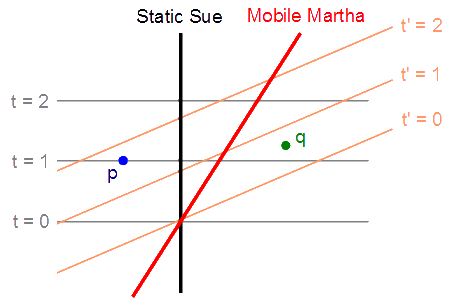
In SR, there is still a preferred notion of “simultaneity” if you pick a particular reference frame.  I drew a picture of that in the previous post:

Here Sue and Martha don’t agree on whether \(p\) or \(q\) came first.  But maybe Sue is objectively right and Martha objectively wrong?  Somebody could still argue that there is a special inertial frame of reference with respect to which God happens to exist.  In other words, God has no position, and yet he has a velocity?  He is not an idol, a piece of wood or stone carved into an anthropomorphic form.  Why should he be limited in this way.

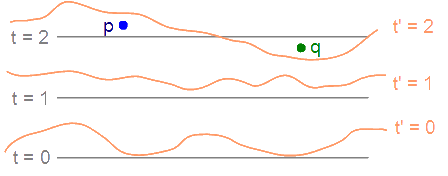
But in GR, spacetime is curved, and there are no inertial coordinate systems defined on the whole spacetime.  You can divide Spacetime into Space and Time in any way you like, using wiggly surfaces (although one might want to restrict to surfaces which are everywhere spacelike).  For example, the relationship between 2 coordinate systems could look like this:


In GR is not always any particular connection between a given coordinate system and a given observer, so I have not drawn Sue and Martha in this picture, but I have still drawn the spacelike separated points \(p\) and \(q\) which are in an ambiguous time relation.  (Since spacetime is 4 dimensional, the time slices I’ve drawn actually represent 3 dimensional surfaces.)

Of course, nothing stops you from choosing a funky coordinate system in Newtonian mechanics or SR either.  For example, it is often convenient to choose a rotating frame of reference to follow a rotating body such as the Earth.  Or a coordinate system which tracks an accelerating observer.  (Many pop descriptions of GR give the false impression that you need GR to describe accelerating coordinate systems; this is obviously false since objects can accelerate even in Newtonian mechanics, and nobody can prevent you to choosing coordinates however you like no matter what the correct theory of physics is.)

The difference in GR is that none of the coordinate choices are particularly nice or special.  It looks from the picture above like the gray coordinate system is nicer than the apricot one, but that’s just because your computer screen is flat.  On a typical curved spacetime, all time slices are bent in one place or another.  Thus, instead of having a 3 parameter family of “nice” time slices, we have an infinite dimensional family.  (The details depend on which particular curved spacetime we have.)

Do we really want to say that God’s experience of time depends on making an arbitrary choice about how to respond to the gravitational field of each and every star?  An choice which, from the perspective of physics, is a completely meaningless choice of coordinate system?  God’s perspective on the universe should not be more provincial and limited than the perspective of a mere physicist such as myself.  The Glory of Israel does not change, so why does he need a time coordinate?

Now it is true that on some specially nice spacetimes, there is a naturally nice choice of time coordinate.  For example in an FRW expanding universe, there is a “cosmic time” coordinate which tracks the overall size (the “redshift factor”) of the universe.  Some philosophers, such as St. William Lane Craig, have suggested that God’s “time” might simply be this “cosmic time”.

But this is a misunderstanding of the physics of our universe.  The FRW metric is a just an approximation to reality.  It describes a universe which is completely uniform (the same in everywhere) and isotropic (the same in every direction).  This is a very good approximation on large distance scales (billions of light years), but on shorter distance scales (e.g. the solar system, or the milky way, or your living room) you may have noticed that matter is not distributed uniformly.  It comes in clumps, and each of these clumps has a gravitational field which distorts the spacetime metric, making the FRW metric no longer correct.  On a lumpy spacetime, the notion of “cosmic time” is not well-defined.

With sufficient effort, one might be able to define a different time coordinate which is well defined.  Perhaps the maximum proper time since the Big Bang, or something.  But reformulating GR in a way that makes special reference to such quantities spoils the beauty of Einstein’s theory.  It is ugly.  As for a blind and lame theory like that, I hate it in my soul.  Why should our physical theory describing gravitation get uglier when we describe how it relates to God?

The closest thing I know about to an elegant reformulation of GR with a special time coordinate is called “shape dynamics”.  (I say know about, since I don’t understand it).  Apparently this is equivalent to GR in a coordinate system where you pick your time slices to be CMC (“constant mean curvature”) slices.  I won’t explain that right now, except to say that the soap films in your bubble bath are also CMC surfaces.  But given a GR spacetime metric, there might be many possible choices of CMC slicings, or none.  So the equivalence to GR is not complete.

It is of course always possible that a new theory of physics (such as Hořava gravity) might reimpose something like absolute time.  But I wouldn’t count on it.

I think this is a good illustration of the point I made in Models and Metaphysics:

But it seems to me that the correct view is in the middle, that Physics has some bearing on Metaphysics but it doesn’t fully determine it.

There are always going to be ways to force physics into being compatible with an A-theory metaphysics of time, but it doesn’t look elegant or pretty.  The B-theory seems to fit much more naturally.  Physics can’t usually rule out metaphysical ideas, but it can make them look a lot clunkier.

But in this case, physics isn’t telling us anything we couldn’t have learned from good philosophical theology.  Or from scriptural exegesis—which will be the subject of my next post in this series.

Next: Impassibility and the Bible

Seeking Church Unity

In the comments section of this post, I’ve been having a debate with a Roman Catholic about this whole Protestantism thing, so perhaps now is a good time to write a post about the unity of the Church.

I. My Own Testimony

I suppose I may as well start by discussing my personal history.  I grew up in the Church of the Nazarene (a Wesleyan denomination) but at various stages of my life I have regularly attended services with the Free Methodists (7 years), Baptists (3 years) and Lutherans (1 year), not counting smaller visits.  I also like stepping into Anglican services, and even Catholic Masses (though out of respect for their rules I do not take communion with the Catholics).

While it’s true I’m the sort of Protestant who reads the Catholic Encyclopedia for fun, my adventures in ecumenism (interactions between different branches of Christianity) really started in earnest at St. John’s College.  During my last semester there I attended Holy Trinity, a wonderful Antiochian Orthodox congregation in Santa Fe.  When I had first been invited to visit the church my freshman year, it seemed like a bizarre eastern cult that just happened to also be about Jesus, but over time I came to realize the commonalities and differences more clearly.  It had a profound effect on my spiritual and musical sensibilities.  Also, the priest (St. John Bethancourt) is the most visibly holy person I have ever met on this earth.  He cannot enter a room without caring about whatever person he meets within. I am eternally grateful for the treasures obtained during this time, yet after careful consideration of the differences in theology, I remain a Protestant.

As a graduate student I attended Layhill Community Church, where during the time for prayer any person could go up to the altar railing to pray with St. Wil, the associate pastor.  He was a man of great faith and I noticed that eerie coincidences would sometimes occur after I prayed with him for things.  (This is the kind of thing skeptics attribute to confirmation bias, but Christians attribute to Divine Providence.)

For instance, one Sunday I asked to be able to worship God better, and the following Tuesday, while opening a bottle of olive oil to cook with, I suddenly remembered all the passages in Scripture about anointing with oil and the Holy Spirit, and was full of joy and praise.  Only afterwards did I remember what I had asked for.   (Despite the potent significance of olive oil as an ingredient in several of the Catholic sacraments, the next example will be even more relevant for church unity.)

Another time I was praying at the altar with St. Wil for the unity of the church, and in the following week (or two at the most) my housemate St. Ray invited me to attend a new bible study for grad students at the Catholic Student Center just off the U Maryland campus!  So of course I went, and actually attended for 4 years which was longer than he did.  Each year the study was led by a different monk from the Dominican House of Studies in Washington DC (except one year we got a seminarian instead).

After Ray invited me, he suddenly got worried it would be disruptive if I started arguing with everyone about Protestantism, so I agreed to keep it cool.  The first meeting I was silent about that, but vocal about everything else.  The second meeting I confessed; they were rather surprised because they had thought I had been speaking in a particularly Catholic way about the allegorical meaning of Adam and Eve during the first meeting.  I was even invited (along with the others) to sometimes lead class discussions, which I tried to do with a minimum of controversy, focusing on commonalities except when absolutely necessary.

I got to see a lot of their struggles with various aspects of Catholicism, and sometimes tried to formulate ways of looking at the problems which combines the strengths of both types of theology, e.g. “Sacraments are not a way that we manipulate God, they are a way that God manipulates us!”  They were aware that I disagreed about certain important things, but even though we weren’t in communion, there was still community and communication!  It was excellent practice for charitable discussion, and I am deeply grateful that they were Catholic enough (the word Catholic means “universal”, after all) to include me.

As I said, I tried to avoid excessive controversy in the group, but after hours I had some vibrant discussions with the Dominican brothers about Catholicism, and when I visited the House of Studies I got to have a friendly intellectual brawl, of the sort that causes so much consternation among people who don’t like arguments, since they associate them with hostility.  They gave me books by St. Cardinal Newman, whose epistemology (“theory of knowledge”) I find a bit whacko, for the reasons mentioned in that recent comments section, the one in which I flagrantly violated Socrates’ rule for good conversations.  To keep things shorter, St. Bayes or bust!

II. An Index of Communion

As is well known, Jesus prayed for the unity of the Church, on the night of his betrayal:

My prayer is not for them alone. I pray also for those who will believe in me through their message,  that all of them may be one, Father, just as you are in me and I am in you.  May they also be in us so that the world may believe that you have sent me.  I have given them the glory that you gave me, that they may be one as we are one—I in them and you in me—so that they may be brought to complete unity.  Then the world will know that you sent me and have loved them even as you have loved me.  (John 17:20-23)

for the unity of our love is one of the signs by which the world can see that our faith is real, thus fulfilling his command to us:

A new command I give you: Love one another.  As I have loved you, so you must love one another.  By this everyone will know that you are my disciples, if you love one another.” (John 13:34-35)

But unity is not easy.  Although in a sense we Christians are already one due to being part of the body of Christ and “members of each other” (Romans 12:5), and in this way we are part of the One Holy Universal and Apostolic Church and the communion of the saints, practically speaking the expression of that unity may be impaired.  Just as quarreling siblings may be one family genetically but not be united in affection, or quarrelling spouses may be one in flesh but divided in spirit.

So the expression of unity is something that requires us to all work together to exercise maturity of character, using the gifts which God has provided us.  As St. Paul says:

But to each one of us grace has been given as Christ apportioned it. This is why it says:

“When he ascended on high,
he took many captives
and gave gifts to his people.” (Psalm 68:18)

(What does “he ascended” mean except that he also descended to the lower, earthly regions?   He who descended is the very one who ascended higher than all the heavens, in order to fill the whole universe.) So Christ himself gave the apostles, the prophets, the evangelists, the pastors and teachers, to equip his people for works of service, so that the body of Christ may be built up until we all reach unity in the faith and in the knowledge of the Son of God and become mature, attaining to the whole measure of the fullness of Christ.

 Then we will no longer be infants, tossed back and forth by the waves, and blown here and there by every wind of teaching and by the cunning and craftiness of people in their deceitful scheming.  Instead, speaking the truth in love, we will grow to become in every respect the mature body of him who is the head, that is, Christ.   From him the whole body, joined and held together by every supporting ligament, grows and builds itself up in love, as each part does its work.  (Eph. 4:1-16)

So, how are we doing on this front?

Well, the bad news is that the Church has splintered into numerous different denominations, not all of which regard each other as being really Christian.  And a few of them aren’t really Christian, though most accept the basic truths of the faith as expressed in e.g. the Nicene Creed.  But as St. Lewis pointed out a while back, the commonalities are far more profound than the differences.

Let’s try to be honest about how bad this problem really is.  The most common figure one hears (from atheists complaining about the fractiousness of Christians, Catholics complaining about the fractiousness of Protestants, or Protestants complaining about the fractiousness of everyone), is to simply count the number of denominations, getting some huge figure in the tens of thousands, but this is an absolutely terrible way to assess the state of Church unity!

First of all, a lot of these organizational splits were for historical reasons (based on how different groups got evangelized, or because of doctrinal differences or attitude towards slavery or something like that which is no longer a live issue) or were for administrative convenience (e.g. to deal with being in different countries, or because the churches have somewhat different organizational structures which would be difficult to combine), and are perfectly compatible with both groups thinking the other is really Christian and cooperating for the sake of God’s kingdom.

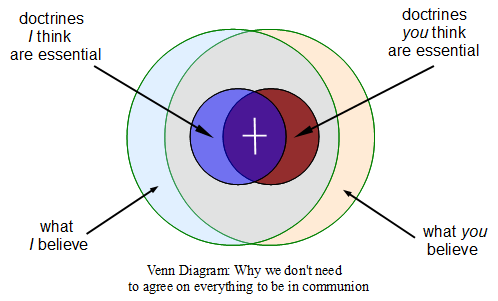
It would be better to ask “What is the probability that two randomly selected devout Christians are in communion with each other?”  This gives a numerical measure, a “communion index”, describing the degree of church unity.  The answer turns out to be about 1/3 (see below).  Could be better, could be a lot worse.

Merely having administratively independent units is not the same thing as being divided in love, or in communion.  Even the Catholics have 24 nearly-independent administrative units (which appoint their own leaders and have their own customs and rules, but remain in communion with the Pope and accept his doctrinal decrees), while the Eastern Orthodox have about 15 “autocephalous” (self-governing) churches.  These two churches were in communion with each other until about 1054 when both sides started excommunicating each other over an arcane theological dispute.  These excommunications were lifted in 1965, but the churches are still not in communion for other reasons.

There are also 6 independent Oriental Orthodox churches, a group of churches including e.g. the Copts who did not accept the decision of the Council of Chalcedon.  Although I personally think Chalcedon provided the best language for understanding the Incarnation, in retrospect the “Monophysite” or “Miaphysite” group was probably just using different words to refer to the same thing, and were not really heretics in the same way that the Gnostics or Arians were.  Thus it was wrong to excommunicate them; and this is not only my own opinion but also the opinion of the leaders on both sides:

Hence we wish to reaffirm solemnly our profession of common faith in the Incarnation of our Lord Jesus Christ, as Pope Paul VI and Patriarch Moran Mor Ignatius Jacoub III did in 1971: They denied that there was any difference in the faith they confessed in the mystery of the Word of God made flesh and become truly man. In our turn we confess that He became incarnate for us, taking to himself a real body with a rational soul. He shared our humanity in all things except sin. We confess that our Lord and our God, our Saviour and the King of all, Jesus Christ, is perfect God as to His divinity and perfect man as to His humanity. In Him His divinity is united to His humanity. This Union is real, perfect, without blending or mingling, without confusion, without alteration, without division, without the least separation. He who is God eternal and indivisible, became visible in the flesh and took the form of servant. In him are united, in a real, perfect indivisible and inseparable way, divinity and humanity, and in him all their properties are present and active.

The subtext here is the thing which only really mature people are capable of saying, namely: “Oops, I’m sorry, we were wrong.” (However, since this original schism, the Catholic church has developed their theology further, so the churches are unfortunately still not in communion.)

Protestants have a lot more sects, but then again most Protestants regard most other Protestant groups as being really Christians, and therefore part of the Universal Church founded by Jesus.  Nowadays the biggest disputes tend to be about the axis that runs from liberal/modernist to fundamentalist/literalist, rather than denominational loyalties.  (I’m somewhere in the middle, since I think miracles have really happened and the Scriptures’ teachings on e.g. sexual ethics and so on need to be taken seriously, but I also accept the findings of biology and physics and don’t think rigid definitions of inerrancy are the right way to talk about the authority of the Scriptures.)

With a few exceptions, most Protestant denominations allow all those who confess Jesus as their Savior and Lord to take communion in their church.  So does the Assyrian Church of the East, an ancient apostolic church which was at one time known as the Nestorian church because the heretic Nestorius was received there, but it is now generally regarded as unfair to tarnish the whole group by his opinions.  (The Assyrian church is much smaller than the others, although historically it was very important and and even spread to China).

So for purposes of calculating the odds that two Christians will be in communion, Nicene Christianity is really divided into 4 large subgroups: 1) Catholics, 2) most Protestants, 3) Eastern Orthodox, and 4) Oriental (listed in decreasing order by number of adherents) plus some smaller groups.  Because the groups are not all the same size, the coefficient is closer to 1/3 than 1/4.

III. Three Kinds of Unity

Is the reconciliation of the major branches of Christianity even possible?  And what can we do to make a difference?

Catholics care the most about unity, and are willing to do the most in terms of practical accommodations.  Also, although they are a big institution which changes very slowly, they do change, and they know how to fall in line behind the decisions of the Pope.  The difficulty is that they think that their past official pronouncements are infallible, and that it is necessary to believe every one of them to be in communion with them.  So in doctrinal terms, it is impossible for them to ever compromise.  That sounds a lot like a deal breaker to me.  Of course, if the Catholics are right about everything, then the hundreds of Protestant denominations would just need to all recognize this fact simultaneously.  Right, that sounds plausible.

The Eastern Orthodox church is a lot closer in its theology to the Catholics, and it would be more feasible for them to hash out a compromise.  And I will wildly celebrate any such union should it occur.  But there’s also a lot of bad blood between them as a result of various historical incidents (such as the Sack of Constantinople in 1204, which apparently some of the Orthodox remember as if it were yesterday).  Plus the Catholics made political attempts to take over various of the Eastern patriarchies, which succeeded in creating a bunch of Eastern Rite Catholics, but alienated them further.  Twice the two churches got a bunch of leaders together and announced they were reconciled, but both times the Eastern Orthodox back home refused to accept the decision.

So there’s been so much entrenchment of the various sides, with enough bad history between Catholics/Protestants and Catholics/Orthodox etc. that the groups reuniting with each other seems to be quite impossible.

And it is impossible.  Impossible for human beings, that is.  Not impossible for God:

 Jesus looked at them and said, “With man this is impossible, but not with God; all things are possible with God.” (Mark 10:27)

“‘If you can?” said Jesus. “Everything is possible for one who believes.”  (Mark 9:23)

There’s always the option of fasting and praying, and genuinely asking God to shine light into our hearts.  Surely God is willing to act when the time is right:

If my people, who are called by my name, will humble themselves and pray and seek my face and turn from their wicked ways, then I will hear from heaven, and I will forgive their sin and will heal their land.  (2 Chronicles 7:14)

So the first step is to realize that it is something that God will do, not something we can do.  All of the parties to this dispute believe that there is a God in heaven who can act, so why do we so frequently act as though a negative outcome were inevitable?

The second thing is to recognize how far we’ve come already.  For a couple centuries, Protestants and Catholics were killing each other in order to try to come out ahead politically.  Until everyone got sick of that and decided to have an Enlightenment with secular republics instead.  The killings don’t happen anymore, leaving aside Northern Ireland anyway.

Even after that, until quite recently (perhaps a century ago), many Catholics and Protestants seem to have believed that more or less everyone on the other side was going straight to Hell when they died.  This era too has passed.

And it wasn’t my generation’s doing, either.  It was the hard work of a few individuals in previous generations, who insisted on talking to each other and opening up honest communication, even when it seemed impossible.  Vatican II was a pretty big deal too, what with Catholics rethinking their attitude towards Protestants and accepting some Protestant ideas in the process (e.g. Mass in the language of the people).  Meanwhile, even if there are still some fundamentalists out there who think ecumenical dialogue is of the devil, for the most part Protestants also became more open to the idea that some Catholics have actual spirituality and relationships with Jesus, and that we can be allies in some ways.

 “Thus the saying ‘One sows and another reaps’ is true.  I sent you to reap what you have not worked for. Others have done the hard work, and you have reaped the benefits of their labor.” (John 4:37-38)

In fact the wounds of division have already begun to be healed.  The first step was unity of love.  This step came about when different Christian groups became genuinely interested in the well-being of Christians in the other groups (even before they convert to our side).

It is just barely possible to love a group of people and also think that they are lying scoundrels who will go straight to Hell, but we all know that love isn’t what usually motivates this attitude.  It’s not a coincidence that the word “charity” is used to mean both “Love in the Christian sense” and also “Not interpreting what other people say in the worst possible light”.  When you care about people, you don’t just want to see the negatives but also the positives.  As St. Lewis writes in Mere Christianity:

Suppose one reads a story of filthy atrocities in the paper.  Then suppose that something turns up suggesting that the story might not be quite true, or not quite so bad as it was made out. Is one’s first feeling, ‘Thank God, even they aren’t quite so bad as that,’ or is it a feeling of disappointment, and even a determination to cling to the first story for the sheer pleasure of thinking your enemies are as bad as possible?  If it is the second then it is, I am afraid, the first step in a process which, if followed to the end, will make us into devils.  You see, one is beginning to wish that black was a little blacker.  If we give that wish its head, later on we shall wish to see grey as black, and then to see white itself as black.  Finally we shall insist on seeing everything—God and our friends and ourselves included—as bad, and not be able to stop doing it: we shall be fixed for ever in a universe of pure hatred.

Compare to this attitude:

Love is patient, love is kind. It does not envy, it does not boast, it is not proud.   It does not dishonor others, it is not self-seeking, it is not easily angered, it keeps no record of wrongs.  Love does not delight in evil but rejoices with the truth.  It always protects, always trusts, always hopes, always perseveres.  Love never fails.  (1 Cor 13:4-8)

There are always going to be silly, superficial reasons to condemn the other side.  (No matter how many good arguments there are for a position, there will always also be some terrible ones!)  But love does not look for reasons to condemn, but for reasons to rejoice.  If it criticizes, it does so not to boost its own ego, but out of genuine caring and out of respect for the good it sees is already present.  It is willing to investigate carefully before deciding that the other side are evil rebels.

The next stage is the unity of hope.  This step comes when people not only care for those on the other side, but also actually believe that their situation isn’t hopeless, that if we form friendships and have dialogues and do good for each other, then it may actually make a difference.  This is the stage we are currently working at, in my opinion, although obviously one could always use more love to fuel the process.

With hope, we actually begin to desire to be in communion with each other, because we have begun to think it might one day be possible.  And even now, we can want this together (making due allowances for the fact that what complete unity would look like, is itself one of the theological controversies in question), and we can pray for it together.

“Again, I assure you: If two of you on earth agree about any matter that you pray for, it will be done for you by My Father in heaven.  For where two or three are gathered together in My name, I am there among them” (Matthew 18:19-20).

I’m thinking this means, two or three Christians who have to work a bit to understand each other and agree about something!  (Not 2 or 3 self-satisfied Christians who are already primed to think in exactly the same way, and who don’t care what anyone outside their group thinks.)  Real unity requires effort, but the reward is that it produces real community:

How good and pleasant it is
when brothers live together in harmony!

It is like fine oil on the head,
running down on the beard,
running down Aaron’s beard
onto his robes.

It is like the dew of Hermon
falling on the mountains of Zion.
For there the Lord has appointed the blessing—
life forevermore.  (Psalm 133)

Of course not all of us are called to ecumenical work trying to understand other types of Christians—some of us are to focus on serving individual congregations (which can already present enough challenges for reconciliation!), or to provide aid to non-Christians, or to evangelize, or to serve the body of Christ in some other way.  We all belong to each other, and according to the law of our King, the Son of David:

The share of the man who stayed with the supplies is to be the same as that of him who went down to the battle.  All will share alike.  (1 Sam 30:24)

And the final stage will be the unity of faith, when the love that is between us is enough that God can work through it so that we fully recognize and repent of the divisions that are between us.  I don’t know exactly what a practical version of this would look like (and as I said, this is one of the very things which is disputed), but I can still work towards it.  Jesus prayed for it; it is possible.  Let’s have it happen in this world rather than wait for the next one.

Speaking as a Protestant I would emphasize that this unity of faith does not necessarily require us to agree on the exact same list of doctrines.  When St. Paul writes:

May the God who gives endurance and encouragement give you the same attitude of mind toward each other that Christ Jesus had, so that with one mind and one voice you may glorify the God and Father of our Lord Jesus Christ.  Accept one another, then, just as Christ accepted you, in order to bring praise to God.

it is clear that for him, “one mind” does not actually mean “agrees about everything”, for the theme of the entire previous chapter and a half up to this point (Romans 14:1-15:7) is about dealing with the situation in which two Christians disagree about disputable matters.

A doctrine can be true, or even important, without being an essential dogma which must be believed to be a real Christian.  (Even Catholics don’t think everything is a dogma, but they do have a procedure for moving more and more things into the “dogma” category… thus making reunion harder and harder as time passes.)

There’s a terrible idea called “secondary separation” in a few Protestant circles, which is that you should not only separate yourself from Christians who disbelieve in the doctrines you think are essential, you should also separate from Christians who fail to separate from such people… and so on ad nauseum.  Clearly, in the absence of a Pope, that can only end with a tiny schismatic group of self-righteous Pharisees.  Which is why we shouldn’t think that way!

Instead, we need to accept one another.  This doesn’t mean we shouldn’t have any standards for what we mean when we call somebody else a Christian, since both Jesus (Matt 18:15-20) and St. Paul (1 Cor 5) taught that in extreme circumstances, the church can and should excommunicate people.  But it does mean that our standards for other people need to be less strict than our standards for ourselves.  To summarize in a picture:

Note what happens here if we allow the little circles to expand until they become as large as the big circles.  In that case, we will come out of communion, by refusing to accept somebody else unless they are exactly like us.  This is schism, in which a failure of love leads to a rupture in the bonds of faith.

Although I wrote “believe” in this picture, the same thing applies when we talk about which behaviors are acceptable in a Christian community.  Here it is even easier, since we have more control over our behaviors than over our beliefs.  To have a functioning community, we need to be strict with ourselves, but more accepting when it comes to the conduct of others.

People are always alert to hypocrisy, situations where somebody says that X is required but doesn’t do X themselves.  You might think of this as a situation where the “small” circle is actually bigger than the “big” circle, and the person is condemned by their own standards.  But merely avoiding hypocrisy is not nearly enough.  If two people each allow themselves to do everything they personally think is OK, then unless they have identical beliefs, one will step outside the bounds set by the other.

“Do not judge, and you will not be judged.  Do not condemn, and you will not be condemned.  Forgive, and you will be forgiven.  Give, and it will be given to you.  A good measure, pressed down, shaken together and running over, will be poured into your lap.  For with the measure you use, it will be measured to you.”  (Luke 6:37-38)

IV. How to get other Christians to accept you

It’s fun to argue, and it may cause some individuals to move from one viewpoint to another, but I don’t think it’s where the most important work lies.  If you want to contribute to church unity, the way to do it is to serve.  The way to get other groups of Christians to recognize what you believe in, is not to fight them but to make yourself indispensable to them.

Think about St. Lewis’ writings.  He led millions to Christ, and to a deeper spirituality.  He chose to write primarily about those things which Christians have in common.  And the funny thing is, Christians of pretty much every kind all have him as their hero.  For example, the Eastern Orthodox have a tendency to think that Orthodoxy is the One True Church, and many of them think that those outside of it aren’t real Christians.  And yet an enormous number of them admire and respect St. Lewis, an Anglican.  Doesn’t matter if it’s inconsistent with their general views about the non-Orthodox, they’re forced to recognize him as a Christian, because he is just too darn useful to their spiritual lives to anathematize.

“When Christ ascended on high,
he took many captives
and gave gifts to his people.”

The communion of saints operates through the gifts we give to each other.  It has not been held back by denominational barriers.  I have heard hymns written by Protestants sung in Catholic Masses; I have seen books written by Catholic saints provide guidance for Protestants.  We are already one family, we just need to realize it.

So go and serve other groups of Christians.  Find out what they need, and then give it to them.  Make it so they can’t help but see that the Spirit of God is moving you.  (We are all quite willing to believe that the people who help our team are inspired from above.)  At the very least, we are always able to pray for each other.  Make the Lord’s priorities your priorities:

When Jesus had washed their feet and put on His robe, He reclined again and said to them, “Do you know what I have done for you?  You call Me Teacher and Lord. This is well said, for I am.  So if I, your Lord and Teacher, have washed your feet, you also ought to wash one another’s feet.  For I have given you an example that you also should do just as I have done for you.  I assure you: A slave is not greater than his master, and a messenger is not greater than the one who sent him.  If you know these things, you are blessed if you do them.” (John 13:12-17)