Author Archives: Scott Church

About Scott Church

I am a landscape photographer and I.T. professional in the greater Seattle area. I graduated from the University of Washington with a Bachelor's in Mechanical Engineering and a Masters in Applied Physics, and in a former life, I was an aerospace engineer. When I'm not writing or at work I can be found plying the waters of the Pacific Northwest for salmon, trout, and steelhead, or bushwacking with my camera gear.

Curvature II: Spacetime

By Scott Church – Guest Blogger

In the first installment of this series, we explored the nature of curved spaces and introduced ourselves to some of the mathematical tools needed to describe how length, breadth, and height can be curved without higher dimensions to “curve into.” In the interest of keeping our exploration as intuitive as possible, we began with the Euclidean geometry we learned in high school and explored curvature from the vantage point of time as we experience it—a universal history that is the same for all of us and independent of the spatial stage on which our lives unfold. Today we will explore the nature of time and its relationship to space and discover (spoiler alert!) that in fact, it is neither separate from space nor absolute—not only can length, breadth, and height be curved, duration can be as well. The universe we inhabit is one of curved spacetime.

Special Relativity

The Newtonian physics we learned in high school presumes absolute three-dimensional space and time. In the low gravity and velocity world we live in, that is how we experience them. But intuitive as this may seem to us, there are hints that something is amiss. That physics also taught us that the speed of light \(c\) is a universal constant that can be derived from Maxwell’s equations. And as we saw in Part I, the laws of physics, including \(c\), must be invariant for all observers stationary or moving. Pause for a moment and reflect on what this implies. If I am standing beside a highway and you drive by at 50 mph, that is the speed I will observe. In the car, you will see yourself as stationary and the world passing you at 50 mph in the opposite direction, including me. Another driver doing 70 mph in the fast lane will pass me at that speed and you at 20 mph. But Maxwell’s equations will remain true and invariant for all observers, so if a beam of light is shined in the same direction, it will pass all three of us at the same speed. How is this possible?

Imagine that you are now the one who is stationary, and I fly past you in a fighter jet at a speed \(v\) of 3600 mph, (or one mile/sec for round numbers) carrying a clock that is in sync with an identical clock of yours. As I pass you, it emits a pulse of light in your direction at time \(t_1\) which reaches your eye after travelling a distance \(d_{t1}\) (Figure 1). One second later at \(t_2\), a second pulse is emitted, but I will have flown one mile further so that pulse must travel a distance \(d_{t2}\) before it reaches your eye. My clock will be ticking at the same rate in my reference frame as yours is for you, but the seconds you observe on my clock will be longer because the second pulse you receive from it must travel further at the same speed \(c\) to reach your eye than the first one did. Your experience will be that my time runs slower for you than it does for me. And for the same reason, your clock will be running slower for me than it is for you.
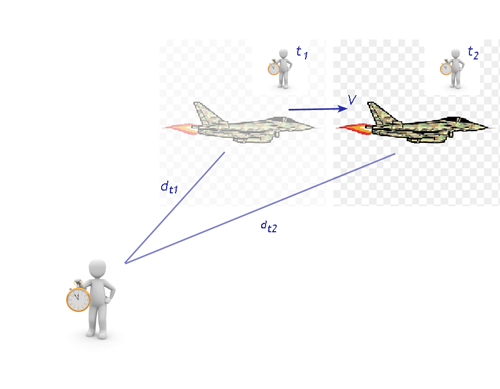
 

Figure 1

As for distances, the length of my jet will be measured by the time it takes a pulse of light to travel from the nose (\(A\)) to the tail (\(B\)) at speed \(c\) (Figure 2). In my reference frame that will be given by,

\(L = c\Delta t_{ba}\)                    [Eqn. 1]

 where \(t_{ba}\) is my proper time (that is, the time measured by a clock at rest in my reference frame).
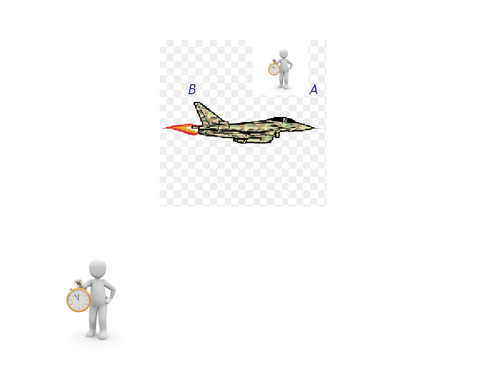
Figure 2

In your reference frame, the pulse of light will take a time \(\Delta t^{‘}_{ba}\) to travel the length of my jet. However, while the pulse is in transit, point \(B\) will have moved forward a distance \(v \Delta t{‘}_{ba}\) so the pulse will arrive at point \(B_2\) instead (Figure 3),
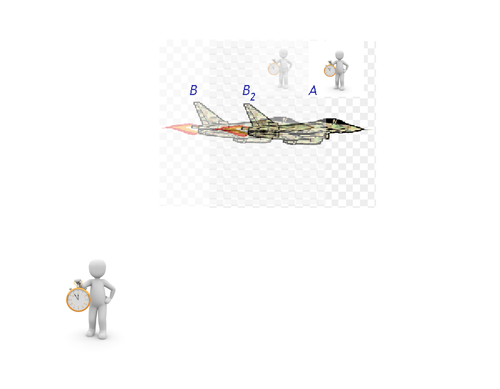
Figure 3

And you will observe the length of my jet to be the distance between \(A\) and \(B_2\), or,

\(L^{‘} = (c – v)\Delta t^{‘}_{ba}\)                    [Eqn. 2]

Not only will you see the pulse travelling a shorter distance that me, the time \(\Delta t^{‘}_{ba}\) will also be less than the \(\Delta t_{ba}\) I observe because time is running slower for you than for me. The length \(L^{‘}\) you observe for my jet will be smaller than the length \(L\) I observe, and you will see me and my jet as though we were compressed in the direction of travel.

Thus, we arrive at one of the foundational principles of special relativity; Space and time are neither absolute nor independent of each other. They’re united in a single spacetime manifold whose metric contains an underlying symmetry that preserves Maxwell’s equations and \(c\) for all observers. And this manifold is not simply a map of locations and distances—it’s a frame-independent history of events for every location within it.

In Part I we saw that in the flat Newtonian universe of our experience, time is absolute and independent of space. All observers experience it the same, and spatial geometry is Euclidean with the interval between any two points is given by the Pythagorean Theorem,

 \(ds^{2} = dx^{2} + dy^{2} + dz^{2}\)                    [Eqn. 3]

In spacetime, however, this is no longer the case. Now we have a collection not of points, but events that reflect the histories of each spatial point within it. The interval no longer defines the distance from here to there; It defines here and now, to there and then. Accounting for this in our metric tensor won’t be as simple as it may sound. As we’ve seen, the speed of light must remain the same for all observers whether stationary or moving in any reference frame. And the relative motion slows time down and compresses space until both reach zero at the speed of light. From our vantage point, a photon’s reference frame is a single event with a zero-length interval, so our interval must include time with a sign opposite to that of space. After multiplying time by \(c\) to convert it to equivalent distance units, this gives,

\(ds^{2} = dx^{2} + dy^{2} + dz^{2} – (ct)^{2}\)                    [Eqn. 4]

Which adopting the usual (though not strictly necessary) convention of making time the first, or zero component, results in the spacetime metric tensor,

                              [Eqn. 5]

The diagonal terms expressed as a tuple, [-1, 1, 1, 1], is known as the metric’s signature. In differential geometry (the branch of mathematics that generalizes the geometry we learned in high school to all types of curves spaces), a continuous N-dimensional manifold that has a well-defined and positive-definite metric tensor at all points (not all mathematically possible ones do) is referred to as Riemannian. That is, a flat 4-D Riemannian metric is one that for every point on it, infinitesimal displacements in the locally flat tangent plane have a metric signature of [1, 1, 1, 1]. A universe with Euclidean geometry and absolute time would have this metric everywhere. But in a universe constrained by special-relativity the interval can be zero as well as positive, so the metric is non-degenerate rather than positive-definite. Manifolds of this type are referred to as pseudo-Riemannian.

In Part I, we conducted a geometric thought experiment in which we traversed a closed triangular path through the flat space of an observer named Freddy, and another through the curved space of an observer named Cathy along geodesics (paths that reflect the shortest distance between any two points). In each, we carried one vector with us while leaving an identical parallel copy of it behind and upon returning to point A. When we did this in Freddy’s flat space we found, not surprisingly, that after completing the journey the two vectors were still parallel to each other. But after the same journey through Cathy’s curved space, we discovered that the vector we carried with us was no longer parallel to the one we left behind even though both were still pointing in the same direction (globally south), and we had travelled a shorter distance that still encompassed a larger area. We introduced some mathematical concepts that allowed us to define a covariant derivative 1 to describe the rate of change of the vector we carried with us along our path \(s^{\sigma}\),

\(\nabla_{\mu}s^{\sigma} = \partial_{\mu}s^{\sigma} + \Gamma^{\sigma}_{\mu\nu}s^{\nu}\)                    [Eqn. 6]

The first term on the right is the usual vector calculus gradient along the direction of travel. The second term, however, introduced a new object, the Christoffel symbol, that allowed us to map changes in the underlying tangent plane containing \(s^{\sigma}\), itself onto local coordinate systems within it as we traversed the path. Integrating this derivative along our path would then fully capture the changes in our mobile vector with respect to its stationary twin we left behind.

That exercise, however, traversed a path through Cathy’s curved two-dimensional space, so equation 6 described distances and directions only. Had we included time in her curved universe, the path we walked would have been a trajectory of motion with history, and upon arriving back at A we would have found that our mobile vector was now older or younger than its stationary copy as well. In curved space, geodesics are the shortest distance between points—here and there. But in spacetime they are histories that reflect the shortest path, stationary or moving, between here and now, and there and then. As such, they define an equation of motion for the trajectory an object will follow when no forces are acting on it.

In a flat spacetime like Freddy’s, an object left to itself will remain stationary or move at constant velocity, so its geodesic will be a straight line whose slope will be the constant speed it is moving at. If one or more forces act on the object it will accelerate, and its history will follow a curved path whose velocity changes from moment to moment. We can derive the equation of motion for this by using equation 5 to derive the second order time derivative along \(ds^{\sigma}\), to equate the acceleration produced by a force it to its strength divided by the object’s mass. In his flat spacetime, a single unvarying tangent plane spans the entire universe, so the Christoffel term will vanish, leaving us with,

\(\frac{\partial^2 s^{\sigma}}{\partial t^2} = \frac{F}{m} = 0\)                    [Eqn. 7]

Which we will recognize as a geodesic equation of motion for Newton’s second law that we learned in high school.

In Cathy’s universe things are different. There, geodesics are curved so the Christoffel term will generally be non-zero, and her equation of motion will be given by,

\(\frac{\partial^2 s^{\sigma}}{\partial t^2} + \Gamma^{\sigma}_{\mu\nu}\frac{\partial s^{\mu}}{\partial t^2}\frac{\partial s^{\nu}}{\partial t^2} = 0\)                    [Eqn. 8]

Notice that in curved spacetimes like hers, the second term on the left will be non-zero even in the absence of forces, so the first term will be as well. Left to themselves, objects in a curved spacetime will experience freefall along accelerating trajectories.

Which brings us to the next topic…

General Relativity

The other hallmark of our high-school physics lessons was Newtonian gravity. In a universe of flat space and absolute time like Freddy’s, gravity is an attractive force between objects whose strength is a function of their masses and the distance separating them. Specifically, the gravitational force \(F_g\) between two objects with masses \(m_1\) and \(m_2\) is given by,

\(F_g = g_c\frac{m_1m_2}{r^2}\)                    [Eqn. 9]

Where \(r\) is the distance between their centers of mass and \(g_c\) is the universal gravitational constant we also learned in our high-school physics classes.

For centuries this understanding of gravity has served us well in regions of low mass, velocity, and distance, and still does. I spent twenty years as an aerospace engineer designing commercial jet aircraft structures, and the aircraft my colleagues and I applied these principles to still have exemplary safety and performance records. But even so, physicists have long been troubled by the idea of “spooky action at a distance” forces. How can objects interact with each other invisibly over large distances? On the other hand, we can put it differently by saying that gravity causes objects with mass to accelerate toward each other at a rate given by their masses and the distance separating them, and as we saw above, freefall acceleration is a consequence of spacetime curvature. Jumping the gun, we also know that mass and energy are equivalent (hence Einstein’s celebrated \(E = mc^2\)) and moving objects with mass have a kinetic energy that is a function of their momentum and mass (\(K = p^2/2m\)). This raises an interesting question…

What if gravity isn’t a force at all, but simply a local manifestation of spacetime curvature due to mass, energy, and momentum?

If this is true, then we would expect that two objects of differing mass in the field of a third object of much larger mass (like the earth, for instance) would experience the same freefall acceleration toward it—essentially, that the “force” \(F_g\) the gravitational field exerts on their differing small masses would result in the same acceleration for both,

\(\frac{F_{g1}}{m_1} = \frac{F_{g2}}{m_2}\)                    [Eqn. 10]

And this would be the same acceleration that would result from an equal but non-gravitational force (e.g. – the thrust produced by a rocket engine). As you’ve probably guessed by now, this is the case. Gravitational mass and inertial mass are indistinguishable from each other, and freefall accelerations induced by the former are a consequence not of any “spooky action at a distance” force, but of the local spacetime curvature created by its presence. This identity, known as the equivalence principle, is the heart and soul of general relativity. Throw a pebble into a pond and watch it arc through the summer sky before splashing down, and you are literally seeing the curvature of length, height, breadth, and duration where you’re standing because of the mass of the earth beneath your feet! 2

And once again, if spacetime curvature is caused by mass, energy, and momentum, we can ask ourselves how this could be captured mathematically. As in Part I, a formal derivation of the relationship between the two is beyond the scope of an introduction to the topic, but we can introduce the types of mathematical objects needed and how they relate to each other. The first thing we need is an object that describes curvature. Like the terms introduced so far, it will need to capture the change in angles over infinitesimal displacements from any reference frame we view it from, so it will need to be a covariant or contravariant tensor. And since we want it to describe curvature specifically rather than displacements, it will be a function of the Christoffel symbols that describe how they change when we walk a parallel transport path (or more properly, a function of their first derivatives, or rates of change). To unambiguously capture this, we will have to carry a four-vector \(ds\) (that is, a vector in three spatial dimensions plus time) around an enclosed path for which all the interior angles are orthogonal to each other (locally 90 degrees). Previously, we were able to do this with a triangular path in Cathy’s space because for clarity of the underlying principles we presumed it to be spherically curved, but that won’t be true of curved spacetime in general. So, now we must carry our four-vector along a four-legged parallel transport path (presumed to be infinitesimally small for a local curvature description), again preserving its local orientation at every point, as shown in Figure 4 (Wikimedia, 2015).
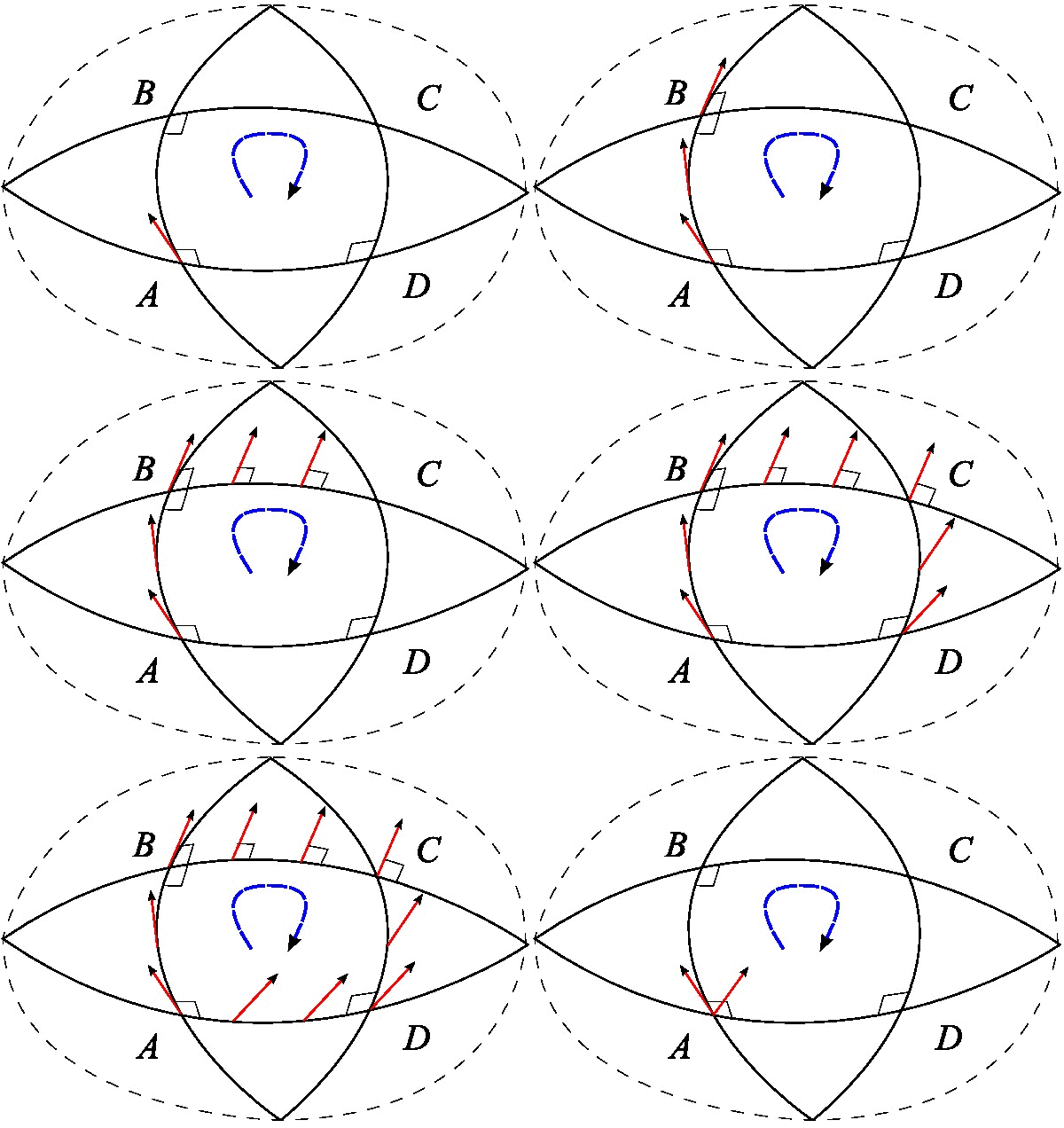
Figure 4

Upon returning to our starting point, we will have a function that describes how each of the four components of \(ds\) changed with respect to the others for each of the four legs of the journey. As such it will be a tensor with four indices (rank 4) each of which covers four dimensions, so it will have \(4^4\), or 256 components. This tensor, known as the Riemannian curvature tensor \(R^{\mu}_{\nu\rho\sigma}\), fully describes the actual curvature of spacetime at every point on the manifold. It can be specified in covariant or contravariant terms, but since it captures how a contravariant vector is affected by local covariant curvature, it’s customary to express it with one “upstairs” index and three “downstairs” ones, as shown here.

Before going any further, there are two related tensors we’re going to need (why will become apparent shortly). In Part I we discussed how a tensor object defined by N indices can be “contracted” to fewer indices by projecting one or more of the index’s components onto the others—in essence, “averaging” it into the remaining ones. For a tensor expressed in covariant form for all indices, we do this by multiplying it by the contravariant metric tensor in one or more of its indices. Contracting the Riemann tensor in this manner for two of its four indices gives,

 \(g^{\rho\sigma}R_{\mu\nu\rho\sigma} = R_{\mu\nu}\)                    [Eqn. 11]

The resulting tensor, \(R_{\mu\nu}\), is known as the Ricci tensor. Contracting it again on both of its indices yields the Ricci scalar, \(R\). These have different physical interpretations. The Ricci tensor describes the rate of change of an infinitesimal element of spacetime volume along \(ds\) due to tidal forces. That is, as we move through spacetime along a group of infinitesimally separated parallel geodesics, it describes how an element of volume between them changes in each direction. The Ricci scalar, on the other hand, gives a non-dimensional measure of how the overall enclosed volume itself changes.

Next, we need a tensor object that describes the mass, energy, and momentum we suspect to be curvature’s source. That tensor (which we won’t make any attempt to formally derive here), is known as the stress energy momentum tensor, \(T^{\mu\nu}\). Its components are defined in a manner similar to those of the metric tensor, \(g_{\mu\nu}\), but using momentum density four-vectors (momentum density in three spatial dimensions plus energy density, which can be thought of as “momentum” in time for a stationary object). Because its momentum density components are vectors, it is customary to express it in contravariant form (indices “upstairs”). The first index (\(\mu\)) gives the four-momentum components being considered, and the second (\(\nu\)) gives the direction it is being compared to. The physical significance of its components is as shown in Figure 2 (Wikimedia, 2013).


Figure 5 – The Stress Energy Momentum Tensor

With these tools in hand, we can proceed with our investigation of how mass, energy, and momentum curve space and time, but there are still a few constraints we need to account for.

First, the stress energy momentum tensor is rank 2 but the Riemann curvature tensor is rank 4 (that is, the former has two indices with 16 components, whereas the latter has 4 indices and 256 components), so we can’t just equate them to each other. Whatever effect \(T^{\mu\nu}\) has on curvature will have to manifest itself as a rank 2 curvature object as well—that is, it will have to be a contraction of the Riemann tensor that reflects the behavior we observe in gravity, so we want to know what sort of contraction will give us that.

We saw earlier that in the absence of forces, spacetime curvature manifests as acceleration. Strictly speaking, this applies only to point masses in the gravitational field of a much larger mass. For objects that have size and shape, the story changes. In Newtonian physics, the gravitational force between two masses varies inversely as the square of the distance between them (equation 9). So, if you are falling toward the earth feet first, your feet are being pulled harder than your head because they are closer to the earth’s center of gravity. Inasmuch as this is the low mass/energy/momentum limit of GR, the same will be true in curved spacetime as well. Likewise, your freefall into the earth’s gravitational well will be along a geodesic, and the deeper you go, the closer adjacent geodesics to your sides will be. Figure 3 (Wikimedia, 2008) shows what a gravitational well created by a mass as the bottom of the “pocket” looks like.3 The longitudinal lines are freefall geodesics with their steepness at each node being the strength of gravity there, and the squares enclosed by the grid can be thought of as shapes.


Figure 6 – Gravitational Well

Notice how falling into the well squeezes the latitudinal rectangles into increasingly longitudinal ones. In the earth’s relatively weak gravitational field compared to your size, the effect is too small to notice. But as you fall toward it, feet-first, you are being stretched and squeezed. This stretching and squeezing of large objects are tidal forces, and in the limit of a point mass, they reduce to simple freefall acceleration. Since in the most general terms, tidal forces are how curvature manifests, we would expect the stress energy momentum tensor to equate to a rank 2 tensor that describes them. And as we’ve seen, we have one… the Ricci tensor!

But we’re not out of the woods yet. There is one more constraint we need to honor; Another of the fundamental ones we learned in our high school physics, conservation of energy and momentum. Although neither is well-defined nor self-evidently conserved for the whole universe (or large regions of it), for locally flat inertial reference frames in the tangent planes of every point in it, both need to be conserved. This means that for every point on the manifold the divergence of the stress energy momentum tensor must be zero. That is,

\(\nabla_{\mu}T^{\mu\nu} = 0\)                   [Eqn. 12]

And here we have a problem… Tidal forces do not vanish in locally flat regions, and neither does the divergence of the Ricci tensor. If they did, falling through a black hole event horizon would be a lot less traumatic! So, our contracted curvature tensor object is going to need some tweaking.

Fortunately, the full Riemann curvature tensor itself gives us a way out. As it happens, its own internal consistency does require it to vanish locally; When curvature vanishes (as it must in local tangent planes) so does the curvature tensor. One consequence of this is that the sum of its divergences with respect to any three of its four indices must add to zero. That is,

\(\nabla_{\mu}R^{\mu }_{ \nu\rho\sigma} + \nabla_{\nu}R^{\nu}_{\mu\rho\sigma} + \nabla_{\rho }R^{\rho}_{\mu\nu \sigma} = 0\)                   [Eqn. 13]

This relationship is known as the second Bianchi identity (of which there are several). Again, we needn’t worry about its formal derivation here. But for our purposes, what matters is that with some mathematical gymnastics we can derive from it the contracted Bianchi identity,

\(\nabla_{\mu}R^{\mu\nu} = \frac{1}{2}\nabla_{\mu}g^{\mu\nu}R\)                   [Eqn. 14]

 Gathering terms gives,

\(\nabla_{\mu}\left ( R^{\mu\nu} – \frac{1}{2}g^{\mu\nu}R \right ) = 0\)                   [Eqn. 15]

And finally, by combining the Ricci tensor for tidal forces and the Ricci scalar for volumetric curvature, we have a tensor object we can equate to the stress energy momentum tensor that captures the spacetime curvature it induces while sharing with it a zero divergence that locally preserves conservation of energy and momentum. It’s customary to refer to the term in brackets as the Einstein tensor \(G^{\mu\nu}\), from which we have,

\(G^{\mu\nu} = R^{\mu\nu} – \frac{1}{2}g^{\mu\nu}R = \kappa T^{\mu\nu}\)                   [Eqn. 16]

Where \(\kappa\) is a proportionality constant which again, we won’t derive here, but turns out to be,

\(\kappa = \frac{8\pi g_c}{c^4}\)                   [Eqn. 17]

And there you have it, Ladies and Gentlemen… an equation that relates mass, energy, and momentum to spacetime curvature, and therefore gravitation!

One final question remains. Technically, equation 16 is arbitrary to within an additive constant as well. When Einstein first derived this relationship, he realized that it predicted a universe that was necessarily expanding or contracting, and thus impermanent. The idea of a universe that wasn’t eternal was philosophically abhorrent to him, so he included a constant term on the left (typically denoted with the Greek letter \(\Lambda\)), multiplied by the metric tensor for consistency and sized to offset the expansion, thereby preserving a curved, but static and eternal universe. Later, when it was independently confirmed that the universe is in fact, expanding (a fascinating story in its own right!), Einstein retracted the constant calling it “the greatest mistake of my life.” But as it turns out, it wasn’t. It has since been discovered that the cosmological constant is not only real, but positive and causing the expansion of the universe to accelerate! The discovery was so striking that the leaders of the team who discovered it, Saul Perlmutter, Brian Paul Schmidt, and Adam Guy Riess were jointly awarded the 2011 Nobel Prize in physics.

So… combining equations 16 and 17 with all terms expressed as covariant (which is customary), and restoring the cosmological constant to its rightful place we have,

\(G_{\mu\nu} + \Lambda g_{\mu\nu} = \frac{8\pi g_c}{c^4} T_{\mu\nu}\)                   [Eqn. 18]

These are the celebrated Einstein Field equations that are the hallmark of general relativity. The terms on the left fully describe the geometry of spacetime for all observers at every point in the universe, and the term on the right describes the mass, energy, and momentum that produces that geometry.

This was meant to be an introduction to spacetime curvature, so we’ve arrived at them with some big leaps and little in the way of formality. Though at first blush they may seem daunting and difficult to wrap your mind around, the important thing for today is an understanding of what the terms in these equations mean, and why they must have the general forms they do to describe how length, height, breadth, and duration can be curved. For those who want to explore further, there any number of good introductions to general relativity for the layperson. One that I found particularly readable and informative was Clifford Will’s book Was Einstein Right – Putting General Relativity to the Test (1993), first published in 1986 when I was in grad school. If you feel ready to make the deep dive into the full formalism of general relativity, there are many textbooks on the subject. But if there is one that has stood for many years as the Bible of general relativity, it’s Misner, Thorne, and Wheeler’s Gravitation (2017). It’s rigorous and will take some time to wade through, but it’s the best, and most thorough general relativity course I am personally aware of and has been since it was first published in 1973.

The psalmist tells us,

“The heavens are telling the glory of God; and the firmament[a] proclaims his handiwork. Day to day pours forth speech, and night to night declares knowledge. There is no speech, nor are there words; their voice is not heard; yet their voice goes out through all the earth, and their words to the end of the world.” – Psalm 19:1-4

When I gaze up at the nighttime sky, I see stars that are hundreds of light years away, many of which are surrounded by worlds, possibly even worlds not unlike my home. And I realize that I’m gazing upon those stars and worlds not as they are now in my reference frame, but as they were centuries ago. If I were to turn a large enough telescope on that sky I would see galaxies, quasars, nebulae, and a bewildering spectacle of other wonders, some of which are billions of years old and revealing themselves to me from a time long before humans or even our solar system existed. And if I filter their light through a spectrometer, I will see the fingerprints of their chemical constituents shifted increasingly toward the red the more distant they were, and I would realize that I was watching the universe grow—not as an expansion of matter into a pre-existing void, but literally the expansion of space and time themselves from a cataclysmic birth 13.73 billion years ago. I would see in that the glory of God and his handiwork…

And I would suspect, as J.B.S. Haldane did a century ago, the handiwork of God, where length, breadth, height, and duration are themselves clay in His artistic hands, is not only queerer than I suppose, but queerer than I can suppose.

Footnotes

1)  In Part I we introduced the nabla symbol on the left (\(\nabla_{\mu}\)), which in mathematics is known as the Laplace operator. It is a shorthand reference for the gradient (first derivative) in the direction of a vector defining the \(\mu\) coordinate system. That is, \(\nabla_{\mu} = \frac{\partial }{\partial x_0} + \frac{\partial }{\partial x_1} + \frac{\partial }{\partial x_2} + \frac{\partial }{\partial x_3}\) where the index \(\mu\) = 0, 1, 2, 3. This representation of a gradient in a particular direction is also referred to as the divergence.

2)  Interestingly, this isn’t just theoretical. Google and Apple map apps leverage first-order corrections for spacetime curvature near the earth’s surface to refine the accuracy of your location from raw GPS triangulated signals. General relativity is literally why your phone knows your location to within a couple hundred feet or so rather than one or two city blocks!

3)  Strictly speaking, this is a 2-D gravitational well with absolute time rather than a true 4-D gravitational which would include time. But for the current purpose, it suffices to illustrate the point.

References

Misner, C.W., Thorne, K.S. & J.A. Wheeler. 2017. Gravitation. Princeton University Press (Oct. 24, 2017). ISBN-10: 9780691177793, ISBN-13: ‎978-0691177793. Online at https://www.amazon.com/Gravitation-Charles-W-Misner/dp/0691177791/ref=sr_1_1?crid=1OKXLNQA5YVAR&keywords=gravitation&qid=1694219167&sprefix=gravitation%2Caps%2C253&sr=8-1&ufe=app_do%3Aamzn1.fos.18630bbb-fcbb-42f8-9767-857e17e03685.  Accessed Oct. 9, 2023.

Wikimedia. 2008. Image courtesy of AllenMcC. Based on the work of Bamse, and Melchoir, CC BY-SA 4.0, Mar. 2, 2013. Online at https://commons.wikimedia.org/wiki/File:GravityPotential.jpg. Accessed Oct. 9, 2023.

Wikimedia. 2013. Image courtesy of Maschen. Based on the work of Bamse, and Melchoir, CC BY-SA 4.0, Mar. 2, 2013. Online at https://commons.wikimedia.org/w/index.php?curid=24940142. Accessed Oct. 9, 2023.

Wikimedia. 2015. Image courtesy of IkamusumeFan, CC BY-SA 4.0, Jan. 1, 2015. Online at https://commons.wikimedia.org/w/index.php?curid=2615879. Accessed Oct. 9, 2023.

Will, C.N. 1993. Was Einstein Right? – Putting General Relativity to the Test. Basic Books; 2nd edition (June 2, 1993). ISBN-10: ‎0465090869; ISBN-13: ‎978-0465090860. Online at https://www.amazon.com/Was-Einstein-Right-Putting-Relativity/dp/0465090869/ref=sr_1_1?crid=TOG1ZAWGPF20&keywords=was+einstein+right&qid=1696883510&sprefix=was+einstein+right%2Caps%2C171&sr=8-1. Accessed Oct. 9, 2023.

Curvature I: Space

My own suspicion is that the Universe is not only queerer than we suppose, but queerer than we can suppose. – J.B.S. Haldane (Possible Worlds and Other Papers, 1927)

I was born hopelessly curious and under the tutelage of a nurturing teacher and parents who surrounded me with books, I fell in love with physics in the 2nd grade—when all my friends were enthralled with Batman, jets, and G.I. Joe. What drew me to it was the wonder of mysteries I couldn’t wrap my budding mind around, and chief among these was the notion that space, and time could be curved. I remember pouring over my parent’s Time-Life encyclopedia set which among other things, contained a full-color plate titled “Three kinds of space” featuring gridded surfaces shaped like a sphere, a pancake, and a saddle labeled +1, 0, and -1 respectively (the Friedmann constants, although of course, I didn’t know that then). I remember gazing at them struggling to understand… How can length, breadth, height, and duration be bent…? What does that even mean…? The question became even more mind-numbing when I later discovered that there can be spaces with more than three or four dimensions—indeed, an infinite number of dimensions—and these can all be curved as well. It wasn’t until well into graduate school that I started to get a shaky footing in that recondite landscape.

As three-dimensional beings, most of us grasp curvature visually. We can see curved lines and sheets against the backdrop of three dimensions because they bend into the other dimension/s. But how can three-dimensional space (or more properly four-dimensional space-time) bend when there are no other dimensions to bend into? The key to understanding this is to approach the question not by trying to visualize higher-dimensional spaces, but by exploring them with a mathematically based thought experiment physicists and mathematicians refer to as parallel transport. Let’s introduce two explorers: Flat Freddy who lives in a two-dimensional flat universe, and his sister Curved Cathy who lives in a curved one. For them, there is no third dimension much less any higher ones.

Parallel Transport

Let’s start with Freddy, placing him at the vertex of a triangle with two parallel vectors oriented along his direction of travel, one red and one green (Figure 1).

Figure 1

Now, let him go for a walk around the triangle’s perimeter in the direction the vectors are pointing, leaving the green vector behind, and taking the red one with him while ensuring that for the entire journey it remains oriented in the same direction (as we will soon see, this matters). Completing the first leg of the journey, he arrives at point B (Figure 2) with his red vector still parallel to the green one, and unchanged from its original orientation (light red).


Figure 2

Then, let’s have him journey an equal distance to the right at a 90-degree angle. When he arrives at point C, his red vector is still parallel to the green one and its previous orientations (Figure 3).


Figure 3

Finally, let’s take Freddy back home and reunite his two vectors. When Freddy checks his compass, he sees that point A is to his left and back at a 45-degree angle to the BC leg he just covered. When he arrives home again, he finds that his red and green triangles are still parallel to each other, exactly as they were when he began, and remained throughout his trek (Figure 4).


Figure 4

Getting his map out, Freddy sees that his journey traversed a right triangle with two 45-degree angles, the final leg of which covered a distance given by the Pythagorean Theorem,

\(\overline{AC} = \sqrt{({\overline{AB})^{2}} + ({\overline{BC})^{2})\)            [Eqn. 1]

And enclosed an area given by,

\(A = \frac{X^{2}}{2}\)           [Eqn. 2]

Where \(X\) is the length of \(\overline{AB}\) (or \(\overline{BC}\)). No surprises here. This is exactly what earth-bound three-dimensional creatures like us would expect.

Parallel Transport in Curved Space

Now, let’s have Cathy take the same journey in her universe. For clarity’s sake, let’s assume her universe is spherical with a “radius” that will better illustrate the outcome (more on why that word is in quotes soon). Like Freddy, we’re going to have her walk a triangular path beginning at point A with parallel red and green vectors, both tangent to the straightest path from point A to point B (Figure 5). As before, she will leave the green vector behind while carrying the red one with her, keeping it oriented in the same direction throughout. This time however, things are going to be a little more subtle. In Freddy’s universe the meaning of “straight” is clear enough. But as we will soon see, in Cathy’s this term will require a more precise definition.


Figure 5

When she completes the first leg of her journey at point B, her red vector hasn’t changed orientation. It is still pointing straight ahead, tangent to her path of travel (Figure 6).

Figure 6

Following in Freddy’s footsteps, she then journeys an equal distance to the right at a 90-degree angle, arriving at point C with her red vector still unchanged in direction (Figure 7).


Figure 7

Cathy has now travelled the same route from point A to point C that Freddy did in his universe and covered the same distance getting there. But now, something is amiss. When she checks her compass, she finds that point A isn’t to the left of her BC leg and 45 degrees back. Home is now 90 degrees to her left. Even more strangely, upon arriving home (Figure 8) she sees that her red vector is no longer parallel to the green one as it was when she started (light red). Now it is oriented at 90 degrees to it, even though it remained pointed in the same direction for the entire trip!

Figure 8

Furthermore, when she gets her map out, she sees that unlike her brother, she has traversed an equilateral triangle whose inner angles add up to 270 degrees rather than 180 degrees. And even though the final leg of her journey was noticeably shorter than Freddy’s, she traversed a larger region. Having studied higher mathematics at Flatland University, she is familiar with higher-dimensional spaces than the two dimensional one she knows, and an equilateral triangle with three 90-degree interior angles sounds suspiciously like a higher-dimensional sphere. Sure enough, when she measures the area enclosed by her journey, she finds that it is given by,

\(A = \frac{\pi R^{2}}{2}\)           [Eqn. 3]

Where \(R\) is a parameter that behaves mathematically like the radius of a three-dimensional sphere even though in her universe, there is no third dimension to contain one.

Note that Cathy’s conclusions were based only on measurements of distance and area, and the orientation of a vector she carried with her around a closed two-dimensional path. At no time did she step “outside” of her space into a third dimension from which the radius of a 3-D sphere could be observed. What she measured is simply a parameter that behaves like one in area calculations. Of course, Figures 5-8 are shown in 3-D perspective for heuristic purposes, but beyond that, there is no need for Cathy to postulate any higher dimensions to explain what she sees. As far as she knows, in her universe only two dimensions exist. How could Cathy’s two-dimensional universe be “spherical” when the sphere of our experience is a three-dimensional shape?

Straight vs. Geodesic

To answer this question, let’s go back to the turn of the 3rd Century B.C. when the Greek Mathematician Euclid published his Elements. In it, he laid the foundation of geometry in our three-dimensional space and Freddy’s two-dimensional one with five axioms, or postulates. Of these, four are interdependent in that each one can be formally derived from the remaining three. The remaining one, his fifth postulate, he stated as follows,

If a line segment intersects two straight lines forming two interior angles on the same side that are less than two right angles, then the two lines, if extended indefinitely, meet on that side on which the angles sum to less than two right angles. – (Heath, 1956)

It follows from this that if the two interior angles formed are equal to two right angles, those lines will never meet. Though Euclid doesn’t specifically say so, this would make the two lines parallel, which led 19th Century Scottish mathematician John Playfair to restate it in what today is perhaps its most popular version,

There is at most one line that can be drawn parallel to another given one through an external point.

For centuries, the fifth postulate troubled mathematicians because reasonable as it may seem, it’s entirely ad hoc. It has no interdependence with the other four and is superfluous to a complete formalism of Euclidean geometry. It was only a matter of time until people began to wonder what geometric doors would be opened if it were discarded.

The first step in that direction is a reexamination what we mean by straight and parallel. Like Freddy, most of us think of a line as straight if it is one-dimensional in the sense of having no curvature—or more formally perhaps, if all points on it share a common tangent vector in one direction. Likewise, we think of two lines as parallel if they lie within a common two-dimensional plane and are aligned in the same direction with no intersection point. Indeed, this is how mathematicians defined both terms for many centuries, and to this day Euclid’s fifth postulate is often referred to as his parallel postulate. But if it proves to be superfluous to the formalism of Euclidean geometry then non-Euclidean geometry becomes possible and these definitions will need to be revisited.

Without the fifth postulate, on an N-dimensional manifold (or space), a curve connecting any two points \(A(x_1, x_2, …, x_N)\) and \(B(x_1, x_2, …, x_N)\) is said to be straight if, and only if it is the shortest distance between them on the manifold. In a flat space like Freddy’s (or ours), this reduces to our intuitive definition above, but that definition alone does not constrain manifolds to be flat. This suggests that if we want to quantify how paths between events are traversed in universes like Cathy’s, our mathematical descriptions need to be revised, and our parallel transport thought experiment gives us a clue as to how.

Modeling Curved Geometry

A full mathematical treatment of general relativity is beyond our scope today, but we can get our feet wet with an overview of the tools it will require. To model any N-dimensional space, be it flat or curved, there are two fundamental requirements we must meet.

First, we need a way to describe not only distances, but angles. To do that we will need to define at least two vectors at every point on it, \(r^{\mu}\) and \(r^{\nu}\), where the indices \(\mu\) and \(\nu\) denote the N coordinates of each. Strictly speaking, they can be specified in any coordinate system of our choosing, and oriented in any non-parallel direction we like, but ideally, we want them to be orthogonal to each other (as shown in Figure 9) so that they define a coordinate system/s themselves. With these, we can then use a vector inner product, or dot product of them to define a matrix function \( g_{\mu\nu}\) whose squared diagonal terms can be summed to give the squared distance along any interval, and whose off-diagonal terms are the dot product projections of each vector’s components onto those of the other. This function, which is referred to as the metric tensor,1 contains within its \(N^{2}\) components a description of all lengths and trigonometric relationships between the two vectors.2  [Aron discusses this at length in his 2012 post All points look the same.]

Figure 9

Neglecting time for simplicity (we’ll get to this later), in a flat 2-D space like Freddy’s, the two vectors will not have components that lie along each other so the off-diagonal terms will be zero, and the vectors are chosen so that their lengths define units in our chosen coordinate system,3  the diagonal terms will be 1 and the sum of their squares defines the Pythagorean theorem. Thus,

            [Eqn. 4]

Second, we need to ensure that our models preserve one of the most sacred principles in physics—namely, that the universe exists independent of us, so its behavior should be independent of how we choose to describe it. If the most fundamental laws of physics are different here and now in this coordinate system and units than it is there and then in those coordinates and units, that would imply that we have an unreasonably unique status in it. In our hearts, we know that isn’t the case, so our descriptions of it should look the same in all frames of reference and units. In physics this is referred to as the principle of general covariance.

To do this we need to account for the fact that some quantities behave differently under a change of scale in coordinate system units. For instance, if the vector \(r^{\mu}\) is one meter long, it will have a length of 1 in a coordinate system specified in meters. But if the scale is changed to centimeters, its length will be 100. The same will apply to angles. The vector itself remains the same—what has changed is its representation in a rescaled coordinate system. Quantities that behave this way are said to be contravariant because their size will vary counter to variations in the scale of units they’re represented with.

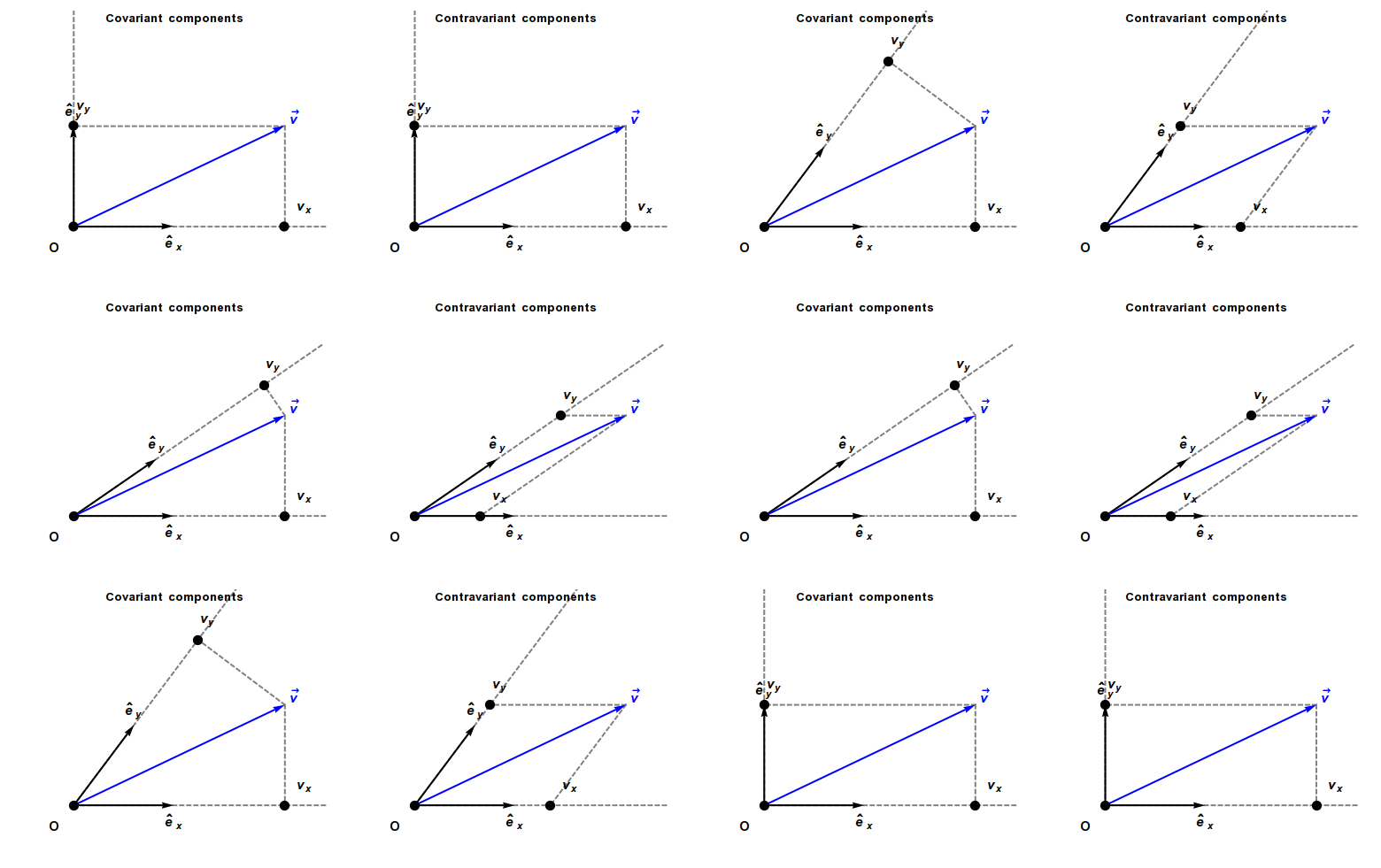
On the other hand, there are quantities such as gradients for which this isn’t the case. A 6% grade is a 6% grade whether we specify it in meters/meter or cm’s/cm, so rescaling coordinate systems will vary length specifications along any coordinate axis, but not the gradient in that direction. The metric tensor \(g_{\mu\nu}\) is such an object. As we’ve seen, it’s effectively a generalized dot product between local coordinate system axes. Since its components give their projections onto each other, it behaves like a gradient under coordinate system transformations. Quantities like this are said to be covariant because they retain their values regardless of how their coordinate system scale is varied. The difference is shown in Figure 10 (Wikimedia, 2018).

Figure 10

This may seem like hair-splitting, but when we move from the realm of absolute flat spaces to that of curved geometries, the difference matters. Some quantities like vectors, lend themselves to a contravariant description whereas others, like gradients, lend themselves to a covariant one. In the parlance of general relativity, it’s customary to specify the indices of the former with superscripts (“upstairs”) and the latter with subscripts (“downstairs”). Each type of tensor can be converted into the other by multiplying with an appropriately dimensioned factor (which is referred to as “raising or lowering indices”), but things are a lot clearer when we stick to representing each in the form that is most natural to them. As such, objects like vectors whose specifications vary under a rescaling multiple coordinate axes are typically specified with “upstairs” indices and those like the metric that behave more like gradients use “downstairs” ones.

With these qualifications, let’s revisit our earlier parallel transport experiments and put some flesh on the bones. In Figure 9 we saw that in Freddy’s universe, \(r^{\mu}\) and \(r^{\nu}\) will be the same everywhere and so will \(g_{\mu\nu}\). It makes no difference where (or when) we place any coordinate system. But what about Cathy’s universe? At point A, a small surrounding region will be approximately flat and represented by a tangent plane containing \(r^{\mu}\), \(r^{\nu}\) centered on it (Figure 11). Now, let’s define a third tangent vector \(s^{\sigma}\) along our parallel transport path from A to B.

Figure 11

Once again, we walk the path from A to B in the direction \(ds^{\sigma}\) as in Figures 5 and 6, carrying the tangent plane and \(r^{\mu}\) and \(r^{\nu}\) with us (Figure 12).


Figure 12

At each point in the path, \(r^{\mu}\), \(r^{\nu}\), and \(s^{\sigma}\) are still oriented in the same directions with respect to any local coordinate system, and the latter remains parallel to the path we’re travelling. When we arrive at B, we see that things still look the same to us as they did when we started. But this time the local tangent plane and coordinate systems we carried with us have twisted with respect to where they were at A and no longer looks the same to an observer who stayed behind.

In Freddy’s universe, one tangent plane uniquely spans the entire space. All distances and angles look the same from any reference frame within it, and carrying vectors such as \(r^{\mu}\) and \(r^{\nu}\) from one point to another is just a matter of summing displacements along any given path between them. But in a curved space like Cathy’s, we need a mathematical object that not only describes displacements along a path, but also one that maps that path onto the local tangent planeas it rolls across the curved surface as shown in Figure 13 (Wikimedia, 2023).

Figure 13

This object, which mathematicians refer to as an affine connection, allows us to describe vectors along any path through a larger curved space in terms of a fixed coordinate system within the local tangent plane at any point. An infinite number of such connections are possible but there is one, known as the Levi-Civita connection, that is a natural choice for spaces that have a well-defined metric tensor at every point because it allows us to define a derivative (or rate of change) along a curved space path that generalizes the usual mathematical rules of vector calculus in locally flat tangent plane regions to the larger curved space. This covariant derivative (which we denote with the nabla symbol 4) will need to have two parts and is given by,

\(\nabla_{\mu} = \partial_{\mu} + \Gamma^{\sigma}_{\mu\nu}\)           [Eqn. 5]

For an infinitesimal displacement along any path, the first term on the right is the gradient with respect to the local tangent plane as defined in the usual flat space manner. The second term is the rate at which the tangent plane itself (and the covariant metric tensor embedded in it) is changing in the direction of a contravariant displacement \(ds^{\sigma}\) in the direction of a tangent vector to the path. As such, it will be matrix function with three indices, two of which are best represented as covariant and a third contravariant one which we will denote with the index \(\sigma\). This function, which per convention we designate with a capital Greek Gamma, is known as a Christoffel symbol. Since it requires three indices to fully capture the evolution of the metric tensor, in Cathy’s space it will have 23, or 8 components to her metric tensor’s 4. We refer to Christoffels as “symbols” because they aren’t true tensors in that they aren’t globally frame-independent until multiplied by an infinitesimal displacement in at least one direction. And as shown, equation 5 doesn’t make sense because the indices on the right and left sides don’t agree with each other. More properly, it defines a mathematical operator that must act on something to produce a meaningful equation. Applying it to \(ds^{\sigma}\) gives,

\(\nabla_{\mu}s^{\sigma} = \partial_{\mu}s^{\sigma} + \Gamma^{\sigma}_{\mu\nu}s^{\nu}\)           [Eqn. 6]

With the upstairs and downstairs \(\nu\) in the second term cancelling, this equation is now consistent across indices and the Christoffel term behaves like a tensor. This path derivative will look the same from every coordinate system in Cathy’s curved space. In flat spaces like Freddy’s, the tangent plane is the same everywhere and unchanging so the Christoffel term will vanish leaving us with the usual Euclidean directional derivative we learned in first-year vector calculus.


For today’s purposes we needn’t worry about how these equations were derived. The important thing is to understand why curved spaces require these kinds of mathematical tools rather than the familiar ones of Euclidean geometry, and how they reflect curvature in multiple dimensions without additional dimensions to “curve into.” If you’re like me, the latter point is the biggest stumbling block. It’s one thing to know that curved spaces are mathematically possible without additional background dimensions. But it’s another thing altogether for three-dimensional Euclidean space beings to visualize them. Space (or spacetime) can be curved in one of two ways: positive, or negative.5 Positively curved space is spherical and, if extended far enough, finite and closed. In our previous example, Cathy’s universe is a spherical one. And as we saw, the interior angles of a triangle in such a space add to greater than 180 degrees. Her space is finite in size, and travelling in a straight line in any direction will eventually return you to where you started from. Negatively curved space is saddle-shaped and has hyperbolic geometry. The interior angles of a triangle in it would add to less than 180 degrees, and like flat Euclidean space, it extends to infinity in all directions. Figure 14 shows both as compared to flat space.

Figure 14

It’s easy to visualize two-dimensional curved spaces like these in isometric views that show their contours in an additional dimension. But what would they look like where there was none?

In the case of a positively curved space, we can’t do this because there is no way to represent a path that returns to where it started in the same number of dimensions.6 But for negatively curved spaces that extend to infinity, we have a visual example in the art of 20th Century Dutch graphic artist M.C. Escher. Among other things, Escher was known for artistic renderings of mathematical concepts including symmetries and tessellation. His Circle Limit collection of wood carvings depict repeating image patterns whose changing shapes from the center outward are a tessellation of hyperbolic geometry on a disc into right triangles. His 1959 work Circle Limit III (Figure 15), widely regarded as the best in the series, does this with patterns of fish.


Figure 15

There are many ways to tessellate geometric spaces and none are perfect, including this one. But if Cathy’s two-dimensional space was negatively rather than positively curved, this would be a reasonable representation of how it would look to her. If she walked a parallel transport path through it as in figures 5-8 taking the size and orientation of the fish as indicative of distances and angles, upon returning to where she started, she would find that the distances and interior angles she traced would be like those in the negatively curved saddle in figure 14. And if she travelled a straight geodesic path in any direction indefinitely, she would asymptotically reach infinity as she approached the rim. The disc is two-dimensional, but the geometry embedded in it behaves as though it were a saddle-shaped sheet in three dimensions even though the third dimension isn’t there. The underlying mathematics of its hyperbolic (saddle) geometry are embodied in Equation 6. And while we have until now restricted ourselves to two-dimensional spaces for ease of illustration, notice that the indices in its terms can assume any number of values, not just two. As such, it generalizes to any number of curved dimensions, none of which need any “higher” dimension/s to curve into.

There is, however, one dimension that we’ve conspicuously ignored until now… time. We live in a universe where not only length, breadth, and height can be curved, but duration can be as well, and curved spacetime ups the ante in several important respects that we’ll dive into in Part II. So, stay tuned!
 
Curvature II: Spacetime
 

Footnotes

1)   In mathematics, tensors are matrix functions that define a multilinear relationship between sets of objects in a vector space that preserve their identity in any coordinate system or transformation. Vectors can be thought of as a one-dimensional tensor (that is, a tensor with only one column or row). The dimensionality of a tensor’s matrix array (as specified in the number of indices it requires) is referred to as its rank \(R\), and the number of components it will have in an N-dimensional space is given by \(N^{R}\). Thus, \(g_{\mu\nu}\) is a rank 2 tensor that in Freddy’s 2-D space will have four components, and in our 4-dimensional spacetime has 16.

2)   Strictly speaking, the metric tensor isn’t really a true dot product. Rather, it is a generalization of the familiar dot product of Euclidean geometry to the pseudo-Riemannian geometry constrained by special relativity, where time behaves differently than space (more on this in Part II). But for our current exploration of 2-D spatial curvature, this needn’t concern us.

3)   Mathematicians refer to this as an orthonormal basis that spans the space.

4)   In mathematics, the nabla symbol (\(\nabla_{\mu}\)) is known as the Laplace operator. It is a shorthand reference for the gradient (first derivative) in the direction of a vector defining the \(\mu\) coordinate system; That is, \(\nabla_{\mu} = \frac{\partial }{\partial x_0} + \frac{\partial }{\partial x_1} + \frac{\partial }{\partial x_2} + \frac{\partial }{\partial x_3}\) where the index \(\mu\) = 0, 1, 2, 3. This representation of a gradient in a particular direction is also referred to as the vector’s divergence.

5)   The reasons for this are mathematical and beyond the scope of this discussion.

6)   This is because spherically curved space has a different topology than flat and negatively curved spaces. In mathematics, topology is the study of a manifold’s geometric properties that are preserved when it is stretched or deformed without cutting or sewing, opening or closing holes, or passing it through itself. Negatively curved space has the same topology as flat space because a flat rubber sheet can be stretched to form a saddle. By contrast, a positively curved space cannot be flattened or deformed into a saddle without cutting and forming edges (e.g. – a Mercator projection). There is no way to create a flat representation of it that preserves great circle paths that end where they began without encountering an edge. Likewise, a toroid (donut) cannot be deformed into a sphere or a saddle without cutting and sewing edges, so it has a higher-level topology than negatively or positively curved spaces.


References

Heath, T.L. ed., 1956. The thirteen books of Euclid’s Elements. Courier Corporation. Online at https://books.google.com/books?hl=en&lr=&id=mvBIAwAAQBAJ&oi=fnd&pg=PP1&dq=euclid+elements&ots=ed2L7zetPz&sig=wPKfMQ22SZvf4gF_83USfDwb0oY#v=onepage&q=euclid%20elements&f=false. Accessed Sept. 28, 2023.

Wikimedia. 2018. Image courtesy of Jacob Bertolotti. Online at https://commons.wikimedia.org/wiki/File:Covariantcomponents.gif. Accessed Sept. 28, 2023.

Wikimedia. 2023. Image courtesy of Silly rabbit, CC BY-SA 3.0. Online at https://commons.wikimedia.org/w/index.php?curid=2615879. Accessed Sept. 28, 2023.

In the Valley of the Shadow of Death

A lesson from Martin Luther on walking in faith during pandemics.

By Scott Church – Guest Blogger

After decimating nearly one-third of Europe during the 14th Century, the Bubonic plague continued to ravage it in periodic epidemics before it was effectively eradicated in the mid-20th Century (White, 2014; Schiferl, 1983; Griggs, 2014). For the most part, these outbreaks were isolated to villages or regions, and it was possible to flee to safety elsewhere until they subsided. In August of 1527, one such outbreak came to Wittenberg while Martin Luther was at the university there, and Elector Johann Hess of Saxony ordered him and other professors to flee to Jena for safety.

Luther refused, choosing instead to stay behind with his wife Katharina von Bora and open their home as a ward for the sick, whom they cared for at great personal risk to themselves. He penned a letter to Elector Johann explaining his reasons (Luther, 2020). Five centuries later, in the age of COVID-19, his words and the testimony of his life show us what true God-fearing faith during pandemics is… and more importantly, what it is NOT.

In his words,

“[W]hoever serves the sick for the sake of God’s gracious promise… has the great assurance that he shall in turn be cared for. God himself shall be his attendant and his physician, too. What an attendant he is! What a physician! Friend, what are all the physicians, apothecaries, and attendants in comparison to God? Should that not encourage one to go and serve a sick person, even though he might have as many contagious boils on him as hairs on his body, and though he might be bent double carrying a hundred plague-ridden bodies! … Therefore, dear friends, let us not become so desperate as to desert our own whom we are duty-bound to help and flee in such a cowardly way from the terror of the devil, or allow him the joy of mocking us and vexing and distressing God and all his angels…”

True disciples don’t deliberately put themselves in harm’s way out of mere fealty to church doctrine, or to appease worldly narratives and political agendas others have tarnished it with for reasons that serve their own interests rather than God’s. They do so in loving service to their neighbor. In the words of the apostle Paul, they offer themselves as living sacrifices, holy, acceptable to God, which is their reasonable service (Rom. 12:1).

Note the reference to reasonable service (from the KJV Bible)—Or as the Amplified Bible renders it, “rational (logical, intelligent) act of worship.” Genuine faith sees the face of Jesus in the poor, the oppressed, and the sick, and with full rational knowledge of the risks involved, seeks to be His healing face in their lives. It is in THAT place that we trust God’s Will for our best, and our neighbor’s.

By contrast, Luther tells us, there are those who,

“Sin on the right hand. They are much too rash and reckless, tempting God and disregarding everything which might counteract death and the plague. They disdain the use of medicines; they do not avoid places and persons infected by the plague, but lightheartedly make sport of it and wish to prove how independent they are. They say that it is God’s punishment; if he wants to protect them he can do so without medicines or our carefulness.”

This sort of “faith” will have nothing to do with reason (logic, intelligence). It flies recklessly in the face of real-world facts, rejects medicine, makes no attempt to socially distance from the sick, and even goes so far as to make fun of those who do, simply to assert its independence… that is, freedom.

Sound familiar…?  ;-)

According to Luther,

“This is not trusting God but tempting him. God has created medicines and provided us with intelligence to guard and take good care of the body so that we can live in good health… If one makes no use of intelligence or medicine when he could do so without detriment to his neighbor, such a person injures his body and must beware lest he become a suicide in God’s eyes. By the same reasoning a person might forego eating and drinking, clothing and shelter, and boldly proclaim his faith that if God wanted to preserve him from starvation and cold, he could do so without food and clothing. Actually that would be suicide.

It is even more shameful for a person to pay no heed to his own body and to fail to protect it against the plague the best he is able, and then to infect and poison others who might have remained alive if he had taken care of his body as he should have. He is thus responsible before God for his neighbor’s death and is a murderer many times over. Indeed, such people behave as though a house were burning in the city and nobody were trying to put the fire out. Instead they give leeway to the flames so that the whole city is consumed, saying that if God so willed, he could save the city without water to quench the fire…”

True disciples are rational (logical, intelligent). They embrace science, medicine, and socially responsible behavior—not out of license masquerading as “freedom,” but because they are responsible to God for their own health, and… [wait for it] … their neighbor’s. To do otherwise—to reject their reasonable service, which is holy, acceptable to God—is to tempt Him rather than trust Him, and in so doing, become a murderer plain and simple.

In summary, he tells us,

“No, my dear friends, that is no good. Use medicine; take potions which can help you; fumigate house, yard, and street; shun persons and places wherever your neighbor does not need your presence or has recovered, and act like a man who wants to help put out the burning city. What else is the epidemic but a fire which instead of consuming wood and straw devours life and body? You ought to think this way: Very well, by God’s decree the enemy has sent us poison and deadly offal. Therefore I shall ask God mercifully to protect us. Then I shall fumigate, help purify the air, administer medicine, and take it. I shall avoid places and persons where my presence is not needed in order not to become contaminated and thus perchance infect and pollute others, and so cause their death as a result of my negligence. If God should wish to take me, he will surely find me and I have done what he has expected of me and so I am not responsible for either my own death or the death of others. If my neighbor needs me, however, I shall not avoid place or person but will go freely, as stated above. See, this is such a God-fearing faith because it is neither brash nor foolhardy and does not tempt God.”

Nor is this restricted to personal faith only. It is a calling to the church and community as well,

“’Whoever loves danger,’ says the wise man, ‘will perish by it’ (Ecclus. 3:26). If the people in a city were to show themselves bold in their faith when a neighbor’s need so demands, and cautious when no emergency exists, and if everyone would help ward off contagion as best he can, then the death toll would indeed be moderate. But if some are too panicky and desert their neighbors in their plight, and if some are so foolish as not to take precautions but aggravate the contagion, then the devil has a heyday and many will die. On both counts this is a grievous offense to God and to man…”

To these ends, Luther’s exhortation to “make use of medicine and intelligence” is particularly timely for us. When diseases broke out in his world, one had only two options—do your best to avoid them; and pray for a healthy recovery if you don’t succeed. We, on the other hand, have been blessed with five centuries of advances in virology, immunology, and medicine his world didn’t have. And of all the blessings at our fingertips in the age of COVID-19, one stands out more than any other—the one that allows us to arm ourselves against it, and possibly even eradicate it… vaccines. Unfortunately, many people still aren’t getting them, which is keeping widespread herd immunity out of reach. In the United States in particular, many are flat-out refusing vaccination for ideological reasons, not the least of which is a general hostility toward science and public health measures that from all appearances, no amount of evidence or logic will ever be able to penetrate. Many others, however, are hesitant due to concerns about how safe and effective COVID vaccines are (especially considering public health recommendations to continue masking and social distancing even after vaccination) but can otherwise be reasoned with if these concerns are addressed. They can be.

COVID vaccines are effective

As of this writing, three COVID-19 vaccines are in general use in the United States: The messenger RNA-based (mRNA) vaccines manufactured by Pfizer and Moderna, and the Johnson & Johnson adenovirus-based “one-shot” vaccine. All three have been thoroughly tested and approved by the FDA (Tanne, 2020; Oliver, 2020). The AstraZeneca adenovirus-based vaccine has also been approved for general use in Europe (EMA, 2021). Demonstrated efficacies of mRNA-based vaccines against infection or symptoms requiring hospitalization from the original wild strains of SARS-COV-2 are 95-97% for the Pfizer–BioNTech BNT162b2, and 92-95% for Moderna mRNA-1273. Corresponding figures for the Johnson & Johnson [J&J] Ad26.COV2.S and AstraZeneca–Oxford ChAdOx1 nCov-19 vaccines are around 67-72% (Haas et. al., 2021; Tenforde et. al., 2021; Callaway, 2021; Noor, 2021; Polack et. al., 2020; Mahase, 2020; Olliaro et. al., 2021; Mallapaty & Callaway, 2021).

As of Sept. 2021, these figures are still holding up well, even against recent variants such as B.1.617.2, or Delta. Per multiple studies in Europe and North America, effectiveness of the Pfizer–BioNTech vaccine against the more robust and transmissible Delta variant ranges from 79% to 88% for infection and symptomatic illness, and 89% to 100% (!) for hospitalization (Tregoning et. al., 2021; Lopez Bernal et. al., 2021; Baraniuk, 2021; CDC, 2021).

For all vaccines collectively, one recent study in New York found overall age-adjusted effectiveness against new COVID-19 cases and hospitalizations to be 75% and 89.5% to 95.1% respectively (Rosenberg et. al., 2021). A similar recent study in England found 50-60% effectiveness against infection by Delta (symptomatic or otherwise), including the less effective one-shot ones such as J&J (Smout, 2021). Even a single immunization has been shown to boost neutralizing titers against all variants and SARS-CoV-1 by up to 1000-fold (Stamatatos et. al., 2021), and one study of new COVID-19 cases in Kentucky during May and June of 2021 found that those who were vaccinated were 2.34 times less likely to be infected than those who had previously had COVID-19 and survived but weren’t vaccinated (Cavanaugh et. al., 2021). One recent study in Israel did find an effectiveness of only 64% for Pfizer–BioNTech BNT162b2 against infection and symptomatic illness (Hass et. al., 2021). However, it was based on incidence rates in subjects who were considered fully vaccinated one week after receiving their second dose, whereas per U.S. CDC guidelines, one isn’t considered fully vaccinated until two weeks after their second dose (CDC, 2021b).

If one does contract COVID-19 after vaccination, severe symptoms, hospitalizations, and deaths among breakout cases are almost an order of magnitude lower than those among the unvaccinated. Even in the case of the more vaccine-resistant Delta variant, the Pfizer–BioNTech BNT162b2 and Moderna mRNA-1273 vaccines reduce risk of hospitalization after four months by 93% and 91% respectively, and by 92% and 77% after six months (Scobie et. al., 2021; Self et. al., 2021).

But of course, if in doubt one could simply check the trended data on new US cases and deaths vs. vaccination rates since mass distribution of these vaccines began in earnest last January (JHUM, 2021). The dramatic declines in COVID-19 with rising national vaccination levels reflected in these datasets are self-evident. The spike in new cases after July 11, 2021 was almost entirely due to the Delta variant spreading among the unvaccinated, who as of July 30, 2021 comprised 96-99.8% of all cases (Kates et. al., 2021). And among the rising percentages of breakthrough cases (thanks to the unvaccinated Petrie dish), severe illness, hospitalizations and deaths are clearly a fraction of those for the unvaccinated (CDC, 2021c; Evans & Wernau, 2021).

By the numbers and the extensiveness with which they’ve been tested, the effectiveness of these vaccines in preventing infection, hospitalization, or death from COVID-19 is beyond reasonable dispute. But that said, it’s important to be clear about what we mean by effectiveness and efficacy (there’s a difference). When we say, for instance, that the Pfizer–BioNTech vaccine has an efficacy of 88% against infection, we mean that in controlled studies where a random sample of subjects received the Pfizer vaccine and an identical (or as similar as possible) control group of subjects received a placebo, 88% fewer subjects in the vaccinated group contracted COVID-19 during the trial period than the unvaccinated group–that is, if 100 COVID-19 cases turned up in the unvaccinated group, twelve did in the vaccinated group, and likewise for efficacies against hospitalization and death. On the other hand, vaccine effectiveness generalizes these comparisons to wider vaccine use in the general public. Since vaccine distribution and use may differ regionally and/or demographically from controlled laboratory studies, vaccine effectiveness may differ somewhat from efficacy.

In both cases, what we are NOT saying is that an efficacy/effectiveness of 88% against infection means that vaccines only work for 88 out of 100 people, nor that they will only work 88% of the time for you. Likewise, 93% efficacy/effectiveness against hospitalization does NOT mean that seven out of every 100 breakout cases will be hospitalized, and the rest will be asymptomatic. It isn’t hand grenades. :-)

It simply means that there will be 88% fewer infections and 93% fewer hospitalizations in a vaccinated population than an unvaccinated one. But everyone who is vaccinated still has some level of protection from vaccines that they wouldn’t otherwise have. [The WHO Vaccine efficacy, effectiveness and protection page has a very readable and informative overview of all this.]

All other factors held constant the bottom line is that vaccination protects everyone and does so in at least three ways.

First, while it is true that in some cases the individual protection offered by vaccines may not be enough to prevent one from coming down with the disease or being hospitalized, they still reduce everyone’s risk for infection, and nearly all of those who do come down with a breakout case anyway will have less severe symptoms than they otherwise would have. How well vaccination protects you personally will depend on a wide range of factors including your age, your overall immune function, any comorbidities you may have, how much exposure you get from daily life (home, workplace, etc.), and more. But regardless, you will be more protected with vaccination than without it. And unless you have known life-threatening vaccine allergies or related immune function risks, getting vaccinated poses no risk compared to remaining unvaccinated since you would have to be infected and get sick to generate an immune response anyway, so there’s no reason not to get one.

Second, if 88 out of 100 people who are vaccinated don’t contract COVID-19 when exposed to it, that means there are 88 fewer people spreading the disease before they develop symptoms, which in turn reduces everyone’s risk of exposure to it in the first place (more on this shortly). This is a key point, especially for those who intend to love their neighbor as themselves…

Choosing to be vaccinated doesn’t just protect you from infection, it protects your loved ones, your friends, and your community.

Finally, and most alarmingly, the vast majority of people filling hospital beds nationwide and around the world are unvaccinated COVID-19 patients, and the resulting burden is taxing healthcare workers and resources to the breaking point—so much so that in many regions, hospitals are literally having to resort to “death panels” to decide who gets care based on their likelihood of survival (Knowles, 2021; Hiltzik, 2021; Westneat, 2021). In other words, we have now reached a point in this pandemic where people are literally dying from preventable conditions because there are no hospital beds for them.

A month ago, my 89-yr-old father fell and broke his knee. He was left on a gurney in a hallway at Deaconess Hospital in Spokane, Washington for eight hours because there wasn’t a single bed available for him—all but a handful were being used by unvaccinated COVID-19 patients from Idaho who were seeking care in Washington because of the very Idaho hospital death panels discussed in the last two sources cited above. If he’d been in a car accident, needed an emergency appendectomy, or had a heart attack, he’d be dead… for literally no reason other than that all the beds in the nearest hospital were taken up by unvaccinated COVID-19 patients.

Choosing to be vaccinated doesn’t just protect you from hospitalization and death, it protects doctors, nurses, and healthcare workers struggling to save lives, and saves everyone from needless crippling or death due to lack of available care.

COVID vaccines are safe

As of this writing, nearly 6.3 billion COVID-19 vaccinations have been administered worldwide. More than 393 million have been administered in the United States, and 63% of the U.S. population have had at least one shot (Ritchie et. al., 2021; JHUM, 2021). Anaphylaxis adverse reaction rates have run around 0.0011% for Pfizer and 0.00025% for Moderna or roughly two to eleven adverse events per million vaccinations administered (Rutkowski et. al., 2021; Shimabukuro et. al., 2021; Banerji et. al., 2021). Corresponding figures for adenovirus vaccines such as Johnson & Johnson [J&J] Ad26.COV2.S and AstraZeneca–Oxford ChAdOx1 are around 0.0003% for blood clotting (Ledford, 2021; CDC, 2021d). Overall, as of Aug. 16, 2021, after administration of more than 357 million doses of COVID-19 vaccines, a grand total of 6,789 deaths had been reported, or 0.0019% of doses administered (CDC, 2021d), and few of these deaths have even been specifically tied to the vaccines themselves rather than extraneous factors or even coincidence. For these and many other reasons, as of Aug. 23, 2021, the Pfizer–BioNTech BNT162b2 has full rather than emergency FDA approval (USFDA, 2021).

For comparison, your odds of being struck by lightning once in an 80-year lifetime (believe it or not, the National Weather Service maintains stats on this!) are one in 15,300, or 0.0065%–more than three times the odds of a severe adverse reaction (SAR) from any COVID-19 vaccine (NWS, 2021). Apart from valid doctor-certified medical exemptions, it isn’t reasonable to refuse vaccination based on risk this low.

In conclusion, it should be also noted that there is a flood of disinformation regarding vaccine safety and effectiveness circulating on social media and in online activist and news/op-ed forums. A detailed examination of the numerous claims and allegations being made is beyond our scope today but suffice to say that virtually none of it has any basis whatsoever in fact and it continues to spread only because it receives uncritical reception in these forums outside of the scientific peer-review process.1 By the reliable data and numbers, the safety of these vaccines is also beyond reasonable dispute.

Do I still need to mask up and socially distance after vaccination?

In a word, yes… but only as the circumstances of your daily activities and regional safety guidelines dictate. Here are the things that need to be kept in mind…

As of this writing, 99% of all new COVID-19 cases in the US are the Delta variant (CDC, 2021e). As already noted, the existing Pfizer vaccine has been shown to be 79-88% effective against Delta for infection. That’s tantamount to saying that it’s 12-21% ineffective, meaning that even if you’re vaccinated you still have roughly one chance in six of coming down with COVID-19 if exposed to it, perhaps asymptomatically.

What happens if you do…? It’s well known that breakout cases among the vaccinated can still carry viral load significant enough to be contagious even if they don’t become symptomatic, and in some cases, they may even carry as much as those who aren’t vaccinated (CDC, 2021). Either way, if you do, how many susceptible people you pass it to while contagious will depend on a wide range of factors—your age and immune function, demographics of your daily encounters, behavior (including masking and social distancing), etc. Taking all these factors into account, given the average person infected with a disease, the expectation value for how many people he/she will spread it to in an unvaccinated environment while contagious is given by its base reproductive factor, or \(R_{0}\).

As of this writing, Delta has an estimated \(R_{0}\) of between 5 and 9.5, as opposed to that of chickenpox, which has an \(R_{0}\) of 8.5 (CDC, 2021; UNSW, 2021; Liu & Rocklöv, 2021; Georgiou, 2021). As such, even if you are vaccinated, if you come down with a breakout case of Delta COVID-19 in an unvaccinated setting and don’t quarantine or change your behavior, you will likely spread the disease to at least some people before recovering or dying. In most cases being vaccinated will reduce the likelihood that you will spread it, but it’s possible that you could spread it to as many as five to nine others. Each of them will then do likewise, and so on—more so among the unvaccinated. As successive generations of infection proceed through a given population, the number of susceptible hosts will be eroded by acquired immunity or death, and continued infection rates will to first order yield an effective reproductive factor, \(R_{eff}\), given by,

\(R_{eff} = R_{0}\left ( 1 – p_{1} \right ) \)

where \(p_{1}\) is the percentage of a population that has acquired immunity either through infection or… vaccination. As can be seen, the key to reducing \(R_{eff}\) is to increase \(p_{1}\)… And vaccination makes this possible at a much faster rate with orders of magnitude fewer casualties.

For Delta (or any other SARS-COV-2 variant) to be contained regionally or globally, \(R_{eff}\) must remain less than 1.0 long enough for the virus to die out. So, given a median \(R_{0}\) of 7.3 for the estimated range above, this means that \(p_{1}\) must be greater than 0.86. As of Oct. 3, 2021, total cumulative U.S. COVID-19 cases were at 43.7 million and deaths at 701,000, or around 13.1% of its population that has acquired immunity, and concurrently, 54.9% of its population is fully vaccinated (JHUM, 2021; CDC, 2021). Conservatively assuming negligible breakout case overlap, and naively presuming a normalized overall vaccine effectiveness of 88% (per the upper range of Pfizer–BioNTech Delta variant effectiveness cited above), that works out to at most, a \(p_{1}\) of 0.61—far short of the target needed for containment. And none of this accounts for the erosion of vaccine effectiveness by the evolution of increasingly vaccine-resistant strains, which once they break out of vaccinated hosts, spread most virulently among the unvaccinated.

What can we do? By my lights, there are three responsible options:

Option #1:  If you haven’t done so already, consider getting vaccinated.

This is by far, the best protection you can offer yourself and others against infection and/or hospitalization from all extant strains of SARS-COV-2. If you have a history of allergies and/or reactions to vaccines and are worried about whether they’re safe for you, consult your primary care doctor. You might also want to spend some time at the CDC’s COVID-19 Vaccine Information portal for more information. Bear in mind that these vaccines are free. You don’t need health insurance to get them and they’re available at most pharmacies as well as clinics, including grocery store pharmacies (My wife and I got both our Pfizer shots at our neighborhood Safeway). The pharmacists there will gather the needed information regarding your risks, and consult your primary care doctor as well if need be. For safety reasons, you will be asked to remain in the waiting area for 10-30 minutes after receiving your shot. And in the extremely unlikely case that you do have a SAR (Severe Adverse Reaction) to vaccination, they will have EpiPen’s on hand that will immediately rectify all but the tiniest handful of them.

Again, this cannot be emphasized enough—There is an obscene amount of pseudoscience, conspiracy theories, and other disinformation being circulated on social media by anti-vax activists. 1 To repeat a viral mantra in these communities… Under no circumstances whatsoever should you “do your own research” on YouTube, Facebook, or any agenda-driven online forums outside of the scientific peer-review process. Your primary care doctor has your personal medical history, and properly trained pharmacists who work with COVID-19 vaccines and understand what risks they have will be able to contact him/her if there are any concerns. They and they alone can speak to whether they’re safe for you.

Option #2:  Mask and socially distance when prudent, especially indoors.

If COVID-19 vaccines aren’t a safe and viable option for you, you can still protect yourself and others by socially distancing and wearing a mask. SARS-COV-2 is spread primarily by expectorated droplets and aerosols (this is where the six-foot rule comes from) and masking dramatically decreases the spread of these droplets. Outdoors, breezes and atmospheric dispersion make this less of a concern. But indoors it’s more important, especially in smaller spaces.

The best protection is provided by medical-grade N95 masks like those manufactured by 3M’s Particulate Respirator 8211. These are the only masks that will individually block SARS-COV-2 viral transmission in both directions, protecting you as well as others. Their only downsides are limited availability, and for some people, discomfort (they tend to produce skin irritation and/or itching).

The next best thing is a high-quality 3-ply cloth mask with microfilters such as those made by Airband. Even better is double-masking—wearing a surgical mask under a 3-ply cloth one. Recent research has shown that properly done, this can reduce one’s risk of transmission and infection by 90% or more, rivaling the efficacy of mRNA vaccines (Brooks et. al., 2021). Proper use of masks is as important as mask selection, so it’s a good idea to review the CDC’s Guidelines for improving mask protection.

It also should be pointed out that agenda-driven activists on social media and in online “news” and propaganda forums are spreading even more pseudoscience and disinformation about masks and social distancing than vaccines, and virtually none of it has any basis whatsoever in fact either. 2 As before under no circumstances whatsoever should anyone be “doing their own research” in such forums outside of the scientific peer-review process.

Option #3:  Avoid crowds and prolonged indoor gatherings.

As already noted, expectorated droplets are the primary vector of transmission for SARS-COV-2. However, normal breathing does release a viral load that only a medical-grade N95 mask will stop. In outdoor or large, well-ventilated spaces this viral load is too small to make a difference. But in tightly crowded conditions and gathering in small, enclosed spaces it can build up to dangerous levels. If you don’t have access to medical-grade N95 masks, avoid crowded gatherings in poorly ventilated spaces—yes, unfortunately, that does include churches where proper circulation and social distancing measures aren’t being implemented.

Finally, bear in mind that as we have seen, even if you are vaccinated, adopting options #2 and #3 as well will still give you protection from a breakout infection, and help protect others if you do come down with one.

Whatever path we choose, let us examine our own hearts and remember that it’s not just we ourselves that we’re protecting, but our neighbors, our loved ones, and our communities. As the poet John Donne said,

“No man is an island entire of itself; every man is a piece of the continent, a part of the main; if a clod be washed away by the sea, Europe is the less, as well as if a promontory were, as well as any manner of thy friends or of thine own were; any man’s death diminishes me, because I am involved in mankind. And therefore never send to know for whom the bell tolls; it tolls for thee.”

As we face our own plague—As millions of our fellow citizens suffer under the iron fist of this cruel disease, hundreds of thousands die slow, horrible, intubated deaths, and doctors and nurses put in 70/80-hour weeks at the edge of their human reserves to save lives—Luther reminds us that we are all in this together, and we’ve been called to go forth into that Valley of the Shadow of Death hand-in-hand

Not in brashness or foolhardiness… Not in willful rejection of science and medicine… Not in service to Self and license masquerading as “freedom…”

But as living sacrifices, holy, acceptable to God, in reasonable service to each other knowing that whatever may befall us, God is by our side completing the work he began in us. “Truly I tell you, whatever you did for one of the least of these brothers and sisters of mine, you did for me” (Matt. 25:39-40).

Or in the words of Paul,

“All things are lawful, but not all things are profitable. All things are lawful, but not all things edify. Let no one seek his own good, but that of his neighbor” (I Cor. 10:23-24).

“Do nothing from selfishness or empty conceit, but with humility of mind regard one another as more important than yourselves; do not merely look out for your own personal interests, but also for the interests of others. Have this attitude in yourselves which was also in Christ Jesus, who, although He existed in the form of God, did not regard equality with God a thing to be grasped, but emptied Himself, taking the form of a bond-servant, and being made in the likeness of men. Being found in appearance as a man, He humbled Himself by becoming obedient to the point of death, even death on a cross. For this reason, also, God highly exalted Him and bestowed on Him the name which is above every name, so that at the name of Jesus every knee will bow, of those who are in heaven and on earth and under the earth, and that every tongue will confess that Jesus Christ is Lord to the glory of God the Father” (Phil. 2:3-11).

Do nothing from selfishness or conceit… Regard others as more valuable than yourself, and look to their interests as well as your own…

Have this attitude (this mindset, this worldview, these values… not these parroted dog-whistles or party-line narratives) in you which was also in Christ Jesus…

Who although He was God Incarnate, with all the power, authority, and glory thereof, did not consider that august status a thing to be grasped (clung to, defended with bared teeth and narcissistic injury), but emptied Himself, taking on the role of a servant

And being found in mortal human form, was obedient to the point of death—even death on a cross, which in New Testament times was a death of disgrace reserved only for the lowest of despised criminals…

This is the kind of discipleship we’ve been called to… And it’s a far cry from rugged individualism and idolatrous nationalism whitewashed with joyful hymns and inspirational bumper stickers.

Say what you will about his quaint puritanical language, his belief that “evil spirits” cause plagues, and other bucolic naivetes. But like us, Luther was a man of the age he lived in. His words were penned long before he or any of his contemporaries had access to modern epidemiology, immunology, or even knowledge of germs. To dismiss him for speaking from, and to the age he lived in would be at best anachronistic, and at worst, sanctimonious. Archaic or not, in this age of COVID-19, the example he left with us is as self-evident as it is timeless, and those of us who call ourselves Christians would do well to heed it—especially those who seem to think that trusting God means tempting Him by rejecting science and medicine and behaving recklessly in the name of “freedom,” and then expecting Him to clean up their messes without holding them accountable as His sons and daughters.

We can embrace a faith like his that “makes use of intelligence and medicine” and “serves the sick for the sake of God’s gracious promise.” We can offer ourselves as living sacrifices, holy, acceptable to God in reasonable service to our fellow human beings and put an end to this pandemic. We can reach for the best that is in us, the best that is in our souls…

Or we can set aside loving our neighbors as ourselves (Mark 12:31) and tempt God with a “faith” based on denial, recklessness, and idolatrous worldly narratives and spread this disease throughout the world, filling hospitals and graves in our wake.

In short, we can be salt and light to a world in need… or in Luther’s words, murderers.

The choice is ours. But make no mistake… We’re kidding ourselves if we think we can choose the latter and expect that outside of our own echo chambers, the world isn’t going to notice the difference and judge our witness accordingly.

Footnotes

1)      A deeper examination of some of the most widespread anti-vax myths currently in circulation can be found at two public Facebook posts of my own titled Covid-19 Vaccine Whack-A-Mole and Covid-19 Vaccine Whack-A-Mole – Part 2.

2)      Likewise, a deeper examination of the most widespread anti-mask myths currently in circulation can be found at a public Facebook post of my own titled Anti-Mask Whack-A-Mole.

References

Banerji, A., Wolfson, A.R., Wickner, P.G., Cogan, A.S., McMahon, A.E., Saff, R., Robinson, L.B., Phillips, E. and Blumenthal, K.G., 2021. COVID-19 Vaccination in Patients with Reported Allergic Reactions: Updated Evidence and Suggested Approach. The Journal of Allergy and Clinical Immunology in Practice. Online at https://www.jaci-inpractice.org/article/S2213-2198(21)00466-9/abstract. Accessed Oct. 3, 2021.

Baraniuk, C., 2021. Covid-19: How effective are vaccines against the delta variant? BMJ: British Medical Journal, 374. Online at https://www.bmj.com/content/374/bmj.n1960. Accessed Oct. 3, 2021.

Cavanaugh A.M., Spicer K.B., Thoroughman D., Glick C., & K. Winter. 2021. Reduced Risk of Reinfection with SARS-CoV-2 After COVID-19 Vaccination — Kentucky, May–June 2021. MMWR Morb Mortal Wkly Rep, 2021;70:1081-1083. DOI: http://dx.doi.org/10.15585/mmwr.mm7032e1. Online at https://www.cdc.gov/mmwr/volumes/70/wr/mm7032e1.htm?s_cid=mm7032e1_w. Accessed Oct. 3, 2021.

Centers for Disease Control and Prevention (CDC). 2021. Improving communications around vaccine breakthrough and vaccine effectiveness. PowerPoint presentation, July 29, 2021. Online at https://context-cdn.washingtonpost.com/notes/prod/default/documents/8a726408-07bd-46bd-a945-3af0ae2f3c37/note/57c98604-3b54-44f0-8b44-b148d8f75165. (period included in the link). Accessed Oct. 3, 2021.

Centers for Disease Control and Prevention (CDC). 2021b. COVID-19 Vaccines That Require 2 Shots. Aug. 9, 2021. Online at https://www.cdc.gov/coronavirus/2019-ncov/vaccines/second-shot.html. Accessed Oct. 3, 2021.

Centers for Disease Control and Prevention (CDC). 2021c. COVID-19 Vaccine Breakthrough Case Investigation and Reporting. Aug. 20, 2021. Online at https://www.cdc.gov/vaccines/covid-19/health-departments/breakthrough-cases.html. Accessed Oct. 3, 2021.

Centers for Disease Control and Prevention (CDC). 2021d. Selected Adverse Events Reported after COVID-19 Vaccination. Aug. 17, 2021. Online at https://www.cdc.gov/coronavirus/2019-ncov/vaccines/safety/adverse-events.html. Accessed Oct. 3, 2021.

Centers for Disease Control and Prevention (CDC). 2021e. COVID Data Tracker – Variant Proportions. Updated Sept. 22, 2021. Online at https://covid.cdc.gov/covid-data-tracker/#cases_totalcases. Accessed Oct. 3, 2021.

Callaway, E. 2021. Pfizer COVID vaccine protects against worrying coronavirus variants. Nature, May 6, 2021. Online at https://www.nature.com/articles/d41586-021-01222-5. Accessed Oct. 3, 2021.

European Medicines Agency (EMA). 2021. EMA recommends COVID-19 Vaccine AstraZeneca for authorization in the EU. Jan. 29, 2021. Online at https://www.ema.europa.eu/en/news/ema-recommends-covid-19-vaccine-astrazeneca-authorisation-eu. Accessed Oct. 3, 2021.

Evans, M. & J. Wernau. 2021. Unvaccinated Americans Are Behind Rising Covid-19 Hospitalizations. Wall Street Journal, July 18, 2021. Online at https://www.wsj.com/articles/unvaccinated-covid-19-hospitalizations-11626528110?mod=article_inline. Accessed Oct. 3, 2021.

Georgiou, A. 2021. How Contagious Are Chickenpox, Measles As CDC Document Reveals Delta Variant’s R0. Newsweek, July 30, 2021. Online at https://www.newsweek.com/how-contagious-chickenpox-measles-cdc-document-delta-variant-coronavirus-r0-1614661. Accessed Oct. 3, 2021.Oct. 3

Griggs, M.B. 2014. 30,000 People In Quarantine After Bubonic Plague Kills One in China. Smithsonian, July 23, 2014. Online at https://www.smithsonianmag.com/smart-news/bubonic-plague-outbreak-china-leads-quarantine-180952136/. Accessed Oct. 3, 2021.

Haas, E.J., Angulo, F.J., McLaughlin, J.M., Anis, E., Singer, S.J., Khan, F., Brooks, N., Smaja, M. Mircus, G., Pan, K. Southern, J., Swerdlow, D.L., Jodar, L., Levy, Y., & Alroy-Preis, S. 2021. Impact and effectiveness of mRNA BNT162b2 vaccine against SARS-CoV-2 infections and COVID-19 cases, hospitalizations, and deaths following a nationwide vaccination campaign in Israel: an observational study using national surveillance data. The Lancet, May 05, 2021. Online at https://doi.org/10.1016/S0140-6736(21)00947-8. Accessed Oct. 3, 2021.

Hiltzik, M. 2021. Column: ‘Death panels’ arrive — in COVID-stricken Republican Idaho. Los Angeles Times, Sept. 17, 2021. Online at https://www.latimes.com/business/story/2021-09-17/death-panels-republican-covid-stricken-idaho. Accessed Oct. 3, 2021.

Johns Hopkins University & Medicine (JHUM). 2021. Coronavirus Resource Center: World Map >> US. Updated Oct. 3, 2021, 11:21 AM PT. Online at https://coronavirus.jhu.edu/map.html. Accessed Oct. 3, 2021.

Kates, J., Dawson, L., Anderson, A., Rouw, A., Michaud, J, & N. Singer. 2021. COVID-19 Vaccine Breakthrough Cases: Data from the States. Kaiser Family Foundation, July 30, 2021. Online at https://www.kff.org/policy-watch/covid-19-vaccine-breakthrough-cases-data-from-the-states/. Accessed Oct. 3, 2021.

Knowles, H. 2021. Hospitals overwhelmed by covid are turning to ‘crisis standards of care.’ What does that mean? Washington Post, Sept. 22, 2021. Online at https://www.washingtonpost.com/health/2021/09/22/crisis-standards-of-care/. Accessed Oct. 3, 2021.

Ledford, H., 2021. COVID vaccines and blood clots: five key questions. Nature, 592(7855), pp.495-496. Online at https://www.icpcovid.com/sites/default/files/2021-04/Ep%20132-12%20COVID%20vaccines%20and%20blood%20clots_%20five%20key%20questions.pdf. Accessed Oct. 3, 2021.

Liu, Y. and Rocklöv, J., 2021. The reproductive number of the Delta variant of SARS-CoV-2 is far higher compared to the ancestral SARS-CoV-2 virus. Journal of Travel Medicine. Online at https://academic.oup.com/jtm/advance-article/doi/10.1093/jtm/taab124/6346388. Accessed Oct. 3, 2021.

Lopez Bernal, J., Andrews, N., Gower, C., Gallagher, E., Simmons, R., Thelwall, S., Stowe, J., Tessier, E., Groves, N., Dabrera, G. and Myers, R., 2021. Effectiveness of Covid-19 vaccines against the B. 1.617. 2 (delta) variant. New England Journal of Medicine. Online at https://www.nejm.org/doi/full/10.1056/NEJMoa2108891. Accessed Oct. 3, 2021.

Luther, M. 2020. Whether One May Flee From A Deadly Plague. Aug. 1527. Reprinted in Christianity Today, May 19, 2020. Online at https://www.christianitytoday.com/ct/2020/may-web-only/martin-luther-plague-pandemic-coronavirus-covid-flee-letter.html. Accessed Oct. 3, 2021.

Mahase, E. 2020. Covid-19: Moderna vaccine is nearly 95% effective, trial involving high risk and elderly people shows. BMJ: British Medical Journal (Online), 371. Online at https://search.proquest.com/openview/f23612d9e0218b4d0ee67dcdb5c57884/1?pq-origsite=gscholar&cbl=2043523. Accessed Oct. 3, 2021.

Mallapaty, S. and Callaway, E., 2021. What scientists do and don’t know about the Oxford-AstraZeneca COVID vaccine. Nature, 592(7852), pp.15-17. Online at https://www.icpcovid.com/sites/default/files/2021-03/Ep%20123-2%20What%20scientists%20do%20and%20don%E2%80%99t%20know%20about%20the%20Oxford%E2%80%93AstraZeneca%20COVID%20vaccine.pdf. Accessed Oct. 3, 2021.

National Weather Service (NWS). 2021. How Dangerous is Lightning? Online at https://www.weather.gov/safety/lightning-odds. Accessed Oct. 3, 2021.

Noor, R. 2021. Developmental Status of the Potential Vaccines for the Mitigation of the COVID-19 Pandemic and a Focus on the Effectiveness of the Pfizer-BioNTech and Moderna mRNA Vaccines. Current clinical microbiology reports, Mar. 3, 2021, pp.1-8. Online at https://link.springer.com/article/10.1007/s40588-021-00162-y. Accessed Oct. 3, 2021.

Oliver, S.E. et. al. 2020. The Advisory Committee on Immunization Practices’ Interim Recommendation for Use of Moderna COVID-19 Vaccine—United States, December 2020. MMWR. Morbidity and mortality weekly report, 69. Online at https://www.cdc.gov/mmwr/volumes/69/wr/mm695152e1.htm. Accessed Oct. 3, 2021.

Olliaro, P., Torreele, E. and Vaillant, M. 2021. COVID-19 vaccine efficacy and effectiveness—the elephant (not) in the room. The Lancet Microbe. Online at https://www.thelancet.com/journals/lanmic/article/PIIS2666-5247(21)00069-0/fulltext?s=08. Accessed Oct. 3, 2021.

Polack, F.P., Thomas, S.J., Kitchin, N., Absalon, J., Gurtman, A., Lockhart, S., Perez, J.L., Pérez Marc, G., Moreira, E.D., Zerbini, C. and Bailey, R. 2020. Safety and efficacy of the BNT162b2 mRNA Covid-19 vaccine. New England Journal of Medicine, 383(27), pp.2603-2615. Online at https://www.nejm.org/doi/full/10.1056/NEJMoa2034577. Accessed Oct. 3, 2021.

Ritchie, H., Ortiz-Ospina, E., Beltekian, D., Mathieu, E., Hasell, J., Macdonald, B., Giattino, C., Appel, C., Rodés-Guirao, L., and M. Roser. 2021. Coronavirus (COVID-19) Vaccinations. Our World In Data, May 6, 2021. Online at https://ourworldindata.org/covid-vaccinations. Accessed Oct. 3, 2021.

Rosenberg ES, Holtgrave DR, Dorabawila V, et al. New COVID-19 Cases and Hospitalizations Among Adults, by Vaccination Status — New York, May 3–July 25, 2021. MMWR Morb Mortal Wkly Rep 2021;70:1306–1311. Online at http://dx.doi.org/10.15585/mmwr.mm7037a7. Accessed Oct. 3, 2021.

Rutkowski, K., Mirakian, R., Till, S., Rutkowski, R. and Wagner, A. 2021. Adverse reactions to COVID‐19 vaccines: a practical approach. Clinical & Experimental Allergy. Online at https://onlinelibrary.wiley.com/doi/full/10.1111/cea.13880. Accessed Oct. 3, 2021.

Schiferl, E., 1983. Iconography of Plague Saints in Fifteenth-century Italian Painting. Fifteenth Century Studies, 6, p.205. Online at https://www.proquest.com/openview/b63edc66b065c7024f2bf4ba28c1a661/1?pq-origsite=gscholar&cbl=1818258. Accessed Oct. 3, 2021.

Scobie HM, Johnson AG, Suthar AB, et al. Monitoring Incidence of COVID-19 Cases, Hospitalizations, and Deaths, by Vaccination Status — 13 U.S. Jurisdictions, April 4–July 17, 2021. MMWR Morb Mortal Wkly Rep 2021;70:1284–1290. Sept. 17, 2021. Online at https://www.cdc.gov/mmwr/volumes/70/wr/mm7037e1.htm?s_cid=mm7037e1_w. Accessed Oct. 3, 2021.

Self WH, Tenforde MW, Rhoads JP, et al. Comparative Effectiveness of Moderna, Pfizer-BioNTech, and Janssen (Johnson & Johnson) Vaccines in Preventing COVID-19 Hospitalizations Among Adults Without Immunocompromising Conditions — United States, March–August 2021. MMWR Morb Mortal Wkly Rep. ePub: 17 September 2021. Online at http://dx.doi.org/10.15585/mmwr.mm7038e1. Accessed Oct. 3, 2021.

Shimabukuro, T.T., Cole, M. and Su, J.R., 2021. Reports of anaphylaxis after receipt of mRNA COVID-19 vaccines in the US—December 14, 2020-January 18, 2021. Jama, 325(11), pp.1101-1102. Online at https://jamanetwork.com/journals/jama/article-abstract/2776557. Accessed Oct. 3, 2021.

Smout, A. 2021. English study finds 50-60% reduced risk of COVID for double-vaccinated. Reuters, Aug. 3, 2021. Online at https://www.reuters.com/world/uk/english-study-finds-50-60-reduced-risk-covid-double-vaccinated-2021-08-03/. Accessed Oct. 3, 2021.

Stamatatos, L., Czartoski, J., Wan, Y.H., Homad, L.J., Rubin, V., Glantz, H., Neradilek, M., Seydoux, E., Jennewein, M.F., MacCamy, A.J. and Feng, J., 2021. mRNA vaccination boosts cross-variant neutralizing antibodies elicited by SARS-CoV-2 infection. Science, Vol. 372, No. 6549. Online at https://science.sciencemag.org/content/372/6549/1413. Accessed Oct. 3, 2021.

Tanne, J.H., 2020. Covid-19: FDA panel votes to approve Pfizer BioNTech vaccine. BMJ 2020;371:m4799. Online at https://www.bmj.com/content/371/bmj.m4799. Accessed Oct. 3, 2021.

Tenforde, M.W. et. al. 2021. Effectiveness of Pfizer-BioNTech and Moderna Vaccines Against COVID-19 Among Hospitalized Adults Aged≥ 65 Years—United States, January–March 2021. MMWR. Morbidity and Mortality Weekly Report, 70. Online at https://www.cdc.gov/mmwr/volumes/70/wr/mm7018e1.htm. Accessed Oct. 3, 2021.

Tregoning, J.S., Flight, K.E., Higham, S.L. et al. Progress of the COVID-19 vaccine effort: viruses, vaccines and variants versus efficacy, effectiveness and escape. Nat Rev Immunol (2021). https://doi.org/10.1038/s41577-021-00592-1. Online at https://www.nature.com/articles/s41577-021-00592-1. Accessed Oct. 3, 2021.

University of New South Wales (UNSW). 2021. What We Now Know About the SARS-CoV-2 Delta Variant That’s Wreaking Havoc Globally. Press release, Aug. 4, 2021. Online at https://scitechdaily.com/what-we-now-know-about-the-sars-cov-2-delta-variant-thats-wreaking-havoc-globally/. Accessed Oct. 3, 2021.

U.S. Food and Drug Administration (USFDA). 2020. Comirnaty and Pfizer-BioNTech COVID-19 Vaccine. Coronavirus Disease 2019 (COVID-19) press release, Aug. 23, 2021. Online at https://www.fda.gov/coronavirus-disease-2019-covid-19/comirnaty-and-pfizer-biontech-covid-19-vaccine. Accessed Oct. 3, 2021.

Westneat, D. 2021. ‘Sophie’s choice, over and over’: Death panels are the new phase of the pandemic. Seattle Times, Sept. 11, 2021. Online at https://www.seattletimes.com/seattle-news/health/sophies-choice-over-and-over-death-panels-are-the-new-phase-of-the-pandemic/. Accessed Oct. 3, 2021.

White, A. 2014. Plague and Pleasure: The Renaissance World of Pius II. CUA Press. ISBN: 0813226813, 9780813226811. Online at https://books.google.com/books?id=SfIdBgAAQBAJ. Accessed Oct. 3, 2021.

Tis the Season… For Revisionist History

[This is an updated version of an essay published at my own website in December 2014.—Scott Church]

As Christmas draws nigh, I am reminded of the many reasons why it’s my favorite holiday. It’s the culmination of my favorite time of year—when geese and swans are on the wing through crisp morning fog, the hills are on fire with the colors of dwindling annual life cycles in their foliage, and salmon fill the rivers, returning with such undying exuberance to complete a cycle of life as old as the cascades they leap with so much primal determination. My family and I visit a tree farm in the Cascade foothills and return with our Christmas tree. We decorate it, hang lights, and fill our home with Christmas carols, sacred hymns, and the canons of the season. Autumn wreath and other spicy scents waft from candles. The joy and worshipfulness of the whole season fills gives me joy. But most of all, Christmas is the time when we remember that God chose to come down from Heaven and become one of us, sharing in the fleshly reality of our joys and sorrows, and offering His life as a loving sacrifice for ours. Unto us a Savior is born!

But like so many other things that bring joy and meaning to our lives, it also has a way of bringing some of the lamest ax grinders among us out of the woodwork like moths to the flame. We’ve all heard the endless pratlling of benighted fundamentalists who take offense whenever someone says, “Happy Holidays!” instead of “Merry Christmas,” as though the Christmas story celebrated by 2.2 billion people worldwide is somehow threatened by anyone who doesn’t hold Christian beliefs and prefers to find their own meaning in the season. But for all their annoying priggishness, at least these people have some semblance of history and scholarship on their side. More bothersome (to me at least) are the self-proclaimed guardians of politically correct secularism who insist that Christmas, and indeed the entire body of Christian doctrine and tradition, were somehow stolen from pagan traditions by nefarious church leaders intent on suppressing them. The Immaculate Conception and virgin birth of Jesus, the manger, the visit of the magi bearing gifts, the date of December 25 and more… all, we’re told, originated in pagan myths such as those of the gods Mithras, Sol Invictus, Horus, and other ancient cosmogonies. Even the historical figure of Jesus Himself, His twelve disciples and the crucifixion and resurrection are said to have been plagiarized. Every fall, once the Thanksgiving decorations come down and the Christmas lights start going up, it’s only a matter of time before cartoons and Facebook memes like the one below start making the rounds in anti-religion social media chat rooms.

Apart from the boorish tastelessness of vandalizing a Christmas classic, every word of this is false and no reputable scholars take any of it seriously. Even so, the rise of such fashionable mythology within anti-religion circles makes for an interesting, and at times entertaining story. Verily, verily, human nature is a gift that keeps on giving.

The actual date of Jesus’ birth is not known. The gospels tell the Nativity story from different perspectives but contain few clues as to its date, and the next two centuries contain little extra-biblical evidence to supplement them. Surprising as it may be to some, the early church did not attach much significance to the birth of Jesus, preferring instead to celebrate his ministry, death and resurrection. Some Christian writers of the period even condemned the Roman practice of celebrating birth anniversaries as “pagan” practices (Origen), rendering it highly unlikely that they or the church would’ve been in the habit of celebrating the Nativity. Toward the end of the 2nd Century an interest in dating the birth of Jesus emerged in the Coptic Church of Northern Africa, and by 200 C.E. several dates were being proposed (Clement). During the 2nd Century some Christian writers saw intimations of Jesus in the vernal equinox and placed the Annunciation and the passion of Christ on or near the 14th day of Nisan (March 25 in the Julian calendar). Irenaeus (c. 130–202) made this claim and linked it to the crucifixion as well, as did Tertullian of Carthage (Tertullian), Hippolytus and the pseudo-Cyprianic (Talley, 1986). In 243 C.E. an anonymous work titled De Pascha Computus suggested that the creation of the sun and the Annunciation both occurred on or near the vernal equinox as well (McGowan, 2002).

The notion that the Annunciation and passion of Christ, as well as creation should fall on the vernal equinox was widespread by the mid-3rd Century, and by the middle of the 4th Century celebrations of Christmas had converged on two dates: December 25 in the West and January 6 in the East. Valentinus’ Chronography of 354 refers to a Christian liturgical feast denoted as “Natus Christus in Betleem Judeae: Christ was born in Bethlehem of Judea.” By this time the Donatists of Northern Africa were also honoring the December 25 date and appeared to have been doing so since their inception as a church under the persecution of Diocletian in 312 C.E. (McGowan, 2002). In the East, where the birth of Christ had been tied more strongly to the Epiphany, Christmas was celebrated on January 6. The period between the two dates came to be known as the Twelve Days of Christmas. By 388 C.E. the December 25 date had been imported into the Eastern Church as well by John Chrystosom who gave a sermon claiming, “Our Lord, too, is born in the month of December … the eight before the calends of January [25 December] …, But they call it the ‘Birthday of the Unconquered’. Who indeed is so unconquered as Our Lord …? Or, if they say that it is the birthday of the Sun, He is the Sun of Justice…” (Martindale, 1908; Roy, 2005; Wainwright and Tucker, 2006).

So, by the mid-3rd Century Christian writers had based the conception of Jesus on the vernal equinox leading to a birth date of December 25 (Duchesne, 1919; Alexander, 1994; Roll, 1995; Talley, 1996; Wybrew, 1997; McGowan, 2002; Roy, 2005; Senn 2006, 2012; Rothenberg, 2011). By the middle of the 4th Century, liturgical feasts had been marking the date for some time and had almost certainly been doing so before the ascension of Constantine to the Eastern and Western thrones in 312 C.E.

It’s important to note that prior to Constantine Christians were a persecuted minority. Official state sanctions against Christians were desultory throughout the 2nd Century and escalated to Diocletian great persecution from 303 to 311 C.E. during which as many as 20,000 Christians were executed for not bowing down before the officially recognized gods of Rome. They were hardly in a position to “usurp” any pagan festivals and in fact, for reasons of religion and physical safety they were actively trying to distance themselves from them. Prior to the 4th Century Christian writings make no references to altering, or otherwise laying claim to any pagan holidays or dates (McGowan, 2002). It was during this period (274 C.E.) that Aurelian declared Sol Invictus (“Unconquered Sun”) the official sun god of Rome and officially established the festival Dies Natalis Solis Invicti on December 25 to commemorate him. Sun god worship was present in Rome in one form or another since before the 1st Century. But whereas Christian writers had established arguments for the birth of Jesus on this date by 200 C.E., there is little evidence to suggest that feast days commemorating Sol Invictus were celebrated prior to the mid-4th Century (Wikipedia, 2017). In fact, evidence suggests that Natalis Invicti may have been a response to December 25 Christian liturgical feasts rather than a motivator for them (Tighe, 2003). It wasn’t until Constantine issued the Edict of Milan in 313 C.E. that persecution of Christianity ended (only to be renewed to some degree by Julian the Apostate from 361 to 363 C.E.), and Christianity didn’t become the state religion of Rome acquiring the power “usurp” any pagan practices until 380 C.E. under the reign of Theodosius I (Wikipedia, 2017b).

But according to our cartoon historian… a minority of Christians launched a sinister plot to steal the festival of Natalis Invicti from the pagans who were persecuting them 50 to 70 years before it was even practiced, and nearly two centuries before the church had any sanctioned power to do so.

What about Saturnalia?  It originated as a festival for farmers in honor of Saturn (from satus for “sowing”) that marked the end of the autumn planting, and was practiced in one form or another from as early as 217 B.C. until well into the 5th Century C.E. Originally a two day affair beginning around December 17, it eventually became a week-long festival culminating on December 23 (Salusbury, 2009; Wikipedia, 2017c). Though it has been suggested that the festival may have been extended to December 25 by Domitian (AD 51-96) during his reign as an assertion of authority (Salusbury, 2009), for the bulk of its C.E. history it was a 5-7 day festival that culminated with the Sigillaria (day of gift giving) on December 23. Its timing does not align well with December 25 or January 6 dates for Christmas, and it’s very unlikely to have had any influence on the church’s adoption of either date (Gwynn, 2011).

But if Sol Invictus and Saturnalia are questionable Christmas story candidates, the cult of Mithras is downright ludicrous. Mithras was a Roman reinvention of the ancient Indo-Iranian angelic deity Mithra (Sanskrit, Mitra), the guardian of covenant and oath, harvest, cattle, and water. He was the all-seeing protector of truth, and the divinity of contracts and judicial process (Wikipedia, 2017c). He is first mentioned in the Rig Veda circa 1400 B.C. after which his worship spread to the Persian world through Zoroastrianism where he was known as Mithra. It’s unclear whether Zoroaster himself embraced Mithra, but he appears throughout the Zoroastrian Avesta (particularly the Khorda Avesta, or Book of Common Prayer) possibly as early as 559 B.C. He entered the Hellenic world as Mithras when Alexander the Great conquered Persia in the late 4th Century B.C. Roman Mithraism first appears in the historical record late in the 1st Century C.E. and flourished throughout the empire, particularly among the military, until the 4th Century. Unlike other pagan religions of the period, Mithraism was a mystery religion whose doctrines, rituals and festivities were closely guarded secrets. No scriptures, writings or first-hand worship accounts are known to exist apart from a handful of catechisms and one 4th Century liturgy. Everything that is known about it has been derived from inscriptions at archaeological sites and second-hand commentary about it in the writings of contemporary outsiders (Clauss, 2001; Pearse, 2012; Pearse, 2012; Wikipedia, 2017e). There is general scholarly agreement that although he was derived from the Zoroastrian tradition, the Roman Mithras was noticeably dissimilar to his Persian counterpart and today he is regarded as a distinct product of the Roman Imperial religious world (Wikipedia, 2017c, 2017d, 2017e; Encyclopedia Britannica, 2017). It’s important to note that syncretism was a common feature of Roman paganism and Mithraism was no exception. Most archaeological finds associated with the worship of Mithras contain statues dedicated to other gods and inscriptions dedicated to Mithras were commonplace in other cult sanctuaries. Roman Mithraism was more a way of practicing pagan worship than a religion in its own right and Mithras’ worshippers were often found worshipping other gods in the civic religion. Mithraism was far more likely to be influenced by other religions rather than an influence on any of them (Burkert, 1987; Clauss, 2001; Pearse, 2012).

Nevertheless, attempts have been made to explain Christianity away as a plagiarism of Roman Mithraism. The idea that the two might be related was first suggested during the 19th Century by Renan (1882) based on a criticism of Mithraic rituals by Justin Martyr (155-157 C.E.). This in turn led to decades of speculation culminating in numerous alleged similarities between Mithras and Jesus, including (but not restricted to) that he was born of a virgin on December 25, crucified and resurrected after 3 days, marked with the sign of a cross, and attended by 12 disciples. Apart from superficial similarities no real evidence exists for any of these claims and few if any scholars take them seriously. They survive mostly as urban legends circulated by New Age and/or New Atheist communities (Pearse, 2012, 2014; Wikipedia, 2017f). In fact, given that Christianity predates Roman Mithraism by nearly half a century, what few similarities there are, appear to be the result of Mithraism borrowing from Christianity rather than the other way around (Nash, 1984; Pearse, 2012). Of the current myths regarding Mithras and Christianity, the ones most relevant to Christmas are that he was born on December 25, and that he was a virgin birth.

The December 25 date is based entirely on conflations of Mithras with Sol Invictus. The sun (Sol) figures prominently in Mithraic tales like The Banquet of the Sun, and he was often referred to descriptively as sol invictus (the unconquered sun), but never by formal title. Sol Invictus and Mithras were separate deities. The title “Invictus” was given to a number of pagan deities (not unlike “Reverend”) and wasn’t reserved for Sol Invictus alone. In fact, Sol Invictus and Mithras are shown together in a number of scenes as separate deities (including The Banquet of the Sun). Some feature Mithras ascending behind Sol in the latter’s chariot, the deities shaking hands, and sharing pieces of meat at the altar on a spit or spits. One even shows Sol Invictus kneeling before Mithras (Clauss, 2001; Beck, 2004). No other mention of December 25 relating to Mithras occurs anywhere in the ancient record, and there is no evidence to suggest that the state sanctioned Roman festival of Sol Invictus was related to Mithras in any way.

Attempts to ascribe a virgin birth to Mithras are downright bizarre. The historical record contains two accounts of his birth: The Roman version, and the Indo-Iranian version that preceded it. In the former Mithras is depicted as emerging fully grown from a rock in a cave bearing a torch or dagger and wearing a Phrygian cap after which his first act was the slaying of a bull (Clauss, 2001). Some accounts associate the rock of his birth to the water god Oceanus and it serves as a fountain. The Indo-Iranian myths are similar with a few variations. Here Mithra is born of a rock by the shore of Araxes (Widengren, 1966). Some have claimed that the Vedic tradition depicts Mitra as being born to the virgin goddess Anahita, but this is difficult to defend as that tradition portrays Mitra as her consort rather than her son (Lindemans, 1997). In any event, this aspect of the Vedic tradition appears to have had little or no impact on the Zoroastrian Mithra or the Roman Mithras.

Perhaps I’m missing something, but if there’s any similarity here to the virgin birth of Jesus or any other Christian doctrine I’m not seeing it. I doubt many virgins would take kindly to being equated with wet rocks or consorts.

Finally, we come to my personal favorite—Horus.

Horus, who was one of the oldest and most significant gods of the Egyptian pantheon, was worshipped from the late Predynastic period to the Greco-Roman era. The earliest records portray him as the patron deity of Nekhen, the first known national god of Upper Egypt. Most commonly he was portrayed as a falcon and the son of Isis and Osiris, but in some traditions Hathor, goddess of joy, feminine love, and motherhood is his mother or wife. Horus fulfilled numerous functions. Most notably he was the god of the sky, sun, war and protection. In some records he is described as containing the sun and moon as his right eye and left eyes which traversed the sky when he flew across it (Wikipedia, 2017h). Among the festivals of ancient Egypt Horus figures most prominently in Heb-Sed which honored his father, the god Osiris, in a series of rites that celebrated him as dead, dismembered, and reconstituted. There he is celebrated as Osiris’ son, alter-ego and eternal avenger. Heb-Sed culminated on the last day of Khoiak with a ceremony in which four arrows were shot in four directions to ward off of evil powers and acknowledge the rule of Pharoah and the role of Horus in his father’s battles (Roy, 2005). In addition to Heb-Sed Plutarch reports that the birth of Elder Horus (one of many variations of the Horus myth) was observed on the second epagomenal day of the Egyptian calendar (Plutarch, 1936).

The birth of Horus is recounted in the myth Isis and Osiris. In most versions of the myth he is born to the goddess Isis after she retrieves the dismembered body parts of her murdered husband Osiris except his penis which was thrown into the Nile and eaten, depending on the account by a catfish or a crab. Plutarch reports that when Isis was unable to retrieve Osiris’ penis she used her magic to fashion one from gold and impregnated herself with it. Some versions portray Isis either as reviving Osiris enough to have an erection via the refashioned penis, or reviving the penis itself (NYFS, 1973; Lesko, 1999; Scholtz, 2001; Shaw, 2003).

The Egyptian calendar was primarily lunar and varied in both time and population sector across the Early, Middle and Late Kingdoms. Often it being driven more by seasonal cycles (e.g. flooding of the Nile) than explicit astronomical events. The five epagomenal days were included to account for solar/lunar calendar creep (Wikipedia, 2017g; Meyboom, 1995). The Coptic calendar introduced by Ptolemy III in 238 BC was based on it with the primary difference being addition of a 6th epagomenal day. Depending on Kingdom period Khoiak roughly overlaps September and October, or November to January in the Gregorian calendar. In the Coptic calendar it runs from the Gregorian calendar period of December 10 to January 8 which translates to November 27 to December 26 in the Julian calendar (Wikipedia, 2017g). The second epagomenal day of the Egyptian calendar corresponds to an astronomical date of July 31. No historical or archaeological record of any kind directly or indirectly ties the birth of Horus to December 25.

So… Never mind alleged plots to steal Christmas Day from a Roman sun god’s holiday decades before it even existed, or “virgin” birth stories based on another god’s emergence from a wet rock, let me get this straight…

Osiris is murdered and dismembered, his johnson is whacked off, tossed into the Nile River, and promptly eaten by crabs…

But not to be deterred, his nubile young bride fashions for herself a magical golden dildo, screws herself silly with it, has a cigarette afterward, and spits out sweet, cherub-faced Horus…

And this, we’re told, is where Christians get their story of the *cough* virgin *cough* birth of Jesus of Nazareth to a first century Hebrew peasant girl.

On my best day, I couldn’t write material this good if I tried! :D 

What any of these epic tales have to do with Christmas, Jesus of Nazareth (an historical figure), or Christianity remains to be seen (Wikipedia, 2017b; Nash, 1994). But that hasn’t kept legions of secular conspiracy theorists from inventing ways to connect them, which raises the question of why such ideas have so much cache today. Clearly, scholarship isn’t involved, so what is? Having followed this sort of thing for some time, I believe there are at least three factors fueling its popularity.

First, there’s the general public’s fascination with pseudoscientific and/or controversial ideas, and the fact that there’s no shortage of people with an ax to grind against traditional Christianity (unfortunately, not always without cause). To those with anti-religion agendas, speculations of Christian plagiarism are a bloody 10-pound pot roast in a shark tank. Given their well-known fascination with genetic fallacies, New Atheists are particularly vulnerable to this sort of thing. Genetic fallacies assert that if the origin of some idea or belief can be accounted for it is thereby explained away, which is of course, false. The truth or falsehood of a belief has nothing whatsoever to do with how it was acquired (evolution has equipped us with binocular vision for instance, which gives us depth perception and the ability to ascertain curvature, but it doesn’t follow that the earth is flat or that space isn’t three-dimensional). Yet numerous popular books like Richard Dawkins’ The God Delusion are based almost entirely on the belief that if the origin of religious doctrines can be accounted for historically or psychologically they are thereby falsified. Christian conspiracies are bound to play a significant role in such works whether there’s any evidence for them or not.

Second, it is true that there are some superficial similarities between Christianity and ancient paganism. Dates sacred to both traditions do tend to be grouped together for instance, and on occasion, they even overlap. But the real reason is more pedestrian than any conspiracy. To the ancients, the sun was an obvious object of reverence, and thus, an obvious choice for a god. To Christians, it was an equally obvious symbol of God’s bounty and life-giving provision, and its seasonal cycles were given the utmost significance. Equinoxes were associated with planting and harvest, burgeoning life and death, and as the shortest day of the year, it was natural to equate the winter solstice with the birth of the sun and the coming year. So, it’s little wonder that pagan festivals would cluster around these astronomical dates. And as we saw earlier, for reasons that had nothing whatsoever to do with any pagan tradition Christians came to associate the vernal equinox with the Immaculate Conception and the passion of Christ, thereby placing his birth on or near the winter solstice as well.

There is a well-known logical fallacy referred to as cum hoc ergo propter hoc (Latin: “With this, therefore because of this”) which states that correlation implies causation. B correlates with A, therefore A caused B. This is also false. Two or more events might correlate by coincidence—accidents do happen after all, or they both might be separate consequences of something else. Events cannot be causally connected until these possibilities have been ruled out. In this case, they haven’t. The fortuitous alignment of Christian and pagan sacramental holidays is a natural consequence of the fact that the earth has seasons because its rotational axis isn’t perpendicular to its orbital ecliptic plane… in other words, astrophysics. No sinister, politically incorrect, anti-pagan conspiracies or cover-ups are involved.

It is true that after the 4th Century Christians incorporated many pagan traditions into Christmas celebrations and continue to do so to this day. My family and I put up Christmas lights and exchange presents, both practices inherited from Saturnalia. We also put up a Christmas tree, a custom which may have been borrowed from pre-Christian pagan traditions although this is speculative at best (Wikipedia, 2017i). I have many atheist and agnostic friends who do so as well. Does this mean we all believe in Mithras or Sol Invictus, or that we’re plotting to suppress pagan ideas or steal their traditions? Of course not. We incorporate them because we find them beautiful and meaningful to us personally. We have no desire to inhibit anyone else’s worship, only to practice our own with whatever symbols and ceremonies speak to our hearts. Apart from prejudice, there’s no reason to believe the early church as a whole was any different.

But to date, arguably the biggest factor in the spread of these ideas was a year 2007 pseudo-documentary called Zeitgeist, the first of a three-part series that eventually led to an international movement of the same name. The Zeitgeist series promoted a number of conspiracy theories not the least of which were that,

  • The 9/11 attacks were orchestrated by “New World Order” forces and the World Trade Center was deliberately brought down by a controlled demolition.
  • A global cabal of bankers has been manipulating world events
  • The Federal Reserve was behind the sinking of the Lusitania, Pearl Harbor, the Gulf of Tonkin incident, and several wars including the Vietnam War.
  • All humans will be implanted with RFID chips to monitor behavior and dissent.

All of which and more, we’re told, is part of a global plot to set up a religiously motivated “New World Order” (Wikipedia, 2017j).

The religiously motivated part is key to the movie’s claims. Zeitgeist is based on the so-called “Christ Myth” theory, an idea that originated during the 19th Century and has since assumed many forms most of which have been shaped more by intellectual and cultural fashion than anything concrete. According to the Christ Myth Jesus of Nazareth either never existed or had nothing to do with the origin of Christianity if He did, and Christianity was derived entirely from various pagan myths. Early in its history it had at least some scholarly support (particularly in the years prior to WWII when archaeology and text criticism were still in their infancy) but advances in these and other fields have relentlessly eroded what little support it originally had (Wikipedia, 2017k). Today few scholars take it seriously and it is confined almost exclusively to New Age conspiracy theorists and anti-religion activists like Richard Dawkins and the late Christopher Hitchens. In its most extreme forms, the Christ Myth go so far as to claim that Christianity was intentionally crafted by secretive religious cabals intent on gaining global power by eradicating pagan traditions. This is the starting point for the movie’s claims. The Christ Myth is at the root of nearly every claim made in Zeitgeist and the movie and its sources have become something of a one-stop-shopping kiosk for its defense. Skeptic Magazine described Zeitgeist as “The Da Vinci Code on steroids” (Callahan, 2009) and in fact, much of the movie’s content is strikingly similar to that series. A review of its sources (Joseph, 2007) yields little more than armchair archaeology, occult works (including one on “astrotheology and shamanism”), conspiracy theories and New Atheist agitprop. At best no more than 2 or 3 could be considered even remotely scholarly, and the most recent of these is nearly 60 years old.

But the real heavy lifting comes from the works of one Dorothy M. Murdoch, who publicly goes by the name “Acharya S” (Bertlet 2011; Winston, 2007; Callahan, 2009). Acharya is a Hindu term for a Brahmin teacher or guru, and as near as I can tell, the “S” doesn’t stand for anything. Murdoch, whose personal website is called “Truth Be Known,” was Zeitgeist’s primary consultant. Now I can’t speak for anyone else, but where I come from, a website named “Truth Be Known” run by someone who goes by the moniker “Guru [Capital Letter]” has wingnut written all over it. So, I decided to have a look at Ms. Murdoch’s credentials, and surprise, surprise… she has none. The Bio and Credentials pages at Truth Be known go to excessive lengths to convince us that she really does have some relevant expertise. There, she informs us that,

“While I myself am ‘self-taught’ in the sense that I developed a fascination for learning certain subjects at an early age, unlike the bulk of my detractors I actually do have formal, academic credentials relevant to my field of expertise.” (Truth Be Known, 2017)

What are these “formal, academic credentials,” you ask…?

  • “Schools in a small town known for its emphasis on academic excellence” including a 2nd Grade “experimental” program.
  • Growing up on a “small farm” with “loads of animals” and “fields and woods all around” where she learned “the nature-worshipping roots of many religious concepts.”
  • Serving as trench master on a few “archaeological excavations” in Corinth, Greece, and Connecticut (!).
  • Expertise in “esoterica” and other “mystical studies.”

Etc. etc. Naturally, details of the archaeological digs are carefully omitted, as are arguments for their alleged relevance to the origins of any Abrahamic religion, including Christianity (why she thinks a dig in Connecticut would have anything to do with either is anyone’s guess). Murdoch claims to have been “classically educated at some of the finest schools…” but the only verifiable education she has beyond high school is a BA in Classics from a small Pennsylvania college that she extols as one of America’s most august “potted Ivy League” institutions (which no one I’ve encountered has ever heard of). Murdoch also makes much of her alleged “membership” in the American School of Classical Studies at Athens. But a check of that institution’s website reveals no mention of her among its faculty or alumni. Callahan (2009) even contacted many people affiliated with the school, past and present, and was told that neither they, nor anyone they knew had ever heard of her. And Lord only knows what passes for “esoterica” and “mystical studies” (although I suspect some hallucinogens and a bottle of Night Train Express might render them more accessible).

The bottom line…? Murdoch is a New Age crank who has no formal education or professional experience in any field relevant to the topics she writes about. When one must devote multiple website pages to convincing others of their qualifications, even to the point of extolling their 2nd Grade education, it’s because those qualifications don’t speak for themselves. She, of course, defends this…

“The ‘credential argument’ frequently constitutes an ad hominem attack, especially in the case of individuals who disagree with mainstream perspectives. In reality, it is not always necessary to have perfect and proper credentials to become an expert or authority in a subject, or even to understand it.” (Truth Be Known, 2017)

True enough. But while none of the above specifically refutes any of her claims per se, in the very least, it calls her objectivity and competence into question—particularly since by her own admission her views are outside of “mainstream perspectives” (i.e. credible peer-reviewed scholarship). Reasonable people who are as lacking in qualifications as she is would be the first to admit that and would approach subjects like this with at least some humility. They would make every effort to ground their investigations in broadly-based extant research and solicit professional feedback whenever possible before running with any conclusions they reach.

There’s a term for people who are certain of their beliefs, and see themselves as visionaries persecuted by mainstream academia… they’re called crackpots.1

Which brings us to her seminal work, The Christ Conspiracy (Acharya, 1999), which is the primary source for Zeitgeist’s Christ Myth claims. Most of the movie’s other sources were taken from there as well, and as of January 26, 2008 many of these also cited it in return (Callahan, 2009). This is hardly surprising. Incestuous scholarship is rampant in Christ Myth circles. The same handful of conspiracy theorists and cranks routinely cite each other in circles, seldom venturing into peer-reviewed research. On the rare occasions that they do, they invariably cite it out of context. Murdoch even goes so far as to cite herself as an “independent” source for her claims. She is known for citing “D.M. Murdoch” as a source while publishing under her Brahmin guru name, and vice versa. As of this writing many of Zeitgeist’s original sources appear to have been removed from the Companion Guide, most likely because Murdoch and the movie’s producers have been covering their incestuous and/or discredited tracks. In what follows I will restrict myself to general comments about the book. First, because the content in it that is most relevant to the topic at hand, Christmas, has already been addressed. And second, because frankly, the content that isn’t erroneous is negligible and a reasonably complete catalog of its countless blunders would take up volumes.

Beyond a doubt, The Christ Conspiracy is one of the most amateurish and incompetently researched works I’ve ever seen. From start to finish it ricochets between hysterical anti-religion diatribes and arguments that range from questionable to schizophrenic. Every page contains numerous errors that even 10 minutes’ worth of fact-checking would have corrected. To wit;

  • Murdoch claims the 12 disciples of Jesus were taken from the 12 signs of the zodiac. The basis for this appears to be a carving showing Mithras surrounded by the 12 signs of the zodiac, which Murdoch arbitrarily labels “disciples.” Similar claims are made about Horus in spite of the well-established fact that he is mythically portrayed as having four semi-divine disciples called “heru-shemsu,” or “followers of Horus” (Traunecker, 2001). Seattle Seahawks fans refer to themselves as the “12th Man.” If this sort of reasoning and carelessness with words like “disciple” were taken at face value, then football teams and their fans are borrowing from the zodiac as well.
  • She quotes Acts 11:26 as saying that the first Christians were found in Antioch, but claims there was no extant Gospel there until 200 C.E. A simple reading of the text reveals that the disciples of Jesus were first called Christians there. Prior to that they were known as “disciples.” In virtually every modern Biblical translation even a casual inspection of the passage makes this obvious, yet somehow it eludes Murdoch. There is almost unanimous scholarly consensus that all four written Gospels were in circulation prior to the 2nd Century and their content had been passed by oral tradition long before that. In fact, the evidence suggests that the Gospel of Matthew was written in Antioch between 50 and 70 C.E. (Harris, 2010; Brown, 1994; and many others).
  • Murdoch repeatedly associates the “Son” of God with the Sun of God arguing that “son” and “sun” are the same word. Apparently, no one told her that the modern English language didn’t exist prior to the 16th Century, which makes conflating the two during the First Century a really neat trick. The Hebrew, Greek, and ancient Egyptian equivalents aren’t even remotely similar to each other either. One would think this should be obvious to someone with a BA in Classics from a “potted Ivy League” college. Apparently not.

And so on, and so on…

The book is riddled with errors like these. One struggles to find even five or six consecutive sentences that don’t contain at least one blunder that any attentive investigator would have caught. At times Murdoch’s assertions are downright bizarre. At one point we’re told that,

“To deflect the horrible guilt off the shoulders of their own faith, religionists have pointed to supposedly secular ideologies such as Communism and Nazism as oppressors and murderers of the people. However, few realize or acknowledge that the originators of Communism were Jewish (Marx, Lenin, Hess, Trotsky) and that the most overtly violent leaders of both bloody movements were Roman Catholic (Hitler, Mussolini, Franco) or Eastern Orthodox Catholic (Stalin), despotic and intolerant ideologies that breed fascistic dictators. In other words, these movements were not ‘atheistic,’ as religionists maintain.” (Achayra, 1999)

Never mind whether “deflecting guilt” is the only reason “religionists” (or anyone else) might oppose gas chambers and gulags. Apparently, being Jewish by race makes one Jewish by religion as well… even if said “Jew” has the most vehemently atheistic worldview imaginable. Murdoch doesn’t like Jews very much, and rarely misses an opportunity to castigate them—a fact which works very nicely with Zeitgeist’s anti-Semitic conspiracy theories. She also seems to think that being born into a religious family makes one religious as well. Mussolini, for instance, was a well-known atheist, and Hitler, who considered Christianity to be “nonsense founded on lies,” spoke positively of it only when doing so was necessary as propaganda (Wikipedia, 2017m; 2017n). Yet somehow, to Murdoch both pass for “Roman Catholic.” Richard Dawkins was born in Kenya to Anglican parents and was a Christian until halfway through his teenage years (Hattenstone, 2003). By her logic, that makes him a Christian. I wonder if he would agree with that assessment.

Like most works of its kind, The Christ Conspiracy is heavily sourced to like-minded lay writers publishing outside of the scientific peer-reviewed process, and what little is not is invariably out of context. But most of the book’s content regarding Egyptology and religious development in the ancient world can be traced to two 19th Century authors, Gerald Massey and Helena Blavatsky. Massey was a poet and spiritualist who also pursued Egyptology as a hobby (hence all of Murdoch’s nonsense about the god Horus). He had no formal education of any kind. Blavatsky was a spiritualist and occultist best known for founding the Theosophical Society. Broadly speaking, Theosophy (as taught by Blavatsky and the Theosophical Society) is founded on a doctrine referred to as The Intelligent Evolution of All Existence occurring on a “cosmic” scale involving the “physical and non-physical aspects of the known and unknown Universe.” Blavatsky believed the human race is part of the great “cosmic evolution” passing through a series of “Root Races,” the current being the Aryan, or Fifth Root Race. These Root Races are not ethnicities, but “evolutionary stages” of human development. The Fourth Root Race was in Atlantis, and the Sixth and final Root Race will be the “Spiritual” Root Race (Wikipedia, 2017o; 2017p). Blavatsky denied that Theosophy was a religion, preferring instead to call it “divine science” (as though study of the Divine isn’t religious in any way… like most occult thinkers, Blavatsky’s terminology and concepts tend to be muddled). She is considered by many to be the founder of the modern New Age movement.

And there you have it folks. The Christ Myth theory touted far and wide as a “scientific” investigation of the origin of Christianity ultimately boils down to…

The Da Vinci Code.

“Astrotheology,” pseudo-archaeology, Atlantis, anti-Semitic conspiracy theories… This is what our cartoon historian and other like-minded ambassadors for “reason” are offering as a rational alternative to Christianity and the traditional Christmas story.

Interestingly, the only professional affiliation of Ms. Murdoch’s that actually does check out is a 2005-2006 fellowship at the Council for Secular Humanism’s Committee for the Scientific Examination of Religion (Wikipedia, 2017q). Apparently, in secular humanist circles “astrotheology,” “esoterica,” and Jewish bankers plotting to take over the world and microchip us all passes for “science.”

We pay a steep price when we allow fashionable “just so” stories to take precedence over properly researched facts. Not only do we make fools of ourselves, we miss out on the richness of a deeper understanding of the world and the best that is in us… the best in our souls. In the authentic version of the Peanuts cartoon above Linus quotes Luke;

And there were in the same country shepherds abiding in the field, keeping watch over their flock by night. And lo, the angel of the Lord came upon them, and the glory of the Lord shone round about them, and they were sore afraid. And the angel said unto them, “Fear not, for behold, I bring you good tidings of great joy, which shall be to all people. For unto you is born this day in the City of David a Savior, who is Christ the Lord. And this shall be a sign unto you: Ye shall find the Babe wrapped in swaddling clothes, lying in a manger.” And suddenly there was with the angel a multitude of the heavenly host praising God and saying, “Glory to God in the highest, and on earth peace, good will toward men!”  (Luke 2:8-14)

Unto us a Savior is born.

The word gospel comes from the Old English god-spell derived from the Greek εὐαγγέλιον which means good news. Good news indeed! God was not content just to gaze down upon us with pity from a safe and distant Heaven. He chose to be born into our world… to become one of us, see the world through mortal eyes, mingle His tears with ours, and die on our behalf. The writer of Hebrews compares Jesus to the Old Testament high priest Melchizedek, and goes on to say,

“For we do not have a high priest who is unable to empathize with our weaknesses, but we have one who has been tempted in every way, just as we are—yet he did not sin. Let us then approach God’s throne of grace with confidence, so that we may receive mercy and find grace to help us in our time of need.”  (Heb. 4:15-16)

On December 25, before my morning coffee… before watching my daughter tear into her presents under our Saturnalia tree and lights… I kneel before God and thank Him for entering the world. I thank Him for entering it as a peasant, not a king… I thank Him for suffering every temptation and hardship I do, so that He may walk beside me truly knowing what it’s like to be me in this veil of tears called life…

Most of all, I thank Him for laying down His own life to guarantee me a way through it, even though I do not, and never have deserved one. To me, and 2.2 billion Christians around the world, this is the true meaning of Christmas!

Many people do not share my Christian faith—in fact, most of humanity doesn’t. Some have sought God along other paths. Others are still searching for Him as best they can. Some have come to the honest conclusion that He simply doesn’t exist because so far, they’ve been unable to find evidence that speaks clearly enough to their listening ears. What all these folks have in common are open eyes, open hearts, and open hands. They are ready to receive a gift, and to whatever extent they’re able they will find their own meaning in the Christmas season and celebrate it with thanks. But many others mark the season with clenched fists. They have axes to grind—with God, with religion, with the church, perhaps with the very spirit of the holiday itself—and are more interested in defending personal ideological turf than receiving gifts. I imagine many of these folks enjoy the Christmas season with family and friends, and perhaps take something away from it despite that. But it’s sad to see people miss out on the deepest meaning of Christmas and God’s blessings for them, simply because they refuse to let go of ideas that wouldn’t survive even 30 seconds of due diligence.

I wish for everyone God’s richest Christmas blessings. Whatever our beliefs may be, and however we choose to celebrate it, may we do so in spirit and in truth… with open minds, and open hands rather than clenched fists.


Footnotes

1)    Incidentally, Murdoch’s critics aren’t restricted to the religious. Case in point, New Testament scholar Bart Erhman, whose work on textual criticism and the historical Jesus has led to much academic controversy in its own right (a topic for a separate essay). Ehrman, who describes himself as “an agnostic leaning toward atheism,” is hardly a friend of traditional Christianity. But although he disputes the picture of the historical Jesus portrayed in the Gospels, regarding The Christ Conspiracy he says, “all of Acharya’s major points are in fact wrong…” and that the book “is filled with so many factual errors and outlandish assertions that it is hard to believe the author is serious…” He goes on to say that, “Mythicists of this ilk should not be surprised that their views are not taken seriously by real scholars, mentioned by experts in the field, or even read by them” (Ehrman & Dixon, 2012).

References

Acharya, S. (1999). The Christ Conspiracy: the greatest story ever sold. Adventures Unlimited Press.

Alexander, J. N. (1994). Waiting for the Coming: The Liturgical Meaning of Advent, Christmas, Epiphany. Pastoral Press. ISBN-10: 1569290113; ISBN-13: 978-1569290118. Available online at http://www.amazon.com/Waiting-Coming-Liturgical-Christmas-Epiphany/dp/1569290113/ref=sr_1_1?ie=UTF8&qid=1418062289&sr=8-1&keywords=Waiting+for+the+Coming%3A+The+Liturgical+Meaning+of+Advent%2C+Christmas%2C+Epiphany. Accessed December 6, 2017.

Anderson, M. A. (2008). Symbols of Saints: Theology, Ritual, and Kinship in Music for John the Baptist and St. Anne (1175-1563). ProQuest 2008 ISBN 978-0-54956551-2), pp. 42–46.

Beck, R. (2004). “In the Place of the Lion: Mithras in the Tauroctony” in Beck on Mithraism: Collected Works with New Essays. Ashgate Pub Ltd. ISBN-10: 0754640817; ISBN-13: 978-0754640813. Pgs. 286-287. Available online at http://www.amazon.com/Beck-Mithraism-Collected-Contemporary-Thinkers/dp/0754640817/ref=sr_1_1?ie=UTF8&qid=1418595723&sr=8-1&keywords=Beck+on+Mithraism. Accessed December 6, 2017.

Bertlet, C. (2011).”Loughner, ‘Zeitgeist – The Movie,’ and Right-Wing Antisemitic Conspiracism”. Talk To Action Online, Jan. 14, 2011. Available online at http://www.talk2action.org/story/2011/1/14/92946/9451. Accessed December 6, 2017.

Brown, R. E. 1994. The Death of the Messiah: From Gethsemane to the Grave: A Commentary on the Passion Narratives in the Four Gospels. 2 vols. New York: BantamDoubleday. ISBN-10: 0385471777; ISBN-13: 978-0385471770. Online at www.amazon.com/Death-Messiah-Gethsemane-Grave-Boxed/dp/0385471777/ref=pd_sbs_14_1?_encoding=UTF8&pd_rd_i=0385471777&pd_rd_r=2S19CWH871CMRSCZP5NV&pd_rd_w=NfN1F&pd_rd_wg=DJ0Ik&psc=1&refRID=2S19CWH871CMRSCZP5NV. Accessed Dec. 9, 2017.

Burkert, W. (1987). Ancient mystery cults (Vol. 1). Harvard University Press. ISBN 0-674-03387-6. Available online at http://books.google.com/books?hl=en&lr=&id=qCvlvqCXF8UC&oi=fnd&pg=PA1&dq=%22Ancient+Mystery+Cults%22&ots=PTpb7HM7Ka&sig=YtiznCG5tMc6zgDQ_3PaLb9CuvA#v=onepage&q=%22Ancient%20Mystery%20Cults%22&f=false. Accessed December 6, 2017.

Callahan, T. (2009). “The Greatest Story Ever Garbled”. Skeptic 28 (1). Available online at http://www.skeptic.com/eskeptic/09-02-25/#feature. Accessed December 6, 2017.

Clauss, M. (2001). The Roman cult of Mithras: the god and his mysteries. Taylor & Francis. Available online at http://books.google.com/books?hl=en&lr=&id=PCjFb2nxryEC&oi=fnd&pg=PR7&dq=%22The+Roman+cult+of+Mithras%22&ots=a3v8MtcL3Q&sig=cqDYWJISrJUA5ZeNM0xpbQwsxyc#v=onepage&q=%22The%20Roman%20cult%20of%20Mithras%22&f=false. Accessed December 6, 2017.

Clement of Alexandria. Stromateis 1.21.145.

Cross, F. L., & Livingstone, E. A. (Eds.). (2005). The Oxford dictionary of the Christian church. Oxford University Press. Available online at http://books.google.com/books?id=fUqcAQAAQBAJ&printsec=frontcover&dq=isbn:9780192802903&hl=en&sa=X&ei=8tGFVJmAEpS2oQTEl4K4AQ&ved=0CB8Q6AEwAA#v=onepage&q&f=false. Accessed December 6, 2017.

Duchesne, L. (1919). Christian worship: its origin and evolution: a study of the Latin liturgy up to the time of Charlemagne. Society for promoting Christian knowledge. Available online at http://books.google.com/books?hl=en&lr=&id=WRMvAAAAYAAJ&oi=fnd&pg=PR1&dq=Christian+Worship:+Its+Origin+and+Evolution&ots=kpdhqZ1aBa&sig=j2FHT_ndzZZOWIwvCkUUA8_DyJE#v=onepage&q=Christian%20Worship%3A%20Its%20Origin%20and%20Evolution&f=false. Accessed December 6, 2017.

Encyclopedia Britannica. (2017). Mithra. Available online at http://www.britannica.com/EBchecked/topic/386025/Mithra. Accessed December 6, 2017.

Ehrman, B. D., & Dixon, W. (2012). Did Jesus Exist?: The Historical Argument for Jesus of Nazareth. NYHarperOne, New York. Available online at http://www.amazon.com/Did-Jesus-Exist-Historical-Argument-ebook/dp/B0053K28TS/ref=sr_1_1?ie=UTF8&qid=1421368984&sr=8-1&keywords=Did+Jesus+Exist%3F. Accessed December 6, 2017

Finegan, J. (1964). Handbook of Biblical Chronology: Principles of Tine Reckoning in the Ancient World and Problems of Chronology in the Bible. Princeton: Princeton Univ. Press, pp. 23-29.

Gwynn, D. M. (2011). The ‘End of Roman Senatorial Paganism. In The Archaeology of Late Antique’Paganism’, Vol. 7. Eds. L. Lavan and M. Mulryan. ISBN 9789004192379 9004192379. Pg. 135. Available online at https://books.google.com/books?id=Nz5z_AsU_jkC&pg=PA140&lpg=PA140&dq=saturnalia+Gwynn&source=bl&ots=49kdVX3Oc8&sig=kBRKS3VkeUyTMjbexCJeJq8mEMA&hl=en&sa=X&ei=-iuGVOCgJc6zoQS34oGYBg&ved=0CEAQ6AEwBQ#v=onepage&q=saturnalia%20Gwynn&f=false. Accessed December 6, 2017.

Harris, S.L. 2010. Understanding the Bible. McGraw-Hill Education; 8 edition (January 20, 2010). ISBN-10: 9780073407449; ISBN-13: 978-0073407449. Online at www.amazon.com/Understanding-Bible-Stephen-Harris/dp/0073407445/ref=sr_1_1?ie=UTF8&qid=1514186342&sr=8-1&keywords=Understanding+the+Bible+harris. Accessed Dec. 9, 2017.

Hattenstone, S. (2003). “Darwin’s child”. London: The Guardian, Feb. 10, 2003. Available online at http://www.theguardian.com/world/2003/feb/10/religion.scienceandnature. Accessed December 6, 2017.

Joseph, P. (2007). Zeitgeist: The Movie Companion Source Guide. Zeitgeist The Movie. Available online at http://www.zeitgeistmovie.com/Zeitgeist,%20The%20Movie-%20Companion%20Guide%20PDF.pdf. Accessed December 6, 2017.

Justin Martyr. (155-157 C.E.). First Apology. Overview online at http://en.wikipedia.org/wiki/First_Apology_of_Justin_Martyr. Accessed December 6, 2017.

Lesko, B. S. (1999). The great goddesses of Egypt. University of Oklahoma Press. Available online at http://books.google.com/books?hl=en&lr=&id=Mb3F7roWPvsC&oi=fnd&pg=PR9&dq=The+Great+Goddesses+of+Egypt&ots=07OIB3mf5t&sig=qjvgxGBSoDR8z-ybveNLtFRAIag#v=onepage&q=The%20Great%20Goddesses%20of%20Egypt&f=false. Accessed December 6, 2017.

Lindemans, M.F. (1997). Anahita. Encyclopedia Mythica. Available online at http://www.pantheon.org/articles/a/anahita.html. Accessed December 6, 2017.

Martindale, C.C. 1908. Christmas. The Catholic Encyclopedia. Vol. 3. New York: Robert Appleton Company. Available online at http://www.newadvent.org/cathen/03724b.htm. Accessed December 6, 2017.

Meyboom, P. G. (1995). The Nile mosaic of Palestrina: early evidence of Egyptian religion in Italy (Vol. 121). Brill. Available online at https://books.google.com/books?id=jyTFEJ56iTUC&pg=PA72&lpg=PA72&dq=khoiak+calendar+dates&source=bl&ots=FcqPak2SCi&sig=CyfYYCc2ficVWK9ZGAtS94C_tOA&hl=en&sa=X&ei=UN2ZVNDrGonUoAS60IGYAw&ved=0CDQQ6AEwBA#v=onepage&q=khoiak%20calendar%20dates&f=false. Accessed December 6, 2017.

McGowan, A. (2002). How December 25 Became Christmas. Bible Review, 18(6), Pgs. 46-48. Available online at www.biblicalarchaeology.org/daily/biblical-topics/new-testament/how-december-25-became-christmas/. Accessed December 6, 2017.

Nash, R. H. (1984). Christianity and the Hellenistic world. Zondervan. ISBN-10: 0310452104; ISBN-13: 978-0310452102Available online at http://www.amazon.com/Christianity-Hellenistic-World-Bible-Commentary/dp/0310452104/ref=sr_1_1?ie=UTF8&qid=1418601460&sr=8-1&keywords=Christianity+and+the+Hellenistic+World. Accessed December 6, 2017.

Nash, R. H. (1994). Was the New Testament Influenced by Pagan Religions. Christian Research Journal. Available online at http://www.iclnet.org/pub/resources/text/cri/cri-jrnl/web/crj0169a.html. Accessed December 6, 2017.

New York Folklore Society (NYFS) (1973). “New York folklore quarterly” 29. Cornell University Press. p. 294.

Origen of Alexandria. Homily on Leviticus 8.

Pearse, R. (2012). The Roman Cult of Mithras. Tertullian.org. Available online at http://www.tertullian.org/rpearse/mithras/display.php?page=main. Accessed December 6, 2017.

Pearse, R. (2014). Mithras and Christianity. Tertullian.org. Available online at http://www.tertullian.org/rpearse/mithras/display.php?page=mithras_and_christianity. Accessed December 6, 2017.

Plutarch. (1936). Isis and Osiris, in vol. V of the Moralia, tr. Frank Cole Babbitt, Loeb Classical Library, Harvard University Press, 1936.

Renan, E. (1882). Marc-Aurèle et la fin du monde antique. Calmann-Lévy, Paris. p. 579. Available online (in French) at http://books.google.com/books?hl=en&lr=&id=6E2auh5QnD0C&oi=fnd&pg=PP7&dq=%22Marc-Aurele+et+la+fin+du+monde+antique%22&ots=r4CYIpIdhk&sig=OzF80ZU4XJNBCUbsZ_-5yzH7y0c#v=onepage&q=%22Marc-Aurele%20et%20la%20fin%20du%20monde%20antique%22&f=false. Accessed December 6, 2017.

Roll, S.K. (1995). Towards the Origin of Christmas. (Kok Pharos Publishing 1995 ISBN 90-390-0531-1) p. 82, cf. note 115. Available online at http://books.google.com/books?id=6MXPEMbpjoAC&pg=PA82&dq=Roll+%22appropriate+that+Christ%22&hl=en&sa=X&ei=-S_LUJ3LFc22hAeluIGADg&redir_esc=y#v=onepage&q=Roll%20%22appropriate%20that%20Christ%22&f=false. Accessed December 6, 2017.

Rothenberg, D. J. (2011). The Flower of Paradise: Marian Devotion and Secular Song in Medieval and Renaissance Music. Oxford University Press. Available online at http://books.google.com/books?hl=en&lr=&id=XkVpAgAAQBAJ&oi=fnd&pg=PP1&dq=The+Flower+of+Paradise&ots=UKr8UFOyYa&sig=hsC7RZNsgrdyKI20DfIO7fbaFfU#v=onepage&q=The%20Flower%20of%20Paradise&f=false. Accessed December 6, 2017.

Roy, C. (2005). Traditional Festivals, Vol. 2 [M-Z]: A Multicultural Encyclopedia (Vol. 1). ABC-CLIO. Pg. 146. Available online at http://books.google.com/books?hl=en&lr=&id=IKqOUfqt4cIC&oi=fnd&pg=PR7&dq=Traditional+Festivals:+A+Multicultural+Encyclopedia&ots=6tY88ts9EK&sig=eWI_mJ1Sr5GRL12P6uD2zXkS-SM#v=onepage&q=Traditional%20Festivals%3A%20A%20Multicultural%20Encyclopedia&f=false. Accessed December 6, 2017.

Salusbury, M. (2009). Did the Romans Invent Christmas? History Today, 59 (12). Available online at http://www.historytoday.com/matt-salusbury/did-romans-invent-christmas. Accessed December 6, 2017.

Senn, F. C. (2006). The People’s Work: A Social History of the Liturgy. Fortress Press. p.72. Available online at http://books.google.com/books?id=WcYG2j0jFjQC&pg=PA72&dq=Christmas+Nisan+world&hl=en&sa=X&ei=vb0XVMS1Jo7b7Abo84HwBA&ved=0CE8Q6AEwBg#v=onepage&q=Christmas%20Nisan%20world&f=false. Accessed December 6, 2017.

Senn, F. C. (2012). Introduction to Christian Liturgy. Fortress Press. p. 114. Available online at http://www.amazon.com/Introduction-Christian-Liturgy-Frank-Senn/dp/0800698851/ref=sr_1_1?s=books&ie=UTF8&qid=1418056980&sr=1-1&keywords=9780800698850. Accessed December 6, 2017.

Scholz, P.O. (2001). Eunuchs and castrati: a cultural history. Markus Wiener Publishers. p. 32. ISBN 1-55876-201-9.

Shaw, I. (2003). The Oxford History of Ancient Egypt. Oxford University Press. ISBN 0-19-815034-2.

Talley, T. J. (1986). The origins of the liturgical year. New York: Pueblo Publishing Company, ISBN-10: 0814660754; ISBN-13: 978-0814660751. Available online at http://www.amazon.com/Origins-Liturgical-Year-Second-Emended/dp/0814660754/ref=sr_1_1?ie=UTF8&qid=1418049622&sr=8-1&keywords=origins+of+the+liturgical+year. Accessed December 6, 2017.

Tertullian of Carthage. Adversus Iudaeos 8.

Tighe, W.J. (2003). Calculating Christmas: The Story Behind December 25. Touchstone Journal, Dec. 2003. Available online at http://touchstonemag.com/archives/article.php?id=16-10-012-v. Accessed December 6, 2017.

Traunecker, C. (2001). The gods of Egypt. Cornell University Press. Available online at http://books.google.com/books?hl=en&lr=&id=y78zDGDCUjkC&oi=fnd&pg=PR7&dq=The+Gods+of+Egypt&ots=JceDGSVv37&sig=-fj_j8oC6J3ASyUa3vtZwKmCORs#v=onepage&q=The%20Gods%20of%20Egypt&f=false. Accessed December 6, 2017.

Truth Be Known. (2017). Personal website of Dorothy M. Murdoch (Acharya S). Available online at www.truthbeknown.com. Subpages with Murdoch’s bio and credentials are at http://www.truthbeknown.com/author.html and http://www.truthbeknown.com/credentials.html respectively. Accessed December 6, 2017.

Ulansey, D. (1991). The origins of the Mithraic mysteries: Cosmology and salvation in the ancient world. Oxford University Press. Available online at http://books.google.com/books?hl=en&lr=&id=25_SOWldSUUC&oi=fnd&pg=PA3&dq=The+Origins+of+the+Mithraic+Mysteries:+Cosmology+and+Salvation+in+the+Ancient+World&ots=N49iON72KU&sig=ZzVNyHACTOgKs0RGncsydXq-Cbw#v=onepage&q=The%20Origins%20of%20the%20Mithraic%20Mysteries%3A%20Cosmology%20and%20Salvation%20in%20the%20Ancient%20World&f=false. Accessed December 6, 2017.

Vermaseren, M. J. (1951). The miraculous birth of Mithras. Mnemosyne, Fourth Series, Vol. 4, Fasc. 3/4 (1951), pp. 285-301. Available online at http://www.jstor.org/stable/4427315?seq=1. Accessed December 6, 2017.

Wainwright, G., & Tucker, K. B. W. (Eds.). (2006). The Oxford history of Christian worship. Oxford University Press. Pg. 65. Available online at http://books.google.com/books?hl=en&lr=&id=h5VQUdZhx1gC&oi=fnd&pg=PR5&dq=The+Oxford+History+of+Christian+Worship&ots=z7IETfcXtd&sig=aAF-LwH9eecVFdziSEhiZq8EVw8#v=onepage&q=The%20Oxford%20History%20of%20Christian%20Worship&f=false. Accessed December 6, 2017.

Widengren, G. (1966). The Mithraic Mysteries in the Graeco-Roman World with Special Regard to their Iranian background. La Persia e il mondo grecoromano Accad. Naz. dei Lincei 76, pp. 444-45; I. M. Diakonoff, Phyrgian (Delmar, N.Y., 1985).

Wikipedia (2017). Sol Invictus: Sol Invictus and Christianity and Judaism. Available online at http://en.wikipedia.org/wiki/Sol_Invictus#Sol_Invictus_and_Christianity_and_Judaism. Accessed December 6, 2017.

Wikipedia (2017b). Persecution of Christians: 2nd Century to Constantine. Available online at http://en.wikipedia.org/wiki/Persecution_of_Christians#Persecution_from_the_2nd_century_to_Constantine. Accessed December 6, 2017.

Wikipedia (2017c). Mithra. Available online at http://en.wikipedia.org/wiki/Mithra. Accessed December 6, 2017.

Wikipedia (2017d). Avesta. Available online at http://en.wikipedia.org/wiki/Avesta. Accessed December 6, 2017.

Wikipedia (2017e). Mithraic Mysteries. Available online at http://en.wikipedia.org/wiki/Mithraic_mysteries. Accessed December 6, 2017.

Wikipedia (2017f). Mithras in comparison with other belief systems: Mithraism and Christianity. Available online at http://en.wikipedia.org/wiki/Mithras_in_comparison_with_other_belief_systems#Mithraism_and_Christianity. Accessed December 6, 2017.

Wikipedia (2017g). Egyptian Calendar. Coptic Calendar. Available online at http://en.wikipedia.org/wiki/Egyptian_calendar with additional material on the Coptic Calendar at http://en.wikipedia.org/wiki/Coptic_calendar. Accessed December 6, 2017.

Wikipedia (2017h). Horus. Available online at http://en.wikipedia.org/wiki/Horus. Accessed December 6, 2017.

Wikipedia (2017i). Christmas Tree. Available online at http://en.wikipedia.org/wiki/Christmas_tree. Accessed December 6, 2017.

Wikipedia (2017j). Zeitgeist (film series). Available online at http://en.wikipedia.org/wiki/Zeitgeist_(film_series). Accessed December 6, 2017.

Wikipedia (2017k). Christ myth theory. Available online at http://en.wikipedia.org/wiki/Christ_myth_theory. Accessed December 6, 2017.

Wikipedia (2017m). Benito Mussolini: Religious Views. Available online at http://en.wikipedia.org/wiki/Benito_Mussolini#Religious_views. Accessed December 6, 2017.

Wikipedia (2017n). Adolf Hitler: Religious Views. Available online at http://en.wikipedia.org/wiki/Adolf_Hitler#Religious_views. Accessed December 6, 2017.

Wikipedia (2017o). Theosophical Society. Available online at http://en.wikipedia.org/wiki/Theosophical_Society. Accessed December 6, 2017.

Wikipedia (2017p). Helena Blavatsky. Available online at http://en.wikipedia.org/wiki/Helena_Blavatsky. Accessed December 6, 2017.

Wikipedia (2017q). Acharya S. Available online at http://en.wikipedia.org/wiki/Acharya_S. Accessed December 6, 2017.

Winston, E. L. (2007). Zeitgeist – The Movie Debunked. Skeptic Project Online, Nov. 29, 2007. Available online at http://conspiracies.skepticproject.com/articles/zeitgeist/. Accessed December 6, 2017.

Wybrew, H. (1997). Orthodox Feasts of Jesus Christ & the Virgin Mary: Liturgical Texts With Commentary. St Vladimir’s Seminary Press. ISBN 978-0-88141203-1; ISBN-13: 978-0881412031. Available online at http://www.amazon.com/Orthodox-Feasts-Jesus-Christ-Virgin/dp/0881412031/ref=sr_1_1?ie=UTF8&qid=1418062432&sr=8-1&keywords=Orthodox+Feasts+of+Jesus+Christ+%26+the+Virgin+Mary. Accessed December 6, 2017.

Will the real god God please stand up?

[Updated Dec. 28, 2017, with a revised and expanded discussion of arguments from Sean Carroll’s book The Big Picture. – SC]

There are many reasons why I’m not retired, but one of the bigger ones is that I haven’t figured out yet how to get at least a quarter (if not a dollar bill) from every person who’s ever asked me how I can believe in “a god or gods” in an age of “science” and “reason”. The question is usually sincere rather than an attempt to troll, but either way, the wording alone is enough to reveal where things are headed, and the ensuing discussions have been nothing if not utterly predictable. In virtually every case the underlying narrative was based on the same handful of fashionable just-so stories, none of which appeared to have ever been questioned.

Back in days of yore, I was told, bucolic ancients looked out on a universe resplendent with mysteries they could neither understand nor predict, yet depended on for their survival. For all its dependable seasons and regularities, the universe visited floods, fires, and other tragedies on them as often as it yielded its bounty. In their attempt to understand why and find a just order to it all, they attributed these mysteries to the capricious activities of spirits called “gods” who were like us in every respect, except that they were disembodied and endowed with vast magical powers over various parts of the natural order. As the rise of science rolled back these mysteries with rational explanations, such gods were no longer needed to account for them. Eventually, the faiths based on them were rendered superfluous, and thus did Science triumph over religion (note the capital “S” and lower-case “r”).

There are so many things wrong with this it’s difficult to know where to begin. Perhaps the best way to unpack this mess is to start with the origins of the God of Classical Theism on which the Abrahamic religions are founded. These cover the professed religious beliefs of well over half of humanity and roughly 80% of North America and account for virtually every instance of the above narrative I’ve ever personally witnessed.1

Contrary to widespread belief, Classical Theism as a formal system of thought didn’t originate with Christianity or Judaism, nor was it an attempt to explain any mystery of the natural world (which makes it quite telling that the God that eventually emerged from that tradition bore a striking similarity to the uniquely monotheistic God of the Old Testament that the Israelites had been worshipping via revelation for nearly a millennium). The seminal theological question never was “is there a god?”—it is, and always has been, “why is there something rather than nothing?” In the Fifth Century BC, the Greek philosopher Parmenides formulated an axiom that was later Latinized as ex nihilo nihil fit (“out of nothing comes nothing”). Unless you believe in magic this is as straightforward as axioms get, and for nearly 2500 years no thinker of any repute has seriously challenged it. [At least not until the present day, when a handful of metaphysically illiterate Atheist physicists decided that philosophy is “dead” because it hasn’t kept up with their profession, and gave themselves permission to redefine the word “nothing” and make Magic a sub-discipline of physics. But that’s a topic for another day.] This, in turn, raised other issues. Parmenides went on to argue that change and differentiation must be illusory, for to change, he said, is for something to cease to exist in one state and begin to exist in another. Because that would require things to come from nothing, and disappear back into it, he considered it absurd. And yet, change is every bit as indisputable a fact of life as existence itself. What are we to make of these two realities, and how they relate to each other? For the next one or two centuries, philosophers of different schools argued these questions, some emphasizing the primacy of change, and others the primacy of the unchanging unity of things.

The first true leap forward came circa the mid-Fourth Century BC when Aristotle published his Metaphysics. Aristotle argued that the apparent tension between being and becoming can be accounted for if we differentiate between the actual state of existence of real-world things (or substances) and their innate potentialities for existing in different ones (later Scholastic thinkers denoted these respectively as acts and potencies). Change occurs when the active potencies of one substance causally instantiate outcomes from the passive potencies of another via four types of causality—Their material constituents (material causality), their essential form and identifying properties (formal causality), their direct physical interactions (efficient causality), and their directedness toward ends (final causality). For instance, we could say that the motion of massive objects reflects their mass and other properties (material and formal causes), and the forces they interact with (efficient causes). Aristotle would also say that they fall to the ground when dropped because the earth is their natural resting place (final causality). Similar ideas were developed by Plato, and by the Stoics and Neoplatonists after him, and eventually brought to fruition by medieval Scholastic philosophers and theologians of the Christian, Jewish, and Islamic traditions. Various schools of thought were represented in each, but most if not all, eventually converged on some combination of the following axioms;

1)   The universe is contingent. Its essential nature, or form (and that of everything in it) is separate from its existence. [e.g. – We can meaningfully conceptualize horses and unicorns without regard to whether there are any.]

2)   The universe is causally interconnected. The acts and potencies of its physical constituents are interrelated in rationally consistent ways.

3)   The universe evolves. Per 2), its actual state of existence changes from moment to moment in dependable ways. [e.g. – Seeds grow into trees, objects fall toward a gravitational source, etc.] As such, science is a meaningful endeavor that gives us real, grounded knowledge about the way the world is.

4)   Potencies may be active powers or passive capacities for change, and the events that unfold from their activity may be (formal terms again) essentially ordered, or accidentally ordered (dependent on, or independent of the continuing activity of their cause/s). [e.g. – A father has the active power to father children, and his kids will continue to exist whether he continues fathering behavior or not (accidentally ordered events). A guitar has the passive power to make music by actualizing the passive power of air to produce sound, but only if it is played by a musician, and the music will exist only while the guitar is being played (essentially ordered events).]

5)   Purely passive potentialities cannot self-realize—they must be instantiated (made actual) by something else that is actual. [e.g. – wood has the passive potentiality to burn, but only if it’s exposed to an actual source of heat. An infinitely long chain of stationary railroad cars (or one connected in a loop) cannot move, even though each car is connected to one that can pull it. There must be a least one engine with the active potency for inducing motion.]

6)   The universe’s actualities and potentialities are a mix of active powers and passive possibilities. [e.g. – A locomotive has the active power to pull a train of cars with passive potentials for motion, but also has other passive dependencies, such as the need for an engineer; you have the active power to walk or run, but not to continue living without food and water; etc.]

7)   As persons with active and passive potencies of our own, we are rational, freely choosing, intentional agents. As such, our observations and thoughts can, and do, give us reliable knowledge of the universe.

From these (particularly the concept of essentially-ordered causality), they concluded that there must exist something that is pure act—the ground of all being and empowered possibility, with no passive potentialities or dependencies (Davies, 2004; Feser, 2010; 2014). Furthermore, this pure act must be;

a)   Eternal – Not within, or in any way constrained by time or space.

b)   Unchanging – Not evolving per any passive potencies susceptible to influences external to itself.

c)   Simple – A substantial, or essential unity without parts or differing properties of the sort possessed by physical things.

d)   Omnipotent – Unlimited in active powers.

e)   Omniscient – Present in, and aware of, all that is.

f)   Possessing both intellect and will, and as such, is the ground of all personhood (as opposed to being “a” person).

g)   The intentional cause of everything else that is, and thus, the objective source of the meaning, value, and purpose of things.

Aristotle referred to this pure act as the Unmoved Mover. Christian, Jewish, and Islamic philosophers recognized Him as the God of Classical Theism who appears in the Bible and Quran. How these conclusions were reached, and how this timeless, changeless God is related to the Christian Trinity and His portrayal in the pages of both Scriptures, would fill numerous posts and is beyond our scope today. But before we proceed, a few comments are in order.

First, it’s widely believed that Aristotle’s metaphysics is dependent on his outdated physics, and therefore no longer relevant today. In his 2014 debate with William Lane Craig, Atheist physicist Sean Carroll spoke for many when he addressed transcendent causality and the universe (Carroll & Craig, 2014) stating that,

“[T]here’s a bigger problem with it, which is that it is not even false. The real problem is that these are not the right vocabulary words to be using when we discuss fundamental physics and cosmology. This kind of Aristotelian analysis of causation was cutting edge stuff 2,500 years ago. Today we know better. Our metaphysics must follow our physics. That’s what the word metaphysics means…

[T]he way physics is known to work these days is in terms of patterns, unbreakable rules, laws of nature… There is no need for any extra metaphysical baggage, like transcendent causes, on top of that. It’s precisely the wrong way to think about how the fundamental reality works.”

All of this is either false or grossly misleading. In modern analytic philosophy, Aristotelian/Scholastic concepts of ontology and causality are every bit as active a field of study as they’ve ever been (e.g. – Martin, 1997; Davies, 2004; Feser, 2014; 2015; Oderberg, 2008, etc. and sources cited therein). There are, of course, differing schools of thought on them, and their relationship to the sciences is actively debated. Some lean toward a deep interrelationship between physics and these metaphysical ideas. Others such as Edward Feser (2010; 2014; 2015) argue that the two are entirely separate realms. Aron and I fall somewhere in the middle. [For more, see Aron’s entire series of posts on Fundamental Reality.]

While it is true that modern physics treats causality differently than Aristotle and the Scholastics did (e.g. – the notions of material and formal causes are largely redundant in physics and not really needed), clearly the two realms of thought speak to the same underlying realities and even share some common language. The very “patterns, unbreakable rules, laws of nature” Carroll speaks of inherently imply an underlying unity which not only makes physics possible but fits the terms act and potency beautifully. Potentials, for instance, are a regularly recurring theme in physics, and the fact that equations of motion can be derived from them also bears a striking similarity to the Aristotelian notion of final causality. The dynamics of a falling mass can be differentially specified in terms of a static gravitational potential, but a Scholastic would say that the mass falls to earth because that’s its natural resting place. The ideas being expressed here aren’t as different as many suppose. Another common misconception is that final causality involves teleology. In fact, it’s about directedness as much as purpose or design, if not more, and applies to inanimate objects as well as living things. It’s not a huge leap to see directedness in the way static potentials lead to equations of motion.

These Aristotelian concepts are less rigorously developed of course, but conceptually at least, they substantially overlap their counterparts in physics, which implies at least some unity between the two. But at the same time, as we saw in my last post, the fact that there are numerous ontic interpretations of QM alone should give us pause before assuming that one of these realms is entirely supervenient on the other. In any event, wherever one falls on this spectrum, the one thing that isn’t true is that “our metaphysics must follow our physics”. Nor is that “what the word metaphysics means” as Carroll claims. Aristotle’s Metaphysics was so named because he wrote that book after he wrote his Physics, not because the former is in any less foundational than the latter, or entirely supervenient on it (in Greek, the root meta is equivalent to the Latin post, meaning “after”).

Second, it’s worth noting that this argument, which is known as the cosmological argument, is widely misunderstood. In popular writings, particularly those of its critics, it’s almost always presented as an argument for a historical creation event based on accidentally-ordered temporal chains of causality when in fact, it’s based entirely on essentially-ordered, or simultaneous causality.2 The traditional example given by St. Thomas Aquinas and other Scholastics is that of someone pushing a ball with a stick. The passive potency of the ball for rolling motion is realized only while it is being pushed by the stick’s passive potency for doing so, which in turn is realized only while the one wielding it is exercising his/her active potency for wielding it to push objects. The entire causal chain is simultaneous in the present moment and has nothing whatsoever to do with any cause or causes that may have existed even a few seconds prior. In fact, Aquinas, who developed the argument better than anyone else in history, famously believed that it wasn’t possible to demonstrate that the universe had a temporally-ordered causal beginning. He believed it did because Scripture said so, but he felt that observation and philosophical arguments alone couldn’t demonstrate that. Today, of course, Carroll’s dismissal of transcendent causes notwithstanding, the evidence for a beginning is considerable and whether they admit it or not, a source of dismay for Atheists. Aquinas’ claims to the contrary are relevant here, only to the extent that they emphasize that time-ordered causality plays no role in traditional cosmological arguments.

Furthermore, in the writings of Aristotle and the Scholastics, the term move denotes change in general, not just rectilinear motion as we understand it. To them, changes in any property—including say, color, temperature, or even a beginning of existence—would be considered “movement”. Interestingly, Carroll misses the subtleties of this as well. In his book The Big Picture (2017) he tells us that,

“[T]he whole structure of Aristotle’s argument for an unmoved mover rests on his idea that motions require causes. Once we know about conservation of momentum, this idea loses its steam… What matters is that the new physics of Galileo and his friends implied an entirely new ontology, a deep shift in how we thought about the nature of reality. ‘Causes’ didn’t have the central role that they once did. The universe doesn’t need a push; it can just keep going.” (My emphasis)

Clearly, this argument doesn’t account for accelerated motion, which anyone who’s ever dropped a $600 cell phone off a balcony will tell you, is quite real. For some reason, this doesn’t seem to concern him. The real puzzle, however, is that he acknowledges that Aristotelian motion is a much broader concept than mere spatial displacement, and even uses the word transformation to describe it. Why he imagines that an argument against an untransformed transformer could be based on rectilinear motion alone is anyone’s guess. The metaphysical importance of conservation of momentum, he tells us, is “hard to overemphasize” and he sees in it an underlying principle that in his view, can be extrapolated to all contingency and change. But how this is supposed to work in practice is never clarified. Throughout this chapter (aptly titled The World Moves by Itself) he speaks of “causes” and “motions“ in the most general metaphysical sense and uses those terms interchangeably. But the only working examples he offers involve frictionless displacement of objects like coffee cups, which he supplements with glib remarks about how terms like “cause” and “effect” aren’t found in physics textbooks (as though the language of physics and its methods are the only ones that are meaningful in the real world).

Near as I can tell, Carroll believes that conservation of momentum is built on a metaphysical foundation that generalizes to all conservation laws. Essentially, this amounts to the claim that Noether’s theorem (and possibly its extension to quantum field symmetries) constitutes a sort of “blood-brain barrier” isolating all contingent change in the universe from the interventions of any creator god. If so, the problems with this are obvious. For starters, he points out (correctly) that Aristotle’s unmoved mover was later fully developed by Aquinas. As we’ve already seen, essentially-ordered causality and God as the universe’s sustainer as well as its creator are foundational concepts in his thought. Anyone even remotely familiar with this will immediately recognize a universe that “keeps going” after an initial “push” as one based on an independent temporally-ordered causal chain that some divine machinist occasionally tinkers with—an argument that Aquinas went to great lengths to refute, and clearly not the cosmological argument he defended. Second, attributing virtually all contingency and change to conservation laws is, to say the least, a stretch. What sort of conservation law gave me blue rather than brown eyes, for instance, or required me to order a triple-shot cappuccino this morning rather than a hot chocolate? Even if we ignore all this, there’s one rather large elephant in the room that isn’t being addressed. The sort of conservation laws Carroll is appealing to are only valid over locally flat regions of space-time. For the universe as a whole, neither momentum nor energy is even well-defined, much less conserved (MTW, 2017)—a fact that he’s not only aware of but has written about elsewhere himself (Carroll, 2010), yet now conveniently chooses to forget.3

It’s odd that Carroll manages to muddle so many metaphysical concepts as completely, and chronically, as he does. Unlike many scientists these days, he has a background in philosophy (having minored in it as an undergraduate) and is known for his thoughtfulness and attention to detail with metaphysical topics. He’s repeatedly, and rightly, called out many of his colleagues for their Philistine recklessness in these areas and with philosophy in general. If anyone should know better, it would be him.

Finally, it should also be noted that the history of thought on God’s nature isn’t quite as monolithic as I perhaps made it sound. In recent years, for instance, some theologians and philosophers of religion have questioned the notions of God as grounded personhood (as opposed to personality), His simplicity, and the claim that He’s timeless and unchanging. God, it’s argued, cannot be meaningfully omniscient and loving, as He’s presented in the Bible and Quran, unless He has attributes that manifest in a personality, not unlike ours, and He in some sense experiences time (although opinions as to whether His time maps onto the space-time of our experience, and if so, how). This school of thought, referred to by some as theistic personalism, has been particularly popular among advocates of presentism (the so-called “A-Theory” of time). It’s more notable advocates include Richard Swineburne, Alvin Plantinga, J.P. Moreland, and William Lane Craig.

Theistic personalism is a relatively late development in the history of Classical Theism and hasn’t gained widespread acceptance among theologians and philosophers of religion (Davies, 2004). The traditional arguments for the simplicity and timelessness of the God of Classical Theism as presented above are formidable and well-supported not only by metaphysics but the Abrahamic Scriptures as well. The apparent difficulties presented by a timeless God in changing history are not as difficult as they may seem at first blush either. Once we realize that if God is omnipresent throughout His created space-time, and interacting with it at every point according to His Will, He will appear to change from the standpoint of time-bound creatures like us, much the way a static landscape appears to change to the passengers of a car driving through it. Dispensing with all this simply to bring God more in line with our experience adds layers of arbitrary, and unnecessary metaphysical complexity that cry out for Occam’s Razor. As if that weren’t enough, it runs badly afoul of physics as well. The presentism that it most naturally fits has numerous issues, not the least of which are the difficulties of reconciling it with the Lorentz boost. While it is possible to make presentism work in a relativistic framework (Copan & Craig, 2004), the match ain’t exactly made in Heaven and IMHO at least, creates far more problems than it solves. Nevertheless, theistic personalism does have its place in modern theological discourse, and it has been ably defended by its proponents (Moreland & Craig, 2003).

There… Now that all the fine print is out of the way, let’s return to our seven-axiom argument for the existence of God. At this point, several things should be readily apparent.

1)   God is not “a god”

When Atheists (or more commonly, New Atheists) speak of “a god or gods” what they invariably have in mind are demigods—minor deities of the sort one finds in ancient mythologies. These are the disembodied space and time-bound magical spirits central to their narrative. In The God Delusion Richard Dawkins (2008) states that,

“I have found it an amusing strategy, when asked whether I am an atheist, to point out that the questioner is also an atheist when considering Zeus, Apollo, Amon Ra, Mithras, Baal, Thor, Wotan, the Golden Calf and the Flying Spaghetti Monster. I just go one god further.”

The problem with this is obvious—the “gods” he names bear no resemblance whatsoever to the God of Classical Theism. In Greek mythology, Zeus had a family tree like us. He was the child of the Titans Chronos and Rhea, and they were, in turn, descended from the primordial Greek deities (Wikipedia, 2016). Like the rest of the Greek pantheon, not only was he a time-bound spirit, he was earth-bound as well and “lived” at a physical location (Mt. Olympus). In fact, as often as not, such demigods were deified human rulers. Case in point, the Akkadian ruler/gods Gilgamesh and Naram-Sin who respectively ruled during the late Third and early Second Millennia BC (Armstrong, 2015).

God on the other hand (note the capital “G”), is the ground of all being and personhood. He is neither space and time-bound nor an instantiation—there is no general class of things called “grounds of all being” of which He can be said to be one example among many. The very claim that there could be more than one such ground is inherently self-contradictory. It’s no accident that the Abrahamic religions are all monotheistic. And as the creator of all else that exists—including the very space-time manifold whose geometry is, per general relativity, related to the mass-energy and momentum it contains—calling Him a demigod amounts to claiming that He’s bound by His own creation, and dependent on it for His existence. That, my friends, is patently absurd. Saying that God is “a god” isn’t merely wrong, it’s a category error.

Interestingly, the distinction we find today between the anthropomorphic personified God of televangelist’s sermons and children’s picture Bibles, and the God of Classical Theism was every bit as true in Aristotle’s day as well. Then, as now, philosophers distinguished between Everyman’s bearded, gray haired Zeus who threw thunderbolts from Mt. Olympus, and the classical theistic “Zeus” (or more properly, Greek primordial God) of formal thought. If this were the 4th Century BC, New Atheists like Dawkins would be out in front of the Athens Peripatetic school in togas beating their well-inflated chests about “a zeus or zeus’es,” and Aristotle would be the one biting his tongue and doing whatever could be done to educate them. Some things never change… ;-)

2)   God is not a hypothesis

Science doesn’t deal in “facts” (at least not as most people understand that word). More correctly, it deals with data. One begins with reproducible measurements of some observed phenomena (e.g. – the power density spectrum of the cosmic microwave background, or tracks emerging from particle collisions in a cloud chamber). One or more hypotheses are formed to account for them, and the most viable of these are developed into formal theories from which the outcomes of further, yet untested observations can be predicted. In the case of physics, this generally means a set of differential equations and boundary conditions, a Lie algebra that embodies an expected symmetry, or the like. Failure of a theory’s predictions is its null hypothesis and counts as evidence against it. If further experiments yield the predicted outcomes, confidence in the theory grows, and if not, suspicion does. In this sense, hypotheses that make no testable predictions cannot meaningfully be called scientific.4

Enter our axioms 1) through 7). Though all are based on observation, and scientific illustrations could be given for them, they cannot be called “data” in any scientifically meaningful sense. How does one create a “dataset” to quantify concepts like act and potency, and use it to validate a ground of all being and personhood and the contingency of the universe? What they are, is a set of metaphysical axioms about the underlying ontic nature of the universe, and God (again, note the capital “G”) isn’t a hypothesis we postulate to account for them—He’s a formally reasoned conclusion derived from them.

Alright, before anyone blows a gasket, let me be clear about what I mean. No, I am not saying that the existence of God can be logically/mathematically proven. If it were that easy Atheism wouldn’t be a worldview worth discussing, and its proponents wouldn’t include some of the finest minds in history. What I am saying is that it’s a different sort of argument than the traditional data -> hypothesis -> test methodology science relies on. Claiming that there’s no evidence for God, as opposed to “a god or gods,” is like claiming that there’s no “evidence” for “an equation or equations” called the Mean Value Theorem of Calculus. The Mean Value Theorem isn’t a hypothesis—it’s a formal proof that begins with certain axioms (e.g. – a continuous manifold, monotonic everywhere differentiable functions, etc.). The extent to which one accepts those axioms is the extent to which one accepts the conclusion. Likewise, to reject that conclusion is to reject the axioms it begins with.

Which brings us to the next point…

3)   Atheism is not a null hypothesis

Finally, we arrive at New Atheism’s most beloved get-out-of-jail-free card—the belief that it’s merely the rejection of Theism, and as such, a null hypothesis that needs no defense. Sam Harris (2008) minces no words when he states that,

“’Atheism’ is a term that should not even exist. No one ever needs to identify himself as a ‘non-astrologer’ or a ‘non-alchemist.” … Atheism is nothing more than the noises people make in the presence of unjustified religious beliefs.”

A New Atheist friend and colleague once put it to me even more starkly on social media,

“An Atheist is one who rejects the claims made by theists. An Atheist is simply a person who is not a theist. Atheism is not in itself a claim, and as such, simply cannot be false. Only claims can be proven false; a lack of claim cannot be said to be false. How can I be wrong when I say ‘you haven’t presented a compelling argument for your case’?” (My emphasis)

Clever, aren’t we? Don’t state your claims directly, frame them as a rejection of someone else’s… then conveniently excuse yourself from any responsibility for a proper defense of them, and set the standard of proof however high it needs to be to protect you, infinitely if necessary. Sleight of hand like this isn’t just bread-and-butter for New Atheists of course. Creationists and climate change skeptics rely heavily on it as well. Denial… it ain’t just a river in Egypt anymore! ;-)

To be fair, this would be valid if we were postulating the activity of demigods in the created order as one possible explanation for some phenomenon. If my fishing buddy insists that the nibble I just had was a trout, I’m under no obligation to defend my skepticism when we both know the pond is full of bass and catfish as well. The burden of proof is on him to produce evidence for his “trout” theory as opposed to a bass or catfish one. But as we’ve seen, that’s not what’s happening here. We aren’t offering any “god hypothesis” to account for something in the natural world, whether it be trout in a pond or anything else. We’re formally demonstrating that a set of metaphysical axioms requires His existence. Atheists like Harris and my friend aren’t rejecting belief in “a god or gods”—they’re rejecting the metaphysical axioms that lead to the God of Classical Theism. That cannot be done in a vacuum without committing oneself to some, or all, of the following counter-axioms;

8)   The universe is a brute fact. Science may reveal its countless subtleties and underlying unities, but ultimately it just has the contingent features it does rather than an infinite number of other possibilities. There is no reason why… it just is that way.

9)   Per 8), the beginning of the universe’s existence (13.73 billion years ago) is also a brute fact. There is no reason why… it just created itself from nothing.

10)   There is no such thing as causality—only events unfolding in certain ordered ways. “Causality” is just a concept we use to describe the appearance of mechanism between bits of stuff (what I referred to above as “interactions”), but ultimately those events are, to use David Hume’s term, “loose and separate.” They have no inherent relationship to each other.

11)   Matter does not actually possess any inherent properties or essential natures of the sort that could be described in terms of essence or potency (as I defined them above). Reality is ultimately just “bits of stuff” mechanically interacting according to mathematical laws expressed in terms of parameters that give the appearance of such. [“Um, ‘interactions’ and ‘laws’…? Didn’t you just say in 10) that…?” “Silence Dorothy! Pay no attention to that man behind the curtain…!”]

12)   The rationality of the laws of nature—that those “loose and separate” events between bits of stuff happen to unfold according to what physicist Eugene Wigner called “the unreasonable effectiveness of mathematics—is also a brute fact. There is no reason why… it just is that way.

13)   “Loose and separately” ordered bits of stuff are blind, and as such the universe ascribes no objective value or purpose. Everything in it, including us, is a byproduct of random, meaningless accidents—what Richard Dawkins called “blind, pitiless indifference” (Dawkins, 1996). Thus, morality is either nihilistic or entirely subjective.

14)   Alternately, if objectively normative moral values do exist—yours, mine, or anyone else’s—then they too are brute facts. There is no reason why… they just are what they are. [“But my goodness gracious… isn’t it marvelous how nicely they align with mine…?”]

15)   Consciousness and personhood are illusory. To again use David Hume’s term, we’re just “bundles of percepts” in bodies made up of bits of stuff behaving according to deterministic laws. [“Um, ‘deterministic’…? Didn’t you say in 10) that…?” “Silence Dorothy! Pay no attention to that man behind the curtain…!”] “You” or “I” are concepts we use to describe our experience of the neural activity in our brains, and how it affects our perceptions and behaviors. Beyond that, we are no more “persons” in the sense of being freely empowered, intentional, and possessing rational agency than an email server is (analytic philosophers refer to this viewpoint as eliminative materialism).

16)   Though we are accidentally evolved “bundles of percepts,” our perceptions and reasoned thoughts are reliable sources of knowledge of the deepest inner workings of the universe and ourselves.

Notice that these aren’t mere “rejections” of anything. Like 1) through 7), they’re positive metaphysical assertions about the ontic foundations of the universe, and as such, they have rational consequences. We can reject belief in mythological demigods, invisible dragons, or the Flying Spaghetti Monster if we like. But we cannot reject the God of Classical Theism without committing ourselves to a fully developed and properly defended philosophy of Materialism, any more than we can reject belief in light without accepting belief in darkness—which is of course, precisely what every Atheist philosopher of any repute in history has labored to produce. David Hume, Friedrich Nietzsche, Bertrand Russell, Antony Flew… these and many other luminaries devoted their lives to producing materialistic philosophies of nature, mind, and ethics based on some, or all of the above counter-axioms, and published countless influential works in the process (Hume, 2000; 2017; Nietzsche, 2000; Russell, 1967; 2017; Flew, 2005 to name a few).

According to Harris and my friend, all of that was a waste of time—what these and countless other luminaries should’ve been doing, was belittling televangelists and suicide bombers on social media and in TED talks to like-minded audiences. They, of course, knew better. Those who insist that there’s no evidence for “a god or gods” are merely demonstrating that they don’t even understand the question, much less have a properly thought out answer for it.5


A reporter once presented the late Samuel Shenton, then president of the Flat Earth Society, with a photograph of earth taken by the Apollo 13 astronauts from roughly 150,000 miles distance. Shenton stared long and hard at it, after which he began to nod. “Yes,” he finally said… “It is easy to see how the untrained eye could be fooled by that picture!” Well-trained eyes are becoming an increasingly important part of the modern intellectual landscape… particularly in secular communities that wear their claims to “reason” and objectivity like golden tiaras. But as I said in my last post, if our only tool is a hammer then sooner or later everything will look like a nail. Though some would deny it (sincerely, I believe), to many in these communities, science is no longer a discipline. It has become a religion in its own right—Scientism, the sacred Oracle whose mighty outstretched hand no question of earth, sky, heart, or soul can elude. Its practitioners are no longer experts, but authorities—high priests of the goddess Reason, whose metaphysical pronouncements are every bit as authoritative as the theistic fundamentalist dogmas they, often rightly, deride.

Nowhere is this more true than with physics—a discipline that not only knocks on the door of many metaphysical questions, but immerses itself in counterintuitive mysteries that at times seem almost magical, and higher mathematics that to the guy on the street are every bit as arcane as ancient hieroglyphics… so much so that a term has even been coined for it: physics envy. And human nature being what it is, once a scientist has been elevated from mere expertise to the august status of High Priest, he/she becomes an authority not only in their own field, but in beer brewing, Elizabethan poetry, personal lubricants, or any other topic for which it’s their whim to have an opinion. Anymore, hardly a week goes by that I don’t see yet another news story extolling Stephen Hawking’s latest complaints and/or warnings about society, international politics, or the impacts of technology on the future of humanity—as though expertise in quantum cosmology qualifies him to speak to any of those topics. [That isn’t Hawking’s fault of course. Scientists rarely ask for the deification so glibly bestowed on them by a credulous public.]

Unfortunately, there’s one big problem with all this… Like it or not, science is a discipline, not an Oracle. A powerful discipline to be sure, and one that has rolled back the mysteries of the universe like no other, but a discipline nonetheless, and for damn sure, no more either. And like all other disciplines, it is, and always will be, but one tool among many. As such, it lends itself to many but not all questions, and the experts who wield it are fallen mortals every bit as subject to their own hopes, fears, and human limitations as we are. It’s the height of naivete and outright hubris to pretend that we can cleanse it of our own limitations and treat it like a magic wand that can answer every question, meet every moral, spiritual, and existential need, and endow our existence with purpose… and we pay a steep price when we do. The philosopher Alfred North Whitehead once said,

“Scientists, animated by the purpose of proving they are purposeless, constitute an interesting subject for study.”

True that.


Footnotes

1)   I’m not knowledgeable enough about Hinduism to speak with any authority about it, but its concept of Brahman as the Absolute appears to bear some similarity to the God of the Abrahamic traditions. If so, then including it in this list would raise the tally of humanity that embraces some version of the God of Classical Theism to nearly 70%.

2)   There is one version of the cosmological argument that does presume that the universe had a beginning—the Kalam cosmological argument whose most notable proponent is William Lane Craig. However, it isn’t based on time-ordered causality either. The Kalam argument differs from the traditional one in that it contains two additional premises: Whatever begins to exist has a cause; and that this cause must be transcendent because (per Parmenides) the universe cannot efficiently cause itself. But like the traditional cosmological argument, it takes this cause to be essentially-ordered as well.

3)  Conservation of energy is suspect even for a flat universe. In this case, the global energy of the universe can be derived from the Poisson equation, which has no solution for an unbounded fluid. There is one, and only one case in which the universe can be said to have a well-defined global energy, and that is if it’s closed, in which case, a global definition of energy/momentum flux (gravitationally equivalent to Gauss’ Law) would require it to be zero.

4)  Interestingly, some physicists and philosophers are now beginning to question this, and their reasons are rather surprising. In recent years, multiverse models based on eternal inflation and the so-called string landscape have in the eyes of many physicists, become “the best game in town” for a “theory of everything” that could potentially resolve many issues in physics and cosmology. The inflationary framework accounts beautifully for a few cosmological conundrums that would otherwise be inexplicable (e.g. – the “flatness” problem, and the uniformity of the cosmic microwave background). But in the absence of a viable candidate for the inflaton (as of this writing), the scalar potential/s in inflationary models are flexible enough that for the time being at least, validating the framework has largely proven to be a whack-a-mole exercise. For every model that’s been observationally ruled out, more have sprung up. Likewise, while string theory has led to much progress in many areas, it has also proven excessively flexible—so much so that since its inception more than 40 years ago, it has yet to make a single testable prediction. Furthermore, the scale on which it’s real nuts and bolts are expected to reveal themselves requires testing at energies that will never be accessible to us (Woit, 2007). For all intents and purposes, this renders string landscape multiverse models virtually untestable… even in principle. However, in spite of these problems, they offer two really big carrots that in addition to their other strengths have proven irresistible to many physicists: a) In conjunction with anthropic arguments, they currently offer the only workable explanations of fine tuning that are based solely on physics; and b) Though vulnerable to some formidable arguments that the universe had a beginning, eternal inflation does offer at least some hope for avoiding a creation event. Technically, “eternal” inflation is a reference to future-eternal inflation and thus a bit of a misnomer. A past-eternal universe would run afoul of the BGV theorem; there are a few ways to get around it, although the best of them are contrived to say the least.

The bottom line is that as of this writing, the string landscape/eternal inflation multiverse offers the only path forward for cosmology that doesn’t smack of a Creator. Given the theistic alternatives, it’s little wonder that many Atheist physicists (most notably Sean Carroll) are willing to accept these limitations and argue that it’s time to dispense with testable predictions in science. If a theory is “elegant” (in their view) and at least fits observation, it is de-facto true. Likewise, it also comes as no surprise that many of the strongest opponents of this movement (known as Post-Empiricism) are Christians like George Ellis (Ellis & Silk, 2014).

Ironically, the shoe is now on the other foot. Atheists who for so long have (often rightly) accused religious believers of clinging to comfortable dogmas without evidence, are now the ones insisting that science should be divorced from it. When their backs are against the wall (and to their credit IMHO), they prove to be every bit as mortal as people of faith. And like us, they cherish their worldviews enough that they’ll occasionally struggle for their preservation even to a fault.

5)   Antony Flew is a particularly telling case in point. Often referred to as the Father of 20th Century Atheism, he was arguably the most important Atheist philosopher of his age. His seminal work God and Philosophy (2005), which was originally published in 1966, almost single-handedly shaped the direction of Atheist thought and scholarship during his lifetime. Shortly before his death in 2010, he shocked the secular world when he set aside his life’s work and said that based on reason and evidence, he could no longer deny the existence of God (Flew & Varghese, 2008). Flew didn’t conclude with a God who is personal, as in the Bible and Quran, nor did he embrace any major religion. But his God did bear a striking similarity to the God of Classical Theism, and he gave a particularly deferential hat-tip to… Christianity.

Needless to say, this dealt New Atheists a narcissistic injury which they still haven’t recovered from to this day. The reaction was immediate, and what one would expect. Despite his life’s work, Flew was promptly branded an apostate to the True Faith and excommunicated. Dawkins (2008) fumed about his “tergiversation” (as though using the biggest and most impressive word he could find in a crossword puzzle would somehow convert bullshit into a valid argument). Others resorted to smear campaigns (up to and including accusing him of senility), and intellectual cross-burnings that would make even the flock of Westboro Baptist Church blush. The one thing that was not, and to this day has not been produced, is a properly researched and soundly defended critique of his stance.

Perhaps New Atheists are as offended by religion as they are because they have more in common with blindly dogmatic religious fundamentalists than they’re prepared to admit. Few people evoke as much hate as those who hold a mirror up to us that we don’t want to face.


References

Armstrong, K. (2015). Fields of blood: Religion and the history of violence. Anchor; Reprint edition (September 15, 2015). ISBN-10: 0307946967; ISBN-13: 978-0307946966. Available online at www.amazon.com/Fields-Blood-Religion-History-Violence/dp/0307946967/ref=tmm_pap_swatch_0?_encoding=UTF8&qid=1499969508&sr=8-1. Accessed July 13, 2017.

Carroll, S. 2010. Energy Is Not Conserved. Discover, Feb, 22, 2010. Online at http://blogs.discovermagazine.com/cosmicvariance/2010/02/22/energy-is-not-conserved/#.WkLCkkqnFaQ. Accessed Dec. 26, 2017.

Carroll, S. (2017). The Big Picture: On the Origins of Life, Meaning, and the Universe Itself. Dutton; Reprint edition (May 16, 2017). Chap. 3. ISBN-10: 1101984252; ISBN-13: 978-1101984253. Available online at www.amazon.com/Big-Picture-Origins-Meaning-Universe/dp/1101984252/ref=mt_paperback?_encoding=UTF8&me=. Accessed Dec. 27, 2017.

Carroll S. & W. L. Craig. (2014). “God and Cosmology: The Existence of God in Light of Contemporary Cosmology”. New Orleans Baptist Theological Seminary, New Orleans, LA – March 2014. Transcript available at www.reasonablefaith.org/god-and-cosmology-the-existence-of-god-in-light-of-contemporary-cosmology. Accessed July 14, 2017.

Copan, P., & Craig, W. L. (2004). Creation out of nothing: A biblical, philosophical, and scientific exploration. Baker Academic (June 1, 2004). ISBN-10: 0801027330; ISBN-13: 978-0801027338. Available online at www.amazon.com/Creation-out-Nothing-Philosophical-Exploration/dp/0801027330/ref=sr_1_1?ie=UTF8&qid=1500324234&sr=8-1&keywords=Creation+out+of+nothing. Accessed July 17, 2017.

Dawkins, R. (1996). River out of Eden: A Darwinian view of life. Basic Books; Reprint edition. ISBN-10: 0465069908; ISBN-13: 978-0465069903. Available online at www.amazon.com/River-Out-Eden-Darwinian-Science/dp/0465069908/ref=sr_1_1?s=books&ie=UTF8&qid=1499814281&sr=1-1&keywords=river+out+of+eden. Accessed July 11, 2017.

Davies, B. (2004). An Introduction to the Philosophy of Religion. Oxford University Press; 3 edition (January 8, 2004). ISBN-10: 0199263477; ISBN-13: 978-0199263479. Available online at www.amazon.com/Introduction-Philosophy-Religion-Brian-Davies/dp/0199263477/ref=sr_1_3?s=books&ie=UTF8&qid=1499974934&sr=1-3&keywords=brian+davies. Accessed July 13, 2017.

Dawkins, R. (2008). The God Delusion. Mariner Books; Reprint edition, ISBN-10: 0618918248; ISBN-13: 978-0618918249. Available online at www.amazon.com/God-Delusion-Richard-Dawkins/dp/0618918248/ref=sr_1_1_title_1_pap?s=books&ie=UTF8&qid=1408044395&sr=1-1&keywords=god+delusion. Accessed July 11, 2017.

Ellis, G., & Silk, J. (2014). Scientific method: Defend the integrity of physics. Nature, 516(7531). Available online at www.nature.com/news/scientific-method-defend-the-integrity-of-physics-1.16535. Accessed July 11, 2017.

Feser, E. (2010). The last superstition: A refutation of the new atheism. St. Augustines Press; 1St Edition edition (December 10, 2010). ISBN-10: 1587314525; ISBN-13: 978-1587314520. Available online at www.amazon.com/Last-Superstition-Refutation-New-Atheism/dp/1587314525/ref=tmm_pap_swatch_0?_encoding=UTF8&qid=1499974707&sr=8-1. Accessed July 13, 2017.

Feser, E. (2014). Scholastic Metaphysics. Editions Scholasticae. ISBN-10: 3868385444; ISBN-13: 978-3868385441. Available online at www.amazon.com/Scholastic-Metaphysics-Contemporary-Introduction-Scholasticae/dp/3868385444/ref=sr_1_3?ie=UTF8&qid=1464406953&sr=8-3&keywords=feser. Accessed July 13, 2017.

Feser, E. (2015). Neo-scholastic Essays. St. Augustines Press; 1 edition (June 30, 2015). ISBN-10: 1587315580; ISBN-13: 978-1587315589 Available online at www.amazon.com/Neo-Scholastic-Essays-Edward-Feser/dp/1587315580/ref=pd_sim_14_3?ie=UTF8&dpID=51vOUR5k8eL&dpSrc=sims&preST=_AC_UL320_SR214%2C320_&psc=1&refRID=MP3S70WMRDF7N9VQNPMA. Accessed July 15, 2017.

Flew, A. (2005). God and philosophy. Prometheus Books (April 8, 2005). ISBN-10: 1591023300; ISBN-13: 978-1591023302. Available online at www.amazon.com/God-Philosophy-Antony-Flew/dp/1591023300/ref=mt_paperback?_encoding=UTF8&me=. Accessed July 21, 2017.

Flew, A., & Varghese, R. A. (2008). There is a God. HarperOne; unknown edition (November 4, 2008). ISBN-10: 0061335304; ISBN-13: 978-0061335303. Available online at www.amazon.com/There-God-Notorious-Atheist-Changed/dp/0061335304/ref=tmm_pap_swatch_0?_encoding=UTF8&qid=1500661815&sr=1-1. Accessed July 21, 2017.

Harris, S. (2008). Letter to a Christian Nation. Vintage; Reprint edition. ISBN-10: 0307278778; ISBN-13: 978-0307278777. Available online at www.amazon.com/Letter-Christian-Nation-Sam-Harris/dp/0307278778/ref=sr_1_6_title_1_pap?s=books&ie=UTF8&qid=1408131913&sr=1-6&keywords=sam+harris. Accessed July 11, 2017.

Hume, D. (2017). An enquiry concerning human understanding. CreateSpace Independent Publishing Platform (July 1, 2017). ISBN-10: 1461180198; ISBN-13: 978-1461180197. Available online at www.amazon.com/Enquiry-Concerning-Human-Understanding/dp/1461180198/ref=tmm_pap_swatch_0?_encoding=UTF8&qid=1500660885&sr=8-3. Accessed July 21, 2017.

Hume, D. (2000). A treatise of human nature. Oxford University Press; New Ed edition (February 24, 2000). ISBN-10: 0198751729; ISBN-13: 978-0198751724. Available online at www.amazon.com/Treatise-Human-Nature-Oxford-Philosophical/dp/0198751729/ref=sr_1_13?ie=UTF8&qid=1500660885&sr=8-13&keywords=david+hume. Accessed July 21, 2017.

Martin, C. F. (1997). Thomas Aquinas God and Explanations. Edinburgh University Press; 1 edition (June 30, 1997). ISBN-10: 0748609016; ISBN-13: 978-0748609017. Available online at www.amazon.com/Thomas-Aquinas-Explanations-Christopher-Martin/dp/0748609016/ref=sr_1_1?ie=UTF8&qid=1500142014&sr=8-1&keywords=Thomas+Aquinas+God+and+Explanations. Accessed July 15, 2017.

Misner, C. W., Thorne, K. S., & Wheeler, J. A. (MTW). 2017. Gravitation. Princeton University Press. ISBN-10: 0691177791; ISBN-13: 978-0691177793. Chap. 20.2. Online at www.amazon.com/Gravitation-Charles-W-Misner/dp/0691177791/ref=sr_1_1?ie=UTF8&qid=1514324449&sr=8-1&keywords=gravitation. Accessed Dec. 26, 2017.

Moreland, J. P., & Craig, W. L. (2003). Philosophical foundations for a Christian worldview. IVP Academic; unknown edition (April 28, 2003). ISBN-10: 0830826947; ISBN-13: 978-0830826940. Available online at www.amazon.com/Philosophical-Foundations-Christian-Worldview-Moreland/dp/0830826947/ref=sr_1_1?ie=UTF8&qid=1460753368&sr=8-1&keywords=Philosophical+Foundations+for+a+Christian+Worldview. Accessed July 17, 2017.

Nietzsche, F. (2000). Basic Writings of Nietzsche. Modern Library; Modern Library edition (November 28, 2000). ISBN-10: 0679783393; ISBN-13: 978-0679783398. Available online at www.amazon.com/Writings-Nietzsche-Modern-Library-Classics/dp/0679783393/ref=tmm_pap_swatch_0?_encoding=UTF8&qid=1500661604&sr=1-7. Accessed July 21, 2017.

Oderberg, D. S. (2008). Real essentialism. Routledge; 1 edition (January 30, 2008). ISBN-10: 041587212X; ISBN-13: 978-0415872126. Available online at www.amazon.com/Essentialism-Routledge-Studies-Contemporary-Philosophy/dp/041587212X/ref=sr_1_2?ie=UTF8&qid=1500142092&sr=8-2&keywords=Thomas+Aquinas+God+and+Explanations. Accessed July 15, 2017.

Russell, B. (1967). History of Western Philosophy. Simon & Schuster/Touchstone (October 30, 1967). ISBN-10: 0671201581; ISBN-13: 978-0671201586. Available online at www.amazon.com/History-Western-Philosophy-Bertrand-Russell/dp/0671201581/ref=mt_paperback?_encoding=UTF8&me=. Accessed July 21, 2017.

Russell, B. (2017). The problems of philosophy. CreateSpace Independent Publishing Platform (April 21, 2017). ISBN-10: 1545507635; ISBN-13: 978-1545507636. Available online at www.amazon.com/Problems-Philosophy-Bertrand-Russell/dp/1545507635/ref=mt_paperback?_encoding=UTF8&me=. Accessed July 21, 2017.

Wikipedia. (2016). Greek primordial deities. Available online at en.wikipedia.org/wiki/Greek_primordial_deities. Accessed July 17, 2017.

Woit, P. (2007). Not even wrong: The failure of string theory and the search for unity in physical law. Basic Books; Reprint edition (September 4, 2007). ISBN-10: 0465092764; ISBN-13: 978-0465092765. Available online at www.amazon.com/Not-Even-Wrong-Failure-Physical/dp/0465092764/ref=mt_paperback?_encoding=UTF8&me=. Accessed July 16, 2017.


discipline