Category Archives: Metaphysics

Interpreting the Quantum World II: What Does It Mean?

In the first installment of this series, we immersed ourselves in the quantum realm that lies beneath our everyday experience and discovered a universe that bears little resemblance to it. Instead of the solid, unambiguously well-behaved objects we’re familiar with, we encountered a unitary framework (\(\hat U\)) in which everything (including our own bodies!) is ultimately made of ethereal “waves of probability” wandering through immense configuration spaces along paths deterministically guided by well-formed differential equations and boundary conditions, and acquiring the properties we find in them as they rattle through a random pinball machine of collisions with “measurement” events (\(\hat M\)). This is all very elegant—even beautiful… but what does it mean? When my fiancé falls asleep in my arms, her tender touch, the warmth of her breath on my neck, and the fragrance of her hair hardly seem like mere probabilities being kicked around by dice-playing measurements. The refreshing drink of sparkling citrus water I just took doesn’t taste like one either. What is it that gives fire to this ethereal quantum realm? How does the Lord God breathe life into our probabilistic dust and bring about the classical universe of our daily lives (Gen. 2:7)? We finished by distilling our search for answers down to three fundamental dilemmas:

1)  What is this thing we call a wave function? Is it ontologically real, or just mathematical scaffolding we use to make sense of things we don’t yet understand?

2)  What really happens when a deterministic, well-behaved \(\hat U\) evolution of the universe runs headlong into a seemingly abrupt, non-deterministic \(\hat M\) event? How do we get them to share their toys and play nicely with each other?

3)  If counterfactual definiteness is an ill-formed concept, why are we always left with only one experienced outcome? Why don’t we experience entangled realities?

Physicists, philosophers, and theologians have been tearing their hair out over these questions for almost a century, and numerous interpretations have been suggested (more than you might imagine!). Most attempt to deal with 2), and from there, back out answers to 1) and 3). All deserve their own series of posts, so let me apologize in advance for only having time to do a fly-by of the more important ones here. In what follows I’ll give an overview of the most viable, and well-received interpretations to date, and finish with my own take on all of it. So, without further ado, here are our final contestants…

Copenhagen

This is the traditionally accepted answer given by the founding fathers of QM. According to Copenhagen, the cutting edge of reality is in \(\hat M\). The world we exist in is contained entirely in our observations. Per the Born Rule, these are irreducibly probabilistic and non-local,and result in classically describable measurements. The wave function and its unitary history \(\hat U\) are mere mathematical artifices we use to describe the conditions under which such observations are made, and have no ontic reality of their own. In this sense, Copenhagen has been called a subjective, or epistemic interpretation because it makes our observations the measure of all things (pun intended :-) ). Although few physicists and philosophers would agree, some of the more radical takes on it have gone as far as to suggest that consciousness is the ultimate source of the reality we observe. Even so, few Copenhagen advocates believe the world doesn’t exist apart from us. The tree that falls in the woods does exist whether we’re there to see and hear it or not. What they would argue is that counterfactuals regarding the tree’s properties and those of whatever caused it to fall don’t instantiate if we don’t observe them. If no one sees the tree fall or experiences any downstream consequence of its having done so, then the question of whether it has or not is irreducibly ambiguous and we’re free to make assumptions about it.

Several objections to Copenhagen have been raised. The idea that ontic reality resides entirely in non-local, phenomenologically discrete “collapse” events that are immune to further unpacking is unsatisfying. Science is supposed to explain things, not explain them away. It’s also difficult to see how irreducibly random \(\hat M\) events could be prepared by a rational, deterministic \(\hat U\) evolution if the wave function has no ontic existence of its own. To many physicists, philosophers, and theologians, this is less a statement about the nature or reality than the universe’s way of telling us that we haven’t turned over enough stones yet, and may not even be on the right path.

For their part, Copenhagen advocates rightly point out that this is precisely what our experiments tell us—no more, no less. If the formalism correctly predicts experimental outcomes, they say, metaphysical questions like these are beside the point, if not flat-out ill-formed, and our physics and philosophy should be strictly instrumentalist—a stance for which physicist David Mermin coined the phrase “shut up and calculate”.

Many Worlds

One response to Copenhagen is that if \(\hat U\) seems to be as rational and deterministic as the very real classical physics of our experience, perhaps that’s because it is. But that raises another set of questions. As we’ve seen, nothing about \(\hat U\) allows us to grant special status to any of the eigenstates associated with observable operators. If not, then we’re left with no reason other than statistical probability to consider any one outcome of an \(\hat M\) event to be any more privileged than another. Counterfactuals to what we don’t observe should have the same ontic status as those we do. If so, then why do our experiments seem to result in discrete irreducibly random and non-local “collapse” events with only one outcome?

According to the Many Worlds (MWI) interpretation, they don’t. The universe is comprised of one ontically real, and deterministic wave function described by \(\hat U\) that’s local (in the sense of being free of “spooky-action-at-a-distance”) and there’s no need for hidden variables to explain \(\hat M\) events. What we experience as wave function “collapse” is a result of various parts of this universal wave function separating from each other as they evolve. Entangled states within it will be entangled while their superposed components remain in phase with each other. If/when they interact with some larger environment within it, they eventually lose their coherence with respect to each other and evolve to a state where they can be described by the wave functions of the individual states. When this happens, the entanglement has (for lack of a better term) “bled out” to a larger portion of the wave function containing the previous entanglement, and the environment it interacted with, and states are said to have decohered. Thus, the wave function of the universe never actually collapses anywhere—it just continues to decohere into the separate histories of previously entangles states that continue with their own \(\hat U\) histories, never interacting with each other again. As parts of the same universal wave function, all are equally real, and questions of counterfactual definiteness are ill-formed.

The advantages of MWI speak for themselves. From a formal standpoint, a universe grounded on \(\hat U\) and decoherence that’s every bit as rational and well-behaved as the classical mechanics it replaced, certainly has advantages over one based on subjective hand grenade \(\hat M\) events. It deals nicely with the relativity-violating non-locality and irreducible indeterminacy that plague Copenhagen as well. And for reasons I won’t get into here, it also lends itself nicely to quantum field theory, and Feynmann path integral (“sum over histories”) methods that have proven to be very powerful.

But its disadvantages speak just as loudly. For starters, it’s not at all clear that decoherence can fully account for what we directly experience as wave function collapse. Nor is it clear how MWI can make sense of the extremely well-established Born Rule. Does decoherence always lead to separate well-defined histories for every eigenstate associated with every observable that in one way or another participates in the evolution of \(\hat U\)? If not, then what meaning can be assigned to probabilities when some states decohere and others don’t. Even if it does, what reasons do we have for expecting that it should obey probabilistic constraints?

And of course, we haven’t even gotten to the real elephant in the room yet—the fact that we’re also being asked to believe in the existence of an infinite number of entirely separate universes that we can neither observe, nor verify, even though the strict formalism of QM doesn’t require us to. Physics aside, for those of us who are theists this raises a veritable hornet’s nest of theological issues. As a Christian, what am I to make of the cross and God’s redemptive plan for us in a sandstorm of universes where literally everything happens somewhere to infinite copies of us all? It’s worth noting that some prominent Christian physicists like Don Page embrace MWI, and see in it God’s plan to ultimately gather all of us to Him via one history or another, so that eventually “every knee shall bow, and every tongue confess, and give praise to God (Rom. 14:11). While I understand where they’re coming from, and the belief that God will gather us all to Himself some day is certainly appealing, this strikes me as contrived and poised for Occam’s razor.

In the end, despite its advantages, and with all due respect to Hawking and its other proponents, I don’t accept MWI because, to put it bluntly, it’s more than merely unnecessary—it’s bat-shit crazy. According to MWI there is, quite literally, a world out there somewhere in which I, Scott Church (peace be upon me), am a cross-dressing, goat worshipping, tantric massage therapist, with 12” Frederick’s of Hollywood stiletto heels (none of that uppity Victoria’s Secret stuff for me!), and D-cup breast implants…

Folks, I am here to tell you… there isn’t enough vodka or LSD anywhere on this lush, verdant earth to make that believable! Whatever else may be said about this veil of tears we call Life, rest assured that indeterministic hand grenade \(\hat M\) events and “spooky action at a distance” are infinitely easier to take seriously. :D

De Broglie–Bohm

Bat-shit crazy aside, another approach would be to try separating \(\hat U\) and \(\hat M\) from each other completely. If they aren’t playing together at all, we don’t have to worry about whether they’ll share their toys. Without pressing that analogy too far, this is the basic idea behind the De Broglie-Bohm interpretation (DBB).

According to DBB, particles do have definite locations and momentums, and these are subject to hidden variables. \(\hat U\) is real and deterministic, and per the Schrödinger equation governs the evolution of a guiding, or pilot wave function that exists separate from particles themselves. This wave function is non-local and does not collapse. For lack of a better word, particles “surf” on it, and \(\hat M\) events acting on them are governed by the local hidden variables. In our non-local singlet example from Part I, the two electrons were sent off with spin-state box lunches. All of this results in a formalism like that of classical thermodynamics, but with predictions that look much like the Copenhagen interpretation. In DBB the Born Rule is an added hypothesis rather than a consequence of the inherent wave nature of particles. There is no particle/wave duality issue of course because particles and the wave function remain separate, and Bell’s inequalities are accounted for by the non-locality of the latter.

There’s a naturalness to DBB that resolves much of the “weirdness” that has plagued other interpretations of QM. But it hasn’t been well-received. The non-locality of its pilot wave \(\hat U\) still raises the whole “spooky action at a distance” issue that physicists and philosophers alike are fundamentally averse to. Separating \(\hat U\) from \(\hat M\) and duct-taping them together with hidden variables adds layers of complexity not present in other interpretations, and runs afoul of all the issues raised by the Kochen-Specker Theorem. We have to wonder whether our good friend Occam and his trusty razor shouldn’t be invited to this party. And like MWI, it’s brutally deterministic, and as such, subject to all the philosophical and theological nightmares that go along with that, not to mention our direct existential experience as freely choosing people. Even so, for a variety of reasons (including theories of a “sub-quantum realm” where hidden variables can also hide from Kochen-Specker) it’s enjoying a bit of a revival and does have its rightful place among the contenders.

Consistent Histories

As we’ve seen, the biggest challenge QM presents is getting \(\hat U\) and \(\hat M\) to play together nicely. Most interpretations try to achieve this by denying the ontological reality of one, and somehow rolling it up into the other. What if we denied the individual reality of both, and rolled them up into a larger ontic reality described by an expanded QM formalism? Loosely speaking, Consistent Histories (or Decoherent Histories) attempts to do this by generalizing Copenhagen to a quantum cosmology framework in which the universe evolves along the most internally consistent and probable histories available to it.

Like Copenhagen, CH asserts that the wave function is just a mathematical construct that has no ontic reality of its own. Where it parts company is in its assertion that \(\hat U\) represents the wave function of the entire universe, and it never collapses. What we refer to as “collapse” occurs when some parts of it decohere with respect to larger parts leading, it is said, to macroscopically irreversible outcomes that are subject to the ordinary additive rules of classical probability. In CH, the potential outcomes of any observation (and thus, the possible histories the universe might follow) are classified by how homogeneous and consistent they are. This, it’s said, is what makes some of them more probable than others. A homogeneous history is one that can be described by a unique temporal sequence of single-outcome propositions, such as, “I woke up” > “I got out of bed” > “I showered” … Those that cannot be, such as ones that include statements like “I walked to the grocery store or drove there” are not. These events can be represented by a projection operator \(\hat P\) from which histories can be built, and the more internally consistent they are (per criteria contained in a class operator \(\hat P\)), the more probable they are.

Thus, in CH \(\hat M\) is not a fundamental QM concept. The evolution of the universe is described by a mathematical construct, \(\hat U\) that can be interpreted as decohering into the most internally consistent (and therefore probable) homogeneous histories possible for it to. The paths these histories take give us a framework in which some sets of classical questions can be meaningfully asked, and other can’t. Returning to our electron singlet example, CH advocates would maintain that the wave function wasn’t entangled in any real physical sense. Rather, there are two internally consistent histories for the prepared electrons that could have emerged a spin measurement: Down/Up, and Up/Down. Down/Up/Up/Down isn’t a meaningful state, so it’s meaningless to say that the universe was “in” it. Rather, when the entire state of us/laboratory/observation is accounted for, we will find that the universe followed the history that was most consistent for that. There is no need to discriminate between observer and observed. Decoherence is enough to account for the whole history, so \(\hat M\) is a superfluous construct.

CH advocates claim that it offers a cleaner, and less paradoxical interpretation of QM and classical effects than its competitors, and a logical framework for discriminating boundaries between classical and quantum phenomena. But it too has its issues. It’s not at all clear that decoherence is as macroscopically irreversible as it’s claimed to be, or that by itself it can fully account for our experience of \(\hat M\). It also requires additional projection and class operator constructs not required by other interpretations, and these cannot be formulated to any degree practical enough to yield a complete theory.

Objective Collapse Theories

Of course, we could just make our peace with \(\hat U\) and \(\hat M\). Objective collapse, or quantum mechanical spontaneous localization (QMSL) models maintain that the universe reflects both because the wave function is ontologically real, and “measurements” (perhaps interactions is a better term here) really do collapse it. According to QMSL theories, the wave function is non-local, but collapses locally in a random manner (hence, the “spontaneous localization”), or when some physical threshold is crossed. Either way, observers play no special role in the collapse itself. There are several variations on this theme. The Ghirardi–Rimini–Weber theory for instance, emphasizes random collapse of the wave function to highly probably stable states. Roger Penrose has proposed another theory based on energy thresholds. Particles have mass-energy that, per general relativity, will make tiny “dents” in the fabric of space-time. According to Penrose, in the entangled states of their wave function these will superpose as well, and there will be an associated energy difference that entangled states can only sustain up to a critical threshold energy difference (which he theorizes to be on the order of one Planck mass). When they decohere to a point where this threshold is exceeded, the wave function collapses per the Born Rule in the usual manner (Penrose, 2016).

For our purposes, this interpretation pretty much speaks for itself and so do its advantages. Its disadvantages lie chiefly in how we understand and formally handle the collapse itself. For instance, it’s not clear this can be done mathematically without violating conservation of energy or bringing new, as-yet undiscovered physics to the game. In the QMSL theories that have been presented to date, if energy is conserved the collapse doesn’t happen completely, and we end up with left-over “tails” in the final wave function state that are difficult to make sense of with respect to the Born Rule. It has also proven difficult to render the collapse compliant with special relativity without creating divergences in probability densities (in other words, blowing up the wave function). Various QMSL theories have handled issues like this in differing ways, some more successfully than others, and research in his area continues. But to date, none of the theories on the table offers a slam-dunk.

The other problem QMSL theories face is a lack of experimental verification. Random collapse theories like Ghirardi–Rimini–Weber could be verified if the spontaneous collapse of a single particle could be detected. But these are thought to be extremely rare, and to date, none have been observed. However, several tests for QMSL theories have been proposed (e.g. Marshall et al., 2003; Pepper et al., 2012; or Weaver et al., 2016 to name a few), and with luck, we’ll know more about them in the next decade or so (Penrose, 2016).

Conclusion

There are many other interpretations of QM, some of which are more far-fetched than others. But the ones we’ve covered today are arguably the most viable, and as such, the most researched. As we’ve seen, all have their strengths and weaknesses. Personally, I lean toward Objective Collapse scenarios. It’s hard to believe that something as well-constrained and mathematically coherent as \(\hat U\) isn’t ontologically real. Especially when the alternative bedrock reality being offered is \(\hat M\), which is haphazard and difficult to separate from our own subjective consciousness (the latter in particular smacks of solipsism, which has never been a very compelling, or widely-accepted point of view). Of the competing alternatives that would agree about \(\hat U\), MWI is probably the strongest contender. But for reasons that by now should be disturbingly clear, it’s far easier for me to accept a non-local wave function collapse than its take on \(\hat M\). Call me unscientific if you will, but ivory towers alone will never be enough to convince me that I have a cross-dressing, goat-worshipping, voluptuous doppelganger somewhere that no one can ever observe. Other interpretations don’t fare much better. Most complicate matters unnecessarily and/or deal with the collapse in ways that render \(\hat M\) deterministic.

It’s been said that if your only tool is a hammer, eventually everything is going to look like a nail. It seems to me that such interpretations are compelling to many because they’re tidy. Physicists and philosophers adore tidy! Simple, deterministic models with well-defined differential equations and boundary conditions give them a fulcrum point where they feel safe, and from which they think they can move the world. This is fine for what it’s worth of course. Few would dispute the successes our tidy, well-formed theories have given us. But if the history of science has taught us anything, it’s that nature isn’t as enamored with tidiness as we are. Virtually all our investigations of QM tell us that indeterminism cannot be fully exorcized from \(\hat M\), and the term “collapse” fits it perfectly. Outside the laboratory, everything we know about the world tells us we are conscious beings made in the image of our Creator. We are self-aware, intentional, and capable of making free choices—none of which is consistent with tidy determinism. Anyone who disputes that is welcome to come up with a differential equation and a self-contained set of data and boundary conditions that required me to decide on a breakfast sandwich rather than oatmeal this morning… and then collect their Nobel and Templeton prizes and retire to the lecture circuit.

The bottom line is that we live in a universe that presents us with \(\hat U\) and \(\hat M\). As far as I’m concerned, if the shoe fits I see no reason not to wear it. Yes, QMSL theories have their issues. But compared to other interpretations, its problems are formalistic ones of the sort I suspect will be dealt with when we’re closer to a viable theory of quantum gravity. When we as students are ready, our teacher will come. Until then, as Einstein once said, the world should be made as simple as possible, but no simpler.

When I was in graduate school my thesis advisor used to say that when people can’t agree on the answer to some question one of two things is always true: Either there isn’t enough evidence to answer the question definitively, or we’re asking the wrong question. Perhaps many of our QM headaches have proven as stubborn as they are because we’re doing exactly that… asking the wrong questions. One possible case in point… physicists have traditionally considered \(\hat U\) to be sacrosanct—the one thing that above all others, only the worst apostates would ever dare to question. Atheist physicist Sean Carroll has gone so far as to claim that it proves the universe is past-eternal, and God couldn’t have created it! [There are numerous problems with that of course, but they’re beyond the scope of this discussion.] However, Roger Penrose is now arguing that we need to do exactly that (fortunately, he’s respected enough in the physics community that he can get away with such challenges to orthodoxy without being dismissed as a crank or heretic). He suggests that if we started with the equivalence principle of general relativity instead, we could formulate a QMSL theory of \(\hat U\) and \(\hat M\) that would resolve many, if not most QM paradoxes, and this is the basis for his gravitationally-based QMSL theory discussed above. Like its competitors, Penrose’s proposal has challenges of its own, not the least of which are the difficulties that have been encountered in producing a rigorous formulation \(\hat M\) along these lines. But of everything I’ve seen so far, I find it to be particularly promising!

But then again, maybe the deepest secrets of the universe are beyond us. Isaac Newton once said,

“I do not know what I may appear to the world, but to myself I seem to have been only like a boy playing on the seashore, and diverting myself in now and then finding a smoother pebble or a prettier shell than ordinary, whilst the great ocean of truth lay all undiscovered before me.”

As scientists, we press on, collecting our shiny pebbles and shells on the shore of the great ocean with humility and reverence as he did. But it would be the height of hubris for us to presume that there’s no limit to how much of it we can wrap our minds around before we have any idea what’s beyond the horizon. As J. B. S. Haldane once said,

“My own suspicion is that the Universe is not only queerer than we suppose, but queerer than we can suppose.” (Haldane, 1928)

Who knows? Perhaps he was right. God has chosen to reveal many of His thoughts to us. In His infinite grace, I imagine He’ll open our eyes to many more. But He certainly isn’t under any obligation to reveal them all, nor do we have any reason to presume that we could handle it if He did. But of course, only time will tell.

One final thing… Astute readers may have noticed one big elephant in the room that I’ve danced around, but not really addressed yet… relativity. Position, momentum, energy, and time have been a big part of our discussion today… and they’re all inertial frame dependent, and our formal treatment of \(\hat U\) and \(\hat M\) must account for that. There are versions of the Schrödinger equation that do this—most notably the Dirac and Klein Gordon equations. Both however are semi-classical equations—that is, they dress up the traditional Schrödinger equation in a relativistic evening gown and matching handbag, but without an invitation to the relativity ball. For a ticket to the ball, we need to take QM to the next level… quantum field theory.

But these are topics for another day, and I’ve rambled enough already… so once again, stay tuned! 


References

Haldane, J. B. S. (1928). Possible worlds: And other papers. Harper & Bros.; 1st edition (1928). Available online at www.amazon.com/s/ref=nb_sb_noss?url=search-alias%3Daps&field-keywords=Possible+worlds%3A+And+other+papers. Accessed May 17, 2017.

Marshall, W., Simon, C., Penrose, R., & Bouwmeester, D. (2003). Towards quantum superpositions of a mirror. Physical Review Letters, 91 (13). Available online at journals.aps.org/prl/abstract/10.1103/PhysRevLett.91.130401. Accessed June 9, 2017.

Pepper, B., Ghobadi, R., Jeffrey, E., Simon, C., & Bouwmeester, D. (2012). Optomechanical superpositions via nested interferometry. Physical review letters, 109 (2). Available online at journals.aps.org/prl/abstract/10.1103/PhysRevLett.109.023601. Accessed June 9, 2017.

Penrose, R. (2016). Fashion, faith, and fantasy in the new physics of the universe. Princeton University Press, Sept. 13, 2016. ISBN: 0691178534; ASIN: B01AMPQTRU. Available online at www.amazon.com/Fashion-Faith-Fantasy-Physics-Universe-ebook/dp/B01AMPQTRU/ref=sr_1_1?ie=UTF8&qid=1495054176&sr=8-1&keywords=penrose. Accessed May 16, 2017.

Weaver, M. J., Pepper, B., Luna, F., Buters, F. M., Eerkens, H. J., Welker, G., … & Bouwmeester, D. (2016). Nested trampoline resonators for optomechanics. Applied Physics Letters, 108 (3). Available online at aip.scitation.org/doi/abs/10.1063/1.4939828. Accessed June 9, 2017.
Interpreting the Quantum World I: Measurement & Non-Locality

In previous posts Aron introduced us to the strange, yet compelling world of quantum mechanics and its radical departures from our everyday experience. We saw that the classical world we grew up with, where matter is composed of solid particles governed by strictly deterministic equations of state and motion, is in fact somewhat “fuzzy.” The atoms, molecules, and subatomic particles in the brightly colored illustrations and stick models of our childhood chemistry sets and schoolbooks are actually probabilistic fields that somehow acquire the properties we find in them when they’re observed. Even a particle’s location is not well-defined until we see it here, and not there. Furthermore, because they are ultimately fields, they behave in ways the little hard “marbles” of classical systems cannot, leading to all sort of paradoxes. Physicists, philosophers, and theologians alike have spent nearly a century trying to understand these paradoxes. In this series of posts, we’re going to explore what they tell us about the universe, and our place in it.

To quickly recap earlier posts, in quantum mechanics (QM) the fundamental building block of matter is a complex-valued wave function \(\Psi\) whose squared amplitude is a real-valued number that gives the probability density of observing a particle/s in any given state. \(\Psi\) is most commonly given as a function of the locations of its constituent particles, \(\Psi\left ( \vec{r_{1}}, \vec{r_{2}}… \vec{r_{n}} \right )\), or their momentums, \(\Psi\left ( \vec{p_{1}}, \vec{p_{2}}… \vec{p_{n}} \right )\) (but not both, which as we will see, is important), but will also include any of the system’s other variables we wish to characterize (e.g. spin states). The range of possible configurations these variables span is known as the system’s Hilbert space. As the system evolves, its wave function wanders through this space exploring its myriad probabilistic possibilities. The time evolution of its journey is derived from its total energy in a manner directly analogous to the Hamiltonian formalism of classical mechanics, resulting in the well-known time-dependent Schrödinger equation. Because \(\left | \Psi \right |^{2}\) is a probability density, its integral over all of the system’s degrees of freedom must equal 1. This irreducibly probabilistic aspect of the wave function is known as the Born Rule (after Max Born who first proposed it), and the mathematical framework that preserves it in QM is known as unitarity. [Fun fact: Pop-singer Olivia Newton John is Born’s granddaughter!]

Notice that \(\Psi\) is a single complex-valued wave function of the collective states of all its constituent particles. This makes for some radical departures from classical physics. Unlike a system of little hard marbles, it can interfere with itself—not unlike the way the countless harmonics in sound waves give us melodies, harmonies, and the rich tonalities of Miles Davis’ muted trumpet or Jimi Hendrix’s Stratocaster. The history of the universe is a grand symphony—the music of the spheres! Its harmonies also lead to entangled states, in which one part may not be uniquely distinguishable from another. So, it will not generally be true that the wave function of the particle sum is the sum of the individual particle wave functions,

\(\Psi\left ( \vec{r_{1}}, \vec{r_{2}}… \vec{r_{n}} \right ) \neq \Psi\left ( \vec{r_{1}} \right )\Psi\left ( \vec{r_{2}} \right )… \Psi\left ( \vec{r_{n}} \right )\)

until the symphony progresses to a point where individual particle histories decohere enough to be distinguished from each other—melodies instead of harmonies.

Another consequence of this wave-like behavior is that position and momentum can be converted into each other with a mathematical operation known as a Fourier transform. As a result, the Hilbert space may be specified in terms of position or momentum, but not both, which leads to the famous Heisenberg Uncertainty principle,

\(\Delta x\Delta p \geqslant \hbar/2\)

where \(\hbar\) is the reduced Planck constant. It’s important to note that this uncertainty is not epistemic—it’s an unavoidable consequence of wave-like behavior. When I was first taught the Uncertainty Principle in my undergraduate Chemistry series, it was derived by modeling particles as tiny pool ball “wave packets” whose locations couldn’t be observed by bouncing a tiny cue-ball photon off them without batting them into left field with a momentum we couldn’t simultaneously see. As it happens, this approach does work, and is perhaps easier for novice physics and chemistry students to wrap their heads around. But unfortunately, it paints a completely wrong-heading picture of the underlying reality. We can pin down the exact location of a particle, but in so doing we aren’t simply batting it away—we’re destroying whatever information about momentum it originally had, rendering it completely ambiguous, and vice versa (in the quantum realm paired variables that are related to each other like this are said to be canonical). The symphony is, to some extent, irreducibly fuzzy!

So… the unfolding story of the universe is a grand symphony of probability amplitudes exploring their Hilbert space worlds along deterministic paths, often in entangled states where some of their parts aren’t entirely distinct from each other, and acquiring whatever properties we find them to have only when they’re measured, many of which cannot simultaneously have exact values even in principle. Strange stuff to say the least! But the story doesn’t end there. Before we can decipher what it all means (or, I should say, get as close as doing so as we ever will) there are two more subtleties to this bizarre quantum world we still need to unpack… measurement and non-locality.

Measurement

The first thing we need to wrap our heads around is observation, or in quantum parlance, measurement. In classical systems matter inherently possesses the properties that it does, and we discover what those properties are when we observe them. My sparkling water objectively exists in a red glass located about one foot to the right of my keyboard, and I learned this by looking at it (and roughly measuring the distance with my thumb and fingers). In the quantum realm things are messier. My glass of water is really a bundle of probabilistic particle states that in some sense acquired its redness, location, and other properties by the very act of my looking at it and touching it. That’s not to say that it doesn’t exist when I’m not doing that, only that its existence and nature aren’t entirely independent of me.

How does this work? In quantum formalism, the act of observing a system is described by mathematical objects known as operators. You can think of an operator as a tool that changes one function into another one in a specific way—like say, “take the derivative and multiply by ten.” The act of measuring some property \(A\) (like, say, the weight or color of my water glass) will apply an associated operator \(\hat A\) to its initial wave function state \(\Psi_{i}\) and change it to some final state \(\Psi_{f}\),

\(\hat A \Psi_{i} = \Psi_{f}\)

For every such operator, there will be one or more states \(\Psi_{i}\) could be in at the time of this measurement for which \(\hat A\) would end up changing its magnitude but not its direction,

\(\begin{bmatrix} \hat A \Psi_{1} = a_{1}\Psi_{1}\\ \hat A \Psi_{2} = a_{2}\Psi_{2}\\ …\\ \hat A \Psi_{n} = a_{n}\Psi_{n} \end{bmatrix}\)

These states are called eigenvectors, and the constants \(a_{n}\) associated with them are the values of \(A\) we would measure if \(\Psi\) is in any of these states when we observe it. Together, they define a coordinate system associated with \(A\) in the Hilbert space that \(\Psi\) can be specified in at any given moment in its history. If \(\Psi_{i}\) is not in one of these states when we measure \(A\), doing so will force it into one of them. That is,

\(\hat A \Psi_{i} \rightarrow \Psi_{n}\)

and \(a_{n}\) will be the value we end up with. The projection of \(\Psi_{i}\) on any of the \(n\) axes gives the probability amplitude that measuring \(A\) will put the system into that state with the associated eigenvalue being what we measure,

\(P(a_{n}) = \left | \Psi_{i} \cdot \Psi_{n} \right |^{2}\)

So… per the Schrödinger equation, our wave function skips along its merry, deterministic way through a Hilbert space of unitary probabilistic states. Following a convention used by Penrose (2016), let’s designate this part of the universe’s evolution as \(\hat U\). All progresses nicely, until we decide to measure something—location, momentum, spin state, etc. When we do, our wave function abruptly (some would even be tempted to say magically) jumps to a different track and spits out whatever value we observe, after which \(\hat U\) starts over again in the new track.

This event—let’s call it \(\hat M\)—has nothing whatsoever to do with the wave function itself. The tracks it jumps to are determined by whatever properties we observe, and the outcome of these jumps are irreducibly indeterminate. We cannot say ahead of time which track we’ll end up on even in principle. The best we can do is state that some property \(A\) has such and such probability of knocking \(\Psi\) into this or that state and returning its associated value. When this happens, the wave function is said to have “collapsed.” [Collapsed is in quotes here for a reason… as we shall see, not all interpretations of quantum mechanics accept that this is what actually happens!]

Non-Locality

It’s often said that quantum mechanics only applies to the subatomic world, but on the macroscopic scale of our experience classical behavior reigns. For the most part this is true. But… as we’ve seen, \(\Psi\) is a wave function, and waves are spread out in space. Subatomic particles are only tiny when we observe them to be located somewhere. So, if \(\hat M\) involves a discrete collapse, it happens everywhere at once, even over distances that according to special relativity cannot communicate with each other—what some have referred to as “spooky action at a distance.” This isn’t mere speculation, nor a problem with our methods—it can be observed.

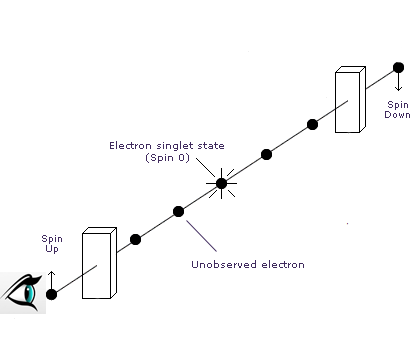
Consider two electrons in a paired state with zero total spin. Such states (which are known as singlets) may be bound or unbound, but once formed they will conserve whatever spin state they originated with. In this case, since the electron cannot have zero spin, the paired electrons would have to preserve antiparallel spins that cancel each other. If one were observed to have a spin of, say, +1/2 about a given axis, the other would necessarily have a spin of -1/2. Suppose we prepared such a state unbound, and sent the two electrons off in opposite direction. As we’ve seen, until the spin state of one of them is observed, neither will individually be in any particular spin state. The wave function will be an entangled state of two possible outcomes, +/- and -/+ about any axis. Once we observe one of them and find it in, say, a “spin-up” state (+1/2 about a vertical axis), the wave function will have collapsed to a state in which the other must be “spin-down” (-1/2), and that will be what we find if it’s observed a split second later as shown below.

But what would happen if the two measurements were made over a distance too large for a light signal to travel from the first observation point to the second one during the time delay between the two measurements? Special relativity tells us that no signal can communicate faster than the speed of light, so how would the second photon know that it was supposed to be in a spin-down state? Light travels 11.8 inches in one nanosecond, so it’s well within existing microcircuit technology to test this, and it has been done on many occasions. The result…? The second photon is always found in a spin state opposite that of the first. Somehow, our second electron knows what happened to its partner… instantaneously!

If so, this raises some issues. Traditional QM asserts that the wave function gives us a complete description of a system’s physical reality, and the properties we observe it to have are instantiated when we see them. At this point we might ask ourselves two questions;

1)  How do we really know that prior to our observing it, the wave function truly is in an entangled state of two as-yet unrealized outcomes? What if it’s just probabilistic scaffolding we use to cover our lack of understanding of some deeper determinism not captured by our current QM formalism?

2)  What if the unobserved electron shown above actually had a spin-up property that we simply hadn’t learned about yet, and would’ve had it whether it was ever observed or not (a stance known as counterfactual definiteness)? How do we know that one or more “hidden” variables of some sort hadn’t been involved in our singlet’s creation, and sent the two electrons off with spin state box lunches ready for us to open without violating special relativity (a stance known as local realism)?

Together, these comprise what’s known as local realism, or what Physicist John Bell referred to as the “Bertlmann’s socks” view (after Reinhold Bertlmann, a colleague of his at CERN). Bertlmann was known for never wearing matching pairs of socks to work, so it was all but guaranteed that if one could observe one of his socks, the other would be found to be differently colored. But unlike our collapsed electron singlet state, this was because Bertlmann had set that state up ahead of time when he got dressed… a “hidden variable” one wouldn’t be privy to unless they shared a flat with him. His socks would already have been mismatched when we discovered them to be, so no “spooky action at a distance” would be needed to create that difference when we first saw them.

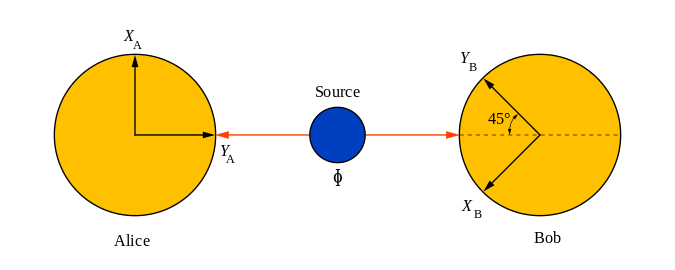
In 1964 Bell proposed a way to test this against the entangled states of QM. Spin state can only be observed in one axis at a time. Our experiment can look for +/- states about any axis, but not together. If an observer “Alice” finds one of the electrons in a spin-up state, the second photon will be in a spin-down state. What would happen if another observer “Bob” then measured its spin state about an axis at, say, a 45-deg. angle to vertical as shown below?

The projection of the spin-down wave function on the eigenvector coordinate system of Bob’s measurement will translate into probabilities of observing + or – states in that plane. Bell produced a set of inequalities bearing his name which showed that if the electrons in our singlet state had in fact been dressed in different colored socks from the start, experiments like this will yield outcomes that differ statistically from those predicted by traditional QM. This too has been tested many times, and the results have consistently favored the predictions of QM, leaving us with three options;

a)  Local realism is not valid in QM. Particles do not inherently possess properties prior to our observing them, and indeterminacy and/or some degree of “spooky action at a distance” cannot be fully exorcised from \(\hat M\).

b)  Our understanding of QM is incomplete. Particles do possess properties (e.g. spin, location, or momentum) whether we observe them or not (i.e. – counterfactuals about measurement outcomes exist), but our understanding of \(\hat U\) and \(\hat M\) doesn’t fully reflect the local realism that determines them.

c)  QM is complete, and the universe is both deterministic and locally real without the need for hidden variables, but counterfactual definiteness is an ill-formed concept (as in the “Many Worlds Interpretation” for instance).

Nature seems to be telling us that we can’t have our classical cake and eat it. There’s only room on the bus for one of these alternatives. Several possible loopholes have been suggested to exist in Bell’s inequalities through which underlying locally real mechanics might slip through. These have led to ever more sophisticated experiments to close them, which continue to this day. So far, the traditional QM frameworks has survived every attempt to up the ante, painting Bertlmann’s socks into an ever-shrinking corner. In 1966, Bell, and independently in 1967, Simon Kochen and Ernst Specker, proved what has since come to be known as the Kochen-Specker Theorem, which tightens the noose around hidden variables even further. What they showed, was that regardless of non-locality, hidden variables cannot account for indeterminacy in QM unless they’re contextual. Essentially, this all but dooms counterfactual definiteness in \(\hat M\). There are ways around this (as there always are if one is willing to go far enough to make a point about something). The possibility of “modal” interpretations of QM have been floated, as has the notion of a “subquantum” realm where all of this is worked out. But these are becoming increasingly convoluted, and poised for Occam’s ever-present razor. As of this writing, hidden variables theories aren’t quite dead yet, but they are in a medically induced coma.

In case things aren’t weird enough for you yet, note that a wave function collapse over spacelike distances raises the specter of the relativity of simultaneity. Per special relativity, over such distances the Lorentz boost blurs the distinction between past and future. In situations like these it’s unclear whether the wave function was collapsed by the first observation or the second one, because which one is in the future of the other is a matter of which inertial reference frame one is viewing the experiment from. Considering that you and I are many-body wave functions, anything that affects us now, like say, stubbing a toe, collapses our wave function everywhere at once. As such, strange as it may sound, in a very real sense it can be said that a short while ago your head experienced a change because you stubbed your toe now, not back then. And… It will experience a change shortly because you did as well. Which of these statements is correct depends only on the frame of reference from which the toe-stubbing event is viewed. It’s important to note that this has nothing to do with the propagation of information along our nerves—it’s a consequence of the fact that as “living wave functions”, our bodies are non-locally spread out across space-time to an extent that slightly blurs the meaning of “now”.  Of course, the elapsed times associated with the size of our bodies are too small to be detected, but the basic principle remains.

Putting it all together

Whew… that was a lot of unpacking! And the world makes even less sense now than it did when we started. Einstein once said that he wanted to know God’s thoughts, the rest were just details. Well it seems the mind of God is more inscrutable than we ever imagined! But now we have the tools we need to begin exploring some of the way His thoughts have been written into the fabric of creation. Our mission, should we choose to accept it, is to address the following;

1)  What is this thing we call a wave function? Is it ontologically real, or just mathematical scaffolding we use to make sense of things we don’t yet understand?

2)  What really happens when a deterministic, well-behaved \(\hat U\) symphony runs headlong into a seemingly abrupt, non-deterministic \(\hat M\) event? How do we get them to share their toys and play nicely with each other?

3)  If counterfactual definiteness is an ill-formed concept and every part of the wave function is equally real, why do our observations always leave us with only one experienced outcome? Why don’t we experience entangled realities, or even multiple realities?

In the next installment in this series we’ll delve into a few of the answers that have been proposed so far. The best is yet to come, so stay tuned!

References

Penrose, R. (2016). Fashion, faith, and fantasy in the new physics of the universe. Princeton University Press, Sept. 13, 2016. ISBN: 0691178534; ASIN: B01AMPQTRU. Available online at www.amazon.com/Fashion-Faith-Fantasy-Physics-Universe-ebook/dp/B01AMPQTRU/ref=sr_1_1?ie=UTF8&qid=1495054176&sr=8-1&keywords=penrose. Accessed June 11, 2017.

Sean Carroll and the Afterlife

A while back, a reader of my blog asked me to respond to the following video in which Sean Carroll discusses why he doesn’t believe in the afterlife:

Sean Carroll On Death And The Afterlife

[Please note that, as a matter of policy I will not review or respond to ideas that are encapsulated in videos, unless there is a text transcript.  I made an exception for this particular person, as a very special favor which is not to be repeated…]

I replied more or less as follows:

Dear _____,

I’m familiar with Sean Carroll’s arguments and while I understand that they may be intimidating, he’s leaving out something pretty important here.  Namely God.

Of course Carroll is an atheist and so he doesn’t believe in God.  But we Christians do think there is evidence for God and miracles from e.g. the Resurrection of Jesus.  Even Carroll admits that sufficiently powerful evidence could change the conclusion that QFT is a complete description of nature.  He just hasn’t yet understood that that this evidence does in fact exist, in the form of the historical documentary evidence for miracles.  This of course requires us to believe that, contrary to what Carroll said, sometimes things outside of our current understanding of physics do affect the human world.  But that’s not as implausible as he makes out, since it often happens in Science that a theory is very accurate in certain circumstances, except in rare situations where it completely fails due to interaction with new kinds of things.  If the new thing was just new kinds of QFT particles, then it couldn’t really work (for all the reasons Carroll mentioned), but if it is something like God, that would not fall under the purview of QFT!

Now while Carroll has defended his Atheism elsewhere, this particular debate was about life after death, not Atheism.  For the purposes of this debate, he’s basically just assuming that Materialism is true, and that therefore the only way there could be life after death is if the information in our brain was preserved by some physical mechanism.

Now I actually agree with him that it is very implausible, if Materialism is true, for there to be any physical mechanism which preserves our mind after death!  So nothing he said bothers me.  Because I don’t think that the reason we will live forever is because we have some magical soul-particles in our brain (not yet discovered in the laboratory) which happen to have the property of being immortal.

Instead I think the reason we will live forever is that God loves us and that he’s promised to do it.  So at the end of time, when Jesus comes back, God will raise us from the dead in new physical bodies, and if that violates the current laws of physics that’s okay by him.  (If he wants to copy our information into some other format to keep us self-aware in between the time of our death and Resurrection, he can do that too!  The New Testament suggests that probably something like this is the case, but it puts a lot more emphasis on the Resurrection of our bodies when Jesus returns.)

I also think that Carroll is more confident than he should be that the Laws of Physics can explain why physical systems are conscious.  The so called “Hard Problem of Consciousness” is an extremely deep philosophical puzzle, and even many atheistic philosophers (like David Chalmers or Thomas Nagel) think that there is a mystery here which is very hard to explain on a purely reductionistic materialistic worldview.  While this is a very interesting topic (which suggests that, at some level, Materialism is wrong about some deeply important things), I think it is hard to really prove for sure that this would imply anything about life after death.  Traditionally, many theistic philosophers have tried to prove the Immortality of the Soul through philosophical reasoning, based on facts about the supposed immateriality of the mind, but the Philosophy of Mind is sufficiently confusing I don’t think this is the best way forward.

I would instead focus on the fact that God has promised, in the Bible, to raise human beings from the dead and made an advance demonstration of this with Jesus.  Our confidence that he keeps his promises (a.k.a. “faith”) is based primarily on our relationship with him and not based on the kinds of pro and con arguments which were made in this debate.  I think our confidence that we will live forever is going to be proportional to our love and knowledge of God, so if you find yourself having difficulty believing in Heaven, the solution is not to directly try to believe in that harder (in isolation from other things) but rather to meditate further on your relationship with Jesus, and then the afterlife issue will straighten itself out automatically.  That’s not to say that what we believe about the afterlife isn’t important, but only that it follows from a correct understanding of who God is.

Blessings,
Aron

Consciousness and Falsifiability

So g and I were discussing the nature of Consciousness in another thread, and he said something here that I’ve been meaning to reply to for a while.  We were discussing Chalmers’ arguments (described in this paper and elsewhere) that Consciousness cannot be deduced from the Laws of Physics.

g wrote in part:

Consciousness-mysterians have in effect adopted a strategy that guarantees that their questions cannot be answered. There simply isn’t any evidence one could possibly present, any argument one could possibly make, that would count as showing that consciousness is a physical phenomenon.  [This] is the key difference that Chalmers points out, though of course he does so in terms more sympathetic than mine to consciousness-mysterianism. And it’s also what you draw attention to, again with a spin different from mine :-).

But, really, doesn’t making that argument trigger at least a feeling of unease? What you’re saying comes down to this: nonphysicalism about consciousness is unfalsifiable even in principle: no possible evidence could ever suffice. Usually unfalsifiability is a serious problem for a theory. Personally, I’m only comfortable holding an uncheckable-even-in-principle belief with much confidence if (1) I think I can actually prove it from first principles (note: observing that it’s unfalsifiable doesn’t count!) as with pure mathematics or statements that are true by definition, or (2) I can’t avoid holding it because it’s an unavoidable load-bearing element of my cognitive apparatus, as with those first principles themselves. In Bayesian terms, an uncheckable belief can’t accumulate evidence, so it has to come from your prior, and I prefer my priors without too much unnecessary stuff built into them :-). And nonphysicalism about consciousness seems to me very much not the sort of thing covered by either #1 or #2. — Of course, your attitude to unfalsifiability need not be the same as mine.

Yeah, as you guessed, I don’t think this is a proper use of the criterion of falsifiability.  Let me try to explain why I think this.

In what follows, I will be assuming that my audience is familiar with some basic philosophy lingo, as well as the first Chalmers essay I linked to.

Also, please note that I am only a “nonphysicalis[t] about consciousness” in a very specific sense which will hopefully become clear in what follows.  (I’m okay with somebody who wants to say that the mind and brain are in some sense identical, as long as they don’t claim to be able to prove this identity from the laws of physics.)

I. Goodbye, Eliminativism

Before I begin, I want to clear one bugbear out of the way; readers who wish to cut to the chase might want to skip this section.  Some philosophers of mind are eliminative materialists, they think that Consciousness isn’t really even a thing that exists, and that the concept should be completely removed from a truly scientific account of the world.  (This position is very different from the reductionist position the rest of my essay will be discussing, where you say that Consciousness does exist but that it can be derived from more fundamental concepts.)

I’m not sure that Eliminativism even deserves to be given the time of day, since to me it is just obvious that conscious and perceptual experience is a thing.  <checks mind>  Yup, I have experiences!  Furthermore as many people have noted, it is impossible to even argue for eliminativism without using language which presupposes the existence of mind and beliefs (e.g. “I think Eliminativism is true“, “I believe the hypothesis for this reason“, “it is justified by our knowledge of these observations in the laboratory”, “appearances are an illusion; they merely appear to exist”, “no rational and scientificallyminded person could avoid realizing that…”  etc. etc.)  A consistent eliminativist would have to give up all the terms in red, and that would make them unable to express any theories at all.

If that were not enough, anyone who wants to talk about falsifiability (or any other version of empiricism) had better keep the idea of Consciousness around.  For the core of that idea, is that a good scientific theory ought to make at least some predictions about things we actually experience so that they can be ruled out by the data if they are wrong.  The technique of observation—which is conscious by definition—is implicit in the scientific method.  What is the point of even doing an experiment in the laboratory, with some elaborate but mindless machine if, at the end of the day, no human being checks to see what the results of the experiment are?

Experience is bedrock; that is what we use to test the existence of other, unobserved things! If you doubt the existence of experiences, then you have no reason to accept the existence of anything else.  So this is one of those “first principles” that g refers to in his comment.

Hence Consciousness exists.  Now of course, there is one very obvious sense in which the existence of consciousness isn’t falsifiable.  Namely, that if there weren’t any conscious beings, then you wouldn’t be around to notice their absence.  But, that is not the kind of falsifiability puzzle that g was talking about.  He wasn’t suggesting that the existence of consciousness should be falsifiable, but rather that certain kinds of theories about its true nature should be falsifiable.  Let us see.

II. Why Conceptual Truths aren’t Falsifiable.

If we ask a question like “Are p-zombies conceivable”, then it seems to me we’re basically asking a question about the structure of logically possible worlds.  Is there a logically possible world in which there are entities physically like us which do not have the property of Consciousness?  (In what follows I will treat “logical possibility” and “conceivability” as synonyms, although some philosophers are likely to wish to make a distinction between them.)

Now, questions about what is logically possible are not really empirical questions.  Because, empiricism can only tell us which of the logically possible worlds we actually live in.  It cannot tell us which worlds are possibilities in the first place.  Instead, we reason about possible worlds by doing a conceptual analysis of the concepts in question.  This seems like it is necessarily an a priori sort of analysis, because the space of possible worlds should not depend on which of the worlds is actually the case.  And if such truths are a priori, then we shouldn’t expect it to be falsifiable, we should in fact expect it to be nonfalsifiable, like the truths of mathematics.

(I’ve previously written a bit about Reasonable Unfalsifiable Beliefs before.  I’m not sure it really gets into the issue I’m describing here, but one of the things I discussed there is how certain propositions can be unfalsifiable while still possessing significant evidence in their favor.)

Now, that doesn’t mean that positions about the logical conceivability of worlds should always be held in a completely dogmatic way.  It may be that in some cases, you have to do a tricky conceptual analysis of a concept (in this case “Consciousness”) to determine what we in fact mean by the word, before you can decide what is or is not entailed by its existence.  Nor does it mean that you should be impervious to updating your beliefs; it just means that the proper method for changing your beliefs is through philosophical discussion rather than through scientific collection of data: somebody might say something like “You think that X is impossible, but what if it happened in way Y, did you think of that?”

(And then you might say “No I didn’t think of possibility Y, thanks for pointing out the flaw in my argument, I owe you big time!” or maybe “You idiot, Y isn’t at all applicable to what I said because blah blah blah…” and then the conversation could continue from there…)

Thus, believing that something can be demonstrated a priori on conceptual grounds without resort to empericism, is not quite the same thing as assigning a strictly 0 prior probability to being wrong.  A complicated math proof is true a priori, but there is still the possibility of having made an error somewhere in the proof.  Rather, it is a statement about by what methodology one knows the truth in question.

III. Can you tell me a story?

Although empirical observation doesn’t directly tell us about which worlds are logically possible, there is still a limited role that observation plays through developing the exercise of the imagination.  We may become more aware of certain logical possibilities as a result of learning certain things about the world.  So for example, if somebody stupidly said that it was a priori impossible for Newtonian mechanics to be wrong and then we did experiments and found it was wrong, then that might be taken to refute the position.  But in this case the foolishness of the claim could have been revealed beforehand by imagining with sufficient clarity the scenario in which Newtonian mechanics is false.  It needn’t have actually happened that way to refute the position.  (It’s a bit like Nature saying, in a particularly hard-to-ignore voice, “Have you considered the possibility that Newtonian mechanics is wrong?“)

What that means, is that if you think that Science will eventually show that Consciousness can be deduced from the physical facts about the brain, then in principle you ought to be able to write a science fiction story now about a set of observations, such that reasonable people would agree that if those observations came to pass, then Consciousness would be fully explained in physical terms.  You see, the most magical thing about Science is its ability to check things through observation, but I am waiving that requirement here by allowing you to make up whatever set of observations you like.  And that makes it harder to say “Science will one day show…”, since if you can’t write the science fiction story you can’t plead lack of funding or experiments.  You can only plead lack of imagination.

(In this very, very limited sense, the position that Consciousness can’t be reduced to the Laws of Physics can be falsified.  It would be falsified if we found some scientific facts that made reasonable people spot the error in the philosophical arguments of people like Chalmers.  But then again it would also be falsified if you can even write a science fiction story that points out the errors in Chalmers’ arguments!  On the other hand, once one is willing to accept the possibility that Science could refute seeming conceptual truths, then the belief that Science can explain Consciousness now becomes the unfalsifiable belief, because even in the face of a complete failure to imagine what an explanation would look like, one could always hope that a future scientific revolution will change everything!)

One test of a priori knowledge is that we cannot even conceive of a scenario in which something isn’t true.  (For example, I can’t conceive of a scenario in which 2+2=5.)  If that is really true, then it actually implies that the position isn’t falsifiable.  But that shouldn’t make us uncomfortable unless it’s the kind of proposition we wouldn’t have expected to be a priori.

(Of course you can always imagine an idiotic position which can’t be falsified because the person who holds it insists on holding it no matter what and keeps modifying the hypothesis to save it.  For example, someone (it is just barely possible) might believe in Young Earth Creationism no matter what the experiments of Biology, Geology, and Physics find, because they think that this is merely God testing them or whatever.  But that is not really so much because YEC is unfalsifiable, it’s more because the person refuses to recognize that their position is falsified even when the facts do falsify it.  It’s a very different case if you can’t think of any facts which would convince a reasonable person that the belief is wrong.)

IV. A Primer on Modal Logic

When it comes to the Philosophy of Mind, many of these disputed propositions are explicitly about what is logically possible (or conceivable).  In particular, I think the dispute between Chalmers and more reductionistic philosophers—for example Daniel Dennett—is like this.

If Chalmers is right about Consciousness, then he has to be right a priori.  But the same goes for Dennett—if he’s right that Consciousness can in principle be reduced to physical statements about the brain, then I think his position that this is conceivable would also have to be right a priori. [1]  As I have been saying, any true statement about which things are logically possible, must itself be logically necessary: if true, necessarily true; if false, necessarily false.  Thus, whoever is correct, we can’t really expect that their position will be empirically falsifiable.

We can formalize the arguments I’ve been making a little bit using Modal Logic.  In this system of notation, if \(p\) represents that a proposition is true, and \(\neg p\) (i.e. not p) that it is false, then $$\boxempty p$$ is the statement that \(p\) is a necessary truth, while $$\Diamond p = \neg \boxempty \neg p$$ is the statement that \(p\) is a possible truth.  One then assumes certain reasonable seeming axioms, including (N) that the theorems of Modal Logic are necessary truths and (K) that \(\boxempty(p \to q) \to (\boxempty p \to \boxempty q)\).  People also usually stipulate that \(\boxempty p \to p \to \Diamond p\), since necessity implies actuality, while actuality implies possibility.

There are actually multiple possible interpretations of exactly what we mean by necessary and possible, but the one I currently have in mind is the notion of analytic possibility, where \(\boxempty p\) means that \(p\) follows from pure logic, together with the conceptual meanings of whatever words enter into the proposition \(p\).

Under this particular interpretation, it seems unreasonable not to accept the following axioms of modal logic:

(S4) \(\boxempty p \to \boxempty \,\boxempty p\)

(S5) \(\Diamond p \to \boxempty \Diamond p\)

These axioms formalize the idea, which I’ve defended above, that logic is true for a priori conceptual reasons, so that the same rules of logic are valid in all logically possible worlds.

(Of course in normal life we often talk about necessity in a much looser way, e.g. you can say that if Joe is a bachelor it is logically impossible (hence necessarily false) for him to have a wife, but since he could have gotten married to Sally 5 years ago, it wasn’t necessarily impossible for him to be married.  This forms a seeming counterexample to S4 but this is only because the scope of the necessities are different.  If \(\boxempty\) always means absolute logical necessity, taking into account all possible variations, then such counterexamples do not arise.)

The axioms (S4) and (S5) have an interesting consequence.  Any time a proposition has multiple modal symbols in front of it, for example \(\boxempty \Diamond \Diamond \boxempty \Diamond p\), this assertion is always equivalent to to removing all but the last modal operator.  So this complicated proposition is equivalent to simply \(\Diamond p\).  This fact will be useful in the next section.

V. The Burden of Proof

Since both philosophers are making a priori claims, we have to be very careful about determining which of them has the “burden of proof”.

Usually I find it annoying and unproductive when philosophical arguments degenerate into discussions of who has the burden of proof.  Nevertheless, it’s fairly reasonable to take claims that something is logically necessary (or logically impossible) to have a very high burden of proof; if there isn’t a good reason to believe it, then we disbelieve it.  It is an unreasonably strong claim to say that logic proves that pigs cannot fly.  Even though in the real world, they usually tend not to.  (But there are always exceptions.  When we were flying my cat to the East Coast, my Grandpa took the opportunity to ask the animal handler there.  It turns out that pigs do fly, at least on United Arlines.)

Conversely, claims of logical possibility have a low burden of proof; if we don’t know of any proof that something is impossible, then it is probably possible.  (And if we know there can’t be a proof that something is logically impossible, then presumably it must be logically possible, since logical possibility just is that which does not lead to any logical inconsistency. [2])

But in this case both philosophers’ views can be phrased as making strong claims of logical necessity!  To paraphrase:

Team Chalmers: It is conceptually impossible (i.e. necessarily false) for Consciousness to be fully explained in strictly physical terms.

Team Dennett: It is conceptually impossible (i.e. necessarily false) for p-zombies to exist (at least, given sufficient information about the workings of the brain).

So here we have two conflicting philosophical positions, and both sides are staring at the other, thinking that the other team is making an absurdly overconfident claim.  So who is really being cocky here?

I think we can resolve this issue by using modal logic.  What Team Dennett is really committed to is this proposition:

Strong Physicalism: Given the Laws of Physics (taking the usual form of mathematical field equations), one can logically deduce that certain physical systems such as the brain (assuming they exist) possess the property of Consciousness.

While it is an empirical physics question what the exact Laws of Nature are, and an empirical biology question how exactly our brain is wired, these empirical propositions are not really the essential part of the hypothesis in question.  It seems unlikely that the dispute between Chalmers and Dennett really comes down to the exact equations of the Standard Model, or the exact way in which the neurons are connected.  Let us suppose hypothetically that all of these scientific details are known, the interesting question is whether assuming all that, Consciousness follows by purely logical considerations.

I have called this position Strong Physicalism, because one could imagine a Weak Physicalist position which states that Consciousness follows by some weaker mode of necessity, for example metaphysical necessity (that which is necessary in itself, given the fundamental nature of things, even if human beings are not capable of proving it), or perhaps necessary given certain additional principles, that might be plausible to postulate. [3]

Now the thing to notice is that Strong Physicalism itself contains a logical modal operator \(\boxempty\) within it.  If we let \(b\) be a list of physical facts about a human brain (which are of course logically contingent, since human beings do not exist by logical necessity), and we let \(c\) be the proposition that this human being is conscious, then we can restate each team’s claim of logical necessity as follows:

Team Dennett: \(\boxempty (b \to c)\) (from Strong Physicalism)

Team Chalmers: \(\boxempty \neg \boxempty (b \to c)\) (Strong Physicalism is necessarily false)

But by the rules of modal logic, \(\boxempty \neg \boxempty (b \to c) = \boxempty \Diamond \neg (b \to c) = \Diamond \neg (b \to c)\), a mere possibility claim.

So this makes it clear.  Team Dennett is making the claim that a first-order proposition, one that does not involve any modal symbols, is necessarily true.  This is a very strong claim and the burden of proof is on them to show it.

On the other hand, Team Chalmers is making a claim that a second-order proposition, one that involves a modal symbol, is a necessary truth.  But all second-order propositions about logic partake of necessity; either they are necessarily true or necessarily false.  Hence, this is an exception to the usual rule that claims of a priori necessity have a strong burden of proof.

Instead, one should strip off all but the last modal symbol.  When one does this, one can see that Team Chalmers is actually making a possibility claim about the first-order propositions.  Hence their claim is almost certainly true, unless there is good reason to think that Team Dennett’s beliefs might follow from the structure of logic itself.  If there is a good argument for that, I am still waiting to hear it.  (Arguments about how amazing the progress of Science has been to date, of course do not qualify as arguments about the structure of logic!)

It was this realization, back when I was a grad student, that put me firmly in Chalmers’ camp.

One might worry that this is a bit of a trick and that I could have rephrased things in a way where the argument could be run in reverse, so that by rearanging the terms somehow it would appear that the Chalmerites were making the 1st order necessity claim and the Dennettites the 2nd order necessity claim. [4]  But I don’t see any way of making that permutation convincingly.  Strong Physicalism is (as it says on the tin) a very strong claim, which has a \(\boxempty\) in it by its very definition.  Nobody is forcing anyone to go around making super-strong claims of logical necessity.  Strong theses have powerful implications, but for that very reason they are very easy to refute.

As I have said all along, there are weaker versions of physicalism which don’t make such strong claims, and I’m not saying that those views can be ruled out so easily.  But these are precisely the versions of physicalism which do preserve some degree of mystery when it comes to Consciousness. [3 again]

VI. Occam’s Shaving Cut

A scientifically-minded person might be tempted to retort, “Well hang it all, you’re missing the entire point here!  Forget your sophistical modal argumentation, isn’t it so much simpler to just assume that consciousness is physical, not some weird additional new thing?  Occam’s Razor, which as you well know is a foundational principle of science, states that we should usually go with the simpler view until the data makes it untenable.  And postulating some crazy new mysterious stuff besides the laws of nature (that work so well in other areas) is anything but simple.”

But I think this is a misapplication of the Razor, likely to lead to shaving cuts.  The normal use of Occam’s Razor is when we have two or more logically possible hypotheses, each of which is compatible with the data, and we want to figure out which of them is most likely to be true.  In Bayesian terms, the simpler hypothesis is often (though not always) the one with the higher prior probability.

But Strong Physicalism isn’t a hypothesis about which of the logical possibilities corresponds to the real world.  It’s a hypothesis about the space of logical possibilities itself!  It is a category error to say that the space of logical hypotheses must itself be simple, since it simply consists of all thinkable hypotheses (however complicated or absurd).  Do you think would be absurd for p-zombies to actually exist?  Good!  I do too!  But that doesn’t mean it doesn’t exist as a logical possibility.  There is no limit to how complicated or absurd a logical possibility can be, as long as it is not self-contradictory.

When we use Occam’s Razor, we are generally presupposing that we have already successfully identified the space of logical possibilities, and that we have already used ordinary logic to figure out what each hypothesis says.  We can use the Razor to say “Hypothesis X is better because it is simpler and still logically implies observation Y”.   But we shouldn’t use it to say “It is better to think that X logically implies Y (even if I can’t see how it does), because things would be so much simpler if it did imply Y than if it didn’t!”  Whether or not X explains Y is a feature of the logical structure of X and Y, and that is not the sort of thing we ought to be applying Occam’s Razor to.

Now I admit that if X is a very successful theory, and there is genuine reason to think it might imply Y if we just did some very complicated calculation properly, then of course we should probably give X the benefit of the doubt instead of assuming we need to find a better theory.  This happens all the time in Physics.  But even in these cases, whether or not X implies Y is still a fact about pure logic.  It either does or it doesn’t follow.  If it turns out that X doesn’t imply Y, then no amount of wishful thinking about simplicity can make it oblige.  Logical consistency trumps Occam’s Razor, every time.

This is why mathematicians don’t use Occam’s Razor all that often.  I won’t say there is no use for it; sometimes one can detect patterns in numbers empirically, and it may be reasonable to guess that the patterns continue in the simplest way.  But mathematicians aren’t satisfied with that, because in their domain you can usually prove logically what is or is not the case, which is a much better method.

And the issues raised by Chalmers and Co. aren’t really a matter of complicated calculations—they aren’t saying, “oh but Consciousness is so complicated, so how can it arise from a simple thing like the brain?”  That would be ridiculous, since as we all know the brain is fiendishly complicated.  (I feel like I really ought to link to some amazing pop-sci article about neuroscience here, but I’m having difficulty finding the right one.  Maybe an Oliver Sacks book?)  Rather they are pointing out a logical gap that seems to exist no matter what we postulate about the workings of the brain.

The way to bridge that gap would be to write a description of a physical system that just is logically identical to that system having experience and awareness.  One could propose definitions like “processes information in such and such complicated way blah blah” but then one still needs to show that this is identical to our subjective feeling of awareness, which most certainly exists (see section I).  And I don’t see how this could possibly be done, without postulating some additional bridging principles.

VII. Thanksgiving

Since today is Thanksgiving Day, it seems appropriate to end by expressing my gratitude that Consciousness is real.  Since without it, we would be unable to appreciate any of our other blessings!

Footnotes

Footnote 1: Somebody might propose that Consciousness could arise in two different logically possible ways, and that one way is reducible to physics, while the other way is not.  Then it could be a empirical question which of these two categories human Consciousness happens to fall into in the real world.  For purposes of my argument, I am treating such a scenario as a special case of Dennett’s viewpoint, because (as I think Chalmers would admit) if it is conceivable for Consciousness to be reduced to purely physical properties about a sufficiently complex physical system, there is no particularly good reason to believe that the brain couldn’t be an example of such a complex system.

Footnote 2: Some caveats may be in order here about Gödel’s incompleteness theorems, and “ω-inconsistency“.  To be brief, in some cases the shortest “proof” that a statement is logically inconsistent might be infinitely long; in which case such infinite proofs must be included for my statement in the main text to be true.  However, I very much doubt that this subtlety of mathematical logic is particularly relevant to the subject of Consciousness, since the brain is a finite system and so it seems that any relevant proofs ought to be completable in a finite number of steps.

(Some people have proposed a different role for Gödel’s theorem, claiming that the ability of human beings to reason about math proves that our intellectual capacities cannot be reduced to computation.  But I think these arguments are bunk!  First note that Gödel’s theorem only states that a formal system for proving mathematical truths by rote cannot be both complete and consistent.  Whereas human beings reason primarily by informal methods, so Gödel’s theorem does not seem to apply to us in any obvious way.  So this does not prove intellect cannot be reduced to computation, because (a) there is no reason to think that human beings are capable of proving all true arithmetic propositions, and (b) there is no reason to think an intelligent AI couldn’t reason about mathematics in an informal way, and if it were truly intelligent, it probably would!)

Footnote 3: Note that in Chalmers’ classification, “Type B” materialism (which asserts that the brain and mind are ontologically identical, but that we can only grasp this identity as an a posteriori truth) is actually an example of Weak Physicalism.  For this reason, I don’t think it is ruled out by any of the arguments I’ve made here.  This view is oddly similar to the Chalcedonian explanation of how Christ can be simultaneously divine and human.

Footnote 4: An example of a modal argument which can be run in reverse is the question-begging Modal Ontological Argument for the existence of God.  There you assume 1. if God exists, he does so necessarily: \(G \to \boxempty G\), and also 2. the existence of God is at least possible: \(\Diamond G\), and from there you can turn the crank of modal logic to prove 3. that Theism is a necessary truth: \(\boxempty G\).  But if you had instead assumed that Atheism is at least possible: 2′. \(\Diamond \neg G\), then you can instead prove that God is impossible: 3′. \(\boxempty \neg G\).  While either argument is technically logically valid according to the rules of modal logic, a fallacy comes when you try to get people to interpret \(\Diamond\) in the 2nd premise in a weak epistemic sense, saying they should accept it because it at least theism seems not to be logically self-contradictory, whereas the first premise is only plausible as a claim about metaphysical necessity, not a claim about logical necessity.

Against Pantheism

In the comment mines I suggested, off-handedly, three possible metaphysical explanations for consciousness, without endorsing any of them.

A reader John responds to one of these suggestions:

To my primitive mind, this seems to be the most valid argument:

3. In fact, it is not possible to explain consciousness from nonconscious entities. Therefore, the most fundamental thing in existence is a mind, and we are parts of that mind. Matter is just a delusion which this mind believes in for some unknown reason. (I don’t find this view plausible at all, but that’s not the point.)

This is a longstanding view from oriental philosophy, and it intrigues me why you don’t find it plausible.

Thanks for your comment.  My main reason for finding this type of Pantheistic/Idealistic view implausible are these:

1. Matter sure seems like something with a real, consistent, and objective nature, quite unlike a dream.  For example, when I wake up my furniture and stuff is always in more or less the same place.  There are trees by the road whether or not I care for them to be there.  As a physicist I can make precise models of how matter will behave under certain circumstances, and in fact it does those things.  It does not consult my wishes except when I act on it using my body, and even then things do not always go according to plan.

Matter is a very parsimonious explanation of practically every experience I have.  So considering it a delusion seems unjustified.  And even if matter were a illusion, it must still exist as an illusion; if I hallucinate a blue tiger, there may not be a real tiger in the room but there is still a real image in my mind.  So saying matter is an illusion doesn’t actually reduce the number of entities which need to be explained!  Actually it makes things worse, because I cannot think of any reason why God would have the type of schizophrenia required to think he is multiple persons living in a common environment.  Nor can in turn be an illusion that I suffer from illusions, since that would be a logical contradiction.

(Speaking very broadly—since there are many varieties of Hinduism and Buddhism—a lot of these oriental philosophies don’t really believe in logic in the first place, or only use it to argue for contradictions, so that we give up our dualistic forms of logic.  But I could never accept that perspective on logic in a million years—there is literally nothing more illogical than denying the validity of logic!  I refuse to be insane.)

2. If we define God as the ultimate explanation for the Universe, which cannot itself be explained, then to say that everything is God is to say that nothing at all can be explained.  But if a view explains nothing, it is less good than a view which explains, well, anything!  I touched on this point in my discussion of Pantheism in my series on Fundamental Reality.

3. The actual Creator of the universe has spoken to me both in the Bible and in personal conversation, and he does not seem to regard other people as as part of himself in the requisite fashion.  To Moses, he says “I am who I am” (Exodus 3:16), not “I am who you are”.  In fact he seems to disapprove of a number of specific things which human beings do—we Christians call these things “sin”.  And as I have argued, if God is good and we are not, then it follows that we are not God.  To think that we are parts of God might be gratifying to our pride, but it is more wholesome to realize we are not God, and instead accept that we are created beings loved by him.  As St. Chesterton said:

I want to love my neighbour not because he is I, but precisely because he is not I.  I want to adore the world, not as one likes a looking-glass, because it is one’s self, but as one loves a woman, because she is entirely different.  If souls are separate love is possible.  If souls are united love is obviously impossible.  A man may be said loosely to love himself, but he can hardly fall in love with himself, or, if he does, it must be a monotonous courtship.  If the world is full of real selves, they can be really unselfish selves. (Orthodoxy, “The Romance of Orthodoxy”)

Only in the case of one human being did God identify himself so fully with him, as to allow him to share completely in his divine titles and identity.  And Jesus was no ordinary human, what with being the Word of God, who pre-existed with him from the beginning!  If we were divine beings, we would know it.

True, by receiving the gift of Jesus’s Spirit, we do become by grace “partakers of the divine nature” (2 Peter 1:4).  But this is not the same as being the unique and uncreated Son of God.  To be commune with God is not the same as to be God.

So it’s important for the distinction between the Creator and created to be sharply distinguished from the beginning.  Once that’s 100% clear, we can allow the mystics the liberty to speak the “language of love” concerning the intimate union between themselves and God, without fear of being misunderstood.  I could say to my wife that I am part of her and she is part of me, without either of us thinking that we must be the same person in a literal sense.