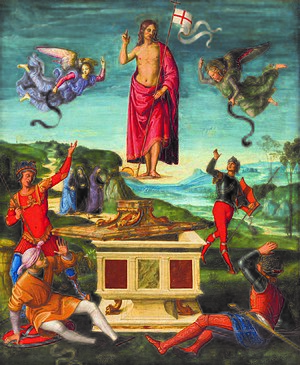
A friend from Real Life™ emailed me the following question. I just realized this was nine months ago. So, after a period of procrastination long enough to literally make a baby, I am now responding.
Chris writes:
A recurring theme in your writing is the historical evidence for the events of the New Testament. I’ve encountered this thrust of apologia quite often, as you might expect given how powerful it is. Indeed, I agree that no other religion can claim such falsifiability. Nevertheless, this argument has always struck me as somewhat off for the following reason. God has allegedly put us on this Earth – with free will – so that we may choose to worship him. Should we choose to embrace God (so the story goes), we achieve everlasting life. Should we turn away from him for eternity – hell and damnation. Now, Jesus explicitly tells us in the New Testament that to embrace God is equivalent to accepting Jesus as our Lord and Savior. Thus the infinitely-important question of “Will my soul be saved” comes down to “Do I believe Jesus is my Lord and Savior?” Here’s the kicker: If I take this argument in isolation, whether or not I decide Jesus is my Savior rests entirely on the efficacy of my historical investigation. If the NT is true and I’m a good historian, then my infinitely-important soul is saved. If I’m a worse historian, my soul might be damned for eternity. It seems awfully unjust of God to stake my soul on my ability as a historian. So unjust, in fact, that this narrative combined with the omnibenevolence of God seems wholly inconsistent. Said another way, it seems rather silly for God to create conscious beings and then to infinitely damn them or infinitely save them for something as trivial as whether they had the resources to adequately verify that one particular set of writings weren’t fabricated. For this reason, I feel uneasy about holding up the *historical* evidence for Christianity as evidence for Christianity.
Let me quickly try to dispel one possible counterargument. You might remind me that this argument was never meant to be taken in a vacuum. There are other, more significant reasons one might become a believer; this argument is simply icing on the cake, or perhaps one thing that might break the symmetry between religions so that not-yet-believers know which religion is most worth investigating. I think this counterargument misses the point. The point is the following. Imagine I’m a non-believer who hears about this historical evidence for the first time and then later converts. My approval of this historical evidence was either fungible in my conversion, or it was not. If it was fungible, then it was not an important factor, and you could have convinced me by other means. On the other hand, if it was not fungible then it was a necessary ingredient in my conversion, and my previous argument goes through. It seems that if God gave me the resources to decide Jesus is my Savior, one of them cannot be this historical evidence.
Dear Chris,
Thanks for your thoughtful question. It is a sufficiently deep and important question that I didn’t feel I could do justice to it with a short reply; so I’m afraid my response is quite lengthy. I admit that at times I’ve had similar doubts—although these doubts have mainly focussed more on the value of the project of Historical Apologetics, not on doubting whether God will judge the world fairly!
I. God is Just
For the Bible is clear that God’s judgments are always just:
The Lord reigns forever;
he has established his throne for judgment.
He rules the world in righteousness
and judges the peoples with equity. (Psalm 9:7-8)
and I don’t mean that in some horrible Calvinist way either, where anything God does is “justice” by definition no matter how unfair it is by human standards, and human beings simply aren’t allowed to question it. In fact, some of God’s most famous saints, Abraham and Moses and Job, have questioned God’s justice, and God explicitly approved of them doing so, because he is not an arbitrary dictator!
Even St. Paul, despite his emphasis on salvation by faith, says the same thing:
God “will repay each person according to what they have done.” To those who by persistence in doing good seek glory, honor and immortality, he will give eternal life. But for those who are self-seeking and who reject the truth and follow evil, there will be wrath and anger. There will be trouble and distress for every human being who does evil: first for the Jew, then for the Gentile; but glory, honor and peace for everyone who does good: first for the Jew, then for the Gentile. For God does not show favoritism.
(Romans 2:5-11)
and so does St. John,
This is the message we have heard from him and declare to you: God is light; in him there is no darkness at all. (1 John 1:5)
The doctrine that God is ethically good is absolutely foundational to Christian theology. It is more fundamental than even the Bible itself. If any interpretation of the Bible contradicts it, that interpretation is simply wrong.
Of course, it is always possible for finite and limited human beings to misunderstand what justice calls for in any particular case. Thus, there is a time and place to humbly accept that God knows better than we do, that we are not qualified to judge others. But that is different from giving up our notion of justice entirely and worshipping a demon.
So if there is ever a time where you are worried that the Christian God would condemn somebody unjustly, theology gives a clear answer. If it would be unjust to damn that person, then God won’t do it! It’s that simple.
II. Salvation by Belief?
The problem arises, of course, because of other passages in the New Testament which seem to suggest that people are judged specifically based on their beliefs. Specifically, that people are saved if (and only if!) they believe in Jesus. A sample follows:
But now apart from the law the righteousness of God has been made known, to which the Law and the Prophets testify. This righteousness is given through faith in Jesus Christ to all who believe. (Romans 3:21-22)
Therefore whoever confesses me before men, him I will also confess before my Father who is in heaven. But whoever denies me before men, him I will also deny before my Father who is in heaven.
(Matthew 10:32-33, cf. Luke 12:8-9)
For God so loved the world that he gave his one and only Son, that whoever believes in him shall not perish but have eternal life. For God did not send his Son into the world to condemn the world, but to save the world through him. Whoever believes in him is not condemned, but whoever does not believe stands condemned already because he has not believed in the name of God’s one and only Son. (John 3:16-18)
The jailer called for lights, rushed in and fell trembling before Paul and Silas. He then brought them out and asked, “Sirs, what must I do to be saved?” They replied, “Believe in the Lord Jesus, and you will be saved—you and your household.” (Acts 16:29-40)
If you declare with your mouth, “Jesus is Lord,” and believe in your heart that God raised him from the dead, you will be saved. For it is with your heart that you believe and are justified, and it is with your mouth that you profess your faith and are saved. (Romans 10:9-10)
Whoever believes in the Son of God accepts this testimony. Whoever does not believe God has made him out to be a liar, because they have not believed the testimony God has given about his Son. And this is the testimony: God has given us eternal life, and this life is in his Son. Whoever has the Son has life; whoever does not have the Son of God does not have life.
(1 John 5:10-12)
[and, although there are good reasons to think that the original Gospel of Mark did not include the verses following 16:8, the next passage was a historically important proof-text:]
Whoever believes and is baptized will be saved, but whoever does not believe will be condemned. (Mark 16:16)
Several other passages also talk about baptism as washing away sins, although Christians argue about whether this is merely a symbolic ritual or an actual condition of salvation.
Other verses seem to teach that you will be forgiven if (and only if!) you forgive other people when they sin against you.
Then there are the passages in the New Testament which seem, at first sight, to teach something closer to salvation by works. For example, the Parable of the Sheep and the Goats represents people as being saved if (and only if!) they showed mercy to others. The people who do so are regarded as having helped Christ without knowing it was him. In such cases, salvation seems to be possible even for those who had no explicit belief in Christ. Conversely, even a zealous Christian minister may find themselves rejected on the last day:
“Not everyone who says to me, ‘Lord, Lord,’ will enter the kingdom of heaven, but only the one who does the will of my Father who is in heaven. Many will say to me on that day, ‘Lord, Lord, did we not prophesy in your name and in your name drive out demons and in your name perform many miracles?’ Then I will tell them plainly, ‘I never knew you. Away from me, you evildoers!’ ” (Matt 7:21-23)
“Faith” implies trust and fidelity, not just belief. Certainly the teaching of Jesus and the Apostles combines the call to belief with the call to repentance, the desire to turn your life around in accordance with God’s will. And perseverance is also called for: it is the one who “stands firm to the end” and “overcomes” who will be saved.
As St. James says:
Thus also faith by itself, if it does not have works, is dead. But someone will say, “You have faith, and I have works.” Show me your faith without your works, and I will show you my faith by my works.
You believe that there is one God. You do well. Even the demons believe—and tremble! (James 2:17-19)
The problem of reconciling all of these passages with each other (and with the Old Testament) has lead to some pretty complicated debates about “Soteriology” (the theology of salvation) between different kinds of Christians. I don’t want to rehash these debates here, but the key point is that it is necessary to think about all of them to get a complete picture of what God is asking for.
A logician might note that strictly speaking, there cannot actually be more than one necessary-and-sufficient condition for salvation—unless somehow those conditions are perfectly correlated with each other! But it is probably a mistake to treat Bible verses as though they were supposed to be propositions in a modern logic textbook. That was not the writing style of 1st century Jews. If you can’t cope with paradoxes, then Christianity will never make sense to you. No single verse is intended to present every aspect of what salvation looks like; rather they each speak to a different aspect of the mystery. The point of these verses is to get people into a position where they are definitively saved, not to satisfy our curiosity about marginal cases.
While some Evangelical Christians may talk as though “salvation by faith” simply means that you are saved if (and only if) you have the correct beliefs about Jesus and have asked him to forgive you, the biblical teaching is a little more complex. If you just take one element of salvation by itself, ignoring the rest of the biblical testimony, you shouldn’t be surprised to end up with an imbalanced and misleading picture!
But clearly, any soteriology based on the New Testament must accept that belief in Jesus plays a very important role in the process of salvation! The passages above are meaningless unless—at least for the prototypical person who hears the gospel message—salvation is connected to whether that person believes or not.
Thus, these complexities do not invalidate your question about the role of belief. But they should be kept in mind in what follows.
III. Why it Seems Absurd
Now this idea of salvation through belief seems morally absurd to most rationalists and other skeptics. Even if we assume for the sake of argument (although this too is contested) that some wicked people might deserve eternal punishment, how could it possibly be fair to judge people on the basis of which propositions they happen to find credible? At first sight it seems just as absurd if God judged people’s eternal destiny based on whether they can appreciate classical music, or whether they happen to be good at trivia games.
You have mentioned this as a problem specifically with historical arguments for Christianity. But if your argument is correct, it seems like it would be a general purpose argument against any form of Christianity which is established by intellectual reasoning. After all, people also have different degrees of competence when it comes to evaluating philosophical arguments, or their own experiences, or anything really.
Either you happen to be exposed to convincing evidence for Christianity, or you are not. If you are not, how can God blame you for not believing a proposition which honestly seemed false to you? It cannot be a moral duty to believe something on the basis of insufficient evidence. Even if there is good evidence for Christianity, at least some people are going to find it implausible for a variety of idiosyncratic reasons. Worse, some Christians are going to believe it for inadequate and stupid reasons. Do these people gain eternal life precisely by being stupid? And will they forfeit it if they come to their senses, before learning any good arguments for Christianity?
Obviously, you can choose to do more research, and if a proposition is true, that will often reveal additional evidence for it. But how that evidence appears to you will of course depend on many philosophical and psychological factors, including (as Chris points out) how skilled of a historian you happen to be. Some of these factors don’t seem to have any necessary connection to morality or even spirituality. So is it really fair for God to judge people on that basis?
—Interlude: A Disturbing Response
Some Christians, especially those of a Reformed bent, might say that this is exactly the point. We are all wicked, none of us deserve to be saved, salvation is by grace, and therefore God has picked a condition for salvation which has nothing whatsoever to do with merit or goodness. If God has not predestined you for salvation, then you won’t believe, and even if—due to lack of exposure to the evidence, say—there was nothing blameworthy about your inability to believe, you’ve still done plenty of other bad things, so that God is justified in sending you to Hell for those offenses. (Even though there was no feasible way to escape being wicked, aside from believing in Jesus.)
While I agree with the great Reformation truth that salvation is by God’s grace, not by anything we do to deserve it—surely this is because God is merciful, not because he is morally absurd! Therefore, I can’t accept the conclusions of the previous paragraph. The Bible teaches that God is just and merciful even when he deals with sinners. Otherwise, what’s the point of even mentioning these attributes, in a book written for sinners?
Therefore I can’t believe that the Lord would leave people who are born in sin, people who can’t save themselves, trapped in that condition for a completely arbitrary reason. Without ignoring the difficult passages of Scripture which seem to talk in terms of predestination, there are also plenty of Arminian proof texts, which state in various ways that God “wants all people to be saved and to come to a knowledge of the truth” (1 Tim 2:4).)
So, if God discriminates on the basis of belief, we are permitted to inquire about whether that system is really just.
—Interlude Ends
To continue to play devil’s advocate on the side of the skeptic:
When a proposition is established by sufficiently clear proofs—or if, on the other side, there seems to be little or no evidence to support it—then it often feels like one barely has any choice about whether to believe it or not. I cannot choose to believe that the sun won’t rise in the morning, or that 2+2 = 5. So if somebody wrongly believes that there are decisive arguments against Theism or Christianity, it seems like God would be judging that person for something which is practically involuntary. Which would be totally unfair.
In closer cases, when there is evidence or feelings on both sides of a matter, then it does often feels like an act of will is required to settle what we believe about that topic. And for most people, much of the time, religious topics seem to fall into that class of questions. The truth or falsity of religion is not a matter of direct sense perception; and regardless of which side has better arguments, those arguments evidently are not so transparently clear as to preclude all doubt or controversy. Thus the “will to believe”, or to disbelieve, does come into play. But even then, shouldn’t we believe whatever appears to have the most evidence? If we are mistaken, that is a purely intellectual matter—how can it be a moral catastrophe?
So it seems that a person should not be held morally accountable on the basis of what they believe.
IV. Beliefs can be Immoral
And yet, I can’t help but notice that nobody actually seems to accept that view in practice! In most other areas of life, we all seem to accept that, under certain conditions, beliefs can sometimes make a person morally good or bad.
Indeed, the same rationalists who find Christian soteriology incomprehensible, will often turn around and judge religious people for believing doctrines which they consider to be silly or immoral. And very frequently, this has the force of a moral judgment, not just an intellectual one. (For example, see this very famous essay by W.K. Clifford.) Rationalism is—almost by definition—the belief that one ought to believe whatever proposition has the most evidence. (For some definition of “evidence”, and for some definition of “ought” which for many modern atheists does not include a belief in objective morality…) And so far as this goes, I agree. It is cowardly and deceptive to choose to believe something which you secretly, in your heart of hearts, know to be unjustified.
Therefore, if a rationalist believes in morality at all, they will typically say that a belief can be immoral if it is formed in a bad way. Indeed this is why many rationalists dislike religion, because (as they think) it encourages the formation of unjustified beliefs.
Indeed, many skeptics think that belief in Hell is itself an example of a depraved belief, for roughly the reasons described in section III! This brings us to a new point. Most people think that some beliefs can be judged to be immoral based on their content, even without knowing how those beliefs were acquired. For example, most Americans believe it is immoral to believe that certain races are inferior, and many liberals now think it is immoral to not give full support to the LGBT agenda. To be sure, the people who condemn these beliefs also think they are false. But they would be much more tolerant of a false but harmless belief.
The acrimony of political disagreements often carries the implication that people who disagree with one side of an issue are immoral. And surely, however tolerant we may be of minor differences, in extreme cases we are almost forced to agree! If a man believes that the Bourgeoisie need to be “liquidated” for there to be any progress in lifting up the poor, then he is not only bad and wrong, but dangerous too.
Mind you, political partisans are way too quick to accuse people on the other side of being evil, on rather slender grounds. In the USA, aside from a few hot-potato culture war issues, people in both parties mostly tend to agree on what a prosperous and just society would look like, and we just disagree on what is practically achievable, and the most effective means to get there. Hence, we should all stop slandering each other—but then, malicious and biased slanders also serve as excellent examples of immoral beliefs! So this is no escape from my point.
A couple other character flaws that have a belief-component are arrogance and jealousy. Who can stand a person who looks down on everyone else because they believe no one else has anything to teach them? Arrogance is generally regarded as a vice, not just a failure of epistemology. (In some ways it is even more appalling if the arrogance is sincere rather than feigned.) And if a man is constantly thinking that his girlfriend will cheat on him any time she so much as glances at another person—then either he has a rotten girlfriend, or (more likely) a rotten character, likely to cause both of them misery.
Many more vices could be added to this list: hypocrisy, foolishness, bigotry, and recklessness.
Now if God exists and has revealed himself, then at least sometimes people will have maliciously false beliefs directed towards divine things as well. Should we then add to this list impiety and heresy?
V. Excuses and Malice
Before we answer that question, I want to note that there are also many times where we don’t hold people responsible for harmful beliefs, for example, when somebody is honestly mistaken about the facts. In fact, we often don’t even hold people responsible for their actions when those actions were a reasonable response to a false belief. So as a general matter, false beliefs are not only excusable in themselves, they can even excuse what otherwise would be a sin or a crime.
If a smoker is unaware of a gas leak, and doesn’t realize that lighting a cigarette will cause a crowded building to go up in flames, then he is not guilty of arson or murder. (Even if the smoker knew it was wrong to smoke due to its destructive effects on his lungs, that does not make him guilty of the other consequences, which were not foreseeable.) Or if a person is crazy, so that their beliefs are systematically wrong due to some biological factor, then again we don’t usually hold them responsible for their actions. Even when a person has a wrong ethical system, sometimes we regard it as a mitigating factor if they came by it honestly and are just trying to do the best they can.
So being mistaken is sometimes an excuse for having bad beliefs. That is because the person has no malice, they weren’t trying to hurt people; in fact they genuinely believed their actions were helpful. In that case, it simply isn’t reasonable to impute guilt to them, unless in some way they were negligent in coming to hold those beliefs.
But other times, the malice seems to be wrapped up in the belief itself. To take an extreme example, suppose that a hypothetical Nazi sincerely believes that the Jews are plotting to take over the country and that the only way to stop them is to expel or kill them. This man has an immoral system of morality, but those moral beliefs were encouraged to grow by some false factual beliefs.
Perhaps—in part due to being a bad historian!—the man is unable to recognize that the Protocols of the Elders of Zion is a forgery. In this case, a false factual belief has helped to seduced him into having a bad moral character. Nor is the belief itself really innocent. Somewhere along the line, either in him or in the people who influenced him, the slander was accepted maliciously: out of fear, hatred, or murderous rage. That malice was incorporated into the man’s beliefs, and cannot really be separated from them or himself. So his belief and his hatred are not two detachable things. Nevertheless, he is not as responsible as the man who deliberately forged the Protocols and thus tempted him to hate.
(To be sure, a saintly but gullible person might believe as a factual matter that the Jews are plotting against Germany, without therefore feeling ill-will towards any particular Jews he meets. But, if the person has charity towards the Jews, generally speaking it will make him more likely to realize that the Anti-Semitic slander is a pack of lies! Charity is a help to honesty.)
You could try to evade this conclusion by saying that nobody is morally responsible for their beliefs per se, they are only morally responsible once those beliefs are expressed in actions. That is a very reasonable attitude for a government judicial system, since human magistrates have neither the power nor the wisdom required to punish “thought crime” without becoming oppressive. But as a general moral rule, it won’t fly. What people believe directly affects what they do! Can we really say that the Nazi is innocent, perfectly innocent, up until the moment when he decides to serve his fatherland by doing what his beliefs tell him is his moral duty (and which he will suffer pangs of conscience if he doesn’t do?)
As St. Chesterton writes in his essay The Diabolist:
“I am becoming orthodox,” I said, “because I have come, rightly or wrongly, after stretching my brain till it bursts, to the old belief that heresy is worse even than sin. An error is more menacing than a crime, for an error begets crimes. An Imperialist is worse than a pirate. For an Imperialist keeps a school for pirates; he teaches piracy disinterestedly and without an adequate salary. A Free Lover is worse than a profligate. For a profligate is serious and reckless even in his shortest love; while a Free Lover is cautious and irresponsible even in his longest devotion. I hate modern doubt because it is dangerous.”
Similarly, the beliefs that “everyone is out to get me” and that “nobody loves me” concern factual matters, but they are still deadly poison to those who find them attractive. Or consider the effects of the belief that life is pointless and has so much suffering that we would all be better off dead. Or the effects of the belief that morality is a meaningless set of scruples for suckers.
Let me emphasize that I am not saying we should decide what is “true”, based simply on the pragmatics of whether those beliefs are safe or useful. I don’t think it is wise to try to believe falsehoods in order to make the world a better place. Rather, I am saying that however attractive falsehoods may be, for a man of integrity, the Truth is the best safety and refuge.
Perhaps this boils down to a certain faith in the fundamental decency of existence, that Truth and Goodness are ultimately symbiotic. This is one of the main premises of Cognitive-Behavioral Therapy: that beliefs and actions affect each other, and therefore you can treat unhealthy behaviors and feelings by correcting the wrong beliefs that underlie them. In some ways evil is itself a form of mental illness, but it is a mental illness rooted in cherished beliefs, thus it is not inevitable.
In other words,
“You shall know the truth, and the truth shall make you free.” (John 8:32)
VI. God has Made a World
This raises some questions about divine justice and the order of the world. We are all dependent to a large degree on others for our beliefs and opinions about the world. Is it fair for God to judge human beings for the ways that they were shaped by their societies?
If the Protocols of the Elders of Zion had never been written, our hypothetical German Nazi would not have been tempted by it. Or if he happened to have the right sort of historical training, then this too might immunize him to the silliness of the Nazi’s historical claims about the Aryan and Jewish races. Or, if he had been raised differently, by parents who taught him the importance of openness to the humanity of others, then maybe he would have hidden Jews in his basement instead of persecuting them.
It is tempting to say that this is unjust, that God should give to each person an exactly equal chance to turn to him and be saved. It shouldn’t depend on any extraneous circumstances which don’t seem to have anything to do with “spirituality”, as you suggest here:
If the NT is true and I’m a good historian, then my infinitely-important soul is saved. If I’m a worse historian, my soul might be damned for eternity. It seems awfully unjust of God to stake my soul on my ability as a historian.
and here:
My approval of this historical evidence was either fungible in my conversion, or it was not. If it was fungible, then it was not an important factor, and you could have convinced me by other means. On the other hand, if it was not fungible then it was a necessary ingredient in my conversion, and my previous argument goes through.
There should be nothing circumstantial involved:
Did Maleldil suggest that our own world might have been saved if the elephant had accidentally trodden on the serpent a moment before Eve was about to yield?” (St. Lewis, Perelandra)
But by the same argument, the serpent should not have been able to tempt Eve either. Nor should Eve’s decision have any effect on whether Adam sins. Nor should his sin have any influence on their future children. Nor should your sin be able to influence anyone else. Each spirit must be an isolated monad, making a perfectly naked, free choice to serve God or rebel; totally unaffected by heredity, bodily desires, emotions, or anything else which is not freely chosen. That is what your argument demands, if we take it to its logical conclusion. Nothing should be able to affect anything else.
Yet that would be tantamount to not creating a world at all! A world is, by its very nature, a system of interacting things. And a human being is a spiritual animal with a heredity and senses and a psychology. The Church condemned the Gnostic idea that salvation is a purely spiritual affair, because we believe that God is also the creator of the physical universe. Physical things can mediate spiritual realities. What you are asking for would make us no longer human beings.
Would you really want to live in a world where parents were unable to pass on their wisdom and values to their children? Where you could never encourage a friend by saying a kind word to them in their time of doubt? Where a chance encounter with a stranger could never bless them or you? Where academic research could never uncover something really important, something that can change the way that human beings think about the universe? A world where you could never intercede before God for somebody else, who is going down the wrong path?
It must be one way or the other. If parents can really influence their children to good, then by making a different set of choices they must necessarily be able to influence them to evil. If true scholarship can lead people to God, then false scholarship must be able to alienate them. By the very nature of a world, other people must be able to affect us.
When the Lord proclaimed his Name before Moses on Mount Sinai, he gave him this description of his character:
“The Lord, the Lord, the compassionate and gracious God, slow to anger, abounding in love and faithfulness, maintaining love to thousands, and forgiving wickedness, rebellion and sin. Yet he does not leave the guilty unpunished; he punishes the children and their children for the sin of the parents to the third and fourth generation.” (Exodus 34:6-7)
Thus the Bible teaches that in a certain sense, the sins of the parents are visited on the children. As we shall see later, God’s primary punishment for sin is allowing it to have its natural consequences on that person’s character. But because we pass down our moral values to our children, the negative effects of ours sins will necessarily affect future generations as well.
Yet God is always standing by, waiting for people to repent and change:
“But suppose this son has a son who sees all the sins his father commits, and though he sees them, he does not do such things:
He does not eat at the mountain shrines
or look to the idols of Israel.
He does not defile his neighbor’s wife.
He does not oppress anyone
or require a pledge for a loan.
He does not commit robbery
but gives his food to the hungry
and provides clothing for the naked.
He withholds his hand from mistreating the poor
and takes no interest or profit from them.
He keeps my laws and follows my decrees.
He will not die for his father’s sin; he will surely live.”
(Ezekiel 18:14-17)
Thus, although we begin as a product of our environment, at the end of the day God will judge us as individuals, on the basis of the person we have chosen to become. We can choose to rise above the level of our culture, or we can sink below it. We can also influence that culture to become better or worse.
Our ability to be influenced by other people, sometimes in random ways, is ultimately a hopeful phenomenon. For it makes redemption logically possible, the addition of a new element that changes our course in the world. It makes it possible for God to intervene in the world in order to change the trajectory of history.
And this is why God sent his Son into the world to save sinners. Instead of suspending the causal operation of Nature entirely, he decided to intervene by adding just one drop of something new, at a particular time and place. But that new thing is alive; it grows and spreads like yeast, changing the entire batch of dough.
So the thing you are asking for is impossible, by the very nature of Creation and Redemption. There is no reasonable way to give each person an equal chance to be saved, without making our ability to influence other people meaningless. However, I do believe that God will give to each person a genuinely sufficient chance to be saved—as required by his justice and mercy. And if some people happen to get even more opportunities and help than that, their good fortune doesn’t make anyone else spiritually worse off.
If there happen to be people who experience such abundant grace that it is virtually guaranteed that they will enter Heaven, how does that harm you? The case that would raise severe questions about God’s providence is if there were other people who couldn’t be saved no matter how hard they tried.
VII. Belief and Unbelief, Considered in Relation to Christ
Thus far, I have argued that belief and disbelief have moral implications even apart from religious considerations. But if God is offering eternal salvation to the human race, belief and unbelief in that sphere will be incomparably more important. (Although come to think of it, mundane belief and unbelief also becomes more important, insofar as earthly matters will inevitably affect spiritual matters!)
If God has sent a Savior to redeem the world from sin, then on a Cognitive-Behavioral model, we can reasonably suppose that at least some aspects of that Redemption will involve elements of belief. That at least part of human sinfulness consists of being afflicted with wrong beliefs that we need to be delivered from.
Of course, Christianity says a lot more than just that. It says that faith in Christ is the means by which salvation is graciously imparted to individuals, reconciling them to God. That it is not only a motivation to do good works, but it allows God to do a work in us, which we could never have done by any work of our own.
(Exactly how belief facilitates salvation is somewhat mysterious, although there seem to be some analogies from everyday life: e.g. it is necessary to believe you can swim before you can learn to swim, or it is necessary to believe in another person in order for marriage to work. In what follows, I hope to at least be able to explain some ways in which unbelief can make it difficult for a person to be saved.)
It is important not to consider the issue of belief as if it were an abstract mystical principle having nothing at all to do with historical events. Christ came into the world at a particular time and in a particular way. The warnings of the New Testament about unbelief were written in response to some very specific acts of unbelief, and the harmfulness of that unbelief is a matter of historical record. I do not mean that these passages do not apply to modern day people! The message is universal, intended for all Mankind. But we need to take a look at the context of what was going on then, in order to most accurately figure out what it means now.
While all of the Gospels record the events in question, it is St. John’s Gospel that summarizes the situation with the greatest clarity. Remember that “For God so loved the world…” passage I quoted in section II? It goes on to say this:
This is the verdict: Light has come into the world, but people loved darkness instead of light because their deeds were evil. Everyone who does evil hates the light, and will not come into the light for fear that their deeds will be exposed. But whoever lives by the truth comes into the light, so that it may be seen plainly that what they have done has been done in the sight of God. (John 3:19-21)
Does that sound to you like it is describing innocent, good-faith skepticism? It is not. This is the attitude of somebody who avoids the light for fear that it will show them up as being evil. This is the pernicious sort of unbelief—the kind that is in bad faith—which in the context of the Gospels led them straight to murder of the innocent.
As you know, Jesus was hated by most of the religious leaders of his time. Partly because they thought he was making blasphemous and politically dangerous claims, but they were also infuriated that he showed up their hypocrisy, greed, and legalism in a way that made them look bad. Rather than change themselves, they chose to try to remove an innocent person who was annoying them, threatening their complacent way of life. And then, after the Resurrection, they treated those who offered them forgiveness in the same way:
“Therefore I am sending you prophets and sages and teachers. Some of them you will kill and crucify; others you will flog in your synagogues and pursue from town to town.” (Matt 23:34, cf. Luke 11:49)
And it is not as though they weren’t in a position to know the truth if they cared to. The reason why Jesus condemned his own generation so harshly, is that they saw not only his goodness but also the miraculous signs—the ones that you wistfully hope you might see to settle the issue of Christianity—with their own eyes. And yet many of them refused to believe, even in the teeth of the evidence.
Jesus speaks bluntly about that issue:
If I had not come and spoken to them, they would not be guilty of sin; but now they have no excuse for their sin. Whoever hates me hates my Father as well. If I had not done among them the works no one else did, they would not be guilty of sin. As it is, they have seen, and yet they have hated both me and my Father. (John 15:22-24)
So what happens if somebody disbelieves in Jesus, not out of any malice or self-deception, but simply because they never got enough evidence? Well, the passage above seems to have the answer: they would not be guilty of sin. That person is not condemned for their unbelief.
Since God is just, people are judged according to the resources they had at their disposal:
From everyone who has been given much, much will be demanded; and from the one who has been entrusted with much, much more will be asked. (Luke 12:48)
So if it’s just that someone is bad at thinking clearly about history and revelation, well God knows that and he will take it into account. This is also why the people who lived before Christ are not condemned for their lack of knowledge, for as St. Paul says in his sermon to the Athenians:
In the past God overlooked such ignorance, but now he commands all people everywhere to repent. (Acts 17:30)
The “now” refers to the New Covenant era after Christ came. But from the Athenian point of view, it was not the day of the Resurrection, but rather the day of St. Paul’s preaching, which inaugurated this new Era and gave them their first opportunity to repent. It stands to reason that if (for innocent reasons) a person is unable to believe in Jesus, their position is no worse off than that of a pagan before the time of Christ. It is not as if there was a wave of damnation travelling out at the speed of light from Jerusalem, after the Passion of Christ! That would dishonor him, since
“God did not send his Son into the world to condemn the world, but to save the world through him.” (John 3:17)
Condemnation arises, not as any direct part of God’s plan, but rather it arises when people become aware of God’s truth and respond to it with hatred and contempt, twisting themselves out of shape rather than admitting its claims on them.
Therefore, it is only those who are exposed to the Good News about Jesus who are in a position to reject it definitively. That is why he says to his Apostles:
“Whoever listens to you listens to me; whoever rejects you rejects me; but whoever rejects me rejects him who sent me.” (Luke 10:16, cf. Matt 10:40)
Does that mean people are better off not hearing the Gospel at all? No, because those who have not heard are still trapped in their sins, hence they are not saved yet. At some point in the future—either in this world or the next—God will give them an opportunity to repent and believe, as it is written:
For Christ also suffered once for sins, the just for the unjust, that He might bring us to God, being put to death in the flesh but made alive by the Spirit, by whom also He went and preached to the spirits in prison, who formerly were disobedient when once the Divine longsuffering waited in the days of Noah…
[The Gentiles] will give an account to Him who is ready to judge the living and the dead. For this reason the gospel was preached also to those who are dead, that they might be judged according to men in the flesh, but live according to God in the spirit. (1 Peter 3:18-20, 4:5-6)
(Most Christian denominations think there is no opportunity to be saved after death, but the biblical evidence for that doctrine is surprisingly scant, while a few passages like the one above seem to teach that there is such an opportunity.)
But what about those who have heard the Good News? Is it possible for them to have unbelief without malice—because for whatever reason they just don’t find it plausible—and therefore not come under condemnation? Yes, for Jesus said that:
Anyone who speaks a word against the Son of Man will be forgiven, but anyone who speaks against the Holy Spirit will not be forgiven, either in this age or in the age to come. (Matt 12:32, cf. Mark 3:28-29, Luke 12:10)
This is generally regarded as one of the scariest passages in the Bible. Neurotic and despondent people sometimes take this passage out of context, and torment themselves by thinking that some minor transgression was actually the “unpardonable sin”, dooming them to eternal condemnation even if they repent of it.
But we should not be so scared that we fail to notice the reassuring words given at the beginning of the verse. In Semitic cultures, the term “son of man” literally means “human being”, but as all careful readers of the Gospels know, Jesus liked to use the term as an oblique reference for himself specifically. Therefore, we can paraphrase the first half of this verse as follows:
Anyone who rejects me and says evil things about me—seeing me only as a mere human being—will be forgiven for that.
Why? Because they didn’t know what they were doing and rejected him without malice.
According to the Providence of God, Christ entered the world in great humility. His divine power was veiled, hidden in frail human flesh. So it is not surprising if people rejected him then, and still reject him today, simply because they failed to recognize his glory.
VIII. Sins Against the Spirit
What about the second half of the verse? It certainly doesn’t mean that cursing in the name of the Holy Spirit is somehow a worse crime than cursing in the name of the Father or the Son, as if the Holy Spirit were extra sensitive about his dignity! It’s a sin to take any name of the Lord in vain, but that isn’t the sin that Jesus was talking about.
Again we need to look at the historical context. The context is that Jesus was going around healing disabled people. There were crazy, demon-possessed people, being cured by the word of Christ and miraculously becoming sane. That was the work of the Holy Spirit. And some of the Pharisees, seeing him cure a man who was simultaneously blind, mute and crazy, had this to say about it:
“He does not cast out demons except by the power of Beelzebul, the ruler of demons!” (Matt 12:24)
After looking directly at a miraculous sign from heaven, faced with clear evidence of God’s goodness and mercy, they decided it was diabolical and disgusting. As the Devil says in Paradise Lost:
Evil, be thou my good,
so they said, equivalently: “Good, be thou my evil”!
How is one to recover from this? If a man rejects Christ because he has wrong ideas about him, because he thinks he didn’t really do what the Gospels say he did, then at some later moment he may come to the Truth. Or, if he misinterprets some of Christ’s words and so views him in a negative light, then he is not rejecting Christ per se but rather he is rejecting an evil thing that he wrongly attributes to Christ.
But if the Spirit makes Christ’s goodness clear to a person and then he rejects that very goodness, then his spiritual state is desperate. While all of us have sinned by turning away from God towards created things, this sin involves direct malice towards God, who is Truth and Love. If he persists in that attitude, he is removing from himself the ability to repent, since repentance presupposes the ability to recognize and love the Good. That is why this sin is unpardonable. (And therefore, if anyone does repent, they need not fear that they have committed the unpardonable sin!)
Fortunately, most of us today do not have the same degree of direct evidence concerning Christ that the Pharisees did. Perhaps God conceals himself partly for our spiritual protection, so that we may not sin presumptuously, as they did. It is far better for those who are unwilling to accept Christ to sink into Deism or Atheism or Agnosticism, then for his glory to remain obvious so that they become open enemies of God, to their spiritual peril.
But even so, the peril is not entirely absent. Most of the time, when I share the Gospel with nonreligious people, they are merely curious, skeptical, dismissive, or argumentative. But a few times, my interlocutor has said something more like this: “To be honest, my real reason for rejecting Christianity isn’t because of the evidence against it. Even if I were convinced it were true, I would still reject God because I hate him and want nothing to do with him! That is why I don’t believe in it.” Now it is not my place to judge the state of anyone’s soul. Perhaps these people’s conception of God is so inadequate that they cannot be said to be rejecting the True God. But if God is the source of all love, and if union with him is necessary for our ultimate happiness, then obviously this kind of thinking is extremely dangerous!
There are some more subtle forms of unbelief that pave the way to destruction. While I am not a Roman Catholic, I have found the following traditional Catholic list—going back to at least St. Peter Lombard—of “Six Sins Against the Holy Spirit” to be helpful for meditation:
- Despair
- Presumption
- Resisting the Known Truth
- Obstinacy in Sin
- Envy of Another’s Spiritual Good
- Impenitence
The items on this list are not exactly the unpardonable sin per se, but they are “risk factors” for it; having a tendency to pave the way for a definitive rejection of God. They are all forms of unbelief which embody an unwillingness to receive salvation. One cannot commit any of these sins while living in complete darkness, ignorant of salvation; rather it becomes possible to commit them once you begin to see the light.
Despair is the belief that it is not possible for you to be saved. People who are vulnerable to this sin sometimes think they are being humble, but in fact they are despising God’s mercy and holding it in contempt. (The aspirational slogan “If you believe in yourself, then you can” is lame and wrong, but it is usually true in life that “If you don’t believe, then you can’t”!) In Star Wars: Return of the Jedi, part of the reason that Darth Vader is enslaved by the Dark Side of the Force is that he believes he is irredeemable. Paradoxically, Despair can become a self-fulfilling prophecy that makes salvation impossible. But that is our own fault, not God’s fault.
Presumption is the conviction that you don’t need repentance and grace, because God in his mercy will accept you just the way you are, as if sin were no big deal. It places confidence in one’s own righteousness (or lack thereof) rather than the Lord. While Catholics would emphasize the dangers of “faith without works”, as a Protestant I would say that thinking you can save yourself by means of good deeds or religious ceremonies is itself a form of Presumption! But it is not presumptuous to have a high degree of confidence in God’s mercy to save you by the merits of Christ, to the extent that this confidence is grounded in God’s promises and character, rather than a self-satisfied refusal to change.
These twin vices are the Scylla and Charybdis of the spiritual world. Yet in a way they are the same as each other: both are perversely opposed to the virtue of Hope, which tenaciously seeks salvation in God alone and places confidence in him alone. By God’s grace, let us avoid both of them.
Incidentally, when a Christian is giving spiritual counsel to another person, it is very important to determine whether the person seeking help is temperamentally despondent (and therefore potentially vulnerable to Despair) or temperamentally complacent (and therefore more vulnerable to Presumption). The things you ought to say are completely different in the two cases. (This is part of why it is so hard to hammer out the right wording for the conditions for salvation—a formulation which is true and helpful for the despondent person may be grossly misleading for the complacent person, and vice versa). Yet with different words, each must be told the same thing:—”Trust in Christ, not yourself!”
Resisting the Known Truth has been the main theme of this essay, so few additional words are needed other than to point out that since Christ is the Truth, to deliberately set yourself against any truth, is implicitly to set yourself against him. For example, the relativistic idea that everyone can construct their own personal truth, to suit their own preferences, is really—to the extent that it is based on a hostility towards the idea of a single universal and authoritative Truth—hatred towards God.
Obstinacy in Sin means deliberately refusing to give up a sin, even after you know it is wrong, and the Spirit gives you the grace and power to do so. Despondent people should note that being continually tripped up by addictions or temptations is not the same thing as Obstinacy, so long as you keep repenting and trying to get free from sin.
Envy of Another’s Spiritual Good means a lot more than just saying “That’s awesome!—how come I don’t have that?” While discontentment with our own lot can sometimes be a vice, the more dangerous form of Spiritual Envy is the jealousy that tries to disparage or destroy someone else’s virtue because it is found in a rival to your own ambitions. Think about the reaction of the Pharisees to Jesus. (And then remember that, the next time you are tempted to look down on somebody for being a virtuous “goody two-shoes” because they have moral scruples that you don’t have.)
And Impenitence means a fixed determination not to repent. It is called Final Impenitence if a person chooses to remain in this state even up to the moment of their death. In section VII it was argued that some people are given an opportunity to repent after death, but it would be presumptuous to expect that if you resist God’s grace your whole life, that somehow you will be a different person on the other side of the grave. As someone once said, “You are the person you have been becoming!”
All of these attitudes put you in danger of becoming the kind of person who won’t—and eventually can’t—repent and be saved. But one should not interpret this list of offenses in an excessively rigid way, as if any one little “slip-up” will put you beyond the scope of God’s enormous mercy. While I’m sure that if we are honest, we can all see elements of some of these offenses in our own character traits—nevertheless, by God’s grace (together with that very honesty) we can avoid being destroyed by any of these traps.
Each of these sins is a form of perverse doublethink. To avoid them is easy if you can just be “simple” enough—all you have to do is remain single-minded (i.e. pure) in your pursuit of truth and goodness, reacting to them in what should be the obvious, straightforward way. Those who genuinely love what is good and seek the truth will also receive their natural reward:
“Blessed are the poor in spirit,
for theirs is the kingdom of heaven.
Blessed are those who mourn,
for they will be comforted.
Blessed are the meek,
for they will inherit the earth.
Blessed are those who hunger and thirst for righteousness,
for they will be filled.
Blessed are the merciful,
for they will be shown mercy.
Blessed are the pure in heart,
for they will see God.
Blessed are the peacemakers,
for they will be called children of God.
Blessed are those who are persecuted because of righteousness,
for theirs is the kingdom of heaven. (Matt 5:3-12)
IX. The Final Judgment
I said before that God judges people with perfect justice, but there is actually a sense in which neither God nor Christ judges anyone at all! For Jesus says that
The Father judges no one, but has entrusted all judgment to the Son (John 5:22)
and yet the Son also does not judge:
“I have come into the world as a light, so that no one who believes in me should stay in darkness. If anyone hears my words but does not keep them, I do not judge that person. For I did not come to judge the world, but to save the world. There is a judge for the one who rejects me and does not accept my words; the very words I have spoken will condemn them at the last day. For I did not speak on my own, but the Father who sent me commanded me to say all that I have spoken. I know that his command leads to eternal life.” (John 12:46-49)
What does this mean? It seems to mean that we must give up the idea that God judges people by imposing some kind of essentially external, arbitrary classification. Rather, he judges people by showing them the truth (“the very words I have spoken”) and allowing them to become either better or worse, as a natural consequence of their reaction to it.
So you should not worry about God throwing anybody into Hell because they failed to fill out the proper paperwork. Rather, you should ask the question, “Is my unbelief motivated by an earnest desire for the truth? Or, is it based on a desire to hide from the truth, and therefore, is turning me into a more hellish person, by the very nature of the decision I am making?”
St. Charles Williams’ spiritual thriller Descent into Hell features (among several other characters) a historian named Lawrence Wentworth. He is a military historian who is tempted to hold his own reputation above the love of the truth. Near the beginning of the book, he slides into intellectual dishonesty in order to refute a rival historian:
He was finding the answer to Aston Moffatt’s last published letter difficult, yet he was determined that Moffatt could not be right. He was beginning to twist the intention of the sentences in his authorities, preferring strange meanings and awkward constructions, adjusting evidence, manipulating words. In defence of his conclusion he was willing to cheat in the evidence–a habit more usual to religious writers than to historical.
This lack of grip on the truth exposes him to manipulation by dark spiritual forces—since this is a fantasy novel, a succubus is involved—and is the first step towards an inability to extend himself beyond his ego to care about others at all. In the end, he loses even his love of history, since that would require him to care about a truth beyond himself.
Now Mr. Wentworth’s historical studies had nothing directly to do with the Gospel of Jesus. He puts his soul in peril through general self-centeredness and withdrawal. But there are historians whose area of expertise is the New Testament, and they are up against the truth about Jesus every day, by the very nature of their profession.
This is not necessarily to their spiritual advantage. In fact, elite Divinity Schools are a hotbed of skepticism, having been hijacked by unbelievers (in a long process that ended about a hundred years ago). Yale Divinity School is notorious for shipwrecking the faith of young aspiring ministers. My wife and best friend both studied at the Chicago Divinity School, so I have heard some first-hand reports of what these places are like. (My wife was an innocent Missouri girl who didn’t realize what she was getting into!)
I’m sure that most atheists find it SUPER-annoying when Christians tell them that they really know, deep down in their hearts, that Jesus is Lord, and are rejecting him out of spite! I hope I’ve already made it clear that I don’t believe in making such accusations as a general matter, except when there’s good evidence to support it.
However, in the case of biblical scholars, sometimes I find their circular reasoning so transparently obvious that I can’t help but wonder… It would be one thing if they simply weighed the evidence differently than I do. But when biblical scholars use obvious evasions, e.g. by saying that history is “methodologically naturalist” as a matter of principle—in other words, that no amount of historical evidence could ever persuade them of the Resurrection—at some point I begin to wonder whether they are Resisting the Known Truth. When they go on to present extremely speculative non-miraculous reconstructions of the Gospels to the general public, as if it were somehow scientifically proven (thus transmuting a supposedly “methodological” rule into a substantive naturalistic conclusion) then I wonder how they could not realize that they are bullshitting.
Although goodness knows there is plenty of BS in other fields of study which have nothing to do with the Deity. As Hanlon’s Razor says: “Never attribute to malice that which is equally explained by stupidity.” Nevertheless, the more I learn about the motivations of the so-called “higher” criticism, the more cynical I have become about it. (Each generation of scholars’ Quest for the Historical Jesus tells you more about that generation than it does the historical person supposedly being studied.)
But discussing the foibles of biblical critics in a scholarly way would take another long blog post of its own. Since we don’t have time for that, I will instead support my thesis in a very non-scholarly way: by appealing to a personal revelation from Heaven.
One Sunday, when I was visiting my best friend, I went to church with him in a pretty chapel near the U. Chicago Div. School building. He was dating a Catholic at the time, so it was a Catholic Mass. I had been having conversations with the divinity students the previous week, so naturally I was praying for the institution during the church service. The priest was probably somebody associated with the Div. School, and his homily was a little bit odd—I couldn’t put my finger on what was wrong, but there was something a bit evasive about it; the stories he was telling didn’t have any obvious point, and it seemed like he unwilling to quite come out and say what he believed. But perhaps I am just imagining that.
It came time for Communion, and because I am a Protestant, the rules of the Catholic church do not allow me to partake. But at least in North America, those who cannot take Communion are still invited to approach the priest with their hands crossed over their chests; this is the signal that they wish to receive a blessing instead of the Eucharist. So I got into the communion line. As I approached the Holy Sacrament and received the blessing I was immediately in the undeniable presence of God—the God before whom we will each stand or fall on Judgment Day, as individuals—and it was as if he was saying “it is enough for you, if you yourself are saved on that Day”. At the same time, the following verse came into my mind:
Then the LORD said to me, “Though Moses and Samuel stood before me, yet my heart would not turn toward this people.” (Jeremiah 15:1)
unless it was this one, which is very closely associated with it in my mind:
Even if these three men—Noah, Daniel and Job—were in it, they could save only themselves by their righteousness, declares the Sovereign Lord. (Ezekiel 14:20)
So I don’t pray for the U. Chicago Divinity School anymore, although I do of course pray for the individual friends of mine who were passing through it.
X. God is in Control
One might have expected that New Testament scholars—of all people—would be in the best possible position to learn the truth of Christ’s Resurrection. But that is like thinking that the contemporary religious leaders should have accepted him. It is hard for those who are rich and self-satisfied to enter the Kingdom of Heaven (Mark 10:23). In the spiritual world, sometimes those who have the greatest advantages may be in the most danger of sinning against the light and falling as Satan fell. As St. Paul says to the Corinthian believers:
For the message of the cross is foolishness to those who are perishing, but to us who are being saved it is the power of God. For it is written:
“I will destroy the wisdom of the wise;
the intelligence of the intelligent I will frustrate.”
Where is the wise person? Where is the teacher of the law? Where is the philosopher of this age? Has not God made foolish the wisdom of the world? For since in the wisdom of God the world through its wisdom did not know him, God was pleased through the foolishness of what was preached to save those who believe. (1 Cor 1:18-21)
This leads me to my last point, which I don’t think has been stated yet with sufficient force. God, the Omnipotent, is more than capable of navigating around the obstacles preventing people from coming to learn the truth. Even if the historians and scholars fall away, the Holy Spirit is still able to draw perfectly ordinary people to the truth.
Of course, most people do not come to the truth by a clear intellectual process whereby they weigh the evidence pro and con. More often, they are attracted by the goodness of Jesus in the Gospels, and feel the tug of the Spirit on their hearts. (Other people claim not to have felt the tug of the Spirit, or they did feel something but decided it was self-deception or emotional manipulation. Not being them, I do not judge.)
Given how strong I think the objective historical evidence is, it can be quite frustrating that most of the people I know seem to be completely impervious to it. (An atheist might argue that the real explanation is the weakness of the evidence—obviously I don’t agree, but even if that were true it hardly explains why most people are so dismissive and flippant prior to carefully weighing the evidence.) Perhaps they cannot believe until God does a work of grace in them to prepare the way for the truth; until then they are like the hard road, from which the birds snatch up the seed so that it cannot grow (Matt 13:4,19).
So it’s tempting to ask, what is the point of even trying to convince people, when as Jesus says:
“No one can come to me unless the Father who sent me draws him.” (John 6:44)
On the other hand, if the Father is drawing somebody in, then why shouldn’t the historical evidence be one of the instruments he uses for that purpose? If he can woo people by means of Christlike friends, by inspired thoughts, by providential coincidences and difficulties that motivate seekers to reach out to him—then why not through history?
Thus, while the Historical Argument is probably not nearly as important as intellectual apologists (like me) might wish it to be, nevertheless for a small minority of Christians—including my best friend, before he went to Div. School—it has played a critical role in their conversion. Even the Apostles often argued for Christianity, while preaching the Gospel to various audiences (as described in the book of Acts).
Section VI talked about how God created a world with many random influences is it. Maybe that makes salvation seem a bit haphazard, but we shouldn’t forget that the world is still under God’s ultimate control. Even if God does like playing dice with the universe, he can also “cheat” a little bit (or a lot) to get the outcomes he wants! So there is no real danger of losing a soul that “ought” to have been saved, due to a series of unfortunate events. (Unless that soul chooses to respond to that series of events by deliberately turning away from him.) Since God has this power, there is no danger of him losing control of the situation:
My sheep listen to my voice; I know them, and they follow me. I give them eternal life, and they shall never perish; no one will snatch them out of my hand. My Father, who has given them to me, is greater than all; no one can snatch them out of my Father’s hand. (John 10:27-29)
So where do all of these considerations leave the Historical Argument for the Resurrection? Well, if these arguments might be part of God’s chosen method for revealing the truth to a particular individual—and if I have successfully argued that this wouldn’t be unjust—then I think the argument can be simply taken at face value. So if you think the evidence for the Resurrection is strong enough, then you should become a Christian, and if not, then you shouldn’t! (Unless of course there is some other, separate line of evidence drawing you in.)
In the meantime, a famous proverb by the sage St. Yogi Berra seems apposite:
“It ain’t over ’till it’s over.”
God has not yet finished what he is doing. Many seekers have not yet been brought safely into the Kingdom, but that doesn’t mean that they won’t straggle in by the end. The wheat and the tares will not be separated until the day of the harvest (Matt 13:24-30), so we are not yet in a position to see a clear division.
For now, the key is to remain faithful to whatever light that you have already been given. The Letter to the Hebrews (quoting Psalm 95) puts it perfectly:
So, as the Holy Spirit says:
“Today, if you hear his voice,
do not harden your hearts
as you did in the rebellion,
…during the time of testing in the wilderness,
where your ancestors tested and tried me,
…though for forty years they saw what I did.”
(Heb 3:7-9)
The phrasing of “Today, if you hear his voice” is just right. Today. When he speaks, do not evade by shifting your focus to yesterday or tomorrow. If. Conditional. The words do not assume that you are hearing God’s voice today; maybe you aren’t.
The bad preacher usurps the role of the Holy Spirit; he tries to emotionally manipulate the audience into thinking that there is something wrong with them if they don’t feel that pull. But the good preacher is not so presumptuous. He knows that everyone in his audience is at a different stage of their relationship with God. So he simply presents the Word of God and waits expectantly, hoping and praying for an opportunity, but not forcing the issue unless the Spirit prompts him to.
Thus, I cannot say whether God is calling you today, this week, or this year. But if he does call, you know what to do.

 raised upright but the sphere is a perfect shape!