Category Archives: Theology

Conciliar Post

Conciliar Post is a group blog whose goal is to publish meaningful dialogue between members of different Christian traditions.

My wife’s friend St. Elizabeth, who is an Orthodox Christian, connected me with the organizers of CP, and I am pleased to announce that a (slightly revised) version of my blog post Seeking Church Unity will be appearing at CP, in two parts:

Seeking Church Unity, Part 1
Seeking Church Unity, Part 2

If all goes well, I will also be writing brand new blog posts for CP in the future.  Likely they will all be posts related to theological topics, with low physics content.

I’ve also added CP to the sidebar.  Enjoy!

Respect for the President

[Historical Note: this blog post was written prior to the U.S. Presidential election of 2016.  However, it highlights an issue which I think has been a problem with American politics for as long as I’ve been paying attention to it.]

“You shall not revile God, nor curse the ruler of your people.” (Exodus 22:28)

Treat everyone with high regard: Love the brotherhood of believers, fear God, honor the king. (1 Peter 2:7)

Let everyone be subject to the governing authorities, for there is no authority except that which God has established…. This is also why you pay taxes, for the authorities are God’s servants, who give their full time to governing.  Give to everyone what you owe them: If you owe taxes, pay taxes; if revenue, then revenue; if respect, then respect; if honor, then honor.  (Romans 13:1, 6-7)

Given the chaos of the election season, I just wanted to write a reminder to my fellow Christians who live in the United States about our civic and Christian duty to respect whichever person ends up being President next year.

I am writing this now, when both candidates have a significant chance of being elected, so that nobody will think I am a hypocrite, who only cares about this issue when somebody I like is in the White House.

(That does not mean I am neutral when it comes to this election.  While I am not a huge fan of either candidate this season, Donald Trump is far more dangerous, irresponsible, and crude than his rival, and I may have some personal difficulty in following my own advice if he is elected.  Although it is conceivable he would keep his promise to appoint justices to the Supreme Court in keeping with my own views, this year the “worst case scenarios” for the Executive Branch seem way worse than for the Judicial Branch.  But that doesn’t change what I am going to say.)

Anyway, the Bible says you are supposed to honor the ruler of your country, because all rulers are appointed by God—not in the sense that God necessarily approves of their rise to power, nor the things they do while in charge—but rather in the sense that it is God’s general will that governments exist and that, under normal circumstances, people should submit to duly constituted authorities.

There are two communities naturally ordained by God, based on the way he created human nature: family and governments.  Similarly, there are two communities that were supernaturally ordained by God: Israel and the Church.  The members of all these communities owe their leaders some degree of obedience and respect, because without that they cannot function as healthy communities.

In every other nation besides ancient Israel, God has left the details of how the government should be structured up to the human beings in that area.  At the time of the Bible, most governments were monarchies of various sorts.  Now we live in a democracy, where we have the privilege of choosing our own rulers.  That is a great blessing, but it does not change the fundamental reality of the situation.  Once we have chosen these rulers, in principle they have the exact same divine authority that would have existed in a monarchy—I mean when they are acting within the scope of their delegated powers; I’m very grateful we don’t live in a society where the president is an absolute dictator!  (The President has no direct authority to command American citizens except where authorized to do so by law.)

Just as it is God’s will that children should obey their parents, and (even after they grow up and are no longer subject to them) give them due honor for providing them with life, sustenance, and upbringing, so too should Christians obey legitimate government authority, and also give due respect to the individuals who exercise that authority, in a way that is appropriate given the democratic customs of our own society.

It does not matter if the individual in question is unworthy of the honor.  As people in the military say: “you salute the uniform, not the man”.  When Sts. Peter and Paul wrote their letters, most likely the man in charge was NERO CAESER, who was not a very nice man.  If you are concerned about infanticide, torture, foreign conquests, denial of religious freedom, undermining separation of powers, or the “Imperial Presidency”, well these things were all much worse in the Roman Empire than they are today, and yet the Apostles still taught that Christians should honor the king!  Jesus himself taught that we should “Render to Caeser what belongs to Caeser, and to God what belongs to God”.

Of course, sometimes other ethical principles must take precedence over that of obeying authority.  If our earthly leaders tell us to sin, then we must “obey God rather than men”.  For example, many early Christians were martyred rather than participating in the cult of Emperor worship.  A more recent American example was the civil disobedience that took place during the Civil Rights Movement.  In some extreme situations, a government may be so tyrannical that armed rebellion against it is morally necessary.  But I take it as obvious that the USA is not currently such a tyranny.

Of course, raw power is not the same as government authority.  To a brigand or conqueror who makes no pretense of ruling in his subjects’ interest, but merely comes to plunder and rape and kill, we owe no respect or obedience whatsoever, quite the contrary!  But once such a person sets up laws and officials in order to promote the common good of society, then to that extent it is a government, and it should be submitted to in ordinary affairs until such time as it can be replaced with something better.

The Bible passages above make it clear that we are required to give respect and not merely grudging obedience to our leaders.  Of course, it is perfectly acceptable to criticize the President’s policy decisions, to sound the alarm at usurpations of power, to whistleblow crimes, to reject immorality etc.  You are not required to agree with him or her, any more than the command to “honor your father and mother” means you must always agree with their decisions.

What is not acceptable is to take a constant tone of bitter disrespect, to express continual contempt, to make mean-spirited jokes (a genuinely funny joke is another matter), to make unwarranted comparisons to Hitler and Stalin, to believe every slanderous rumor you hear about them, to despise half the population for voting for them, etc.

Whenever a party’s own politician is in charge, they can see quite clearly just how deranged the critics on the other side have become, and how it harms our ability to unite as a nation and make important decisions.  I urge you all to remember that the same thing is true when the other party’s choice is in charge.  Politicizing every single issue isn’t actually good for the country.  Each of the last 3 Presidents has been hated by the opposition party to a far greater extent than can possibly be healthy.  And “the other party started it” is not a good excuse.

Just as in other areas of life, people tend to rise and fall towards the expectations other people set for them.  As St. Chesterton once wrote:

“It is a practical course to destroy a thing; but the only other practical course is to idealize it. A respected despot may sometimes be good; but a despi[sed] despot must always be despicable.”

[Brackets are my own speculative attempt to correct what I believe to be a 111 year old typo.]

If whatever the President does is viewed as an unprecedented assault on all the liberties we hold dear, the there is no incentive for them to be better than that, because the other side won’t respect them even if they do follow the law.

We should also remember to pray for them, not just that they would do a good job, but also because the job is spiritually dangerous and they risk losing their own souls in the process.  Few Presidents escape the White House without rubbing off part of their consciences, through supporting actions that they would at one time have been outraged at.

Since the President is the representative of the whole nation, whoever curses the President also curses the nation, and therefore curses himself.  So instead be a blessing.  The same principles apply in politics as anywhere else:

Do not repay anyone evil for evil.  Be careful to do what is right in the eyes of everyone. If it is possible, as far as it depends on you, live at peace with everyone.  Do not take revenge, my dear friends, but leave room for God’s wrath, for it is written: “It is mine to avenge; I will repay,” says the Lord. On the contrary:

“If your enemy is hungry, feed him;
if he is thirsty, give him something to drink.
In doing this, you will heap burning coals on his head.”

Do not be overcome by evil, but overcome evil with good. (Romans 12:17-21)

Some last thoughts about voting:

1) Mathematically, your vote can make a significant difference on average (at least if an election is close).

2) There are other elections on Nov 8 besides the Presidential election, and they are also important!  Please research the candidates and cast an informed vote.

3) But, if you’ve walked into the voting booth just to vote for President, and you have no idea who or what the other things on the ballot are, then I recommend you leave these other ballot questions blank so that the voters who have researched those issues can decide them.  Please don’t cast an uninformed vote; that just adds noise to the system.

Saints and Miracles

A reader kashyap asks:

Aron,
Excuse me for a completely off-topic question, but this is of current interest to me.  I read in the paper that sainthood was bestowed upon Mother Theresa. One of the requirement is performance of two miracles.  I understand as a devout Christian, you believe that resurrection (a miracle) was so important that God made exception to the laws of nature to make it possible.  I do not have any problem in people believing in their faith. But my problem would be that if you require exceptions (miracles) for every sainthood, there would be too many exceptions to the laws of nature.  What is your opinion on this? If you have talked about such things before, please just give a reference.  Thanks.

kashyap,
The canonization of saints is a Roman Catholic thing, whereas Protestants like myself do not recognize the authority of the Pope, nor do we pray to saints.  Therefore I am not responsible for defending their canonization process, even though (in this case) it couldn’t have happened to a nicer person…  ;-)

What is common ground, accepted by both groups, is that God calls all Christians to be saints, people who are holy just like he is holy, and fills us with his Holy Spirit in order to accomplish this.  Obviously, the results are more effective in some people’s lives than in others, depending on our response to his grace.

Catholics* believe that people who are especially holy go directly to Heaven when they die (whereas they say that most Christians need to spend time in “Purgatory” being cleansed from their sins, before they can enter Heaven).  They believe that these people have an especially powerful ability to intercede with God, and that Christians on earth can petition saints in heaven to pray for their needs.  They also believe that the Pope has the power to infallibly* declare that certain deceased people are, in this sense, “saints”; although in modern times he normally only does this on the recommendation of a committee that investigates the person for evidence of “heroic virtue” and (yes) a minimum number of miracles.  (However, it is a common journalistic mistake, misrepresenting Catholic doctrine, to say that “sainthood was bestowed” on the person; in their theology it is God who makes somebody a saint; the church merely recognizes the fact afterwards, in some subset of cases.  On Nov 1st there is an “All Saints Day” holiday to commemorate all the saints who served in positions of obscurity, without earthly recognition.)  They also believe that the good works of the saints build up a “treasury of merit” which can be dispensed by the Pope to any Catholic who performs certain actions called “indulgences”, in order to reduce or eliminate their time in Purgatory.

* at least, many Catholic theologians believe it is infallible

* The term catholic means “universal”.  I generally use their preferred term out of politeness, although obviously I believe that Protestants are also full members of the “holy catholic church” founded by Jesus.

Whereas Protestants generally reject most of the things I mentioned in the previous paragraph.  We believe that the sacrifice of Christ already provides full forgiveness for all sins without needing to add any extra “merit” from saints on Earth or in Heaven.  And that, while there is nothing wrong with thanking God for the accomplishments of Christians of past ages, or of asking people on earth to pray for us, the practice of asking deceased people for favors is spiritually dangerous because of the temptation to idolatry, and the danger of treating saints (especially St. Mary) as though they were polytheistic deities having power of their own.  (Of course Catholics deny that this is what they are doing, but I don’t think there are enough “safety measures” in place to prevent it from happening sometimes.)  Because of this danger, and because the practice is not commanded or authorized by the Bible, we avoid it.  We also do not believe that Purgatory has sufficient warrant in Scripture to be accepted as a doctrine; instead we teach that everyone who is saved goes directly to be with Jesus when they die.

It is the practice of the New Testament to refer to groups of Christian believers as “saints”.  He wants us all to be holy, because he is Holy.  This is the justification for this blog’s highly unique canonization policy.  To me holiness is a more important thing than miraculous signs, and there may be exceptionally holy people who never do any miracles at all.  The more important “miracle” is the work of transformation that God wants to do in people’s hearts, in order to fill them with love, because he is Love.

Now none of this actually answers your question about the prevalence of signs and wonders.  I personally believe that God does a fairly large number of miracles even in modern times (associated with the ministries of many kinds of Christians, including Catholics and Protestants).  The most scholarly compilation of modern day Christian miracles I know of is in this 2 volume tome, by St. Craig Keener.  Despite the subtitle, the book is really mostly about modern times.  Since you are a Hindu I should also mention that non-Christian miracles are outside the scope of his work.  (I plan to blog about Keener’s book eventually, but I haven’t gotten around to it.)

Is this “too many exceptions”?  Well, too many for what purpose?  Most of these are miracles of healing, and judged from the poverty and diseases we see in many countries, one might just as easily argue that there are too few miracles in the present day, rather than too many.  Certainly there are not so many miracles that we are unable to do Science, and identify the usual course of events in Nature!

I guess the real question concerns the trade-offs God is making between consistency, mercy, and revelation, as he governs the world, but:

Such knowledge is too wonderful for me, too lofty for me to attain.  (Psalm 139:6)

and

I do not concern myself with great matters or things too wonderful for me.  (Psalm 131:1)

where that the last Bible verse ought to be the motto for this blog, because I violate it almost every time I submit a post!

The Bible also records many miracles besides the Resurrection, although these miracles are more like “signs” or “pointers” that help illustrate particular points about the meaning of creation and salvation.  (This viewpoint is explained in St. Lewis book on Miracles, which is in turn based on St. Athanasius’ book On the Incarnation.)  For example, when Jesus miraculously multiplied the bread and fish of a child’s lunch in order to feed thousands of hungry people, this miracle illustrates the fact that God is always multiplying grain and fish in Nature, and that every time we eat we can be thankful for his loving provision.  It also reminds us of the spiritual nourishment which Jesus, the Bread of Heaven, provides to those that trust him.

Whereas the Incarnation of Christ, and especially his Death and Resurrection, is the central event of the Christian faith, the event that vanquishes sin, defeats death, and brings in life everlasting.  It permanently negotiated a new relationship between God and Man, and when Christ comes back from Heaven to Earth (I am talking about the return of the same body that was crucified in the 1st century, not reincarnation as a new human) his resurrection power will cause every human being who has ever lived to come back to life again with immortal physical bodies.  But it is not enough to merely ransom the human race; the entire universe will be renewed as well, so that there will be “a new Heaven and a new Earth, the home of righteousness” (2 Pet 3:13).  And there, his saints will reign with him forever.  So the Resurrection is indeed what you might call an important miracle, one that catalyzes a whole host of other miracles.

(Since earlier I was talking about disputes between different kinds of Christians, I should probably state that everything in the previous paragraph is agreed upon by all major branches of Christianity, including Protestants, Roman Catholics, Eastern Orthodox, Coptics, and the Assyrian Church of the East.  In my view, the beliefs that all Christians share in common are more important than the doctrines that divide us.)

Anyway, you don’t really say in your comment why you think it would be a problem to have “too many miracles”, so I’m not sure how to respond right now.  But feel free to elaborate on your thinking in the comments section.

Is Divine Simplicity compatible with other Doctrines?

Introductory Warning: please note that when theologians call God “simple” that’s a technical term.  It doesn’t mean he is easy to understand.  It means that he is not composed of any parts of any kind.  (Depending on who you talk to, this could also be taken to imply some stronger statements which are believed to follow from that, e.g. that all of God’s attributes are really different ways of talking about the exact some thing, and that they only appear different to us from our limited earthly perspective.)

A certain St. Matthew J. Thériault, whom I met at Ratio Christi, sent me the following questions about whether divine simplicity is compatible with other Christian doctrines such as God’s Omniscience, the Trinity, and the Incarnation:

Attached [click on this for a word file—AW] is the abstract to a presentation I intend to deliver at Ratio regarding the doctrine of Divine Simplicity. Regarding the Trinitarian objection there’s no relation to physics, and you already personally addressed the Incarnation objection when you last visited Ratio (though I’d be interested if you’ve given any more thought to the matter of the simultaneity of the ascended Christ and the Church on earth). However, I imagine you’d be able to offer immense insight regarding my objection to Omniscience, which is partially informed by a short article linked within. Thank you in advance for any feedback you might be able to offer.

My reply email spiraled out of control, and having gotten permission to share it on my blog, I will now do so:

Dear Matthew,

Although as you say the simplicity of God is easier supported by philosophical than by scriptural arguments, nevertheless there is a little bit of Scriptural support for the doctrine of simplicity.  Traditionally, the doctrine was held to be taught in the Shema: “Hear O Israel, YHWH your God is one YHWH” (Deut 6:4).  Jews interpreted this to mean not just that there are no other gods, but also that this God has some kind of absolute unity of being.  Traditional Christianity, rather than deny this interpretation to make room for the Trinity, has tended to affirm it and then to assert that the Trinity does not contradict it, because the sense in which God is three is different from the sense in which God is one (the persons of the Trinity are not parts, or additional deities).

One could also gather some indirect support for divine simplicity from the tendency of Scripture to sometimes refer to God as “I am [attribute]” or “God is [attribute]”.  Also, obviously a lot of the philosophical arguments depend on God’s self-existence which is taught more explicitly by “I am who I am” in Ex 3, John 8, among other passages.

Nevertheless, I think one needs to proceed cautiously.  While it would be heretical and unreasonable to say that God is actually divided into parts, it seems to me that some theologians have subscribed to extensions of the doctrine of simplicity which go beyond what can necessarily be deduced from it.  As you know the very strongest formulations of divine simplicity can lead to a number of philosophical paradoxes which are difficult to resolve.

We must always remember that (whether we are talking about Natural Theology or Scripture), “for now we see through a glass, darkly; but then face to face: now I know in part; but then shall I know even as also I am known”, and also that “no man shall see my face and live”.  Mortal human beings are not capable of seeing the divine nature directly, but only deducing its existence through either revelation or more remote lines.  God may be known to exist from philosophy but he is also the Invisible and Incomprehensible Glory, the numinous Sanctus, that haunts all our experiences but can never quite be contained in any of them.

Therefore we should not be surprised if different attributes of God seem to be in some degree of tension with each other; in fact it would be more surprising if we could fully understand how all of the various attributes can be consistently combined.  Christianity has never shied away from paradox, as can be seen from the doctrines of the Trinity and the Incarnation.  A paradox is not a logical contradiction per se, it is only a sign that our own understanding is limited, yet we can make progress by approaching the same thing from two or more viewpoints which appear to give conflicting information (just like our two eyes, by seeing slightly differing data, can produce a 3d stereographic perspective).

As St. Lewis said about a different theological quandary: “Heaven will solve our problems, but not, I think, by showing us subtle reconciliations between all our apparently contradictory notions. The notions will all be knocked from under our feet. We shall see that there never really was any problem.”

What I have just said about paradox is really my primary answer to all of your questions.  It would be grossly misleading if I gave the impression that I could ‘resolve’ paradoxes in the divine nature in the sense of providing a clear logical schema in which the nature of divinity could be fully grasped with the mind; any such scheme would necessarily be misleading and even impious.  But nevertheless, as a secondary matter, I think I can say some specific things to resolve some of the specific difficulties you list:

A. Omniscience.  This is only an issue if you assume that God’s knowledge is, like ours, representational, that is, that it proceeds by means of making something like an image or duplicate of the object known, in some other physical system (in our case, the brain).  That viewpoint seems excessively anthropomorphic, and I have already argued against it here:

Fundamental Reality VII: Does God Need a Brain?

To put it into bite sized arguments, God’s knowledge cannot be representational because:

1. The Redundancy Objection: If God is omniscient then his thoughts about the universe would necessarily be an exact copy of the universe not differing in any details.  But that is silly because if two things are identical in every respect, they may as well be identified.  Furthermore it would imply that God’s knowledge is limited to the form of the thing (the structural attributes which are the same between the image and the reality) rather than the essence of the thing (which would not be shared between the universe and the image in its mind).  But that would be a limitation on God’s intellect.  So instead we must assert that there is no division between God’s knowledge of a thing, and the thing itself.

2. Infinite Regress Objection: Even human knowledge is not purely representational, because that would threaten an infinite regress.  For example, suppose we look at a lamp and form a mental image of the lamp somewhere in our mind/brain.  We are then aware of the lamp outside ourselves by means of the lamp inside.  But how is it then that we know the lamp inside?  By means of a second image of the lamp inside of us?  That would threaten an infinite regress.  Instead we must somehow have the power to directly perceive, without any intermediary representations, some things that reside in our own brains.  But God would have the power to directly perceive anything, without any limitations.

3. And of course because it contradicts Simplicity, as you point out.  But that just means we have the wrong model of how God’s knowledge should work.

I think the article you link to [“Information Storage and the Omniscience of God”, by Hollis R. Johnson & David H. Bailey] is completely off-base when it proposes that God’s knowledge must be understood as if God were a giant computer.  They should have realized that it was this ridiculous idea of their own which they were refuting, and not anything in the Bible or theology as traditionally understood.  They say that:

“Some defenders of the traditional doctrine of God’s omniscience may respond to this argument by simply declaring that God is omnipotent and thus omniscient, in the sense of residing and operating completely outside the confines of the Universe and the natural laws that govern our Universe. In short, they may assert omnipotence and omniscience by fiat: God can store knowledge, even an infinite amount of knowledge, without any plausible physical storage mechanism or medium. This is because God’s ways are not ours, and our finite mortal minds cannot possibly hope to comprehend the means employed by this supreme Being. Against such reasoning there is no counter argument.”

The reason there is no counterargument against this position is that it is obviously correct.  The idea that God is outside the confines of the physical universe and therefore does not store his knowledge on some physical medium such as a film reel, is not some arbitrary stipulation made to avoid falsifying Theism.  It is part of the definition of Classical Theism that God is outside the universe, for goodness sakes.  To explain God’s knowledge by means of ordinary causal mechanisms, far from being a “scientifically tenable theology” would simply be the denial of classical theology, which holds that God as creator is not subject to the limitations and natural laws which govern creation.  If we found the giant film reel it would refute, not confirm, Classical Theism.  One may as well say that any theism compatible with modern biology would need an evolutionary explanation of why God the Father has a beard!

[Not in my original email: I looked it up, and the authors are actually Mormons.  That explains a lot.  Mormons are polytheists who believe that God the Father is merely an exalted human being, one of many deities who worked his way up in some sort of cosmic pyramid scheme, and that he has a physical body.  So according to them God isn’t omniscient and probably does have a literal beard, and a brain with finite information storage capacity.  This is, of course, completely different from the classical Jewish-Christian-Islamic concept of God as the absolutely powerful and wise being who is the source of all existence.   Such a being, if he happened to exist, would not be a God at all in the traditional Classical Theist sense.  Why should I worship a being simply because he happens to be a finite amount more powerful, wiser, or moral than I am?  There are already human beings who are better than I am, that doesn’t mean they are worthy of my worship!]

B. Trinity.  Here I think I need to quibble with some of your language.

While it is true that the Second and Third Persons in some way originate from the First, I do not think it is orthodox to say that only the Father is the First Cause, apart from the other two persons.  That would seem to gloss over the crucial distinction between “making” and “begetting”.  The Father is not a separate metaphysical entity from the Son and the Spirit, indeed the Father has no separate existence apart from his act of begetting the Son and breathing forth the Spirit, since these acts were by metaphysical necessity; it could not have been otherwise.  (This does not mean it was involuntary, for God is spirit and his acts are therefore by will and love, not physical compulsion.)  The persons are so united that you can’t have any of them without having the other two as well.  For this reason, I would say that the Triune God taken as a whole is the First Cause, rather than the Father alone.

John 5:26 says that “For as the Father has life in himself, so he has granted the Son also to have life in himself”, that is even though it is a gift, the nature of the gift is that the Son has life intrinsically, according to his identical divine nature, rather than derivatively and externally through grace.  Otherwise Christ could not say, in the divine sense, “I am”, but rather should have said “I was made to be”.

As you recognize the persons of the Trinity are not parts (since they are indivisible), but they are real distinctions in the divine nature.  It therefore seems inevitable that the analysis of the “relations” which define the persons (things like Paternal, Begotten, and Proceeding) must necessarily differ from the divine “attributes” such as power, wisdom, or love which are common to all persons because they belong to the single divine nature.  To that extent I agree with you.

But if this admission seems to contradict some specific analytic formulation of “Property Simplicity”, why not simply acknowledge an accidental misstep, coming from an over-strong formulation of Simplicity, and retreat to a slightly weaker version of the doctrine?  For example, one might tentatively say that if God is One, then any of his properties must either be identical to himself OR ELSE to one of the persons, and then say that the latter possibility does not contradict simplicity because each person of the Trinity contains the other two within by “perichoresis”.

You say that “Begotten” is “unidentifiable with and alien to” the First Person, but this seems to be stating it too strongly, since even though the Father is not Begotten he does have the reciprocal property of “Begetting”, which is the exact same thing viewed from the other side.  The one implies the other.  Apparently God can have real distinctions within himself, but only involving relational terms, of the kind we are discussing.

Thus, since the doctrine of the Trinity is clearer in Scripture than the doctrine of Simplicity, we should adjust the latter to make room for the former, but without of course abandoning the doctrine of Simplicity altogether!  Implicit in this is the idea I sketched in my introduction, that God is mysterious, and that the philosophical “proofs” of his attributes, while perhaps compelling, do not amount to strict logical implications.  And therefore that there is room for “adjustments” in our very provisional understandings when we run into trouble!

C. Incarnation.  As you note, I was asked about this during the Ratio Christi meeting, but for clarity I’ll repeat myself a little.  According to the Chalcedonian understanding, the Incarnation involves the union of a complete divine nature with a complete human nature into a single person, Christ.  Properties like Simplicity would apply only to the divine nature, and therefore it does not contradict Simplicity to note that Christ’s physical body had parts and could change etc.

After the Resurrection and Ascension, Christ continues to have a human nature, but now his body and soul are glorified, possessing additional abilities and attributes.  This glorified Resurrection body transcends our current earthly state (although we too will be glorified when our bodies are raised from the dead.)  I would love to know more about this but our data from the Gospels and Acts is limited.  What we do know is that Christ’s body was capable of being recognized (though not always immediately) and touched, that he could speak and eat, and that he was capable of teleporting instantaneously.  After which he ascended into “heaven” (i.e. somewhere else outside of spacetime as we know it, in which God’s will is more fully done as in the Lord’s Prayer, as in the angelic world), which he conceptualized as a return to the Father from whom he came, triggering the pouring out of the Holy Spirit on the Church.

Obviously this cannot be understood in an excessively anthropomorphic way.  While Christ has a body by virtue of the Incarnation, God the Father does not, and therefore “sitting at the right hand of the Father” cannot be taken literally, to mean the proximity of two physical bodies at a common time.  Instead it is an Aramaic way of saying that Christ is placed in a position of full welcome and authority, that a formerly crucified and rejected man is now being given the governance of all Creation, with rebel angels and authorities now fully subject to him.  (Try searching the Psalms for “right hand”.)  Christ’s body continues to have an objective and real existence—and our earthly imaginations cannot conceptualize this except by imagining him residing in something like a “place”—but the nature of that “place” is not one that we can understand, until we ourselves follow him there (John 14:2-3).  There is no reason to think that the visible universe as we know it is anything other than a small portion of God’s creation:

“There may be Natures piled upon Natures, each supernatural to the one beneath it, before we come to the abyss of pure spirit; and to be in that abyss, at the right hand of the Father, may not mean being absent from any of these Natures – may mean a yet more dynamic presence on all levels.”–St. Lewis, “Miracles” (essay in God in the Dock).

How “time” works in this “place” is not something which I think we are in a good position to know.  I agree that Einstein’s theories suggest that time is a feature of our own material universe, so that a completely disconnected universe would probably have a different timestream, if any.  However, if there are interactions between two such universes, then there would presumably still be causal relations between them, and hence (I suppose), some partial notion of prior/posterior events.

This agnosticism about the details might seem a little limiting, but I am afraid it may be the best we can do right now, fun as it may be to speculate on the details of the “control room” from which Christ currently reigns!

I am not sure why you think that there needs to be any “simultaneity” between Christ’s body in heaven and the “physical universe in between his Ascension and Return”, any more than there needs to be simultaneity between the eternal God and us, in order for God to answer our prayers.  Christ is present in the Church in a number of ways; as the Head who gives the Body life, through the presence of the Spirit, sacramentally in the Eucharist, and so on; but none of these ways seem to involve or require any one-to-one map between individual moments of Christ’s existence in heaven and our individual existence on earth.  Even Christ’s everlasting intercession for us comes not through continual labor, “offer[ing] sacrifices day after day”, but rather by presenting his wounds to the Father once for all, as an eternal atonement for the sins of the whole world: past, present, and future.  We may be sure that he knows and cares for all of our needs, which suffices for practical spirituality, without getting into the mechanics of exactly how his glorified human nature shares in the universal knowledge of his divine nature.  Psalm 131.

All right; this has become quite a treatise.  Hope it helps!

Blessings,
Aron

PS Do you mind if I post this exchange on my blog?  This could involve as much or little of your identifying information and words as you wanted.
Descent of the Word

The Stoic philosophers are known for insisting that the Passions be ruled by Reason, and that one should avoid fretting over anything one can’t control.  What is less well known is that they believed in Ethical Monotheism, or something close to it.

Greek religion, not being based on revelation, did not have clear and precise doctrines about the divine.  When a Greek person said “Zeus” they might mean the limited mythological god that appears in Homer (the one who was born at a particular time, squabbled with other deities and had scandalous love affairs) or they might mean the Highest God, who is above all and created everything—what we would call God.  Sometimes one and the same document is inconsistent enough to have it both ways; e.g. the Phaenomena of Aratus, which begins by invoking the Zeus who fills all of Nature and provides all blessings, later (with a somewhat embarrassed “if,  indeed, the story be true”) recounts myths about Zeus being hid in a cave during his childhood!

When St. Paul preached his Sermon on Mars Hill to the Athenians, he could have told them that their religion was completely false and wrong, that Zeus was completely different from the God of Christianity.  Instead he chose to begin with those aspects of Greek culture which pointed to the true God.

There have been pious men in all cultures who have realized that there is one highest God, worthy of all worship.  And whether they prayed to El or Yahweh or Zeus or Brahman or Allah, he heard them.  (If it were forbidden to use the name of pagan deities to refer to Yahweh, then we’d better stop using the term Deity, since Deus is just another form of Zeus.  For that matter we’d better stop saying “God”, since that term also originally came from pagan worship ceremonies.  And we would have to throw out the New Testament as well, since it uses θεος (theos), which was also used for polytheistic gods!)  Please note, I am not saying that all religions are the equal or the same; there are many important differences between religions and it matters which one we believe.  Yes, the Jews are the Chosen People.  But God is not only the god of the Jews, but of the pagans also.

With that excessively long introduction, I now present the “Hymn to Zeus”, written by Cleanthes (c. 330 – c. 230 BC), the second leader of Stoicism:

Most glorious of the immortals, invoked by many names, ever all-powerful,
Zeus, the First Cause of Nature, who rules all things with Law,
Hail! It is right for mortals to call upon you,
since from you we have our being, we whose lot it is to be God’s image,
we alone of all mortal creatures that live and move upon the earth.
Accordingly, I will praise you with my hymn and ever sing of your might.
The whole universe, spinning around the earth,
goes wherever you lead it and is willingly guided by you.
So great is the servant which you hold in your invincible hands,
your eternal, two-edged, lightning-forked thunderbolt.
By its strokes all the works of nature came to be established,
and with it you guide the universal Word of Reason which moves through all creation,
mingling with the great sun and the small stars.
O God, without you nothing comes to be on earth,
neither in the region of the heavenly poles, nor in the sea,
except what evil men do in their folly.
But you know how to make extraordinary things suitable,
and how to bring order forth from chaos; and even that which is unlovely is lovely to you.
For thus you have joined all things, the good with the bad, into one,
so that the eternal Word of all came to be one.
This Word, however, evil mortals flee, poor wretches;
though they are desirous of good things for their possession,
they neither see nor listen to God’s universal Law;
and yet, if they obey it intelligently, they would have the good life.
But they are senselessly driven to one evil after another:
some are eager for fame, no matter how godlessly it is acquired;
others are set on making money without any orderly principles in their lives;
and others are bent on ease and on the pleasures and delights of the body.
They do these foolish things, time and again,
and are swept along, eagerly defeating all they really wish for.
O Zeus, giver of all, shrouded in dark clouds and holding the vivid bright lightning,
rescue men from painful ignorance.
Scatter that ignorance far from their hearts.
and deign to rule all things in justice.
so that, honored in this way, we may render honor to you in return,
and sing your deeds unceasingly, as befits mortals;
for there is no greater glory for men
or for gods than to justly praise the universal Word of Reason.

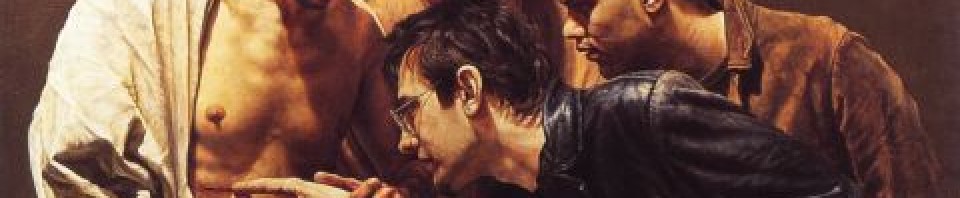
Cleanthes recognizes that God created the world through his Word, that we are created in his image, that we ought to behave rationally but are foolishly drawn to evil, and that we need for God to intervene to show us the true way, and to save us.

About 250 years later, the Deity heard this prayer and answered it by sending his Word to save us from our sins.  The Word had always existed and was the light of the world.  But now it entered the world.  St. John writes:

In the beginning was the Word,
and the Word was with God,
and the Word was God.
He was with God in the beginning.
All things were created through Him,
and apart from Him not one thing was created
that has been created.
Life was in Him,
and that life was the light of men.
That light shines in the darkness,
yet the darkness did not overcome it.

There was a man named John
who was sent from God.
He came as a witness
to testify about the light,
so that all might believe through him.
He was not the light,
but he came to testify about the light.
The true light, who gives light to everyone,
was coming into the world.

He was in the world,
and the world was created through Him,
yet the world did not recognize Him.
He came to His own,
and His own people did not receive Him.
But to all who did receive Him,
He gave them the right to be children of God,
to those who believe in His name,
who were born,
not of blood,
or of the will of the flesh,
or of the will of man,
but of God.

The Word became flesh
and took up residence among us.
We observed His glory,
the glory as the One and Only Son from the Father,
full of grace and truth.
(John testified concerning Him and exclaimed,
“This was the One of whom I said,
‘The One coming after me has surpassed me,
because He existed before me.’”)
Indeed, we have all received grace after grace
from His fullness,
for the law was given through Moses,
grace and truth came through Jesus Christ.
No one has ever seen God.
The One and Only Son—
the One who is at the Father’s side—
He has revealed Him.

No one has ever came to God, except through his Word; the Word which existed beforehand and gave light to Enoch, Melchizedek, Jethro, Job, Epimenides, Socrates, Plato, Cleanthes, and any of the other pagans who sought after God but who lived before Christ’s birth.  But now that Jesus has come into the world, we are rescued from ignorance, and we can now place our faith explicitly in a tangible salvation which was revealed to us from Heaven.

“But blessed are your eyes, because they see; and your ears, because they hear.  For truly I say to you that many prophets and righteous men desired to see what you see, and did not see it, and to hear what you hear, and did not hear it.”  (Matt. 13:16-17)

Thank you, Jesus for coming into the world.  And Merry Christmas to everyone!