
Author Archives: Aron Wall

About Aron Wall

I am a physics professor at Syracuse University, as of 2026. Before that, I read Great Books at St. John's College (Santa Fe), got my physics Ph.D. from U Maryland, and did my postdocs at UC Santa Barbara, the Institute for Advanced Study in Princeton, and Stanford. My first faculty position was at the University of Cambridge. The views expressed on this blog are my own, and should not be attributed to any of these fine institutions.

How to Cope with Obsessive Religious Doubts

I. Introductory Remarks

From time to time people email me with questions about Christian theology, or about how various aspects of modern physics relate to God.  Although I am extremely busy these days, I do sometimes try to answer such questions, especially when it is clear that the topic is related to a spiritual struggle that the questioner is going through.

(If I have not answered your email I am sorry about that.  Between caring for small children, an academic career, and some health annoyances, I’ve had less time to answer everybody who writes to me.  When I do answer people, it is often after a delay of weeks or months.  Thanks for your understanding, and please don’t assume that because I don’t reply, that I therefore didn’t read your email or pray for you.)

If your question is more philosophical and less personal, it might be better to post it to the comment sections of this blog rather than to my email.  For one thing, this gives other people the chance to post their own answers, and also to benefit from any replies.  We can all learn together!

However, sometimes a person’s question is deeply personal, and in this case it is natural not to want your question to be exposed to the public.  In such cases, writing to me by email might be more appropriate.  However, it is still somewhat inefficient if I see the same issues over and over again…

Because of this, I’ve decided to collate some things I’ve written to some people struggling with one very specific spiritual problem, which can cause great suffering to the person afflicted.  If you don’t have this particular problem, then great!  This blog post is not for you.  But I am sure there must be thousands of people out there who need to read this post.

Disclaimers

This blog post is not about me, specifically.  For some reason it is hard to write a blog post about mental health problems without people assuming it is some sort of cry for help, or a round about way of confessing something that I have been struggling with recently.

It’s true that I wouldn’t have been able to help people struggling with this problem, if I were not also a fellow human being, who has suffered from my own doubts and emotional anxieties and struggles (Hebrews 5:1-3), which bear some similarity to the problem the other person is having.  But the descriptions in this post are based at least as much on seeing this pattern in the lives of others, even if some of the advice is based on things that have helped me in the past.

If you are one of the people who has written to me about your spiritual struggles, please be assured of the following:

(a) Nothing in this post can be used to identify you; your confidentiality is always assured unless you explicitly tell me otherwise.

(b) Although I might quote my own words from emails that I wrote to you, this post is not about you as a specific individual, but rather about a common pattern that affects many people.  That is, of the \(N\) people who have written to me about this issue, even if we leave you out of it entirely, I could still have written this blog post based entirely on the other \(N – 1\) people.

This blog post is written for people suffering from a particular sort of spiritual anxiety.  If in the last 2-3 months, you have spent less than 1 hour / week worrying about whether your religious beliefs are true, then this blog post is probably not for you.  Or, if you spend more than 1 hour per week thinking about this topic, but both of the following are true:

(A) you usually don’t experience significant negative emotions while doing so, and
(B) you are usually able to set these thoughts aside, in order to engage in other important activities (such as work, hobbies, interacting with family/friends, or sleeping),

then again this blog post is probably not for you!

(Indeed, if you hardly think about the question of religious truth at all, then you might be better served by a stern warning about the importance of the subject!  If there might be a God who loves you and wants you to be eternally happy, but who also expects you to live in a certain way, shouldn’t you want to know if this is the case?  But, I assume the people who need to hear this sermon probably don’t overlap very much with the Undivided Looking readership.)

II. What it looks like

The pattern I want to discuss is the case of a person who becomes obsessed with Christian apologetics (i.e. the defense of Christian beliefs) to an extent that becomes emotionally unhealthy.

Something triggers them that is either an event (e.g. the death of a friend), or an argument (e.g. reading an atheist cosmologist who thinks God obviously doesn’t exist because the universe [did/did not] have a beginning); or perhaps they are reading the Bible and see something which seems to them to be a contradiction; or perhaps they have a meloncholy or anxious temperament, that is inclined to dwell on doubts about God’s existence or goodness.

Usually the person with this pattern of doubts is a devout religious believer, but in some cases they might also be an irrelegious person who doesn’t like Christianity, but can’t seem to get out of their mind the idea that the judgemental God they perceive in the Bible might somehow still exist, and so they seek a dialogue with a religious believer to voice their fears and anxieties.

For concreteness, let’s invent a concrete fictional questioner named George, and I am going to suppose that he is a devout but struggling Christian.  (By this blog’s eccentric canonization policy, I suppose I ought to therefore call this fictional character Saint George.  This is fitting since he does have a dragon to fight.)

Let’s suppose that St. George was raised in a church with a somewhat insular and fundamentalist worldview.  He was led to believe that Darwinian Evolution is just atheist propaganda, invented by people in order to attack the biblical account of creation.  For a while in high school, he was fed some young earth creationist material which led him to believe that there was some actual scientific evidence that the world is actually only a few thousand years old.  But after he went off to college, he realized that it is difficult for a scientifically literate person to believe in this.

This leads St. George to a crisis of authority.  The people who taught him made some really bad arguments for Christianity.  But maybe there are also some good arguments?

In his spare time George tries to assuage his fears by reading Christian apologetics (or watching videos), as much as he can find online.  He discovers that there are some intelligent seeming Christians out there, with a worldview more open to scientific knowledge, who nevertheless believe that there is good evidence for the Resurrection of Jesus.  Or, he might get interested in various arguments for the divine creation of the universe, for example Cosmological Arguments (based on contingency or based on Big Bang theory or whatever).

But in order to be fair, and to seek out challenges to his worldview—and perhaps also because of the fascinating attraction of opposites—he also consumes anti-religious works on the other side, in order to compare the quality of the arguments.  So far, so good.  But while St. George finds some of the answers given by the Christians seem to be persuasive, others may not seem so convincing.

Or the answers raise a whole new crop of issues and objections.  OK, we know that the disciples didn’t steal Jesus body because there were guards at the tomb, but how do we know that St. Matthew didn’t just invent the story about the guards, or that the Gospel was written by somebody else entirely?  And here’s an atheist on the internet who claims that some random paper on the arXiv shows that the universe might not have had a beginning.

Nothing ever seems to be fully definitive.  (How can it be, when it seems that the justification of Christian faith depends on so many different historical and philosophical factors, which people have been arguing about for centuries?)

George starts to wonder if the problem is with himself or whether the problem is with what he was taught.  How can he resolve these perplexing doubts and difficulties?  Does he really need to be an expert in quantum cosmology and biblical criticism in order to decide whether God exists?

Does he simply need to find the right experts, and trust them to give him all the answers?  But what if the experts disagree, or if he picks an expert based on the fact that they are telling him what he wants to hear?  It was a shock when he first learned that there are bible scholars with PhD’s from top universities, who think that what he believes about the Bible is dead wrong.

Patterns of Addiction

To assuage these worries, St. George increases his consumption of the product.  After all, some of the articles he read by Christian apologists did seem to be helpful for resolving many of the sillier atheist objections.  So it seems like if he can only ask enough questions, and watch enough smart people debating the issue, maybe he’ll reach a state of realization or enlightenment where his intellectual (and spiritual) problems will be resolved.

Unfortunately, this is a potential pathway to addiction.  Apologetics is obviously not chemically addictive, but anything can be psychologically addictive if the right conditions are met.  That is, St. George is in a situation where doing activity X causes him to feel bad, but where his beliefs are such that it seems the right way to respond to these bad feelings is to do X again.  This can cause a feedback loop where X grows and takes up more and more of his thoughtspace.

Now let me be clear.  I don’t mean to imply that being interested in Christian apologetics, or deeply caring about its outcome, is in and of itself psychologically unhealthy, and that researching apologetics is necessarily a wrong thing to do when faced with religious doubts.  Obviously not, or I wouldn’t have written a bunch of apologetics posts!

It’s perfectly reasonable to want to do some research to find out whether what you believe rests on a secure foundation.  For the vast majority of people, that’s all it ever is and this blog post is not about you.  Please keep doing what you were doing before, and if you were happy before, please don’t become unhappy by wondering if you have some sort of apologetics neurosis.  (Just because you might say, in a causal conversation to a friend, that you are “obsessed” with some hobby or interest, doesn’t necessarily mean you are obsessed in a clinical, bad sense of the word.)

If you really do have the bad sort of obsession with religious doubts, you’ll know it because it was already making you miserable—I mean before you started reading this post, and wondering about whether it describes you.  This is not a problem you can have without knowing about it!

As in other cases of addiction, the instinctive response to dealing with the difficulties caused by excess consumption can sometimes be to double down on the tactics that were originally used to try to solve the problem, by “increasing the dosage”, so to speak.  So St. George spends more and more time on the topic.  This of course also increases his chances of thinking about the subject whenever he is not reading about it.  In fact, he starts to experience his doubts in the form of intrusive thoughts, which make it very difficult to concentrate on his work, or his studies in school.

Pretty soon the other areas of his life start to suffer.  To quote a psychological criterion for when a mental pattern becomes a disorder), St. George has started to experience “significant distress or impairment in social, occupational, or other important areas of functioning”.

[I have omitted the word “clinical” here since this I am not a professional psychologist and this blog post is obviously not formal medical advice.]

If St. George has a tendency towards OCD or an anxiety disorder or depression—again, these conditions are nothing to be ashamed of, and these personality traits can exist in mild forms as well as severe forms—then these may be complicating factors.  It might even be that St. George would benefit from seeing some sort of therapist (although if so, he should try to find one who is able to respect the ways in which religion can play a positive role in his life).  Human beings have both bodies and souls, and each one affects the other in a complicated way.

It is important to emphasize that none of this means that George is crazy, or about to go off the deep end.

In fact, St. George is quite possibly a highly rational person, whose beliefs might in several respects be more accurate than those of other people.  Nevertheless, he has a mental health problem—and this is nothing to be ashamed of, it happens to literally everybody on the planet from time to time!

However, St. George has a problem he doesn’t seem to be able to reason his way out of, in part because St. George has a false belief about what his problem actually is, and therefore what is the right way to fix it.

What people want me to say

St. George might stumble across my blog or webpages and say to himself, “Gee, here’s a Christian with a PhD in physics, who is an expert in quantum gravity.  I’ll write him an email and he can sort me out!

Dear Dr. Wall,

Sorry to bother you since you must be busy, but as a fellow believer in Christ I’m hoping you can help me with a problem.  I’ve been struggling with anxiety about my faith ever since I heard about so-and-so’s cosmological model where the universe comes out of a Giant Trombone instead of having a beginning.  Is the Giant Trombone theory really true?  Please help me!

Best wishes,
George

Now it usually is true that the Giant Trombone theory (or whatever is the flavor of the month) is a highly speculative idea with little evidential support, and I will probably be able to say some things that will reassure St. George about that particular point.

At the same time, I can’t help but feel that St. George is putting me in a somewhat false position, i.e. that he expects a certain degree of scientific certainty which I can’t and shouldn’t provide.  What St. George really wants me to say is something like this:

Dear George,

There is no evidence whatsoever for Giant Trombone theory.  In fact, speaking from my authorative position as a scientist, the data is completely conclusive that the universe had an absolute beginning of time.  Only a person who is totally biased, with an a priori prejudice in favor of atheism, could believe otherwise.  For this reason, you can be quite certain that the universe was created by God 13.8 billion years ago.  I hope this resolves your spiritual difficulty.

Blessings,
Aron

But I will never, ever write this email, because it would compromise my integrity as a scientist and as a theologian to do so.  As a scientist, I need to allow for the possibility that Giant Trombone theory (or whatever it is) might turn out to fit the facts, or that there is some aspect of it which I can learn something from.

And speaking as a theologian, I know that God is allowed to create the universe in whatever way he pleases (either with or without a Giant Trombone) and that the Big Bang theory can’t really be the primary foundation of the Christian faith—for the very obvious reason that Chrisitianity is about 20 times older than the Big Bang model (as first proposed by the Catholic priest St. Georges Lemaître), so it can hardly be the reason why anyone before him believed in God.

For me to endorse, even implicitly, the misconception that the existence of God is primarily supported by the Big Bang model, would commit me to thinking that every Christian in history from St. Peter to the time of St. Maxwell believed in Jesus for the wrong reasons.

Admittedly, if the Giant Trombone theory were actually confirmed to be true (which is admittedly kind of unlikely, because I just invented out of whole cloth a few paragraphs ago), it might be a little bit relevant to some questions.  It could potentially push the scales of evidence a little bit, one way or the other, on certain very specific technical arguments for the existence of God.  On the other hand, it won’t make any difference at all to several other classes of arguments, such as those which argue that even Giant Trombones would be contingent realities, and would stand in need of an explanation.

In other words it would contribute somewhat to the Great Philosophical Conversation about Everything.  But it is a very serious mistake to think that God’s existence rests on whether one very specialized type of argument for his existence is valid or not.

(I think it is probably true that a sufficiently powerful intelligence (e.g. an angel) could point out flaws in any arguments a human being might make for the existence of God, or indeed for the existence of almost anything else that we think is real.  But that does not mean the angel couldn’t add: “Yet there is also something essentially right about your argument, if you were able to see even deeper into this topic as I can.”)

If St. George thinks that reviving his certainty about Christianity requires becoming an expert in quantum cosmology, then St. George is simply wrong about how the Christian faith works.  And it is more important to correct this wrongness, than to explain to him the particular ways in which Giant Trombone theory is unlikely to be true.

Long before Big Bang cosmology was a thing, someone wrote these words:

By faith we understand that the universe was formed at God’s command, so that what is seen was not made out of what was visible.  (Heb 11:3)

Let me be quite clear here that this word “faith” in the New Testament does not mean belief without evidence (as many atheists falsely allege, because that makes them feel justified in rejecting it.)  The central meaning of the word is much closer to the English word trust.  That is, it is primarily a word about relationships, not a word about propositions.  Obviously, there are situations in which trust is justified—it all depends on who you are trusting, and what reason you have for trusting them!

If you trust a friend, then you will indeed believe certain propositions.  Presumably you will have a good opinion about their character and reliability.  Also, if you trust your friend’s honesty, and expertise about a given subject, then you will also be disposed to believe whatever they tell you about this subject.

All of this is pretty obvious in a non-religious context, in which case a lot of questions about “faith” just sort themselves out naturally.  Common sense says that faith is sometimes justified, and sometimes leads us astray, depending on who or what you put your faith in.

Faith only becomes a religious matter when the friend you are trusting is God himself, the Creator of the Universe.  Because we can come to know, at least a little bit, the Creator, we can trust that he is the source of all the beauty we can see in the Universe.  This sort of faith actually works in the opposite direction from apologetics about creation.  The Christian faith starts with having a relationship with God (which is potentially available to everyone through his promises), and proceeds from there to become confident in God’s ultimate control over everything.

This sort of faith was available even to people who lived before the Big Bang theory, or the disovery of the Second Law of Thermodynamics.

Why doubts can’t always be resolved in the way you want them to be

In some ways the root cause of the problem is, paradoxically, that St. George is conceptualizing his doubting as an intellectual “problem” which needs to be “solved”, rather than a present emotional difficulty, which he needs to find resources to cope with.  But life, including spiritual life, is not really a problem to be solved, rather it is something to be lived.

There are indeed intellectual puzzles which pop up along the way.  These puzzles are important to think about, and banging our head against them helps us to learn what reality is like.

It is indeed true that that the deepest Reality is not an impersonal uncaring force, but rather a loving God.  And that the best way to relate to these mysteries and puzzles ideally ought to bring you closer to God, rather than farther away.

At the same time, answering intellectual puzzles cannot be confused with life itself.  A crossword puzzle can be solved, and then you are done with it.  But a pet dog is not something which can be “solved” once and for all, and then it won’t bother you anymore.  It is a living reality which can be related to but not in a way which disposes of it.  You can indeed “fix” a dog, but this only deals with one highly specific way in which the dog might be a nuisance to you.

If even a dog cannot really be related to properly with a problem-solution mentality, then still less is it possible for us to relate to God in that way.

St. George is probably a highly intellectual person, and when he encounters a new problem in his life, his instinct is to try to cast it as an intellectual problem to be solved.  This means he has to recast the problem as a “debate” for which the proper solution is evaluating arguments.  But if the original trigger for his spiritual difficulties was more of an emotional or relational difficulty, then this might be an entirely inadequate response to the original trigger for his doubts.

In fact, it may never be possible for St. George to resolve his problem using his chosen method, because it doesn’t address the underlying emotional issue.  In such cases, increasing the dosage of his chosen “medication” won’t help, it will just increase the severity of the side-effects.

As St. Dorothy Sayers writes in The Mind of the Maker:

What is obvious here is the firmly implanted notion that all human situations are “problems” like detective problems, capable of a single, necessary, and categorical solution, which must be wholly right, while all others are wholly wrong. But this they cannot be, since human situations are subject to the law of human nature, whose evil is at all times rooted in its good, and whose good can only redeem, but not abolish, its evil. The good that emerges from a conflict of values cannot arise from the total condemnation or destruction of one set of values, but only from the building of a new value, sustained, like an arch, by the tension of the original two. We do not, that is, merely examine the data to disentangle something that was in them already: we use them to construct something that was not there before: neither circumcision or uncircumcision, but a new creature.

In some medieval versions of the legend, St. George finally defeats the dragon, not by killing it as you would expect, but by baptizing it.  Immediately the dragon becomes completely tame, and he is able to lead it into to the village, where it begins to serve the people there.

Perhaps our modern St. George can take the lesson from this, that sometimes a “problem” is best resolved if we jump out of the initial framework we were trying to use to “solve” it.

A Change of Frame

You will notice that I have sometimes been discussing the issue of obsessing over doubts as if it were a psychological problem—a problem of addiction—rather than directly engaging with the contents of the doubts.

By this I mean no disrespect to the important philosophical issues that St. George’s questions relate to.  As a writer named Sarah Constantin says in a very insightful post called Sane Thinking about Mental Problems:

There are multiple ways of looking at problems with the mind.  I don’t think that there’s a best one, but that it’s practical to switch between them pragmatically and to be mindful of the local advantages and disadvantages of each frame.

There is a medical model which “speaks of mental illness as a type of disease, which can be treated medically.  The mentally ill are sick, and they can get well.  They are patients.”

There is a social model which treats mental problems as disabilities, which require accommodations by society in order to treat everyone fairly.

There is a skill based model which says that “problems of the mind are fundamentally about being weak at a skill, and recovery is about gaining that skill.”  About this approach Constantin says:

The advantage of the skill-based approach is that it incorporates the human capacities of learning and trying.  Once you have the lightbulb moment of “wow, I can try to get better on purpose?”, once you start working directly on things rather than waiting for someone to “treat” you, your progress can accelerate quite suddenly. The skill model takes you, meaning your “wise mind” or the part of you that wants to be sane, seriously as an agent, and enlists your effort and intelligence.

But I was most interested in how she described a spiritual approach to mental illness:

What I’d call the “spiritual model” is a final family of viewpoints, which are related in that they take the denotational content of mental problems seriously, especially mood problems.

In this model, if you are having a crisis of faith, then your depression is fundamentally about religion, and you’re going to need to figure out your answers to religious questions.  If your problems take the form of extreme guilt, then you’re going to have to engage with ethical philosophy and figure out a form of ethics that is compatible with life.  If you’re experiencing nihilistic despair, then you’re going to have to find a source of meaning.  If you’re having delusions, you might need to build up a stable epistemology.

The spiritual model takes unhappiness as a normal or even universal part of the human condition, not something exclusive to “abnormal psychology.” People get profoundly unhappy; people have to find a way to overcome despair; the way to overcome your despair is to figure out where you have a misunderstanding and gain the insight that will resolve it.

The advantage of this approach is that it is much more individual and fine-grained than the other approaches.  It deals with your mind, not the generic mind that has similar problems to yours. And it engages with your mind, including your mental illness, as a peer — not as something to fix or to accept, but as someone to talk to and listen to. It allows for the possibility that your strange thoughts while depressed or manic or whatever might in fact be true, at least in some facets.  There’s a sense in which resolving inner conflicts is “getting to the root of the problem”, actually untangling the knots in your mind, rather than “merely” palliating symptoms.  The work of life, from the spiritual point of view, is building a valid and life-sustaining personal philosophy, and almost incidentally, this will resolve many “psychological problems.”

Although I have no particular reason to think that this blogger is a Christian, I loved the way she described the spiritual approach here as taking people’s search for truth and meaning seriously—to ask what really does give our lives meaning.  Our hearts demand that this be a legitimate question to ask.

I would add that if it turns out that God is the Deepest Truth, and if our relationship to God defines our truest identity, then it would be a mistake to try to construct a purely secular notion of “mental health” in which the answers to religious questions play a marginal role.  If God is our true Father who loves us, then anyone who is living as an atheist is for that very reason mentally ill, out of orientation, living out a delusion.  Even if they don’t go around dancing naked in the streets, or screaming that people are out to get them.

However, this spiritual frame also has its potential pitfalls:

The downside of this approach is that sometimes your problems aren’t really about anything discernible, and it’s counterproductive to try to seek meaning in them, rather than just trying to manage or treat or accommodate them.  Sometimes trying a spiritual approach just means getting trapped in ruminating or becoming an “insight junkie”, with no productive effect on your actual problems.

It’s very rare to see discussions of mental illness that treat multiple possible frames as valid and usable.  I’ve seen personal narratives where people shifted from one frame to another and present it as “seeing the light,” but I think that’s not the whole story. I suspect that successfully living with, or recovering from, mental problems involves being somewhat eclectic about frames.

To summarize: when one frame doesn’t work, it’s worth trying out a different frame. St. George is trying to treat his problem of obsessive doubts as a spiritual problem.  And to the extent that the doubts raise genuine philosophical issues which need to be resolved, that is legitimate.

But supposes he finds that, even after “resolving” the issue as well as he reasonably can intellectually, that his mind just goes right back to Step #1 and begins the process all over again, so that he is caught in an infinite loop.  And that this looping process is partially involuntary, and occurs even when he wishes it wouldn’t.

In that case, he might do better to think of his doubting as an illness which he needs to  recover from.  Or perhaps, as a condition for which he needs to develop skills to prevent these doubts from hijacking the rest of his life.

Not to mention, preventing these doubts from derailing his spiritual walk with God.  (Despite the way they dominate St. George’s self-consciousness, in all likelihood these doubts are in some ways peripheral to George’s actual walk with God.)

No One is Alone

A lot of people might however be reluctant to take the step of trying on the “illness” frame because of the way in which our society stigmatizes mental illness.  But the truth is that almost every human being suffers from some kind of mental problem or another, and there is no sharp line separating the “well” from the “ill”.

Mental health problems are not the same as sins.  According to orthodox Chalcedonian theology, this means that as a human individual, even Jesus was able to suffer from difficulties and burdens of the mind, such as depression.  The prophet Isaiah portrays the Suffering Servant (whom Christians identify with the Messiah) as suffering from depression regarding the apparent lack of success of his ministry:

But I said, “I have labored in vain; I have spent my strength for nothing at all.  Yet what is due me is in the LORD’s hand, and my reward is with my God.”  (Isaiah 49:4)

and we know from Christ’s words on the cross, that even the Son of God was able to feel abandoned, in a world where his Father seemed to be totally absent (even though in reality the Father is never absent).

And this is why the following verse about the Savior is true:

Can we find a friend so faithful
Who will all our sorrows share?
Jesus knows our every weakness,
Take it to the Lord in prayer.

So the fact that St. George has a mental burden which he finds difficult to bear, does not yet distinguish him from Jesus.

George might choose to reframe his doubts as a form of suffering, treating an episode of spiritual anxiety just as if it were a bout of nausea.  What then?  In that case he would try to avoid things that trigger such episodes whenever possible, and would ask God to “let this cup pass from me” to the extent possible.  But when it must be suffered, to just try to get through to the other side somehow or another, knowing that he will eventually get through it.

Even Jesus was tempted to try to prove that he was really the Son of God, by taking an illicit shortcut by “testing God”.  Jesus declined this offer.  (And if you want to follow him, so must you.)

However, unlike Jesus, St. George is a sinner, and this means that he will probably be doubting God in ways that Jesus wouldn’t, and he won’t be bearing his burden with the same degree of patience and trust that the Son of God would.  Nevertheless, he will become more Chrsitlike to the extent that he prayerfully refers all his difficulties (most especially including St. George’s present suffering due to doubts) to the loving care of the Father.

Afterlife Anxieties

[While the whole point of this section is to be reassuring, feel free to skip to the next bold section if you prefer not to think about this topic right now.]

A complicating factor in some cases is the fear of damnation (either for themselves, or for friends and family members), either as an explicit fear, or an implicit motivating factor.

Suppose that St. George has been raised in a church which teaches that God automatically sends everyone who dies without believing in Jesus to Hell.  (His church’s teaching might actually be more nuanced than this, but the question is which theological impressions are controlling George’s mind, which may not even be the same as the theology that he would consciously state if you ask him what you believe.)

This fear of Hell thus acts as a disincentive for a religious person to accept any possibility of a non-religious perspective being valid.  Yet many intelligent Christians are sufficiently self-aware to notice this effect on their own minds, and worry that it is compromising their judgement.

Also, the doctrine raises its own set of thorny (and emotionally disturbing) questions about the justice and goodness of God (even though God is both our Father and the Supreme Good), so now St. George has yet another set of religious doubts and fears to process at the same time.

Actually, this effect can work in both directions.  A person who might be in the process of journeying from unbelief to Christianity, can find it difficult to admit it to themselves—because taking the possibility of Christianity seriously, could also require taking eternal punishment seriously as a possible outcome.  Conversely, many people raised as Christians deconvert, precisely because they experience the threat of Hell primarily as a form of intellectual blackmail, and the only way to win that game is to take a hard line, by refusing to play.

If only they knew how much God loves everyone, and how much he desires for everyone to be reconciled with him!  That God has no desire to punish for the sake of mere revenge, but would much rather bless us with the richest of rewards.  And that none of the warnings in the Bible were intended to stunt anyone’s intellectual or spiritual development—not at all—but only to prevent people from selling their birthright, by refusing to grow and to love by means of various evasions.

One day Christ will return and he will rebuke those who, like Job’s friends, tried to use “orthodoxy” (as they undersood it) not in a redemptive way, but as a tool for controlling people, in order to try to keep people from asking honest questions or thinking for themselves.

Anyway, when this doctrine of eternal punishment is introduced in a clumsy and controlling fashion (which is a million miles away from the actual point of the doctrine) it tends to cause both religious and irreligious people to try to repress any spiritual doubts they might have.  Because if they took their doubts seriously then it would make them extremely uncomfortable.

But if you belong to the minority of people, who aren’t able to repress these doubts, but also don’t yet know how to process them in a healthy manner, then you are one of the people I’m writing this post for.

Suppose St. George thinks he might lose his faith by reading a sufficiently convincing atheist argument.  Now his own eternal happiness also seems to be at stake.  That bombastic, confident, suave infidel on the Internet has become an existential threat.  But on the other side, St. George thinks that, as a Christian and as an honest man, he also has an obligation to seek the truth.  And this means that he should try to believe whatever is best supported by the evidence.  This can lead to a sense of conflict within the saint, between the twin demands of fidelity and honesty.

The conflict really arises because St. George has a false picture of God the Father, since he believes on the one hand that God is just, but also that it is possible that God would punish him for exercising a virtue (namely honesty).  This is a contradiction in St. George’s worldview, that he will need to find a way to resolve.

(In fact St. George is probably exaggerating the likelihood of his falling away from the Christian faith.  His fear of apostasy arises from the same place as his other neurotic fears, by imagining a “worst case scenario” and then playing it out in his head.  But in what follows I don’t want to dismiss this concern, but rather to face it head-on.)

Some Christian denominations teach that it is not possible for Christians to lose their salvation.  But this makes less of a difference to than you might think, since religious people inclined to neuroticism can always find a way to make their religion support their neurosis, no matter what their explicit religious doctrines are.  St. George will simply transfer his doubts and fears to the question of whether he was ever saved in the first place.  Maybe he never invited Jesus into his heart properly; since if he did, then why is he suffering from these current perplexities?

(This problem can be exacerbated in a church environment that encourages Christians to always give an up-beat testimony about how their spiritual walk is going.  There is a sort of “emotional prosperity gospel” in some evangelical circles, an expectation that if you aren’t happy enough then you don’t have enough faith.  This is almost as destructive of a heresy as the physical prospertity gospel which teaches that faith in God leads to material riches.  If you are attending a church like this, you should consider finding another place that allows you to express your real feelings.)

It’s sort of a Protestantish version of a Roman Catholic with scruples, who might think that he has to go over and over again to Confession, in order to confess the same sins, because he fears that he might not have done it properly and with full sincereity the first ten times.

Except that, because Protestantism teaches that salvation is by faith and not by works, a Protestant’s scruples are more likely to concern the question of whether he has enough “faith” to be saved.  (If he is a Calvinist he would instead worry about whether he is predestined to be among the “elect”.)  As though faith were a psychological state that has to be drummed up with willpower, rather than the gift of God which is granted to everyone who turns to Jesus.  (Ah, says the scrupulous person, but it has to be a sincere turning to Jesus, and how can I ever know that I was really sincere in doing so?)

Actually, the main point of the Protestant Reformation was to prevent people from relating to God in this pathological, neurotic way.  But that doesn’t stop individual Protestants from missing the point and doing it anyway.  Rather than saying, along with St. Paul,

“If God is for us, who can be against us?  He who did not spare his own Son, but gave him up for us all—how will he not also, along with him, graciously give us all things?  Who will bring any charge against those whom God has chosen?  It is God who justifies.  Who then is the one who condemns?  No one.”
(Romans 8:31-34)

St. George is acting (however much he may try to obscure this to himself) as though his faith is primarily based on some mental contorsion which he needs to accomplish in himself.  Rather than being a work which only the God can do, and which God will do if he waits patiently.

These fears and anxieties can exist side-by-side with a real and genuine love for God, and a desire to enjoy him in a less self-centered way.  But in St. George’s case this love has not yet fruitioned into the mature state spoken of by St. John, who writes that:

There is no fear in love. But perfect [i.e. complete] love drives out fear, because fear has to do with punishment. The one who fears is not made perfect in love.  (1 John 4:18)

When St. George reads a passsage like this, his instinctive response may be to feel guilty because he doesn’t measure up to this standard.  He may think that the doubts are his own fault, and that he wouldn’t be having this problem if he were only capable of the kind of trust in Jesus that other Christians seem to have.

But even if all that were true, it doesn’t follow that feeling guilty about it is going to get St. George any closer to perfect love, or that guilt is a useful feeling to have about this.  Yes, God wants to give you this experience of trusting love, but not everyone can expect for it to be be perfectly formed from the beginning of their spiritual walk.  Often it only comes with time and maturity, so there is a need to be patient with yourself.

Maybe it would be better for St. George to try feeling compassion for himself.  The New Testament says:

Be merciful to those who doubt. (Jude 22)

St. George would probably be more charitable towards another person who told him about similar spiritual struggles.  St. George needs to realize that if he would have compassion on another person experiencing the same struggles, then God must feel even more compassion towards those having these struggles—including compassion for George himself.

And that is why George is more likely to resolve his anxieties by means of growth in love for his neighbor, than by any amount of religious reading.  If George becomes the sort of person who loves his neighbor unconditionally, then he will also find it easier to understand how God can love him unconditionally.

Exiting the Loop

In order to make progress, St. George needs to make a conscious decision to exit the mental loop and to decide how he is going to live the next portion of his life—either as a Christian, as a seeker, or as a skeptic.  And once he makes this decision, he needs to stick with it for the time being, and not simply go around and around and around in the mental-doubt ferris wheel.

(Let me be clear once more that I am talking to people who have been stressing about this issue for a long time, and are suffering as a result, and trying to give them permission to take that feeling of pain as a legitimate reason to do something different.  If you are encountering Christianity and the arguments for it for the first time, or if you are currently enjoying learning more about the arguments on both sides, then this blog post is not for you.  God might still be asking you to make a decision to give your life to him, in which case you should trust him with that.  But you aren’t suffering from the type of obsessive doubt that I am describing here, and depending on your personality and a gazillion other factors, maybe you never will.)

If you are in St. George’s position, it might help to ask yourself what you would do if you were actually forced to decide now.  Suppose you needed to cross a scary bridge in the Amazon jungle to bring supplies to help missionaries translate the Bible, or you were trying to comfort a dying child asking you questions about Jesus and Heaven.  Suppose there were a clear difference between the course of action you would take if you believed it was all true, and if you didn’t.  What would you attempt to do?

In fact, since there are always ways to obey Jesus’s commands more faithfully in any life circumstance, this isn’t really a hypothetical question.  You are always in a position to make a decision and act!  The verse:

Trust and obey, for there’s no other way
To be happy in Jesus, but to trust and obey.

isn’t just for children, but for adults also.  If your intellectual ruminations aren’t oriented towards active trust in what you believe—towards some actual actions—then it should be no surprise if your mental processes have gone of the tracks.  Trying to force yourself to to “trust” in some way that is decoupled from obedience is total nonsense.  Trusting Jesus doesn’t mean managing to execute some complicated mental gymnastics in your head.  It means doing what he said.

(I mean, to the extent that you understand what he wants you to do.  I’m not advising you to initiate a new series of doubts about some part of his teaching that you don’t understand yet, say about whether he really wants you to sell all of your possessions and give them to the poor.  But rather to pick one thing Jesus said, however small, and start doing it.)

Perhaps you could start by forgiving one enemy or buying clothes for one homeless person.  The saints in the Bible who were praised for their faith, like Abraham or Rahab, always expressed that faith by some specific action.  Otherwise how would we know about their faith?

As another St. George (MacDonald) wrote,

Obedience is not perfection, but trying.  You count him a hard master, and will not stir.  Do you suppose he ever gave a commandment knowing it was of no use for it could not be done?  He tells us a thing knowing that we must do it, or be lost; that not his Father himself could save us but by getting us at length to do everything he commands, for not otherwise can we know life, can we learn the holy secret of divine being.  He knows that you can try, and that in your trying and failing he will be able to help you, until at length you shall do the will of God even as he does it himself.  He takes the will in the imperfect deed, and makes the deed at last perfect.  Correctest notions without obedience are worthless.  The doing of the will of God is the way to oneness with God, which alone is salvation.

Making a decision isn’t going to magically make it so George never experiences the emotion of doubt again.  Time and patience are required.  But as long as his will is in the right place, he will get to the right place in the end.

If St. George wants to be happy while journeying towards that destination, then he needs to do whatever it takes to exit the infinite loop that is making him suffer mentally.  Admittedly this cannot always be done immediately, by direct willpower alone.  Hence, at least some of the time when he has spiritual anxieties, he needs to be willing to resolve these anxieties by engaging in spiritual practices, rather than by re-hashing the same intellectual arguments over and over again.

Spiritual Practices

Spiritual practices include things like: singing hymns, reciting the Lord’s prayer, meditating on Bible verses, physical postures (like kneeling, bowing down, or standing) intended to express reverence, lighting candles or incense, etc, not to mention the great variety of different types of congregational worship services.

There are a great variety of such practices, used by different Christian groups.  Rather than trying to catalogue them all, I will simply note that all Christian groups recommend such practices, and that (assuming theological soundness) you are free to pick whichever practices help you the most.

It should be noted that spiritual practices that reduce anxiety, often involve repetition, which is facilitated by the use of pre-existing material.  (For example, at a moment of severe anxiety, you might recite the same Bible verse over again, until you calm down.)  To avoid possible scruples, it is worth commenting on the compatibility of such practices, with Jesus’ teaching that:

“When you pray, do not keep on babbling like pagans, for they think they will be heard because of their many words.  Do not be like them, for your Father knows what you need before you ask him.”  (Matthew 6:7-8)

Jesus’ target here is a superstitious approach to prayer, in which we think that God will somehow be more likely to be swayed if we approach him with the exact right formula, or that prayer is like magic, so that the more you pray the more “power” is generated.

But I do not think these words imply that it is forbidden to repeat yourself while praying, if the reason for the repetition is for your own sake (because you want your soul to dwell in the words more deeply), rather than for God’s sake (as if he somehow didn’t hear you the first time).

And sincerity is indeed important, but this has little to do with whether a given prayer is extemporaneous, or composed by one of the saints who went before us.  What matters is whether you yourself want to say whatever words that are being said.  Sometimes one discovers that words written by somebody else, say exactly the thing you wanted to say, but couldn’t find the words for.  In that case there is nothing insincere about making those words your own.

[Note: if you happen to suffer from OCD, I am not suggesting that you follow any “compulsions” that arise from this source.  Even if these compulsions seem to be religious in nature, they are not true spiritual practices and tend to weaken the will, rather than strengthening it.  In general, a real spiritual practice will be something you want to do, because it is helpful, rather than something you feel like you have to do.  If you have difficulties distinguishing between real spiritual practices and imaginary obligations, please consult with an experienced spiritual director.]

Later in this series, I will suggest a specific set of practices which may be helpful for those suffering from doubt.

Cultivating Perceptiveness

What I am saying does not mean that George can never return to the intellectual arguments.  The greatest questions of philosophy have the feature, that we never outgrow them.  They keep getting richer, and more interesting as we learn more.  So I don’t mean to advise anyone to drop apologetics or philosophy of religion forever.  But rather, to set them aside for a period, whenever they take the nature of an involuntary compulsion.

You can voluntarily chose to return to these topics at any time.  If you take a long enough break, then you will be different the next time you come back to the topic, due to the new experiences and thoughts you have had in the meantime.  As a result, when you come back to these deep questions, you will see new things, that you didn’t see before.

Choosing to obey doesn’t mean closing your eyes to the world around you.  In fact there is nothing better than obedience to God, for shining abundant light, showing who people are, and what they need.

To perceive and to understand, is quite different from having obsessive doubts.  Obsessive doubts, while they are sometimes caused originally by some traumatic situation, really come from internal causes.  If anything, such obsessive doubts actually interfere with clarity of perception, and sound philosophical judgement.

So in addition to strengthening your will with voluntary action, feeling better may also require cultivating a greater connection to your sensory perceptions of the world around you.

(No, I don’t mean going to Youtube and downloading yet another video about whether or not Jesus rose from the dead.  Yes, technically that involves your ears and eyes, but the intellectual question and emotional anxiety is still in the driver’s seat.)

Shut down your computer, and really look at the room you are sitting in.  Is there any art?  Are there any smells?  Are you hungry, thirsty, or tired?  Are there other people in the house, and if so what are they thinking and feeling?  (It probably doesn’t have much connection with your own religious doubts.  That’s a good thing!  It’s an opportunity to leave your struggles behind and think about something else.)

Are your surroundings boring?  If so, it’s no wonder you’ve gone down an Internet rabbit trail.  What can you do to make your surroundings more interesting?  And when was the last time you went outside?

You might object, “But how does this solve my intellectual problem with religion?”.  But God is everywhere, even in mundane reality, even when you aren’t thinking of him.  And life is not a problem to be solved.  So do it, and you will feel better.  And after you feel better, you will probably start thinking more clearly as well.

An Oversimplified Model of the “Soul”

Just in case it helps, here is a pictoral model of what I’ve been saying in the previous section.  In a cartoonishly oversimplified (i.e. mostly false, but hopefully still useful) picture of the “soul” or mind, you can imagine your mind as containing 4 different aspects or faculties: Perception, Emotion, Intellect, and Will.

They are all connected to each other as follows:
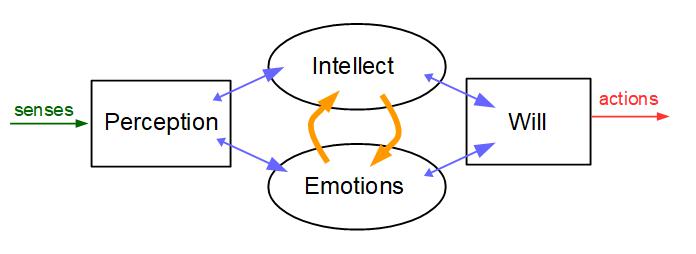
I’ve drawn arrows to show how “information” flows through us:

•  In the first layer our external sense data informs our Perception—by which I do not mean passive receptivity, but rather our active interpretation and understanding of whatever we are currently experiencing in the world.

• Then Perception in turn influences Intellect (which constructs our theoretical model of the world, including “unseen” things we don’t directly perceive, e.g. God or the back sides of objects) and Emotions (which generates feelings, either welcoming or aversive, to various things in our model).

• Additionally, each of the Intellect and Emotion strongly influences the other one internally.  If you have a thought about the world, this is likely to lead to some feelings, and if you have feelings about a thing, this is likely to lead to further thoughts.  (Indeed, without some emotion, our thoughts can’t function, because you have to at least care enough about the subject matter to bother thinking about it!)

• Then Intellect and Emotion both in turn influence the Will, our decisionmaking capacity. This in turn leads to external actions in the world.

[One could dress this sort of thing up with neurology techno-babble, for example I could say “motor cortex” when I talk about taking actions, but I suspect that this sort of thing would lead people to take the models too seriously, so it’s really better to keep things at the level of “folk psychology”!]

Note that the blue arrows actually go in both directions!  The primary direction of influence that we more normally consider goes in the forward (right) direction, but the secondary direction (left), shown as smaller arrows, are also important.  Our Intellect and Emotions affect what we perceive.  And our Will affects our thinking and feeling, as well as which perceptions we choose to pay attention to.  (There should also be some arrows directly between Perception and Will, but the diagram is complicated enough as it is!)

It is possible for mental functioning to flow in a smooth stream from left to right.  When all 4 faculties are fully engaged, this will tend to look like one of 2 patterns:

Perception -> Intellect -> Emotion -> Will;

or:

Perception -> Emotion -> Intellect -> Will,

but with various forms of feedback operating in the backwards directions, to keep things on track, regarding whatever activity you happen to be engaged with.

But what happens in the case of a person afflicted by severe doubts?  In that case it looks more like this:
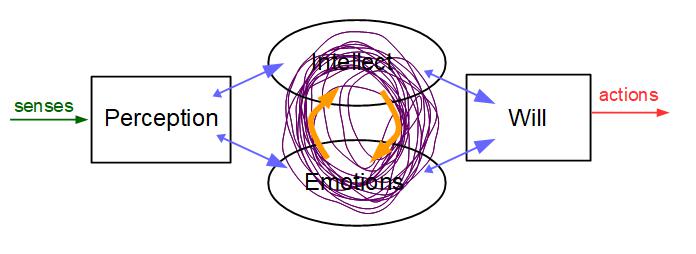
What’s happening here is a sort of feedback loop between the 2 “internal” faculties (Intellect and Emotions), where because you feel strongly about a topic, you keep thinking about it, but this produces more feelings:

…Intellect -> Emotion -> Intellect -> Emotion -> Intellect -> Emotion…

Of course, there’s nothing bad about these orange arrows per se, which serve an important function.  The problem is when it leads to obsession and needless suffering.

The conflicted thoughts (shown here as the purple squiggles) go back and forth in a circle in a way that is completely disconnected from your experiences in the actual world.  This in turn causes disengagement from Perception and Will, as the main crisis in your life is primarily about mental constructs in your own head, not your bodily experiences.  [I am not of course saying that God and Jesus are mere constructs in your head, but your obsessive doubting about them is an internal mental activity.]  But this disengagement in turn makes the doubting worse, because it removes from your life anything that might distract you from your cycling anxious thoughts.

It’s sort of like how when you get a microphone too close to the speaker, it produces a loud SHREEEEEEE!!! sound.  The good news is that this can be fixed through a repositioning of your mental faculties.  The difficulty involves a feedback look between Intellect and Emotion.  But this feedback loop is a conscious mental process, which means that can only exist to the extent that we choose to pay attention to it.

But you can’t stop paying attention to something by simply willing yourself not to.  Because this leads to the “Don’t think about a pink elephant!” trap.  (You just did, didn’t you?)  The solution is instead to deliberately choose to think about something else.

This requires strengthening the “external” mental faculties that aren’t participants of the feedback loop (Perception and Will).  Specifically, this means selecting activities that allow you live more fully in your Perception (paying attention to sensing the world around you).  And also—either separately or at the same time—learning to focus more on your Will (paying more attention to making decisions, leading to concrete actions in the world).

This doesn’t mean your Intellect and Emotions will be unengaged, but they will be differently engaged, in a supporting back-up role, to some activity where Perception or Will are taking the lead.

(Of course, my point is not that Intellect and Emotion are unimportant.  Rather, the system has gotten out of balance, and we are trying to restore that balance!  There are other people out there who are imbalanced in a different way, and who would need the opposite advice, but these aren’t the people afflicted by obsessive religious doubts.)

III. Shouldering the Weight of the Sky

St. George might sometimes feel tempted to express his persistent doubts by saying something like, “I can’t seem to get God out of my head!”.  This is a somewhat odd way to put the problem though.

The perpetual contemplation of God, even while going about one’s work, is something a lot of religious people aspire to.  Even missionaries, pastors, or monks and nuns often find it difficult to remember God in all things, and now here you are trying to forget him!

Unfortunately, St. George’s neurotic loop is a very different phenomenon than mystical contemplation.  St. George can’t get over worrying about whether God really exists or not.  Which is a very different thing from contemplating the mystery of the Trinity, or wondering at the humility of the Incarnation, or seeing Christ in the face of the person God has set in front of you to love.

Neurotic Obsession versus Prudent Care

St. George might try to justify his obsessive doubts by saying the following:

“The question of whether God exists is infinitely more important than anything else, and might affect my eternal destiny, therefore I have to put my life on hold until I find out what is true.”

Now it is quite true that a lot of normal folks don’t take enough trouble to try to seek out the real truth about God and the universe.  Seeing that so many people give contradictory answers, many people without strong convictions assume the problem is insoluble, and give up in despair before they even start.

This despair may sometimes cloak itself in shallow relativism, but is often, I personally suspect, a stubborn will not to know the truth.  For this reason, the chief job of the Christian apologist is not so much to convince people of facts, but to wake them up; to convince them to take personal responsibility for seeking the truth, so that perhaps they open their eyes and grope towards the light.  (While keeping in mind that nobody can ever come to God without God’s grace preparing the way beforehand.)

So it is quite commendable that St. George is searching for answers.  But just because some people think about the issue too little, doesn’t mean it is impossible to err in the opposite direction, by excessively overthinking it.  As Aristotle pointed out, goodness is usually a middle path between the opposite vices of “too little” and “too much”.  For any given virtue (e.g. courage), you can either fall short of it (cowardice) or else overshoot the mark (recklessness).

But God is infinitely important.  How is it possible to be too concerned about something which is infinitely important?

The answer is straightforward: if doing so does not in fact contribute to clarifying your thinking and affections about the issues at stake, but instead leads to a mental illness that places obstacles in your spiritual journey.

Nobody can ever love God too much, since God is utterly and supremely holy, and all good things proceed from him.  Even all the praises of the most exalted angels, all the choirs of seraphim and cherubim, cannot fully describe or encapsulate his sublime glory and beauty.  In this sense, there can be no such thing as an excessive amount of agape/charity towards God.  Even an infinite number of angels singing his praise for an infinite amount of time could not fully understand everything which the Spirit knows about the Father and the Son.  But nevertheless, this same Holy Spirit has been poured out on us, so that we can begin to know him, in his absolute uniqueness.

And yet a particular strategy for dedicating yourself to God can certainly be carried on to excess.  As the Bible says, there is such a thing as “zeal without knowledge” (Proverbs 19:2, Romans 10:2).  If your obsessions about theology are counterproductive, i.e. if they have the opposite effects from what you intended, and are the wrong method to reach your goal, then they can certainly be “excessive” in that sense, even if the goal is infinitely important.

Just because you need food to stay alive, does not mean that the optimal strategy for staying alive is to eat as much food as possible.  You cannot have too much God the way you have too much food, but you can certainly have an excess of theological reading or obsessing about issues that don’t make any difference to your practical obedience to Christ.

Feigning Certainty

This sort of self-sabatoging excess is more likely to happen if you have unrealistic goals about what can be attained from a given course of action.  Although St. George thinks his doubts are due to his own limitations, part of the problem may be that his role models in the faith may be giving him unrealistic ideas about what real certainty looks like.

One possible mistake here is thinking that in order for your faith to be rationally justified, you have to find evidence which is so strong that it is enough to convince any rational person.  (And therefore, anyone who knows about this evidence, whatever it is, and doesn’t agree with the conclusion is irrationally resisting the truth.)   But this is false.

Every human being has a different background, and is coming from a different place.  There are all kinds of reasons why people, who seem reasonable in other ways, might accept or reject various arguments.  In order for your faith to be rationally justified, you only need enough evidence to convince you that it is true, and this evidence might not always be something that you can easily communicate to others; especially if those other people have very restrictive rules for what types of evidence they consider to be valid.

Realizing that there are educated and intelligent people who disagree with you is part of the process of intellectual maturity.  People with PhDs are a lot less intimidating to me then they used to be.  In part because I’ve learned from experience just how astonishingly silly the claims of certain intellectuals with PhD’s can be.  One has to distinguish between the people who are telling you about some field of study that is based on solid evidence, and a person who merely wants to use their academic authority to promolgate their own nutty theories.

(In particular, I’ve learned to be quite skeptical of the theories of many biblical critics, who read between the lines of the Bible, and based on quite scanty evidence tell you the history of how it actually came to be written.)

It is true that you can find lots of people who reject Christianity, or Theism, for terrible reasons (or for reasons they can’t even articulate).  Some of these people are probably being dishonest with themselves.  But that is between that person and God.  Your faith cannot depend on judging the validity of other people’s responses!

Sometimes an inability to tolerate disagreement even leads certain people to become amateur Christian apologists, since they have a psychological need to support their position by adopting a façade of total certainty.  Unfortunately, this is not a good foundation for good reasoning.

One sees this a lot in religious (and political) discussions on the Internet, which have a tendency to degenerate into childish attempts to win arguments through pure bluster.  “You’re 99.99% certain God doesn’t exist?  Well as a result of the ______ argument, I’m 100% certain he does!  In fact, everything I’ve ever read or seen only makes me more certain that a loving God exists!”  “How can you say that, when in fact there is no evidence at all for the existence of an unfalsifiable invisible sky-fairy.”  The messages here on both sides are: Stand in awe of the degree to which I am completely persuaded by my own arguments!  Everyone who disagrees with me must be a total moron!

The people in this conversation are like rookie poker players who, in every other hand, try to take the pot with an enormous and unjustified bluff (and then look totally surprised when this maneuver doesn’t immediately convince everyone else at the table to back down).

That’s why you can’t allow yourself to be bullied by people who refuse to admit any rationality whatsoever in their political or spiritual opponents.  Such people are really displaying their own intellectual insecurities, by constructing a false persona who is unable to be influenced by anything anybody on the “other side” says.  Over time, the fakeness starts to contaminate their real self.  Don’t be like that.

(Humility does require that we be open to correction by others, but you have to be careful never to let somebody’s fake self try to teach your real self.)

Problems with Debate

Even in classier settings, I’m not convinced that “debate” always has very much spiritual value.  As soon as you start debating, the other person becomes your “opponent”, and instead of trying to mutually seek the truth, it becomes a game or sporting event to be won or lost.  Then each party becomes a “lawyer” looking for tricks to sway the audience, rather than laying their cards straight on the table.

In my experience, usually the only way to get through to a person who disagrees with you, is to have them stop thinking of it as an adverserial thing, where you are on one side and they are on the other side, because that makes them feel threatened by what you are saying.  This is one reason why Socrates preferred conversation based on questions, rather than debate, for as he says to the rhetoritician Gorgias:

You, Gorgias, like myself, have had great experience of disputations, and you must have observed, I think, that they do not always terminate in mutual edification, or in the definition by either party of the subjects which they are discussing; but disagreements are apt to arise-somebody says that another has not spoken truly or clearly; and then they get into a passion and begin to quarrel, both parties conceiving that their opponents are arguing from personal feeling only and jealousy of themselves, not from any interest in the question at issue. And sometimes they will go on abusing one another until the company at last are quite vexed at themselves for ever listening to such fellows.

But if you are a Christian, you should know that true conversion never happens as a result of intellectual bullying, but rather by the work of God’s Spirit in people’s hearts.

So it seems a bit misguided to try to look for a champion Christian debater, to take on all the atheist intellectuals, like Dawkins and Krauss and Carroll and all the rest.  It would be far better to pray for these atheists (as individual people I mean, not just as representatives of an opposing worldview).  That’s something you can do right now without needing to recruit a champion (besides Christ, who already shed his blood for them).  If Christ is truly risen from the dead, then he doesn’t need anyone to bend the truth on his behalf in order for him to be known!

The best apologists are also able to state the case for the other side, because they really believe in seeking the Truth, so they aren’t secretly worried that one real truth will undermine another real truth.  But the fake apologists for Christianity (and Atheism) can never summarize the other side fairly, because they are secretly afraid that if they ever did so it might convince somebody.

There are so many people today who are trying to get to spiritual results, by unspiritual means.  They don’t realize, the secret which St. Martin Luther King and Gandhi knew, that to do accomplish anything significant in this world, you first have to change yourself.

If you love the truth more than anything else, I think people around you will notice that, and you will be a witness to the light that shines in the darkness.  On the other hand, if you take shortcuts and try to use dishonest methods to prove the truth, then the foundations will be rotten, and the structures you try to build on that will eventually tumble down.

The bad sort of apologetics effectively denies the ministry of the Holy Spirit, who illuminates and softens our hearts, and teaches us what is true.  The Bible makes it clear that the divinity of Christ is obvious only to those who are given the spiritual eyes to see it.

The Work of the Spirit

As St. Paul said:

The person without the Spirit does not accept the things that come from the Spirit of God but considers them foolishness, and cannot understand them because they are discerned only through the Spirit.  (1 Cor 2:14)

and

Therefore I want you to know that no one who is speaking by the Spirit of God says, “Jesus be cursed,” and no one can say, “Jesus is Lord,” except by the Holy Spirit.  (1 Cor 12:3)

In my experience, the unhappy Christian with doubts (like St. George) is usually a person who does have the spiritual discernment to see Christ on the Cross as the supreme manifestation of the love of God—but has been distracted from this, by looking for certainty in the wrong places, where it is not always to be found.

Christian epistemology, because it is about God, is fundamentally Trinitarian in its structure.  You need Jesus to come to the Father, but you can’t see the Father in Jesus, unless the Spirit enables you to see it.  God has graciously chosen to raise us, in Christ, into his own life.  But if God has shared the mind of his own Spirit with us, this must necessarily mean (what else could it mean?) that there are some propositions which we do know, even if we can’t explain how we know them.  Only God can perceive God, but God has shared his life with us in such a way that we can participate in his self-perception.

However, St. George might well be confused about what the testimony of the Spirit is supposed to look like.  Especially if he goes to a charismatic church where supernatural gifts like prophecy or speaking in tongues are regarded as the sine qua non of Christian experience.  Or, if he goes to a non-charismatic church where the influence of the Holy Spirit is barely discussed.  Either way, St. George might say to himself: “I don’t know what all this talk about the Spirit is supposed to be about.  I’ve never had any sort of voice in my head telling me what to do, or if I ever did, I was never sure wherther or not it was just my imagination.”  (Or in some cases, he might have gone along with a mental voice in his head for a while, and then decided maybe it wasn’t God after all?  That could certainly trigger an episode of doubt, if anything would.)

But it is not always true that if something is part of us, that we must therefore be conscious of how it works.  Apart from an Argument from Authority (based on faith in those who study anatomy and medicine), I wouldn’t even know that my kidneys exist.  But they are vital to my functioning all the same.  And if my kidneys started failling, I’d eventually start to experience the symptoms of illness, showing (in a negative way) that they were actually there there whole time.

If George is doubting the goodness or existence of God and Jesus, he’s probably none too sure about the Spirit either.  So I think it is worth reminding everyone that biblically, the test of whether you genuinely have the Holy Spirit is not blatant supernatural manifestations (most of which could be counterfeited anyway).  The first real test is this: when you look at Jesus, do you perceive God?  If so, that’s what having the Holy Spirit feels like.

To give an analogy from the senses, it is impossible for an organism to see without having eyes and a brain and a visual cortex.  In other words, you can’t see any object outside of you without having something inside of you which is receptive to that sort of thing.  But if you want to know whether your visual cortex is working, you can find that out most easily by looking at an external object which is outside of you and real.  If you can see it, then you can reasonably conclude that your eyes and visual cortext are (at least partially) functional.  Similarly, a test of whether you have the ability to perceive different pitches is to start singing.  Or if you can reason about different quantities and shapes, then you have some mathematical ability.  You don’t learn about these abilities by introspection, but by doing them.

The Holy Spirit can indeed manifest through various supernatural gifts to specific people, but these gifts are neither a necessary or sufficient condition of holiness.  So you don’t need to bother about these other gifts too much, unless they happen to apply to you specifically (in which case there is no subsitute for getting advice from an experienced spiritual advisor who knows you personally).

The second test is similar to the first: are you beginning to love other people the way Jesus loves them?  If so, that is another sign of the Spirit’s presence.  But of course this test is applicable only if you have been beginning to follow Jesus and obey his teaching.  If not, why would you expect to know anything about it?  A person who never tries to use their musical ability, can’t be expected to have very much evidence of its existence.

Jesus’ response to the question of why some people doubt, was to remind people that everything depends on obedience:

Anyone who wants to do the will of God will know whether my teaching is from God or is merely my own.  (John 7:17)

Those who really want to do the will of God, will eventually learn whether Jesus’ teaching is correct or not.  But if you refuse to live in the Spirit, you shouldn’t be surprised if your perception of religious truth is also dulled.  Jesus also said:

Pay attention, therefore, to how you listen. Whoever has will be given more, but whoever does not have, even what he thinks he has will be taken away from him.”  (Luke 8:18)

In other words, if you live out whatever insights you have already received (however meager they may seem) you can expect more and more information from the same source.  On the other hand, if you don’t live out what you’ve been given, you cannot expect to even have a good grasp on the doctrines you think you know.  Obedience—that is, being willing to be like the Son of God—is a necessary condition for discovering their essential truth.

This does not of course mean that there is an absence of objective evidence for Christianity; such evidence does indeed exist, largely in the places where one would expect it to be if the thing had really happened.  There really is historical evidence that miracles sometimes occur.  And the New Testament really is written in a way that suggests that the Apostles actually had encounters with Jesus after he rose from the dead, and not in the way that you would expect them to write it if they were making up a religion for power and profit.

What there is not, is a God who is willing, most of the time, to perform miracles on demand simply to prove his existence to skeptics.  I agree that that god doesn’t exist.  If an entity like that did exist, it would be quite different from the sort of God that is implied by the notion of a tempted, rejected, crucified Messiah.

And as for the world being full of suffering: well (for those with the ears to hear it) this is actually exactly the way you would expect the world to be, if (as Christianity teaches) suffering really were God’s chosen means for redeeming a fallen world.  I think that those who, even in deep suffering, look to what Christ does with suffering, will see the answer to many of their difficulties there.

However, it is naïve to think that these evidences will be capable of convincing most of those who are outside the faith.  Unless they are, at the same time, transformed into a different sort of person capable of seeing things in a new way.

Or in other words, the only way to really know God is through the Spirit’s revelation of the Son.  As the Eastern Orthodox Christian liturgy says:

“‘Let us love one another, that with one mind we may confess:

‘Father, Son, and Holy Spirit; the Trinity one in essence and undivided’.”

Without love for one another, it is not possible to know who God is.  The only way to know God is that God has shared God with us.  The Trinity isn’t just an esoteric doctrine, it is our only real way of coming to know God in his fullness.  If we try to become acquainted with God in some other way—besides the way that he has provided—we won’t come to know what God really is.

The Full Evidence

Someone might say: I thought you were a big believer in Bayesian epistemology?  So how can you now put the Trinity at the center of your epistemology?  Is this some sort of Fideism, or Reformed epistemology, or Presuppositionalism, where one somehow sneaks in the basics of Christianity as an axiomatic assumption?

Not at all.  I do actually do identify as an evidentialist—I think people should only believe in things if they have some good reason to believe in them—but I don’t advocate for arbitrarily excluding psychological or spiritual experiences from the class of things which can potentially count as “evidence”.

I would say that evidence for X includes any experience whatsoever which is more likely to happen if X is true than if X is false.  And this is true whether or not the experience is one that you are able to convincingly communicate to skeptical individuals, who are not a part of your religious community.

This may mean that different people, who have different bases of evidence, might rationally come to different conclusions about important matters.  Indeed, this is one of the core features of the Bayesian approach to probability theory—that it allows for the possibility that people exposed to a different base of evidence, or with different sensibilities about prior probabilities, might rationally come to different conclusions from each other.

Nor am I advocating that anyone decide whether Christianity is true based solely on psychological factors without regard to anything else.  I would find it hard to believe in Christianity, if the objective historical evidence seemed to refute the Resurrection.  But this is very far from being the case.

In the New Testament, the apostles certainly appealed to the historicity of the Resurrection.  But they also talked about the testimony of the Holy Spirit.  (Much more rarely, they appealed to creation, but obviously none of them mentioned Big Bang cosmology when they did so!)

Different members of the Church may differ somewhat in why they are convinced that Jesus is Lord.  But I think if somebody were to totally exclude from their consideration either the historical concreteness of Christ, or the divine indwelling inside of Christians, they would effectively be denying the manifestation of one of the persons of the Trinity (the Son or the Spirit) and their religion would fall short of full Christian belief.

So I’m not trying to argue that anyone ignore the external evidence, or to exclude any data which they feel is relevant.  But I do think it is worthwhile for people to spend more their time looking in the specific places where God has promised to be found; to take seriously those particular grounds for belief that the New Testament emphasizes.

Put another way, since God is personal he can reveal things in whatever manner he pleases.  It’s easy to feel that God “owes” us evidence for his existence, but I think this is only true if we are willing to look in the specific places he chose to put that evidence.  There is the danger of getting so distracted by worrying about whether or not God exists, that we construct an intellectual system of our own to justify this yes/no question.  But that system may not do us much good, if it is disconnected from the actual means God is using to save us.

Anyway, I free admit to some eclecticism, in my choice of different ways to think about how we know things.  That is why I can mention Bayesianism in one post, and the Trinity in another post, and in a third post I can bring them together.  I want to incorporate into my worldview all the truths which I have learned, from whatever source.  Because all truth belongs to God, everything that is genuinely true has to be ultimately compatible.

Obviously, when somebody converts to Christianity, they do so not because they woke up one day and decided to follow a “Christian epistemology”, but because Jesus met them on whatever path they were currently following.  The whole point of epistemology is that we can learn something new and surprising.  Many people are quite surprised when that new thing turns out to be Jesus.  But, in retrospect, anyone who learns about God will learn about him in a way which is based on who he is, and what he is like.

IV. Some Spiritual Practices

This section will give advice to Christians like George who are suffering from obsessive religious doubts.

(Some of this advice may also be helpful to spritual inquirers who don’t yet consider themselves to be Christians, but not all of it will apply, so you may need to make some adjustments.)

To some extent your problem arises because you’ve been confusing thinking about the existence of God, with having an actual relationship with him through the Holy Spirit.  You’ve been learning that obsessing about whether spritual things are real isn’t always a very spiritual activity, which is a confusion that some people never get over for their whole lives.

But you are making good progress by just recognizing the issue.  Some people go to the opposite extreme and stop believing in God entirely, because they identify God with their negative psychological responses to religious questions.  But that won’t happen to you, as long as you remember that cutting out negative obsessions about whether Theism is true isn’t actually the same thing as cutting out God from your life.

A. Pacing yourself

Part of the problem is that you are following a bad script about how to be happy:

“I have to go through a 2 step process in order to be happy.  FIRST I have to work to become completely sure that what I believe is correct, and THEN I will be able to live my life in a productive and healthy way.”

But I think this not really possible for most people who are just starting out in their spiritual journey, for several reasons:

1. It is not possible for human beings to think about the same, emotionally charged subject for a long time, without needing a break from it.  You are a body as well as a soul, and your mind is limited and needs to rest and recharge.

Taking a break and thinking about other things for a while doesn’t mean you are giving up on figuring out what’s true!  It just means you are pacing yourself.  A long distance runner doesn’t try to sprint the whole time, because they are hoping to make it to the goal without killing themselves.  In the same way, it isn’t intellectual cowardice to take whatever duration of breaks from Christian apologetics you need to keep yourself sane.  Rather, it would be foolish NOT to do so if you want to arrive at your goal.

How long and how frequent these breaks need to be, is something you have to discover for yourself by experience.  But let me suggest (very tentatively) that the breaks should be long enough that when you come back it should be a least a little bit fun to think about the topics again (and I doubt you would have spent so much time on it in the past, if you didn’t enjoy it at least a little bit).

If you are learning about the topic in a healthy way, it might still be a little bit scary, but the negative feelings should not predominate, compared to the satisfaction you are getting out of learning new things.

2. The process of deciding what you believe isn’t purely a matter of cerebral arguments on blogs. It also comes from lived experience. As Chesterton writes in his book “Orthodoxy“:

I mean that a man may well be less convinced of a philosophy from four books, than from one book, one battle, one landscape, and one old friend.  The very fact that the things are of different kinds increases the importance of the fact that they all point to one conclusion.

So for example, somebody might go on a hike and end up with a profound experience of feeling God’s creative power in Nature.  But if they went out specifically with the intention of having that experience, then maybe they wouldn’t have had that experience (or it wouldn’t be as convincing, because it would feel like they were manufacturing the experience).

So you should make time for the hobbies you enjoy, even (or especially) if they don’t seem in any particular way to be “religious”.  Make some time to hike, or to run, or to study some thing you enjoy learning about, even though it doesn’t seem to have any immediate relevance to religion.  These hobbies allow you to develop your personality, which is part of who God wants you to be.

You may not be able to completely control how you feel, but if you keep doing these things, they will provide some emotional support for you.

3. More specifically, there are some types of evidence about Christianity which can only be acquired by living the Christian life.  Hence the importance of “prayer, regular church attendance, reading” etc.  As you may have realized, when one does these things as a purely apologetic exercise, they become quite different things then when you do them in a devotional way, without worrying all the time about whether they are justified.  That doesn’t mean you should cut out apologetics altogether, but it does mean that you need times when you do these things in a more devotional way without worrying about apologetics.

(You  might be worried about whether this is honest, given your current level of uncertainty.  Let me come back to that important issue in a moment!)

Another way that Christianity proves itself to be true is in its wisdom about personal relationships and holiness and love, especially as seen in those who are really seeking God’s face.  (Hence the importance of being part of a church community.)  But in order to experience this you have to actually do it (or at least observe other people who are doing it) and this is something that happens over time, not something you can assess in an instant.

It is good for a Christian to be able to develop the skill of giving up the arguments and just reading the Bible and praying daily, when that is called for.  You should also have the skill of thinking about the arguments carefully, and thinking rigorously about the foundations of your faith, when this mode of engagement is called for.  Finally, you need to have the wisdom to pick which skill to deploy at a given moment, based on what is most spiritually important at that time.  This isn’t compartmentalization,  rather it’s just the obvious point that you can’t spend all of your time being distracted by a decision you’ve already made, when it’s time to do the next thing.

4. Recognize that certainty takes time.  “Ask, and you will receive; seek, and you will find; knock, and the door will be opened unto you.”  If you keep on searching for greater certainty about the truth, I think you will eventually find it, if you continue searching patiently.

But you don’t necessarily get to start out with certainty.  Instead, you can start out with just enough evidence to trust God and then work your way up from there.

It is a mistake to think that in order for you to trust God, you need absolute psychological certainty.  Rather, you only need enough certainty to start engaging with God’s project to rebuild your life on the foundation of Christ.  For example, suppose you have a phobia of flying on an airplane, but you need to do so for some reason (e.g. to make it to the wedding of a family member).  Then in this circumstance, the minimum amount of “faith” required, is to choose to board the plane.  If you spend the whole flight worrying that the plane will drop out of the sky, and you will crash and burn and drown, you might well have a miserable flight, but you will still get to the destination, and maybe after you’ve flown a few dozen times, your fear will subside.  (It is not very common to be terrified and bored at the same time.)

On the other hand, if you refuse to board the plane, then no amount of positive self-talk will get you to the destination.  That sort of talk is superficial and has very little to do with having or not having faith in something.

There is a lifelong learning process where you figure out how to trust God with more and more of your life, and in the process come to see that God knows what he is doing and that following him results in spiritual fruit.  But you have to start by trusting him with some area of your life, however small, or how is he going to show you the benefits of doing so?  As it is written: “Blessed are those who hunger and thirst for righteousness, for they will be filled.” (Matthew 5:6)

Maybe it will be encouraging to know that you aren’t the only person experiencing these difficulties, but other Christians are also figuring out ways to muddle through, and once you reach the end of the race you will enter the glory that is reserved for you, which will be all the more glorious because of the obstacles that you needed to surmount on the way.

B. An Imaginative Exercise

Here is a visualization which you may find useful for getting back onto the path.  First read the following incident from the Gospels:

That day when evening came, he said to his disciples, “Let us go over to the other side.”  Leaving the crowd behind, they took him along, just as he was, in the boat. There were also other boats with him.  A furious squall came up, and the waves broke over the boat, so that it was nearly swamped.  Jesus was in the stern, sleeping on a cushion.  The disciples woke him and said to him, “Teacher, don’t you care if we drown?”

The disciples are fearful and wake Jesus; he is indeed able to calm the storm but he also says to them:

“Why are you so afraid? Do you still have no faith?”

Note this: the disciples would still have made it safely through the storm if they had allowed Jesus to have a much-needed nap after a day of hard work preaching.  The Twelve Apostles failed to appreciate the situation they were in—it is not as though the Father would simply allow the boat to go down to the bottom of the sea, with the Messiah and all twelve disciples still in it, now would he?  Indeed, as the Father’s divine Word—through which the galaxies were made—Christ was still in full control of the wind and the waves, even while his human nature was asleep on a pillow in the boat.

This was a real historical event, but it also contains an allegory for the Christian life.  If you believe in Jesus, then he lives within your heart, so you should think of yourself as the boat containing God’s Son.

The storm is the religious doubts and anxieties you face, and all the conflicting emotions and thoughts which turn up as a result.  To some extent you can’t prevent yourself from having these doubts.  But, they are the storm and not the boat.

In the same way, Christ is sometimes asleep in your soul, and seems to be doing absolutely nothing whatsoever to save you.  Your trust in him is best expressed by waiting for him to act in his own way, rather than demanding that he act on your timing.  (Knowing that this time does not last forever; there will be times in the future where he is awake and active).

Allow the superficial parts of your mind (the parts you can’t control) to toss and turn with the waves, while all the while taking solace in the fact that the upper part of your mind (or the depths of your spirit—the mapping onto the up-down axis is just a metaphorical visualization, so you can pick whichever direction is more meaningful to you) is AT REST in God and cannot, will not, depart from loving and trusting God no matter what.  The depths of your spirit are “hidden with God in Christ”.  Your conscious mind is not always aware of it, but it is still there.  Just like how during a storm at sea, the lower parts of the ocean remain calm even while the top parts are being driven every which way by the winds.

C. A List of Things to Do

The second thing to do is to STOP MAKING THINGS WORSE.  If you are digging yourself into a hole, you need to stop digging.  What this means is the following:

1. Stop reading arguments from apologists and infidels, especially as a substitute for other methods of religious devotion.

Stop it, it’s only making things worse.  Surely you at least have control over this.  Your mind is trying to trick you here, into thinking that if you just read one more argument for or against Christianity you will somehow change the fundamental reality of your situation and the problem of doubt vs. faith will get better.  This is just like an alcoholic thinking that one more drink will make his life better.  And who then starts drinking in inappropriate times and places.

(During the covid pandemic, a lot of people got disconnected from worshipping in their church congregations in the usual way.  If that happened to you, try to find ways of connecting with other Christians that involve worship or community, not evaluating arguments.)

2. In fact, stop reading these arguments entirely for a set period of time, for at least 40 days, perhaps longer.  This probably should even include my own blog, if this also triggers the craving. (Don’t worry, all of my articles will still be there when you finish.)

Even though it is important to know why you believe what you believe, that does not mean it is healthy and good to constantly be encouraging yourself to stress and obsess when you know that it isn’t going to make any difference to a decision you’ve already made.

Of course devotional websites and books are still OK and recommended, to the extent that they are helpful for you.  (This should have been the majority of your spiritual reading anyway, I hope you didn’t think that apologetics is a substitute for this.)  Whatever is spiritually encouraging to you, do that (as long as it is NOT intellectual arguments).

3. Every day, read a short passage from the Gospels and meditate on it.  The goal of this kind of devotional is to encourage your spirit, not to stimulate your mind, so for example it could be Mark 4:35-41 every single day until you get tired of it, and then you can change it for Mark 9:17-29, or Matt 14:22-33, or Luke 7:1-10, or John 16:33 or Matt 11:28-29 or Mark 4:26-29 or any other other short passage.  (This series of passages is particularly concerned with faith and doubt, but you can pick any passage you want; the one rule is that you must find it encouraging!)  When you are not reading the passage, remember a single phrase from it and hold onto that like a railing, whenever your ship starts to toss and turn.

4. Ask other Christians you trust to pray for you.

5. Listen to encouraging Christian music of whatever kind you like.

6. Take Holy Communion as often as you can, precisely because this way of relating to God with your body, is so different from the ways which are causing you problems.

Recommendations 2-6 are provided as a balm, to provide positive spiritual nutrition to correct the negative thoughts and feelings.  But in no way to I want to encourage the idea that you need to be “thinking about religion” all the time to be loyal to Christ, any more than you need to think about your lungs all the time in order to go on breathing.

In fact:

7. When your own brain becomes an uncomfortable place to live, and you don’t want to obsess about things anymore, you need to extend yourself outwards.  What I mean is to do something which requires you to focus on the external world with one or more of your 5 senses.

Perhaps a craft project or hobby, or a physical sport or a video game, anything which relaxes your mind and lets you rest the parts of your mind which are tired.  Try turning off your computer, and going outside into the sunshine every single day.

8. Make sure you are eating right, and getting enough exercise to stay healthy.  Your body is connected to your spirit, and if you are not taking care of your body, due to slovenly habits, you are more vulnerable to spiritual diseases.

(I don’t mean to deny the spiritual usefulness of intentional fasting, but fasting is not the right medicine for this particular spiritual problem, and could even make it worse.  Unless perhaps you are able to fast with your body as an alternative to indulging in anxieties with your mind, i.e. as a way of praying with your body while your mind is occupied by something else entirely.  But you may well find this too difficult, so it is easiest to simply refrain from fasting all together.  If you belong to a religious tradition that prescribes fasts at particular times, then either: (a) do whatever is the bare minimum, or else (b) ask your spritual advisors about making an exception in your case, until such time as you can do it in a healthy and sane manner.)

9. Remember that it is by grace that you have been saved, not by any works. Remain in Christ, and he will remain in you and you will bear much fruit.  (Remember that growing fruit takes time, it is not the work of an instant.)

BUT IS IT HONEST?

The question might arise whether this advice is legitimate.  In advising people to simply ignore their doubts, and to go on with living a Christian life—prayer, regular church, sacraments—is that simply a method for tricking oneself into living out an untrue system of beliefs?

On the other hand, if you aren’t sure that Christianity is true, would it be more honest to live outside the Church (and not try to do anything which might induce a false belief due to the power of suggestion)?

That is the dilemma.

But I think the correct solution here is actually simple, in principle (even if it is somewhat difficult on an emotional level when one is feeling full of doubt).  You simply make a decision, on the basis of your current imperfect evidence.  Then you move on from there. As St. Blaise Pascal pointed out, you have to place your bet on one possibility or the other.  Not wagering is not allowed!

(I don’t mean that you aren’t allowed to change your mind later, if you get better evidence, or if the evidence you already have looks different in the light of new experiences.  But you’ve been thinking about this subject for long enough that, at least in the short run, one more blog post probabaly isn’t going to make the decisive difference.  Over the long run, yes, you should keep asking questions including about whether Christianity seems true given everything you know so far.)

The problem with doubts is that they aren’t useful unless they lead to action. It does you no good to simply worry incessantly about whether Christianity is true. That’s why it’s critical to be able to shove emotional doubts aside, whenever they are simply interfering with your faith. I think this is honest as long as you take the actual intellectual question seriously, and process any new data honestly.  But that’s something that can only be done from time to time; it shouldn’t be relitigated every waking hour.

Imagine a General who has to decide whether to commit his troops to a particular battle. Sure, he needs to weigh the evidence and be honest with himself, but he also needs to come to a decision one way or another.  If he never decides anything—or worse, if he just sends them in one moment, and then countermands his order and bring them back, and then gets worried that was a mistake and sends them in again—he will lose the war for sure.  In the heat of battle it would probably be better to make the wrong decision decisively, rather than waffling back and forth indecisively.

That doesn’t mean he can’t change his mind if some genuinely new information pops up, like if he commits to the battle but then he learns the other side has reinforcements and he needs to pull back. But normally, he needs to be decisive and stick to something, even if he can’t be completely sure it’s the right choice.

That is why St. James says:

“Now if any of you lacks wisdom, he should ask God, who gives to all generously and without criticizing, and it will be given to him.  But let him ask in faith without doubting.  For the doubter is like the surging sea, driven and tossed by the wind.  That person should not expect to receive anything from the Lord.  A double-minded man is unstable in all his ways.”
(James 1:5-8)

If Christianity is true, then God will give you the wisdom to eventually know it is true, assuming you keep on bothering him about it.  But you have to be able to stick to the truths you already know, rather than constantly wavering between two opinions.

(That doesn’t mean God won’t answer your prayers just because you are sometimes afraid you are wrong.  Remember the example of the Indecisive General. His doubt was fatal because it was expressed in his actions, not because he secretly worried that he might be making the wrong choice.)

And if Christianity were not true, I think that by trying as hard as you can to live it out you would eventually discover that to be the case.  Spiritual falsehood can be recognized by the fact that it’s not possible to really live on it, that it is stones and not bread.

Concluding thoughts

If you are only reading/watching atheist books or videos in order to test your own faith in God, then yeah obviously you’ll experience anxiety.  That’s exactly what you were looking for, and maybe you should reconsider why you are doing it to yourself. That is, while you have a moral responsibility to do your best to make sure what you believe is true, and while arguably this should include sometimes exposing yourself to polemics by unbelievers of various sorts, that doesn’t necessarily mean that you are obliged to read their materials when you don’t think they would change your mind, and the predictable effect of doing so is to make you unhappy. In everything there is moderation and a correct dosage.

You should also ask yourself theologically what you are really afraid might happen. Are you afraid that you would come to know an unpleasant truth, for example that God does not exist, and that what you’ve believed in is based on a lie? Well the truth is whatever it is, and knowing it cannot actually hurt you. As a psychologist named Gendlin once wrote:

What is true is already so.
Owning up to it doesn’t make it worse.
Not being open about it doesn’t make it go away.
And because it’s true, it is what is there to be interacted with.
Anything untrue isn’t there to be lived.
People can stand what is true,
for they are already enduring it.

Are you afraid that God would judge you for sincerely trying to discover the truth about him? But if God is righteous he cannot punish people for engaging in virtuous activity:

Let the heavens be glad, and let the earth rejoice;
let the sea roar, and all that fills it;
let the field exult, and everything in it!
Then shall all the trees of the forest sing for joy
before the Lord, for he comes,
for he comes to judge the earth.
He will judge the world in righteousness,
and the peoples in his faithfulness.
(Psalm 96:11-13)

Or are you afraid that you would fail to be virtuous in your search for the truth, and thus might fall away from the faith in an intellectually dishonest manner, perhaps leading to your condemnation?  Then pray to God that this will not happen, and he will strengthen you, just as he has promised in Scripture.  Face your fears explicitly and bring them before your Father in heaven, who cares for you.

And then give yourself permission to move on to the next thing.

Appendix: How to Believe in Heaven

A lot of people’s doubts concern the question of whether there is life after death.  Death seems like the final abyss that makes human life meaningless, so to many people this seems like the most pressing religious question.

St. Lewis has some interesting reflections about this in Reflections on the Psalms:

“Is it possible for men to be to much concerned with their eternal destiny? In one sense, paradoxical though it sounds, I should reply, Yes.

For the truth seems to me to be that happiness or misery beyond death, simply in themselves, are not even religious subjects at all. A man who believes in them will of course be prudent to seek the one and avoid the other. but that seems to have no more to do with religion than looking after one’s health or saving money for one’s old age.

The only difference here is that the stakes are so very much higher.

And this means that, granted a real and steady conviction, the hopes and anxieties aroused are overwhelming. But they are not on that account the more religious. They are hopes for oneself, anxieties for oneself. God is not the center. He is still important only for the sake of something else. Indeed such a belief can exist without a belief in God at all. Buddhists are much concerned with what will happen to them after death, but are not, in a true sense, Theists.

It is surely, therefore, very possible that when God began to reveal Himself to men, to show them that He and nothing else is their true goal and the satisfaction of their needs, and that He has a claim upon them simply by being what He is, quite apart from anything He can bestow or deny, it may have been absolutely necessary that this revelation should not begin with any hint of future Beatitude or Perdition.

These are not the right points to begin at. An effective belief in them, coming too soon, may even render almost impossible the development of (so to call it) the appetite for God; personal hopes and fears, too obviously exciting, have got in first. Later, when, after centuries of spiritual training, men have learned to desire and adore God, to pant after Him ‘as pants the hart’, it is another matter. For then those who love God will desire not only to enjoy Him but ‘to enjoy Him forever’, and will fear to lose Him.”   

There is a right way and a wrong way to become convinced that Heaven is real.  If your faith in Heaven is not very robust, it may be because you are going about it the wrong way.

There is no such thing as a purely intellectual shortcut, whereby you can acquire total certainty about the afterlife, without the need to first put in a proportionate total trust in God.  Such a shortcut might make life easier, but I don’t think we are meant to have it.

There is indeed an intellectual component to religion (“You shall love the Lord your God with all your mind”), but it has to be developed in conjunction with the other aspects.  To state it somewhat more provocatively, I think that the process of coming to believe fully in Christianity, is actually the same as the process of sanctification whereby one becomes holy.

This total trust arises by a process of development, or a journey. The question is whether you can trust God, not necessarily with everything at once (which is more than can fit in your brain anyway), but can you trust just a little bit farther than you can currently understand?  If you can trust just a tiny bit more than what you can prove, you will soon understand more, and trust more too.  On the other hand if your trust extends no farther than what you can already prove to yourself, you won’t make any progress at all until that changes.

Think of faith as like a light shining right in front of you as you walk along a dark path through a forested mountain to a house where you’ve been invited to stay.  The question is not whether you can see the entire path to your destination at once, but whether you can see the next step in front of you.  You only need to progress one step at a time to eventually reach the destination, but if you can’t see one more step, then you aren’t going to get anywhere.

Eventually you may come to a part of the path where there is an outlook to which your final destination is visible, but depending on the topography of the terrain, you might have to travel for a bit before you reach that part of the path.

When you finally see it, your heart may cry out with wonder: “Is everything sad going to come untrue?” [*] And that is indeed where the path is leading.

But you should not be overly concerned if your belief in the afterlife seems somewhat dim and shaky, because that is not really the right place to start.  Sometimes it happens that the way you become convinced of some X is not to try really hard to believe X or find compelling proof of it (which can lead to a manufactured or artificial faith, by tricking yourself in various ways), but rather to deepen your understanding of some other thing Y, and then X will naturally follow.

Just like you make grass grow by watering it and adding fertilizer, not by pulling on the leaves to make them grow faster. If you want to work on your belief in the afterlife, you have to develop roots in some other areas. Here are some of the roots:

A) Learning to trust God with what you have in the PRESENT moment. Not some moment in the past, not the future, but the current situation in the present.  What can you personally do to follow God and to serve your neighbor?  It can be almost anything, as long as it’s something you wouldn’t do if you didn’t believe in God.

B) Meditating on the character of Christ, and his promises to you.

C) Learning to love the saints who are more mature than you in the faith.  Especially those from previous generations.  Either those who have already fallen asleep in God; or elderly Christians who have loved Jesus for a longer time than you have, and will likely be preceding you.  To put it bluntly, the more people you know who are dead here, but alive with Jesus, the more easy it will be for you to believe in their continued existence after death.  Starting with other people besides yourself, makes it easier to set aside our fears, and perceive the reality of how Christ gives the saints victory over death.

If you have a robust faith in God, the afterlife follows necessarily as a corrollary.  If you can look at the seeming annihilation of ourselves and all of our loved ones, and say, “Yes, but God will do something about it, because I know him,” then that is a faith which can survive anything else this world can throw at us.

But if you try to find some evidence for the afterlife which is independent of God’s promises to his saints, that won’t work.  So put first things first, and the “last things” that come after death will sort themselves out.

—-
[*] St. J.R.R. Tolkein, The Return of the King.

Blog Updates

As a number of people have pointed out to me, I haven’t been updating my blog much recently.  This is partly because I got into a more conflicted relationship with publication such that I was withholding a lot of writing I was working on.

But right now I have some time to kill recovering from a nasal surgery a week ago—I wasn’t able to breathe through my nose for most of the past 5 years, and now I can, thanks to God and medical care!  I’m feeling great mentally, I just have low physical energy.  So I might try to dig out some old writing and post it now.  If it looks like I am suddenly doing a lot more writing, that’s an illusion: I’ll mostly be editing old stuff.  But maybe I’ll sneak in a new thing or two to keep you on your toes.

There also used to be a system to notify people of new posts by email, but it stopped working a while ago.  The root cause is that I really need to take the plunge and update WordPress to a much newer version so that I can use plugins that are still being maintained.  But I’m a little nervous about losing data so I want to be cautious about it.

On the morning of my surgery, I only had time to read a single blog post, and I providentially stumbled across the following quotation from the Apocrypha:

Honor the physician, for he is essential to you;
for that profession was established by the Lord.
2 The gift of healing comes from the Most High,
and the king provides for the physician’s sustenance.
3 His knowledge gives the physician high standing
and earns him the admiration of those who are great.
4 The Lord has created medicines from the earth,
and no one who is sensible will despise them.
5 Was not water once sweetened by a tree
so that his power might be revealed?
6 He has endowed human beings with skill
so that he might be glorified in his marvelous works.
7 Through them the physician heals and relieves pain,
8 and the pharmacist prepares suitable medicines.
Thus, there is no end to the works of God,
from whom well-being continues to spread throughout the entire world. (Sirach 38)

This seemed providentially appropriate in light of the circumstances…

Comparing Religions XII: Summary and Concluding Thoughts

This is the summary and conclusions for the Comparing Religions blog series.  We went through a series of questions about what you should ask to identify if a religion is true and good.  In my experience, a lot of skeptics don’t even try to answer these questions.  They just assume they know what answer they would get if they tried, so they don’t bother…

It was only when this series was mostly written that I realized it maps onto the statement in the Nicene Creed about the Christian Church:

I believe in one holy, universal, and apostolic Church…

ONE
Regarding the first term “one”, I didn’t say much about Unity—disputes about this tend to have more to do, ironically, with all the arguments that Christians have with each other—see my post on Seeking Christian Unity for some thoughts about it.  But it is certainly probable that if Christians spent more of their energy on loving each other than fighting each other, as Jesus said we were supposed to do, then Christianity would also look more supernatural to outsiders.  I suppose one could check various religions for their degree of internal harmony and unity, but I didn’t.  Of course this would depend on quite a few contingent historical factors, such as how long the religion has had to splinter into different rival groups…

The whole thing kicked off with this blog post: Theology: Less Speculative than Quantum Gravity, in which I came up with a list of questions (quoted below) that seemed reasonable to ask when comparing the merits of various religions.

Then I had the (perhaps foolish) idea, sometime around 2016, to actually try to give my own answers to these questions!  Obviously, I had to start by making various disclaimers:

Part I: Introduction

which at least satisfies the ONE condition by—well read the Roman numeral, it clearly says one on it!

UNIVERSAL
Regarding the universality (also known as catholicity) of the Christian Church, its credibility on this topic could be treated with respect to space:

II. World Evangelism: Has the religion persuaded a significant fraction of the world population, outside a single ethnic group, to believe in it?

or it could be treated with respect to time:

III. Ancient Roots: How does the religion relate to previous and subsequent religions?

APOSTOLIC
The Apostolicity of the Church has to do with its claim to be founded, not primarily on any kind of vague philosophy or mysticism, but on concrete historical events—the teaching, miracles, death, and resurrection of Jesus Christ—which were witnessed and reported by a specific group of people, the Apostles.

(Obviously, this principle is in some tension with universality, as the witnessing of a specific historical event, must happen at a specific time and place, even if the testimony later goes out into the whole world.  It is this type of tension that keeps life interesting…)

The first question is whether a distinctive claim of supernatural revelation is being made at all—there are lots of things out there that people call religions, which don’t have this!  (And they might not even claim to.  They may be perfectly nice political, philosophical, or spiritual movements nevertheless, but they aren’t competing directly with the main Christian claim:

IV. Supernatural Claims:  Did the religious founder claim his message came from supernatural revelation, or is it only the reflections of some wise philosopher who didn’t claim to have divine sanction for their teaching?

The next questions have to do with whether the supernatural features fall under the category known as myths, that is traditional fun stories people tell about gods and heroes in the distant past, that have no real claim to be based on historical testimony:

V: Historical Accounts: This one was a double feature: 

Are the primary texts describing some sort of mythological pre-history, or are they set in historical times?
&
Related, does it sound like fiction, or does it sound like history?

If it does claim to be history, how good is this claim?  Too long of a time interval, and the claim is suspect:

VI: Early Sources: How long was it between the time when the supposed supernatural events took place, and when they were first written down (in a document that has had copies of it preserved).  Is it early enough to suggest the text is based on testimony rather than later legends?

Finally, even if it is history, who cares?  Couldn’t it just have been a normal non-supernatural event?

VII: Natural Inexplicability: What are the odds that the purported supernatural events could have occurred for non-supernatural reasons?

Or could it have just been a pack of lies?  If so, there might be signs of it in the historical data:

VIII: Honest Messengers: Another double feature:

Did the main witnesses benefit materially from their testimony, or did they suffer for it?
&
Is there significant evidence of fraud among the originators of the religion?

(I also wrote a bonus post IX: Delayed Return on the issue of Christ’s prophecy of his Second Coming, because the overall issue of fulfilled or unfulfilled prophecy tends to come up frequently in dialogue between different religions.  I’m not really sure this post belongs with the rest, as it doesn’t discuss the issue across a broad section of different world religions, but I gave it a number so I can’t leave it out!)

HOLY
Obviously, while historical credibility is the main concern here, the question of identifying fraud starts to raise more general questions about what is the moral and spiritual credibility of various religious movements.  The Christian Church claims thinks of this function as related to holiness, a certain sort of closeness to God which Jesus enables in those who follow him.  Something related to moral goodness, but which goes beyond mere conscientiousness, into something more like sacred presence.

Although the whole point of holiness is that it mixes together goodness and spirituality in a non-separable package deal, in this series we considered the two aspects separately.  First we looked at moral profoundness:

X: Moral Depth: What is the general moral character of the religious teaching?

and then at the sense of felt spiritual contact with the divine:

XI: Spiritual Experience: Do people who are serious about this religion generally feel that they are put into an actual relationship with the divine?

Of course, this wraps back around to the question of universality—is this religion actually for everybody?  The various topics bleed into each other and can’t be fully separated.

Concluding Thoughts

First, I would like to recommend a couple of books.  I cannot give credit to all the numerous material I have read about different religions over the years.   But one particularly interesting book I read recently about minor religious traditions is Heirs to Forgotten Kingdoms, by a former UN and British diplomat who talks about various (mostly persecuted) minor religious groups in the Middle East: the Zoroastrians, Mandaeans,  Samaritans, Yidzis, and more!  This is not an apologetics book, it is sociology, but if you manged to make it through all of these posts, you’ll probably be interested to read about the modern experiences of some of these groups.

More foundationally, in some respects my approach in this series is secretly following St. Chesterton’s The Everlasting Man.  I owe to him, the idea that most Comparative Religion proceeds on the basis of essentially false parallels.  He proposes dividing up the pagan religious world on quite different lines:

In this sketch of religious history, with all decent deference to men much more learned than myself, I propose to cut across and disregard this modern method of classification, which I feel sure has falsified the facts of history. I shall here submit an alternative classification of religion or religions, which I believe would be found to cover all the facts and, what is quite as important here, all the fancies. Instead of dividing religion geographically and as it were vertically, into Christian, Moslem, Brahmin, Buddhist, and so on, I would divide it psychologically and in some sense horizontally; into the strata of spiritual elements and influences that could sometimes exist in the same country, or even in the same man. Putting the Church apart for the moment, I should be disposed to divide the natural religion of the mass of mankind under such headings as these: God; the Gods; the Demons; the Philosophers. I believe some such classification will help us to sort out the spiritual experiences of men much more successfully than the conventional business of comparing religions; and that many famous figures will naturally fall into their place in this way who are only forced into their place in the other.

To be sure, St. Chesterton does not do so as a professional historian but as an early 20th century amateur relying primarily on the work of Wells, and it often shows.  But he gets something essential right that a lot of smart people get wrong.

I’m not sure I ever responded anywhere to the inane atheist canard: “We are all atheists about most gods, I just disbelieve in one more than you do.”  While it should be obvious to anyone who carefully read this series, it is worth emphasizing that this facile dismissal really gets the terrain regarding comparative religion completely and totally backwards.

It is quite false, actually, that religions have to assert that all other religions are 100% wrong.  In fact, as a committed Christian I cannot do so, because any time Christianity and another religion X agree on some proposition P, logically I have to think that religion got P right, because my only other option is to think that Christianity is wrong about it.  This is not sycnretism, it is just logic.

It is NOT in fact true that there are a large number N of religions, each of which believes in N different gods, and disbelieves in the existence of all the other N-1 gods.  Rather, the landscape of comparative religion mainly involves two fundamentally incompatible ideas:

1) Polytheism (worship of multiple gods, usually viewed as beings of limited power and goodness who were born at some finite time in the past), and

2) Monotheism (the belief there is only one God worthy of worship, who is viewed as the Creator of all things and supremely good).

Within each of these two groups, the atheist canard is inapplicable.  When educated members of two different monotheistic traditions meet, we do NOT typically assert that the other group’s God does not really exist.  Rather, we recognize that the term “God” (or “Elohim”, “Allah”, “The Great Spirit”, among some ancient philosophers “Zeus”) is a reference to the one actual God who created everything.  We may have somewhat divergent beliefs about this God, but we also typically agree on quite a lot, in terms of divine attributes!  (When one of my Muslim friends offers to pray for me, I don’t say to him “No I don’t believe in Allah”.   Because “Allah” just means “God” in Arabic, and whatever important things we disagree on, we both agree that God exists and answers prayer.)

Somewhat similarly, when two groups of pagan polytheists meet, they seldom assume the other nation’s gods are not real.  They might identify them, or add them as new members to their pantheon, or claim that “my god can beat up your god”.  But there is no need to deny their existence.  The whole point of poly-theism is that you can worship (and a forteriori, accept the existence of) multiple deities at once!

The only time claims of “nonexistence of deities” come up, between different theistic traditions, is when Monotheists critique Polytheism.  In principle Monotheism and Polytheism could be combined in a henotheistic setup (one chief Classical Theist God, and also lots of little-g Homeric-style gods).  But the Monotheistic tradition of Judaism and its descendants also adheres to Monolatry, the exclusive worship of one real Deity.  Even though no denial that spirits higher than human beings exist (e.g. angels and demons), they are regarded as strictly finite beings, unworthy of being worshipped by free men and women.

This implies that polytheism is, at the very least deeply confused about the spiritual realm.  Which is not to say there are no truths in paganism, either.  As a Christian I do still see a lot of value in pagan myths at the level of imagination, and even foreshadowing of Christ!

Certainly, no decent pagan would agree that we owe no respect or piety to whatever beings are responsible for our food, rain, and birth.  That is in fact an important proposition P that Christianity and Paganism are in agreement about.  In other words, I would regard even pagans as being much closer to reality on this point, than atheists are.

For a sympathetic expression of pagan values—and for an understanding of the “agnostic” way that most pagans relate to the divine—it is best to consider an example from somebody who actually understands such a religious tradition from the inside.  Miyazaki, the greatest animated film-maker of all time, gives us a glimpse of the psychology of the thing, in his iconic My Neighbor Totoro.  (One of the few movies suitable for both 3 year olds and adults.)

I am not referring to the perspective of Mei in the film, who has actually met the big Totoro (there are three), but rather the perspective of the Dad, who I think provides a more typical Japenese attitude towards religion.  Earlier in the film, the Dad says he “believes” his little daughter when she claims to have met the forest spirit Totoro.  So they all take a bike ride up to the giant tree that Mei fell into earlier…

Father: What a beautiful tree it is. This tree’s been here, oh, since before anyone can remember. You know, a long time ago, men and trees were the best of friends. It’s actually because of this tree that I decided to buy our house in the first place. And you can bet Mommy’ll like it when she sees it. So, what do you say we thank the king of the forest and get back for our lunch?

Satsuki: I have to meet Michiko after lunch to get ready for an exam.

Mei: I’m coming too!

Father: Atten-tion! (to tree) Thank you for all you’ve done for Mei. Please look after her and protect her forever.  (All three bow.)

Mei & Satsuki: Thank you so much.  (Father turns and runs)

Father: Last one home’s a rotten egg!

Satsuki: Hey, that’s not fair. You cheated!

Mei: Wait! Hey! Hey, wait up!

This is neither a creedal statement in the Christian sense, nor is it disbelief in the Atheist sense.  It occupies a sort of in-between, uncanny space, of respect to higher and unknown powers, but without any sort of clear dogma about what those powers look like.

As Chesterton explains paganism:

Two facts follow from this psychology of day-dreams, which must be kept in mind throughout their development in mythologies and even religions.  First, these imaginative impressions are often strictly local.  So far from being abstractions turned into allegories, they are often images almost concentrated into idols.  The poet feels the mystery of a particular forest; not of the science of afforestation or the department of woods and forests.  He worships the peak of a particular mountain, not the abstract idea of altitude.  […]

The second consequence is this; that in these pagan cults there is every shade of sincerity—and insincerity.  In what sense exactly did an Athenian really think he had to sacrifice to Pallas Athena?  What scholar is really certain of the answer?  In what sense did Dr. Johnson really think that he had to touch all the posts in the street or that he had to collect orange-peel?  In what sense does a child really think that he ought to step on every alternate paving-stone?  […]

But he who has most sympathy with myths will most fully realise that they are not and never were a religion, in the sense that Christianity or even Islam is a religion.  They satisfy some of the needs satisfied by a religion; and notably the need for doing certain things at certain dates; the need of the twin ideas of festivity and formality. But though they provide a man with a calendar they do not provide him with a creed.  A man did not stand up and say ‘I believe in Jupiter and Juno and Neptune,’ etc., as he stands up and says ‘I believe in God the Father Almighty,’ and the rest of the Apostles Creed. Many believed in some and not in others, or more in some and less in others, or only in a very vague poetical sense in any.  There was no moment when they were all collected into an orthodox order which men would fight and be tortured to keep intact.  […]

The substance of all such paganism may be summarised thus. It is an attempt to reach the divine reality through the imagination alone; in its own field reason does not restrain it at all.  It is vital to view of all history that reason is something separate from religion even in the most rational of these civilisations.  It is only as an afterthought, when such cults are decadent or on the defensive, that a few Neo-Platonists or a few Brahmins are found trying to rationalise them, and even then only by trying to allegorise them.  But in reality the rivers of mythology and philosophy run parallel and do not mingle till they meet in the sea of Christendom.  Simple secularists still talk as if the Church had introduced a sort of schism between reason and religion.  The truth is that the Church was actually the first thing that ever tried to combine reason and religion. There had never before been any such union of the priests and the philosophers […]

The crux and crisis is that man found it natural to worship; even natural to worship unnatural things. The posture of the idol might be stiff and strange; but the gesture of the worshipper was generous and beautiful.  He not only felt freer when he bent; he actually felt taller when he bowed.  Henceforth anything that took away the gesture of worship would stunt and even maim him for ever.

To be absolutely clear, I don’t, in fact, have the same dismissive attitude towards paganism that the New Atheists claim I should have towards pagan religions.  I just don’t think they are revelation in the same sense that the Bible is.  Nor do I think that, for the most part, pagans made such claims, even though they did of course mostly believe that the gods were real.

But the amount of religious commonality becomes much greater if you look at the other Abrahmaic religions, which between them share about 50% of the world population.  If Christianity is right, then the teachings of Judaism are approximately 100% true (just not complete).  And Islam is perhaps 90% true, if you focus on essentials.  (Even though obviously Christians can’t accept Mohammad’s claim to be a true prophet, it’s obviously not a big fat coincidence either that so many of his teachings—the ones that agree with previous monotheistic prophets—were correct!)

But, this does not mean that Jews and Muslims—let alone monotheists on purely philsophical grounds—have 100% of the full truths that Christians have.  It makes a difference that God came in human flesh.

The doctrines of the Trinity and Incarnation and Resurrection and so on, are indeed revolutionary and important and salvific religious truths.  But accepting them doesn’t at all require saying that everybody else is 100% wrong about everything!  In fact, they build on other ideas, that are broadly shared by a wide variety of religious traditions.  Which is why, when Christians share the good news, they can and should assume that their audience typically already has some idea of what they mean by “God”, and the idea that we need some sort of forgiveness or redemption.  These ideas might require correction, but not total repudiation.  That’s what it looks like when somebody has part of the truth, but is offered even more.

Nor, of course, do Christians claim to know 100% of the truths about God.  Far from it!  Like everyone else, we only know what was revealed to us, and there is plenty that remains mysterious.

Comparing Religions XI: Spiritual Experience

11. Do people who are serious about this religion generally feel that they are put into an actual relationship with the divine?

Of all the questions I have been asking, this is by far the most difficult to write about in an objective style.  By its nature, it is far more subjective and anecdotal than most of my criteria, yet leaving it out would be even more misleading.  It would be lopsided to only think about the “objective” criteria.  Even if the more “subjective” side of religion is something which each person must discover for themselves, one cannot leave it out of the accounts.  We can at least ask people what they have experienced, and then look into our own hearts as well.

One person can have a mystical perception of God, while another person thinks he sees subtle traces of his presence in subtle ways in Nature and other people, while a third person claims never to have had any special religious experiences at all.  As far as one can tell from external observation, any or all of these three people may be telling the truth about themselves!  One person saying “I have experienced God!” in no way contradicts another person saying “I have not!”.

Yet, just because the criterion is subjective does not mean we should wallow in a religious relativism where “anything goes”.  If the Monotheistic tradition that goes back to St. Abraham is correct, then there is only one God who created everything, then we have no right to idolatrously remake God in our own image.  He is the Reality, our job is to conform ourselves to that reality.  This contrasts with the imaginative riot of Polytheism, Pantheism, or New Age spirituality, which is pleasing at the level of the imagination because it allows each person to make up their own conception of divinity to suit their own fancy.  Yet if you choose to serve gods of your own making, this threatens to be a roundabout way of worshipping yourself, a subtle snare that prevents one from humbly acknowledging flaws and the need for spiritual growth.

If the God of Monotheism exists, then this is an transcendent, metaphysical reality, which does not depend in any way on our own opinions.  Similarly, if he has intervened miraculously in history, this is an objective fact which can be investigated using historical tools.  On the other hand, if God has relationships with individual human beings, then he might relate to each of billions of different people in a billion slightly different ways.  Yet if there is only one God, then it is the same God for all of them.

Now in Christianity, we believe that God is love in his essential being.  Since love is a relationship between persons, even God, even though he is one being, has in himself something analogous to a loving communion of persons, whom we call the Father, Son, and Holy Spirit.  Although the Son and Holy Spirit exist with the Father eternally, he has also sent them into the world in order to reveal himself tangibly and empirically to human beings.  It is because of this revelation that we know that God is love.

The Son is revealed historically, as the person of Jesus Christ, who could be touched and seen, who suffered on the cross and rose from the dead.  The Spirit testifies to the work of the Son, in part by doing the miracles, but also by working inside people’s hearts to show them the true meaning of Christ’s sacrifice.  Hence, any Christian apologetic that ignores the subjective side of things is fundmantally lopsided, since it neglects the work of the Third Person of the Trinity, who is just as much divine as the Father and the Son.

Now Christianity says that the Holy Spirit dwells, not just in prophets or clergy, but in every single believer.  Accordingly, each of us is put into a personal relationship with God through Jesus Christ.  (This is particularly emphasized by Evangelical Protestants like myself, but it is not absent from other Christian traditions.)

The Bible indicates that this was God’s plan from the beginning, although at first the people of Israel were not ready for it.  When Moses was asked by Joshua to stop two elders who were prophesying in his camp, he rebuked him, saying “Are you jealous for my sake?  I wish that all the Lord’s people were prophets and that the Lord would put his Spirit on them!” (Num. 11:29).

Hundreds of years later, the prophet Jeremiah described the New Covenant which would come through the Messiah:

“But this is the New Covenant I will make with the people of Israel after those days,” says the Lord. “I will put my instructions deep within them, and I will write them on their hearts.  I will be their God, and they will be my people.  And they will not need to teach their neighbors, nor will they need to teach their relatives, saying, ‘You should know the Lord.’  For everyone, from the least to the greatest, will know me already,” says the Lord.  “And I will forgive their wickedness, and I will never again remember their sins.”  (Jeremiah 31:33-34)

Making some allowances for Eastern hyperbole, this is a good description of the way in which the Christian religion differs from the Jewish one that preceeds it: (1) It will involve the Spirit guiding people’s hearts (rather than being an external code of laws for a nation), and (2) the forgiveness of sins will play a central role in the New Covenant.  As St. John writes:

I am writing these things to you about those who are trying to lead you astray.  As for you, the anointing [i.e. the Holy Spirit] you received from him remains in you, and you do not need anyone to teach you.  But as his anointing teaches you about all things and as that anointing is real, not counterfeit—just as it has taught you, remain in him.  (1 John 2:26-27)

Now, I suppose there must be some people in all theistic religions who claim that their religion has put them directly in touch with God (or one of the gods).  At the very least, the founder of the religion usually claims to be some kind of prophet.  So I’m not going to make the strong claim that nobody ever feels like they have a personal relationship with God in a non-Christian religion.  But I am going to claim that it’s much rarer for the rank-and-file members of other religions to feel that way.

Nor am I going to make the strong claim that all Christians have exactly the same kind or degree of experience of God, that they all “hear God speaking to them” in the exact same ways.  I am trying to speak in generalities here.  Of course, there are a large number of nominal believers who are Christian only in a cultural sense, and aren’t really seeking God with their whole heart.  But even among serious believers, there is no promise in the New Testament that everyone gets the exact same thing (regarding such spiritual experiences).

St. Paul taught that each person in the Church has a different set of spiritual gifts, and that we need each other to be complete.  Jesus said “Blessed are those who have not seen and yet have believed” (John 20:29).  What matters is that God is working through you, inspiring you to love other people.  As Jesus said, “The wind blows wherever it pleases.  You hear its sound, but you cannot tell where it comes from or where it is going.  So it is with everyone born of the Spirit” (John 3:8).  If God is love, then you can tell that God is working in a person’s life when they start being transformed into his likeness.

Now as far as I can tell, the percentage of Jews and Muslims who would claim to have this kind of intimate relationship with God is quite small.  They don’t usually claim that God has spoken to them personally, or that he dwells within their hearts, or anything along those lines.  These religions don’t really encourage that kind of attitude; it probably seems presumptuous to them.  (My experience is somewhat limited by living in an English speaking country where Christianity is the most common religion, but I do not think this fully accounts for the differences.)

Yet, when I go to various churches, I regularly hear people talking about how God spoke to them, or led them to do various things.  I myself have often felt like his Spirit was guiding me when I had to make some decision, or had some difficulty.  (I have also had mystical experiences of a more dramatic kind, but let’s leave that aside for now.)  Maybe once every month or two (though sometimes at much longer intervals) and often at unexpected times, I feel like I’m being guided by a presence that I recognize.  Sometimes one also gets what seems to be confirmation of the message, from the words of other Christians.  (Once a woman told me they had received the exact same message that I had just shared with the church, and it wasn’t anything obvious either.)

This does not mean there have not been many times when God seemed to be completely and frustratingly silent, or where I wasn’t at all sure whether some thought was from God or just my own subconscious.  I really don’t want to present a false impression here.  Two weeks after some really dramatic spiritual event, I’ll be wondering just like the rest of you why God doesn’t speak more clearly.  So my faith is not all that strong.  But an inability to remember and cling to the truth seems more like my own fault, than his.  So yes, I do believe God talks to me, and to other Christians, from time to time, even if it is not as often as I personally might prefer.

Of course, the other side of prayer is us talking to God.  For a great many pious Jews and Muslims, such “prayer” seems to mean reciting a prescribed set of words, in a specific language (which they may not even understand!) at certain times of day, according to a prescribed set of rules.  Now there is nothing wrong with saying prayers that have been written by other people, if that is helpful to you.  And there is no reason why somebody couldn’t genuinely mean the exact same words each day either.  So I’m not trying to speak against set prayers per se.  But when prayer becomes a mere ritual obligation, it dies.

To me, prayer is the pouring our your deepest needs before your God and Savior.  It is speaking your thoughts, as if to your closest friend; reverently yes, but also boldly, because you are trying to make an actual connection with the Power that made the stars!  It is seeking his deepest will, knowing that you would not be seeking him, if he were not first seeking you.  It is life and breath, not a mere recitation of words!

In my own American context, I’ve talked to several practicing Jews and Muslims about their religion, and while many of them were trying to obey the rules, none ever seemed to think about their religion in this passionate, heartfelt way.  There may be exceptions, but I haven’t met them.  (Except for one Jewish friend, whom I myself encouraged to have a more personal relationship to God in prayer, but he later became a Christian as a result.)

An exception might be Sufism, a mystical school of Islam that seems to encourage a more inner relationship with God.  I don’t really know enough about this movement to comment very meaningfully, but any religious tradition capable of producing pop songs expressing love for God must be doing something right.  Unfortunately it’s hard to get into this material as an English speaker.  For a Christian version, I would suggest the song “All the Way” by the band Delirious?:

Come close to me, too close for words
And still my beating heart
I find your thoughts without one glance
We’re going all the way

With you I’m washed as white as the snow
And all crimson stain becomes just a shadow
You know I would be blind without you
So light up my way to find my way home again
Today, today, today, we’re going all the way

A skeptic might wonder whether this kind of intimate relationship with God is merely a form of self-deception, tricking oneself into believing things based on the expectation of the community around us.  But if so, it should only appear in people who are properly brainwashed.  I have a friend from St. John’s College who at the time went by the name of Stella.  She used to dabble in Wicca, but became a Christian during our sophomore year from reading the Gospel of John, and Augustine, and perhaps a little bit of my influence as well.  “My sheep hear my voice,” Jesus had said in a seminar reading, and it struck home to her.  A few months later, she went down the aisle in a church and rededicated her life to Christ (she had been baptized as an infant in the Catholic church, but her mother had left it quite early in her life).

A while after her conversion, Stella came to me with a concern.  Apparently, God was beginning to speak quietly to her in strange ways, giving her little bits of advice and so on.  Not always with words, “body language” she called it.  Evidently, she’d had no expectation whatsoever that this was going to happen.  In fact she was concerned it meant she was going crazy or something!  I explained to her that this was a perfectly normal occurance, not necessarily correlated with any other sort of insanity, just part of the package deal for Christians.  I also explained that she shouldn’t expect it to happen all the time; that there might be long periods of silence and that this didn’t necesarily mean she’d done anything wrong.

Scoff if you like about what we call people who hear voices in their heads, obviously it is just not true that all these ordinary Church-goers have schizophrenia.  Indeed, the weird thing about hearing the voice of God, is that it doesn’t feel like going crazy, it feels more like being in tune with someone who knows your deepest, most authentic self.  It is stablizing, centering.  It tells you to do things which seem hard at the time (like confessing sins) but which ultimately promote spiritual growth.  And to me this voice speaks with the same voice as Christ in the Gospels.  I’ve read and loved many fictional characters, but none of them have ever entered my brain and become a living fountain of new and profound advice.

For a sympathetic (but at times critical) anthropological analysis of God talking to Evangelical Christians, the book When God Talks Back by T.M. Luhrmann is pretty interesting.

It probably should be explictly said that this can sometimes go terribly wrong in certain churches when the expectation to have such experiences is too high (or when certain Christians start thinking the Devil—who is not known for being particularly stablizing and centering—is speaking to them).

If God isn’t talking—other than through the Bible of course—but you have an emotional need that he speak to a situation, there can certainly be a temptation to manufacture experiences.  And there are times when I’ve probably convinced myself that fragmentary thoughts or images popping into my mind were more meaningful than they actually were.  Only now, in retrospect, do I realize the (nevertheless at the time obvious) emotional need that was in some cases (but not all) driving my attitudes.

And yet, revelation from God is an inextricable part of Christian experience.  And (rarely, to some people) that revelation becomes more intense and harder to deny.  So, as St. Paul said, “Though there is nothing to be gained by it, I will go on to visions and revelations of the Lord.” (2 Cor 12:1)  Specifically, I will talk about more dramatic cases in which I am still quite sure that some communication occurred, where I would only doubt it if I were doubting that God communicates to anyone.

Some Personal Experiences

When I was 20 years old, in my senior year of college, I had a vision of God while I was in church on Sunday.  Let’s back up and put this in context.  The previous day I had been hiking up Atalaya, a gorgeous mountain visible from St. John’s College, with my friend Stella.  We spoke about many things, among them a question about my best friend (the Jewish guy I alluded to above): I had been accepted to grad school at U Maryland, and because his parents lived in Arlington, he thought it would be a great idea to live in an apartment together somewhere in DC area.  I wondered out loud whether this was a good idea because it seemed—and it’s going to be pretty hard for me to justify this thought, because I now can’t anymore see it as well-motivated—like it might be some sort of immature “failure to move on” from the college experience.

The next day, I was in Church.  That semester, I was attending Holy Trinity, the Antiochian Orthodox Church that I mentioned in my post on Seeking Church Unity.  Although as a Protestant I couldn’t take communion there, during their Divine Liturgy on Sunday they distribute a different loaf called “peace bread” to visitors and other members of the congregation.  As I ate the bread, I had an overwhelming sense of the love of God the Father, as obvious as anything one could imagine, and I started involuntarily but quietly laughing with joy.

(At the same time—but this played only a very minor role in the experience—I had a sort of strong visual imagination like an array of solid pillars and pools in between them; a little bit like the Wood Between the Worlds in the Narnia books; or like the adjacent jacuzzi tubs at my parents’ timeshare on Kaua’i (but without the bigger pool, just the smaller ones.)

There were no words and no rebuke.  Yet it was instantly obvious that the concerns I’d had the previous day about “moving on” were frivolous and absurd; inconsistent with the character of the divine love.  It was as if that thought had been unable to withstand contact with the holy presence of God, and had been purged with fire.

The fact that I was tired from hiking and had eaten no breakfast might of course have had something to do with what happened.  Another mystical experience, which I’d had the previous year, also came when eating after breaking a fast of many hours (this was after an urgent visit to the hospital with Stella, not a deliberate religious exercise).

In my mind, this bodily aspect is no reason to doubt the reality of these experiences.  As a Christian I believe that the body and spirit are a sacramental unity, and that something having a biological cause does not in any way prevent in from being a vehicle for God’s Spirit to communicate to us.  This is one reason why the Eucharistic Body and Blood is the central element of Christian worship.  In our human experience, love, sin, and salvation are all messy bodily realities, involving not just abstract spirituality, but also sticky bodily fluids.  This is the domain in which we live as embodied animals, and this is the domain in which the Gospel says that Christ was Incarnate (that is, become flesh) to save us.

As it happened, my best friend and I did get an apartment together for my first year.  And while in many ways that year was a difficult and lonely time for us, that was the year when he courageously told his parents that he was considering converting to Christianity.  (He was very afraid that his father would disown him, as rabbinic law technically requires, but I’m glad to say that he didn’t!  Even though it was very difficult for their family for a while.)

And yes, I do know of situations where God told people to do things which only made sense in light of circumstances which they didn’t already know.  For example, St. Wesley Tink (the former pastor of the church I attended in Princeton), once woke up very early in the morning and felt like God was telling him to drive to his mother-in-law’s house, several hours away.  When he got there, she was in a diabetic coma.  The doctors said she probably would have died if he hadn’t stopped by.  Go ahead; sit down and calculate the odds of him having that urge at the exact right time.  I’ll still be here when you get back.

Another time, when I was a postdoc in Santa Barbara, we were about to go to Europe when we learned that our professional cat-sitter had died!  But one of my wife’s friends offered, out of the blue, to look after our cat Lily.  She knew we were going to Europe, but she had no idea what had happened, and we’d travelled many times before.  When I asked her why, she hesitated a long time and then said that she felt God prompting her to make the call. (Evidently, despite what the Zoroastrians teach, God loves cats too!)

Another pastor I know, St. Dick Dickenson, once prayed over a man in the hospital whose appendix had burst.  He said he heard himself praying out loud that the poisons would collect at the man’s colon—wondering all the while why he was praying out loud the names of various organs, that he had only the sketchiest notion where they might be located—and the doctors opened the man up and, according to him, it was exactly so.  If you knew this man, you would find it difficult to believe him to be insincere.

Or should I tell the story of a modern day Jonah, who was told by God to be a missionary to India?  He didn’t want to go, so he said no to God.  Then he was diagnosed with a rare illness which made his body unable to control its own temperature.  For medical reasons he was forced to move to a more tropical climate…. so he went to India after all.  (When he returns to American churches to tell about his work caring for orphans, he has to wear many bulky layers of coats, but his joy and love is obvious.)

I could tell other stories as well, but let’s stop here.  Of course this sort of thing is “anecdotal” evidence.  But despite the sneering of skeptics, I believe that such anecdotes can have significant evidental value if certain conditions are met.  To me, a lot of their value is that they are drawn from the small sample of Christians I am acquainted with personally.  It’s easy to imagine that certain very rare coincidences might happen around the world, and then those stories might be passed around like gossip and even exaggerated.  But then one would not expect to encounter so many incidents, in a small sample of acquaintences.

If you read in the newspaper that somebody caught a coelacanth while fishing (an order of fish previously believed to have gone extinct around the same time as the dinosaurs), that would be consistent with them being extremely rare events, or perhaps a hoax.  But if several of your friends, living in different areas, each caught coelacanths, then you’d have to conclude they were actually pretty common.  So it seems to me that such “anecdotes”, assuming they are genuine and selected from a small enough sample of individuals, can in principle produce a quite significant Bayesian confirmation of the supernatural.  Of course, the degree of confirmation may differ from person to person, depending on your circle of friends (and whether you attend a church where people feel comfortable talking about this sort of thing).

In any case, the purpose of these posts is to compare Christianity to other claims of supernatural revelation, not to the non-religion of Naturalistic Skepticism.  If, for whatever scientific and historical reason you come to believe in a god who might reveal himself to people, and if you want to be a part of that, then of course it’s important to check which modern-day religious communities actually make people feel like they’ve gotten in touch with the divine.

The next question is, are there any other religions besides Christianity which can make similar claims to be directly confirmed by religious experiences?

A Mormon Parallel?

The closest parallel case I know of is the LDS church, a.k.a. Mormonism.

In one sense this religion is fairly close to orthodox Christianity, in that Mormons acknowledge the Bible as Scripture even though they add additional writings by Joseph Smith.  In another sense, they are a million miles away, since they are polytheists.  (Not only are the Father, Son, and Holy Spirit three separate beings, they believe that the “Heavenly Father” is merely an exalted human being, who started out like us, but worked his way up the cosmic pyramid scheme and became the god of our plaent, just as good Mormon patriarchs will eventually become gods of their own planets.)  And “Jesus” is God’s eldest son, not in the sense of being the eternal Word, but in the crassly literal sense of spirit-procreation with some sort of Heavenly Mother-figure (although unlike any other polytheists ever to have existed, they completely ignore her in their worship ceremonies, which makes no sense if she has an equal metaphysical status to the “Heavenly Father”).  So although Mormons use the words “God” and “Jesus”, they refer to a completely different kind of entity than what Christians mean by these terms.  (But, of course, since they read the Bible, they also believe these beings did many of the same things that our God and Jesus did, so from a historical point of view there is still a lot of overlap.)

I assume it is quite possible that at times, a Mormon in prayer may be in touch with the true God.  After all, that’s the one God that actually exists.  But obviously an orthodox Christian cannot endorse any supposed revelations which seem to support Mormon doctrines that conflict with biblical truth.

Now on any objective historical analysis, the Book of Mormon is going to lose.  It was written by an confirmed charlatan, it reads like bible “fan fiction”, and its description of American Israelite tribes is totally inconsistent with the archaeological record.  Similarly, from an ethical perspective, the history of the LDS church leaves a lot to be desired.  For this reason Mormon missionaries rely on a subjective approach, based almost entirely around feelings.  Mormons believe that whoever reads the Book of Mormon and sincrely prays to find out if it is true, will receive a “burning in the bosom” confirming the message subjectively:

Behold, I would exhort you that when ye shall read these things, if it be wisdom in God that ye should read them, that ye would remember how merciful the Lord hath been unto the children of men, from the creation of Adam even down until the time that ye shall receive these things, and ponder it in your hearts.  And when ye shall receive these things, I would exhort you that ye would ask God, the Eternal Father, in the name of Christ, if these things are not true; and if ye shall ask with a sincere heart, with real intent, having faith in Christ, he will manifest the truth of it unto you, by the power of the Holy Ghost.  And by the power of the Holy Ghost ye may know the truth of all things. (Moroni 10:4-5)

Not very surprisingly (especially if there some psychological pressure being applied by friends, prospective spouses, or missionaries), a certain fraction of the people who try this test will report getting a confirmatory feeling.  This can then be interpreted as divine approval to believe something that could never commend itself by an objective analysis.

Mormons are also encouraged to listen to personal revelations from God after their conversion.  While anyone can receive revelation, it is generally dispensed in a heirarchical fashion, with fathers receiving guidance for their families and submitting to the revelations of their bishops, apostles, and president.  If this revelation directly contradicts what came before—as when the Mormons reversed themselves on polygamy, and whether black people have the “mark of Cain” and therefore cannot be members in good standing—well there is a Mormon saying that “the living prophets always take precedence” over dead prophets, so don’t worry about it!

The moral here is not to try to rely purely on subjective factors, especially ones produced by people and organizations which are very good at emotional manipulation (and I think there is no doubt that Joseph Smith falls into that category).  Also, I cannot help but record my own personal impression—with apologies to any Mormon who happens to be reading this—which is that even though most Mormons seem like very nice people, there is an odor of fakeness about it; as if they are plastic people, who have to always put on the right appearence in order to be accepted.  I have had the privilege to know a few holy people, and that is not what authentic spirituality looks like.

A blogger named Tracing Woodgrains recently gave a painfully honest account of leaving Mormonism after trying very hard to confirm it with spiritual experiences.  What struck me most about this account was the huge amount of intense pressure placed on him (and by implication every other person his age) to spiritually perform in a certain way.  While my experience may not be fully typical, even very devout evangelical congregations (still more, Catholic or mainline ones) tend to be much more laid back about this stuff.  This is only one person’s experience but it seems to indicate that the browbeating culture of Joseph Smith continues to this day.

Doubtless there are other, more othodox Christian groups, which have similar pressures to conform to certain religious experiences—for example in certain kinds of Pentecostal churches, where “speaking in tongues” is regarded as a necessary sign of baptism with the Holy Spirit—and I don’t approve of such pressure in that context either.  Spiritual domineering can occur in any religion.  But I don’t think this kind of thing can explain all the examples I personally know of where people think that God is talking to them, where this sort of domineering was absent.

Amida Buddha?

A second case study is “Pure Land” Buddhism, which worships the Amitabha Buddha.  Now from an outsider’s perspective, the first thing to know about Amida was that (unlike Guatama Buddha) there’s no reason for a non-Buddhist to think he ever existed historically!  Instead, there are texts written hundreds of years after Guatama (the earliest evidence of Amida devotion dates to the 2nd century AD), in which Guatama is represented as claiming that (somewhere a long time ago, in a galaxy far, far away) Amida existed.  He was, they say, a monk who swore a solemn vow that—after becomeing an enlightened Buddha—he would use his enlightened powers to create a “Pure Land” in which it is actually easy to become enlightened.

Any time a religion seems too difficult, inevitably there are going to be wishful people who try to find “shortcuts” in order to make it easier.  (Similarly, if a religion seems too easy, some censorious people are always going to try to add more rules, in order to make it more difficult!)  Remember all of those lay Buddhists who weren’t willing to renounce their family and livelihood in order to become enlightened?  Well, simply by devoting yourself to Amida Buddha by (in one version) praying to him at least 10 times, or (in another version) reciting the following Sanskrit mantra:

namo amitābhāya tathāgatāya tadyathā
amṛtabhave amṛtasaṃbhave
amṛtavikrānte amṛtavikrāntagāmini
gagana kīrtīchare svāhā

you can guarantee that you will be reborn in your next life into the “Pure Land”, where everything is great and being a Buddhist is easy.  (There are various alternative paradises in Buddhist cosmologies, which you might get to by being virtuous in this life, but unlike the Pure Land those one’s mostly aren’t really all that great, because too much pleasure is actually a big distraction from becoming enlightened.)

The Pure Land is full of jewelled gardens and bodhisattvas; there is no pain or suffering, and people can live for as long as they want, with the promise that they are assured of eventually becoming enlightened themselves, without retrogressing.  Although some of the promises are a little creepy to Westerners, like everyone having an exactly identical appearence (to prevent envy, I suppose) and the promise that women will be able to renounce their gender (because it’s easier to be enlightened if you’re a man).

I’ve heard that in Japan, the Pure Land monks would go around trying to get anyone they met on the road to read the scroll with the prayer to Amida.  If anyone was willing to recite the syllables (knowledge of Sanskrit not necessary), then the monks would rejoice in their salvation, and move on to the next person.  Believe in Amida Buddha: your sins will be forgiven and you will go to Heaven when you die!  Many Pure Land Buddhists have a strong emotional attachment to Amida Buddha, and speak of his presence in their lives in terms somewhat reminiscent of Jesus.  It’s like a parody of Evangelical Christianity!

But the differences with Christianity are also important, and should not be forgotten.  One crucial difference, is that life in the Pure Land is technically still shit, just like every other plane of existence.  The one good thing about it is that it’s supposed to make it easier to find the Exit.  They may play up the earthly paradise parts to get worldly-minded converts, but the goal is still to extinguish your own identity.

Another important difference, which I can hardly emphasize enough, is that there’s no objective historical evidence that Amida existed!

Most ordinary people know they need a Savior.  It is perhaps not too suprising, that in cultures where Jesus was unknown, people come up with imaginary religious Saviors in order to meet their (quite real) spiritual need.  Yet Jesus is the actual, historical Son of God that meets that need; as St. Peter said: “Salvation is found in no one else, for there is no other name under heaven given to mankind by which we must be saved” (Acts 4:12).  Not because there is anything magical about the name JE-ZUS considered as a mantra, as a pair of syllables, but because the name stands for the historical reality of God’s salvation dwelling among us.  (Which is good, because the English version of Jesus’ name isn’t very close to the original pronunciation.)  In the Christian worldview, salvation is a matter of objective spiritual facts, not subjective warm fuzzy feelings.

Nevertheless, even if the worshippers of Amida have the wrong answer to the question, Christians should note that they are still asking the right question.  I believe that all those who are earnestly looking for a righteous Savior will—in this life or the next—find the true Savior that brings abundant life (not destruction of individuality) and learn to taste his goodness.

In the meantime, Amida Buddhism is a potent warning to Evangelical Christianity about the dangers of shallowness.  We must take care lest the “altar call” and “sinners prayer” become mere magical talismans, a superstitious ritual (much like reciting a Sanskrit mantra) for making sure you go to the right place after you die.  But I am convinced that if you really let Jesus (the living being, described in the Gospels) take control of your heart, he will change you in a way that goes beyond the placebo effect.  I’ve seen it change other people, and I’ve seen the effects on myself.

More Buddhist Experiences

That said, Amidism is a degenerate form of Buddhism.  What about a more authentic version?  I promised earlier to consider the claim that Buddhism can be supported by means of religious experiences obtained through meditation, particularly Vipassana (insight meditation) in which one contemplates one’s own experience very carefully to try to discern its three attributes of dukkha (unsatisfactoriness), anatta (non-self), and anicca (impermanence).

Early Buddhist texts describe a series of increasingly sophisticated alternative states of consiousness to be attained in sequence.  Eventually, one arrives at “infinite space”, then “infinite consciousness”, then “infinite nothingness”, and then the classical-logic defying description “neither perception nor non-perception”.  None of these count as Enlightenment yet.  They are just steps on the road to Nirvana, the complete release from all attachments (which is believed to prevent any further rebirths into the world).

(Other mystical meditation schools, such as those found in certain sects of Hinduism, may describe paths containing different numbers of steps, and different final goals.  It is unclear to what extent the final results of practicing in different traditions lead to similar outcomes, but in the remarks that follow I will mostly focus on Buddhism since I’ve studied it more closely.)

Some empirically minded people may find the idea attractive that in principle you could check the existence of these mental states yourself without needing to put faith or trust in any kind of supernatural beings.  Of course, these descriptions are obscure enough that you would probably still need a human teacher or guide, to make sure you’re really experiencing the same thing that previous generations of meditators have experienced.

Or perhaps, we could hook a monk up to a MRI machine and note which areas of the brain are active when they meditate.  This could scientifically confirm, if not the phenomenological content of the state, at least that they are objectively in a different brain-state than non-meditators, showing that they are not simply self-deluded.  (A Google Scholar search for the conjunction of “meditation” & “neuroscience” provides over a thousand results, so it appears this is a somewhat hot topic!)

So if all this were done, would this show that e.g. Buddhism is “true”?  Well, not exactly.  The thing is, even without doing these experiments, I already believe that meditators are able, with practice, to attain specific alternative psychological states.  (Just as I already believe that taking drugs can produce specific alternative states of consciousness.)  The question is not whether these states exist, but whether they have the metaphysical significance that Buddhists attribute to them.

To test this, we could try to compare the teachings of Buddhism to the current scientific theories about the brain, and if as some say they match (for example, by deflating certain notions of the “self”) then perhaps one could say that these teachings of Buddhism had scientific support.

However, from the perspective of logical consistency, there are a few things which no “experience” could possibly imply, because they would contradict the a priori preconditions for having experiences in the first place.  For example, no experience could imply Eliminativism (the belief that consciousness does not really exist), because experiences are conscious by definition.  (I am not aware of any Eastern religion that clearly teaches Eliminativism, but this example will help to illuminate the following points.)

Nor could any experience logically imply that dualistic logic is unreliable, because that would be a self-undermining and contradictory claim.  You cannot even say, “Dualism is false, Non-Dualism is true” without introducing distinctions and divisions between different ideas and concepts, affirming some and denying others.  (Note that some Buddhist teachers explicitly deny that Non-Dualism is an authentic part of Buddha’s teaching, while other Buddhist schools, like the majority of Hindus, accept it.)

Similarly, I also do not think any experience can really imply the complete non-existence of the self.  It might show me that my experiences have different properties than what I might naively think (e.g. that I perceive various objects in my visual field in rapid succession rather than simultanously), or that certain aspects of my “self” are socially constructed and that I can let go of them without suffering harm, or that the self changes in certain ways, or that it has parts that do not always cohere into a perfect unity.  But if I simply define myself as “whatever it is that is having `this’ experience”, then I do not see how any possible experience could refute this claim.  (It may be that what is really being taught is a pragmatic attitude of not valuing the self, even as defined in this minimal way, but that would have more to do with ethics than metaphysics.)  Even monks who claim to have achieved Enlightenment, still talk about it as something that happened to them, and they can distinguish it from the claim that somebody else was Enlightened.

(And while I do not believe that Christianity requires belief in an immaterial and immortal soul, I don’t see how the nonexistence of such a soul could be directly established by introspection either, since its existence need not itself be a direct object of experience.)

For the same reasons, Neuroscience cannot really imply Eliminativism or No-Self, because scientific theories are justified by their ability to explain our observations, and observation is just another word for collections of experiences.  So anything which is logically implied by all experiences, must be taken for granted whenever we do good Science.  In this sense, Science actually implies that certain strict forms of Physicalism are necessarily false, to they extent that they claim that the Laws of Physics suffice to explain phenomenological experience.  If some neuroscientists ascribe to such beliefs, this probably has more to do with their materialist philosophical presuppositions, than with anything really shown by brain research.

And of course, to the extent that we take the scientific method seriously as a guide to the nature of the world, Non-Dualism (in the sense of the rejection of all real distinctions between entities) must obviously be rejected from the get-go.  So a lot of these claims that Buddhism fits hand-in-glove with Neuroscience, seem to me to rest on philosophically dubious assumptions.

All of this only refutes certain types of Eastern thought.  It does not imply that no logically consistent form of Buddhism can be expressed.  Since Christianity includes mind-boggling paradoxes like the Trinity and the Incarnation that we believe on the basis of divine revelation, it wouldn’t be fair if I didn’t make similar allowances for some of the seeming logical contradictions in other religions (like Non-Dualism or No-Self), which might only be attempts to express the inexpressible, things that can only be known by having the relevant experiences oneself.

Thus, speaking as a Christian, my real objection to Buddhism mostly lies elsewhere.  It is that attaining these Buddhist experiences are not of primary religious significance to me (just as, I suppose, theistic experiences have no ultimate religious significance for the dedicated Buddhist whose only goal is eliminating suffering).  To me, the goal of religion is union with the wondrous God who created me and everything else.  Any insights into my own insubstantial and transitory nature would just show, by contrast, the importance of leaning on the changeless and eternal Creator, who cares for us as a Father cares for his children.

Christians and Meditation Practices

While there may be spiritual benefits from meditation, this Christian perspective downgrades them to the level of technique.  Vipassana (insight meditation), Samantha (concentration meditation), and whatever other meditation techniques there may be, are useful to the extent (and only to the extent) that they increase our love for God and for our fellow human beings.

From my own theological perspective, it seems to me that the goals of Metta (loving-kindness mediation) are relatively congruent with Christianity, while those of Patikulamanasikara (disgustingness meditation) seem much more dissonant with the Christian understanding of the value of the body.  But as they say, the proof is in the pudding.  If anybody feels that they have become a wiser or kinder person as a result of meditation, I have no reason to gainsay them (especially if it is visible in their treatment of others).

But since these Eastern meditation techniques were developed in a non-Christian religious worldview; certain aspects of them may be either inconsistent with faith in Christ, or else inappropriate for achieving Christian goals.  And those who attempt meditation practices like Vipassana (which is, in some sense, trying to break the brain’s normal way of processing experiences), should be careful because, like doing drugs, in some cases it can cause unpleasant long-term mental changes, like maybe a low-grade depression or feelings of depersonalization.  (Note: I have strong doubts whether Ingram, the author reviewed in the last link, is really explaining the authentic teachings of the Buddha, but my purpose here is simply to warn people about the possible side-effects of intense meditation.)

Thus, although elements of Eastern practices may be helpful to some, I would only feel comfortable recommending their study under the guidance of a Christian spiritual director.  (Unless it is taught purely as an exercise regime, this includes Yoga, whose religious presuppositions are very different from those of Christianity.)  Such a spiritual director would have to be familiar with the techniques in question, wise enough to see their limitations, and zealous enough to shun any hint of idolatry, possession by spirits, religious relativism, or anything else disloyal to the God of Israel—who is rightly jealous for our spirits, since we were made to find our joy in him alone.  (This is a tricky task for which few people would be qualified, and a much safer approach is to entirely avoid such syncretistic combinations.)

It seems to me, therefore, that Christians ought to avoid being “unequally yoked with unbelievers” (2 Cor. 6:14) in this respect; and if they wish to meditate, I would recommend the use of a Christian meditation discipline (e.g. the Lectio Divina).  While the Bible has much more to say about the spiritual practice of prayer, it does speak about meditation in a few places.  In context, this seems to involve deeply pondering the words of God and his righteous acts, rather than a quest for exotic psychological states.

And this is why I am not going to respond to Eastern mysticism by advocating here for some sort of Western mystical tradition focused on Christ, even though such traditions exist and have been pioneered by famous saints.  Why not?  Because I believe that mystical experiences, while potentially valuable, are not the primary method by which God reveals himself to ordinary human beings.  The Kingdom of God is far more frequently revealed in the mundane world of conscience, historical records, and human relationships.

Concluding Thoughts

And there is an important difference that Theism makes.  If God is personal and reveals himself at times and places of his own choosing, then no spiritual practice—ascetic meditation, “listening” during prayer, fasting, doing drugs, whatever it is—can force God to reveal himself in new ways, beyond what he has already given us in the Bible and in our past experiences.  There is no need for us to somehow ascend to heaven to find God, when God has already come down to us in Christ.

Yes, we need to be “open” to God’s voice if he speaks, but it seems presumptuous to try to force his hand and manufacture experiences of our own devising.  Instead, we need to wait patiently for God, to humbly see what he is going to do with our lives at a time of his own choosing.

If a particular person genuinely needs to have special information not contained in the Bible (e.g. if God wants to call a specific modern person to be a pastor), God is certainly allowed to do that.  But if Christianity is true, the main points of divine revelation have already been revealed to the prophets and apostles.  The continual presence of the Spirit shouldn’t be thought of as a continual revelation of new doctrines for our own emotional comfort, but rather as a Light that makes it possible for us to live what has been revealed.

And that is why I am not trying to replicate the conditions in which I have had mystical experiences in the past, nor am I signing up for Christian movements that promise that if only I follow a certain special method, I will have an extra-special relationship with the divine.  I already have that, and when I read about such methods, it seems to me that my Lord says to me, “What is it to you how I show myself to others?  You must follow me in the way of Not-Seeing”.

One day, faith will become sight and Jesus will make his glory obvious to everyone.  Until then, my duties are work, prayer, and rejoicing.

Comparing Religions X: Moral Depth

[It’s hard to believe it’s been nearly 3 years since the last post in this series; maybe writing about a “long delay” jinxed me.  Anyway I got pretty busy with academic stuff, but now I’m on sabbatical.  Like the rest of this series, the core of this post was written about 7-8 years ago, but I kept feeling like I needed to tinker around with it.  But it’s past time to release it into the wild, so here it is.—AW]

10. What is the general moral character of the religious teaching?

This is relevant for two reasons.  First, a good person is more honest, and therefore less likely to try to deliberately trick other people into believing something false (see my previous section on fraud.) People who make up religions are hardly likely to be paragons of moral virtue in other respects.  As Jesus said:

Watch out for false prophets.  They come to you in sheep’s clothing, but inwardly they are ferocious wolves.  By their fruit you will recognize them.  Do people pick grapes from thornbushes, or figs from thistles?  Likewise, every good tree bears good fruit, but a bad tree bears bad fruit.  (Matt. 7:15-17)

By “fruit” Jesus means, not simply conversions or quantity of pious devotions (which any fanatical cult can produce), but rather the moral character of those who claim to be prophets of a true religion, which serve as a test of their claims to be supernaturally inspired.

Second, if God is good and holy—which is a core article of faith for all Abrahamic religions, and also Platonism—then presumably any religion he reveals must also be good and holy.  In fact, one might well expect it to be supernaturally good, since if the religion merely taught ordinary human ethics, we could just as easily come to it by natural reason alone.  This does not, of course, imply that the people God reveals his laws to will be morally perfect (if they had no flaws, they wouldn’t need instruction) but the teaching itself should be morally good.

I. Making Moral Judgements

In comparing different religions for their degree of moral goodness, I am presupposing that moral virtue is not merely a matter of conformity to the arbitrary social conventions that one is brought up with, but rather that an open-minded person can recognize and appreciate goodness, even when it is embedded in a culture very different from their own.

In other words, I am assuming in this blog post that we will not allow ourselves to be bogged down by “Meno’s paradox”.  In a conversation with Socrates, Meno tried to argue that it was impossible for a person who didn’t already know what virtue is, to ever find out about it:

How will you search for it, Socrates, when you have no idea what it is?  What kind of thing from among those you are ignorant of will you set before yourself to look for?  And even if you happened exactly upon it, how would you recognize that this is what you didn’t know?  (Meno, 80d)

But as Socrates pointed out in reply, this argument is fallacious because (as he illustrates with an example from Geometry) we are sometimes capable of “recognizing” a truth, even when we are encountering it for the first time.  Put another way, we already have some sort of “germ of truth” inside of us, which helps us to recognize greater truth when we stumble across it.

Plato called this human ability ἀνάμνησις (recollection), and proposed that it was due to having known the truth in a previous existence.  But we don’t need to take this Platonic myth too literally to recognize the essential point about learning.  As Socrates says in this same dialogue:

I wouldn’t strongly insist on the other aspects of the argument [the stuff about reincarnation], but that we would become better men and braver and less lazy if we believe it is necessary to search for what one doesn’t know, rather than if we think that we can’t discover what we don’t know and should not look for it, for this I will fight strongly, if I am able, in both word and deed.  (86d)

Thus, if we want to search for the true religion in a reasonable and open-minded way (rather than take religious disagreements as an excuse not to think for ourselves) then we need to avoid two opposite extremes:

  1. The first extreme would be if we make a list of all our opinions about highly controversial ethical topics (e.g. abortion, vegetarianism, alcohol, specific sexual taboos…) and demand that a religion can be true only if it agrees with us about each one of these particular issues.  But this approach would absolutely preclude ever using religion to progress in our understanding of morality.                                                                                                                                           .
    It would, after all, be a very limited deity who didn’t know anything more about the conditions for human flourishing than we do.  And since people’s views about morality evolve with time, it would be quite a coincidence if God’s views happened to agree with e.g. early 21st century postmodern liberal mores in every single detail—even on points where we disagree with other places and times!  (And even, with many other people who live in the same country as us.)   Such an approach would only make sense, if I arrogantly assumed that I have nothing to learn from any being wiser than myself.                                                                                                                                           .                                                                                    .
  2. The opposite extreme—which is equally petrifying—would be to adopt a position of total moral helplessness, and take the attitude that we have no inherent knowledge of morality except for what we can learn through the dictates of some specific religion.  But such total deference would make it impossible to use morality as a measuring-rod to help us determine which religion is true.  After all, each religion will claim that its own moral system is right.  So this sort of helplessness, is no better than moral relativism!                                                                                                                                           .
    Even if we start out in a religion which was truly revealed by God, this particular type of fundamentalism would actually prevent us from ever truly internalizing a moral system—as this requires, not just blind obedience, but also learning to appreciate how a particular way of life is healthy and good, at least for human beings like ourselves.                                                                                                                                           . 
    A final and decisive objection is that it is simply incorrect!—in fact, human beings do have the ability to instinctively understand moral truths, in ways that are broadly similar; even if the details of how it expresses itself are modulated by our particular cultures and religious frameworks.

In summary, we should not expect our preconceptions to line up with every single teaching of a religion.  But taken as a whole, it should come across as something clearly better than what we would have on our own.

We can rationally take our agreement/disagreement on a particular moral topic to be evidence for/against a particular religion.  But, if we discover a religion which seems to have gotten many deep and important truths about humanity right, then we also need to take it seriously even when it makes claims that seem counterintuitive to us.  (A rational person can take such claims “on the credit of the system”, as St. John Newman memorably put it.)

Who is the Judge?

A closely related question is this: Do we come to religion with some degree of humility, and in the posture of someone willing to learn something new?  Suppose we imagine assembling all of the `holy books’ in the world, and looking through each one.  How will we pick the morally best one?

If we come in the posture of a cynic, then we will be looking for something in the book which morally offends us.  Once that happens, we will reject the book (unless somebody can convince us we were mistaken in doing so).  In other words, we are coming to the book with the intention of judging God.  Well, I cannot imagine any such person deciding to rank the Bible as the most moral of all religious books.  Yes, there is some good stuff in there, but there is a considerable amount of weird and violent stuff.  There are some inscrutable divine decrees, and several things which are foreign to modern sensibilities.

It is doubtful that such a person could be happy with any religion; but if they had to pick one, they’d probably be happier with some modernized religious community without much in the way of distinctive beliefs (like Unitarian Universalism, Reconstructionist Judaism, etc.)

On the other hand, we could also imagine somebody coming to a holy book as a penitent who needs spiritual healing, or as a confused person who wants wisdom.  If I take this attitude, then I (as a morally imperfect person) am looking for the holy book that is most able to judge me, to show the ways in which I fall short and can do better.  I want a book which can inspire me morally to a higher standard, and which illuminates the paradoxes and complexities which arise trying to live a spiritual life in the real world.  If you are looking to be judged in this way, then I am not aware of any book which is better for this purpose then the Bible.

(Note that this approach is quite different from “total moral helplessness”, since it still requires us to engage our minds!  We still need to decide whether the holy book speaks to our condition; whether its moral critique is incisive or superficial; whether it is calling us to a higher stage of moral development, or a lower one which we have already superceded.)

In other words, your assessment of the Bible’s ethics is going to depend in large part on what you are hoping to get out of it.  As the Bible itself says in multiple places, “God opposes the proud, but gives grace to the humble.”

A Product of Its Time

What a true revealed religion should definitely not be, is simply a reflection of the prevailing ethics of the time and place in which the claimed prophet lived.  There are lots of examples of ancient religious leaders prescribing barbaric acts, that were common in their era of history.  But in some ways, this phenomenon is more hilariously obvious when the ethical system being hawked has only quite recently gone out of vogue.

As an example of this, consider the early 20th century internationalist modernism endorsed by Shoghi Effendi (the grandson and first successor to the main prophet of the Bahái religion):

The unity of the human race, as envisaged by Bahá’u’lláh, implies the establishment of a world commonwealth in which all nations, races, creeds and classes are closely and permanently united, and in which the autonomy of its state members and the personal freedom and initiative of the individuals that compose them are definitely and completely safeguarded.

This commonwealth must, as far as we can visualize it, consist of a world legislature, whose members will, as the trustees of the whole of mankind, ultimately control the entire resources of all the component nations, and will enact such laws as shall be required to regulate the life, satisfy the needs and adjust the relationships of all races and peoples.  A world executive, backed by an international Force, will carry out the decisions arrived at, and apply the laws enacted by, this world legislature, and will safeguard the organic unity of the whole commonwealth.  A world tribunal will adjudicate and deliver its compulsory and final verdict in all and any disputes that may arise between the various elements constituting this universal system.

A mechanism of world inter-communication will be devised, embracing the whole planet, freed from national hindrances and restrictions, and functioning with marvellous swiftness and perfect regularity.  A world metropolis will act as the nerve center of a world civilization, the focus towards which the unifying forces of life will converge and from which its energizing influences will radiate.  A world language will either be invented or chosen from among the existing languages and will be taught in the schools of all the federated nations as an auxiliary to their mother tongue.  A world script, a world literature, a uniform and universal system of currency, of weights and measures, will simplify and facilitate intercourse and understanding among the nations and races of mankind.

In such a world society, science and religion, the two most potent forces in human life, will be reconciled, will cöoperate, and will harmoniously develop.  The press will, under such a system, while giving full scope to the expression of the diversified views and convictions of mankind, cease to be mischievously manipulated by vested interests, whether private or public, and will be liberated from the influence of contending governments and peoples.  The economic resources of the world will be organized, its sources of raw materials will be tapped and fully utilized, its markets will be cöordinated and developed, and the distribution of its products will be equitably regulated.

(“World Unity the Goal”, The World Order of Bahá’u’lláh [paragraph breaks added by me])

These words were written in 1936, and they are quite obviously a product of the time and place in which they were written.  For anyone who has seen the rest of the 20th century, the idea of placing our spiritual hopes for the future in the hands of a more powerful version of the United Nations—which in turn imposes a monoculture on the rest of the world—is too absurd to contemplate as a potential divine revelation.

Obviously, no real divine revelation was needed to come up with this idea.  Effendi (and to a lesser extent Bahá’u’lláh) were simply taking up the “spirit of the age”—what the internationalists and socialists of that time were already striving for—and recasting it as a principle of their own religion.  But a universally valid moral system ought to transcend the prejudices of the particular time and place in which it was originally developed.

(The one somewhat prescient aspect of this passage is that humanity did indeed come up with a global “mechanism of world inter-communication”: a.k.a. the Internet.  Kudos for that.  But the Internet is a highly de-centralized system, which allows for cultural diversity, and which certainly does not require a omnicompetent world-state in order to function.  And as we are all now acutely aware, the Internet doesn’t actually solve our moral coordination problems, it just transfers them to a new sphere.)

If what you care about most is maximizing ethical niceness, but you also want a religion which is a few centuries old (and thus not simply a repackaged version of contemporary morals) you could always try Sikhism—about which I know relatively little, but it seems to be one of the ethically nicer religions out there (notwithstanding being the religion of a warrior caste).  However, I haven’t been able to get much out of reading its holy book (the Guru Granth Sahib) at an intellectual level, as it mainly seems to repeat the same basic ideas over and over again.  Probably the point is not so much to be intellectually stimulated but to absorb the main idea by singing it over and over again.  But, I suppose that is the sort of benefit that one would only get by actually joining a religion…

II. Christianity

So is there a system of religious ethics which does transcend its particular time and place, sufficiently to be credible as having a transcendental origin?

Surprisingly, Jesus’ moral teaching, as recorded in the Gospels, e.g. the Sermon on the Mount, actually passes this test.  [If you’ve never read it before, stop and read the whole thing right now, starting with “Blessed are the poor in spirit” in chapter 5 and ending at the statement of the crowds being astonished by his teaching at the end of chapter 7.]  It is still an impressive spiritual standard, still relevant even after 2,000 years of humanity’s moral development, and it has inspired even non-Christian activists such as Gandhi to greater moral heights.

(The Sermon does contain a few minor cultural references to religious institutions of the time; for example Jesus mentions the practice of offering gifts to the Temple at Jerusalem, and also the Sanhedrin which was the supreme court for religious practice in Israel.  But it seems clear that all these references are inessential to the basic principles Jesus was preaching.)

Jesus cuts away the legalism common to many religious traditions, and puts the focus on integrity in the heart:

You have heard that it was said to the people long ago, `You shall not murder, and anyone who murders will be subject to judgment.’  But I tell you that anyone who is angry with a brother will be subject to judgment.  Again, anyone who calls his brother ‘Raqa’ [Empty-headed] is answerable to the Sanhedrin, but anyone who says, ‘fool!’ will be in danger of the fire of hell.

Therefore, if you are offering your gift at the altar and there remember that your brother or sister has something against you, leave your gift there in front of the altar. First go and be reconciled to them; then come and offer your gift.  (5:21-24)

In other words, if you want to be righteous, it’s not sufficient to just not kill people.  Even somebody who doesn’t express their hatred in words, may be murdering their brother in their hearts (many times over), and that contempt comes out in the words we use to speak about other people.  So if you want to cut to the root of the matter, you have to begin with the way you regard others in your mind.

The same sort of deepening applies to the other commandments as well:

You have heard that it was said, `You shall not commit adultery.’  But I tell you that anyone who looks at a woman lustfully has already committed adultery with her in his heart!…

It has been said, ‘Anyone who divorces his wife must give her a certificate of divorce.’  But I tell you that anyone who divorces his wife, except for sexual immorality, makes her the victim of adultery, and anyone who marries a divorced woman commits adultery.

Again you have heard that it was said to those of old, `You shall not swear falsely, but shall perform your oaths to the Lord.’  But I say to you, do not swear at all…  Let your ‘Yes’ be ‘Yes,’ and your ‘No,’ ‘No.’  For whatever is more than these is from the evil one.

(5:27-37, excerpts)

Jesus’ radical new interpretation of the Torah shows us the real source of misdeeds—our own desire to get what we want, even at the price of manipulating others.  They show that no amount of following of technical justifications—”it’s okay that I left my wife for another woman because I filled out the proper legal paperwork”; or “I don’t have to keep this promise because I didn’t swear I would do it”—can prevent us from doing wrong.  Instead, we need for our own internal motivations to be right.

Beyond Legalism: Children, not Slaves

Most religions tend to focus on regulating externals of behavior.  They are obsessed with figuring out the answer to the question “What is the minimum acceptable standard of behavior?”  This process tends to produce an elaborate law-code, often (as in the case of rabbinic Judaism) becoming more and more complex with time.

But Christianity says that God doesn’t want slaves, who obey mindlessly out of fear, without knowing the reasons why.  It is true that his awe-inspiring glory deserves our worship and submission.  Yet the New Testament says he wants to treat us as his adult children (who can be trusted with freedom after learning what is good) and as his close friends (who know his plans and thoughts).  As far as I know, this attitude is unique among theistic religions.  It would be quite presumptuous, if God had not taken the initiative by drawing near to us, in order to share the mind of his Spirit with us.  Yet now that I have been granted these privileges, giving them up again in order to serve a more distant deity would be disappointing.  To draw back from this intimacy, from the thoughtful responsibility he has entrusted me with, seems more like immaturity than humility.

Love your Enemies

When Jesus goes on to say:

But I tell you, do not resist an evil person.  If anyone slaps you on the right cheek, turn to them the other cheek also.  And if anyone wants to sue you and take your shirt, hand over your coat as well.  If anyone forces you to go one mile, go with them two miles.  Give to the one who asks you, and do not turn away from the one who wants to borrow from you.

You have heard that it was said, ‘Love your neighbor and hate your enemy.’ But I tell you, love your enemies and pray for those who persecute you, that you may be children of your Father in heaven.  He causes his sun to rise on the evil and the good, and sends rain on the righteous and the unrighteous.  (Matthew 5:39-45),

these sayings are far from trivial to implement, yet actually this is the only practical suggestion—the one that actually works in practice, e.g. in the Civil Rights movement in America—for creating peace between those who hate each other, other than wiping one of the groups out.

Christians have differed as to whether Jesus’ words imply total Pacifism (I don’t think so myself), but I do think that these words introduce us to a nonviolent form of power which, when applied intelligently, is far greater than the power of violence; because it has the power to move people to freely become better, in a way that no amount of external coercion can ever do.

America’s greatest 20th century political activist, St. Martin Luther King Jr., explained the meaning of this passage as follows:

The ultimate weakness of violence is that it is a descending spiral begetting the very thing it seeks to destroy, instead of diminishing evil, it multiplies it. Through violence you may murder the liar, but you cannot murder the lie, nor establish the truth. Through violence you may murder the hater, but you do not murder hate. In fact, violence merely increases hate. Returning violence for violence multiplies violence, adding deeper darkness to a night already devoid of stars. Darkness cannot drive out darkness; only light can do that. Hate cannot drive out hate; only love can do that.

(Where do we go from here: Chaos or Community)

These words are not mere idealism, as in: wouldn’t it be nice if people behaved this way, but we know they never will.  For King, these words described a highly practical strategy for social change.  He had hands-on experience using Jesus’ method to reform the segregationist South.   Of course, King also paid the price for it.  It can be seen from this example that nonviolence does not imply submissively accepting the status quo; rather it is a creative way of seeking justice by appealing to people’s better nature.

As far as I can see, Jesus’ radical ethic of love, forgiveness and acceptance is morally better than anything else on offer.

I do not of course mean to imply that the ethical duty to love one’s enemies was absolutely original in all respects when stated by Jesus.  It was anticipated by Plato, and certain parts of the Hebrew Bible, although Christ emphasized it more forcefully.   The point is not so much that it was utterly new, but that it was right, even though it was not a truth generally appreciated in Jesus’ culture, nor indeed in any culture not influenced by Christianity.  (Sometimes I’m not too sure about Christians either!)

Two Potential Stumbling Blocks

Although it should be indisputable from the above that Jesus’ ethical teaching calls his followers to an extremely high ethical standard, there are still a couple of ways in which his morality might still seem alienating or “bad” to many nonreligious readers.  It is worth highlighting these issues briefly, although each would really justify a long post of its own:

Road Bump #1: God the Father

The first point is that Christianity is unavoidably and distinctively theistic, through and through.  Without denying that there are some aspects of Jesus’ teaching which could be applied with profit by non-religious people, much of what he says simply makes no sense, when separated from the idea of a God whose character we can count on.  Even when Jesus announces a moral rule that atheists might be able to get behind, he nearly always appeals to theological reasons—for example, imitating the character of God—to explain why the rule should be followed.

I have seen pastors who tried to put forward Jesus’ teachings as a sort of “worldly wisdom” that can be appreciated and put into practice even by those who aren’t yet religious.   But, apart from a few tidbits, I’m not sure this approach is a very coherent way of introducing seekers to Christianity.

The fact is, it makes no sense to give up your earthly life and goals for the sake of eternal happiness, if in fact there is no God to take care of us, and to keep his promises, and to be blessed by being in communion with him.  Anyone who wants to “try it out”, will quickly see that Jesus’ commands cannot be separated from Jesus’ teaching about our generous and kind Father, whom we are urged to trust to provide for our needs:

“Ask and it will be given to you; seek and you will find; knock and the door will be opened to you.  For everyone who asks receives; the one who seeks finds; and to the one who knocks, the door will be opened.

Which of you, if your son asks for bread, will give him a stone?  Or if he asks for a fish, will give him a snake?  If you, then, though you are evil, know how to give good gifts to your children, how much more will your Father in heaven give good gifts to those who ask him!”  (Matthew 7:7-11)

This does not necessarily mean that an agnostic cannot begin to try to obey some of Jesus’ teachings—but I do not see how they could possibly do so, without at least hoping or wishing that a God like this exists, and that following Jesus’ teaching might put them in some kind of relationship with something like this deeper reality that Jesus called Father.

Given that we are currently evaluating different forms of religious ethics, this is only to be expected.  If you do not yet currently believe in a God, then understanding Jesus’ teaching will require you to imaginatively “suspend your disbelief” on this point.  There is no point in taste-testing a religion for its ethical truth, if you aren’t prepared to grant, at least hypothetically, its most essential premise.

Having granted this premise, what is most distinctive in Christianity is not just whether we believe in God, but rather than nature and character of the God being described, and the way in which his goodness can be taken as a model to transform our own lives.

The second potential road-block is this:

Road Bump #2: Final Judgement

A second, more sensitive issue, is the fact that Jesus repeatedly warns people about the fact that there is a final judgment coming at the end of history, and that even though God loves us, it is quite possible—in fact easy, if a person takes no care to avoid it—for that person to be condemned to Hell.  This is a feature which is bound to seem unpalatable to anyone who doesn’t feel that their degree of guilt (or perhaps, anyone’s guilt) would warrant such a stiff sentence.  And of course, the higher the moral standard we are expected to uphold, the scarier these threats are.

As Bertrand Russell argued:

There is one very serious defect to my mind in Christ’s moral character, and that is that He believed in hell. I do not myself feel that any person who is really profoundly humane can believe in everlasting punishment. Christ certainly as depicted in the Gospels did believe in everlasting punishment, and one does find repeatedly a vindictive fury against those people who would not listen to His preaching—an attitude which is not uncommon with preachers, but which does somewhat detract from superlative excellence. You do not, for instance, find that attitude in Socrates. You find him quite bland and urbane towards the people who would not listen to him; and it is, to my mind, far more worthy of a sage to take that line than to take the line of indignation.   (Why I am not a Christian)

Of course, belief in post-mortem punishment is far from unique to Christianity.  Any religion which believes in both human freedom and life after death, necessarily has to grapple with the question of what happens to people who sink into a self-chosen state of moral corruption.  Even most Buddhist sects believe in various hells (generally regarded as finite, but astronomically long, in duration).

A complete discussion of the topics of Heaven and Hell goes well beyond the subject of this blog post, the purpose of which is not to share my own personal ideas about how this theology could be justified.  One could note however that the possibility of damnation would seem to be logically inherent in any theological system which satisfies the following criteria:

  1. All humans will live forever;
  2. It is impossible for humans to be happy forever without loving God;
  3. God does not force humans to love him, if they choose not to.

On these premises, if anyone would prefer to be immoral (and thus unhappy) rather than to love God, then there does not seem to be any obvious alternative to a system of indefinite incarceration, for those who reject Heaven.

The Offer of Grace

What is unique to Jesus’ teaching, is the extent to which these warnings are side-by-side with the most forceful declarations of God’s mercy and grace towards sinners:

What do you think?  If a man owns a hundred sheep, and one of them wanders away, will he not leave the ninety-nine on the hills and go to look for the one that wandered off?  And if he finds it, truly I tell you, he is happier about that one sheep than about the ninety-nine that did not wander off.  In the same way your Father in heaven is not willing that any of these little ones should perish.  (Matthew 18:10-24)

We do not have to be saved by our own efforts; instead the Good Shepherd comes looking for his lost sheep in order to save it.  Jesus welcomed the prostitutes and the dishonest tax collectors, because God is a loving Father whose heart goes out to all his children, no matter what they have done.  God doesn’t want anyone to perish, but for everyone to come to him and be saved.

If anyone is outside the scope of God’s forgiveness, it is not because God runs out of patience and kindness, but rather because that person is trapped in their own hatred and failure to forgive others.  In other words, the only unforgivable sin is to reject the Holy Spirit, even when he makes his goodness clear to you.  All who repent and turn to Christ can be saved, no matter what they have done.

Not “Meek and Mild”

Jesus’ own ways of reaching out to people were highly controverisial.  Shockingly for the time, he took women on as close disciples.  He was criticized for going to parties with notorious sinners, for healing people on the Sabbath, and for telling religious people that their hypocrisy was an abomination in God’s eyes.  As he himself noted, a life of real virtue leads to persecution.

They also accused him of blasphemy, for saying things which sounded as if he was claiming some sort of equality or association with God himself.  (This is also something which we have to come to terms with in deciding what Jesus really was, since as many people have pointed out, if he was wrong that would make him a delusional megalomaniac.)

I remember reading the Gospel of Matthew for the first time as a child and being surprised by the continual extremeness of Christ’s teachings.  My parents are devoted Christians and I was very pious, so you would think I would already have known what to expect, but still—the words of Jesus were shocking.  It seemed appropriate that Christ’s words were typed in red ink in my mother’s Bible, as if they were going to burn through the page like acid.  As St. Chesterton wrote in The Everlasting Man (a rethinking of comparative religion from a Christian perspective):

A man reading the Gospel sayings would not find platitudes.  If he had read even in the most respectful spirit the majority of ancient philosophers and of modern moralists, he would appreciate the unique importance of saying that he did not find platitudes.  It is more than can be said even of Plato.  It is much more than can be said of Epictetus or Seneca or Marcus Aurelius or Apollonius of Tyana.  And it is immeasurably more than can be said of most of the agnostic moralists and the preachers of the ethical societies; with their songs of service and their religion of brotherhood.  The morality of most moralists ancient and modern, has been one solid and polished cataract of platitudes flowing for ever and ever.  That would certainly not be the impression of the imaginary independent outsider studying the New Testament.  He would be conscious of nothing so commonplace and in a sense of nothing so continuous as that stream.

He would find a number of strange claims that might sound like the claim to be the brother of the sun and moon; a number of very startling pieces of advice; a number of stunning rebukes; a number of strangely beautiful stories.  He would see some very gigantesque figures of speech about the impossibility of threading a needle with a camel or the possibility of throwing a mountain into the sea.  He would see a number of very daring simplifications of the difficulties of life; like the advice to shine upon everybody indifferently as does the sunshine or not to worry about the future any more than the birds.  He would find on the other hand some passages of almost impenetrable darkness, so far as he is concerned, such as the moral of the parable of the Unjust Steward.  Some of these things might strike him as fables and some as truths; but none as truisms.  For instance, he would not find the ordinary platitudes in favour of peace.  He would find several paradoxes in favour of peace. He would find several ideals of non-resistance, which taken as they stand would be rather too pacific for any pacifist.  He would be told in one passage to treat a robber not with passive resistance, but rather with positive and enthusiastic encouragement, if the terms be taken literally; heaping up gifts upon the man who had stolen goods….

The statement that the meek shall inherit the earth is very far from being a meek statement.  I mean it is not meek in the ordinary sense of mild and moderate and inoffensive.  To justify it, it would be necessary to go very deep into history and anticipate things undreamed of then and by many unrealised even now; such as the way in which the mystical monks reclaimed the lands which the practical kings had lost.  If it was a truth at all, it was because it was a prophecy.  But certainly it was not a truth in the sense of a truism.  The blessing upon the meek would seem to be a very violent statement; in the sense of doing violence to reason and probability….

Something of the same thing may be said about the incident of Martha and Mary; which has been interpreted in retrospect and from the inside by the mystics of the Christian contemplative life.  But it was not at all an obvious view of it; and most moralists, ancient and modern, could be trusted to make a rush for the obvious.  What torrents of effortless eloquence would have flowed from them to swell any slight superiority on the part of Martha; what splendid sermons about the Joy of Service and the Gospel of Work and the World Left Better Than We Found It, and generally all the ten thousand platitudes that can be uttered in favour of taking trouble—by people who need take no trouble to utter them.

(“The Riddles of the Gospel”, in The Everlasting Man)

But if Christ really came down from Heaven, you might expect him to teach a morality which is of a different nature than any Earthly cultural code.  Just as if you were sent back in time thousands of years to the ancient world, you would inevitably react with dismay at many atrocities which the ancients took for granted; so too Jesus preached just as if he came from another world, where life operates on completely different lines than what we Earthlings are used to.

Humble Service

Another of these paradoxes was Jesus’ idea about the nature of leadership.  To the first leaders of his Church, he says:

“You know that the rulers of the Gentiles lord it over them, and their high officials exercise authority over them.  Not so with you!  Instead, whoever wants to become great among you must be your servant, and whoever wants to be first must be your slave—just as the Son of Man did not come to be served, but to serve, and to give his life as a ransom for many.”  (Matthew 20:20-28)

And here the Theology of Christianity—that God sent his Son to forgive his enemies and save us from destruction—is in perfect consonance with the Ethics.  Jesus’ actions were not hypocritical; he lived a life (and died a death) of self-sacrifice and forgiveness.  Healing the sick and crazy, welcoming social outcasts and telling them their sins were forgiven, feeding the hungry, raising the dead, preaching the good news to the poor.  Jesus’ character makes the commonplace seem miraculous and the miraculous commonplace.

It is certainly true that the doctrine of the Atonement—that Jesus’ innocent victimization on the Cross is the method by which God forgives our sins—can be perplexing and disconcerting, when considered from the point of view of ordinary human justice, especially if it is explained using inapt metaphors.

If your notion of the divine does not allow for elements of mysterious depth, if you insist that nothing can transcend your own understanding, then I have no way of getting you past this third potential stumbling block.  All I can say is that a supposed divine revelation would be quite impoverished indeed if it contained nothing strange or difficult.  When we study subatomic matter, out of which we ourselves are made, we find the bizarre mind-bending paradoxes of Quantum Mechanics, which can be described mathematically but nobody can agree on what’s going on metaphysically.  It would be strange indeed if our interactions with God—a being coming in from outside our physical world entirely—did not have a comparable degree of weirdness!

A Spiritual Kingdom

Finally, Christianity says that Jesus conquered death itself at his Resurrection from the grave.  He did not meet the Jewish expectations of a world revolution, but he did something greater, triumphing over all the strong things in the world with his tender weakness.  That is why he proclaimed that the kingdom of heaven was very near, and would be a revolution in the hearts and minds of anyone willing to be born anew, in order to enter it with humility, like a small child.

If this did not happen and—as some believe—the Messiah is yet to come, can he possibly be greater than this?  After Jesus, anyone else would be an anticlimax.  Even if you were to write a fictional story to try to imagine a superior Messiah, the only way you could make your fictional Messiah morally satisfying is by including enough elements of Jesus’ character, that the story would really owe its emotional and moral depth to him.  (Or one could simply accept the moral retrogression back to the military leader trope, as is largely the case in e.g. the Dune mythos.  This leads to a satisfying story for a novel, but if it happened in reality, it would not answer the deepest spiritual needs of the human race.)

Christians believe that Jesus’ teaching is the Way (the Tao) which comes down from Heaven.  Unlike the Torah or the Quran, the New Testament contains no instructions for setting up an earthly theocratic government; instead it is a spiritual kingdom:

Jesus said, “My kingdom is not of this world.  If it were, my servants would fight to prevent my arrest by the Jewish leaders.  But now my kingdom is from another place.”  (John 18:36)

Therefore, his followers have no excuse for engaging in religious persecution on Earth.

Jesus and Hypocrisy

Although many have tried.  Let me say right away that I do not consider any religion to be refuted merely by the hypocrisy of those who come in later generations.  I am asking how glorious the original teachings are, not how well they have been followed.  Christians, like others, are frequently hypocrites.  In fact, one might well expect the religion with the highest ethical standards to provide the greatest temptation to hypocrisy, since those are the standards which are hardest to live up to.  So when people complain about how the Church is full of hypocrites, they thereby testify that they know that the Christian standards are (at least in certain respects) good and right.  We don’t usually complain when people fall short of a religious standard which we don’t approve of!

And if you hate hypocrisy, bear in mind that you probably owe this very insight to Jesus’ teaching.  Just as the weekend comes from the Judaeo-Christian practice of Sabbath keeping, so the modern Westerner’s sensitive conscience on this point comes, directly or indirectly, from the New Testament.  There is no religious text which speaks more forcefully against hypocrisy.  Jesus’ denunciations of this sin were spectacularly harsh.  And yet his severity was clearly needed, given the later conduct of many of his own followers.

Because these warnings are in the DNA of the Christian Church, it can never remain permanently fossilized in legalism and spiritual decay.  There will always be a revival.  If you are sincerely worried about becoming a hypocrite yourself, and if you want to pick the religious teacher most likely to prevent you, if you follow him sincerely—surely, Jesus is the one.

(Although, I can’t help but notice that the people who complain about religious people being hypocrites, seldom seem all that worried that they might be hypocritical in other respects.  Shall we coin a term and call that “meta-hypocrisy”?)

Of course, hypocrisy is not at all the same as simply not living up to one’s own moral standards.  Otherwise there would be no difference between the self-righteous Pharisee and the repentant tax-collector!  We all fail to live up to what morality requires, but some people sincerely repent of it, while others don’t care or try to pretend everything is okay.  If you ever find a religious group which succeeds in keeping their own moral standard, you should run away from them as fast as you can!  Because if they can meet it, it must be abysmally low.  At least if people fall short of the standard they set by their preaching, they leave open the possibility of repenting and doing better in the future.

Other Religions

The moral teachings of other religions, might indeed have been improvements on what went before, but are limited and defective in comparison with Christianity.  I don’t mean of course to imply that there’s nothing ethically good in other religions.  But they don’t impress and amaze me, to the same degree that Christianity does.

III.  Judaism

Although Christians believe the Torah to be genuinely revealed by God, even this must be regarded as “limited”, since according to Christianity it is  incomplete in nature, and its ceremonies pointed the way to something better, to come later.  Since Christianity came from Judaism, a Christian cannot consistently say that the core ideas of Jewish ethics were mistaken.  But, we can point to the place where Jewish ethics has reached its highest point of fulfilment, which is in the teachings of Jesus.

But first, what is the most distinctive feature of Jewish ethics?  One of the main innovations of Judaism was the unification of religion and morality.  God is believed to be both righteous himself, and the one who demands righteousness on Earth.

In paganism, the concepts of sin (that which offends God) and moral wrongdoing (injustice) can come apart; an act may please one god and yet offend another.  But in Jewish theology, sin and wrongdoing are coextensive: one can never offend God by a righteous act nor please him by a wicked one.  To be sure, the implication goes in both directions, meaning that a Jew might sometimes need to submit to a difficult divine command, the reasons for which are obscure.  But it is always implied that when this is so, the moral limitation lies with us humans, rather than with God.  Hence, obedience is itself a righteous act, and is never merely a craven submission to a more powerful being, as in much of paganism.

Before anyone marches in with a Dawkins-esque caricature of the “God of the Old Testament”, let me say right away that there is simply no comparison here to the moral universe of pagan mythology.  Not even the most hardened blasphemer would deny that the God of the Bible is at least moralistic in his character.  He is always portrayed as actively defending moral norms, with acts of justice or mercy.  When a reader objects to one of the Old Testament God’s verdicts, they usually do so for one of three reasons [not all of which are applicable to each case]: (1) because the punishment seems too harsh, or (2) involves collective justice on groups, or (3) involves offenses against archaic codes of conduct which we no longer accept.  In a certain Nietzschean sense, one might say that the biblical God is more frequently accused of an excess of morality (at least in the sense of punishing sins), rather than a deficit of morality.  But the God of the Old Testament does not ever simply disregard morality to gain personal advantage; nor does he, like Zeus, commit adultery with his neighbor’s wife and then turn her into a animal to cover up his hijinks.  In this sense the Hebrew tradition, even at its most distressing, can be objectively seen to reside on a higher moral and metaphysical plane than pagan polytheism.

And it should be noted that the Israelites themselves, comparing their beliefs to others, did not view their own God as being especially implacable in wrath.  Rather, they characterized him as a “gracious and merciful God, slow to anger and abounding in love, a God who relents from sending calamity” (Jonah 4:2).

A critic might say that, simply by asking the question which religion is morally good, we are already begging the question massively in favor of Judaism and its offshoots, since it was Judaism that popularized this idea in the first place.

And yet none of us can completely transcend our roots.  When Western skeptics critique the moral sensibilities of Jewish scriptures, they are usually doing so on the basis of moral assumptions which they learned, indirectly, from Christianity.  Since Christianity is deeply rooted in Judaism, this really means that their ammunition against Judaism comes indirectly from sources within Judaism itself.  Had Judaism and Christianity never existed, it is quite probable that most modern “civilized” people would have no concept of universal human rights.  Hence: less emphasis on protection of the weak and victimized, more tolerance for barbaric practices like slavery, torture, and gladiator fights, etc.  There have been plenty of civilized pagan cultures (Greeks, Romans, Chinese, Japanese) in which these concepts have not played a major role.

(This does not mean that there were no ways that e.g. Greco-Roman pagan religion intersected with morality.  There were a few specific moral violations that were viewed as likely to be punished by the gods, such as violations of hospitality or oaths, or violence against parents.  And of course, Egyptian polytheism eventually developed some very precise notions of divine judgement in the afterlife.  But for the most part, appeasing the gods was regarded more as a practical necessity, than a moral one.  For a good overview of the way that most pagans in the Roman Empire viewed their religious rituals—which had very little in common with what most modern people would regard as “spiritual”—see this excellent blog series by a very entertaining historian.)

Proceeding to more specific observances, there are indeed many parts of the Torah which are still very morally inspirational today, such as the Ten Commandments, or the laws about ensuring justice and mercy for widows, orphans, and strangers:

Do not deprive the foreigner or the fatherless of justice, or take the cloak of the widow as a pledge.  Remember that you were slaves in Egypt and the Lord your God redeemed you from there.  That is why I command you to do this.

When you are harvesting in your field and you overlook a sheaf, do not go back to get it.  Leave it for the foreigner, the fatherless and the widow, so that the Lord your God may bless you in all the work of your hands.  When you beat the olives from your trees, do not go over the branches a second time.  Leave what remains for the foreigner, the fatherless and the widow.  When you harvest the grapes in your vineyard, do not go over the vines again.  Leave what remains for the foreigner, the fatherless and the widow.  Remember that you were slaves in Egypt. That is why I command you to do this.  (Deut 24:17-22)

When looking at passages like this, we can indeed agree with the Psalmist that:

The judgments of the LORD are true, being altogether righteous.  They are more precious than gold, than much pure gold; they are sweeter than honey, than honey from the comb.  (Psalm 19:9-10)

Yet, although much in the Torah is splendid and righteous, and many of its ceremonies seem beautifully significant, other provisions are difficult to justify except as concessions to the prevailing culture—as in the case of divorce, where Jesus justified his own teaching on the subject by saying that “Moses permitted you to divorce your wives because your hearts were hard.  But it was not this way from the beginning” (Matt. 19:8).

It is then, an option for a Christian to critique other morally repugnant provisions in the Torah, as making similar allowances to the barbaric conditions of the time, rather than being perpetually prescriptive norms.  Such provisions might include e.g. the rules allowing warfare to be waged against civilians (Deut. 20:10-15), the rules allowing Israelites to buy non-Israelite slaves (Lev. 25:44-46, but cf. Deut 23:15-16 for a contrasting rule concerning refugees), and indeed the subordinate position of women in a patriarchal society (not that this is a major topic of legislation in the Torah, it’s more that it’s taken for granted).

Of course this raises questions for Christians (like myself) who believe that these commandments were revealed by God to Moses.  It might be possible to justify these legal provisions as “perfect” in the limited sense that it these were the best set of laws that could be given to the Israelites at the time God gave them.  However, there’s been considerable moral progress since then.  Thus—although it remains in the Christian Bible as a perpetual record of God’s past guidance to his people—in its literal application, the Torah is simply no longer a contender for the best moral code for humanity.

(Given Christian ethics, the hardest commandment in the Torah to defend is probably the order to wipe out the Canaanite tribes.  Now defending genocide is one of those things that is no longer quite so respectable as it used to be, and rightly so!  Nevertheless, I tried my hand here at explaining several ways in which this divine command is meaningfully different than what e.g. Hitler did.)

Turning to Judaism in its modern rabbinic form, it is still somewhat racially narrow, and often more concerned with technical legalistic observances than with the heart.  After the destruction of the Temple, the Pharisees—the spiritual ancestors of modern day Rabbinic Judaism—reformed and modernized their religion, but also took many liberties of interpretation, some of which are staggering in their perverseness.  For example, the Pharisees interpreted Exodus 23:2:

Do not follow the crowd in doing wrong.  When you give testimony in a lawsuit, do not pervert justice by siding with the crowd.

as implying the right of a majority of rabbis to effectively (re)interpret Scripture, even though the literal meaning of the text specifically says not to follow the majority in doing wrong.

Of course, this rabbinic flexibility does allow for religious mores to be progressively updated in response to social changes, but it also tends to produce a game in which each new rule spins off an increasingly complex chain of further legislation via interpretation.  Since this process has been going on for thousands of years, the results can get very strange.

For example, the rabbinic prohibition on mixing milk with meat somehow emerged from the Torah commandment: “Do not cook a baby goat its mother’s milk” (a better generalization might be: Don’t be a jerk to beings that are totally in your power).  This in turn spun off the additional rule to keep separate dishware for meat and dairy, and so on.  Then one identifies various loopholes, allowing you to get around certain rabbinic rules when they become too onerous, and so on.  All of this seems like a major distraction from actual ethics and spirituality.

Although, taking a more positive point of view, there is a certain attractiveness (at least in an outsider’s view) of an Orthodox Jewish piety; in which minute decisions are continually referred back to the Talmud and to divine law; so as to dedicate the smallest mundane details of family life to the service of a Name that is too sacred to even be spoken out loud.  From the Christian perspective, this is indeed very instructive as an image of what the word “holiness” means, total dedication to God.  But to take such a lifestyle as a matter of obligation differs from the Christian relationship to God which is based more on the guiding presence of the Holy Spirit than in following a particular code of laws.

Another positive effect of all these rabbinic disputations, which should probably be mentioned, was to produce a culture of vibrant intellectual debate.  Even separated from its original religious matrix, this culture of questioning seems to persist in the case of secular Jews.  This is one possible explanation for the enormous Jewish impact on philosophy, science, and culture (far exceeding what one would expect from the total Jewish world population).

IV.  Zoroastrianism

In Zoroastrianism, the commandments seem to be more concerned with ritual purity than with ethics, to a far greater extent than in Judaism.  Yes, honesty and fair-dealing are considered important, but the most important rules concern things like burial practices and hygiene codes.

While I don’t think these punishments are enforced in modern times: in the Venidad (part of traditional Zoroastrian scripture), many purely ceremonial offenses are considered worse than murder, and are punishable by being flogged with hundreds or even thousands of lashes of the whip.  Unforgivable sins (those which cannot be expiated with any amount of punishment) include: burying the corpse of a man or dog, homosexuality, and voluntarily committing “the unnatural sin” [masturbation, according to some translators].  For these acts there can be no atonement whatsoever!  (At least for those who are already members of the religion.  Those who converted, back when that was a thing that happened, apparently got a pass, as long as they promised never to do it again.  Though nowadays, I imagine that most of these rules about punishments aren’t seriously practiced.)

Zoroastrians are Dualists: they believe the world was made by two gods, one of them good and the other evil.  Unlike the Judaeo-Christian worldview, which affirms the essential goodness of creation, Zoroastrianism teaches that certain aspects of Nature were created by the Devil, and are inherently evil and impure.  For example they believe that cats were created by the Evil God, while dogs were created by the Good God.  Therefore it is considered is a righteous deed to kill cats, but a grievous sin to kill a dog.  Speaking as a cat person, I think this is pretty clearly drawing the line between good and evil in the wrong place!  It is simply not ecologically or ethically sound to simplistically divide animal species into “good” and “evil”, as if we lived in a children’s animal fable.  Even if there is a good case to be made for fewer bloodsucking mosquitoes!

(Islam has a completely different take on this, as Mohammad seems to have also been a cat person.)

However, Zoroastrians also strongly emphasize the importance of free will, and the ability of rational creatures (even the gods!) to choose between good or evil.  There is even an amusing Zoroastrian legend that the Devil created the Peacock just to prove that he could make something good, if he wanted to.

(Oddly, this is not the only Devil-Peacock connection one comes across in comparative religion.  The Yazidi venerate the “Peacock angel” Melek Taus, whom they identify with Iblis—an Arab word for the Devil.  In the Quran, Iblis refuses God’s command to prostrate himself before the newly created Adam, and as a result loses his position as chief over the angels.  But in Yazidi mythology, Iblis refuses to venerate Adam out of a misguided loyalty to God, and he is eventually restored to his former position as the most exalted manifestation of God’s glory.  Needless to say this belief, easily confused with a more malign Satanism, has led to considerable misunderstandings with the surrounding Muslim cultures, and the Yazidis have suffered many severe persecutions, most recently under ISIS.)

So, if you want to think of yourself as a participant in an epic battle between good and evil, Zoroastrianism is a pretty cool religion.  But the lines between good and evil are drawn in some pretty arbitrary seeming places.  I don’t really see much ethical wisdom here which can’t be obtained more easily from Judaism (plus Judaism actually accepts converts if you ask persistently enough).

V.  Islam

The Islamic religion preaches racial harmony, generosity to the poor, and sincere piety.  In the tradition of Ethical Monotheism, the Quran proclaims that God is firmly on the side of moral behavior and fair conduct:

God commands justice, doing good, and generosity towards relatives and He forbids what is shameful, blameworthy, and oppressive.  He teaches you, that you may take heed.  Fulfil any pledge you make in God’s name and do not break oaths after you have sworn them, for you have made God your surety: God knows everything you do.  Do not use your oaths to deceive one another—like a woman who unravels the thread she has firmly spun—just because one party may be more numerous than the other.  God tests you with this, and on the Day of Resurrection He will make clear to you the things you differed about.  (Haleem translation, Sura 16:90-92)

On the other hand, the Quran does not pass modern standards for the treatment of women.  It permits the sexual exploitation of women through slavery, polygamy, and easy divorce; and in several cases its laws discriminate explicitly against females, e.g. Sura 2:282, which considers the testimony of two women equivalent to one man.  (Although Mohammad must be given credit for banning infanticide against female babies.)

In the Hadith, Mohammad legislated the death penalty for apostates (those who stop believing in Islam).  And in numerous passages, the Quran encourages warfare and violence against pagans and those viewed as enemies of Islam, sanctioned by reward and punishment in the afterlife:

God has purchased the persons and possessions of the believers in exchange for the Garden [i.e. Paradise]—they fight in God’s way; they kill and are killed—this is a true promise given by him in the Torah, the Gospel, and the Quran.  Who could be more faithful to his promise than God?  So be happy with the bargain you have made, that is the supreme triumph.  Those who turn to God in repentance; who worship and praise Him; who fast, bow down and prostrate themselves; who order what is good, forbid what is wrong and observe God’s limits.  Give glad news to such believers.  It is not fitting for the Prophet and the believers to ask forgiveness for the idolaters—even if they are related to them—after being shown that they are the inhabitants of the Blaze [i.e. Hell].  (Haleem, Sura 9:111-113, brackets are my own added interpretation)

It is certainly possible to exaggerate the extent to which the Quran commands religious warfare.  There are also some passages which advocate for peace (although many of these were from the early stages of Mohammad’s ministry, leading some Muslim scholars to argue they were abrogated by later revelations).  But no one can deny that warfare is a frequently recurrent theme; even if the applicability of these verses to the modern day is, of course, a matter on which different Muslims have many different opinions.

The time has long passed when I last had the experience of finding a new book in my Bible.  If the voice that spoke in the Quran, had been the same voice that speaks to me in the Bible; if it had wooed me with divine paradoxes that call out to the depths of the spirit, cutting through all my excuses like a sword, and dazzling me with the promises of hidden glory; then I think I would have gladly listened to it, even if the price it asked me to pay (leaving behind my own family’s religious convictions, and joining a new community) was high.

But as I see it, the Quran is not even trying to reveal a paradoxical reality or an awe-inspiring ethical code; it is really just a kind of civilization-building compromise; a simplification which attempts to combine the universalism of the Christian message with some of the ritualism of the Jewish system.  Despite the intense focus of the Quran on the rewards and punishments of the afterlife, Mohammad’s kingdom was very much of this world; therefore his followers do fight.

Despite being later in time, Islam does not uphold nearly as bracing a moral standard as Christianity, and it is arguable whether it is even a moral improvement on the Torah.  In this respect it appears to be a moral retrogression—which might be justifiable if it had been intended for a limited cultural setting, but it is a severe problem in a supposedly final revelation for all humanity until the Day of Judgement.

Even Muslims can see that much of the legislation in the Quran is merely concerned with being good enough, setting a minimum standard of decency for what had previously been a barbaric time and place.  As one thoughtful Persian argued in a medieval debate with a Christian:

I have said, I say and I will say that good and beautiful is the Law of Christ and much better than the earlier Law, but that mine [the Quran] is superior to both.  Therefore consider what I am going to say, you may hear something that you do not condemn altogether.  Your law, I say, is beautiful and good, but it is very hard and very burdensome and can not easily be useful.  These remedies are too bitter to taste.  So there is no error in believing it is not completely perfect.  The Law of Mohammed follows the middle path and proclaims ordinances which are bearable and in sum gentler and more humane.  Hence it is moderate in all respects and takes precedence over other laws.  Indeed, the shortcomings of the old Law it fills by the supplements which it brings; on the other hand it reduces the exaggerations of the Law of Christ.  There is also what it prunes visibly from both Laws, and suddenly it quite prevails over them.

It also avoids, I think, the mediocrity and the imperfection of the Law of the Jews on the one hand, and on the other hand, the elevation and height of the precepts of Christ, their harshness, that they are excessive and impractical so far for men, because they force, so to speak, our terrestrial nature to mount up to Heaven.  It thus avoids both faults and strives for moderation in everything.  Thereby it appears better than all the Laws that have preceded it.

The virtues, you know, consist of avoiding excesses and keeping exactly to a happy medium.  That’s what we call virtue, and what virtue is.  What is virtue is a happy medium, and what is not such is not virtue.  This is the doctrine of all the ancients, and you yourself have said the same earlier.

But tell me, is it to stay in the happy medium—’to love one’s enemies, to pray for them’, to provide them with food when they are hungry;—And what is amusing—allow me this freedom—to ‘hate his parents and brothers and even his own soul;—’to he who took your shirt, to give him also your coat’;—’to give without distinction to he who asks’ until you appear more naked than a stick and ridiculous in the eyes of those who would then make your property the loot of the Mysians, by pretending to be in need;—to he who strikes ‘on one cheek, to turn the other; to never stand up to evil’;—to have ‘no stick, no bag, no money, nor two tunics’;—‘to not worry about tomorrow’?  “Who is the man of iron, diamond, more insensible than stone, who will bear all these things,—who will bear the offence and cherish the insulter;—who will do good to he who is ill-disposed towards him;—who by his extra bounty will invite the people of this species to gorge on him like vultures on the corpses of the dead?

[We should probably make allowances for the fact that this debate was hosted by Christians, and recorded by them, so that the Persian scholar might not have felt free to attack Christianity in the strongest possible terms.  Nevertheless, the viewpoint being argued seems plausible enough as an honest statement of opinion by a real Muslim.]

From a Christian perspective, the basic mistake here is thinking of the law of Christ as if its main purpose was to be a terrestrial law code.  From this perspective, a law could deviate from perfection either by being “too strict” or by being “too lax”, given the realities of human nature.  Yet Christianity is not primarily meant to be a new code of laws, but rather it is a means of experiencing supernatural grace.  From that perspective it is an attraction, that the law of Christ cuts deeper than anything we could obey by our own efforts.  Suppose that our “terrestrial nature” is indeed destined “to mount up to Heaven”; not indeed by our own efforts, but rather by the grace of God redeeming sinful people, and conforming us to the supernatural standard of goodness set by Jesus?  Then we need to know what truly heavenly people would look like, and Jesus provides that picture.

Muslims admire Islam for the reasonableness of its requirements.  For example, if you are physically unable to prostrate or to go on pilgrimage, then God understands that, and you can just do whatever you can do.  On the other hand, while Christians certainly believe God makes allowances for our weakness, we admire the Gospel message more for its unreasonableness by human standards.  God demands that which exceeds our abilities; but then gives us the grace to fulfil his commands.

Islam and Prophets

This issue is closely connected to the Islamic theology concerning prophets.  Most Muslims believe that all prophets are sinless, which would blatantly contradict the Bible in numerous places.  However, I have come to conclude that this doctrine was never taught by Mohammad; in particular it seems to explicitly contradict the Quran, which contains multiple examples of prophets sinning (e.g. there is a story of Jonah similar to the Bible, Mohammad is rebuked by God for doing certain things, etc).

Nevertheless, there is still a significant difference when it comes to the overall tone of respect which the Quran has for prophets, as compared to the Bible which consistently emphasizes the flaws and sins of nearly all of its major protagonists, except for Jesus.  Leave aside the villains; let’s look at the saints: Noah gets drunk; Abraham lies about his wife; Isaac plays favorites; Jacob tries to trick everyone; Joseph’s brothers sell him into slavery; Judah visits a prostitute; Aaron makes a golden calf; Moses loses his temper; Jephthah swears a rash vow; Samson is a violent hothead; David commits adultery with Bathsheba; Solomon is led astray to idolatry; Hezekiah boasts to the Babylonian envoys; Zechariah doubts the angel; Peter repeatedly wavers in his faith; Paul is quarrelsome.  Even Mary, the Blessed Mother of the Lord, comes to try to take Jesus home to cool off, after the rest of his family decides he’s gone nuts!  This is all rather astonishing, especially given the tendency of other religious literature (including later Christian chronicles and legends) to succumb to pious hagiography.  To my mind this moral realism is one of the most striking effects of divine inspiration, in the narrative parts of the Bible.

(Conversely, one of the most striking aspects of those parts of the Bible in which humans talk to God—like the Psalms and Job—is the brutal honesty with which the saints are allowed to express their feelings to their Lord.  Here too, I know of no real parallel outside the Judaeo-Christian tradition.  It is certainly not a common practice in Islam.)

The Muslim attitude is, how can you trust a prophet if he’s a sinner?  Which makes perfect sense if you think that sin is just a matter of disobeying some reasonable code of conduct which any decent person is capable of following.  But the Bible provides the more bracing truth that everyone is a sinner who needs salvation (Christ alone excepted).  Even heroes of nonviolence, like Mahatma Gandhi and Martin Luther King Jr., can commit quite serious sins (as a close look at their biographies will reveal).

The Gospel passes judgement even on its own messengers, “so that every mouth may be silenced and the whole world held accountable to God” (Romans 3:20).  The Christian doctrine of original sin is much maligned, but as St. Chesterton pointed out, its actual effects are to promote sympathy and solidarity between human beings.  We are all in the same leaky boat, and we all need rescuing!  Righteousness is something which we cannot achieve by merely human efforts, even if those efforts take the form of religious rituals (praying X times a day, going on pilgrimage, donating to charity etc.)

What is Grace?

Another way of putting this: Islam is inherently Pelagian in its theology of human nature.  (St?) Pelagius—despite the fact that he was himself a very devout and pious man—was condemned for his heretical and destructive teachings by the Catholic Church.  The problem was that he taught that human beings are morally capable of obeying the law without needing to undergo a radical spiritual transformation.  On a Pelagian (or Islamic) view of salvation, the main spiritual need of humanity is to be educated and informed about what it is that God commands.  Having learned the correct way to live, our task is choosing to submit to God’s commands and obey them, which we have the power to do.  But orthodox Christianity teaches, that what humans need is not primarily instruction, but rather an infusion of new life which comes from on high.

What kind of grace do we need?  The Quran portrays God as merciful to believers, but he does not show extravagant love to sinners as he does in the Bible.  Indeed the Quran seems more frequently to relish in the damnation of evildoers, rather than mourning them.  Compare this to the biblical tradition: “As surely as I live, declares the Lord God, I take no pleasure in the death of the wicked, but rather that they turn from their ways and live!” (Ezekiel 33:11).

In my experience, it can be a bit difficult for Christians to communicate our theology of grace to Muslims, since it is easy to overstate the difference between the two religions, when in fact there is a lot of common ground.

If you try to tell your Muslim friend that it is impossible to be good without divine help, they will almost certainly agree with you!  This is just common sense, in any tradition of ethical monotheism.  Pelagius himself would never have said that God doesn’t help us to do good works, or that it is wrong to pray for his assistance in being good.  After all, God created us, and nothing in the world can even continue to exist without his active sustenance.  (Even the most hard-core Calvinist ideas about divine predestination have parallels in Islamic theology.)

If you try to talk about God’s mercy—well it is also very important to Muslims that God is merciful.  In all five of their prescribed daily prayers, they invoke “the Name of Allah—the Most Compassionate, Most Merciful” (Sura 1:1).  If you ask them whether it is always possible for even the most sinful person to repent and be forgiven by God, again your Muslim friend will probably agree.  Assuming the sinner is sincere in their repentance, and they earnestly desire to live a righteous life going forwards, why wouldn’t God accept them?

But as we have seen, what the Bible means by grace goes deeper than this.  In the New Testament, God pours out his love and grace even to those who are currently his enemies.  There is no analogue in the Quran to divine “love” in the sense of: “For God so loved the world that he gave his one and only Son” (John 3:16), nor to “sacrifice” in the sense of: “While we were still sinners, Christ died for us” (Rom 5:8).  In fact, there can’t be any parallel, because it would be considered blasphemous to say that God has a Son, or that anything which God does, can be compared to being a crucifixion victim.  (As discussed previously, Islam does not even seem comfortable with the idea of purely human prophet experiencing such a fate.)

And as for the human response to God’s grace… suppose we consider the most law-oriented book of the New Testament: the epistle by Jesus’ brother James.  This letter considers its most essential task, to be convincing Christians to obey Christ’s “perfect law of freedom” (1:25), and it says that “faith without works is dead” (2:26).  If a Muslim scholar wanted to identify the stratum of early Christian teaching which is most compatible with Islam, they would probably pick this letter.  And yet, even in this book, St. James strikes a note totally incompatible with Islamic (or Pelagian) theology:

Every good and perfect gift is from above, coming down from the Father of the lights, with whom there is no variation or shadow of change.  By his own choice, he gave us birth by the word of truth” (1:17-18).

Or as Jesus said to a Jewish religious leader, “You must be born again” (John 3:7).  This refers not to our natural birth, but to a spiritual birth into a new life which comes from God!  Receiving this new life from God, makes us truly children of God.

While obviously this does not refer to literal procreation in an earthly sense, Jesus’ use of a biological metaphor here still communicates something deeply important.  When Christians call God “Father”, we do so not as a mere title of respect (though he is worthy of all respect, nor do we call him “Father” simply because he looks after our needs as a parent does (though he certainly does that as well).  Neither of these would require any notion of “new birth”.  Rather, we call God Father because he has enabled us to participate in his own spiritual life, which we receive from Christ.  This divine life cannot be replicated simply by human effort.  (This would be just as impossible, as for a woman to get pregnant by looking at pictures of babies.)  This is why, throughout the Gospels, Jesus continually talks about receiving the word of God using agricultural metaphors: seeds growing into plants, vines nourishing branches, etc.

We come to Christ because we have had the experience of being unable to live up to even our own moral standards; and we find forgiveness and hope there, and a grace that seems to touch our point of need.  To say: “the problem is you were trying to follow moral rules that were too hard, just do these other rituals instead, and remember that God is merciful” seems like it is missing the point.  My own spiritual needs cry out for something deeper than that.

And then Christianity offers something far greater than we had any right to expect.  We believe that those who are in Christ, become spiritual sons and daughters of God, living by the power of God’s own life.  Even though we are human and not divine—and however inadequate our current strivings may be—the purpose and goal of our sainthood is nevertheless to become, in some inconceivable manner, spiritually united to divinity.  As closely as a husband is united to a wife, or as a mother to her unborn child, or the soul to the body.  This is a relation to God that Islam does not offer, and cannot offer, given its other theological commitments.

Hence, from the perspective of someone who believes this central Christian gospel (the good news about Jesus), the Islamic religion simply doesn’t come across as a mere extension or addition of new material.  Rather, it is a denial of what Christians consider to be the good news: that God did for us, and will do in us, a work of righteousness which goes beyond human capabilities.  In the moral realm, we need somebody who can say to us, what Jesus said to the crippled man: “Pick up your mat and walk!” (John 5:8).

VI.  Hinduism

To find a religion which competes with Christianity in its desire for mystical union with the divine, we now turn to the East, to the religions of India.  In this section we will look “Hinduism”, although in fact this is a pretty broad target, containing a very eclectic group of different philosophical traditions, which are really only regarded as “one thing” as a result of being grouped together by British Imperialists.  As these traditions are practiced by different groups of people, there is no obligation for these ideas to all be compatible with each other, so it is very difficult to discuss Hinduism in any sort of unified way.  There is a lot going on here.  Some of it good, and some of it bad.

Traditional Hinduism is fairly closely bound up with a system of racial subordination, which it grew up around.  It’s hard for me to get too worked up about this at the personal level, not being Indian, and I don’t want to overstep when judging a culture different from my own.  But if there were a hypothetical American religion which taught that black people shouldn’t necessary aspire to the same religious goals as white people, but should follow the duties of their own traditional station in life, in hopes of being reincarnated as a white person… then I think that religion would strike me as being pretty evil!

By contrast, the popular Bhakti (devotion) movement in Hinduism teaches that one can gain salvation through devotion to a particular deity (or set of deities), and that this devotion transcends caste divisions.  These reform movements became very popular in India, starting in the 15th century.  Perhaps this was in part due to influence from Western religious concepts.  Different religions do not actually exist in watertight compartments; they influence each other in various ways.

The mythology associated with Hinduism, like other pagan mythologies, often does not portray its deities as holy and righteous, but rather as petty, selfish and sensual.  This shows that these gods are only idols, made in the image of our own flaws in order to tell a good story.  Even if they were real, they would have no moral authority, because they behave no better than the powerful and rich rulers of our own species.

My friend Sudipta is an agnostic from India; he doesn’t consider himself Hindu, but he is from a Hindu cultural background.  Although not a Christian, he says “I have no problem calling Christ divine, because he forgave those who crucified him.”  We’ve had several conversations in which he minimized the differences between religions, saying they’re all equally good, no way to know who is really right, etc.  On one occasion, after I invited him to my church in Maryland, we were walking back to the Metro station, and he was telling me about a religious festival (I think Diwali) involving one of the Hindu goddesses.  Suddenly he started coughing and sputtering as if he had something in his throat (we looked for a drinking fountain but none was available).  “Maybe I said something about the goddess she didn’t like,” he said. “They aren’t merciful, like your god is!”

As St. E. Stanley Jones (a Christian missionary to India who was close friends with Gandhi) wrote:

Moreover, in Hinduism the moral law is not rooted in God, God is not the basis of morals.  It is to be found in the law of Karma which operates independently of God.  God is lifted above the law of Karma, and has nothing to do with it.  If God is lifted above morals, the devotee gets to the place where he, too, transcends morals.  He is not affected by good or evil.  Both for God and man morality has no eternal significance.

In the Gospel the moral life is founded in the very nature of God.  Both God and man are bound by the same moral attitudes.  “Follow me as I follow God,” Paul could say, and when he said this he was saying the highest thing he could say.

By all that God requires of me
I know that He Himself must be.

This makes the moral universe a universe and not a multiverse.  Morality has permanent meaning and does not vary from age to age and from circumstance to circumstance.  What we have seen of God in Christ becomes the standard for God or man.  To be Christlike is the highest attainable or even imaginable goodness.  Our morality then is firm—fixed in the nature of God and in historic fact the nature of Christ.

But this is not true of Hinduism.  You are not supposed to follow the Incarnations in their moral actions.  I asked a priest at a temple on which was depicted the escapades of Krishna, “Can you follow this as your own example?”  “No,” he said very thoughtfully, “unless you are very strong when you come here you will go off and do the same things.”  The devotee’s safety must lie in the fact that he is strong enough not to do what his Incarnation did.

Of course, the more philosophical side of Hinduism does not concentrate on these mythological indiscretions; it tries to get to a more transcendent concept of the Divine which is beyond both gods and men.  But here again, its morality continually founders on the rock of Pantheism, the idea that God is in everything, and is therefore indifferent to good and evil.  How can it be considered “good” to try to conform your own life to a reality which is indifferent to goodness?

(Here I am speaking to the majority Hindu position of “Non-Dualism”; however you can find Hindu schools of thought which have almost any set of views on the divine, including that God and the world are totally distinct e.g. the Dvaita school founded by Madhvacharya, who claimed to be an avatar of the wind god, but did not identify himself with the ultimate reality, Brahman.)

For example, the Bhagavad Gita was clearly written by a poet with a strong intuition concerning the grandeur and majesty of the One who is above all, and in that respect it is a spiritually insightful work.  But it continually waffles on this important issue, of whether God really is benevolent and loving, and whether creation is to be regarded with joy or suspicion.  Krishna sometimes speaks as if he were to be identified with the best and most noblest of things, but in other parts he claims to be identical with everything, both high and low.

The book certainly makes a distinction between those who cultivate good desires and rise in their next life, and those who act ignorantly and fall in their next life.  But the best and noblest thing is to be indifferent to any such rewards, and so to transcend the system altogether, going straight to love of Krishna alone.  At one point, the text gets within striking distance of Christian morality:

A person is said to be still further advanced when he regards all—the honest well-wisher, friends and enemies, the envious, the pious, the sinner and those who are indifferent and impartial—with an equal mind.  (Gita 6:9)

But reading the context makes it clear that this is more about indifference than benevolence:

For such persons heat and cold, happiness and distress and honor and dishonor are all the same.  (Gita 6:7)

Yes, one is to regard enemies as equal to friends, but only as one is to regard pain as equal to pleasure—the point is not to regard them at all!

Thus, at the end of the day, Arjuna still ends up killing his friends and family in battle.  He is to do so without any concern for them, because it is really God who is swallowing them up with his many mouths; Arjuna is merely fulfilling his duty in life.

VII. Buddhism

I suppose that Buddhism has the most noble type of ethical system (the Stoic type) that could possibly be expected from a wise philosopher without the benefit of divine revelation.  Like Christianity, it is concerned primarily with the heart, not with external regulations.  (In theory, if not always in practice.)  As Buddha said to an inquirer:

“What do you think, Kalamas?  When non-greed, non-hatred, non-delusion arise in a person, is it for his welfare or for his harm?” — “For his welfare, venerable sir.”  “Kalamas, a person without greed, hatred, delusion not overcome by them, his mind not obsessed by them, does not destroy life, take what is not given, transgress with another’s wife, or speak falsehood; nor does he encourage others to do likewise.  Will that lead to his welfare and happiness for a long time?” — “Yes, venerable sir.”  (Discourse with Kalamas)

The structure of this idea is very similar to the Christian doctrine of the unity of ethics:

The commandments, “You shall not commit adultery,” “You shall not murder,” “You shall not steal,” “You shall not covet,” and whatever other command there may be, are summed up in this one command: “Love your neighbor as yourself.”  Love does no harm to a neighbor.  Therefore love is the fulfillment of the law.  (Romans 13:9-10),

yet in another respect it is the exact opposite since Buddha posited dispassion (negative) rather than love (positive) as the root of moral conduct.

These quotations illustrate the fact that religions do not differ very much in their account of the most basic ethical obligations to other humans—the behaviors prohibited by Buddha are basically identical to the second half of the Ten Commandments—but they do differ essentially in their account of how and why we are to be ethical, and indeed what a supremely ethical person would look like.  They differ at the heart, but more or less agree on the basic outward observances.

Having said that, it is noteworthy that most sects of Buddhism (like many Hindus) take the rule against killing much further, by requiring vegetarianism; which Christianity generally regards as an optional practice.  There is certainly an obvious ethical case to be made for vegetarianism, given that most animals raised as livestock seem to be capable of experiencing affection and suffering, and are therefore appropriate objects of empathy.  On the other hand, many animals in Nature are naturally carnivorous, and our own human teeth imply that we evolved to be an omnivorous species, so that is some evidence we are “meant” to eat meat.  It seems to me this ethical difference may come down partly to different beliefs about facts—if you happen to believe that people can reincarnate as animals, then the case for not eating meat is a lot stronger.

(Please note, that I am talking about vegetarianism in the abstract, as the issue would have been presented in the ancient world.  We are not currently discussing modern industrial “factory farms”, which were created only about 100 years ago.  These seem like an obvious moral abomination, which I assume would have horrified most ancient religious leaders in the West as well as the East.  Anyway, I am not denying that the suffering of factory farmed animals is a grave evil, despite the fact that I have only made the most pathetically minimal attempts to modify my own diet in response—mostly I only try to reduce the amount of chicken I eat.)

Buddha also rejected the caste system of Hinduism, observing wryly that:

Whoever from a noble, priestly or royal family, bringing an upper piece of fire-stick of teak or sāl or of a sweet-scented tree or of sandal or lotus, lights a fire and gets it to give out heat — this fire has flame and hue and brightness and is able to serve the purposes of a fire.

And too, whoever from a despised family, a trapper family, a bamboo-plaiter family, a cartwright family, a scavenger family, bringing an upper piece of fire-stick from a dog’s trough or a pig’s trough or a trough for dyeing or dry sticks from a castor-oil shrub, lights a fire and gets it to give out heat — this fire too has flame and hue and brightness and is able to serve the purposes of a fire.  (Discourse with Asalayana)

And yet, Buddhist texts do not contain the same denunciations of social injustice that you find in Abrahamic religious scriptures.  (Indeed they could not, given their views about avoiding attachment to worldly goals.)  Indeed, I may be giving a false impression by selecting out a few Scriptures that touch on what Westerners would recognize as ethical themes.  In general, ethics are discussed much less frequently than questions about how to organize monastic communities, and the techniques for attaining enlightenment.

This brings us to the key point.  Buddhism correctly recognizes—from observation—that there is a serious flaw or mistake in human nature which needs to be rectified by extreme measures.  People cannot be happy because, regardless of what we have already attained or experienced, we are left unsatisfied and desire more.

From the Christian point of view, its main fault is that it proposes a type of despair; it assumes that the human condition is essentially bad, and that we need to escape from our desires, cravings, attachments, and illusions, into something more closely akin to apathy.  Benevolence is a virtue, but all forms of emotional attachment (including love for family and friends) are to be rejected.

Please understand that I am here talking about real Buddhism, not the vaguely exotic Eastern ambiance which Westerners use as a foil to project their ideas of what a non-Christian wisdom tradition ought to look like.  According to David Chapman (himself a rather eccentric modernizing Tantric Buddhist), much of what passes for Buddhist ethics was simply reimported from the West.  Chapman writes:

By the Victorian era, Christianity’s beliefs had become obviously false…

Rationally-inclined liberal Victorians developed secular moral philosophy, trying to find new, rational foundations for more-or-less the same morals.  (Current secular morality, both left and right, derives primarily from Christian morality.)

Romantically-inclined Victorians hoped for an–alternative spiritual foundation for ethics.  Rejecting rationality, they were sure Truth lay in the mystical connection of the True Self with the Absolute Principle of the Universe.  Some great civilization, in a land less barbarous than the ancient Middle East, must have discovered a correct system of ethics, and must have based it on this mystical unity.  Surveying the world’s religions, Buddhism looked most promising. (Buddhist morality is surprisingly un-bad compared with pre-modern alternatives.)  Ah, the ancient wisdom of the exotic East!

Unfortunately, traditional Buddhist morality is plainly inferior to liberal Victorian morality.  And, Buddhism does not use mysticism to justify its morals.  But, these are mere details! Buddhism must have the correct ethics—so we need to look harder to find it.

In fact, since it is not there, the Victorians wrote the ethics they wanted onto Buddhism, creatively hallucinating the object of their desire.

But this was not just a European project.  Asian Buddhist modernizers had their own reasons for inventing “Buddhist ethics,” and they collaborated vigorously in the project.

First, educated Asians recognized that European morality was, in fact, superior.  It was at minimum a stage 4 ethical system: a rational structure of justifications that eliminates arbitrary rules and assigns sensible weights to different moral considerations.  Traditional Buddhist morality goes no further than stage 3, which aims only at communal harmony, not justice.  Although Asian intellectuals disagreed with some specifics, they could see the value of a justifiable structure; so the idea of a Buddhist version was compelling.

Second, Asian rulers constructed modern Buddhism as a defense against colonialism.  Europe’s moral justification for colonialism was “bringing the benefits of civilization to the benighted savages.”  Demonstrating that an Asian country was fully civilized successfully prevented the colonization of Thailand and Japan.  One of the greatest benefits of civilization was a just system of ethics, for which Christianity was the standard.  Christianity was an instrument of colonialism, so it was urgent for Asians to invent an alternative system of ethics that would compare favorably with Christianity on Europe’s own terms

(How Asian Buddhism Imported Western Ethics, some formatting changes)

At a later state of the same process, we get the wishy-washy American Buddhism, which is really just therapeutic moralism with a side of meditation.  It is easy enough to find some hippie teacher who says that Buddhism is just about getting rid of unhealthy attachments while living the life you always wanted, but this is completely foreign to the complete renunciation of all pleasures demanded by most of the historical forms of Buddhism.

In particular, Buddha’s “Middle Way” does not refer to a comfortable middle class existence; rather it refers to Buddha’s conclusion that severe ascetic practices intended to torment the body are just as distracting and unhelpful as pleasure-seeking.

If you are looking for a sex-positive religion, Buddhism isn’t it!  When an early disciple named Sudinna had intercourse with his wife, solely because his family wanted an heir, the Buddha rebuked him severely:

Worthless man, haven’t I taught the Dhamma in many ways for the fading of passion, the sobering of intoxication, the subduing of thirst, the destruction of attachment, the severing of the round, the ending of craving, dispassion, cessation, unbinding?  Haven’t I in many ways advocated abandoning sensual pleasures, comprehending sensual perceptions, subduing sensual thirst, destroying sensual thoughts, calming sensual fevers?

Worthless man, it would be better that your penis be stuck into the mouth of a poisonous snake than into a woman’s vagina.  It would be better that your penis be stuck into the mouth of a black viper than into a woman’s vagina.  It would be better that your penis be stuck into a pit of burning embers, blazing and glowing, than into a woman’s vagina.  Why is that? For that reason you would undergo death or death-like suffering, but you would not on that account, at the break-up of the body, after death, fall into deprivation, the bad destination, the abyss, hell.  But for this reason you would, at the break-up of the body, after death, fall into deprivation, the bad destination, the abyss, hell.  (from the Vinaya Pitaka, quoted here)

[Note that as discussed previously, my quotations are from the Theravadan Pali canon, to keep them as close as possible to the historical Buddha’s teaching.]

To a monk who questioned whether it is really necessary to give up all sensual acts (perhaps thinking he would do them without becoming attached to them) the Buddha replied:

For a person to indulge in sensual pleasures without sensual passion, without sensual perception, without sensual thinking: That isn’t possible.  (Discourse on the Water Snake Simile)

Of course this is extremely difficult to do if you aren’t a monk; so it was understood (even in the Theravada traditions) that most laypeople would still eat nice food, and have sex with their spouses, and love their kids—but that just means they are currently failing to become enlightened in this life.  Hopefully, by being decent and moral people (ideally by taking vows to abstain from killing, sexual immorality, stealing, lying, and drinking alcohol), they can improve their chances to succeed in the next reincarnation!  (Hence Buddhist texts like the Advice to Sigala, encouraging householders to adhere to a sort of conventional-bourgeoisie work ethic.)  But it was generally understood that actual enlightenment was not really compatible with fulfilling such social roles.  In this respect, Buddhist monasticism is not like ordination in other religions, where you can be e.g. a fully practicing Jew without becoming a rabbi, or a fully practicing Catholic without becoming a priest, monk, or nun.

(A lot of later schools of thought in Buddhism can be understood as reacting to the difficulty of this Theravada teaching by adding mitigating features—for example Mahayana adds to Buddhism the idea that bodhisattvas (Buddhist saints) can intercede on behalf of ordinary people to make Enlightenment easier for them; while Tantric Buddhism allows for the indulgence of sensuality and for breaking traditional Buddhist vows as an alternative path towards enlightenment.  But as far as I can tell, both of these are departures from Buddha’s original teaching.)

Seeing that the human condition is full of suffering, Buddhism looks around for the door marked Exit.  (In a system with reincarnation, you can’t just top yourself.)  The goal is to permanently escape from the cycle of births into cessation of suffering, returning (if at all) only to help other people also escape from life.

I take it that Nirvana (literally “blowing out” or “quenching”) is not necessarily regarded as quite the same thing as nonexistence, but it would at least seem to involve the ceasing of all that makes us uniquely human.  No Christian would ever use the word “extinguished” to refer to the state of heavenly glory, let alone the state of the resurrected saints reigning with Christ in the New Heaven and Earth.  By contrast, Buddha himself refused to say whether the enlightened person persisted after death, holding that any possible viewpoint on the issue would keep one entangled in suffering:

[Note: the repetitiveness of many Buddhist sutras was designed to make them easier to recite by memory.  In the following quote I retain this feature, despite its awkwardness in written text.]

Vaccha, the position that “after death a Tathagata exists” is a thicket of views, a wilderness of views, a contortion of views, a writhing of views, a fetter of views.  It is accompanied by suffering, distress, despair, & fever, and it does not lead to disenchantment, dispassion, cessation; to calm, direct knowledge, full Awakening, Unbinding.

Vaccha, the position that ”after death a Tathagata does not exist” is a thicket of views, a wilderness of views, a contortion of views, a writhing of views, a fetter of views.  It is accompanied by suffering, distress, despair, & fever, and it does not lead to disenchantment, dispassion, cessation; to calm, direct knowledge, full Awakening, Unbinding.

Vaccha, the position that ”after death a Tathagata both exists & does not exist” is a thicket of views, a wilderness of views, a contortion of views, a writhing of views, a fetter of views.  It is accompanied by suffering, distress, despair, & fever, and it does not lead to disenchantment, dispassion, cessation; to calm, direct knowledge, full Awakening, Unbinding.

Vaccha, the position that ”after death a Tathagata neither exists nor does not exist” is a thicket of views, a wilderness of views, a contortion of views, a writhing of views, a fetter of views.  It is accompanied by suffering, distress, despair, & fever, and it does not lead to disenchantment, dispassion, cessation; to calm, direct knowledge, full Awakening, Unbinding.

(To Vacchagotta on Fire)

Thus, while Buddhism encourages many noble virtues, its core goal is what some Christians might refer to as a “mortal sin”, which (unless it is repented of) is inconsistent with salvation.  By this I do not mean that it is a vice for which God arbitrarily withholds salvation.  Rather, I mean that, if any Buddhist in fact succeeded in their quest to unmake themselves, it would be a logical contradiction for them to also receive the Kingdom of God, as Christians understand it.  (The sins of the flesh, like sexual immorality, are quite trivial in comparison to the existential despair that causes a person to seek spiritual suicide.)

But I don’t want to be misunderstood as making a judgment about the final state of salvation of Buddhists, since not all of them will succeed in damning themselves.  I would not be very surprised to find out that a great many Buddhists (perhaps even Buddha himself) were sincerely trying to follow the best they knew, and will be rewarded with a fuller knowledge of the truth in the age to come.  But this will necessarily require them to stop chasing after annihilation, and instead go through the gate of life.

The Goodness of Creation, and Suffering

Christianity believes that physical existence is good; because it was created by a God who is good.  Redemption is not about escaping from physicality, instead it is about God assuming human nature in Christ and healing it from within.  It is true that we are called to die to our selfishness, and to be willing to sacrifice anything else if it conflicts with our relationship to Christ, but only so that we may become the holy people who God truly created us to be, more human than ever before!  Unlike Buddhism—and most sects of Hinduism—it does not preach the destruction of our essential individuality.  We are not to be merely absorbed into something impersonal.  The Christian message is called the gospel (good news) for a reason.  Our good news is better than their “good news”!

To be fair, I should probably note that in the past, many Christian monastics came very close to a “Buddhist” interpretation of Christianity, where the ideal monk is supposed to renounce every sort of earthly pleasure or desire, for the sake of seeking Christ alone.  Many early church fathers spoke out against “passions” in general.  And there are passages in Roman Catholic spiritual classics such as  The Imitation of Christ (by St. Thomas à Kempis) or the Ascent of Mount Carmel (by St. John of the Cross) which seem to advocate a total renunciation of everything that is not God.  It must be remembered that Christianity developed in a world which was—partly due to cultural influence from the East—far more sympathetic to asceticism than most moderns are comfortable with.

But this was only one strand of Christian tradition.  At least in theory, Christianity has always affirmed the goodness of the physical creation, including marriage and procreation.  The emotions expressed by St. David in the Psalms, crying out to be delivered from earthly troubles, are representative of a much older view: that you can put God first without having stoic indifference towards the world.

(On the other hand, modern Christians, especially Protestants, are far more likely to fall into the opposite mistake, thinking that the point of worshipping God is to live a fulfilling earthly life; while ignoring all the scriptural passages cautioning us not to set our hopes on this world, but to store up treasures in heaven.)

Zooming out more broadly, it is actually kind of surprising to me how many religions teach that suffering is, in one way or another, basically our own fault.  Pagans look to propitiate the gods whenever something goes wrong; Buddhists say it is our own desires that cause suffering; the doctrine of karma implies that we deserve whatever we get.  Even the medieval Rabbis, somehow overlooking or misreading the Book of Job, taught that all misfortune is a punishment for sin (although I gather that the Holocaust has led most modern Jews to reconsider this idea).

But Christianity has always allowed for the existence of unjust suffering.  It follows a Messiah who was not ashamed to be seen weeping, who felt the full range of human experiences, who went to the Cross in order to suffer on behalf of others.  Instead of karma, it offers grace, undeserved favor.  We get something unimaginably better than what we deserve, including the privilege of suffering with Christ, alongside the needy and oppressed.  And if we share in his sufferings, we will also share in his joy.

Next: Spiritual Experience