Author Archives: Aron Wall

About Aron Wall

I am a physics professor at Syracuse University, as of 2026. Before that, I read Great Books at St. John's College (Santa Fe), got my physics Ph.D. from U Maryland, and did my postdocs at UC Santa Barbara, the Institute for Advanced Study in Princeton, and Stanford. My first faculty position was at the University of Cambridge. The views expressed on this blog are my own, and should not be attributed to any of these fine institutions.

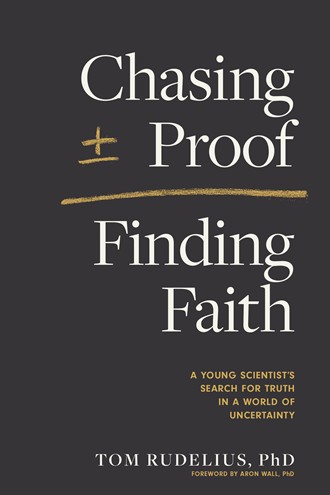
Book by St. Tom Rudelius (and me, a bit)

So my friend St. Tom Rudelius is a physicist who works on string theory, QFT, and early universe cosmology (e.g. the theory of inflation).  He is also a brother in Christ who I have had the privilege to both mentor, and learn from.

He has just written a book about his conversion to Christ (it’s a pretty interesting story, involving rather more “polygraph tests” than this sort of story usually involves) and also his experiences as a Christian in academia.  The book, which was just released today, is called:


I was asked by the publisher to include an excerpt from the book to help promote it.  Completely disregarding their proposed selections, I have chosen one of the later chapters of the book, after he’s already become a Christian:

People often ask me what it’s like to be a person of faith in the field of science. It’s a hard question to answer, because my experiences have varied widely.

Sometimes, physicists will ridicule religion. Once, while visiting the University of Texas to give a talk on my research, I went to lunch with a number of physicists, including the late Nobel laureate (and outspoken atheist) Steven Weinberg. Unaware of my religious leanings, Weinberg began the lunch with a pointed question toward the antievolution movement: “Do all these people who reject evolution also reject cosmology?”

I thought about explaining the difference between young earth creationists and old earth creationists, but ultimately held my tongue.

Sometimes, physicists simply steer clear of religious topics. One day when I was a postdoc at the Institute for Advanced Study in Princeton, the man whose donations to the Institute helped pay my salary came to have lunch with Ed Witten—quite possibly the greatest living theoretical physicist, if not the smartest man on earth—and me. A quick online search had made the donor aware of my religious views, so he spent the entire lunch asking me (very respectfully) about my opinions on religion and politics. It was probably the most stressful conversation I’ve ever had—talking about Jesus and Donald Trump with the smartest man alive and the man who paid my salary.

During the entire conversation, Ed Witten was surprisingly quiet. His only remark came when we were discussing God’s miraculous intervention. “I think a lot of people wish God would intervene more often,” he said.

Sometimes, physicists respect religion. Several of my colleagues have expressed admiration for my religious faith, or religious faith in general, though they themselves do not have any religious convictions.

Sometimes, physicists embrace religion. I don’t know very many Christians in my field, but whenever I meet one, I feel an immediate kinship. Our scientific drive for knowledge pushes us to learn as much as we can about the physical universe, and as Christians that same drive pushes us to learn as much as we can about God. The result is a common language of science, theology, and philosophy not so different from the “twin telepathy” my brother and I have shared since childhood. Though sometimes it is discouraging that so few of my colleagues embrace religious faith, it is encouraging—perhaps even more so—that the ones who do are so strong in their faith and so capable of defending it intellectually.

In much of the world, there is intense animosity, and sometimes even violence, between people of differing religious faiths. Perhaps it’s because we religious physicists represent a minority in our world, but I’ve certainly never felt anything like that from my Jewish, Muslim, and Hindu colleagues. And I hope they’ve never felt anything like that from me. Rather, there seems to be a sense of solidarity among religious scientists. Though there are important differences between our faiths, there’s an even deeper sense of mutual respect among us: I’ve probably received more comments of admiration regarding my faith from Jewish colleagues than I have from Christian ones, and a Muslim colleague once told me that my public interviews and articles on science and God had strengthened his own faith.

On the whole, though, I can say with certainty that I have never felt persecuted or personally attacked for my faith. There are places in the world where Christians are suffering for their faith. But America is not one of those places. I can go to church, pray, read my Bible, and even write books like this one without fear of losing my job. Some of my colleagues may not agree with my faith, but fortunately my success in physics depends on my ability to do physics, not on how I worship in my free time.

Though science and faith are often viewed as enemies, I can also say I have felt less hostility toward religious faith in the upper echelons of physics than at the lower levels, or in the soft sciences or humanities. Anthropology, history, and religious studies departments are famously dismissive of Christianity—a trend many of my Christian friends and I experienced during the course of our university studies.

One of my friends who studied chemistry at Princeton had a high school science teacher who forced the class to learn the definition of a so-called scientific theory—an explanation for some natural phenomenon supported by a vast body of evidence—to refute the common creationist retort that “evolution is only a theory.” But when he got to college, my friend soon realized that such definitions are nonsense: In practice, scientists use the term theory to describe many different things. Some theories, like quantum field theory, are among the best tested phenomena in all of science. Other theories, like string theory, lack any experimental verification whatsoever.

My high school physics teacher—who was one the best and most important teachers I ever had—occasionally made snide remarks about religion. Yet at Cornell, Harvard, and Princeton, I met several religious physics professors. One professor even suggested to his class that God might be the best explanation after all for the fine-tuning of the universe for intelligent life—and he wasn’t even a theist.

Now, it’s also true that most of my extraordinarily brilliant colleagues do not embrace religion. But I’ve found that their reasons are generally quite ordinary. If you ask the average atheist why he or she doesn’t believe in God, you’ll probably get some version of the problem of evil: “If God is all-powerful, all-knowing, and all-loving, why do evil and suffering exist?” If you ask one of the world’s most brilliant scientists why they don’t believe in God, you’ll probably hear the exact same thing.

That’s not to say that the problems of evil and suffering are easy for theists to deal with. It’s simply that the most brilliant minds don’t have a huge advantage over others when it comes to questions of faith. We all have basically the same questions, objections, and doubts. In my experience, the ones who find answers to these questions are typically those who need answers the most. Personally, before Steve’s conversion and subsequent conversations with me, I never felt much need for religion, as I was generally able to get by on my intelligence alone. Perhaps other scientists feel similarly.

Finally, I have found that most scientists—even nonreligious ones—believe in some sort of power greater than ourselves. It’s very common to hear physicists refer to Nature as a sort of placeholder god. For example, Ed Witten once said in an interview, “If I knew how Nature has done supersymmetry breaking, then I could tell you why humans had such trouble figuring it out.” There is a widespread acknowledgment that Nature has chosen a particular way for our universe to be, and it could have chosen something different.

What’s the difference between this Nature and the God (capital G) I believe in? I think the biggest difference is simply that Nature doesn’t really care much about the affairs of humanity, whereas God does. Most everyone would agree that Nature has a preference for order, simplicity, and beauty, but many balk at the suggestion that it would concern itself with the affairs of one particular species on one little insignificant planet. We humans are, to quote astronomer Carl Sagan, nothing but “a mote of dust in the morning sky.” [1] Why would God care about us?  

[1] Carl Sagan, Cosmos (New York: Random House, 1980).

To this, I like to point out that size is not a very good measure of value. I care more about the life of a baby than I do about most galaxies. I care more about the ten-nanometer transistors that make my computer work than I do about distant stars. And even as someone who studies black holes and the big bang for a living, I find nothing more incredible about the cosmos than the fact that it somehow birthed intelligent, conscious beings like us.

Ultimately, one can choose to view the size of our universe as a sign of our insignificance, or one can choose to view it as a sign of the great significance of its creator—a creator whose attention is not divided, who built and sustains the intricate workings of the cosmos, yet who simultaneously cares enough about humanity to become a human himself, to experience pain, suffering, and death so that we could have life.

Perhaps you noticed that my name is also on the front of the book, in much tinier yellow letters at the bottom.  (Or more likely, you didn’t and are even now scrolling back to see if my claim is true.)  This is because I was asked by St. Tom to write a foreword to his book.  (And not only that, I did.)  My foreword begins as follows:

Foreword

(from this formative experience with the publishing world, I have learned that the word has an “e” in it) but after that it goes on to say:

The book you are holding is a remarkable one. There are lots of books out there promoting Christianity, by a type of person you might call salesmen. The goal of a salesman is to produce a watertight and squeaky-clean argument, to convince you that only one position is intellectually respectable, and fully capable of servicing your needs. He is afraid to admit any weakness in his arguments. He is afraid that if he talks honestly about his own doubts and struggles, his audience will take it as a reason to reject the product he is promoting. If you want a book like that, I suggest you look elsewhere. My friend Tom is not a salesman. But he is a person who cares deeply about what is real, both in scientific and religious contexts. And because of this, he is also unafraid to share his spiritual doubts and struggles, both before and after he became convinced that Christianity is objectively true.

After that, the foreword includes eleven more juicy paragraphs, and importantly the only way to read them (if you don’t know about libraries) is by buying the book.  You can do this by clicking on one of the following links:

Amazon

ChristianBook

Tyndale

Target

That’s right, you can now buy the equivalent of one of my blog posts, at the same store you can get detergent and kid’s T-shirts from!  But, you should probably also buy the book to read an interesting and sincere account from Tom, about his obstacles coming to Christ and his emotional struggles with faith afterwards.

Now, you are going to buy the book at any time in the future, it would probably be helpful to Tom if you would buy it ASAP, for example TODAY, so it can go into the early sales figures that make the industry decide whether this book is hot stuff or not.  Sorry, I don’t make the rules of worldly success in the publishing industry, that’s just how it goes.

Having said that, some of you may be tempted to write comments asking, well when are you (Aron Wall, PhD) going to write your own book about Sciencey-and-Religiony stuff, and not just a foreword or backewards glued onto somebody else’s book?

Well, as you can probably tell from my recent blog performance: I’m just way too busy (with mentoring PhD students and postdocs, parenting my 2 & 4 year olds, quantizing gravity, and doing faculty busywork) to get any useful writing done, for the most part.  Nevertheless, you should expect some book about the Fine Tuning Argument for God and/or the Multiverse to appear under my name (as well as that of my coauthors, philosophers John Hawthorne and Yoaav Isaacs), some time in the next oh 1-50 years from now.  Just thought I’d give you a heads-up about that since a file looking deceptively like a rough draft basically already exists, more or less.  Mostly less.

(If any skeptical promotion committees are reading this post, I promise I spent very few of my months working on the Fine Tuning book, and any deficit of actual physics papers is explained by the other stuff in my life…)

Anyway, life is short so don’t save your money for a book that might or might not come out in the next couple of years.  Instead BUY TOM’S BOOK NOW (if you feel led to do that) and trust that you’ll have the spare change to buy mine later.

[Disclaimer: I understand that I will be receiving a free copy of Tom’s book in the mail.  But it will come too late to change my opinion of the book—I will always think of Tom’s manuscript primarily as a Word file.  I’m sure the publishers put a lot of effort into making it look like a real book; but I’m sorry, that’s just the way it is.]

Followup on the Moral Argument for Theism

A commenter named Nikki argued against my post Fundamental Reality XII: The Good, and the Not.

Nikki writes:

I don’t think the post’s argument works – I’d argue that non-theistic morality can be objective and well-grounded, or at least be no worse off in those regards than theistic morality is.

So the first part of this post that really jumped out at me is the claim that if morality is objective, it must be like a mind. Frankly, to me this seems not only false, but a category error. Morality is things like systems, principles, rules, etc. – I’m not sure what the exact best word choice is. The point, though, is it is a thing that minds use, but not in and of itself a mind. You describe morality as approving or disapproving certain things, but this seems to be conflating things like “this abstract system contains claims that X is good/bad,” which could validly be said about morality, and “this abstract system itself consciously judges that X is good/bad,” which could not. It is us who use morality to consciously make those judgements.

As an analogy, personality traits are part of minds, but not minds themselves – to speak of them, by themselves, being conscious, thinking, willing, etc. would be a fundamental mistake. (Though Inside Out was a pretty fun movie). I’ll admit though, I don’t actually think that’s the best analogy. I’d argue the set of laws of logic or mathematics are an even better example of something that is a feature of minds – but is not, and could not possibly be, a mind in itself. However, you’ve said in an above comment that logic is also a description of God’s character.

(Perhaps a bit of a sidetrack here, but I don’t think this could be true either. I believe that you’ve stated elsewhere that while you believe God is metaphysically necessary, he is not logically necessary – but of course, it is logically necessary that the laws of logic or mathematics are true. I don’t think the dependence you’re arguing for could work, even if God exists in some sense. That said, as one might guess, I don’t think God is metaphysically necessary in the first place.

In fact, I have doubts that there is even a “metaphysical necessity” distinct from logical necessity at all. I find Chalmers’ arguments in his paper “Does Conceivability Entail Possibility?” fairly convincing in this regard. I do think there are some weak points, but it seems to me that at least it shows that even if there is a metaphysical modality separate from logical modality, we don’t currently have a good reason to believe in it. I know there are several relevant arguments on this blog, but well, I can’t discuss every single reason for and against the existence of God in this post, so here I’m trying to stick with things related to the original topic/what’s been mentioned in previous comments on it. I might debate the other arguments later.

As a note, Chalmers’ arguments there are important for the case he makes that consciousness is not physical, because they counter the reply of some materialists that consciousness is metaphysically the same as a physical property, even if it cannot logically be derived from other physical facts. Others have argued that this causes problems for theists who both defend the metaphysical necessity of God and the non-physicality of consciousness. I suppose this may not apply to you because you’ve said you can’t rule out that consciousness is physical in some sense, as in what Chalmers calls “Type-B Materialism,” but I did think it was interesting).

Alright, back to the main topic. Does an objective morality depend on God? The whole field of moral philosophy is certainly not something I can fully describe in one post, but I’ll start with something interesting you said in your own previous post in this series:
“Even people who say there’s no such thing as ethical truth suddenly sound quite different when somebody treats them unfairly.”

I suspect that in that statement is at least a hint at what the basis for a nontheistic objective morality might be like. If there is an objective morality, I think it has something to do with the symmetry between you and others – if you don’t treat others well, what’s to prevent them from doing things to you that you don’t want? Even if evil may sometimes have short-term rewards, people committing acts like theft or murder or terrorism ultimately make things worse for everyone, including themselves. Note that these statements do not depend on God to make them true. And I think several strands of thought, such the Golden Rule, Kantian morality, Rawls’ veil of ignorance, and even some game-theoretic analyses, among others, all point towards something like this in a sense.

Now, this may not be very compelling – I’m being vague and have not spelled out a fully detailed nontheistic system. Furthermore, many of the systems I’ve cited actually contradict each other. Nevertheless, I think that there are important shared elements that don’t depend on a belief in God to be convincing (well, Kant’s morality was theistic and the Golden Rule is a part of many religions, but I don’t think everything along the lines that I’ve mentioned is). So it seems that the claim that no secular account of morality can possibly succeed isn’t very certain. I’ll note that you linked in your previous article to the SEP’s article on Moral Naturalism, but merely said those systems were “problematic” without really discussing the individual ideas presented there, although there are many important nonreligious thinkers whose ideas on morality are much more detailed than mine. (I won’t complain about that too much though – after all, I’m not discussing every form of theistic morality in this post myself).

Some more notes: 1. Speaking of moral naturalism, even on atheism, that isn’t the only option available for an objective morality. While I agree naturalism and atheism are often found together in practice, it is still possible for an atheist to be a non-naturalist, including about morality. So even if morality cannot be justified on naturalism, you would have to show that God specifically is the only one who can ground morality, not some other non-natural element.

2. Above, Scott Church argues that on naturalism, the universe does not care about us and we are fundamentally unimportant, so it cannot ground objective morality. But the universe itself does not have to care about us/be a moral agent for morality to be objective! I’d argue that if morality, say, applies to all rational beings, it is objective, and the universe not obeying it does not matter because the universe is not a rational agent. The laws of rationality themselves are a good analogy for this – the universe, itself, does not reason, and it requires minds to use reason, yet the standards of rationality are fully objective (and not derivable from physical equations, by the way). And even on theism, it is agreed that some things, like inanimate objects, are not and cannot be moral, yet again, that does not prevent morality from being objective. Related, while pure pleasure-maximization/pain-minimization has several well-known problems, so I doubt that’s the full objective morality, I do think there are non-arbitrary reasons why those are at least important. They are necessarily important to us by their very nature – no one can truly be indifferent to them even if they claim to be. And even if the universe does not care about them, I take the anti-nihilistic view that it is precisely the fact we care that matters – it’s not as if the universe has any rule against that!

3. I’ve seen this part stated before in some other comments on the blog, but I think it’s important enough that I’ll state it again (especially since unless I’m missing it, I don’t think I’ve seen a response). Escaping the Euthyphro dilemma by saying that God is identical to goodness can only work if we have good reasons to believe that the two could possibly be identical. I don’t think we have those (unlike for the triangle case, in which we do have reasons to believe that “having three sides” and “having three angles” are the same, even though those are logically necessary), but we do, in fact, have reasons to believe the opposite. As I wrote at the beginning of my post, if God is to be viewed as even like a mind, he cannot possibly be identical to morality even if he is an (ultimately) moral agent. For instance, one of the important reasons to consider God like a mind is that he is supposed to be able to take actions, but morality cannot, by itself, take actions. (Also, I’ll admit I don’t know whether your analysis of Plato is accurate, but even if it is, it’s generally fine to take inspiration from an argument and adapt it to your own views. After all, in the original article, you said you used “Hume’s Is-Ought dictum in a manner which he would have thoroughly disapproved of!”)

As a final statement, I don’t think theism is actually better at convincing people of being moral than secularism. There’s some evidence that nonreligious people are even more moral than very religious people, but interpretations are controversial and I’m focusing more on purely philosophical points here. (I do suspect nonreligious people being more moral than the religious, if true, would be a particularly big problem for theism and theistic morality. I think the evidence at least shows that the nonreligious are generally not less moral than the religious, but you’ve agreed in another article that for some senses of “good,” religion is not strictly necessary for it, so that may not be a big problem for you). But anyway, you’ve agreed that not all rational people might be convinced by theistic arguments, and it’s been pointed out above that you can always ask questions like “Why should you follow God’s commands?” so that seems to be an issue. Of course, you might very well always be able to ask similar questions about any nontheistic system, and rational people might not find it convincing. But my point was that secular morality is at least equal to theistic morality in this regard, and while this is a bit speculative, perhaps some of the reasons above might make the former even more convincing than the latter.

My reply got pretty long, so I’m turning it into a blog post.

Dear Nikki,
Welcome to my blog, and thanks for your interesting comment. However, I am not sure that your arguments are actually directed against the specific argument I am making. Here are some replies (not in the order of your points):

I. Objective Morality is a Premise in the Moral Argument

You make a good case defending this proposition: It is possible for a non-theist to rationally come to believe in the existence of an objective ethical system, without thereby coming to believe in God. However, I also believe that this is the case!

In fact, if this were not true, there would be little rhetorical point in presenting a Moral Argument for God’s existence.  In order for an argument for God’s existence to be capable of being convincing, there have to be some people out there who agree with the premises of the argument, but have not yet realized that the conclusion follows (or at least, is made more probable) by the premises.  I obviously do not deny the existence of non-theistic moral realists, because they are the target audience for my post!  (That is why I presented an argument for ethical realism in part XI before describing how  I think Theism grounds ethics in part XII.)

Now obviously, if the a nontheistic argument for objective ethics happened to take the form of an entirely satisfactory reduction of concepts like ethical obligation into naturalistically acceptable terms—e.g. in terms of physical facts of the sort that even Sean Carroll would accept—then the Moral Arguments for Theism would fail, since there would be no additional work for God to do in terms of grounding ethics.  (There might still be a need to ground the laws of physics in some way, but no additional and separate need to ground ethical truths.)  But of course, if you could show that this were true, you would have just solved a very famous and important problem in philosophy!  So I sort of doubt you really think that we can know this to be the case.  And if we cannot know it to be the case, then there is room for discussing non-naturalistic groundings of ethics, in a probabilistic argument for Theism.

You sketch some ways in which you think an non-theistic grounding for objective ethics might work (which fall into the rough family category of what I called “Kantian approaches” to ethics in part X).  As I explicitly stated in that post, Kantianism is not as friendly to the Moral Argument, as Platonism or Aristotelianism is; although I don’t think it is utterly hopeless on that front.  (Kant himself made a sort of pragmatic argument for Theism from Morality, but he didn’t agree with metaphysical arguments of the sort I’m discussing.)   The only conclusion I explicitly drew from Kantianism was:

If Ethics can be deduced rationally as in the Kantian system, then one can at least deduce that if the Universe originates from something like a mind, that mind should also be able to appreciate ethical truths.

So the point you are making was to some extent already acknowledged in this series.  (Of course, on classical forms of Theism, where God is something like the ultimate Reason or Logos behind the Universe, this would still end up identifying God with moral goodness in some deep sense; but such classical views are necessarily bordering on Platonism anyways…)

B. Moral Naturalism and Non-Naturalism

By the way, I revisited the SEP article, and found to my dismay that it had been edited in a way that removed (without refutation) some of the critiques of Moral Naturalist positions. Here is the original version of the article.  If you look, for example, at the original article’s section 4.3, you can see what appears to me to be a pretty desperate attempt by Jackson to make naturalistic ethics work, together with (what appears to me to be) a pretty strong refutation in terms of the permutation problem.  But the main point is not the refutation of that particular idea, but that I don’t see any way forward mentioned in the article which doesn’t seem to have serious problems.

You write:

Speaking of moral naturalism, even on atheism, that isn’t the only option available for an objective morality. While I agree naturalism and atheism are often found together in practice, it is still possible for an atheist to be a non-naturalist, including about morality.

Yes, obviously.  Such views exist (which is why I mentioned them in part X of this series). In fact, individuals with such views (e.g. Moral Platonists) are closer to being the target audience of this post, then perhaps you are.

So even if morality cannot be justified on naturalism, you would have to show that God specifically is the only one who can ground morality, not some other non-natural element.

No, because as I tried to make it clear at the beginning of this series that I wasn’t trying to present a deductive, logically watertight argument for Theism.  As I said in Part I:

Even if there are no strictly deductive arguments (from indisputable premises), there are still going to be plausibility arguments pointing in various directions.  It’s irrational to put too much faith in plausibility arguments, but it’s also irrational to be completely insensible to them.

So the mere existence of logically possible positions, besides the one I argue for, doesn’t bother me.  The question is which positions are most credible.

On the plausibility front, it seems to me that once you start modifying your metaphysics in order to accommodate objective ethics, it would be irrational not to take that into account when assessing the probability of other metaphysical hypotheses.  Ethical Monotheism is, among other things, the belief that a fundamentally good being exists.  The plausibility of this statement depends in part on what we think moral goodness is.  For example, on the view that:

1. “Morality is a emergent and subjective set of feelings found in some of the higher apes, conducive to their evolutionary survival, but having no basis in any metaphysical reality”

then the idea that there exists a fundamentally good being outside the physical universe—which did not evolve—is totally absurd.  On the other hand, if:

2. “moral facts are necessary truths, which tell us something substantive about the structure of non-physical realities”,

then the idea of a fundamentally good being is, though not logically compulsory, at the very least far more plausible than on viewpoint (1) than (2).  Do you agree with that?  If so, then you are necessarily agreeing with me that the Moral Argument for Theism has significant probabilistic force.

[Notes: I am not saying these are the only possible views.  Also, hypothesis (2) does not necessarily deny biological evolution, as it is possible for evolved systems to recognize necessary truths such as mathematical theorems.]

C. The Role of Analogies

Let me remind you a bit of the context of my argument in the Fundamental Reality series.  In parts II-VI, I argued that it is plausible that there exists some fundamental reality which explains everything else, I discussed some properties this entity should have, and after reviewing various candidates I suggested that (based on the mathematical character of the laws of physics) the two most plausible metaphors for understanding this fundamental reality are:

* something like an equation
* something like a mathematician

Now it is important to remember that both of these ideas involve metaphors!  Obviously, if a Naturalist says that some equation provides the deepest truth about the Universe, that doesn’t mean this assertion is being made about a set of chalk lines on a blackboard.

Similarly, if a Theist says that God is like a mind, that doesn’t mean that this Mind is like our mind in every respect.  In particular, Classical Theism proposes a mind for whom there is no distinction between its subjective beliefs and objective reality, and also no distinction between its subjective preferences and objective morality.  This is obviously very different from evolved primate minds like our own!

You wrote:

So the first part of this post that really jumped out at me is the claim that if morality is objective, it must be like a mind. Frankly, to me this seems not only false, but a category error. Morality is things like systems, principles, rules, etc. – I’m not sure what the exact best word choice is. The point, though, is it is a thing that minds use, but not in and of itself a mind. You describe morality as approving or disapproving certain things, but this seems to be conflating things like “this abstract system contains claims that X is good/bad,” which could validly be said about morality, and “this abstract system itself consciously judges that X is good/bad,” which could not. It is us who use morality to consciously make those judgements.

and

As I wrote at the beginning of my post, if God is to be viewed as even like a mind, he cannot possibly be identical to morality even if he is an (ultimately) moral agent. For instance, one of the important reasons to consider God like a mind is that he is supposed to be able to take actions, but morality cannot, by itself, take actions.

I think perhaps you missed the amount of qualifying words I put into my reasoning.  What I wrote was (emphasis added):

But now observe that morality is at least a little bit like a mind, insofar as it approves or favors certain things, and disapproves or disfavors other things. So a fundamental morality would have something analogous to will or desire, and in that respect it would be more like a mind than like an equation, as in Theism.

The point here is not that an objective morality is exactly like a mind, but that it in certain respects more similar to a mind than (say) the equations of the Standard Model are, namely that the Standard Model does not encode any judgements that certain states of affairs are desirable or undesirable (as opposed to probable vs. improbable).

Now, obviously, when we say that God is personal, and can do things like forgive or create, we are adding more to our concept of God then is implied by the mere abstract notion of a metaphysical objective morality.  In my understanding of God, we are adding more to our idea of divinity than the idea of a Platonic form of the Good, but we are not necessarily taking anything away.

In other words, in my conception of God, God is such that he is good, not in an accidental (happenstance) way, but in an essential way, because all goodness in the universe in some sense participates in his goodness, just as all existence participates in his existence.  (The latter claim, of course, obtains for any fundamental reality which is taken to explain all other things.)

D. God Transcends the Abstract/Concrete Divide

Another commenter, St. David Madison, replied to your comment by saying (in part):

“You draw an analogy between morality and personality traits and then point out that personality traits are not conscious and do not themselves think. However, personality traits cannot exist without a personality that possesses those traits.”

This is certainly a reasonable distinction to draw in general; and we could indeed escape from the supposed category error by simply replacing the words “objective ethics” with “that which grounds objective ethics, whatever it is.”  But I think I am instead going to double down on this idea, and say that this supposed category distinction between abstractions and concrete objects breaks down when one is speaking about divinity, just as the distinction between particles and waves breaks down at the subatomic scale.  If God is the source of all else that exists, he must unify within himself the perfections of both abstractions (necessary, eternal, unchanging) and concrete realities (which are causally active, definite, individual etc).

This is indeed, already implied by certain sorts of religious language, in which God is portrayed not as some good or beautiful thing, but as the Supreme Goodness or Truth or Beauty or Life etc.  For example, in the Gospel of John, Jesus asserts his divinity by saying that he is the Way, the Truth, and the Life, which is not the sort of thing that a Positivist philosopher would consider a well-formed statement (a person cannot be an abstract quality).  But I am not convinced we can restrict our language in the way the Positivists wanted to do (I don’t think Positivism even satisfies its own criteria of meaningfulness).  What this religious language points to, is an insight into the nature of divinity as a necessary being, in which all other realities are grounded.  A proposition about a created being can be true, but only the ultimate reality can be the Truth.  In other words, denying the applicability of the concrete/abstract distinction is not something I am doing merely to avoid a logical puzzle, but is already implied by standard religious language about God.

This sort of language about God makes Classical Theism radically different from traditional forms of polytheism, in which the gods are simply regarded as more powerful individuals than us, who still can be born/killed, have conflicts with each other, make mistakes etc.  Yeah, obviously the preferences of finite beings like ourselves can’t possibly ground objective ethics, which was the whole reason why Plato went in a platonic direction instead.

Furthermore, I don’t think we can avoid postulating this sort of concrete/abstract unification, simply by rejecting Classical Theism, as Naturalism seems to me to imply exactly the same thing.  For example, if the fundamental reality is something like a mathematical equation, then we are asserting that it is both an abstract piece of mathematics—which can in principle be understood by humans—AND ALSO the governing principle controlling the universe.  In other words, when a Naturalist does physics, they are still are postulating that the fundamental reality is a λογος, i.e. a rational principle.

Of course, I’m not saying that the equations we write on the blackboard, or in our minds, are strictly identical to the actual laws of physics, which obviously exist whether or not we ever discover them.  But if we asked, “what are the fundamental laws of physics like” we can’t point to anything other than to our abstract human formulation of the equations, and then lamely add “except that it also exists as an actual concrete reality, in a way which transcends our human abstractions”.

In the same way, objective morality exists even apart from human processes to reason about what is or is not moral—So I’m not saying, that this latter, social process of reasoning is equal to God.  Rather it is goodness as it actually exists (which our human reasoning is a mere approximation of) that is rooted in God’s nature, as the ultimate Goodness that other things participate in.

E. Implications for Euthyphro

Escaping the Euthyphro dilemma by saying that God is identical to goodness can only work if we have good reasons to believe that the two could possibly be identical.

This is a strange way to discuss this subject, given that the (modern) Euthyphro dilemma is typically phrased, not in the form of a deductive argument, but in the form of a challenge to Theists to explain their beliefs more clearly.  It’s phrased in the form: “Do you believe A, or B?” (both of which have unpalatable consequences).  But if A and B are not, in fact, exhaustive possibilities, because some other option C is conceivable—and if in fact C was the belief of most ethical monotheists historically, as well as myself—then merely pointing this out is sufficient to defuse the dilemma.

That being said, there is a good reason to think that, if God exists at all, he can ground morality.  Recall that God is, by definition, the explanation for all entities other than himself.  (That’s the whole point of Mono-theism, to have only one ultimate entity.)  So if God exists at all, he either grounds or creates all other realities.  Now if there is objective ethics, then ethics counts as one of these realities.  Since it doesn’t make sense to create ethics (since at least some ethical principles are non-arbitrary, necessary truths) then he must ground it.  (The same argument would hold for logic or mathematics.)

Now, to be clear, this is an argument that God grounds ethics.  It is not an argument which explains how God grounds ethics.  To understand how God grounds ethics we would have to first have direct perception of the divine essence, which we don’t possess.  Instead, we only know the things which proceed from the divine essence, and we have to learn about what God is like, as best we can, from that.

If you like, you can take “a concrete reality which grounds ethics” as a defining property of God, and then ask questions like i) what other properties would such a being need to have, and ii) is there good reason to believe that such a being exists?

If you will allow me to make a more meta-level argument.  It seems to me that giving the Euthyphro dilemma as an objection to Classical Theism is historically obtuse.  It’s like proposing the Equivalence Principle as an objection to General Relativity, when the Equivalence Principle was in fact the motivating thought experiment that led to GR in the first place.  In the same way, the question of what the gods (or really God) has to be like in order to justify treating piety as a virtue, was the underlying question motivating the Euthyphro dilemma.  But somehow atheists never say to themselves, “Geez, the fact that this famous philosophical argument was introduced in a Platonic dialogue, by a theist whose ideas laid the groundwork for the most mainstream philosophical formulation of Monotheism, maybe is a reason to think I’ve missed something and the argument isn’t actually a knock-down in favor of Atheism.”

(To be sure, arguments aren’t “owned” by philosophers and there is no reason in principle why an argument by a philosopher P can’t sometimes be turned against P’s own worldview.  So sure, maybe there is some very subtle reason why GR is still inconsistent with the best formulation of the Equivalence Principle.  But if somebody sends me and email about why they think GR is inconsistent with the EP, and it shows no awareness of why some people have historically thought that GR satisfies the EP, then it’s unlikely that their “gotcha” question about how the EP refutes GR has much merit.  Ditto for Classical Theism and Euthyprho.)

F. Metaphysical vs Logical Necessity

Now to be fair, you did explain why you don’t believe in scenario C.  In addition to your “category error” assertion, you add this:

In fact, I have doubts that there is even a “metaphysical necessity” distinct from logical necessity at all. I find Chalmers’ arguments in his paper “Does Conceivability Entail Possibility?” fairly convincing in this regard.

So on your recommendation, I read through this Chalmers article and I found it pretty unconvincing.  Why should reality be fundamentally scrutable to us?  Or said another way, why can’t there be propositions P which are necessary, but only a mind fundamentally more powerful than the human mind could see why they are necessary?  It seems hubristic to think that human reasoning has access to every possible necessary truth.

Ironically, the reason I don’t believe in Chalmers’ thesis here, is actually very similar to the reasons why I side with Chalmers over Dennett when it comes to Consciousness.  While Dennett makes an interesting philosophical case for the reducibility of conscious experience to neurological facts, ultimately I concluded that Dennettism can only work if Dennettism is true by logical necessity.  In other words, that once you’ve specified all the physical facts then Dennett’s views on consciousness follow automatically.  And it seems to me that this is simply not the case.

Similarly, Chalmers’ idea that if we specify all the physical nonmodal facts, then a single set of views about modal necessity must logically follow (to idealized human reasoners) seems plainly false to me.

(Assuming it even makes sense to distinguish between “modal” and “nonmodal” facts in this way.  This is an important distinction between analytic philosophy and traditional medieval philosophy.  Analytic philosophy sees modality as primarily a feature of certain propositions, and only secondarily as a property of things.  While Aristotelian/scholastic philosophy sees modality as primarily as a property of things, while only secondarily as an attribute of propositions.  A scholastic might argue that the analytic habit of immediately jump to always reasoning about maximal “possible worlds” obscures the role that modal concepts play in causal reasoning, which involves specific concrete entities.)

Anyway, since you hold to something like Chalmers’ view, here’s a dilemma for you: Is the proposition expressing this view itself a logically necessary truth?

(P) There are no metaphysically necessary truths, other than logically necessary truths.

If you say that P is logically necessary, then there must be a proof that it is true which follows deductively from the definitions of the words.  What is that proof?  As far as I can tell, none exists.  Certainly Chalmers doesn’t give a logically conclusive proof in that article, he just gives some reasons why he considers belief in P to be plausible, which is not the same thing.

On the other hand, if P is not logically necessary, then either it is contingent (which is inconsistent with the usual S5 rules for modal logic) or else it is an example of a metaphysically necessary (but not logically necessary) truth, in which case it refutes itself.

One could make a similar, superficially less “meta” argument for the same conclusion by considering the proposition:

(N) A necessary being exists.

A standard analytic argument from S5 modal logic implies that either: i) N is necessarily true, or ii) N is necessarily false.  So which of these is logically necessary?  I say neither, but if you disagree then what do you think the proof of N or its negation would look like?

G. Can God be the grounds of Logic?

I believe that you’ve stated elsewhere that while you believe God is metaphysically necessary, he is not logically necessary – but of course, it is logically necessary that the laws of logic or mathematics are true. I don’t think the dependence you’re arguing for could work, even if God exists in some sense.

This is a little compact, but I’m guessing your argument is something like the following:

1. A contingent truth cannot ground a necessary truth.*
2. God’s existence is logically contingent.
3. But logic itself is logically necessary,
4. Therefore, God cannot ground logic.

[*I suppose there is some sense in which, if a Cat walks onto a Mat, this arguably grounds the necessary proposition: “Either the Cat is on the Mat or the Cat is Not on the Mat” by virtue of being a truthmaker for one of its disjunctives.  But I won’t pursue this possible counterexample further, since I don’t think it is relevant to the sense in which God grounds logic.]

But this argument is fallacious, because when I say that God grounds logic, I am making a metaphysical statement rather than a logical one.  From the perspective of metaphysics, both logic and God are (in my view) metaphysically necessary, and it is not at all impossible for a necessary statement to ground another necessary statement.  In other words, we have to distinguish between:

1a: A logically contingent truth cannot logically ground a logically necessary truth.

which is true, and:

1b: A logically contingent truth cannot metaphysically ground a logically necessary truth.

which does not in any way follow from 1a, and I would say it is false.

H. What Metaphysical Necessity Means

Actually, there is a better way to put this which makes the concept of “metaphysical necessity” somewhat less mysterious.  The right way to talk about this is to make Aristotle’s distinction between that which is necessary to us (axioms of human thought) and that which is necessary in itself (propositions which could not have been otherwise).

When we say that a proposition is metaphysically necessary, we merely mean it falls into the latter category.  The adjective is misleading since, unlike the cases of “logical necessity” or “nomic necessity” (which mean necessary given certain specific principles), the phrase “metaphysically necessary” simply means whatever is necessary simpliciter, i.e. that which (without adding any qualifications) could not have been otherwise (whether or not the reason for its necessity is known to human beings.)

On the other hand, logical necessity is an example of what is necessary to human beings, i.e. an axiom of human reasoning, or a particular technique L used to prove the impossibility of certain propositions.

So, the proposition P from earlier boils down to:

(Equivalent to P): If a proposition cannot be proven to be impossible by technique L, then it really is possible.

while I see no reason to believe that technique L is sufficient to uncover all possible cases of necessity.  Especially since technique L does not even seem to be powerful enough to refute the statement that no concrete entity whatsoever exists.

This relates of course to cosmological considerations as well.  As is well-known, if P is true, then the basic principles of existence are just contingent “brute facts” which means they are not true for any reason at all.  So there is an obvious reason to postulate a necessary concrete entity, which is that it serves as a starting point to explain why anything else exists at all.

This reason to want a necessary being, does not seem to depend on us being able to know why the being is necessary.  This is the Thomistic viewpoint on the Cosmological Argument, and it seems to me to be the only possible middle ground between Anslemian positions (there is a valid Ontological Argument for a necessary being from pure logic) and explanatory nihilism (there is no good reason why the universe exists, it just does).

(Now you could just double down and say, I have no idea what you mean by the phrase: “could not be otherwise”, please explain it to me; and then refuse to accept any answer I give other than one which reduces it to logical implication.  But the same technique could be done to motivate skepticism towards practically any other concept, including the other concepts in this discussion like “mind” or “good” or “abstract” or “grounds”.   (It is not even clear that logical necessity can be fully explained without an infinite regress, as  St. Lewis Carroll pointed out in his Achilles and the Tortoise dialogue.)  I don’t claim to have a definition of metaphysical necessity that would satisfy Socrates, but if we make that the standard, there aren’t going to be very many philosophical terms left!)

I. An Irrelevant Topic

As a final statement, I don’t think theism is actually better at convincing people of being moral than secularism.

This is just so totally irrelevant to the metaphysical questions behind the Moral Argument for Theism, that perhaps I should simply refuse to respond to this entirely.  It’s really just a complete change of topic.

God could be the metaphysical grounds for morality, even if every single human being on Earth were an atheist, or even if every single theist were morally worse than every single atheist.  These motivational questions really have nothing whatsoever to do with the question about what metaphysical theses are made more plausible, if we subscribe to moral realism.  I wrote my blog post Is it Possible to be Good without God? precisely because I was annoyed by how regularly people seem to conflate these totally unrelated questions.

(I’m not saying that the degree of goodness of religious people can’t potentially be used as an evidential argument for or against the existence of God.  What I am saying is that it is a mistake to allow such sociological questions to contaminate our interpretation of the thesis that God grounds ethics.)

That being said, I”ll take the bait and say I do think there is some pretty serious question begging required for a non-circular argument that atheism is fully compatible with moral behavior.  For one thing, if a being such as is described by Classical Theism in fact exists (a perfectly wise and holy and good being, who created us and is the source of all our goodness), then we have the moral obligation to worship and obey that being, and to reflect God’s holiness through a life of prayer and repentance, dedicating our earthly activities to the glory of God.  It is difficult to see how an atheist can satisfy that obligation, because for the atheist these activities are just distractions from a different, more secular understanding of what the good life consists of.

(To be sure, if the atheist has some intellectually honest reasons why they think God does not exist, then this may well be a mitigating circumstance that reduces—or even eliminates entirely—their culpability for this omission.  But if we are discussing the question of which beliefs make it easier to be moral, then usually mitigating circumstances are considered mitigating precisely because they make it harder to be moral.  Furthermore, a lack of culpability does not remove all of the causal consequences of trying to place our ultimate happiness in things other than God—what Christians call idolatry.)

I do suspect nonreligious people being more moral than the religious, if true, would be a particularly big problem for theism and theistic morality.

From the standpoint of Christian doctrine, it is not actually clear why this should be.  Merely having knowledge of God’s existence does not necessarily translate into obedience, and in some cases knowledge can make people morally worse since they ought to behave better but don’t.  As Jesus’ brother St. James said:

You believe that there is one God. You do well. Even the demons believe—and tremble!  (James 2:19)

and as Jesus himself said:

“Not everyone who says to me, ‘Lord, Lord!’ will enter the kingdom of heaven, but only the one who does the will of my Father in heaven.  On that day many will say to me, ‘Lord, Lord, didn’t we prophesy in Your name, drive out demons in Your name, and do many miracles in your name?’  Then I will announce to them, ‘I never knew you! Depart from me, you lawbreakers!’ ”  (Matthew 7:21-23)

The Pharisees were among the most “religious” people in Jesus’ day, and many of their leaders handed Jesus over to Pilate to be crucified.  See also St. Paul’s observations of religious people in Romans 2.

According to Christianity, what people need to be transformed morally, is not so much knowledge as grace.  Knowledge is good if it helps us acknowledge our need for grace, but not so much if it makes us look down on other people.

I think the evidence at least shows that the nonreligious are generally not less moral than the religious…

I’m not sure what evidence you are referring to here, or how you could actually know this to be the case.  If your claim is just that religious people can be morally weak and inadequate, well I already knew that from my own life, without looking at anybody else’s.

If it refers to survey data, you have the problem that what many polls of religious affiliation captures a lot of individuals who only identify as religious in a nominal sense.  Polling nominally religious people, and asking about their rates of divorce, adultery etc. is sort of like asking whether watching the Olympics on TV makes people more physically fit!  It’s the wrong question to study.

If you are referring to personal experience, I can only say that while I know good and bad seeming people (emphasis on “seeming”, it’s not my place to judge them) who are both religious and non-religious, the most loving and self-sacrificial people I know seem to be religious.  And religion also often plays a significant role when very bad seeming people repent and turn their lives around.  Furthermore I have very often heard people refer explicitly to God when they explain why they did something morally difficult, while I cannot ever recall in my personal experience ever hearing somebody say that they did something morally difficult because atheism is true.  (I mean, I could imagine such a motivation: e.g. God isn’t going to save this person, so I have to.  But I don’t think I’ve ever heard anyone explicitly say this “in the wild” so to speak.)

By comparison, studying secular ethics seems to itself have little observable consequences in terms of making people better.  This could be taken as a critique of secular ethics, but it might be better taken as a critique specifically of what modern analytic philosophers mean by ethics as a discipline (as opposed to ancient philosophies, which were typically viewed as a way of life that had to be put into practice, in order to be understood).  I mean, why should studying little numbered arguments about whether ethics is objective, or arguing about what to do in some controversial edge case involving trolleys, actually help one to build habits of life that make one treat your fellow human beings better, and a community which helps support you in doing so?  Religion is one of the few ways of getting such support in the modern era.  (There are some others, but they are getting sparser in an increasingly disconnected age.)  While this isn’t necessarily an argument for God’s existence, it does make your thesis that serious religious practice is totally orthogonal to ethical accomplishment seem pretty implausible.

I called this an “irrelevant topic” because it isn’t terribly relevant to the validity of the Moral Argument.  But of course, from the perspective of what ultimately matters, it is this section that is most important, and the rest which are of lesser relevance.  If Christianity is true, then what will matter the most in the end is not whether you are persuaded by this or that specific argument for Theism, but more whether your heart is open or closed to God at a deeper level than that.  Jesus has promised that those who truly seek God will find him.

If you take it as a goal to be as moral of a person as you can possibly be, then that is at least a start along that road—even if the final destination is going to be, in some ways, quite different than what you expected when starting out on that journey.  But somewhere along the way comes the recognition that you can’t actually be good, and need help to do better, and that is where concepts like grace and salvation start to make more sense…

Blessings,
Aron

Creator, Redeemer, and Sanctifier

Our Father, the Creator

In the beginning God created the heavens and the earth.  (Genesis 1:1)

For us there is but one God, the Father, from whom all things came and for whom we live… (1 Cor 8:6)

Jesus Christ, the Creator

In the beginning was the Word, and the Word was with God, and the Word was God.  He was with God in the beginning.  Through him all things were made; without him nothing was made that has been made.  In him was life, and that life was the light of all mankind.  (John 1:1-3)

…and there is but one Lord, Jesus Christ, through whom all things came and through whom we live.  (1 Cor 8:6)

Holy Spirit, the Creator

Now the earth was formless and empty, darkness was over the surface of the deep, and the Spirit of God was hovering over the waters.  And God said, “Let there be light,” and there was light...  (Genesis 1:2-3)

When you send forth your Spirit, they are created;
And you renew the face of the earth.  (Psalm 104:30)


Our Father, the Redeemer

But it was because the LORD loved you and kept the oath he swore to your ancestors that he brought you out with a mighty hand and redeemed you from the land of slavery, from the power of Pharaoh king of Egypt.  (Deuteronomy 7:8)

But you are our Father, though Abraham does not know us or Israel acknowledge us; you, LORD, are our Father, our Redeemer from of old is your name.  (Isaiah 63:16)

Jesus Christ, the Redeemer

For you know that it was not with perishable things such as silver or gold that you were redeemed from the empty way of life handed down to you from your ancestors, but with the precious blood of Christ, a lamb without blemish or defect.
(1 Peter 1:18-19)

Christ has redeemed us from the curse of the law, having become a curse for us (for it is written, “Cursed is everyone who hangs on a tree”).
(Gal 3:13)

Holy Spirit, the Redeemer

And not only the creation, but we ourselves, who have the firstfruits of the Spirit, groan inwardly as we wait eagerly for adoption as sons, the redemption of our bodies.  (Rom 8:23)

And grieve not the Holy Spirit of God, whereby ye are sealed unto the day of redemption.  (Ephesians 4:30)


Our Father, the Sanctifier

Now may the God of peace Himself sanctify you completely…
(1 Thess 5:23)

“Holy Father, protect them by the power of your name, the name you gave me, so that they may be one as we are one…. Sanctify them by the truth; your word is truth.”
(John 17:11,17)

Jesus Christ, the Sanctifier

Husbands, love your wives, even as Christ also loved the church, and gave himself for it; that he might sanctify and cleanse it with the washing of water by the word, that he might present it to himself a glorious church, not having spot, or wrinkle, or any such thing; but that it should be holy and without blemish.
(Ephesians 5:25-27)

for both he who is sanctifying and those sanctified are all of one [family], for which cause he [i.e. Jesus, the only person of the Trinity who became a human] is not ashamed to call them brethren (Hebrews 2:11)

Holy Spirit, the Sanctifier

He gave me the priestly duty of proclaiming the gospel of God, so that the Gentiles might become an offering acceptable to God, sanctified by the Holy Spirit. (Rom 15:16)

But you were washed, you were sanctified, you were justified in the name of the Lord Jesus Christ and by the Spirit of our God.  (1 Cor 6:11)

Comparing Religions IX: Delayed Return

This is a special bonus post in my Comparing Religions series…  I originally wrote it as a section of the post about evidence of fraud, but it seemed to work better thematically as its own post.

Unfulfilled Prophecies

Another point worth considering is the question of false prophecies, that fail to come true on schedule.  As the Book of Deuteronomy indicates, these are one possible sign of a false prophet:

You may say to yourselves, “How can we know when a message has not been spoken by the Lord?”

If what a prophet proclaims in the name of the Lord does not take place or come true, that is a message the Lord has not spoken. That prophet has spoken presumptuously, so do not be alarmed.  (18:21-22)

As an example, the Watchtower Society is particularly notorious for a history of making false predictions and then creatively reinterpreting them.  For example they claimed Jesus would return to Earth in 1914, and then when that failed to occur decided that that date was when he started reigning “invisibly”, a serious anticlimax.

It would be tedious, and require an entire dissertation, to enumerate all of the examples of failed prophecy among various cults.  (To be truly complete I ought to try to examine at least the major religions, but this post will be mainly Christianity-centered.)

(Incidentially, “prophecy” is a much broader concept than predicting the future—a prophet is anyone with a message from God (or one of the gods, in polytheistic religions); and such messages can concern the past or present just as often as predicting the future.  The questions “What is God like?” and “How should people behave?” are central to how prophecy is conceived in Abrahamic religions.  So the colloquial definition of prophecy, as “predicting the future” is far too narrow to describe prophecy as classically conceived.  Neverthless, prophecy in the Bible certainly does also contain numerous predictions about the future, and that is the concern of this post.)

Prophecy and Evidence

Obviously, if a prophecy comes true in a verifiable manner, that counts as (some) evidence for the religion in question.  (How much evidence, depends on a variety of factors, including (1) how certain it is that the prophecy was written down before the events it predicted, (2) how unlikely the event was to occur naturally, and (3) the degree to which the new prophecy is consistent with previous revelations, etc.)

Conversely, if a prophecy has not come to pass, this could count as evidence against the religion.  It is however important to make a distinction between an unfulfilled prophecy, and a falsified prophecy.

An unfulfilled prophecy is one that simply has not happened yet.  For example, the claim of all Abrahamic religions that God will raise every human being from the dead at the Final Judgement has not been fulfilled yet.  However, the fact that this has not happened yet does not mean it is not going to!  After all, events in the future are not (apart from the prophecy itself) observable in the present.  (Of course, the universal resurrection of the dead is quite impossible in a Naturalistic worldview, but here we are discussing religious worldviews in which God exists, and has the power to do miracles.)

Thus, an unfulfilled prophecy does not necessarily provide much evidence or or against a religion, unless there is good reason to think it should already have happened, or that it is impossible for it to occur.

(In Bayesian terms, if a prophecy being fulfilled counts as evidence for a religion, a prophecy not being fulfilled always counts as some evidence against the religion, so long as there is a nonzero chance that the prophecy could have already been fulfilled by now.  But under favorable circumstances, for example when the prophecy is plausibly about the distant future, the amount of disconfirmation can be quite small.)

On the other hand, a falsified prophecy is one that is definitely not going to occur.  (At least, absent some major reinterpretation of what it means.  Such reinterpretation is often a logically possibility, but one that must be paid for evidentially if the new interpretation is implausible.  One should be especially suspicious when the prophet himself engages in creative reinterpretation, since there are obvious self-justifying motivations there.  Especially if the prophet tried to convince people to take it literally before the events were falsified, and only spins the prophecy after people start complaining it didn’t happen.)

The most common reason for a prophecy to be falsified is if the prophet placed some date or time constraint on the prophecy.  If the date comes to pass, and the event didn’t occur, and if there is no valid excuse for God to pull a fast one and change his plan, then whoops it looks like you’ve been following a false prophet!  Time to repent and find a better religious guide.  On the other hand, a merely unfulfilled prophecy is perfectly compatible with the truth of a religion.

Swords to Plowshares

All of this makes it sound like prophecy exists solely for purposes of apologetic arguments.  From this perspective, a not-yet fulfilled prophecy is a wash, and may seem irrelevant.

This is a misconception.  Just because a prophecy is unfulfilled, doesn’t mean it isn’t important to the present.  In fact, if it weren’t spiritually relevant in some way to the time period before the fulfillment, there would be no point in God revealing it.  For example, when Isaiah says that:

[The Lord] will judge between the nations
and will settle disputes for many peoples.
They will beat their swords into plowshares
and their spears into pruning hooks.
Nation will not take up sword against nation,
nor will they train for war anymore.  (2:4)

it is immediately obvious that this prophecy (universal peace) has not yet come true.  But that is not the only thing going on in the mind of a reader.  We are also struck by the thought that it ought to be true.  The goal is accepted as valid by the heart, even before the mind rejects it as a fact.

Ending war is precisely the sort of thing that a benevolent God should do.  And if he has not done it yet, it still tells us something about God that he has promised to do it.  And it tells us something about the human race, that we instinctively accept it as an ideal, even as we fall so far short of the reality.  This is why the prophet goes on to say:

“Come, descendants of Jacob, let us walk in the light of the LORD.”  (2:5)

In other words, the belief in future universal peace can inspire us to be peacemakers in a more limited way today.  Even though it will take an act of God to make the reality of peace universal, taking it as the ideal still influences how we see the world of today.  (Indeed, it is probably not be an exaggeration to say that the modern international ideal of working towards “world peace” would probably not exist if the Hebrew prophets had never spoken.  This ethical imperative still inspires us as moderns, even if many have forgotten its source.)

The Second Coming

With this in mind, let us consider Jesus’ own claims about his Second Coming, since this is one of the few skeptical objections specific to Christianity which is worth taking seriously.

The ministry of Jesus intersects prophecy along multiple axes.  For example, there is a conversation to be had about the many ways in which Jesus’ ministry fulfilled the prophecies in the Hebrew Bible.  This was the topic of some previous posts.

But Jesus also made some predictions about the future, and the most important one has to do with his return to Earth to judge the world (and to usher in the universal peace between nations we’ve just been discussing!)  This is called the Second Coming.

For those less familiar with Christian theology: it is important that this Second Coming does not refer to some new incarnation as another human person born subsequent to Jesus Christ.  It refers to Jesus himself returning to Earth with the same human flesh that was born of a Jewish girl, nailed to a cross, and which is now immortal and glorified—but still fully human!—in the immediate presence of God.  (Whatever that means… Christians do not believe that God the Father literally has a body, so the sense of “presence” here is some mode other than spatial location.  In the Lord’s Prayer, “Heaven” is identified as the place where God’s will is perfectly done.)

As it says in Psalm 110, in a verse quoted by the New Testament many times:

The LORD says to my lord:
“Sit at my right hand
until I make your enemies
a footstool for your feet.” (Psalm 110:1)

In Christian interpretation, this passage means: God says to the Messiah, ascend to where I am and rule from there, until some future time when I will make all of your enemies submit to you.  This logically implies, that there will be a period of time after Christ ascends to Heaven, but before everyone recognizes him as their Lord.

Jesus on the Timing

Now obviously, if Jesus really talked about his coming back after an absence, this indicates that he saw at least some chronological gap between his present ministry and that future date.  The Gospels also portray Jesus as foreseeing his own humiliation and death.  This indicates that he had a far better grasp on reality than the typical first-century Messianic claimant, who expected to overthrow the Romans and set up an earthly kingdom in Judea, along the lines of the Maccabean revolt which took place a couple centuries before.

But it is sometimes claimed (especially by certain biblical scholars) that Jesus made a point of predicting that his return would be soon, within a single generation; and that when this failed to occur the Church retrospectively changed their understanding.  This is a serious accusation, and if true would significantly affect the New Testament’s credibility.  It is true that there are a few passages in the Gospels which can be interpreted as making such predictions.  But this interpretation is not simple, seeing as there are also a great many passages indicating the opposite.

In fact, in most of his parables about the subject, Jesus usually implies that the Bridegroom’s or Master’s return will take a long time, and that many people will get tired of waiting.  Again and again, he makes a point of saying that the timing will be a surprise:

“Therefore keep watch, because you do not know on what day your Lord will come.  But understand this: If the owner of the house had known at what time of night the thief was coming, he would have kept watch and would not have let his house be broken into.  So you also must be ready, because the Son of Man will come at an hour when you do not expect him.”  (Matt 24:42)

and that not even he could predict the date:

“But about that day or hour no one knows, not even the angels in heaven, nor the Son, but only the Father.”  (Mark 13:32)

A More Problematic Passage

But what about the passage in which Jesus says:

“Truly I tell you, this generation will certainly not pass away until all these things have happened.” (Matt 24:34) ?

In his essay “The World’s Last Night”, C.S. Lewis interpreted this as a rare example of Jesus being in error, writing that:

It is certainly the most embarrassing verse in the Bible.

but he suggests it is nevertheless compatible with Christian theology because:

The one exhibition of error and the one confession of ignorance [i.e. Mark 13:32] grow side by side.

However I do not accept St. Lewis’ interpretation as a valid solution to this problem.  Yes, Jesus did confess ignorance (at least with respect to his human knowledge), but the appropriate response to ignorance is to remain silent, not to make a bold and possibly erroneous prediction!

It is true that in orthodox Chalcedonian theology, Christ is regarded as being fully human as well as fully divine.  His human nature was just like ours in every way but sin.  And ignorance is not the same thing as sin.  Thus, even though Christ was God and therefore knew everything with respect to his divine omniscience, it does not follow that he knew every fact according to human modes of knowledge.  (Presumably an infinite number of facts can’t fit into an ordinary human brain, at least in this life, even if that human brain is fully united with the divine Logos.)  Anyway, St. Luke tells us quite explicitly that Jesus “grew in wisdom and stature” (Luke 2:52) as a child, and growth in wisdom implies learning.

However, none of this leads me to think that Christ could have made a major blunder of theology with respect to his public teaching.  After all, Christ’s words were guided by the Holy Spirit, even more so than in the case of an ordinary prophet, seeing as he was filled with the Spirit “without measure” (John 3:34).  Christ’s teachings in the New Testament have spiritual authority; and thus it would be a major, major problem for Christianity if Jesus had given an untrue prophecy, especially about such a central point.

My Preferred Explanation

I would rather explain this passage with reference to its full context.   All of the verses just quoted are contained within a discourse called the Olivet Discourse, which begins with a question asked by the disciples on the Tuesday before the Crucifixion.  There are three different versions of this speech in different gospels.  Notably, in St. Matthew’s version, the disciples’ question has two parts (numbers and brackets mine):

Jesus left the temple and was walking away when his disciples came up to him to call his attention to its buildings.  “Do you see all these things?” he asked. “Truly I tell you, not one stone here will be left on another; every one will be thrown down.”

As Jesus was sitting on the Mount of Olives, the disciples came to him privately. “Tell us,” they said,

(1) “when will this happen, [i.e. the Destruction of the Temple]

(2)  and what will be the sign of your coming and of the end of the age?”

It can be seen that these are two separate questions, and that (whatever the disciples might have thought when they asked them) the correct chronological answers two these two questions are also quite different.

Regarding (1), the Temple in Jerusalem was destroyed in AD 70 by the Romans, which is indeed within one generation (the Jews conventionally reckoned a generation as being 40 years long, and Jesus died around 30-33 AD).  So this part of the prophecy is actually a spectacular success.

(Many of Jesus’ subsequent predictions also seem to have come true: that Christians would go on to be persecuted, that the Gospel would be preached to all nations, that many false prophets would arise, and that “wars and rumors of wars” would go on during all this time, as they always do.  However, the emphasis of this part of the speech is more about Jesus forewarning the disciples about the problems they will face, rather than gratifying the disciples’ curiosity about the exact shape of future history.)

Regarding (2), Jesus has not yet returned, so there’s been a delay of at least 1988 years, as of the time of this blog post.

And we can give up any idea of an “invisible” coming, or coming in an obscured way as some other historical person, seeing as Jesus is pretty explicit that his Second Coming will be totally obvious to everyone when it finally happens:

“At that time if anyone says to you, ‘Look, here is the Messiah!’ or, ‘There he is!’ do not believe it.  For false messiahs and false prophets will appear and perform great signs and wonders to deceive, if possible, even the elect.  See, I have told you ahead of time.

So if anyone tells you, ‘There he is, out in the wilderness,’ do not go out; or, ‘Here he is, in the inner rooms,’ do not believe it.  For as lightning that comes from the east is visible even in the west, so will be the coming of the Son of Man.”

So to fully answer both of the disciples’ questions, Jesus needs to provide two different chronological answers, and in fact Jesus gives both correct answers—the answer to (1) is “this generation shall certainly not pass away”, while the answer to (2) is that nobody has any clue when it will happen, not even the Son himself!  Unless we interpret these as two separate answers, it is difficult to read the text as even being consistent with itself, let alone history.

Indeed, the account in Luke’s Gospel does seem to anticipate a chronological gap between (1) and (2), with a pivot at the verse which says:

Jerusalem will be trampled on by the Gentiles until the times of the Gentiles are fulfilled.

which seems to suggest an unknown interval of time, and which separates the predictions related to the Destruction of the Temple from the predictions related to the End Times (although not from the sayings about timing).

It is true that the chronological answers to  (1) and (2) are not clearly organized in the Gospels as we have them.  The Synoptic Gospels were most likely written before the Destruction of the Temple (arguments to the contrary tend to be based on the Methodologically Naturalist assumption that predictive prophecy is impossible).

Jesus himself may have been grouping the two events thematically, as two examples of Tribulation/Judgement.  Not unlike how the prophet Isaiah likes to talks about the Resurrection and the Return from Exile in conjunction with each other.  Both are showing history more from God’s perspective, rather than from a human perspective.  (We already knew what the human perspective looks like!)

It seems probable that the disciples themselves were confused by this, and did not clearly distinguish Jesus’ words about timing with respect to their proper referents.  The fact that the Church preserved four different accounts of Jesus’ life, in which the wordings of the same sayings are often slightly different, acknowledges the reality that Jesus is a historical figure and that our knowledge of his life is mediated through human witnesses.  Human witnesses often do not recall the exact words that somebody spoke, but rather the gist of what was said.

(This does not, I think, contradict any Christian doctrines about divine inspiration of the Gospels.  The Christian version of inspiration is that the Holy Spirit guided the writing process so as to reveal the truths he wanted to reveal; and that every single part of the Bible is, in this sense, the word of God; and thus authoritative and Christ-revealing.  It does not mean that all the truths in Scripture are always exposited in an equally clear and manifest fashion, without obscurity.  Nor does it mean that the documents are in no way limited by the human perspectives of their authors, or somehow not subject to the vicissitudes of the textual copying process.  The Bible is divine words and human words at the same time, and neither authorship negates the other.  This means that the Bible is not always the book that Fundamentalists want it to be.  But I very much doubt that having that book would have been good for us!)

Another Verse

As for the similar sounding verse in Mark 9:1:

And he said to them, “Truly I tell you, some who are standing here will not taste death before they see that the kingdom of God has come with power.”

I would interpret this verse as referring, not to the Second Coming (nor to the Transfiguration which immediately follows, as the guy who divided up the Bible into chapters apparently thought) but rather to Jesus’ Resurrection and the inauguration of the Church, which was indeed the establishment of God’s kingdom in Christian theology.

Jesus overcoming human sin and death, appearing to chosen witnesses, and sending the Holy Spirit to soften human hearts, does not seem like quite as much of an inconsequential anti-climax as a hypothetical coming in 1914 that didn’t seem to change anything for anyone.  But then I would say that as a Christian, wouldn’t I?

Weighing Evidence

Since this is a series about comparing evidence for different religions, the question must be raised: to what extent should these sorts of rationalizations count as plausible explanations to skeptics, or for those in non-Christian traditions?

Here, I think it is important to get over the idea that a problem in biblical theology must either be a killing blow which refutes the religion entirely; or else it is no big deal and can be safely ignored after one accepts a pat explanation.  It is possible for an apparent theological discrepancy to provide some mild evidence against a religion, if there are plausible-sounding explanations, but those explanations also seem a bit contrived in other respects.  To determine how significant the problem is, one would then need to consider the rest of the cumulative case for the religion.

So it is perfectly possible for me to admit that some verses of the Bible provide some evidence against Christian doctrines, without immediately throwing the whole system overboard.  Instead one has to accept some things on the credit of the system as a whole.  I hope I am showing the same courtesy to the non-Christian religions, by not over-emphasizing isolated difficulties, but instead trying to assess what seem to be the key issues.

It would be quite astonishing if there were no difficulties to get over in the interpretation of any text which is thousands of years old, and which purports to reveal the intrusion of something from outside the spacetime continuum.  If there were no difficulties, that would itself be a difficulty, since it would be the mark of a human-made religion with no sharp corners or untidy edges.  (Quantum mechanics is weird, why shouldn’t theology be too?)

Descent of the Spirit

OK, somebody might say, but even if you can get over the fact of Jesus’ own predictions, it’s still true that he didn’t fulfill all of the Messianic prophecies, or any of them in the particular way that the Jews were expecting.  The Jews expected the Messiah to set up an earthly kingdom.  Jesus didn’t.  Even if you can get over the comments about “this generation”, isn’t this still an ad hoc attempt to get over the embarrassing problem that Jesus never fulfilled half the stuff he was supposed to do?  The swords were never all beaten into plowshares, and it doesn’t look like our nuclear missiles are going to be reforged into tractors anytime soon either!

I agree that this delay may seem strange to a person who is not themselves caught up into the story of Jesus.   But I do not think it is so arbitrary as it might seem at first.  Even in the period between Jesus’ Resurrection and his Ascension to Heaven, it was still hard for the disciples to give up the idea of an immediate earthly kingdom:

After his suffering, he presented himself to them and gave many convincing proofs that he was alive. He appeared to them over a period of forty days and spoke about the kingdom of God.

On one occasion, while he was eating with them, he gave them this command: “Do not leave Jerusalem, but wait for the gift my Father promised, which you have heard me speak about.  For John baptized with water, but in a few days you will be baptized with the Holy Spirit.”

Then they gathered around him and asked him, “Lord, are you at this time going to restore the kingdom to Israel?”  (Acts 1:3-6)

Jesus reminds them, quite conspicuously, that the time of the Second Coming is unknown, and re-directs their attention to a different promise:

He said to them: “It is not for you to know the times or dates the Father has set by his own authority.  But you will receive power when the Holy Spirit comes on you; and you will be my witnesses in Jerusalem, and in all Judea and Samaria, and to the ends of the earth.”  (1:7-8, emphasis mine)

Given these words, it seems pretty hard to imagine that St. Luke (the author of Acts) was under the impression that Jesus had committed himself to a definite timetable for the Second Coming.

The central story of Christianity is that of a rejected, suffering, forgiving Messiah.  What is the natural conclusion of the story?  A ruling, peacemaking Messiah, yes; but first something else.  I am afraid that from God’s point of view, the next installment of the story involves us.  Christ says to his disciples: “I bled and died for you out of love.  Now you must do the same thing.  And if you are willing to do it, I will give you my Spirit to guide you.”  [Not a direct quote, but clear enough from the Gospels.]

I can see why one would not want to hear these words, but from an aesthetic and theological point of view, they make perfect sense.  If we humans are in the image of God, then wherever God leads, we must follow.  As he sacrificed his live for us, we must now sacrifice our lives for one another, even for those who do not yet believe.  We too must live out the Christian life, even if it means we will be rejected and despised (in which case we must also forgive!).

We are called to be saints; the holy ones of God.  How can we think we will be excused from suffering?  If Christ had come in a single generation, then where would St. Francis be?  Where would Sts. Corrie Ten Boom and Mother Theresa be?  Where would the martyrs be?  Nowhere; they would not exist.

Nor should we excuse ourselves from the call to holiness.  Even if our own spiritual fruits are not yet so great as these, there is no telling what God may do with us in the future, if we allow him.

Many generations of Christians have been tempted to think that things have gotten bad enough that Christ should return and put an end to human misery.  Yet, looking back on history we can see that the human growth and development of the Church would have been incomplete, without all the chances to build monasteries, universities, reformations, modern science, civil rights movements, etc.  All of these historical situations—with their unique mixes of good and bad—have been settings where the saints have needed to creatively adapt the life of Christ, to new situations.  (In another thousand years, perhaps we will be thinking how much we would have lost if history had ended before space travel!)

We human beings may often fail the tests that history presents, but I do not think this matters quite as much as one might think.  Even failure allows for learning, just as suffering allows for growth.  To be sure, the whole story would come to nothing, if Christ were not coming to deliver us in the end.  But if he does bring the whole thing to a satisfactory conclusion, I think we can see why that conclusion might be better if it comes later, rather than sooner.

Pentecost 2021

Next: Moral Depth

Friendship with Non-Christians

I received this email from someone I know:

Hey Aron,

It’s been quite a while. How are things going? Enjoying your time across the pond?

I’m curious about your thoughts on having close non-Christian friends. I’ve known my best friend, who is non-Christian, since college. I was the best man in his wedding. His kids call me ‘uncle’. So I clearly see nothing wrong with it. I’ve come across a number of articles, though, that argue that believers should not have unbelievers as close friends, and that the primary purpose of having a casual friendship with them should be to try and convert them. Take, for example, the following:

“We are called to evangelize the lost, not be intimate with them. There is nothing wrong with building quality friendships with unbelievers – but the primary focus of such a relationship should be to win them to Christ by sharing the Gospel with them and demonstrating God’s saving power in our own lives.” (https://www.gotquestions.org/friendships-unbelievers.html)

This seems to be a pretty consistent theme across various articles on the topic. I always like hearing your view on various things so I’m curious to hear what you think.

I replied approximately as follows:

Good to hear from you.  I consider the idea you mention to be a heresy straight from the blackest, stinkiest pit of Hell.

1.  The commandment is to “Love your neighbor as yourself”, not “Love your neighbor, but only if they are a fellow Christian.”  But love naturally leads to friendship, whenever there are shared interests and interactions making it possible.

The author of this article apparently allows for “quality” friendships, but not for “intimate” or “deep” ones—but I’m not sure this distinction makes very much logical sense.  Leaving romance aside, what could be more intimate than talking about the most important things in one’s own spiritual life?

2.  The advice to avoid becoming close doesn’t make any sense practically either.  Becoming close friends with somebody is THE most effective form of evangelism (certainly in my own experience), but only if it is done sincerely and in good faith.

You can’t know in advance when or if a friendship will lead to an opportunity to explicitly share the Gospel in a way that the other person will be receptive to.  Sometimes it takes 5 years, 10 years, even 50 years to get to that point.  So when are you supposed to show that person the door and eject them as a lost cause?

Imagine saying to a non-Christian: “I’m going to act friendly with you, but all I’m really interested in is converting you.  If you don’t show any signs of listening to my gospel shpiels within a few months or so, then I’ll put up barriers to make sure this doesn’t develop into a close friendship.  Please don’t share your deepest heart-concerns with me, unless you make it obvious that it’s a possible prelude to conversion.  And I in turn will make sure to never share my deepest struggles with you.”

What a horrible thing that would be to say out loud!  It makes me feel sick just to write it.  Wouldn’t any non-Christian quite reasonably be offended by that?  Wouldn’t it confirm all their worst suspicions about us, as judgmental sanctimonious hypocrites?  That all we care about is using them to score religious points?

But you might ask, isn’t trying to lead people to Christ and thus saving their souls the highest form of love?  Isn’t that far more important, and thus loving, than say hanging out and talking about movies or football?

Yes and no.  The REALITY of our neighbor’s soul is of course infinitely more valuable than any of their worldly interests.  That is why the person who gives up their eye, hand, or even life for salvation will find that their true self is the one that is in Jesus.

But, our own CONCEPT of what is going on in our neighbor’s soul is in many ways imaginary, and is therefore often much less real than their secular interests. That’s why we are commanded to get involved with our neighbors’ lives in concrete ways—like sharing meals with them or visiting them when they are sick.  It is the concrete person, the same one who loves BBQ and funny Youtube videos, whom Christ came to save.  The visible self of our neighbor, is usually the most real self we have access to, and therefore the self we are to love as ourselves.

Of course, the greatest saints share God’s perspective on human beings, so it’s perfectly fine to tell them to just focus on people’s souls. There is not much risk that somebody like Mother Theresa would fail to see somebody’s unique individuality because of an excessive focus on spirituality.

But you can’t believe any old blowhard neighborhood pamphleteer who claims to have a “passion for souls”, if their attitude to the neighbor’s kid prattling about Pokemon or something like that is indifference or contempt.

As C.S. Lewis’ devil Screwtape writes:

“It is, no doubt, impossible to prevent his praying for his mother, but we have means of rendering the prayers innocuous. Make sure that they are always very ‘spiritual’, that is is always concerned with the state of her soul and never with her rheumatism. Two advantages will follow. In the first place, his attention will be kept on what he regards as her sins, by which, with a little guidance from you, he can be induced to mean any of her actions which are inconvenient or irritating to himself. Thus you can keep rubbing the wounds of the day a little sorer even while he is on his knees; the operation is not at all difficult and you will find it very entertaining. In the second place, since his ideas about her soul will be very crude and often erroneous, he will, in some degree, be praying for an imaginary person, and it will be your task to make that imaginary person daily less and less like the real mother—the sharp-tongued old lady at the breakfast table. In time you may get the cleavage so wide that no thought or feeling from his prayers for the imagined mother will ever flow over into his treatment of the real one. I have had patients of my own so well in hand that they could be turned at a moment’s notice from impassioned prayer for a wife’s or son’s soul to beating or insulting the real wife or son without any qualm.”

That’s why evangelism is fraught with temptations and perils.  To regard ourselves as better.  To be more interested in our own (perceived) altruism and righteousness than our neighbor’s actual welfare.  (Or, to take these potential pitfalls as excuses not do it at all,)  This battle is not for wusses.  If we reach out it in the face of these fears, it should normally be precisely because our friendship with the person makes us care enough about them to take a risk and share Jesus, ideally in a way that is sensitive to the person’s unique interests and needs.

The article also says:

Another detrimental effect of closeness with unbelievers is our tendency to water down the truths of Scripture so as to not offend them. There are difficult truths in the Word of God, truths such as judgment and hell. When we minimize or ignore these doctrines or try to “soft pedal” them, in essence we are calling God a liar for the sake of those already in the grasp of Satan. This is not evangelism.

But being adaptive to a person’s needs isn’t at all the same as “soft pedalling” the gospel.  It’s applying it to an actual, God-loved life.  Argh!  I think this Got Questions author thinks that liking non-Christians actually interferes with evangelism.  What could be more wrongheaded?  It’s a bit like somebody who hears about someone injuring themselves at the gym, and thus decides that the healthiest lifestyle must therefore be to never exercise.

3. It’s worth noting that articles like the one above are in many ways based on a spirituality of fear, especially fear by authority figures that children and young adults will fall away from the faith.  A parent or teacher who feels responsible for someone else’s spiritual development is naturally tempted to be over-protective, and err on the side of caution.  But this is a trap, which prioritizes keeping people safe over obeying the will of the Father.  It blasphemously supposes that Adam is more powerful to condemn, than Christ is to save.

And it leads to the very un-Christian idea, stated quite explicitly in the first 3 sentences of the article, that spirituality is a function of our environment:

As Christians, we have to constantly face temptations and the attacks of the world around us. Everything we see, read, do, hear, put in our bodies, etc., affects us somehow. That’s why, to maintain a close relationship with God, we have to put aside our old ways of doing things—the things we watch on TV, old bad habits (excessive drinking, smoking, etc.), the activities we participate in, and the people we spend our time with.

It is not so!  “To the pure all things are pure.” (Titus 1:15),  “A man is not defiled by what enters his mouth, but by what comes out of it.” (Matt 15:11).  Note how these verses DIRECTLY contradict the opening premise of the author’s argument, and how this totally unbiblical idea is snuck in before ever giving Christ a chance to speak.

(That doesn’t mean you should go out and destroy your body with drugs; or that God can’t help you overcome harmful addictions.  But the focus of the above paragraph is entirely in the wrong place.)

Then starting in the fourth sentence, it somehow gets even worse.  The article says:

People are divided into only two categories, those who belong to the world and its ruler, Satan, and those who belong to God (Acts 26:18). These two groups of people are described in terms of opposites all through the Bible; e.g., those in darkness/those in the light; those with eternal life/those with eternal death; those who have peace with God/those who are at war with Him; those who believe the truth/those who believe the lies; those on the narrow path to salvation/those on the broad road to destruction, and many more. Clearly, the message of Scripture is that believers are completely different from nonbelievers, and it is from this perspective that we must discern what kind of friendships we can really have with unbelievers.

This is true in an eschatological sense, but note how he conveniently forgets that Jesus told us it was impossible for even the angels to make this separation into two categories prior to the Final Judgement (Matthew 13:24-30).  Still less is it possible for us human beings here on Earth to make this kind of distinction, without judging people in a way that is forbidden to us.

So this application of Scripture is amateurish at best, and diabolical at worst.

I am not saying that we should not distinguish between those inside and outside of the Church.  But any distinctions we can make between believers and unbelievers in this life must be more nuanced; allowing for more uncertainty and shades of grey, and concerned more with the qualities that are actually observable.  It is reasonable to be hopeful of the salvation of the godly Christians we know whose lives clearly exhibit humility and love (even while recognizing that it isn’t our place to judge them).  On the other hand, we should be very reluctant to express a belief that even an obviously wicked person would be damned if they died in their current state.  Because this places limits on God’s mercy, and exposes us to the temptation to have contempt for that person.

(I am not saying that such a person can be saved apart from Christ, since none of us are saved apart from Christ.  But I don’t pretend to know all the means by which Christ can work.)

Note that the passage in Acts quoted is actually about the conversion of St. Paul, and doesn’t at all prove the relevant point.  Paul was commissioned to preach the gospel “so that they may turn from darkness to light”, but this did not require him to definitively know exactly which individuals he preached to were “saved” before or after his preaching.  The important thing is that Paul was working to help people be reconciled to God.

Of course, those entering the Church and being baptized should be told that they are renouncing the work of Satan and being reconciled to Christ, because (normatively speaking) that’s what ought to be happening.  But this does not exclude hypocrites being falsely numbered as Christians; nor does it exclude the possibility of salvation for certain individuals known to God, who are not visible members of the Church, but are still in some kind of relation to Christ, which is not seen from the outside, and may even come as a surprise to that very person.

4. Finally, it’s not the example Jesus gave us.  He was willing to make friends with sinners at parties, including types of companionship that were sufficiently intimate that they caused the Pharisees to question Jesus’ own morals!

On this topic, the article you link to also abuses the Book of Proverbs:

The book of Proverbs has a few wise verses on believers befriending non-believers: “The righteous should choose his friends carefully, for the way of the wicked leads them astray” (Proverbs 12:26). We should stay away from foolish people (Proverbs 13:20, 14:7), from people who lose their temper easily (Proverbs 22:24), and from the rebellious (Proverbs 24:21). All these things represent those who have not been saved.

Uh, no.  These proverbs aren’t at all about avoiding “non-believers” or the “unsaved”.  First of all, that’s ahistorical.  “Saved/unsaved” simply wasn’t a theological category in Judaism, back when Solomon wrote Proverbs.  (For example, it wasn’t until later that the concept of a final judgement and afterlife was explicitly taught by prophets.)

(There is an distinction made in the Old Testament between Israelites and foreigners.  Such passages are a bit more relevant theologically to the relationship between Christians and to those outside the Christian Church.  However, this is not the same distinction as saved/unsaved—since there’s nothing in the Old Testament suggesting that all Gentiles were obliged to convert to Judaism, nor that everyone outside of the nation of Israel was automatically condemned by God.  Anyway, the Book of Proverbs does not take much notice this distinction since it is more about categorizing wise behavior in the abstract.  Indeed the word “Israel” is never used in the entire book, after the first verse!)

Secondly, as I’ve said, the unsaved are undetectable.  We simply can’t tell whether people are unsaved by external examination, that’s for God to judge.

Finally, this reading defies the literal meaning of the text.  For example, Proverbs 22:24 merely says:

Do not make friends with a hot-tempered person,
do not associate with one easily angered,

which includes many believers I regret to say!  (Conversely, there are many placid nonbelievers which are not described by this verse.)  This verse says zero, zip, nothing, about whether or not the easily angered person is “unsaved”, either now or at the Final Judgement.

The reason is given in verse 25:

or you may learn their ways
and get yourself ensnared.

In other words, the goal is to avoid getting your own life caught up in grievance mongering.  There’s no magic that prevents this from happening when the angry person is a fellow believer.  (And you certainly don’t need to judge the other person’s state of salvation to figure out whether they are causing you to get angry more often.)

And like many other proverbs, this is not even a commandment, just practical advice that may or may not be applicable to your particular situation.

Yes, it may sometimes happen that the wisest course of action is to cut off a friendship.  If your association with a specific person is dragging you down morally, without you doing them any good in return, then of course you should re-evaluate that relationship, whether or not the other person is a Christian.  (Assuming the relationship is of a purely voluntary nature, rather than e.g. a close family member, or someone you have a duty to care for.)  But this should not be done priggishly.  In such sad situations the need for separation usually arises from our own moral shortcomings; if we were more like Jesus we would be able to interact with arbitrarily bad sinners without being corrupted by them.

I do agree with the article that Christians should not marry or romantically date non-Christians.  (Although like St. Paul, I would make an exception for pre-existing relationships, since Christ came to heal, not to destroy.)  That is a different situation entirely; since marriage is a vowed, permanent one-flesh union, and there it is essential for the spouses to have union in their fundamental goals, if at all feasible.

The same would hold for any other vow of inescapable fealty to a non-Christian person or institution.  But there are not many such vows available in the modern era, besides marriage!  The medieval world was chalk full of orders of knights, monastic vows etc. while for secular moderns, marriage is pretty much the only vow-based relationship which remains.

Regarding your best friend: (1) are you helping him to become a better person than he would otherwise be?  (2) And is he helping you to become a better person than you would otherwise be?  And (3) does he know that you are a Christian, and that your faith is important to you?  If the answer to all three of these questions is yes, then you have no grounds for concern.

But, you might consider being more intentional about looking for openings to have spiritual conversations with him (unless you are already doing so), when and if the situation arises.  It doesn’t need to be stereotyped or overbearing, just leaving a door open in case something develops.  The details depend a lot on the personality of your friend.  Some people live for a theological cage match, while with others you have to tread softly or you’ll spook them.  You’re the one who knows him, not me.  So you have to trust your own instincts, and the leading of the Spirit.

Blessings,
Aron