[Warning: this post is longer than usual…]
Some readers left some comments about the 3 hour midday darkness which the Gospels report happened during the Crucifixion of Jesus.
St Andy:
I believe God uses natural processes to do His work. Actually, He defines those processes! This means that when a blood moon rose at Christ’s crucifixion, God planned it billions of years ago as rocks and plasma tumbled through space, so the moon would rise in an eclipse on 1 special day.
St. James:
Andy wrote about the crucifixion and the described eclipse; I believe 3 of the gospels state that the sun darkened. Historical records outside of the gospels do not mention an eclipse. It seems that an eclipse during a full moon would be something that would be recorded somewhere. I understand that sky darkening may be attributed to literary technique. There seems to be alot of conflicting information within the bible, how does one know when a conflict is important or when information is symbolic? (in regards to an eclipse, if that happened and that was a recorded event around the world it would be amazing)
It’s natural to wonder about this sort of thing, but one shouldn’t presuppose a given conclusion in advance! Wikipedia says in a peremptory way that “Modern scholars see the darkness as a literary creation rather than a historical event,” but this might tell us more about modern scholars’ attitudes towards miracle claims then it tells us about the actual historical evidence…
I. Some dogs that didn’t bark
Let’s start with the obvious negative. The Chinese were much more meticulous than the West in recording astronomical phenomena such as eclipses (their records being very accurate but not perfect). China is about 4-6 timezone-hours east of Jerusalem so if the Darkness had been worldwide (as opposed to say, just Jerusalem or just the Roman empire) they should have been able to notice and record it! So this probably means that the Darkness could not have extended all the way to China.
[Update: there is discussion of potentially confirming Chinese evidence in the comments section starting here, although I don’t think I buy it because the relevant texts refer to AD 31, which is a problematic date for the Crucifixion due to the timing of Passover. The discussion also indicates that there were, in fact, records of eclipses being kept during the relevant time period. I am grateful to commenter St. Zion for providing this information.]
The Darkness is also not mentioned by any contemporary Roman historians in surviving works. Which ones might reasonably have mentioned it, given the nature of their works and the degree to which they have been preserved? Consulting Wikipedia’s List of Historians, I think the only historians on this list with sufficient scope, writing at the correct time period, are Tacitus, Suetonius, and Josephus. (And if the Darkness were confined to Jerusalem, perhaps it falls only within the potential scope of Josepehus’ work.)
The fact that these historians didn’t mention the event provides some evidence that the event didn’t happen. But not an enormous amount—this is the infamously dangerous Argument from Silence, after all.
You might ask: “But if there were a huge miracle refuting Naturalism and proving Christianity to be true, why wouldn’t everyone write extensively about it?” But that’s a very modernish thing to say. The ancients were not as aware of all possible causes of climate phenomena as we are, and they also mostly thought that supernatural omens did occur from time to time for various reasons. They were generally not philosophical Naturalists in the modern sense, and even those that were (like the Epicureans) probably thought a great many things possible which we now believe to be impossible.
Most people, hearing about the Darkness, probably would have said something like: “Huh, that’s weird” and then went and thought about something else, more politically interesting. You know, like people do. Except for those who later read the Gospels, there would not necessarily be any particular reason to connect the event to the crucifixion of a Jewish prophet occurring elsewhere at the same time.
Pliny the Elder (23-79) was not a historian, but he was a naturalist (in the other sense, a keen observer of nature) who was interested in astronomical events, and what he wrote about the subject is telling:
Eclipses of the sun also take place which are portentous and unusually long, such as occurred when Cæsar the Dictator was slain, and in the war against Antony, the sun remained dim for almost a whole year.
Apparently this event was also recorded by Plutarch, Tibullus, and Suetonius, so it seems likely this account is based on some real phenomenon. It was obviously not an actual solar eclipse, but rather some meteorological phenomenon, perhaps related to vulcanism. Anyway, far from denying the existence of the Darkness at Calvary, he makes it sound like he was aware of additional examples of strange eclipses, and quotes this one as just the most notable example.
So at this point skeptics need to choose their tactic: one cannot consistently argue both (a) that various pagan parallels to the Darkness show that this is the sort of unreliable story the ancients made up all the time, and (b) that the Darkness would have been so amazing to the ancients, that it would have been mentioned by all of them as one of the most notable events to have ever occurred.
II. The positive historical sources
On the other hand, it is also not true that “Historical records outside of the gospels do not mention an eclipse.” Actually, two different early non-Christian Roman historians, Thallus (1st or 2nd century AD) and Phlegon of Tralles (2nd century AD) both appear to have mentioned the Darkness. In addition, Tertullian claims that the Darkness was noted in the official Roman annals.
Unfortunately, like many other ancient books, these writings have not survived, but they are referenced or quoted by other sources. These later sources are Christian authors, so a skeptic might accuse them of simply making up these other sources. That seems implausible to me in this case, but the possibility must be taken into account. Obviously this evidence would be more impressive if the original works had actually survived, but it is wrong to say that there are no historical records which mention the event. So the evidence is not as strong as it might be, but it is there.
In addition, we have the evidence of the Gospels themselves, which are after all historical documents with actual historical data, and which scholars with no bone to pick often use to establish facts about first century Judaism. Skeptics often mock when Christians say things like “X is true because the Bible says so”, saying that this is circular reasoning. But they don’t seem to have problems with arguments like “X is true because Josephus says so”, and nobody thinks Josephus was divinely inspired. Even if we decide to treat the Bible just like we treat any other historical sources, we still have to go and do that! A demand by skeptics that events should be believed in only if they are mentioned by nonbiblical sources, is just as unreasonable as when Christians expect those not yet converted to Christianity to accept things just because they are in the Bible.
For example, when people say “Luke must be wrong about the timing of the Census of Quirinius, because it disagrees with Josephus”, it never seems to occur to them that Josephus might be wrong, when he disagrees with St. Luke. If it were two secular historians, both of these scenarios would presumably be considered equally likely. (Or more likely still, if we knew everything that both historians knew, we would see how the contradiction could be resolved with both of them being right somehow).
II.A. Biblical Sources
Let’s back up a bit and look at our earliest Biblical documentation for this event:
“I will make the sun go down at noon
and darken the earth in broad daylight.
I will turn your religious festivals into mourning
and all your singing into weeping.
I will make all of you wear sackcloth
and shave your heads.
I will make that time like mourning for an only son
and the end of it like a bitter day.” (Amos 8:9-10)
Oops! We seem to have backed up a bit too far. This is actually a prophecy from the 8th century BC prophet Amos. Some skeptical scholars are happy to accuse the Gospel writers of just putting in fulfilled prophecies without regard to whether they actually happened. But we can’t just decide in advance it didn’t happen, we need to decide based on the evidence.
The earliest Gospel, that of St. Mark, says:
It was the third hour [9 am] when they crucified him…
At the sixth hour [noon], darkness came over the whole land until the ninth hour [3 pm]. And at three in the afternoon Jesus cried out in a loud voice, “Eloi, Eloi, lema sabachthani?”(which means “My God, my God, why have you forsaken me?”…
With a loud cry, Jesus breathed his last. The curtain of the temple was torn in two from top to bottom. And when the centurion, who stood there in front of Jesus, saw how he died, he said, “Surely this man was the Son of God!” (Mark 15:25, 33-34, 38-39)
Apart from not telling us when the Crucifixion began, the Gospel of St. Matthew is similar but adds that there was an Earthquake and also a mini-Resurrection:
The earth shook, the rocks split and the tombs broke open. The bodies of many holy people who had died were raised to life. They came out of the tombs after Jesus’ resurrection and went into the holy city and appeared to many people. (Matt 27:51-53)
We can tell that this account isn’t based solely on copying Mark, because more details are added. While the curtain being torn, and the account of other dead people besides Jesus being resurrected and appearing to people (presumably only to certain people and only temporarily, as in the case of Jesus) are remarkable, we will primarily be focussing on the Darkness and the Earthquake as the two signs which might have been observable to those outside the city. St. Luke has:
It was now about the sixth hour [noon], and darkness came over the whole land until the ninth hour [3 pm], for the sun stopped shining. And the curtain of the temple was torn in two. Jesus called out with a loud voice, “Father, into your hands I commit my spirit.” When he had said this, he breathed his last. (Luke 23:44-46)
Apparently there is some textual discrepancy concerning the bold piece: in some early manuscripts St. Luke says that the “sun was eclipsed“. But in any case the event couldn’t possibly have been a normal solar eclipse, since these always occur at a New Moon while Passover (being the 15th of Nisan on a lunar calendar) always occurs during a full moon.
Furthermore, a total solar eclipse lasts for at most 7-and-a-half minutes, while this event is stated to have occurred over 3 hours. (Ancient people, not having watches, generally were not nearly so precise about time measurements as we are, but you’d think they could tell the difference between minutes and hours.)
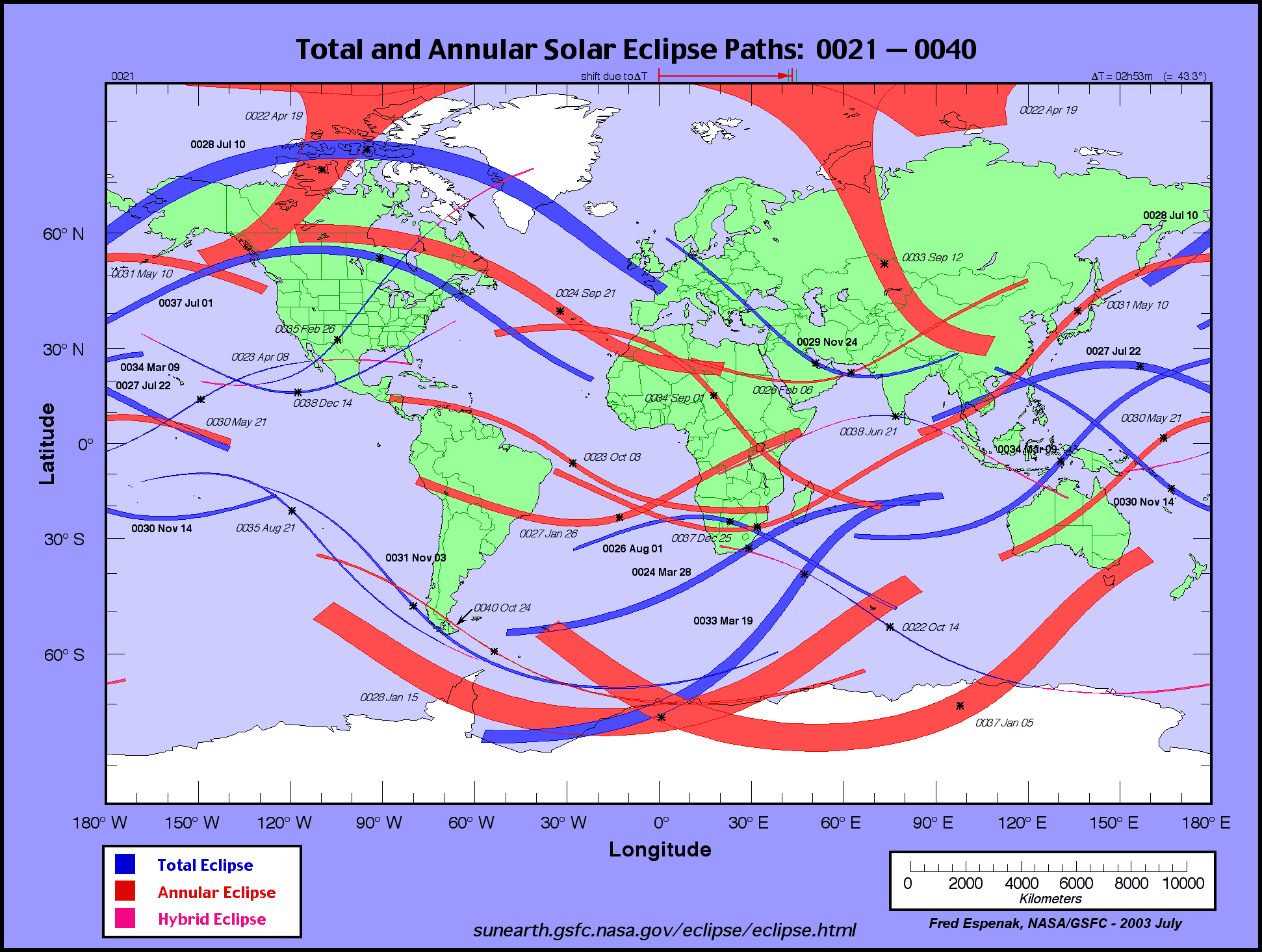
From other biblical data, we know that the two possible years for Jesus’ death were AD 30 and 33. (It can’t have been 31 or 32 seeing that Jesus was crucified on a Friday on or just before Passover.) But according to NASA, there was no total (or annular) solar eclipse scheduled on either year anywhere in the Roman world (the nearest being in November, AD 29; in the right place and the wrong time). Hence, if the Gospel accounts (or the extrabiblical sources reviewed below) are accurate, it can only have been a miraculous and/or meteorological phenomenon, not a true solar eclipse of the type that always takes place at the new moon.
There may possibly also be a reference to the Darkness in the book of Acts, also by St. Luke. In his first sermon preaching the Resurrection on the Jewish Feast of Pentecost 50 days after Jesus’ Resurrection, St. Peter quoted from the prophet St. Joel:
Then Peter stood up with the Eleven, raised his voice and addressed the crowd: “Fellow Jews and all of you who live in Jerusalem, let me explain this to you; listen carefully to what I say. These people are not drunk, as you suppose. It’s only nine in the morning! No, this is what was spoken by the prophet Joel:
‘In the last days, God says,
I will pour out my Spirit on all people.
Your sons and daughters will prophesy,
your young men will see visions,
your old men will dream dreams.
Even on my servants, both men and women,
I will pour out my Spirit in those days,
and they will prophesy.
I will show wonders in the heavens above
and signs on the earth below,
blood and fire and billows of smoke.
The sun will be turned to darkness
and the moon to blood
before the coming of the great and glorious day of the Lord.
And everyone who calls
on the name of the Lord will be saved.’“Fellow Israelites, listen to this: Jesus of Nazareth was a man accredited by God to you by miracles, wonders and signs, which God did among you through him, as you yourselves know. This man was handed over to you by God’s deliberate plan and foreknowledge; and you, with the help of wicked men, put him to death by nailing him to the cross. But God raised him from the dead, freeing him from the agony of death, because it was impossible for death to keep its hold on him. (Acts 2:14-24)
The quotation from Joel is all about how God is going to pour out the Spirit, in a way that transcends gender and class divisions, but it also has this suggestive bit about the sun turning to darkness and the moon to blood. Presumably if the sun actually had been darkened at the Crucifixion, this would help explain why Peter chose this passage and why a lot of people responded.
On the other hand, there isn’t any documented evidence of a blood moon (a moon with a reddish appearance) around the time of the Crucifixion. Apparently there was a partial eclipse that evening, which some claim could have resulted in the moon appearing red, however, this does not seem terribly plausible. The most apparently sober-minded refutation of this claim I could easily find is from Answers in Genesis of all places, a Young Earth Creationist (i.e. crazy science) website which I cannot recommend getting any scientific fact from. But if even they think the Blood-Moon/Lunar-eclipse theory is implausible, it probably is. Which is not to say there couldn’t have been a red-colored moon (for any number of atmospheric reasons, not to mention miracles) but we have no historical evidence for this.
[Update 5/27/16: I feel slightly differently about this now, than when I wrote that paragraph. There’s no particular astronomical reason I know of to think the moon would have appeared red, but there are a variety of reasons why it might have. And it is somewhat striking that there was a regularly scheduled partial lunar eclipse on the same night as the miraculous solar “eclipse” that is the main subject of this post.]
II.B. Thallus
Now for the nonbiblical sources. First, Thallus, as referenced by St. Sextus Julius Africanus, as quoted in turn by St. George Syncellus. This third-hand reference is obviously not ideal in terms of evidence, but as far as I can tell ancient historians are willing to take this type of historical evidence seriously in non-supernatural contexts.
Now Thallus was a historian who wrote a series of history books in Greek. Unfortunately these books are lost and we only have fragments recorded by other authors, but there’s enough of those to make it clear he was a real and respected historian. Some people identify him with a Samaritan “Thallus” which would place him in the first century, but apparently the evidence for this is weak. As his Wikipedia article says:
The identification sometimes made with a certain Thallus of Samaria who is mentioned in some editions of Josephus‘ Antiquities (18.167) fails because that name only appears in those editions because of an idiosyncratic alteration of the text by John Hudson in 1720. Until Hudson’s time all texts had ALLOS (meaning “another”) not THALLOS.
On the other hand, he can be no later than the 2nd century since he is quoted in Tertullian’s Apologeticus (197 AD).
There is also a question about when Thallus’ history actually ended. Again Wikipedia informs us:
Eusebius of Caesarea in a list of sources mentions his work:
- From the three books of Thallus, in which he collects (events) briefly from the fall of Ilion to the 167th Olympiad.
However the text is preserved in an Armenian translation where many of the numerals are corrupt. The fall of Troy is 1184 BC, but the editors, Petermann and Karst, highlight that the end-date of the 167th Olympiad (109 BC) is contradicted by George Syncellus, who quotes Julius Africanus, and suggest that the end-date should read “217th Olympiad”, a change of one character in Armenian.
So we have a bit of an issue in that, on the one hand the supposed quote from Thallus seems to be later than when St. Eusebius said the book ended; on the other hand this could easily have been a numerical corruption. And obviously the end date has to be later, if people are quoting stuff from the book coming from after 109 BC.
Since Syncellus’s text also mentions Phlegon, I’ll introduce him before providing the quote.
II.C. Phlegon
Second, Phlegon of Tralles. He was a a freedman of the emperor Hadrian and a historian who lived during the 2nd century, who seems to have been particularly interested in marvels and rare events, his two extant works being On Marvels and On Long-Lived Persons. I haven’t read through either of them, but if you look at the blurb for this modern translation of the Marvels book, I think you’ll get the idea:
The Book of Marvels, a compilation of marvellous events of a grotesque, bizarre or sensational nature, was composed in the second century A.D. by Phlegon of Tralles, a Greek freedman of the Roman emperor Hadrian. This remarkable text is the earliest surviving work of pure sensationalism in Western literature. The Book is arranged thematically: Ghosts; Sex-Changers and Hermaphrodites; Finds of Giant Bones; Monstrous Births; Births from Males; Amazing Multiple Births; Abnormally Rapid Development of Human Beings; Discoveries of Live Centaurs.
While it might be a bit embarrassing to Christians that the Darkness ended up being written up by the Roman equivalent of a tabloid author, you might also ask, what other type of Roman genre would it end up in?
Well, actually it seems to have ended up, not in the tabloid book but in his (presumably more serious, but who can say?) Collection of Chronicles and List of Olympian Victors instead (a book reviewed here by Photius I, Bishop of Constantinople). Phlegon’s discussion of the Darkness and the Earthquake is quoted/paraphrased by at least 8 different later authors (Sts. Africanus, Origen, Eusebius, Apollinaris—yes the heretical one, Philopon, Malalas, Agapius, and Michael the Syrian). The variety of authors quoting him, with broad consistency about certain details, makes it highly probable that he wrote something very similar to what is attributed to him.
Phlegon seems to have mentioned both the Darkness and the Earthquake. (St. Michael, the latest of these authors, claims that Phlegon also mentioned the Resurrection of the Dead in Jerusalem, but I think this is very suspicious and should probably be discounted.)
Assessing the relevance of this evidence from a Bayesian perspective, I think it is highly relevant that Phlegon added additional material, which cannot have come from the Gospels, e.g. buildings toppling in Nicea (same town where the deity of Christ was affirmed in the Nicene Creed). This indicates that he had some other source for the Darkness, besides simply believing whatever was related in the Christian Gospels. Indeed, it is unclear if the original Phlegon text actually mentioned Jesus or the Gospels as being connected with the Darkness and Earthquake (although St. Origen tells us that Phlegon did write about Jesus in his Chronicles).
II.D. Enough stalling, show me the quotes!
Now for the actual money quotes, the first several of which can be found at this online compilation at textexcavation.com, but I found some more, which were missed by that guy. Roughly in chronological order of the primary Christian source:
1. St. George Syncellus (9th century) quotes this except from St. Sextus Julius Africanus (c. 160 – c. 240) which mentions both Thallus and Phlegon:
On the whole world there pressed a most fearful darkness; and the rocks were rent by an earthquake, and many places in Judea and other districts were thrown down. This darkness Thallus in the third book of his History, calls, as appears to me without reason, an eclipse of the sun. For the Hebrews celebrate the Passover on the 14th day according to the moon, and the passion of our Saviour falls on the day before the Passover; but an eclipse of the sun takes place only when the moon comes under the sun. And it cannot happen at any other time but in the interval between the first day of the new moon and the last of the old, that is, at their junction: how then should an eclipse be supposed to happen when the moon is almost diametrically opposite the sun? Let that opinion pass however; let it carry the majority with it; and let this portent of the world be deemed an eclipse of the sun, like others a portent only to the eye. Phlegon records that, in the time of Tiberius Caesar, at full moon, there was a full eclipse of the sun from the sixth hour [noon] to the ninth [3:00]—manifestly that one of which we speak. But what has an eclipse in common with an earthquake, the rending of rocks, and the resurrection of the dead, and so great a perturbation throughout the universe? Surely no such event as this is recorded for a long period. But it was a darkness induced by God, because the Lord happened then to suffer.
Some points to notice here are that:
a) Thallus is not directly quoted but is merely mentioned as having tried to explain the Darkness as a solar eclipse (which is obviously wrong). Now people don’t usually insert totally fake critical arguments into their works in order to refute them. Unfair caricatures and straw man arguments, sure. But that’s different from totally making up a counter-argument and stuffing it into somebody’s mouth. So Thallus very probably said something along these lines.
b) We don’t know for sure whether Thallus obtained the information about the eclipse independently or was just responding to the Gospels. But given his attempt to explain it as a solar eclipse, he seems to have believed the Darkness was a real event, not an invention of the Christians.
c) Information from Phlegon is also mentioned, but it does not seem to be a direct quote. Some of the quotes below mention the 6th hour but not the 9th hour, so it is possible that Africanus got carried away and interpolated that information from the Gospels.
[Another discussion of this passage is by St. William Lane Craig here. I cribbed the translation from his website but there’s an alternate translation at texcavation.]
2. St. Origen, in his book (248) arguing against the 2nd century anti-Christian writer Celsus, writes that:
And with regard to the eclipse in the time of Tiberius Caesar, in whose kingship Jesus appears to have been crucified, and the great earthquakes which then took place, Phlegon too, I think, has written in the thirteenth or fourteenth book of his Chronicles.
Previously, in the same book, he tells us Phlegon mentioned Christ in another context:
Now Phlegon, in the thirteenth or fourteenth book, I think, of his Chronicles, not only ascribed to Jesus a knowledge of future events (although falling into confusion about some things which refer to Peter, as if they referred to Jesus), but also testified that the result corresponded to His predictions.
and he later summarizes by saying that
He imagines also that both the earthquake and the darkness were an invention; but regarding these, we have in the preceding pages, made our defence, according to our ability, adducing the testimony of Phlegon, who relates that these events took place at the time when our Saviour suffered.
The most natural construction of the last sentence is that Phlegon said the Darkness occurred during Christ’s Crucifixion, but it is possible that Origen merely means that Phlegon gave the time, and it happens to agree.
But Origen’s testimony regarding Phlegon cuts both ways, because in his commentary on Matthew (available in bad pdf scans of the Latin here), he also says that
Phlegon indeed has given some account in his Chronicles, of an eclipse that was in the reign of Tiberius Caesar, but he never intimated that this was at the full moon.
and in this commentary he argues that the events at the passion had to be localized in Jerusalem, in order to account for it not being noticed elsewhere!
It’s unclear why Origen took such radically different tactics in these two books (and we don’t know which he wrote first). But if we accept his statement that Phlegon didn’t write about it taking place at the full moon, this would impeach the reliability of Syncellus/Africanus (#1) as well as that of Apollinaris (#4), both of whom assert that Phlegon did say it happened at the full moon.
If only we had somebody who had preserved the actual quote… oh wait, it seems we just might:
3. St. Jerome‘s Latin translation of St. Eusebius‘ Chronicle (c. 380), which appears to include a direct quote from Phlegon, says that:
Jesus Christ, according to the prophecies which had been foretold about him beforehand, came to his passion in the eighteenth year of Tiberius, at which time also we find these things written verbatim in other commentaries of the gentiles, that an eclipse of the sun happened, Bithynia was shaken by earthquake, and in the city of Nicaea many buildings collapsed, all of which agree with what occurred in the passion of the savior. Indeed Phlegon, who is an excellent calculator of Olympiads, also writes about these things, writing thus in his thirteenth book:
In the fourth year, however, of Olympiad 202 [32-33 AD] an eclipse of the sun happened, greater and more excellent than any that had happened before it; at the sixth hour, day turned into dark night, so that the stars were seen in the sky, and an earthquake in Bithynia toppled many buildings of the city of Nicaea.
These things [are according to] the aforementioned man.
a) The Phlegon quote seems to show no familiarity with the Gospels, instead adding detail from Bithynia (now in Turkey). Nicea is 670 miles away from Jerusalem, but it is only 22 minutes west as the sun travels, making the change in time zone unimportant.
b) Note that the Olympics took place in the summer, and Passover was in the Spring, so 32-33 matches one of the two possible years for Jesus’ death. So if Phlegon’s date is correct, the event described cannot in any case have been a normal solar eclipse.
c) This version does not say anything about the full moon or the ninth hour, but it does say that the Darkness began at noon, and that the eclipse was notable, being greater and darker than any other on record, and that there was also an earthquake, albeit one whose epicenter was hundreds of miles away. (I suppose this could just mean an unrelated earthquake taking place in the same year, but their placement in the same sentence suggests that the events were related.) A major earthquake can be felt hundreds of miles away, the exact distance depending on the area.
d) By pluralizing “commentaries of the gentiles”, St. Eusebius indicates that he has access to other sources besides Phlegon (perhaps Thallus?).
e) Eusebius’ Chronicles were also translated into Armenian, but I was unable to find an English translation of the relevant portion online.
4. (St?) Apollinaris of Laodicea (c. 315-c. 390), commenting on Matthew in a work preserved only in fragments [missed by texcavation.com], as quoted in this book, says that:
Now a certain Phlegon, a philosopher among the Greeks, recollects this darkness as an incredible occurrence in the fourteenth [night] of the moon, when an eclipse should not have appeared . . . for eclipses occur at the time when the two stars [the sun and the moon] draw near to one another. An eclipse of the sun happens at the conjunction of the sun and the moon as it runs into its way. This is not the time of the full moon, when the sun is diametrically opposite to the moon. But the eclipse occurred as creation mourned over what had happened, signifying that the drunken behavior of the Jews was linked to a darkened mind.
5. St. John Philoponus (490 – 570), notable for his physics work contributing towards a theory of inertia, wrote a commentary on Aristotle’s view that heavy objects fall faster than lighter ones, saying:
But this view is completely erroneous, and our view may be completely corroborated by actual observation more effectively than by any sort of verbal argument. For if you let fall from the same height two weights, one many times heavier than the other you will see that the ratio of the times required for the motion does not depend on the weights, but that the difference in time is very small.
Ahem! What I actually meant to tell you, is that in a different book “On the Creation of the World”, he wrote:
And of this darkness… Phlegon also made mention in the [book of] Olympiads. For he says that in the fourth year of Olympiad 202 an eclipse of the sun happened, of a greatness never formerly known, and at the sixth hour of the day it was night, so that even the stars in heaven appeared. And it is clear that it was the eclipse of the sun that happened while Christ the master was on the cross that Phlegon mentioned, and not another, first from his saying that such an eclipse was not known in former times, …and also [because] it is shown from the history itself concerning Tiberius Caesar. For Phlegon says that he became king in the second year of Olympiad 19{8}, but the eclipse happened in the fourth year of Olympiad 202.
a) The first mention of “fourth” is really just a δ (the letter delta) in the Greek text, which was the standard way of writing the numeral “4” in Greek. According to textcavation, one translator thought this was short for δευτερω (second), but this contradicts the later part of the text (not to mention the other versions of the Phlegon passage).
6. St. John Malalas (c. 491 – 578), an unreliable historian (apparently he often reports legends), offers in his Chronographia the following version of the Phlegon quotation:
The most learned Phlegon of Athens has written about this darkness as follows:
“In the 18th year of the reign of Tiberius Caeser, there was a very great eclipse of the sun, greater than any that had been known before. Night prevailed at the sixth hour of the day so that even the stars appeared.”
a) Malalas’ has written “18th year of Tiberius” into the text even though the others generally indicate that Phlegon dated using Olympiads. So this does not appear to be an exact quotation despite its form.
b) The text reads like a slightly abridged version of Jerome/Eusebius (#3 above). It is quite possible that Malalas copied it directly from there without consulting Phlegon himself.
[Added Malalas 5/30/16, numbering of subsequent items increased accordingly.]
Now for some later (perhaps less reliable) sources:
7. St. Agapius of Hierapolis (10th century), an Arabic Christian, writes (texcavation took the translation from this book):
We have found in many books of the philosophers that they refer to the day of crucifixion of Christ, and that they marvel thereat. The first of them is the philosopher Inflātūn, who says in the thirteenth chapter of the book he has written on the kings: In the reign of Caesar, the sun was darkened and there was night in [for?] nine hours; and the stars appeared. And there was a great and violent earthquake in Nicea and in all the towns that surround it. And strange things happened.
a) Inflātūn is apparently the standard Arabic for “Plato”, presumably a mistaken rendering of Plegon’s name.
b) If the Darkness lasted nine hours, that would be a discrepancy with the other accounts (and the Gospels). Could this be a misinterpretation of something like “until the ninth hour”?
8. St. Michael the Syrian (12th century) tells us that
Phlegon, a secular philosopher, has written thus: The sun grew dark, and the earth trembled; the dead resurrected and entered into Jerusalem and cursed the Jews. In the work which he wrote concerning the time of the Olympiads, he said in the thirteenth book: In the fourth year of the third [?] Olympiad, there was a darkness at the sixth hour of the day, a Friday, and the stars appeared. Nicea and the entire region of Bithynia were shaken, and many other places were overturned.
a) The “third” Olympiad must be an error, since that would be 764-763 BC.
b) St. Michael mentions that it occurred on a Friday (the day of the week when Jesus was crucified), which if taken from Phlegon’s account would be an additional compatibility with the Gospels.
c) His account also mentions the dead coming out of their tombs in Jerusalem. But if this was really in Phlegon, it is highly surprising that none of the other authors mention this confirmation of St. Matthew’s Gospel! (Africanus mentions it, but it seems to be his own statement.) The bit where they proceed to curse the Jews also seems over the top, and my guess is that this indicates a certain amount of distortion from the original text, indicating the presence of some telephone-game type additions. But some of the other details are similar to the other texts.
d) Apparently this work is also notable for describing two other Darknesses, which occurred in 536 and 626 AD. These were qualitatively different phenomena (partial obscurement of the sun lasting for months) and seem to have been correlated with volcanic eruptions occurring in those years.
II.E. The Roman annals
For completeness, I should also mention an additional possible reference to the Darkness, as related by St. Tertullian (160-220), in his Apology addressed to the “rulers of the Roman Empire”, also writes of the Darkness at Christ’s Crucifixion:
And yet, nailed upon the cross, He exhibited many notable signs, by which His death was distinguished from all others. At His own free-will, He with a word dismissed from Him His spirit, anticipating the executioner’s work. In the same hour, too, the light of day was withdrawn, when the sun at the very time was in his meridian blaze. Those who were not aware that this had been predicted about Christ, no doubt thought it an eclipse. You yourselves have the account of the world-portent still in your archives.
Tertullian writes with confidence, apparently believing that those he writes to would be able to look it up for themselves. (This appeal is similar to that of St. Justin Martyr, who claims that the miracles of Christ were documented in the “Acts of Pontius Pilate”, although Justin makes no reference to the Darkness.) Unsurprisingly, these Roman records have no longer been preserved.
By the 4th century, various fake accounts from Pontius Pilate began to circulate to meet the needs of Christian (and anti-Christian) apologetics. These are all forgeries; they show obvious dependence on the Gospels and read more like biblical fan-fiction than what a neutral observer might be expected to write. However, none of the currently extant Acts of Pontius Pilate seems to be the document Tertullian was referring to.
Thus there is a possibility that legitimate government records of these events were still in existence at the time Tertullian wrote. (However, there are other claims Tertullian makes, about the report Pilate sent to Tiberius Caesar and its reception in Rome, which are sufficiently implausible to cast some doubt on the accuracy of Tertullian’s sources.)
III. Carrier essay
There is a widely circulated essay on the Darkness by the atheist activist Richard Carrier, which you can find here. [There also exists a peer-reviewed version which is substantially different.]
(As an aside, I have difficulty respecting the historical judgement of anyone capable of doubting the historical existence of Jesus—I don’t mean his miracles and divinity and so on, I mean the existence of a man named Jesus who started the Christian movement. Even skeptical New Testament scholars like Bart Ehrman think this “Jesus myth” idea is totally bonkers. Note that, consulting Wikipedia’s List of Historians again, of the near-contemporary historians with completely extant works covering the right place and time (Josephus, Tacitus, Suetonius, the 4 Gospels, and Acts), all but one of them mentions Jesus!
Even if you think that the references to Jesus by the historians Josephus and Tacitus were interpolations by Christians, here’s a little hint: if there were no Jesus, where did all of those Christian followers making these interpolations come from??? Did a bunch of Jews and Greeks start a club to eat bread together for no reason, and then just woke up one day and spontaneously said to each other, let’s invent a Founder? And, just to offend everyone and get made fun of, let’s say that he was crucified by the Romans on behest of the Jews!)
In his essay on the Darkness, Carrier makes several good points, which I have incorporated into my analysis above, about the dating of Thallus and the relevance of St. Origen’s comments.
However, he combines this with some dubious textual reconstructions of the texts above. For example, after condemning another scholar’s substitution of THALLOS for ALLOS as being too speculative, he makes the same substitution himself elsewhere (but in the opposite direction) to get the result he wants!
In another place, he writes that:
This quotation [of Eusebius, #3 above] shows that Phlegon did not mention Jesus in this context at all (he may still have mentioned him in some other obscure context, if we believe Origen). Rather, Phlegon merely recorded a great earthquake in Bithynia, which is on the coast of the Black Sea, more than 500 miles away from Jerusalem–so there is no way this quake would have been felt near the crucifixion–and a magnificent noontime eclipse, whose location is not clear. If the eclipse was also in Bithynia, as the Phlegon quote implies but does not entail, it also could not have been seen in Jerusalem, any more than partially, since the track of a total eclipse spans only 100 miles and runs from west to east (Jerusalem is due south).
In fact, the only coincidence with the gospel story is the year (although some modern scholars calculate the eclipse in question to have actually occurred in 29 AD) and time: it began at the sixth hour. Prigent suspects this last detail is a corruption by another scribe drawing from the gospel stories, although a noon eclipse is particularly startling and might get special mention (although the total eclipse would only occur at noon in one location–are we to suppose it was in Nicaea?). What is most important, however, is that Phlegon says nothing about the eclipse occuring during a full moon or lasting three hours (both physical impossibilities), yet these details are attributed to him in the lines added to Africanus. Clearly the quote has been altered over time.
In addition to what appears to be an error about how far away earthquakes can be felt (as discussed above), these paragraphs suffer from an acute case of “methodological naturalism”, a presupposition that all historical texts should be interpreted without making reference to anything supernatural. Carrier assumes throughout that the eclipse recorded by Phlegon was an ordinary one, despite the fact that Phlegon presented it as a highly unusual event, more notable than any other recorded eclipse. If we want to know whether a miracle in the Gospels was noticed by other people, it is counterproductive simply to point out that the event could not have happened naturally. That would be making the Christians’ own case for us, that God was at work.
And the fact that the Phlegon quote doesn’t mention Jesus at all makes it stronger evidence of the Gospel record, not weaker! That’s because it makes it more likely that Phlegon was relying on independent reports, rather than simply repeating the claims of early Christians. However well this fits in with Carrier’s later project of trying to delete Jesus from the records of history, I think he’s missed the point here.
Furthermore, there was no ordinary solar eclipse in the year mentioned by Phlegon. Carrier mentions the possibility of redating the Phlegon event to AD 29 (which would be the first year of the 202nd Olympiad) in a parenthesis as a belief of “some modern scholars”. Yet hypothesizing that the date needs correction is hardly a side issue; it is critical for his interpretation to work! And presumably the only reason those scholars advocate redating the eclipse is that the astronomical tables have no solar eclipse in AD 32-33, which is circular reasoning if we are considering the possibility of a supernatural Darkness.
IV. Conclusion
I’ve tried to provide all of the relevant data, both the good and the bad, so that readers can decide for themselves what they think. But my own personal conclusion is that this adds up to a weak argument in favor of the accuracy of the Gospels.
There is a significant amount of testimony for non-Christian sources (Thallus, Phlegon, and possibly the Roman archives) mentioning the Crucifixion Darkness, but it is all filtered through Christian writings. Quite a few authors note Phlegon’s report; not all of their descriptions are plausible or consistent with each other, but the main details tend to agree.
The coincidence with the Gospel Darkness and Earthquake, down to a specification of the year, and starting hour, is impressive, especially in light of the fact that no ordinary solar eclipse can fit the description. From a Bayesian point of view, this would provide at least 2-3 orders of magnitude worth of evidence for the accuracy of the Gospels, if only we could be sure that Phlegon’s account were truly independent of Christianity and yet got these details the same. But we simply can’t know this for sure, given that the original manuscript was lost and what we have was filtered through Christian sources. This makes the evidence a lot weaker than it otherwise would be.
Still, it provides a nice corroboration of the Gospels at a point where many readers are particularly likely to be skeptical, when they report that the sun refused to shine upon our Savior as he suffered for our sins. At the very least, it defeats the argument that the Darkness counts as evidence against Christianity, due to nobody else having noticed this public and obvious spectacle.