Category Archives: History

Comparing Religions II: World Evangelism

Having introduced the subject of comparing religions, we will now analyze the first question:

1. Has the religion persuaded a significant fraction of the world population, outside a single ethnic group, to believe in it?

One of the reasons for this question is that few people have time to investigate all of the numerous religions that exist.  (I’ve done more than most people ever will, but there are still huge gaps in my knowledge.)  Since it is not possible to do a complete analysis of every religious tradition, one must have some way of sifting out the more likely candidates from the less likely ones.  Whatever criterion one uses for this sifting, it has to be something which can be measured prior to doing an in-depth investigation.

In persuasive writing, it is generally considered most rhetorically effective to lead with one of your stronger arguments, so that people don’t dismiss your case out of hand.  But here, the nature of the subject requires me to lead with one of the weaker arguments for a religion, namely its popularity.  But it is not so weak that it doesn’t deserve careful consideration.  Later on, we will discuss some more dispositive tests.

Ad populum (appeal to mass belief) is not necessarily a fallacy, when it is used only as a probability argument rather than a deductive argument.  I would never say that a large number of adherents guarantees that a religion is correct; obviously not.  Many completely wrong beliefs (e.g. homeopathy and astrology) still have lots of people who swear by them.  There are, however, some cogent reasons why a true religion is likely to have more adherents than it would if it were false.  So while the fact that a significant fraction of the world population believes in something cannot (taken by itself) be enough reason to accept it, I do think it justifies taking it seriously enough to investigate its truth.

All Else being Equal, Truth is More Convincing

Presumably a true religion is more likely than a false one to be found convincing by a broad range of people.  It is also more likely to be regarded as important enough to share with others.  While human beings are far from infallible, it says something good about a religion if it can pick up a large number of voluntary converts.  At least some people take into account reason and evidence (and any “signs” they may happen to witness) when deciding what to believe; so all else being equal, truth should provide a religion with a survival advantage.  (If this were not true, then there would be very little point in writing blog posts analysing the evidence for or against religion, because nobody would take them into account.)

It is especially impressive if a religion has been found plausible by people from many different cultures and backgrounds.  A religion might take off in a single ethnic group because of some fluke of history.  On the other hand, a multicultural distribution suggests that perhaps the religion contains something true to life, that it is in some way suited to the human condition at large, not just one cultural milieu.  If it has seemed insightful to many kinds of poets, philosophers, and peasants, then it probably contains at least some element of universally valid truth.

A Census of World Religions

If even 1 in a thousand people (worldwide) investigate religions in a sufficiently sensible and open-minded way to identify the truth (whatever it is), then it would follow that the true religion must have at least 7 million adherents or so, which would narrow us down to about a dozen possibilities (according to the website adherents.com in 2014.)  If you scroll down past the pie chart of the first link, you’ll come to the following list:

  1. Christianity (2.1 billion)
  2. Islam (1.5 billion)
  3. Secular/Nonreligious/Agnostic/Atheist (1.1 billion)
  4. Hinduism (900 million)
  5. Chinese traditional religion (394 million)
  6. Buddhism (376 million)
  7. primal-indigenous (300 million)
  8. African Traditional and Diasporic (100 million)
  9. Sikhism (23 million)
  10. Juche (19 million)
  11. Spiritism (15 million)
  12. Judaism (14 million)
  13. Baha’i (7 million)
    [+additional religions with 4.2 million religions or fewer]

Of course, many of these categorization decisions are questionable.  Nonreligious is by definition the absence of a religious commitment (although Communism might be regarded as a religious substitute for a substantial minority of these people); Chinese traditional represents various admixtures of Buddhism, Taoism, Confucianism, and ancestor worship; indiginous or African traditional are umbrella terms for thousands of different pagan religious traditions (most of which would have less adherents than Baha’i if taken individually); while Juche is just the state ideology of the North Korean dictatorship (which has approximately the same moral credibility as Nazism).  Fringe Christian or Islamic cults might be better regarded as separate religions, and some of them (like Mormonism) I will be treating as separate religions in subsequent posts.  But the exact division is not very important.  The point is that there are really only a small number of options on the table, if you use the rest of humanity to sift out the options that have been found most plausible.

(That being said, if there is some particular religion with fewer adherents that you have some reason to think is specially promising, I’m not saying that you shouldn’t investigate it.  But it is reasonable to start with more popular religions.)

Another Reason to Consider Popularity: Divine Favor

A true religion is also more likely to have divine favor assisting its spread across the world (assuming of course that the religion is theistic).  I don’t want to put too much emphasis on this, since the worship of strength and worldly success is one of the crudest of all religions.  My own religion centers around the Cross, therefore it is (or ought to be) on the side of the unjustly persecuted everywhere.  Might does not make right.  Yet sometimes, when human hearts are receptive, right makes for might.  Truth may be weak, but sometimes this weakness is itself a paradoxical form of strength, as Gandhi showed in India, and the Civil Rights Movement showed in America.

If there is a religion revealed by God, then it is an obvious sociological fact that not everyone on earth has accepted the message.  For whatever reason, it is not the divine will to overawe everyone into accepting it (at least, not yet).  But if it is a genuine revelation, one expects that he would protect and defend it to some extent, at least enough to accomplish whatever goals he has in revealing the message.

At the very least, extinct religions like e.g. Greek or Egyptian polytheism are probably not worth taking very seriously—if those gods are at all real, why would they have allowed their names to be completely forgotten, except as fodder for dissertations, garden statuary, and comic books? It took a lot of kahunas for the prophet Jeremiah, way back in the 600s BC when the Jews were surrounded by polytheists, to taunt the followers of other gods by telling them (in Aramaic, the international language):

“These gods, who did not make the heavens and the earth, will perish from the earth and from under the heavens” (Jer 10:11).

But in quite a large portion of the globe, including of course the Middle East where Jeremiah was prophesying, this is exactly what has happened.  (This process is not yet complete, but if a prophet had predicted that all the world would one day consist of blue-skinned people, and then over the next few centuries half of the people on the planet had turned blue, I would start taking the rest of what he said more seriously, even if it hadn’t yet happened to everyone!)

The Jewish Origins of the Idea of Progress

Historically, it was extremely unusual, in the pre-Christian world, for a religion to predict its own global dominance.  As moderns we think that every ideology should predict a future in which it is more widely successful, but that’s not how most people thought back then.  The ancients usually expected that the world would keep on going more or less as it was before, or maybe keep getting gradually worse.  As Westerners we are used to ideologies having an eschatological aspect—looking forward to a future utopian society that is a radical improvement on the present—but the reason we think this way is precisely because of the influence of Judaism!  (The only other eschatological pre-Christian religion I know of is Zoroastrianism, which presumably either got it from Judaism, or else influenced Judaism in this respect.)

Universal vs. Ethnic Religions

The Jews did not (and still do not) regard it as necessary for pagans to become Israelites in order to be saved.  The Hebrew prophets spoke against idolatry and polytheism, but they foresaw the worldwide acceptance of pure Monotheism as a sign of the future Messianic Era, not as a realistic goal for the present day.

However, at the time of the Roman Empire, there were a large group of “God-fearers”, who came to believe in the truth of Judaism, but did not formally convert due to the burdensome nature of Jewish ritual.  A lot of these people later became Christians, once it became clear that you didn’t have to become a Jew in order to be a full member of the Christian Church.

If this model is right, then God cultivated an ethnic religion for a limited period of time, in order to produce the right circumstances in which the Messiah could come.  But now that he has come, Christianity is a religion for all people, in fulfilment of God’s promises:

“It is too small a thing for you to be my servant
to restore the tribes of Jacob
and bring back those of Israel I have kept.
I will also make you a light for the nations,
that my salvation may reach to the ends of the earth.”
(Isaiah 49:6)

Hence, if we wish to find a worthy rival to Christianity, it should probably be a universal religion, i.e. its message should be sufficiently relevant to the perennial human condition, that it can be adopted by people from every culture and tribe, without completely wrenching them out of their social context.  A religion cannot really be considered cosmic in scope, if it isn’t even able to be cosmopolitan.  This criterion rules out a large number of purely ethnic and tribal religions.

If God were still restricting his message primarily to a single ethnic group, presumably the rest of us would not be judged too harshly for not being in on the program.  Even the insiders might not think you have a moral obligation to join their group.  This makes it a lower priority to investigate ethnic religions such as Judaism or Hinduism (unless of course you happen to belong to one of these groups already).

As the most extreme case of ethnic exclusion, some religions currently forbid conversion altogether, for example traditional Parsees (Zoroastrians in India), and the Druze (in the Middle East).  These religions also forbid their adherents to marry outsiders.  There’s just no way to get in, even if you wanted to!

Other religious traditions teach that God reveals himself through all cultures and therefore it is counterproductive to cast aside your ancestral teachings in favor of theirs.  These religions may discourage converts: for example, a woman from the church I grew up in became interested in Hinduism, and went to India to study under a guru.  He told her to go back to the USA, saying that she wasn’t done being a Christian yet!  I’ve heard other anecdotes along similar lines, so apparently this attitude is fairly common among Hindu teachers.

Then there are various small religions (such as Baha’i, which is right on the edge of my somewhat arbitrary 1/1000 threshold) that are clearly intended to be international in scope, but have failed to achieve a very large number of converts to their cause.

(In some cases this might be because the religion is new.  Of course all religious movements start out small, so we can’t place too much weight on this criterion or it would imply that nobody should have followed Jesus at the beginning, when he only had a few disciples.  At the same time, it seems reasonable to say that an untested charismatic cult leader needs to clear a higher bar than a well-established religious tradition.)

Hence, to score top points on this criterion, it is best to have already convinced a significant fraction of the world.

The Three Big Evangelical Religions

These considerations suggest we should focus the most attention on Christianity, Islam, and Buddhism.  These are the 3 world religions which have had the most success in gaining converts even in radically different cultures, the ones whose message has been perceived as “Good News” to numerous people groups around the world.  (But I will still try to say some things about other religions as well, to the extent that my limited knowledge allows.)  To what extent their religious teachings actually are good news—well, that is a subject for the later posts!

Of these three “evangelical” religions, the spread of Islam is somewhat marred by the fact that the early spread of Islam, starting during Mohammad’s lifetime and continuing for several centuries thereafter, was largely due to military action and subsequent cultural imperialism.  Although obviously Muslims would attribute this rapid spread to God’s will, from a human point of view it seems that the sword discriminates among truths far more clumsily than rational discourse does.  (There are however a few countries, such as Indonesia, where the spread of Islam seems to have largely occurred through peaceful means such as trade.)

Of course some Muslim historians will insist that each of these conquests was morally justified by various particular circumstances.  But, to paraphrase a bit of popular wisdom: anyone might meet one or two jerks, but if everyone you meet seems to be a jerk, then you should consider the possibility that you might be the jerk, and they’re just reacting to your personality.  In particular, any group that tries to conquer large parts of the world by the sword, should not be too surprised when the other countries look on with dismay and try to fight back.  (Here I am speaking historically, and not attempting to justify any particular modern wars.)

It actually took several centuries for these conquests to result in a majority for Islam in the Middle East and North Africa.  At first it was mainly the rulers of the conquered lands who were Muslims.  While pagans were required to convert at swordpoint, monotheistic groups such as Jews, Christians, Mandaeans (yes, there still exist followers of John the Baptist who never converted to Christianity!—although by now they have become very gnostic and reject even Moses), and Zoroastrians were generally tolerated, so long as they accepted second-class citizenship (dhimma), paid extra taxes (jizya), and did not try to convert Muslims to their religion.  Over the long run these legal disadvantages gave Islam a decisive advantage.

Mind you, at times the situation for Jews or “heretics” in medieval Europe was even worse than this.  It is easy to find examples of persecution of religious minorities in Christian history.  (Officially speaking, the Roman Catholic Church hierarchy only asserted authority over baptized individuals, but sometimes local rulers would impose Christianity on their domains, and then later the Church would try to enforce orthodoxy in these populations since they were now “Christians”.)

Even Buddhists have sometimes engaged in religious persecution, e.g. historically in Japan, and at the present in Myanmar (a.k.a. Burma).  A college friend once tried to argue to me that anyone who persecuted other people wasn’t a real Buddhist and therefore didn’t count.  But this was an obvious use of the No True Scotsman ploy.  In my opinion the Christians who persecuted people weren’t in that respect very good examples of Christianity either, but they still existed.

However, I think it is fair to say that both Christianity and Buddhism usually spread to new cultures primarily through evangelism.  This is especially true in their early years, and also in the contemporary world.

For example, after converting to Buddhism, the Indian king Ashoka (formerly a cruel tyrant) seems to have become a pacifist who promoted religious toleration (although there are some contrary traditions whose accuracy is disputed); his support for missionary activity in other countries helped spread Buddhism to many other nations.  And for the first 3 centuries the Christian Church rapidly expanded, even though it had no control over the government and intermittently went through periods of severe persecution, prior to its legalization by the first Christian Emperor, Constantine.

Of course there were plenty of instances of persecuting others which occurred after these religions were well-established.  But it is open to both Buddhists and Christians to claim that the persecutors were bad examples, that they were ignoring the explicit instructions of their own sacred texts, and ought to have known better.  And perhaps that, in the long run, their religion would have advanced just as well or even better, without the aid of violent support.  It is not really open for a Muslim to say the same thing, because then they would have to disown their own Prophet and his immediate followers.  Of course they can still renounce particular instances of expansion through warfare, as being done in an inappropriate time or manner, but they cannot renounce it on principle.

(Christians do have to deal with divinely commanded warfare in the Old Testament, although this was not for evangelical purposes and was geographically limited.  There was no command to spread Judaism to other nations by conquest!  I will reserve discussion of the ethics of this violence until later, but it does introduce our next topic, namely continuity with other religions.)

Next: Ancient Roots

Comparing Religions I: Introduction

A while back, a reader named “Martin B” once asked me this question about other religions:

May I ask what it is that makes you think Christianity stands out and is more believable than other religions and faiths on this planet?

In my previous response, I came up with a list of questions to ask to compare religions.  Here they are again:

  1. Has the religion persuaded a significant fraction of the world population, outside a single ethnic group, to believe in it?
  2. How does the religion relate to previous and subsequent religions?
  3. Did the religious founder claim his message came from supernatural revelation, or is it only the reflections of some wise philosopher who didn’t claim to have divine sanction for their teaching?
  4. Are the primary texts describing some sort of mythological pre-history, or are they set in historical times?
  5. Related, does it sound like fiction, or does it sound like history?
  6. How long was it between the time when the supposed supernatural events took place, and when they were first written down (in a document that has had copies of it preserved).  Is it early enough to suggest the text is based on testimony rather than later legends?
  7. What are the odds that the purported supernatural events could have occurred for non-supernatural reasons?
  8. Did the main witnesses benefit materially from their testimony, or did they suffer for it?
  9. Is there significant evidence of fraud among the originators of the religion?
  10. What is the general moral character of the religious teaching?
  11. Do people who are serious about this religion generally feel that they are put into an actual relationship with the divine?

I will now attempt to answer these questions, both for Christianity and its competitors.

Some disclaimers are probably appropriate.  Obviously there are some religions I know more about than others, and I apologize in advance to any member of another religion if I’ve gotten anything factually wrong.  Corrections are welcome in the comments.

Obviously, in order to say why I think Christianity is more plausible than other religions, I will have to be honest about what I think the shortcomings of other religions are.  In doing this, I do not intend to communicate any disrespect to the adherents of these religions.  I would like to believe as well of everyone as I can, but I am constrained by the truth to give my honest opinion.  I will try to do my best to highlight the good aspects of other religions as well as the problematic aspects.

I do not aim to write from a “neutral” viewpoint (nor do I think there is any such thing on this subject), but I do think I’m fair-minded enough to explore things from other perspectives, yet also—and this is equally important—interested in identifying actual evidence and truth, unlike supposedly “objective” scholars of comparative religion.

Not being interested in the truth of the underlying claims (or at least, interested in imagining what it would be like to care about the truth claims) is actually one of the most subjective ways to study a religion, in my opinion.  Because it sidesteps or brackets the thing most essential to most actual religious believers, it has a tendency to end up comparing superficial cultural similarities and differences, rather than getting to the heart of the matter.

And I am certainly not trying to evangelize my own culture.  I do not want everyone to share my own culture, but Christ.  Christian missionary work is not about the Imperial impulse, getting other people to give up their own culture, in order to learn Greek or English and become Europeans or Americans; no, it is about bringing Christ into every culture, to transform it into what God created it to be.  Certain specific cultural traditions may need to be changed because they are unjust or idolatrous—but that applies to Western culture as well!  The point of missionary work is to introduce other cultures to Jesus and let him show them what needs to change so that they can truly be themselves, not to make them over into the image of another group of people.

Some Christian missionaries have made the Imperial mistake in the past, but I think they’ve mostly figured it out by now.  I have seen many missionaries give presentations at churches about their foreign work, and almost down to the last man and woman, they have all seemed far more excited to share what they’ve learned about foreign cultures with Americans, then to spread American culture anywhere.  It is Jesus and the Gospel which they want to share, not Western culture in general.  (The one major exception is Western medicine, another type of “good news” which is beneficial to everyone, and which most missionaries are also very interested in sharing with other cultures.)

Please bear in mind that I’m trying to paint in really broad strokes here, because otherwise each of these questions would have to be a book in its own right.  So if I say that a religion is “primarily based” on something or other, or I summarize its teachings very briefly, I expect that there are plenty of nuances which I’m glossing over; due to my misperceptions as an outsider, different sects adopting different interpretations, and so on.  There is certainly potential for bias in my descriptions, but I still think these comparisons are worth doing.  Even near-sighted people can usually tell the difference between an elephant, a dog, and a rat.

While I may occasionally mention them, I will not be too concerned with the theological differences between different Christian denominations in this series.  I believe that what Christians share in common is far more important than what separates us.  (Here I am referring to geoups that actually believe in the supernatural claims of the New Testament, and have the mainstream Christian view about the basic nature of God and Jesus.  Fringe groups like Mormonism are probably better thought of as separate religions.)

In some ways, the internal differences within non-Christian religions are actually more significant for this project, because when a dispute between Christians is important, if need be I can simply defend the viewpoint I find most plausible.  But if there is a division inside of a non-Christian religion, in priciple one would need to investigate every possible permutation of the other religion to find the most plausible version.  This task is particularly vexatious in the case of Hinduism, which I am not sure should even be regarded as a single religion!  (Since you can find Hindu sects with basically all possible positions on the nature of divinity and its relation to the world.)  In other cases, I am going to try to keep things simple by focussing on the religious founder and trying to identify what form of the religion he (or she) taught, even though it’s conceivable that the version that is most “authentic” to the founders intentions might not always be the version that is most true or beneficial.

Note that I will be discussing a fairly large number of criteria in the blog posts that follow, and it is not necessarily obvious which criteria are the most important.  Hence, even if I seem to “eliminate” a religion from consideration in one blog post, I may nevertheless continue to discuss that religion in future blog posts.

I am particularly grateful to my friend and fellow physicist Ahmed (of firewalls fame) for several conversations on Islam which have significantly benefitted my understanding.  I consider myself to have much more important things in common with him, than with any of the run-of-the-mill irreligious physicists I know.  Of course the views I express are my own, and so are any mistakes!

When irreligious skeptics in America bring up other religions as an objection to Christianity, it seems to me that they are quite frequently arguing in obvious bad faith.  When they look for parallels to the claims of Christ in some other religion, it is really to argue against Christ, and not because they actually take seriously, for one minute, the idea that some exotic foreign cult leader might actually turn out to be the true prophet sent by God.  If they did take these other religions seriously as rivals to Christianity, I think they would approach the question with far more caution, and would inevitably find themselves making distinctions between the plausibility of different ideas.

(Surely it is horrendously unlikely that all religions would have exactly equal plausibility.  Even if they were all fake, some fakes are a lot more convincing than others!  And you can’t possibly know they’re all fake, until you’ve investigated them carefully.)

At this point I should also mention another “skeptical” approach to evaluating religions which I think has very little merit, just to get it out of the way.  And that is to read the scriptures of a religion solely for the purpose of compiling a long list of “contradictions” that supposely disprove the books in question.  The main problem with this approach is that, generally speaking, the “worse” of a reader you are (i.e. superficial, hostile, and literal-minded) the more seeming contradictions you will find.  In other words, this is an approach which rewards poor reading.  And as St. Lewis remarked in one of his Narnia books, “the trouble about trying to make yourself stupider than you really are is that you very often succeed.”  (Of course, this approach is even sillier when done by followers of another religion, seemingly oblivious to the fact that their own holy book might be subjected to the same treatment.)

You have to give a text an chance, “suspending your disbelief” and savoring its taste on your tongue, even in order to find out what it is really saying.  Only then can you judge whether the ideas in it are sound or not.  This goes doubly for texts that were written a long time ago, where the authors lived in a completely different cultural milieu from our own.  Any historian worth his salt knows that even very accurate historical texts can contain puzzling statements, which may be difficult for us to reconcile with the rest of our knowledge about the period (but the resolution might have been transparently obvious to those who lived through the events, perhaps so obvious that they didn’t bother explaining it).

And when it comes to the more intangible spiritual or ethical truths, only a fool would automatically reject any hint of paradox or tension between opposing ideas.  That’s like saying that because your left eye and your right eye show slightly different images, you have to disbelieve either the one or the other, or both.  The better option is to combine both images, and then you can see in 3D!

This does not imply that all religious ideas are equally valid, either historically or philosophically.  At the end of the day, there might be irresolvable contradictions in a putative religious system.  But you should always make sure to criticize the essence of what is being said, rather than sniping at superficial “gotchas”.

For these reasons, I find it’s usually far more interesting and productive to have conversations about religious disagreements with an actual believer of another religion.  In this case, neither participant can “win” simply by retreating into a bottomless pit of endless skepticism, since each person also has something they wish to defend!

Next: World Evangelism

Tis the Season… For Revisionist History

[This is an updated version of an essay published at my own website in December 2014.—Scott Church]

As Christmas draws nigh, I am reminded of the many reasons why it’s my favorite holiday. It’s the culmination of my favorite time of year—when geese and swans are on the wing through crisp morning fog, the hills are on fire with the colors of dwindling annual life cycles in their foliage, and salmon fill the rivers, returning with such undying exuberance to complete a cycle of life as old as the cascades they leap with so much primal determination. My family and I visit a tree farm in the Cascade foothills and return with our Christmas tree. We decorate it, hang lights, and fill our home with Christmas carols, sacred hymns, and the canons of the season. Autumn wreath and other spicy scents waft from candles. The joy and worshipfulness of the whole season fills gives me joy. But most of all, Christmas is the time when we remember that God chose to come down from Heaven and become one of us, sharing in the fleshly reality of our joys and sorrows, and offering His life as a loving sacrifice for ours. Unto us a Savior is born!

But like so many other things that bring joy and meaning to our lives, it also has a way of bringing some of the lamest ax grinders among us out of the woodwork like moths to the flame. We’ve all heard the endless pratlling of benighted fundamentalists who take offense whenever someone says, “Happy Holidays!” instead of “Merry Christmas,” as though the Christmas story celebrated by 2.2 billion people worldwide is somehow threatened by anyone who doesn’t hold Christian beliefs and prefers to find their own meaning in the season. But for all their annoying priggishness, at least these people have some semblance of history and scholarship on their side. More bothersome (to me at least) are the self-proclaimed guardians of politically correct secularism who insist that Christmas, and indeed the entire body of Christian doctrine and tradition, were somehow stolen from pagan traditions by nefarious church leaders intent on suppressing them. The Immaculate Conception and virgin birth of Jesus, the manger, the visit of the magi bearing gifts, the date of December 25 and more… all, we’re told, originated in pagan myths such as those of the gods Mithras, Sol Invictus, Horus, and other ancient cosmogonies. Even the historical figure of Jesus Himself, His twelve disciples and the crucifixion and resurrection are said to have been plagiarized. Every fall, once the Thanksgiving decorations come down and the Christmas lights start going up, it’s only a matter of time before cartoons and Facebook memes like the one below start making the rounds in anti-religion social media chat rooms.
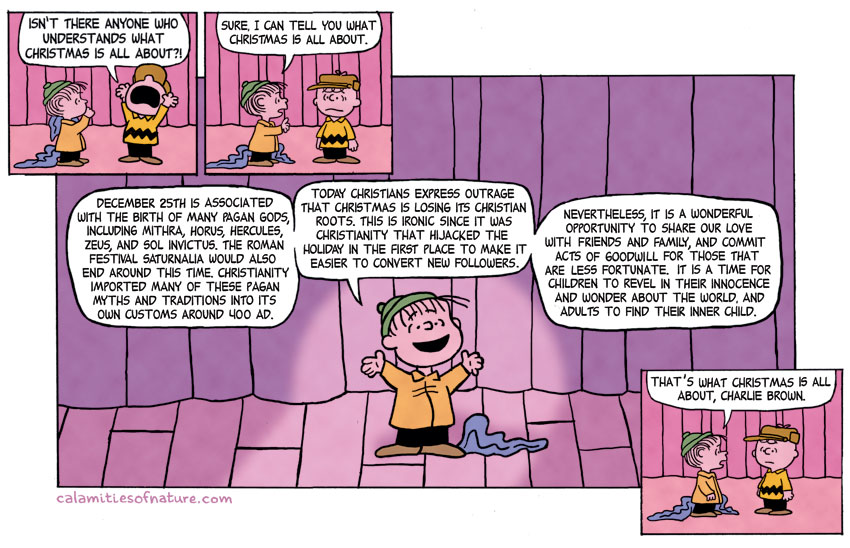
Apart from the boorish tastelessness of vandalizing a Christmas classic, every word of this is false and no reputable scholars take any of it seriously. Even so, the rise of such fashionable mythology within anti-religion circles makes for an interesting, and at times entertaining story. Verily, verily, human nature is a gift that keeps on giving.

The actual date of Jesus’ birth is not known. The gospels tell the Nativity story from different perspectives but contain few clues as to its date, and the next two centuries contain little extra-biblical evidence to supplement them. Surprising as it may be to some, the early church did not attach much significance to the birth of Jesus, preferring instead to celebrate his ministry, death and resurrection. Some Christian writers of the period even condemned the Roman practice of celebrating birth anniversaries as “pagan” practices (Origen), rendering it highly unlikely that they or the church would’ve been in the habit of celebrating the Nativity. Toward the end of the 2nd Century an interest in dating the birth of Jesus emerged in the Coptic Church of Northern Africa, and by 200 C.E. several dates were being proposed (Clement). During the 2nd Century some Christian writers saw intimations of Jesus in the vernal equinox and placed the Annunciation and the passion of Christ on or near the 14th day of Nisan (March 25 in the Julian calendar). Irenaeus (c. 130–202) made this claim and linked it to the crucifixion as well, as did Tertullian of Carthage (Tertullian), Hippolytus and the pseudo-Cyprianic (Talley, 1986). In 243 C.E. an anonymous work titled De Pascha Computus suggested that the creation of the sun and the Annunciation both occurred on or near the vernal equinox as well (McGowan, 2002).

The notion that the Annunciation and passion of Christ, as well as creation should fall on the vernal equinox was widespread by the mid-3rd Century, and by the middle of the 4th Century celebrations of Christmas had converged on two dates: December 25 in the West and January 6 in the East. Valentinus’ Chronography of 354 refers to a Christian liturgical feast denoted as “Natus Christus in Betleem Judeae: Christ was born in Bethlehem of Judea.” By this time the Donatists of Northern Africa were also honoring the December 25 date and appeared to have been doing so since their inception as a church under the persecution of Diocletian in 312 C.E. (McGowan, 2002). In the East, where the birth of Christ had been tied more strongly to the Epiphany, Christmas was celebrated on January 6. The period between the two dates came to be known as the Twelve Days of Christmas. By 388 C.E. the December 25 date had been imported into the Eastern Church as well by John Chrystosom who gave a sermon claiming, “Our Lord, too, is born in the month of December … the eight before the calends of January [25 December] …, But they call it the ‘Birthday of the Unconquered’. Who indeed is so unconquered as Our Lord …? Or, if they say that it is the birthday of the Sun, He is the Sun of Justice…” (Martindale, 1908; Roy, 2005; Wainwright and Tucker, 2006).

So, by the mid-3rd Century Christian writers had based the conception of Jesus on the vernal equinox leading to a birth date of December 25 (Duchesne, 1919; Alexander, 1994; Roll, 1995; Talley, 1996; Wybrew, 1997; McGowan, 2002; Roy, 2005; Senn 2006, 2012; Rothenberg, 2011). By the middle of the 4th Century, liturgical feasts had been marking the date for some time and had almost certainly been doing so before the ascension of Constantine to the Eastern and Western thrones in 312 C.E.

It’s important to note that prior to Constantine Christians were a persecuted minority. Official state sanctions against Christians were desultory throughout the 2nd Century and escalated to Diocletian great persecution from 303 to 311 C.E. during which as many as 20,000 Christians were executed for not bowing down before the officially recognized gods of Rome. They were hardly in a position to “usurp” any pagan festivals and in fact, for reasons of religion and physical safety they were actively trying to distance themselves from them. Prior to the 4th Century Christian writings make no references to altering, or otherwise laying claim to any pagan holidays or dates (McGowan, 2002). It was during this period (274 C.E.) that Aurelian declared Sol Invictus (“Unconquered Sun”) the official sun god of Rome and officially established the festival Dies Natalis Solis Invicti on December 25 to commemorate him. Sun god worship was present in Rome in one form or another since before the 1st Century. But whereas Christian writers had established arguments for the birth of Jesus on this date by 200 C.E., there is little evidence to suggest that feast days commemorating Sol Invictus were celebrated prior to the mid-4th Century (Wikipedia, 2017). In fact, evidence suggests that Natalis Invicti may have been a response to December 25 Christian liturgical feasts rather than a motivator for them (Tighe, 2003). It wasn’t until Constantine issued the Edict of Milan in 313 C.E. that persecution of Christianity ended (only to be renewed to some degree by Julian the Apostate from 361 to 363 C.E.), and Christianity didn’t become the state religion of Rome acquiring the power “usurp” any pagan practices until 380 C.E. under the reign of Theodosius I (Wikipedia, 2017b).

But according to our cartoon historian… a minority of Christians launched a sinister plot to steal the festival of Natalis Invicti from the pagans who were persecuting them 50 to 70 years before it was even practiced, and nearly two centuries before the church had any sanctioned power to do so.

What about Saturnalia?  It originated as a festival for farmers in honor of Saturn (from satus for “sowing”) that marked the end of the autumn planting, and was practiced in one form or another from as early as 217 B.C. until well into the 5th Century C.E. Originally a two day affair beginning around December 17, it eventually became a week-long festival culminating on December 23 (Salusbury, 2009; Wikipedia, 2017c). Though it has been suggested that the festival may have been extended to December 25 by Domitian (AD 51-96) during his reign as an assertion of authority (Salusbury, 2009), for the bulk of its C.E. history it was a 5-7 day festival that culminated with the Sigillaria (day of gift giving) on December 23. Its timing does not align well with December 25 or January 6 dates for Christmas, and it’s very unlikely to have had any influence on the church’s adoption of either date (Gwynn, 2011).

But if Sol Invictus and Saturnalia are questionable Christmas story candidates, the cult of Mithras is downright ludicrous. Mithras was a Roman reinvention of the ancient Indo-Iranian angelic deity Mithra (Sanskrit, Mitra), the guardian of covenant and oath, harvest, cattle, and water. He was the all-seeing protector of truth, and the divinity of contracts and judicial process (Wikipedia, 2017c). He is first mentioned in the Rig Veda circa 1400 B.C. after which his worship spread to the Persian world through Zoroastrianism where he was known as Mithra. It’s unclear whether Zoroaster himself embraced Mithra, but he appears throughout the Zoroastrian Avesta (particularly the Khorda Avesta, or Book of Common Prayer) possibly as early as 559 B.C. He entered the Hellenic world as Mithras when Alexander the Great conquered Persia in the late 4th Century B.C. Roman Mithraism first appears in the historical record late in the 1st Century C.E. and flourished throughout the empire, particularly among the military, until the 4th Century. Unlike other pagan religions of the period, Mithraism was a mystery religion whose doctrines, rituals and festivities were closely guarded secrets. No scriptures, writings or first-hand worship accounts are known to exist apart from a handful of catechisms and one 4th Century liturgy. Everything that is known about it has been derived from inscriptions at archaeological sites and second-hand commentary about it in the writings of contemporary outsiders (Clauss, 2001; Pearse, 2012; Pearse, 2012; Wikipedia, 2017e). There is general scholarly agreement that although he was derived from the Zoroastrian tradition, the Roman Mithras was noticeably dissimilar to his Persian counterpart and today he is regarded as a distinct product of the Roman Imperial religious world (Wikipedia, 2017c, 2017d, 2017e; Encyclopedia Britannica, 2017). It’s important to note that syncretism was a common feature of Roman paganism and Mithraism was no exception. Most archaeological finds associated with the worship of Mithras contain statues dedicated to other gods and inscriptions dedicated to Mithras were commonplace in other cult sanctuaries. Roman Mithraism was more a way of practicing pagan worship than a religion in its own right and Mithras’ worshippers were often found worshipping other gods in the civic religion. Mithraism was far more likely to be influenced by other religions rather than an influence on any of them (Burkert, 1987; Clauss, 2001; Pearse, 2012).

Nevertheless, attempts have been made to explain Christianity away as a plagiarism of Roman Mithraism. The idea that the two might be related was first suggested during the 19th Century by Renan (1882) based on a criticism of Mithraic rituals by Justin Martyr (155-157 C.E.). This in turn led to decades of speculation culminating in numerous alleged similarities between Mithras and Jesus, including (but not restricted to) that he was born of a virgin on December 25, crucified and resurrected after 3 days, marked with the sign of a cross, and attended by 12 disciples. Apart from superficial similarities no real evidence exists for any of these claims and few if any scholars take them seriously. They survive mostly as urban legends circulated by New Age and/or New Atheist communities (Pearse, 2012, 2014; Wikipedia, 2017f). In fact, given that Christianity predates Roman Mithraism by nearly half a century, what few similarities there are, appear to be the result of Mithraism borrowing from Christianity rather than the other way around (Nash, 1984; Pearse, 2012). Of the current myths regarding Mithras and Christianity, the ones most relevant to Christmas are that he was born on December 25, and that he was a virgin birth.

The December 25 date is based entirely on conflations of Mithras with Sol Invictus. The sun (Sol) figures prominently in Mithraic tales like The Banquet of the Sun, and he was often referred to descriptively as sol invictus (the unconquered sun), but never by formal title. Sol Invictus and Mithras were separate deities. The title “Invictus” was given to a number of pagan deities (not unlike “Reverend”) and wasn’t reserved for Sol Invictus alone. In fact, Sol Invictus and Mithras are shown together in a number of scenes as separate deities (including The Banquet of the Sun). Some feature Mithras ascending behind Sol in the latter’s chariot, the deities shaking hands, and sharing pieces of meat at the altar on a spit or spits. One even shows Sol Invictus kneeling before Mithras (Clauss, 2001; Beck, 2004). No other mention of December 25 relating to Mithras occurs anywhere in the ancient record, and there is no evidence to suggest that the state sanctioned Roman festival of Sol Invictus was related to Mithras in any way.

Attempts to ascribe a virgin birth to Mithras are downright bizarre. The historical record contains two accounts of his birth: The Roman version, and the Indo-Iranian version that preceded it. In the former Mithras is depicted as emerging fully grown from a rock in a cave bearing a torch or dagger and wearing a Phrygian cap after which his first act was the slaying of a bull (Clauss, 2001). Some accounts associate the rock of his birth to the water god Oceanus and it serves as a fountain. The Indo-Iranian myths are similar with a few variations. Here Mithra is born of a rock by the shore of Araxes (Widengren, 1966). Some have claimed that the Vedic tradition depicts Mitra as being born to the virgin goddess Anahita, but this is difficult to defend as that tradition portrays Mitra as her consort rather than her son (Lindemans, 1997). In any event, this aspect of the Vedic tradition appears to have had little or no impact on the Zoroastrian Mithra or the Roman Mithras.

Perhaps I’m missing something, but if there’s any similarity here to the virgin birth of Jesus or any other Christian doctrine I’m not seeing it. I doubt many virgins would take kindly to being equated with wet rocks or consorts.

Finally, we come to my personal favorite—Horus.

Horus, who was one of the oldest and most significant gods of the Egyptian pantheon, was worshipped from the late Predynastic period to the Greco-Roman era. The earliest records portray him as the patron deity of Nekhen, the first known national god of Upper Egypt. Most commonly he was portrayed as a falcon and the son of Isis and Osiris, but in some traditions Hathor, goddess of joy, feminine love, and motherhood is his mother or wife. Horus fulfilled numerous functions. Most notably he was the god of the sky, sun, war and protection. In some records he is described as containing the sun and moon as his right eye and left eyes which traversed the sky when he flew across it (Wikipedia, 2017h). Among the festivals of ancient Egypt Horus figures most prominently in Heb-Sed which honored his father, the god Osiris, in a series of rites that celebrated him as dead, dismembered, and reconstituted. There he is celebrated as Osiris’ son, alter-ego and eternal avenger. Heb-Sed culminated on the last day of Khoiak with a ceremony in which four arrows were shot in four directions to ward off of evil powers and acknowledge the rule of Pharoah and the role of Horus in his father’s battles (Roy, 2005). In addition to Heb-Sed Plutarch reports that the birth of Elder Horus (one of many variations of the Horus myth) was observed on the second epagomenal day of the Egyptian calendar (Plutarch, 1936).

The birth of Horus is recounted in the myth Isis and Osiris. In most versions of the myth he is born to the goddess Isis after she retrieves the dismembered body parts of her murdered husband Osiris except his penis which was thrown into the Nile and eaten, depending on the account by a catfish or a crab. Plutarch reports that when Isis was unable to retrieve Osiris’ penis she used her magic to fashion one from gold and impregnated herself with it. Some versions portray Isis either as reviving Osiris enough to have an erection via the refashioned penis, or reviving the penis itself (NYFS, 1973; Lesko, 1999; Scholtz, 2001; Shaw, 2003).

The Egyptian calendar was primarily lunar and varied in both time and population sector across the Early, Middle and Late Kingdoms. Often it being driven more by seasonal cycles (e.g. flooding of the Nile) than explicit astronomical events. The five epagomenal days were included to account for solar/lunar calendar creep (Wikipedia, 2017g; Meyboom, 1995). The Coptic calendar introduced by Ptolemy III in 238 BC was based on it with the primary difference being addition of a 6th epagomenal day. Depending on Kingdom period Khoiak roughly overlaps September and October, or November to January in the Gregorian calendar. In the Coptic calendar it runs from the Gregorian calendar period of December 10 to January 8 which translates to November 27 to December 26 in the Julian calendar (Wikipedia, 2017g). The second epagomenal day of the Egyptian calendar corresponds to an astronomical date of July 31. No historical or archaeological record of any kind directly or indirectly ties the birth of Horus to December 25.

So… Never mind alleged plots to steal Christmas Day from a Roman sun god’s holiday decades before it even existed, or “virgin” birth stories based on another god’s emergence from a wet rock, let me get this straight…

Osiris is murdered and dismembered, his johnson is whacked off, tossed into the Nile River, and promptly eaten by crabs…

But not to be deterred, his nubile young bride fashions for herself a magical golden dildo, screws herself silly with it, has a cigarette afterward, and spits out sweet, cherub-faced Horus…

And this, we’re told, is where Christians get their story of the *cough* virgin *cough* birth of Jesus of Nazareth to a first century Hebrew peasant girl.

On my best day, I couldn’t write material this good if I tried! :D 

What any of these epic tales have to do with Christmas, Jesus of Nazareth (an historical figure), or Christianity remains to be seen (Wikipedia, 2017b; Nash, 1994). But that hasn’t kept legions of secular conspiracy theorists from inventing ways to connect them, which raises the question of why such ideas have so much cache today. Clearly, scholarship isn’t involved, so what is? Having followed this sort of thing for some time, I believe there are at least three factors fueling its popularity.

First, there’s the general public’s fascination with pseudoscientific and/or controversial ideas, and the fact that there’s no shortage of people with an ax to grind against traditional Christianity (unfortunately, not always without cause). To those with anti-religion agendas, speculations of Christian plagiarism are a bloody 10-pound pot roast in a shark tank. Given their well-known fascination with genetic fallacies, New Atheists are particularly vulnerable to this sort of thing. Genetic fallacies assert that if the origin of some idea or belief can be accounted for it is thereby explained away, which is of course, false. The truth or falsehood of a belief has nothing whatsoever to do with how it was acquired (evolution has equipped us with binocular vision for instance, which gives us depth perception and the ability to ascertain curvature, but it doesn’t follow that the earth is flat or that space isn’t three-dimensional). Yet numerous popular books like Richard Dawkins’ The God Delusion are based almost entirely on the belief that if the origin of religious doctrines can be accounted for historically or psychologically they are thereby falsified. Christian conspiracies are bound to play a significant role in such works whether there’s any evidence for them or not.

Second, it is true that there are some superficial similarities between Christianity and ancient paganism. Dates sacred to both traditions do tend to be grouped together for instance, and on occasion, they even overlap. But the real reason is more pedestrian than any conspiracy. To the ancients, the sun was an obvious object of reverence, and thus, an obvious choice for a god. To Christians, it was an equally obvious symbol of God’s bounty and life-giving provision, and its seasonal cycles were given the utmost significance. Equinoxes were associated with planting and harvest, burgeoning life and death, and as the shortest day of the year, it was natural to equate the winter solstice with the birth of the sun and the coming year. So, it’s little wonder that pagan festivals would cluster around these astronomical dates. And as we saw earlier, for reasons that had nothing whatsoever to do with any pagan tradition Christians came to associate the vernal equinox with the Immaculate Conception and the passion of Christ, thereby placing his birth on or near the winter solstice as well.

There is a well-known logical fallacy referred to as cum hoc ergo propter hoc (Latin: “With this, therefore because of this”) which states that correlation implies causation. B correlates with A, therefore A caused B. This is also false. Two or more events might correlate by coincidence—accidents do happen after all, or they both might be separate consequences of something else. Events cannot be causally connected until these possibilities have been ruled out. In this case, they haven’t. The fortuitous alignment of Christian and pagan sacramental holidays is a natural consequence of the fact that the earth has seasons because its rotational axis isn’t perpendicular to its orbital ecliptic plane… in other words, astrophysics. No sinister, politically incorrect, anti-pagan conspiracies or cover-ups are involved.

It is true that after the 4th Century Christians incorporated many pagan traditions into Christmas celebrations and continue to do so to this day. My family and I put up Christmas lights and exchange presents, both practices inherited from Saturnalia. We also put up a Christmas tree, a custom which may have been borrowed from pre-Christian pagan traditions although this is speculative at best (Wikipedia, 2017i). I have many atheist and agnostic friends who do so as well. Does this mean we all believe in Mithras or Sol Invictus, or that we’re plotting to suppress pagan ideas or steal their traditions? Of course not. We incorporate them because we find them beautiful and meaningful to us personally. We have no desire to inhibit anyone else’s worship, only to practice our own with whatever symbols and ceremonies speak to our hearts. Apart from prejudice, there’s no reason to believe the early church as a whole was any different.

But to date, arguably the biggest factor in the spread of these ideas was a year 2007 pseudo-documentary called Zeitgeist, the first of a three-part series that eventually led to an international movement of the same name. The Zeitgeist series promoted a number of conspiracy theories not the least of which were that,

  • The 9/11 attacks were orchestrated by “New World Order” forces and the World Trade Center was deliberately brought down by a controlled demolition.
  • A global cabal of bankers has been manipulating world events
  • The Federal Reserve was behind the sinking of the Lusitania, Pearl Harbor, the Gulf of Tonkin incident, and several wars including the Vietnam War.
  • All humans will be implanted with RFID chips to monitor behavior and dissent.

All of which and more, we’re told, is part of a global plot to set up a religiously motivated “New World Order” (Wikipedia, 2017j).

The religiously motivated part is key to the movie’s claims. Zeitgeist is based on the so-called “Christ Myth” theory, an idea that originated during the 19th Century and has since assumed many forms most of which have been shaped more by intellectual and cultural fashion than anything concrete. According to the Christ Myth Jesus of Nazareth either never existed or had nothing to do with the origin of Christianity if He did, and Christianity was derived entirely from various pagan myths. Early in its history it had at least some scholarly support (particularly in the years prior to WWII when archaeology and text criticism were still in their infancy) but advances in these and other fields have relentlessly eroded what little support it originally had (Wikipedia, 2017k). Today few scholars take it seriously and it is confined almost exclusively to New Age conspiracy theorists and anti-religion activists like Richard Dawkins and the late Christopher Hitchens. In its most extreme forms, the Christ Myth go so far as to claim that Christianity was intentionally crafted by secretive religious cabals intent on gaining global power by eradicating pagan traditions. This is the starting point for the movie’s claims. The Christ Myth is at the root of nearly every claim made in Zeitgeist and the movie and its sources have become something of a one-stop-shopping kiosk for its defense. Skeptic Magazine described Zeitgeist as “The Da Vinci Code on steroids” (Callahan, 2009) and in fact, much of the movie’s content is strikingly similar to that series. A review of its sources (Joseph, 2007) yields little more than armchair archaeology, occult works (including one on “astrotheology and shamanism”), conspiracy theories and New Atheist agitprop. At best no more than 2 or 3 could be considered even remotely scholarly, and the most recent of these is nearly 60 years old.

But the real heavy lifting comes from the works of one Dorothy M. Murdoch, who publicly goes by the name “Acharya S” (Bertlet 2011; Winston, 2007; Callahan, 2009). Acharya is a Hindu term for a Brahmin teacher or guru, and as near as I can tell, the “S” doesn’t stand for anything. Murdoch, whose personal website is called “Truth Be Known,” was Zeitgeist’s primary consultant. Now I can’t speak for anyone else, but where I come from, a website named “Truth Be Known” run by someone who goes by the moniker “Guru [Capital Letter]” has wingnut written all over it. So, I decided to have a look at Ms. Murdoch’s credentials, and surprise, surprise… she has none. The Bio and Credentials pages at Truth Be known go to excessive lengths to convince us that she really does have some relevant expertise. There, she informs us that,

“While I myself am ‘self-taught’ in the sense that I developed a fascination for learning certain subjects at an early age, unlike the bulk of my detractors I actually do have formal, academic credentials relevant to my field of expertise.” (Truth Be Known, 2017)

What are these “formal, academic credentials,” you ask…?

  • “Schools in a small town known for its emphasis on academic excellence” including a 2nd Grade “experimental” program.
  • Growing up on a “small farm” with “loads of animals” and “fields and woods all around” where she learned “the nature-worshipping roots of many religious concepts.”
  • Serving as trench master on a few “archaeological excavations” in Corinth, Greece, and Connecticut (!).
  • Expertise in “esoterica” and other “mystical studies.”

Etc. etc. Naturally, details of the archaeological digs are carefully omitted, as are arguments for their alleged relevance to the origins of any Abrahamic religion, including Christianity (why she thinks a dig in Connecticut would have anything to do with either is anyone’s guess). Murdoch claims to have been “classically educated at some of the finest schools…” but the only verifiable education she has beyond high school is a BA in Classics from a small Pennsylvania college that she extols as one of America’s most august “potted Ivy League” institutions (which no one I’ve encountered has ever heard of). Murdoch also makes much of her alleged “membership” in the American School of Classical Studies at Athens. But a check of that institution’s website reveals no mention of her among its faculty or alumni. Callahan (2009) even contacted many people affiliated with the school, past and present, and was told that neither they, nor anyone they knew had ever heard of her. And Lord only knows what passes for “esoterica” and “mystical studies” (although I suspect some hallucinogens and a bottle of Night Train Express might render them more accessible).

The bottom line…? Murdoch is a New Age crank who has no formal education or professional experience in any field relevant to the topics she writes about. When one must devote multiple website pages to convincing others of their qualifications, even to the point of extolling their 2nd Grade education, it’s because those qualifications don’t speak for themselves. She, of course, defends this…

“The ‘credential argument’ frequently constitutes an ad hominem attack, especially in the case of individuals who disagree with mainstream perspectives. In reality, it is not always necessary to have perfect and proper credentials to become an expert or authority in a subject, or even to understand it.” (Truth Be Known, 2017)

True enough. But while none of the above specifically refutes any of her claims per se, in the very least, it calls her objectivity and competence into question—particularly since by her own admission her views are outside of “mainstream perspectives” (i.e. credible peer-reviewed scholarship). Reasonable people who are as lacking in qualifications as she is would be the first to admit that and would approach subjects like this with at least some humility. They would make every effort to ground their investigations in broadly-based extant research and solicit professional feedback whenever possible before running with any conclusions they reach.

There’s a term for people who are certain of their beliefs, and see themselves as visionaries persecuted by mainstream academia… they’re called crackpots.1

Which brings us to her seminal work, The Christ Conspiracy (Acharya, 1999), which is the primary source for Zeitgeist’s Christ Myth claims. Most of the movie’s other sources were taken from there as well, and as of January 26, 2008 many of these also cited it in return (Callahan, 2009). This is hardly surprising. Incestuous scholarship is rampant in Christ Myth circles. The same handful of conspiracy theorists and cranks routinely cite each other in circles, seldom venturing into peer-reviewed research. On the rare occasions that they do, they invariably cite it out of context. Murdoch even goes so far as to cite herself as an “independent” source for her claims. She is known for citing “D.M. Murdoch” as a source while publishing under her Brahmin guru name, and vice versa. As of this writing many of Zeitgeist’s original sources appear to have been removed from the Companion Guide, most likely because Murdoch and the movie’s producers have been covering their incestuous and/or discredited tracks. In what follows I will restrict myself to general comments about the book. First, because the content in it that is most relevant to the topic at hand, Christmas, has already been addressed. And second, because frankly, the content that isn’t erroneous is negligible and a reasonably complete catalog of its countless blunders would take up volumes.

Beyond a doubt, The Christ Conspiracy is one of the most amateurish and incompetently researched works I’ve ever seen. From start to finish it ricochets between hysterical anti-religion diatribes and arguments that range from questionable to schizophrenic. Every page contains numerous errors that even 10 minutes’ worth of fact-checking would have corrected. To wit;

  • Murdoch claims the 12 disciples of Jesus were taken from the 12 signs of the zodiac. The basis for this appears to be a carving showing Mithras surrounded by the 12 signs of the zodiac, which Murdoch arbitrarily labels “disciples.” Similar claims are made about Horus in spite of the well-established fact that he is mythically portrayed as having four semi-divine disciples called “heru-shemsu,” or “followers of Horus” (Traunecker, 2001). Seattle Seahawks fans refer to themselves as the “12th Man.” If this sort of reasoning and carelessness with words like “disciple” were taken at face value, then football teams and their fans are borrowing from the zodiac as well.
  • She quotes Acts 11:26 as saying that the first Christians were found in Antioch, but claims there was no extant Gospel there until 200 C.E. A simple reading of the text reveals that the disciples of Jesus were first called Christians there. Prior to that they were known as “disciples.” In virtually every modern Biblical translation even a casual inspection of the passage makes this obvious, yet somehow it eludes Murdoch. There is almost unanimous scholarly consensus that all four written Gospels were in circulation prior to the 2nd Century and their content had been passed by oral tradition long before that. In fact, the evidence suggests that the Gospel of Matthew was written in Antioch between 50 and 70 C.E. (Harris, 2010; Brown, 1994; and many others).
  • Murdoch repeatedly associates the “Son” of God with the Sun of God arguing that “son” and “sun” are the same word. Apparently, no one told her that the modern English language didn’t exist prior to the 16th Century, which makes conflating the two during the First Century a really neat trick. The Hebrew, Greek, and ancient Egyptian equivalents aren’t even remotely similar to each other either. One would think this should be obvious to someone with a BA in Classics from a “potted Ivy League” college. Apparently not.

And so on, and so on…

The book is riddled with errors like these. One struggles to find even five or six consecutive sentences that don’t contain at least one blunder that any attentive investigator would have caught. At times Murdoch’s assertions are downright bizarre. At one point we’re told that,

“To deflect the horrible guilt off the shoulders of their own faith, religionists have pointed to supposedly secular ideologies such as Communism and Nazism as oppressors and murderers of the people. However, few realize or acknowledge that the originators of Communism were Jewish (Marx, Lenin, Hess, Trotsky) and that the most overtly violent leaders of both bloody movements were Roman Catholic (Hitler, Mussolini, Franco) or Eastern Orthodox Catholic (Stalin), despotic and intolerant ideologies that breed fascistic dictators. In other words, these movements were not ‘atheistic,’ as religionists maintain.” (Achayra, 1999)

Never mind whether “deflecting guilt” is the only reason “religionists” (or anyone else) might oppose gas chambers and gulags. Apparently, being Jewish by race makes one Jewish by religion as well… even if said “Jew” has the most vehemently atheistic worldview imaginable. Murdoch doesn’t like Jews very much, and rarely misses an opportunity to castigate them—a fact which works very nicely with Zeitgeist’s anti-Semitic conspiracy theories. She also seems to think that being born into a religious family makes one religious as well. Mussolini, for instance, was a well-known atheist, and Hitler, who considered Christianity to be “nonsense founded on lies,” spoke positively of it only when doing so was necessary as propaganda (Wikipedia, 2017m; 2017n). Yet somehow, to Murdoch both pass for “Roman Catholic.” Richard Dawkins was born in Kenya to Anglican parents and was a Christian until halfway through his teenage years (Hattenstone, 2003). By her logic, that makes him a Christian. I wonder if he would agree with that assessment.

Like most works of its kind, The Christ Conspiracy is heavily sourced to like-minded lay writers publishing outside of the scientific peer-reviewed process, and what little is not is invariably out of context. But most of the book’s content regarding Egyptology and religious development in the ancient world can be traced to two 19th Century authors, Gerald Massey and Helena Blavatsky. Massey was a poet and spiritualist who also pursued Egyptology as a hobby (hence all of Murdoch’s nonsense about the god Horus). He had no formal education of any kind. Blavatsky was a spiritualist and occultist best known for founding the Theosophical Society. Broadly speaking, Theosophy (as taught by Blavatsky and the Theosophical Society) is founded on a doctrine referred to as The Intelligent Evolution of All Existence occurring on a “cosmic” scale involving the “physical and non-physical aspects of the known and unknown Universe.” Blavatsky believed the human race is part of the great “cosmic evolution” passing through a series of “Root Races,” the current being the Aryan, or Fifth Root Race. These Root Races are not ethnicities, but “evolutionary stages” of human development. The Fourth Root Race was in Atlantis, and the Sixth and final Root Race will be the “Spiritual” Root Race (Wikipedia, 2017o; 2017p). Blavatsky denied that Theosophy was a religion, preferring instead to call it “divine science” (as though study of the Divine isn’t religious in any way… like most occult thinkers, Blavatsky’s terminology and concepts tend to be muddled). She is considered by many to be the founder of the modern New Age movement.

And there you have it folks. The Christ Myth theory touted far and wide as a “scientific” investigation of the origin of Christianity ultimately boils down to…

The Da Vinci Code.

“Astrotheology,” pseudo-archaeology, Atlantis, anti-Semitic conspiracy theories… This is what our cartoon historian and other like-minded ambassadors for “reason” are offering as a rational alternative to Christianity and the traditional Christmas story.

Interestingly, the only professional affiliation of Ms. Murdoch’s that actually does check out is a 2005-2006 fellowship at the Council for Secular Humanism’s Committee for the Scientific Examination of Religion (Wikipedia, 2017q). Apparently, in secular humanist circles “astrotheology,” “esoterica,” and Jewish bankers plotting to take over the world and microchip us all passes for “science.”

We pay a steep price when we allow fashionable “just so” stories to take precedence over properly researched facts. Not only do we make fools of ourselves, we miss out on the richness of a deeper understanding of the world and the best that is in us… the best in our souls. In the authentic version of the Peanuts cartoon above Linus quotes Luke;

And there were in the same country shepherds abiding in the field, keeping watch over their flock by night. And lo, the angel of the Lord came upon them, and the glory of the Lord shone round about them, and they were sore afraid. And the angel said unto them, “Fear not, for behold, I bring you good tidings of great joy, which shall be to all people. For unto you is born this day in the City of David a Savior, who is Christ the Lord. And this shall be a sign unto you: Ye shall find the Babe wrapped in swaddling clothes, lying in a manger.” And suddenly there was with the angel a multitude of the heavenly host praising God and saying, “Glory to God in the highest, and on earth peace, good will toward men!”  (Luke 2:8-14)

Unto us a Savior is born.

The word gospel comes from the Old English god-spell derived from the Greek εὐαγγέλιον which means good news. Good news indeed! God was not content just to gaze down upon us with pity from a safe and distant Heaven. He chose to be born into our world… to become one of us, see the world through mortal eyes, mingle His tears with ours, and die on our behalf. The writer of Hebrews compares Jesus to the Old Testament high priest Melchizedek, and goes on to say,

“For we do not have a high priest who is unable to empathize with our weaknesses, but we have one who has been tempted in every way, just as we are—yet he did not sin. Let us then approach God’s throne of grace with confidence, so that we may receive mercy and find grace to help us in our time of need.”  (Heb. 4:15-16)

On December 25, before my morning coffee… before watching my daughter tear into her presents under our Saturnalia tree and lights… I kneel before God and thank Him for entering the world. I thank Him for entering it as a peasant, not a king… I thank Him for suffering every temptation and hardship I do, so that He may walk beside me truly knowing what it’s like to be me in this veil of tears called life…

Most of all, I thank Him for laying down His own life to guarantee me a way through it, even though I do not, and never have deserved one. To me, and 2.2 billion Christians around the world, this is the true meaning of Christmas!

Many people do not share my Christian faith—in fact, most of humanity doesn’t. Some have sought God along other paths. Others are still searching for Him as best they can. Some have come to the honest conclusion that He simply doesn’t exist because so far, they’ve been unable to find evidence that speaks clearly enough to their listening ears. What all these folks have in common are open eyes, open hearts, and open hands. They are ready to receive a gift, and to whatever extent they’re able they will find their own meaning in the Christmas season and celebrate it with thanks. But many others mark the season with clenched fists. They have axes to grind—with God, with religion, with the church, perhaps with the very spirit of the holiday itself—and are more interested in defending personal ideological turf than receiving gifts. I imagine many of these folks enjoy the Christmas season with family and friends, and perhaps take something away from it despite that. But it’s sad to see people miss out on the deepest meaning of Christmas and God’s blessings for them, simply because they refuse to let go of ideas that wouldn’t survive even 30 seconds of due diligence.

I wish for everyone God’s richest Christmas blessings. Whatever our beliefs may be, and however we choose to celebrate it, may we do so in spirit and in truth… with open minds, and open hands rather than clenched fists.


Footnotes

1)    Incidentally, Murdoch’s critics aren’t restricted to the religious. Case in point, New Testament scholar Bart Erhman, whose work on textual criticism and the historical Jesus has led to much academic controversy in its own right (a topic for a separate essay). Ehrman, who describes himself as “an agnostic leaning toward atheism,” is hardly a friend of traditional Christianity. But although he disputes the picture of the historical Jesus portrayed in the Gospels, regarding The Christ Conspiracy he says, “all of Acharya’s major points are in fact wrong…” and that the book “is filled with so many factual errors and outlandish assertions that it is hard to believe the author is serious…” He goes on to say that, “Mythicists of this ilk should not be surprised that their views are not taken seriously by real scholars, mentioned by experts in the field, or even read by them” (Ehrman & Dixon, 2012).

References

Acharya, S. (1999). The Christ Conspiracy: the greatest story ever sold. Adventures Unlimited Press.

Alexander, J. N. (1994). Waiting for the Coming: The Liturgical Meaning of Advent, Christmas, Epiphany. Pastoral Press. ISBN-10: 1569290113; ISBN-13: 978-1569290118. Available online at http://www.amazon.com/Waiting-Coming-Liturgical-Christmas-Epiphany/dp/1569290113/ref=sr_1_1?ie=UTF8&qid=1418062289&sr=8-1&keywords=Waiting+for+the+Coming%3A+The+Liturgical+Meaning+of+Advent%2C+Christmas%2C+Epiphany. Accessed December 6, 2017.

Anderson, M. A. (2008). Symbols of Saints: Theology, Ritual, and Kinship in Music for John the Baptist and St. Anne (1175-1563). ProQuest 2008 ISBN 978-0-54956551-2), pp. 42–46.

Beck, R. (2004). “In the Place of the Lion: Mithras in the Tauroctony” in Beck on Mithraism: Collected Works with New Essays. Ashgate Pub Ltd. ISBN-10: 0754640817; ISBN-13: 978-0754640813. Pgs. 286-287. Available online at http://www.amazon.com/Beck-Mithraism-Collected-Contemporary-Thinkers/dp/0754640817/ref=sr_1_1?ie=UTF8&qid=1418595723&sr=8-1&keywords=Beck+on+Mithraism. Accessed December 6, 2017.

Bertlet, C. (2011).”Loughner, ‘Zeitgeist – The Movie,’ and Right-Wing Antisemitic Conspiracism”. Talk To Action Online, Jan. 14, 2011. Available online at http://www.talk2action.org/story/2011/1/14/92946/9451. Accessed December 6, 2017.

Brown, R. E. 1994. The Death of the Messiah: From Gethsemane to the Grave: A Commentary on the Passion Narratives in the Four Gospels. 2 vols. New York: BantamDoubleday. ISBN-10: 0385471777; ISBN-13: 978-0385471770. Online at www.amazon.com/Death-Messiah-Gethsemane-Grave-Boxed/dp/0385471777/ref=pd_sbs_14_1?_encoding=UTF8&pd_rd_i=0385471777&pd_rd_r=2S19CWH871CMRSCZP5NV&pd_rd_w=NfN1F&pd_rd_wg=DJ0Ik&psc=1&refRID=2S19CWH871CMRSCZP5NV. Accessed Dec. 9, 2017.

Burkert, W. (1987). Ancient mystery cults (Vol. 1). Harvard University Press. ISBN 0-674-03387-6. Available online at http://books.google.com/books?hl=en&lr=&id=qCvlvqCXF8UC&oi=fnd&pg=PA1&dq=%22Ancient+Mystery+Cults%22&ots=PTpb7HM7Ka&sig=YtiznCG5tMc6zgDQ_3PaLb9CuvA#v=onepage&q=%22Ancient%20Mystery%20Cults%22&f=false. Accessed December 6, 2017.

Callahan, T. (2009). “The Greatest Story Ever Garbled”. Skeptic 28 (1). Available online at http://www.skeptic.com/eskeptic/09-02-25/#feature. Accessed December 6, 2017.

Clauss, M. (2001). The Roman cult of Mithras: the god and his mysteries. Taylor & Francis. Available online at http://books.google.com/books?hl=en&lr=&id=PCjFb2nxryEC&oi=fnd&pg=PR7&dq=%22The+Roman+cult+of+Mithras%22&ots=a3v8MtcL3Q&sig=cqDYWJISrJUA5ZeNM0xpbQwsxyc#v=onepage&q=%22The%20Roman%20cult%20of%20Mithras%22&f=false. Accessed December 6, 2017.

Clement of Alexandria. Stromateis 1.21.145.

Cross, F. L., & Livingstone, E. A. (Eds.). (2005). The Oxford dictionary of the Christian church. Oxford University Press. Available online at http://books.google.com/books?id=fUqcAQAAQBAJ&printsec=frontcover&dq=isbn:9780192802903&hl=en&sa=X&ei=8tGFVJmAEpS2oQTEl4K4AQ&ved=0CB8Q6AEwAA#v=onepage&q&f=false. Accessed December 6, 2017.

Duchesne, L. (1919). Christian worship: its origin and evolution: a study of the Latin liturgy up to the time of Charlemagne. Society for promoting Christian knowledge. Available online at http://books.google.com/books?hl=en&lr=&id=WRMvAAAAYAAJ&oi=fnd&pg=PR1&dq=Christian+Worship:+Its+Origin+and+Evolution&ots=kpdhqZ1aBa&sig=j2FHT_ndzZZOWIwvCkUUA8_DyJE#v=onepage&q=Christian%20Worship%3A%20Its%20Origin%20and%20Evolution&f=false. Accessed December 6, 2017.

Encyclopedia Britannica. (2017). Mithra. Available online at http://www.britannica.com/EBchecked/topic/386025/Mithra. Accessed December 6, 2017.

Ehrman, B. D., & Dixon, W. (2012). Did Jesus Exist?: The Historical Argument for Jesus of Nazareth. NYHarperOne, New York. Available online at http://www.amazon.com/Did-Jesus-Exist-Historical-Argument-ebook/dp/B0053K28TS/ref=sr_1_1?ie=UTF8&qid=1421368984&sr=8-1&keywords=Did+Jesus+Exist%3F. Accessed December 6, 2017

Finegan, J. (1964). Handbook of Biblical Chronology: Principles of Tine Reckoning in the Ancient World and Problems of Chronology in the Bible. Princeton: Princeton Univ. Press, pp. 23-29.

Gwynn, D. M. (2011). The ‘End of Roman Senatorial Paganism. In The Archaeology of Late Antique’Paganism’, Vol. 7. Eds. L. Lavan and M. Mulryan. ISBN 9789004192379 9004192379. Pg. 135. Available online at https://books.google.com/books?id=Nz5z_AsU_jkC&pg=PA140&lpg=PA140&dq=saturnalia+Gwynn&source=bl&ots=49kdVX3Oc8&sig=kBRKS3VkeUyTMjbexCJeJq8mEMA&hl=en&sa=X&ei=-iuGVOCgJc6zoQS34oGYBg&ved=0CEAQ6AEwBQ#v=onepage&q=saturnalia%20Gwynn&f=false. Accessed December 6, 2017.

Harris, S.L. 2010. Understanding the Bible. McGraw-Hill Education; 8 edition (January 20, 2010). ISBN-10: 9780073407449; ISBN-13: 978-0073407449. Online at www.amazon.com/Understanding-Bible-Stephen-Harris/dp/0073407445/ref=sr_1_1?ie=UTF8&qid=1514186342&sr=8-1&keywords=Understanding+the+Bible+harris. Accessed Dec. 9, 2017.

Hattenstone, S. (2003). “Darwin’s child”. London: The Guardian, Feb. 10, 2003. Available online at http://www.theguardian.com/world/2003/feb/10/religion.scienceandnature. Accessed December 6, 2017.

Joseph, P. (2007). Zeitgeist: The Movie Companion Source Guide. Zeitgeist The Movie. Available online at http://www.zeitgeistmovie.com/Zeitgeist,%20The%20Movie-%20Companion%20Guide%20PDF.pdf. Accessed December 6, 2017.

Justin Martyr. (155-157 C.E.). First Apology. Overview online at http://en.wikipedia.org/wiki/First_Apology_of_Justin_Martyr. Accessed December 6, 2017.

Lesko, B. S. (1999). The great goddesses of Egypt. University of Oklahoma Press. Available online at http://books.google.com/books?hl=en&lr=&id=Mb3F7roWPvsC&oi=fnd&pg=PR9&dq=The+Great+Goddesses+of+Egypt&ots=07OIB3mf5t&sig=qjvgxGBSoDR8z-ybveNLtFRAIag#v=onepage&q=The%20Great%20Goddesses%20of%20Egypt&f=false. Accessed December 6, 2017.

Lindemans, M.F. (1997). Anahita. Encyclopedia Mythica. Available online at http://www.pantheon.org/articles/a/anahita.html. Accessed December 6, 2017.

Martindale, C.C. 1908. Christmas. The Catholic Encyclopedia. Vol. 3. New York: Robert Appleton Company. Available online at http://www.newadvent.org/cathen/03724b.htm. Accessed December 6, 2017.

Meyboom, P. G. (1995). The Nile mosaic of Palestrina: early evidence of Egyptian religion in Italy (Vol. 121). Brill. Available online at https://books.google.com/books?id=jyTFEJ56iTUC&pg=PA72&lpg=PA72&dq=khoiak+calendar+dates&source=bl&ots=FcqPak2SCi&sig=CyfYYCc2ficVWK9ZGAtS94C_tOA&hl=en&sa=X&ei=UN2ZVNDrGonUoAS60IGYAw&ved=0CDQQ6AEwBA#v=onepage&q=khoiak%20calendar%20dates&f=false. Accessed December 6, 2017.

McGowan, A. (2002). How December 25 Became Christmas. Bible Review, 18(6), Pgs. 46-48. Available online at www.biblicalarchaeology.org/daily/biblical-topics/new-testament/how-december-25-became-christmas/. Accessed December 6, 2017.

Nash, R. H. (1984). Christianity and the Hellenistic world. Zondervan. ISBN-10: 0310452104; ISBN-13: 978-0310452102Available online at http://www.amazon.com/Christianity-Hellenistic-World-Bible-Commentary/dp/0310452104/ref=sr_1_1?ie=UTF8&qid=1418601460&sr=8-1&keywords=Christianity+and+the+Hellenistic+World. Accessed December 6, 2017.

Nash, R. H. (1994). Was the New Testament Influenced by Pagan Religions. Christian Research Journal. Available online at http://www.iclnet.org/pub/resources/text/cri/cri-jrnl/web/crj0169a.html. Accessed December 6, 2017.

New York Folklore Society (NYFS) (1973). “New York folklore quarterly” 29. Cornell University Press. p. 294.

Origen of Alexandria. Homily on Leviticus 8.

Pearse, R. (2012). The Roman Cult of Mithras. Tertullian.org. Available online at http://www.tertullian.org/rpearse/mithras/display.php?page=main. Accessed December 6, 2017.

Pearse, R. (2014). Mithras and Christianity. Tertullian.org. Available online at http://www.tertullian.org/rpearse/mithras/display.php?page=mithras_and_christianity. Accessed December 6, 2017.

Plutarch. (1936). Isis and Osiris, in vol. V of the Moralia, tr. Frank Cole Babbitt, Loeb Classical Library, Harvard University Press, 1936.

Renan, E. (1882). Marc-Aurèle et la fin du monde antique. Calmann-Lévy, Paris. p. 579. Available online (in French) at http://books.google.com/books?hl=en&lr=&id=6E2auh5QnD0C&oi=fnd&pg=PP7&dq=%22Marc-Aurele+et+la+fin+du+monde+antique%22&ots=r4CYIpIdhk&sig=OzF80ZU4XJNBCUbsZ_-5yzH7y0c#v=onepage&q=%22Marc-Aurele%20et%20la%20fin%20du%20monde%20antique%22&f=false. Accessed December 6, 2017.

Roll, S.K. (1995). Towards the Origin of Christmas. (Kok Pharos Publishing 1995 ISBN 90-390-0531-1) p. 82, cf. note 115. Available online at http://books.google.com/books?id=6MXPEMbpjoAC&pg=PA82&dq=Roll+%22appropriate+that+Christ%22&hl=en&sa=X&ei=-S_LUJ3LFc22hAeluIGADg&redir_esc=y#v=onepage&q=Roll%20%22appropriate%20that%20Christ%22&f=false. Accessed December 6, 2017.

Rothenberg, D. J. (2011). The Flower of Paradise: Marian Devotion and Secular Song in Medieval and Renaissance Music. Oxford University Press. Available online at http://books.google.com/books?hl=en&lr=&id=XkVpAgAAQBAJ&oi=fnd&pg=PP1&dq=The+Flower+of+Paradise&ots=UKr8UFOyYa&sig=hsC7RZNsgrdyKI20DfIO7fbaFfU#v=onepage&q=The%20Flower%20of%20Paradise&f=false. Accessed December 6, 2017.

Roy, C. (2005). Traditional Festivals, Vol. 2 [M-Z]: A Multicultural Encyclopedia (Vol. 1). ABC-CLIO. Pg. 146. Available online at http://books.google.com/books?hl=en&lr=&id=IKqOUfqt4cIC&oi=fnd&pg=PR7&dq=Traditional+Festivals:+A+Multicultural+Encyclopedia&ots=6tY88ts9EK&sig=eWI_mJ1Sr5GRL12P6uD2zXkS-SM#v=onepage&q=Traditional%20Festivals%3A%20A%20Multicultural%20Encyclopedia&f=false. Accessed December 6, 2017.

Salusbury, M. (2009). Did the Romans Invent Christmas? History Today, 59 (12). Available online at http://www.historytoday.com/matt-salusbury/did-romans-invent-christmas. Accessed December 6, 2017.

Senn, F. C. (2006). The People’s Work: A Social History of the Liturgy. Fortress Press. p.72. Available online at http://books.google.com/books?id=WcYG2j0jFjQC&pg=PA72&dq=Christmas+Nisan+world&hl=en&sa=X&ei=vb0XVMS1Jo7b7Abo84HwBA&ved=0CE8Q6AEwBg#v=onepage&q=Christmas%20Nisan%20world&f=false. Accessed December 6, 2017.

Senn, F. C. (2012). Introduction to Christian Liturgy. Fortress Press. p. 114. Available online at http://www.amazon.com/Introduction-Christian-Liturgy-Frank-Senn/dp/0800698851/ref=sr_1_1?s=books&ie=UTF8&qid=1418056980&sr=1-1&keywords=9780800698850. Accessed December 6, 2017.

Scholz, P.O. (2001). Eunuchs and castrati: a cultural history. Markus Wiener Publishers. p. 32. ISBN 1-55876-201-9.

Shaw, I. (2003). The Oxford History of Ancient Egypt. Oxford University Press. ISBN 0-19-815034-2.

Talley, T. J. (1986). The origins of the liturgical year. New York: Pueblo Publishing Company, ISBN-10: 0814660754; ISBN-13: 978-0814660751. Available online at http://www.amazon.com/Origins-Liturgical-Year-Second-Emended/dp/0814660754/ref=sr_1_1?ie=UTF8&qid=1418049622&sr=8-1&keywords=origins+of+the+liturgical+year. Accessed December 6, 2017.

Tertullian of Carthage. Adversus Iudaeos 8.

Tighe, W.J. (2003). Calculating Christmas: The Story Behind December 25. Touchstone Journal, Dec. 2003. Available online at http://touchstonemag.com/archives/article.php?id=16-10-012-v. Accessed December 6, 2017.

Traunecker, C. (2001). The gods of Egypt. Cornell University Press. Available online at http://books.google.com/books?hl=en&lr=&id=y78zDGDCUjkC&oi=fnd&pg=PR7&dq=The+Gods+of+Egypt&ots=JceDGSVv37&sig=-fj_j8oC6J3ASyUa3vtZwKmCORs#v=onepage&q=The%20Gods%20of%20Egypt&f=false. Accessed December 6, 2017.

Truth Be Known. (2017). Personal website of Dorothy M. Murdoch (Acharya S). Available online at www.truthbeknown.com. Subpages with Murdoch’s bio and credentials are at http://www.truthbeknown.com/author.html and http://www.truthbeknown.com/credentials.html respectively. Accessed December 6, 2017.

Ulansey, D. (1991). The origins of the Mithraic mysteries: Cosmology and salvation in the ancient world. Oxford University Press. Available online at http://books.google.com/books?hl=en&lr=&id=25_SOWldSUUC&oi=fnd&pg=PA3&dq=The+Origins+of+the+Mithraic+Mysteries:+Cosmology+and+Salvation+in+the+Ancient+World&ots=N49iON72KU&sig=ZzVNyHACTOgKs0RGncsydXq-Cbw#v=onepage&q=The%20Origins%20of%20the%20Mithraic%20Mysteries%3A%20Cosmology%20and%20Salvation%20in%20the%20Ancient%20World&f=false. Accessed December 6, 2017.

Vermaseren, M. J. (1951). The miraculous birth of Mithras. Mnemosyne, Fourth Series, Vol. 4, Fasc. 3/4 (1951), pp. 285-301. Available online at http://www.jstor.org/stable/4427315?seq=1. Accessed December 6, 2017.

Wainwright, G., & Tucker, K. B. W. (Eds.). (2006). The Oxford history of Christian worship. Oxford University Press. Pg. 65. Available online at http://books.google.com/books?hl=en&lr=&id=h5VQUdZhx1gC&oi=fnd&pg=PR5&dq=The+Oxford+History+of+Christian+Worship&ots=z7IETfcXtd&sig=aAF-LwH9eecVFdziSEhiZq8EVw8#v=onepage&q=The%20Oxford%20History%20of%20Christian%20Worship&f=false. Accessed December 6, 2017.

Widengren, G. (1966). The Mithraic Mysteries in the Graeco-Roman World with Special Regard to their Iranian background. La Persia e il mondo grecoromano Accad. Naz. dei Lincei 76, pp. 444-45; I. M. Diakonoff, Phyrgian (Delmar, N.Y., 1985).

Wikipedia (2017). Sol Invictus: Sol Invictus and Christianity and Judaism. Available online at http://en.wikipedia.org/wiki/Sol_Invictus#Sol_Invictus_and_Christianity_and_Judaism. Accessed December 6, 2017.

Wikipedia (2017b). Persecution of Christians: 2nd Century to Constantine. Available online at http://en.wikipedia.org/wiki/Persecution_of_Christians#Persecution_from_the_2nd_century_to_Constantine. Accessed December 6, 2017.

Wikipedia (2017c). Mithra. Available online at http://en.wikipedia.org/wiki/Mithra. Accessed December 6, 2017.

Wikipedia (2017d). Avesta. Available online at http://en.wikipedia.org/wiki/Avesta. Accessed December 6, 2017.

Wikipedia (2017e). Mithraic Mysteries. Available online at http://en.wikipedia.org/wiki/Mithraic_mysteries. Accessed December 6, 2017.

Wikipedia (2017f). Mithras in comparison with other belief systems: Mithraism and Christianity. Available online at http://en.wikipedia.org/wiki/Mithras_in_comparison_with_other_belief_systems#Mithraism_and_Christianity. Accessed December 6, 2017.

Wikipedia (2017g). Egyptian Calendar. Coptic Calendar. Available online at http://en.wikipedia.org/wiki/Egyptian_calendar with additional material on the Coptic Calendar at http://en.wikipedia.org/wiki/Coptic_calendar. Accessed December 6, 2017.

Wikipedia (2017h). Horus. Available online at http://en.wikipedia.org/wiki/Horus. Accessed December 6, 2017.

Wikipedia (2017i). Christmas Tree. Available online at http://en.wikipedia.org/wiki/Christmas_tree. Accessed December 6, 2017.

Wikipedia (2017j). Zeitgeist (film series). Available online at http://en.wikipedia.org/wiki/Zeitgeist_(film_series). Accessed December 6, 2017.

Wikipedia (2017k). Christ myth theory. Available online at http://en.wikipedia.org/wiki/Christ_myth_theory. Accessed December 6, 2017.

Wikipedia (2017m). Benito Mussolini: Religious Views. Available online at http://en.wikipedia.org/wiki/Benito_Mussolini#Religious_views. Accessed December 6, 2017.

Wikipedia (2017n). Adolf Hitler: Religious Views. Available online at http://en.wikipedia.org/wiki/Adolf_Hitler#Religious_views. Accessed December 6, 2017.

Wikipedia (2017o). Theosophical Society. Available online at http://en.wikipedia.org/wiki/Theosophical_Society. Accessed December 6, 2017.

Wikipedia (2017p). Helena Blavatsky. Available online at http://en.wikipedia.org/wiki/Helena_Blavatsky. Accessed December 6, 2017.

Wikipedia (2017q). Acharya S. Available online at http://en.wikipedia.org/wiki/Acharya_S. Accessed December 6, 2017.

Winston, E. L. (2007). Zeitgeist – The Movie Debunked. Skeptic Project Online, Nov. 29, 2007. Available online at http://conspiracies.skepticproject.com/articles/zeitgeist/. Accessed December 6, 2017.

Wybrew, H. (1997). Orthodox Feasts of Jesus Christ & the Virgin Mary: Liturgical Texts With Commentary. St Vladimir’s Seminary Press. ISBN 978-0-88141203-1; ISBN-13: 978-0881412031. Available online at http://www.amazon.com/Orthodox-Feasts-Jesus-Christ-Virgin/dp/0881412031/ref=sr_1_1?ie=UTF8&qid=1418062432&sr=8-1&keywords=Orthodox+Feasts+of+Jesus+Christ+%26+the+Virgin+Mary. Accessed December 6, 2017.

In the Red Light District

I’m in the middle of a six week trip in Europe; currently I’m attending the Amsterdam String Workshop.

I’m reminded of something that happened to me a year-and-a-half ago December when I visited the String Theory group in Amsterdam.  I didn’t realize until I starting doing touring on Sunday that my hotel was close to the main “red light” district, where the alleyways are full of semi-naked women in booths selling their bodies to the tourists.  The main red light district is right in the middle of the oldest part of town, well worth seeing for the architecture, if you can ignore the vice peddling (which is easier during the daytime).

I was absolutely shocked in the red light district—but not by the prostitutes or the drug use, which I had expected.  (Although these things are bad and degrading, don’t do them.)  There is a beautiful old Dutch Reformed church there, dating from the 1300’s, which I wanted to see.  I went in to see the church, but whoever was in charge had allowed an artist to set up a crass avant garde multi-media work of art in the interior, with disturbing images of unwholesome faces projected on the blank walls speaking nonsense phrases, and even representations of bright neon casino scratch pads, glowing on the floor!  I felt it was an extremely disrespectful, if not diabolical, use of a space dedicated to our Father in heaven, and in which faithful Christians were buried.

There were a small number of middle aged couples roaming around looking a bit perplexed.  I was outraged.  I said to myself “How DARE they do this to my Father’s house!” and I couldn’t stay there any longer because I could not contain my rage.  (I said something about it to the poor lady handing out tickets at the entrance.  I tried to make it clear to her that my anger was not directed at her, but I had to say it to somebody.)

As I was wandering around in a daze, I noticed that there was another church in the district, a Roman Catholic church, which was free for anyone to enter.  (The first church had had a 10 euro entrance fee, which is also wrong—what if one of the prostitutes felt a sudden urge to go into a church and pray?—but one quickly becomes desensitized to fees for entering famous churches in Europe).  It was full of tourists but pious ones, and I felt such relief to know that, despite the theological differences, there was some place in the area dedicated to God which was still held sacred, and where the people had natural feelings.  I sat down in an empty pew and wept.

Darkness at Noon

[Warning: this post is longer than usual…]

Some readers left some comments about the 3 hour midday darkness which the Gospels report happened during the Crucifixion of Jesus.

St Andy:

I believe God uses natural processes to do His work. Actually, He defines those processes!  This means that when a blood moon rose at Christ’s crucifixion, God planned it billions of years ago as rocks and plasma tumbled through space, so the moon would rise in an eclipse on 1 special day.

St. James:

Andy wrote about the crucifixion and the described eclipse; I believe 3 of the gospels state that the sun darkened. Historical records outside of the gospels do not mention an eclipse. It seems that an eclipse during a full moon would be something that would be recorded somewhere. I understand that sky darkening may be attributed to literary technique. There seems to be alot of conflicting information within the bible, how does one know when a conflict is important or when information is symbolic? (in regards to an eclipse, if that happened and that was a recorded event around the world it would be amazing)

It’s natural to wonder about this sort of thing, but one shouldn’t presuppose a given conclusion in advance!  Wikipedia says in a peremptory way that “Modern scholars see the darkness as a literary creation rather than a historical event,” but this might tell us more about modern scholars’ attitudes towards miracle claims then it tells us about the actual historical evidence…

I. Some dogs that didn’t bark

Let’s start with the obvious negative.  The Chinese were much more meticulous than the West in recording astronomical phenomena such as eclipses (their records being very accurate but not perfect).  China is about 4-6 timezone-hours east of Jerusalem so if the Darkness had been worldwide (as opposed to say, just Jerusalem or just the Roman empire) they should have been able to notice and record it!   So this probably means that the Darkness could not have extended all the way to China.

[Update: there is discussion of potentially confirming Chinese evidence in the comments section starting here, although I don’t think I buy it because the relevant texts refer to AD 31, which is a problematic date for the Crucifixion due to the timing of Passover.  The discussion also indicates that there were, in fact, records of eclipses being kept during the relevant time period.  I am grateful to commenter St. Zion for providing this information.]

The Darkness is also not mentioned by any contemporary Roman historians in surviving works.  Which ones might reasonably have mentioned it, given the nature of their works and the degree to which they have been preserved?  Consulting Wikipedia’s List of Historians, I think the only historians on this list with sufficient scope, writing at the correct time period, are Tacitus, Suetonius, and Josephus.  (And if the Darkness were confined to Jerusalem, perhaps it falls only within the potential scope of Josepehus’ work.)

The fact that these historians didn’t mention the event provides some evidence that the event didn’t happen.  But not an enormous amount—this is the infamously dangerous Argument from Silence, after all.

You might ask: “But if there were a huge miracle refuting Naturalism and proving Christianity to be true, why wouldn’t everyone write extensively about it?”  But that’s a very modernish thing to say.  The ancients were not as aware of all possible causes of climate phenomena as we are, and they also mostly thought that supernatural omens did occur from time to time for various reasons.  They were generally not philosophical Naturalists in the modern sense, and even those that were (like the Epicureans) probably thought a great many things possible which we now believe to be impossible.

Most people, hearing about the Darkness, probably would have said something like: “Huh, that’s weird” and then went and thought about something else, more politically interesting.  You know, like people do.  Except for those who later read the Gospels, there would not necessarily be any particular reason to connect the event to the crucifixion of a Jewish prophet occurring elsewhere at the same time.

Pliny the Elder (23-79) was not a historian, but he was a naturalist (in the other sense, a keen observer of nature) who was interested in astronomical events, and what he wrote about the subject is telling:

Eclipses of the sun also take place which are portentous and unusually long, such as occurred when Cæsar the Dictator was slain, and in the war against Antony, the sun remained dim for almost a whole year.

Apparently this event was also recorded by Plutarch, Tibullus, and Suetonius, so it seems likely this account is based on some real phenomenon.  It was obviously not an actual solar eclipse, but rather some meteorological phenomenon, perhaps related to vulcanism.  Anyway, far from denying the existence of the Darkness at Calvary, he makes it sound like he was aware of additional examples of strange eclipses, and quotes this one as just the most notable example.

So at this point skeptics need to choose their tactic: one cannot consistently argue both (a) that various pagan parallels to the Darkness show that this is the sort of unreliable story the ancients made up all the time, and (b) that the Darkness would have been so amazing to the ancients, that it would have been mentioned by all of them as one of the most notable events to have ever occurred.

II. The positive historical sources

On the other hand, it is also not true that “Historical records outside of the gospels do not mention an eclipse.”  Actually, two different early non-Christian Roman historians, Thallus (1st or 2nd century AD) and Phlegon of Tralles (2nd century AD) both appear to have mentioned the Darkness.  In addition, Tertullian claims that the Darkness was noted in the official Roman annals.

Unfortunately, like many other ancient books, these writings have not survived, but they are referenced or quoted by other sources.  These later sources are Christian authors, so a skeptic might accuse them of simply making up these other sources.  That seems implausible to me in this case, but the possibility must be taken into account.  Obviously this evidence would be more impressive if the original works had actually survived, but it is wrong to say that there are no historical records which mention the event.  So the evidence is not as strong as it might be, but it is there.

In addition, we have the evidence of the Gospels themselves, which are after all historical documents with actual historical data, and which scholars with no bone to pick often use to establish facts about first century Judaism.  Skeptics often mock when Christians say things like “X is true because the Bible says so”, saying that this is circular reasoning.  But they don’t seem to have problems with arguments like “X is true because Josephus says so”, and nobody thinks Josephus was divinely inspired.  Even if we decide to treat the Bible just like we treat any other historical sources, we still have to go and do that!  A demand by skeptics that events should be believed in only if they are mentioned by nonbiblical sources, is just as unreasonable as when Christians expect those not yet converted to Christianity to accept things just because they are in the Bible.

For example, when people say “Luke must be wrong about the timing of the Census of Quirinius, because it disagrees with Josephus”, it never seems to occur to them that Josephus might be wrong, when he disagrees with St. Luke.  If it were two secular historians, both of these scenarios would presumably be considered equally likely.  (Or more likely still, if we knew everything that both historians knew, we would see how the contradiction could be resolved with both of them being right somehow).

II.A. Biblical Sources

Let’s back up a bit and look at our earliest Biblical documentation for this event:

“I will make the sun go down at noon
and darken the earth in broad daylight.
I will turn your religious festivals into mourning
and all your singing into weeping.
I will make all of you wear sackcloth
and shave your heads.
I will make that time like mourning for an only son
and the end of it like a bitter day.” (Amos 8:9-10)

Oops!  We seem to have backed up a bit too far.  This is actually a prophecy from the 8th century BC prophet Amos.  Some skeptical scholars are happy to accuse the Gospel writers of just putting in fulfilled prophecies without regard to whether they actually happened.  But we can’t just decide in advance it didn’t happen, we need to decide based on the evidence.

The earliest Gospel, that of St. Mark, says:

It was the third hour [9 am] when they crucified him…

At the sixth hour [noon], darkness came over the whole land until the ninth hour [3 pm].  And at three in the afternoon Jesus cried out in a loud voice, “Eloi, Eloi, lema sabachthani?”(which means “My God, my God, why have you forsaken me?”…

With a loud cry, Jesus breathed his last.  The curtain of the temple was torn in two from top to bottom.  And when the centurion, who stood there in front of Jesus, saw how he died, he said, “Surely this man was the Son of God!” (Mark 15:25, 33-34, 38-39)

Apart from not telling us when the Crucifixion began, the Gospel of St. Matthew is similar but adds that there was an Earthquake and also a mini-Resurrection:

The earth shook, the rocks split and the tombs broke open. The bodies of many holy people who had died were raised to life.  They came out of the tombs after Jesus’ resurrection and went into the holy city and appeared to many people.  (Matt 27:51-53)

We can tell that this account isn’t based solely on copying Mark, because more details are added.  While the curtain being torn, and the account of other dead people besides Jesus being resurrected and appearing to people (presumably only to certain people and only temporarily, as in the case of Jesus) are remarkable, we will primarily be focussing on the Darkness and the Earthquake as the two signs which might have been observable to those outside the city.  St. Luke has:

It was now about the sixth hour [noon], and darkness came over the whole land until the ninth hour [3 pm], for the sun stopped shining.  And the curtain of the temple was torn in two. Jesus called out with a loud voice, “Father, into your hands I commit my spirit.” When he had said this, he breathed his last.  (Luke 23:44-46)

Apparently there is some textual discrepancy concerning the bold piece: in some early manuscripts St. Luke says that the “sun was eclipsed“.  But in any case the event couldn’t possibly have been a normal solar eclipse, since these always occur at a New Moon while Passover (being the 15th of Nisan on a lunar calendar) always occurs during a full moon.

Furthermore, a total solar eclipse lasts for at most 7-and-a-half minutes, while this event is stated to have occurred over 3 hours.  (Ancient people, not having watches, generally were not nearly so precise about time measurements as we are, but you’d think they could tell the difference between minutes and hours.)

From other biblical data, we know that the two possible years for Jesus’ death were AD 30 and 33.  (It can’t have been 31 or 32 seeing that Jesus was crucified on a Friday on or just before Passover.)  But according to NASA, there was no total (or annular) solar eclipse scheduled on either year anywhere in the Roman world (the nearest being in November, AD 29; in the right place and the wrong time).   Hence, if the Gospel accounts (or the extrabiblical sources reviewed below) are accurate, it can only have been a miraculous and/or meteorological phenomenon, not a true solar eclipse of the type that always takes place at the new moon.

There may possibly also be a reference to the Darkness in the book of Acts, also by St. Luke.  In his first sermon preaching the Resurrection on the Jewish Feast of Pentecost 50 days after Jesus’ Resurrection, St. Peter quoted from the prophet St. Joel:

Then Peter stood up with the Eleven, raised his voice and addressed the crowd: “Fellow Jews and all of you who live in Jerusalem, let me explain this to you; listen carefully to what I say. These people are not drunk, as you suppose.  It’s only nine in the morning!  No, this is what was spoken by the prophet Joel:

 ‘In the last days, God says,
I will pour out my Spirit on all people.
Your sons and daughters will prophesy,
your young men will see visions,
your old men will dream dreams.
Even on my servants, both men and women,
I will pour out my Spirit in those days,
and they will prophesy.
I will show wonders in the heavens above
and signs on the earth below,
blood and fire and billows of smoke.
The sun will be turned to darkness
and the moon to blood
before the coming of the great and glorious day of the Lord.
And everyone who calls
on the name of the Lord will be saved.’

“Fellow Israelites, listen to this: Jesus of Nazareth was a man accredited by God to you by miracles, wonders and signs, which God did among you through him, as you yourselves know.  This man was handed over to you by God’s deliberate plan and foreknowledge; and you, with the help of wicked men, put him to death by nailing him to the cross.  But God raised him from the dead, freeing him from the agony of death, because it was impossible for death to keep its hold on him.  (Acts 2:14-24)

The quotation from Joel is all about how God is going to pour out the Spirit, in a way that transcends gender and class divisions, but it also has this suggestive bit about the sun turning to darkness and the moon to blood.  Presumably if the sun actually had been darkened at the Crucifixion, this would help explain why Peter chose this passage and why a lot of people responded.

On the other hand, there isn’t any documented evidence of a blood moon (a moon with a reddish appearance) around the time of the Crucifixion.  Apparently there was a partial eclipse that evening, which some claim could have resulted in the moon appearing red, however, this does not seem terribly plausible.  The most apparently sober-minded refutation of this claim I could easily find is from Answers in Genesis of all places, a Young Earth Creationist (i.e. crazy science) website which I cannot recommend getting any scientific fact from.  But if even they think the Blood-Moon/Lunar-eclipse theory is implausible, it probably is.  Which is not to say there couldn’t have been a red-colored moon (for any number of atmospheric reasons, not to mention miracles) but we have no historical evidence for this.

[Update 5/27/16: I feel slightly differently about this now, than when I wrote that paragraph.  There’s no particular astronomical reason I know of to think the moon would have appeared red, but there are a variety of reasons why it might have.  And it is somewhat striking that there was a regularly scheduled partial lunar eclipse on the same night as the miraculous solar “eclipse” that is the main subject of this post.]

II.B. Thallus

Now for the nonbiblical sources.  First, Thallus, as referenced by St. Sextus Julius Africanus, as quoted in turn by St. George Syncellus.  This third-hand reference is obviously not ideal in terms of evidence, but as far as I can tell ancient historians are willing to take this type of historical evidence seriously in non-supernatural contexts.

Now Thallus was a historian who wrote a series of history books in Greek.  Unfortunately these books are lost and we only have fragments recorded by other authors, but there’s enough of those to make it clear he was a real and respected historian.  Some people identify him with a Samaritan “Thallus” which would place him in the first century, but apparently the evidence for this is weak.  As his Wikipedia article says:

The identification sometimes made with a certain Thallus of Samaria who is mentioned in some editions of JosephusAntiquities (18.167) fails because that name only appears in those editions because of an idiosyncratic alteration of the text by John Hudson in 1720. Until Hudson’s time all texts had ALLOS (meaning “another”) not THALLOS.

On the other hand, he can be no later than the 2nd century since he is quoted in Tertullian’s Apologeticus (197 AD).

There is also a question about when Thallus’ history actually ended.  Again Wikipedia informs us:

Eusebius of Caesarea in a list of sources mentions his work:

From the three books of Thallus, in which he collects (events) briefly from the fall of Ilion to the 167th Olympiad.

However the text is preserved in an Armenian translation where many of the numerals are corrupt. The fall of Troy is 1184 BC, but the editors, Petermann and Karst, highlight that the end-date of the 167th Olympiad (109 BC) is contradicted by George Syncellus, who quotes Julius Africanus, and suggest that the end-date should read “217th Olympiad”, a change of one character in Armenian.

So we have a bit of an issue in that, on the one hand the supposed quote from Thallus seems to be later than when St. Eusebius said the book ended; on the other hand this could easily have been a numerical corruption.  And obviously the end date has to be later, if people are quoting stuff from the book coming from after 109 BC.

Since Syncellus’s text also mentions Phlegon, I’ll introduce him before providing the quote.

II.C. Phlegon

Second, Phlegon of Tralles.  He was a a freedman of the emperor Hadrian and a historian who lived during the 2nd century, who seems to have been particularly interested in marvels and rare events, his two extant works being On Marvels and On Long-Lived Persons.  I haven’t read through either of them, but if you look at the blurb for this modern translation of the Marvels book, I think you’ll get the idea:

The Book of Marvels, a compilation of marvellous events of a grotesque, bizarre or sensational nature, was composed in the second century A.D. by Phlegon of Tralles, a Greek freedman of the Roman emperor Hadrian. This remarkable text is the earliest surviving work of pure sensationalism in Western literature. The Book is arranged thematically: Ghosts; Sex-Changers and Hermaphrodites; Finds of Giant Bones; Monstrous Births; Births from Males; Amazing Multiple Births; Abnormally Rapid Development of Human Beings; Discoveries of Live Centaurs.

While it might be a bit embarrassing to Christians that the Darkness ended up being written up by the Roman equivalent of a tabloid author, you might also ask, what other type of Roman genre would it end up in?

Well, actually it seems to have ended up, not in the tabloid book but in his (presumably more serious, but who can say?) Collection of Chronicles and List of Olympian Victors instead (a book reviewed here by Photius I, Bishop of Constantinople).  Phlegon’s discussion of the Darkness and the Earthquake is quoted/paraphrased by at least 8 different later authors (Sts. Africanus, Origen, Eusebius, Apollinaris—yes the heretical one, Philopon, Malalas, Agapius, and Michael the Syrian).  The variety of authors quoting him, with broad consistency about certain details, makes it highly probable that he wrote something very similar to what is attributed to him.

Phlegon seems to have mentioned both the Darkness and the Earthquake.  (St. Michael, the latest of these authors, claims that Phlegon also mentioned the Resurrection of the Dead in Jerusalem, but I think this is very suspicious and should probably be discounted.)

Assessing the relevance of this evidence from a Bayesian perspective, I think it is highly relevant that Phlegon added additional material, which cannot have come from the Gospels, e.g. buildings toppling in Nicea (same town where the deity of Christ was affirmed in the Nicene Creed).  This indicates that he had some other source for the Darkness, besides simply believing whatever was related in the Christian Gospels.  Indeed, it is unclear if the original Phlegon text actually mentioned Jesus or the Gospels as being connected with the Darkness and Earthquake (although St. Origen tells us that Phlegon did write about Jesus in his Chronicles).

II.D. Enough stalling, show me the quotes!

Now for the actual money quotes, the first several of which can be found at this online compilation at textexcavation.com, but I found some more, which were missed by that guy.  Roughly in chronological order of the primary Christian source:

1. St. George Syncellus (9th century) quotes this except from St. Sextus Julius Africanus (c. 160 – c. 240) which mentions both Thallus and Phlegon:

On the whole world there pressed a most fearful darkness; and the rocks were rent by an earthquake, and many places in Judea and other districts were thrown down.  This darkness Thallus in the third book of his History, calls, as appears to me without reason, an eclipse of the sun.  For the Hebrews celebrate the Passover on the 14th day according to the moon, and the passion of our Saviour falls on the day before the Passover; but an eclipse of the sun takes place only when the moon comes under the sun.  And it cannot happen at any other time but in the interval between the first day of the new moon and the last of the old, that is, at their junction: how then should an eclipse be supposed to happen when the moon is almost diametrically opposite the sun?  Let that opinion pass however; let it carry the majority with it; and let this portent of the world be deemed an eclipse of the sun, like others a portent only to the eye. Phlegon records that, in the time of Tiberius Caesar, at full moon, there was a full eclipse of the sun from the sixth hour [noon] to the ninth [3:00]—manifestly that one of which we speak.  But what has an eclipse in common with an earthquake, the rending of rocks, and the resurrection of the dead, and so great a perturbation throughout the universe?  Surely no such event as this is recorded for a long period.  But it was a darkness induced by God, because the Lord happened then to suffer.

Some points to notice here are that:

a) Thallus is not directly quoted but is merely mentioned as having tried to explain the Darkness as a solar eclipse (which is obviously wrong).  Now people don’t usually insert totally fake critical arguments into their works in order to refute them.  Unfair caricatures and straw man arguments, sure.  But that’s different from totally making up a counter-argument and stuffing it into somebody’s mouth.  So Thallus very probably said something along these lines.

b) We don’t know for sure whether Thallus obtained the information about the eclipse independently or was just responding to the Gospels.  But given his attempt to explain it as a solar eclipse, he seems to have believed the Darkness was a real event, not an invention of the Christians.

c) Information from Phlegon is also mentioned, but it does not seem to be a direct quote.  Some of the quotes below mention the 6th hour but not the 9th hour, so it is possible that Africanus got carried away and interpolated that information from the Gospels.

[Another discussion of this passage is by St. William Lane Craig here.  I cribbed the translation from his website but there’s an alternate translation at texcavation.]

2. St. Origen, in his book (248) arguing against the 2nd century anti-Christian writer Celsus, writes that:

And with regard to the eclipse in the time of Tiberius Caesar, in whose kingship Jesus appears to have been crucified, and the great earthquakes which then took place, Phlegon too, I think, has written in the thirteenth or fourteenth book of his Chronicles.

Previously, in the same book, he tells us Phlegon mentioned Christ in another context:

Now Phlegon, in the thirteenth or fourteenth book, I think, of his Chronicles, not only ascribed to Jesus a knowledge of future events (although falling into confusion about some things which refer to Peter, as if they referred to Jesus), but also testified that the result corresponded to His predictions.

and he later summarizes by saying that

He imagines also that both the earthquake and the darkness were an invention; but regarding these, we have in the preceding pages, made our defence, according to our ability, adducing the testimony of Phlegon, who relates that these events took place at the time when our Saviour suffered.

The most natural construction of the last sentence is that Phlegon said the Darkness occurred during Christ’s Crucifixion, but it is possible that Origen merely means that Phlegon gave the time, and it happens to agree.

But Origen’s testimony regarding Phlegon cuts both ways, because in his commentary on Matthew (available in bad pdf scans of the Latin here), he also says that

Phlegon indeed has given some account in his Chronicles, of an eclipse that was in the reign of Tiberius Caesar, but he never intimated that this was at the full moon.

and in this commentary he argues that the events at the passion had to be localized in Jerusalem, in order to account for it not being noticed elsewhere!

It’s unclear why Origen took such radically different tactics in these two books (and we don’t know which he wrote first).  But if we accept his statement that Phlegon didn’t write about it taking place at the full moon, this would impeach the reliability of Syncellus/Africanus (#1) as well as that of Apollinaris (#4), both of whom assert that Phlegon did say it happened at the full moon.

If only we had somebody who had preserved the actual quote… oh wait, it seems we just might:

3. St. Jerome‘s Latin translation of St. EusebiusChronicle (c. 380), which appears to include a direct quote from Phlegon, says that:

Jesus Christ, according to the prophecies which had been foretold about him beforehand, came to his passion in the eighteenth year of Tiberius, at which time also we find these things written verbatim in other commentaries of the gentiles, that an eclipse of the sun happened, Bithynia was shaken by earthquake, and in the city of Nicaea many buildings collapsed, all of which agree with what occurred in the passion of the savior. Indeed Phlegon, who is an excellent calculator of Olympiads, also writes about these things, writing thus in his thirteenth book:

In the fourth year, however, of Olympiad 202 [32-33 AD]  an eclipse of the sun happened, greater and more excellent than any that had happened before it; at the sixth hour, day turned into dark night, so that the stars were seen in the sky, and an earthquake in Bithynia toppled many buildings of the city of Nicaea.

These things [are according to] the aforementioned man.

a) The Phlegon quote seems to show no familiarity with the Gospels, instead adding detail from Bithynia (now in Turkey).  Nicea is 670 miles away from Jerusalem, but it is only 22 minutes west as the sun travels, making the change in time zone unimportant.

b) Note that the Olympics took place in the summer, and Passover was in the Spring, so 32-33 matches one of the two possible years for Jesus’ death.  So if Phlegon’s date is correct, the event described cannot in any case have been a normal solar eclipse.

c) This version does not say anything about the full moon or the ninth hour, but it does say that the Darkness began at noon, and that the eclipse was notable, being greater and darker than any other on record, and that there was also an earthquake, albeit one whose epicenter was hundreds of miles away.  (I suppose this could just mean an unrelated earthquake taking place in the same year, but their placement in the same sentence suggests that the events were related.)  A major earthquake can be felt hundreds of miles away, the exact distance depending on the area.

d) By pluralizing “commentaries of the gentiles”, St. Eusebius indicates that he has access to other sources besides Phlegon (perhaps Thallus?).

e) Eusebius’ Chronicles were also translated into Armenian, but I was unable to find an English translation of the relevant portion online.

4. (St?) Apollinaris of Laodicea (c. 315-c. 390), commenting on Matthew in a work preserved only in fragments [missed by texcavation.com], as quoted in this book, says that:

Now a certain Phlegon, a philosopher among the Greeks, recollects this darkness as an incredible occurrence in the fourteenth [night] of the moon, when an eclipse should not have appeared . . . for eclipses occur at the time when the two stars [the sun and the moon] draw near to one another.   An eclipse of the sun happens at the conjunction of the sun and the moon as it runs into its way.  This is not the time of the full moon, when the sun is diametrically opposite to the moon.  But the eclipse occurred as creation mourned over what had happened, signifying that the drunken behavior of the Jews was linked to a darkened mind.

5. St. John Philoponus (490 – 570), notable for his physics work contributing towards a theory of inertia, wrote a commentary on Aristotle’s view that heavy objects fall faster than lighter ones, saying:

But this view is completely erroneous, and our view may be completely corroborated by actual observation more effectively than by any sort of verbal argument. For if you let fall from the same height two weights, one many times heavier than the other you will see that the ratio of the times required for the motion does not depend on the weights, but that the difference in time is very small.

Ahem!  What I actually meant to tell you, is that in a different book “On the Creation of the World”, he wrote:

And of this darkness… Phlegon also made mention in the [book of] Olympiads.  For he says that in the fourth year of Olympiad 202 an eclipse of the sun happened, of a greatness never formerly known, and at the sixth hour of the day it was night, so that even the stars in heaven appeared.  And it is clear that it was the eclipse of the sun that happened while Christ the master was on the cross that Phlegon mentioned, and not another, first from his saying that such an eclipse was not known in former times, …and also [because] it is shown from the history itself concerning Tiberius Caesar.  For Phlegon says that he became king in the second year of Olympiad 19{8}, but the eclipse happened in the fourth year of Olympiad 202.

a) The first mention of “fourth” is really just a δ (the letter delta) in the Greek text, which was the standard way of writing the numeral “4” in Greek.  According to textcavation, one translator thought this was short for δευτερω (second), but this contradicts the later part of the text (not to mention the other versions of the Phlegon passage).

6.  St. John Malalas (c. 491 – 578), an unreliable historian (apparently he often reports legends), offers in his Chronographia the following version of the Phlegon quotation:

The most learned Phlegon of Athens has written about this darkness as follows:

“In the 18th year of the reign of Tiberius Caeser, there was a very great eclipse of the sun, greater than any that had been known before.  Night prevailed at the sixth hour of the day so that even the stars appeared.”

a) Malalas’ has written “18th year of Tiberius” into the text even though the others generally indicate that Phlegon dated using Olympiads.  So this does not appear to be an exact quotation despite its form.

b) The text reads like a slightly abridged version of Jerome/Eusebius (#3 above).  It is quite possible that Malalas copied it directly from there without consulting Phlegon himself.

[Added Malalas 5/30/16, numbering of subsequent items increased accordingly.]

Now for some later (perhaps less reliable) sources:

7.  St. Agapius of Hierapolis (10th century), an Arabic Christian, writes (texcavation took the translation from this book):

We have found in many books of the philosophers that they refer to the day of crucifixion of Christ, and that they marvel thereat.  The first of them is the philosopher Inflātūn, who says in the thirteenth chapter of the book he has written on the kings: In the reign of Caesar, the sun was darkened and there was night in [for?] nine hours; and the stars appeared.  And there was a great and violent earthquake in Nicea and in all the towns that surround it.  And strange things happened.

a) Inflātūn is apparently the standard Arabic for “Plato”, presumably a mistaken rendering of Plegon’s name.

b) If the Darkness lasted nine hours, that would be a discrepancy with the other accounts (and the Gospels).  Could this be a misinterpretation of something like “until the ninth hour”?

8.  St. Michael the Syrian (12th century) tells us that

Phlegon, a secular philosopher, has written thus: The sun grew dark, and the earth trembled; the dead resurrected and entered into Jerusalem and cursed the Jews.  In the work which he wrote concerning the time of the Olympiads, he said in the thirteenth book: In the fourth year of the third [?] Olympiad, there was a darkness at the sixth hour of the day, a Friday, and the stars appeared.  Nicea and the entire region of Bithynia were shaken, and many other places were overturned.

a) The “third” Olympiad must be an error, since that would be 764-763 BC.

b) St. Michael mentions that it occurred on a Friday (the day of the week when Jesus was crucified), which if taken from Phlegon’s account would be an additional compatibility with the Gospels.

c) His account also mentions the dead coming out of their tombs in Jerusalem.  But if this was really in Phlegon, it is highly surprising that none of the other authors mention this confirmation of St. Matthew’s Gospel!  (Africanus mentions it, but it seems to be his own statement.)  The bit where they proceed to curse the Jews also seems over the top, and my guess is that this indicates a certain amount of distortion from the original text, indicating the presence of some telephone-game type additions.  But some of the other details are similar to the other texts.

d) Apparently this work is also notable for describing two other Darknesses, which occurred in 536 and 626 AD.  These were qualitatively different phenomena (partial obscurement of the sun lasting for months) and seem to have been correlated with volcanic eruptions occurring in those years.

II.E. The Roman annals

For completeness, I should also mention an additional possible reference to the Darkness, as related by St. Tertullian (160-220), in his Apology addressed to the “rulers of the Roman Empire”, also writes of the Darkness at Christ’s Crucifixion:

And yet, nailed upon the cross, He exhibited many notable signs, by which His death was distinguished from all others. At His own free-will, He with a word dismissed from Him His spirit, anticipating the executioner’s work. In the same hour, too, the light of day was withdrawn, when the sun at the very time was in his meridian blaze. Those who were not aware that this had been predicted about Christ, no doubt thought it an eclipse. You yourselves have the account of the world-portent still in your archives.

Tertullian writes with confidence, apparently believing that those he writes to would be able to look it up for themselves.  (This appeal is similar to that of St. Justin Martyr, who claims that the miracles of Christ were documented in the “Acts of Pontius Pilate”, although Justin makes no reference to the Darkness.)  Unsurprisingly, these Roman records have no longer been preserved.

By the 4th century, various fake accounts from Pontius Pilate began to circulate to meet the needs of Christian (and anti-Christian) apologetics.  These are all forgeries; they show obvious dependence on the Gospels and read more like biblical fan-fiction than what a neutral observer might be expected to write.  However, none of the currently extant Acts of Pontius Pilate seems to be the document Tertullian was referring to.

Thus there is a possibility that legitimate government records of these events were still in existence at the time Tertullian wrote.  (However, there are other claims Tertullian makes, about the report Pilate sent to Tiberius Caesar and its reception in Rome, which are sufficiently implausible to cast some doubt on the accuracy of Tertullian’s sources.)

III. Carrier essay

There is a widely circulated essay on the Darkness by the atheist activist Richard Carrier, which you can find here.  [There also exists a peer-reviewed version which is substantially different.]

(As an aside, I have difficulty respecting the historical judgement of anyone capable of doubting the historical existence of Jesus—I don’t mean his miracles and divinity and so on, I mean the existence of a man named Jesus who started the Christian movement.  Even skeptical New Testament scholars like Bart Ehrman think this “Jesus myth” idea is totally bonkers.  Note that, consulting Wikipedia’s List of Historians again, of the near-contemporary historians with completely extant works covering the right place and time (Josephus, Tacitus, Suetonius, the 4 Gospels, and Acts), all but one of them mentions Jesus!

Even if you think that the references to Jesus by the historians Josephus and Tacitus were interpolations by Christians, here’s a little hint: if there were no Jesus, where did all of those Christian followers making these interpolations come from???  Did a bunch of Jews and Greeks start a club to eat bread together for no reason, and then just woke up one day and spontaneously said to each other, let’s invent a Founder?  And, just to offend everyone and get made fun of, let’s say that he was crucified by the Romans on behest of the Jews!)

In his essay on the Darkness, Carrier makes several good points, which I have incorporated into my analysis above, about the dating of Thallus and the relevance of St. Origen’s comments.

However, he combines this with some dubious textual reconstructions of the texts above.  For example, after condemning another scholar’s substitution of THALLOS for ALLOS as being too speculative, he makes the same substitution himself elsewhere (but in the opposite direction) to get the result he wants!

In another place, he writes that:

This quotation [of Eusebius, #3 above] shows that Phlegon did not mention Jesus in this context at all (he may still have mentioned him in some other obscure context, if we believe Origen). Rather, Phlegon merely recorded a great earthquake in Bithynia, which is on the coast of the Black Sea, more than 500 miles away from Jerusalem–so there is no way this quake would have been felt near the crucifixion–and a magnificent noontime eclipse, whose location is not clear. If the eclipse was also in Bithynia, as the Phlegon quote implies but does not entail, it also could not have been seen in Jerusalem, any more than partially, since the track of a total eclipse spans only 100 miles and runs from west to east (Jerusalem is due south).

In fact, the only coincidence with the gospel story is the year (although some modern scholars calculate the eclipse in question to have actually occurred in 29 AD) and time: it began at the sixth hour. Prigent suspects this last detail is a corruption by another scribe drawing from the gospel stories, although a noon eclipse is particularly startling and might get special mention (although the total eclipse would only occur at noon in one location–are we to suppose it was in Nicaea?). What is most important, however, is that Phlegon says nothing about the eclipse occuring during a full moon or lasting three hours (both physical impossibilities), yet these details are attributed to him in the lines added to Africanus. Clearly the quote has been altered over time.

In addition to what appears to be an error about how far away earthquakes can be felt (as discussed above), these paragraphs suffer from an acute case of “methodological naturalism”, a presupposition that all historical texts should be interpreted without making reference to anything supernatural.  Carrier assumes throughout that the eclipse recorded by Phlegon was an ordinary one, despite the fact that Phlegon presented it as a highly unusual event, more notable than any other recorded eclipse.  If we want to know whether a miracle in the Gospels was noticed by other people, it is counterproductive simply to point out that the event could not have happened naturally.  That would be making the Christians’ own case for us, that God was at work.

And the fact that the Phlegon quote doesn’t mention Jesus at all makes it stronger evidence of the Gospel record, not weaker!  That’s because it makes it more likely that Phlegon was relying on independent reports, rather than simply repeating the claims of early Christians.  However well this fits in with Carrier’s later project of trying to delete Jesus from the records of history, I think he’s missed the point here.

Furthermore, there was no ordinary solar eclipse in the year mentioned by Phlegon.  Carrier mentions the possibility of redating the Phlegon event to AD 29 (which would be the first year of the 202nd Olympiad) in a parenthesis as a belief of “some modern scholars”.  Yet hypothesizing that the date needs correction is hardly a side issue; it is critical for his interpretation to work!  And presumably the only reason those scholars advocate redating the eclipse is that the astronomical tables have no solar eclipse in AD 32-33, which is circular reasoning if we are considering the possibility of a supernatural Darkness.

IV. Conclusion

I’ve tried to provide all of the relevant data, both the good and the bad, so that readers can decide for themselves what they think.  But my own personal conclusion is that this adds up to a weak argument in favor of the accuracy of the Gospels.

There is a significant amount of testimony for non-Christian sources (Thallus, Phlegon, and possibly the Roman archives) mentioning the Crucifixion Darkness, but it is all filtered through Christian writings.  Quite a few authors note Phlegon’s report; not all of their descriptions are plausible or consistent with each other, but the main details tend to agree.

The coincidence with the Gospel Darkness and Earthquake, down to a specification of the year, and starting hour, is impressive, especially in light of the fact that no ordinary solar eclipse can fit the description.  From a Bayesian point of view, this would provide at least 2-3 orders of magnitude worth of evidence for the accuracy of the Gospels, if only we could be sure that Phlegon’s account were truly independent of Christianity and yet got these details the same.  But we simply can’t know this for sure, given that the original manuscript was lost and what we have was filtered through Christian sources.   This makes the evidence a lot weaker than it otherwise would be.

Still, it provides a nice corroboration of the Gospels at a point where many readers are particularly likely to be skeptical, when they report that the sun refused to shine upon our Savior as he suffered for our sins.  At the very least, it defeats the argument that the Darkness counts as evidence against Christianity, due to nobody else having noticed this public and obvious spectacle.