Category Archives: Ethics

Separation of Physics and Theology?

Down in the comments section of this post, reader St. TY has the following kind thing to say about me:

What an excellent blog. I have been looking for one like this for a long time. I tell what I like about it: Although we all know St. Aron’s Christian bias, but he does not let it intrude into his physics and, as one with a mathematical background, I like that separation of Church and State.

As for the format I’m old fashioned and I like the written word because good writing demands clarity and coherence I must add honesty, and so I like reading Aron’s pieces and the comments.

I would like Aron to put all of this meaty stuff in a book.
Would you, Aron?
Thank you.

Thanks so much for your gracious compliments about my blog!  It’s too bad really, that I must strongly disagree with you when you say that

Although we all know St. Aron’s Christian bias, but he does not let it intrude into his physics and, as one with a mathematical background, I like that separation of Church and State.

Your proposal that I keep a separating wall is not really very undivided, is it?  I expressed a different aspiration in my About page:

“Undivided Looking” expresses the aspiration that, although compartmentalized thinking is frequently helpful in life, one must also step back and look at the world as a whole. This involves balancing specialized knowledge with common sense to keep both kinds of thinking in perspective.

So in response I would say, that one’s physics views can and should be influenced by one’s theological views (or vice versa), if there is a legitimate reason why it should do so.  There is, after all, only one universe, and therefore no compartments can be kept completely watertight.  For example, most economists don’t need to know much about chemistry, but if they’re talking about buying things that might explode then there needs to be some cross-talk.

Christianity is not a “bias”, but a “belief”, one which happens to be true.  Deducing things from one’s beliefs is not bias unless it is done in an irrational and capricious manner.  But perhaps you were speaking in a semi-humorous way, in the way that we might say that all scientists seek to be biased towards the truth!

Reasonable physicists will probably have similar intuitions about how physics should be done (I’m excluding unreasonable people like Young Earth Creationists), regardless of whether they are atheists or theists.  Or rather, people have different intuitions about physics but they mostly don’t correlate with religious views!  But if on a particular matter (e.g. the universe having a beginning in time) somebody happens to be influenced by their religion (or lack thereof) to think that one viewpoint is more likely than another, I don’t think that should be taboo.

Far from corrupting the scientific process, I think science usually works better when people explore a variety of intuitions and options.  As I said in discussing the importance of collaboration in science:

Healthy scientific collaboration encourages reasonable dissent.   Otherwise group-think can insulate the community from effective criticism of accepted ideas.  Some people say that scientists should proportion their beliefs to the evidence.  However, there’s also some value in diversity of opinion, because it permits subgroups to work on unpopular hypotheses.  I suppose things work best when the scientific community taken as a whole proportions its research work to the evidence.

It doesn’t necessarily matter whether the source of the original intuition is something that could be accepted by all scientists.  What matters is that the resulting idea can be tested.  Sometimes, the original motivation for a successful scientific theory is rather dubious (e.g the Dirac sea motivation for antimatter), but nevertheless the resulting theory is confirmed by experiment and later is motivated by a different set of considerations.

So I don’t believe in the complete separation of Physics and Theology, hence the blog.  But maybe I believe in something else which has some similar effects on my writing.  You must after all be detecting something about what I am doing which provoked your favorable statement.

Perhaps it is this: I believe in being honest.  I must to the best of my ability weigh the evidence on fair scales, and be open about what I am doing.  It would be dishonest if, because I want to prove the truth of Theism, I were to report the relevant Physics data in an imbalanced way, playing up anything which might seem to help my case and playing down anything which does not.  People often do this kind of thing reflexively when they argue, even to the extent of first deceiving themselves before they deceive others.  But it’s still unfair tactics, especially when deployed by the expert against the layman.

It is not dishonesty for me to have my own views about what’s important in Physics and what’s not, but it would be dishonest if I implied that all physicists agreed with me about that when they don’t.  Nor would it be dishonest if my views about speculative physics are influenced to some extent by my theological views—I think this is inevitable, and possibly not even fully conscious—but to pretend that a view is based on purely physical considerations when it is not, or to distort the data about Physics to match a preconceived agenda (theological or otherwise) is repugnant to me.

So I’ll do the best I can to be honest, and hopefully that will tilt the scales in the right direction.

Once upon a time, a college friend and I planned to write a book about Science-and-Religion topics, but that never got off the ground.  A few of the ideas from that time are being recycled here.

I originally started this blog because an elder Christian whom I respect back in Maryland told me (and gave me to understand that it was a divine revelation to him, and I trust him to know the difference) that I should not neglect my gift of teaching when I went to Santa Barbara.  At first I tried to start a Bible study with my church, but it already had lots of other groups, and it kept not working out for various reasons; then I thought of the idea of blogging instead.

Once I reach a critical mass on the blog, perhaps some of them could be organized into book format.  But I don’t need to decide that yet.  For the time being, the informal blogging environment seems more fruitful for developing ideas.

True Justice

After writing about the death penalty recently, I was reflecting about the real meaning of Justice.  It’s tempting to think that Justice refers to the thing which happens (or should have happened) in Law Courts.  And of course we hope that the laws and the “justice system” will work out in a way which is actually just.  However, there is a sense in which the justice system is a million miles away from true Justice, if we define Justice as harmonious reciprocal relationships.

Even if the justice system worked perfectly on its own terms, it would be a mistake to think that this is Justice.  The fact that crimes are committed (or else people are suing each other in civil courts) means that the harmonious relationships in society have already been disrupted.  Our Law Courts are, at best, a means for correcting injustice, and even then they can only do so in limited respects:  judges can restore property and restrain criminals, but they cannot change people’s hearts to love each other again.

We call a hospital part of the “health-care system” not because lying in a hospital bed is Health, but because it is something we use to remedy sickness.  The best sort of Health is not needing to go to the hospital in the first place.

Let’s see what the Prophet Zechariah has to say about this.  Someone came and asked him a question about what the (religious) law should be:

In the fourth year of King Darius, the word of the Lord came to Zechariah on the fourth day of the ninth month, the month of Kislev.  The people of Bethel had sent Sharezer and Regem-Melek, together with their men, to entreat the Lord by asking the priests of the house of the Lord Almighty and the prophets, “Should I mourn and fast in the fifth month, as I have done for so many years?”  (Zechariah 7:1-3, NIV)

Some context is important here.  The Jews had formerly been captured and exiled to Babylon, as a divine punishment for their sins.  Jerusalem and its Temple had been destroyed, and the fast in question commemorated that.

But now the Persians are in charge, and they have authorized the City and Temple to be rebuilt.  So the Bethelites have a natural question.  Do we have to still keep fasting or not?  The fast has become part of their religious practices, and they want to know whether it still applies to them.  What will Zechariah tell them?

Religious people naturally trend into thinking of religion as a certain set of rules which have to be kept, as if it were a secular legal code and they just have to stay on the right side of the law.  They want to know which way God wants things to be—but in fact either Yes or No would be misleading, because God wants a different sort of thing entirely:

Then the word of the Lord Almighty came to me:  “Ask all the people of the land and the priests, ‘When you fasted and mourned in the fifth and seventh months for the past seventy years, was it really for me that you fasted? And when you were eating and drinking, were you not just feasting for yourselves? (7:4-6)

Stop asking whether you should fast or feast—it’s the wrong question.  Instead ask why you were fasting, and why you were feasting.  Was it really for God, or was it just to mourn your own sorrows and celebrate yourself?

And the word of the Lord came again to Zechariah: “This is what the Lord Almighty said: ‘Administer true justice; show mercy and compassion to one another.  Do not oppress the widow or the fatherless, the foreigner or the poor. In your hearts do not think evil of each other.’ ” (7:8-10)

The Lord replaces the people’s question with a different command—do justice, resuce the oppressed.  THIS is the point of all of the religious rules, not which days are appropriate for fasting.  This is reiterated later:

“These are the things you are to do: Speak the truth to each other, and render true and sound judgment in your courts; do not plot evil against each other, and do not love to swear falsely. I hate all this,” declares the Lord.  (8:15-17)

There is indeed a role for Law Courts in this notion of Justice.  Zechariah was speaking to a broken society which had lost its bearings, which needed legal stability and fair dealing in order for any reconstruction to occur.  But the requirement of Justice goes deeper than just institutions.  The Just person is not just characterized by legal justice but by honesty and integrity in all of his dealings.

The Law Courts are a means and not an end.  What end it is a means towards may be seen in this beautiful passage:

This is what the Lord Almighty says: “Once again men and women of ripe old age will sit in the streets of Jerusalem, each of them with cane in hand because of their age.  The city streets will be filled with boys and girls playing there.”

This is what the Lord Almighty says: “It may seem marvelous to the remnant of this people at that time, but will it seem marvelous to me?” declares the Lord Almighty.  (8:4-6)

We have now nearly ascended the treacherous craggy slopes of Mount Justice.  Peering into the misty summit, upon which the Earthly Paradise is located, what do we see?  Children playing games with each other!  And sentimental elders looking on and reminiscing.

We do not see here the perfect restoration of body at the Resurrection, but we see the highest vision of Justice between humans beings which any society here and now can attain.  Doubtless the children sometimes accuse each other of cheating.  But the ideal of neighborliness is there, which is indeed the point of the command to Love your Neighbor.  This is Justice.

There is also a harmonious relation of the entire people to God:

This is what the Lord Almighty says: “I will save my people from the countries of the east and the west.  I will bring them back to live in Jerusalem; they will be my people, and I will be faithful and righteous to them as their God.”  (8:7-8)

This is Justice too.  The establishment of a truly just earthly society (harmony between human beings) requires also a correct relation to the God who works justice and righteousness in the earth:

This is what the Lord Almighty says: “You who now hear these words spoken by the prophets who were there when the foundations were laid for the house of the Lord Almighty, let your hands be strong so that the Temple may be built.  Before that time there were no wages for man or beast.  No one could go about his buisness safely because of his enemy, for I had turned every man against his neighbor.  But now I will not deal with the remnant of this people as I did in the past,” declares the Lord Almighty.

“The seed will grow well, the vine will yield its fruit, the ground will produce its crops, and the heavens will drop their dew. I will give all these things as an inheritance to the remnant of this people.”  (8:9-12)

God, humans, animals, the environment; all harmoniously related.  This is Justice.

Once the Temple is established (not just as a building but in our hearts) then there is a bond between neighbors which allows children to play safely in the streets.  Humans and animals can be fed for their work, because they are treated fairly.  Commerce is possible because people don’t need to be afraid of aggressors (this is why the Law Courts aren’t optional).  Responsible cultivation of Nature is possible because the Temple trains us that things which belong to God are sacred.

Only then does the Prophet return to the question of fasting:

This is what the Lord Almighty says: “The fasts of the fourth, fifth, seventh and tenth months will become joyful and glad occasions and happy festivals for Judah. Therefore love truth and peace.”

This is what the Lord Almighty says: “Many peoples and the inhabitants of many cities will yet come, and the inhabitants of one city will go to another and say, ‘Let us go at once to entreat the Lord and seek the Lord Almighty. I myself am going.’ And many peoples and powerful nations will come to Jerusalem to seek the Lord Almighty and to entreat him.”

This is what the Lord Almighty says: “In those days ten people from all languages and nations will take firm hold of one Jew by the hem of his robe and say, ‘Let us go with you, because we have heard that God is with you’.”  (8:18-23)

Real Justice is attractive, and causes celebration and emulation.  It is no longer a question of rules, but of God’s promises.  Whether or not you abstain from anything else, abstain from injustice.  Days for producing Justice are always festivals.  Therefore, rejoice always whatever you do.

Thoughts about the Death Penalty

In the previous post I mentioned that I support the death penalty, without providing any details.  Commenter Darryl asks:

Aron, (and other commenters, too!) I wonder if I might probe your notions on the death penalty. Given that in the US alone at least 120 (a fairly conservative estimate depending on which sources one consults) persons on death row have been exonorated by DNA evidence, what are your thoughts on this quote I came across the other day: “So, as long as the death penalty is in place, you are pretty much guaranteed to occasionally execute an innocent person.”

I agree with the quote at the end of Darryl’s comment.  However, I would add that “So long as imprisonment is in place, you are pretty much guaranteed to occasionally imprison an innocent person,” and “So long as fines are in place…” etc.  Any human system of justice, no matter how careful, risks punishing the innocent.  And the more cautious the system is to protect the innocent, the more often the guilty will remain unpunished.

In this respect, the only thing that is different about the death penalty is that once you do it, it cannot be reversed.  However, this is a relative rather than an absolute distinction.  If you sentence someone to 25 years and then the person is exonerated 20 years later, you can give back the 5 years but you cannot give back the 20 years.  (In politically unstable countries, the reversibility of imprisonment may even be an argument for the death penalty, if one is worried e.g. that the genocidal dictator’s old faction will retake power and set him free.)

I also do not think that the death penalty is really even an order of magnitude worse than life imprisonment.  If I were unjustly accused of a crime, I would prefer A) 50% chance of being released to rejoin my family and my career; 50% chance executed, over B) 100% chance of life imprisonment w/o possibility of parole.  Remember all those Revolutionary War slogans about liberty being more important than life!—do we still believe that?

Obviously, whenever an innocent person is executed this is a travesty of justice, a very bad outcome.  We live in a modern, first-world nation in which long-term humane imprisonment is possible.  Therefore, if there is no particular good to be had from executions rather than imprisonment, then it is our moral duty to abolish the death penalty.  But is that really true?

The trouble with most debates about the death penalty is that the begin in the middle (quibbling about statistics) rather than at the beginning, which is to ask why one might have the death penalty at all.  Until you first ask what the purpose of the death penalty is, you cannot know whether the trade-off is worth it.

Here are some possible motivations for punishing the guilty:

  1. compensation of victims
  2. prevention of future wrongdoing
  3. deterrence
  4. rehabilitation of the offender
  5. retribution (i.e. because they deserve it)

In our system of justice, we make a clear distinction between civil proceedings (which exist to compensate the wronged) and criminal proceedings (which exist to vindicate the state’s abstract interest in justice).  I think that this is a good distinction, and that therefore #1 is irrelevant to the current question.

With respect to #2 and #3, life imprisonment and executions are probably about equally good.  In principle, if execution is worse, people ought to be motivated more strongly to avoid it.  But I’m not sure it works out that way in practice, given criminal psychology, and the remoteness of the punishment from the crime.  (However, there is an important exception in the case of inmates who murder prison guards or other prisoners—in this case locking them up obviously doesn’t prevent the crime, and if they already have a life sentence, the death penalty seems necessary as escalation.)

With respect to #4, the death penalty may well be better than life imprisonment.  True, life imprisonment provides more time to repent.  But the death penalty provides better circumstances.  If the prospect of one’s own immanent death—due to one’s own crimes, no less—does not cause someone to reconsider their way of life, it is hard to see what would.  Here the nonreligious and Christian might part ways.  The former is likely to feel that it doesn’t matter much if a person repents, if you have to kill them to get it.  While for those like myself who believe in an eternal divine judgment following death, it is a matter of the greatest importance.

But I think the core issue at stake is actually #5: does anyone deserve to die?  Is it possible for someone (such as the mass murderers described in my last post) to be so polluted by guilt, that it is a travesty of justice for them NOT to be executed?  I think so, and it is for this reason that I support the death penalty.

For example, a while back there were two Judges in Pennsylvania who accepted bribes from a privately-run juvenile jail, in order to send the kids that appeared before them to jail, regardless of the nature of the circumstances.  These men betrayed their position of power and deliberately perverted justice in a way likely to corrupt and destroy the innocent.  Words cannot express how reprehensible their crime was.  Actions are better.  They ought not to have been allowed to go on breathing.  (Instead they received 28 and 17.5 years.)

I said earlier that the death penalty didn’t seem that much worse to me practically than life imprisonment, which is permanent exile, slavery, and confinement all wrapped up in one package.  But there is one other respect in which “death is different”, namely that it is psychologically horrible (and fascinating).

Ironically, I think the controversy over the death penalty itself illustrates this psychological response.  Passions are stirred; zealous anti-death advocates hasten to show that the person was convicted unjustly.  Those 120 people who were exonerated due to DNA tests were probably lucky to be on death row—if not, their cases would probably have been neglected, and they would still be in jail.

Death is numinous.  In that post I wrote concerning the concept of atonement for guilt:

This is a numinous problem, not just an ethical problem.  So it needs a numinous solution.

As the Bible says in a chilling passage:

“Whoever sheds man’s blood,
By man his blood shall be shed;
For in the image of God
He made man.” (Genesis 9:6)

Unless there is such a thing as real guilt, there is also no such thing as real forgiveness.  Thank God that we have the “sprinkled blood that speaks a better word than the blood of Abel” (Heb. 12:24), which is sufficient to atone for all of our sins!

Now, how much evidence should we have before we execute someone?  I can see nothing wrong with the standard implicitly required by the U.S. Constitution, namely beyond a reasonable doubt.  If it is unreasonable to doubt whether the person did the crime, then it is unreasonable to take into account the possibility of their innocence when sentencing them.

In this country, no one is executed unless either (a) 12 citizens unanimously agree that they are guilty beyond a reasonable doubt, or (b) the accused waives his right to a jury trial.  After that there are usually 5 different levels of appeals courts empowered to inspect the case for procedural flaws.

It may well be that juries fail to apply beyond a reasonable doubt to the cases that come before them, and as a result some innocent people are found guilty.  But this has nothing per se to do with the death penalty.  If you are not found guilty beyond a reasonable doubt, the correct judgment is an acquittal—not life imprisonment.  Not even a $20 criminal fine can be imposed in this case.  If our current justice procedure is unreliable, this is a problem for all cases, not just capital ones.

If there are people on death row whose cases were never proven beyond a reasonable doubt, they should be released!  That is not a good reason to commute the sentences of those criminals who were proven guilty beyond a reasonable doubt.

Chastity: not just for religious folk

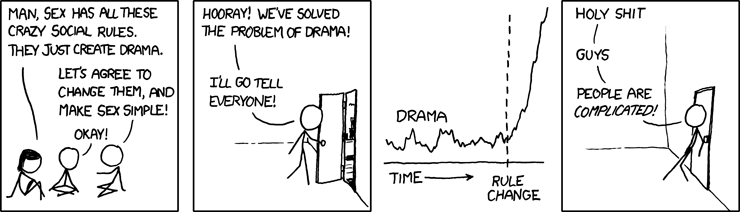
Drama

https://xkcd.com/592/ [comic added later]

In this time and place, the secular world does not place a high value on chastity, which seems to be regarded as some sort of eccentric religious virtue.  So long as one avoids disease, and harassment in the workplace, and uses contraception to avoid “unwanted pregnancy”, the only touchstone is consent.  (Since paedophilia is still taboo, “consent” is interpreted using a legal fiction that says that those below e.g. 18 cannot consent.)  Married types are often faithful to their spouses, but the unmarried do what they like.

It is true that there are some distinctively religious (as well as some distinctively Christian) reasons to be chaste.  But it is silly to think these are the only reasons.  Traditional sexual morality is not founded exclusively on mystical doctrines about God.  It is also based on practical experience, concerning some basic biological and psychological facts about human beings.  Facts which are going to operate regardless of your opinion about any transcendental realities.  That is why most traditional cultures have discouraged fornication, even those which have quite different doctrines about the gods and the meaning of earthly pleasures.  It is not because they listened to their priests, but because they listened to their grandmothers.

I will however have to assume one mystical dogma in this post, namely that there is such a thing as ethics, which commands do not harm your fellow human being, and that this rule is obligatory.  Furthermore, that one’s fellow human beings includes ONESELF, so that the ethical person is first and foremost committed to human flourishing in the one example of humanity which they actually have control over.  Therefore, you cannot excuse a self-destructive behavior by saying “it doesn’t hurt anyone else”, because if you really love what is good, you will want to see it produced in yourself as well as others.  Besides, by destroying yourself you lose your ability to help other people, and cause anyone who loves you to suffer.

By the same token, it is insufficient if the other person consents, because people sometimes consent to things which are harmful to them.  You have to actually decide whether the act of sex would be beneficial or destructive to the other person.

Next comes the biology and psychology.  The first fact is that sexual passions cause an intense pleasure, comparable in intensity to addictive drugs.  There is nothing inherently wrong in this, but it does mean that we are unlikely to be very sober-minded when making choices about it.  Therefore, whatever principles ethics may suggest, they ought to be enforced by clear and explicit social rules in order to avoid ambiguous situations.

The second fact is that we are a species which pair-bonds through sex, conditioned by chemicals such as oxytocin.  Therefore, the usual consequence of sex is to create a strong emotional attachment between the two participants.  It may be possible to avoid this by deliberately shielding oneself with emotional barriers, but this is unreliable.  And what will happen if one person pair-bonds while the other person keeps their reserve?

Worse still, emotional distancing seems likely to lead to a sexuality based not on love but on a sort of contempt for one’s own body, or for other people.  It’s worth noticing in this connection, that lust is not always “love”, even if by “love” we only mean romantic affection.  Like our sense of humor, lust can even relish cruelty, to oneself or others.  There is a reason why certain words for this act have become curse words.

For these reasons, the ethical person will refrain from casual sex, and will only make love in the context of a genuine relationship based on mutual affection and friendship.

Furthermore, these relationships had better be exclusive if they are to be stable.  Jealousy is another of those awkward facts about human nature which must be taken into account.  It’s easy for people (especially immature people who are unaware of their own limitations) to decide that they are sophisticated and mature enough to handle an “open relationship”, but the notorious instability of such relationships proves otherwise.  Besides, although jealousy is a vice in most contexts, I do not think it is wrong is this context.  At least, “free love”—the vision of an idealized (almost communist) human nature in which all can be shared equally among close friends, but no one is entitled to private relationships unsuitable for sharing with others—does not at all appeal to me.

Finally, if these relationships are to result in long-term happiness then there needs to be an explicit understanding that the relationship is intended to be permanent.  The alternative is to pair-bond with someone (or more likely, a series of someones), under conditions in which you can reasonably expect that you will eventually be strangers, or even enemies, to that person.

I did not date in college, but I was friends with several couples who dated and eventually broke up.  When people are emotionally involved, but not emotionally committed, it is a trainwreck waiting to happen.  From an objective outside viewpoint, it seems like the heartbreak outweighs the joy.  Modern dating practices are bad enough in this respect, but adding sexual bonding to the mix makes it much worse.

The other awkward little fact about sex is that it makes babies.  As commonly practiced, contraception is not 100% successful.  Even secular-liberal sexual morality recognizes the problematic nature of an “unwanted pregnancy”.  Any time a man has sex with a fertile woman whom he is unwilling to marry, he risks making her choose between (a) having an abortion, or (b) having a child grow up with an absent father (and possibly a reluctant mother too).

I believe that (a) is immoral.  But rather than get sidetracked about whether there are “secular” reasons for this, I will simply point out that in any case it is a difficult and likely traumatic decision for the woman to make.  Another one of those awkward facts about human biology is that a pregnant woman’s body is full of hormones trying to get her to feel a strong emotional bond to the unborn homo sapiens growing inside of her.

And as for (b), an ethical person should realize that the interests of children in having loving parents is a thousand times more important than their own interest in sexual or romantic thrills.  On the other hand, if in romance you are seeking the deepest interests of the other person, then this interest, like the interest of the child, is best supported by marriage.  A gentleman does not use a lady and then discard her when she becomes inconvenient.  Nor does he abandon his own flesh and blood.

This post is not intended to say anything against love.  Chastity is love: it wills the good of its beloved, by controlling sensual desires, for the sake of the beloved’s completeness and integrity.