Category Archives: Politics

Conciliar Post

Conciliar Post is a group blog whose goal is to publish meaningful dialogue between members of different Christian traditions.

My wife’s friend St. Elizabeth, who is an Orthodox Christian, connected me with the organizers of CP, and I am pleased to announce that a (slightly revised) version of my blog post Seeking Church Unity will be appearing at CP, in two parts:

Seeking Church Unity, Part 1
Seeking Church Unity, Part 2

If all goes well, I will also be writing brand new blog posts for CP in the future.  Likely they will all be posts related to theological topics, with low physics content.

I’ve also added CP to the sidebar.  Enjoy!

Respect for the President

[Historical Note: this blog post was written prior to the U.S. Presidential election of 2016.  However, it highlights an issue which I think has been a problem with American politics for as long as I’ve been paying attention to it.]

“You shall not revile God, nor curse the ruler of your people.” (Exodus 22:28)

Treat everyone with high regard: Love the brotherhood of believers, fear God, honor the king. (1 Peter 2:7)

Let everyone be subject to the governing authorities, for there is no authority except that which God has established…. This is also why you pay taxes, for the authorities are God’s servants, who give their full time to governing.  Give to everyone what you owe them: If you owe taxes, pay taxes; if revenue, then revenue; if respect, then respect; if honor, then honor.  (Romans 13:1, 6-7)

Given the chaos of the election season, I just wanted to write a reminder to my fellow Christians who live in the United States about our civic and Christian duty to respect whichever person ends up being President next year.

I am writing this now, when both candidates have a significant chance of being elected, so that nobody will think I am a hypocrite, who only cares about this issue when somebody I like is in the White House.

(That does not mean I am neutral when it comes to this election.  While I am not a huge fan of either candidate this season, Donald Trump is far more dangerous, irresponsible, and crude than his rival, and I may have some personal difficulty in following my own advice if he is elected.  Although it is conceivable he would keep his promise to appoint justices to the Supreme Court in keeping with my own views, this year the “worst case scenarios” for the Executive Branch seem way worse than for the Judicial Branch.  But that doesn’t change what I am going to say.)

Anyway, the Bible says you are supposed to honor the ruler of your country, because all rulers are appointed by God—not in the sense that God necessarily approves of their rise to power, nor the things they do while in charge—but rather in the sense that it is God’s general will that governments exist and that, under normal circumstances, people should submit to duly constituted authorities.

There are two communities naturally ordained by God, based on the way he created human nature: family and governments.  Similarly, there are two communities that were supernaturally ordained by God: Israel and the Church.  The members of all these communities owe their leaders some degree of obedience and respect, because without that they cannot function as healthy communities.

In every other nation besides ancient Israel, God has left the details of how the government should be structured up to the human beings in that area.  At the time of the Bible, most governments were monarchies of various sorts.  Now we live in a democracy, where we have the privilege of choosing our own rulers.  That is a great blessing, but it does not change the fundamental reality of the situation.  Once we have chosen these rulers, in principle they have the exact same divine authority that would have existed in a monarchy—I mean when they are acting within the scope of their delegated powers; I’m very grateful we don’t live in a society where the president is an absolute dictator!  (The President has no direct authority to command American citizens except where authorized to do so by law.)

Just as it is God’s will that children should obey their parents, and (even after they grow up and are no longer subject to them) give them due honor for providing them with life, sustenance, and upbringing, so too should Christians obey legitimate government authority, and also give due respect to the individuals who exercise that authority, in a way that is appropriate given the democratic customs of our own society.

It does not matter if the individual in question is unworthy of the honor.  As people in the military say: “you salute the uniform, not the man”.  When Sts. Peter and Paul wrote their letters, most likely the man in charge was NERO CAESER, who was not a very nice man.  If you are concerned about infanticide, torture, foreign conquests, denial of religious freedom, undermining separation of powers, or the “Imperial Presidency”, well these things were all much worse in the Roman Empire than they are today, and yet the Apostles still taught that Christians should honor the king!  Jesus himself taught that we should “Render to Caeser what belongs to Caeser, and to God what belongs to God”.

Of course, sometimes other ethical principles must take precedence over that of obeying authority.  If our earthly leaders tell us to sin, then we must “obey God rather than men”.  For example, many early Christians were martyred rather than participating in the cult of Emperor worship.  A more recent American example was the civil disobedience that took place during the Civil Rights Movement.  In some extreme situations, a government may be so tyrannical that armed rebellion against it is morally necessary.  But I take it as obvious that the USA is not currently such a tyranny.

Of course, raw power is not the same as government authority.  To a brigand or conqueror who makes no pretense of ruling in his subjects’ interest, but merely comes to plunder and rape and kill, we owe no respect or obedience whatsoever, quite the contrary!  But once such a person sets up laws and officials in order to promote the common good of society, then to that extent it is a government, and it should be submitted to in ordinary affairs until such time as it can be replaced with something better.

The Bible passages above make it clear that we are required to give respect and not merely grudging obedience to our leaders.  Of course, it is perfectly acceptable to criticize the President’s policy decisions, to sound the alarm at usurpations of power, to whistleblow crimes, to reject immorality etc.  You are not required to agree with him or her, any more than the command to “honor your father and mother” means you must always agree with their decisions.

What is not acceptable is to take a constant tone of bitter disrespect, to express continual contempt, to make mean-spirited jokes (a genuinely funny joke is another matter), to make unwarranted comparisons to Hitler and Stalin, to believe every slanderous rumor you hear about them, to despise half the population for voting for them, etc.

Whenever a party’s own politician is in charge, they can see quite clearly just how deranged the critics on the other side have become, and how it harms our ability to unite as a nation and make important decisions.  I urge you all to remember that the same thing is true when the other party’s choice is in charge.  Politicizing every single issue isn’t actually good for the country.  Each of the last 3 Presidents has been hated by the opposition party to a far greater extent than can possibly be healthy.  And “the other party started it” is not a good excuse.

Just as in other areas of life, people tend to rise and fall towards the expectations other people set for them.  As St. Chesterton once wrote:

“It is a practical course to destroy a thing; but the only other practical course is to idealize it. A respected despot may sometimes be good; but a despi[sed] despot must always be despicable.”

[Brackets are my own speculative attempt to correct what I believe to be a 111 year old typo.]

If whatever the President does is viewed as an unprecedented assault on all the liberties we hold dear, the there is no incentive for them to be better than that, because the other side won’t respect them even if they do follow the law.

We should also remember to pray for them, not just that they would do a good job, but also because the job is spiritually dangerous and they risk losing their own souls in the process.  Few Presidents escape the White House without rubbing off part of their consciences, through supporting actions that they would at one time have been outraged at.

Since the President is the representative of the whole nation, whoever curses the President also curses the nation, and therefore curses himself.  So instead be a blessing.  The same principles apply in politics as anywhere else:

Do not repay anyone evil for evil.  Be careful to do what is right in the eyes of everyone. If it is possible, as far as it depends on you, live at peace with everyone.  Do not take revenge, my dear friends, but leave room for God’s wrath, for it is written: “It is mine to avenge; I will repay,” says the Lord. On the contrary:

“If your enemy is hungry, feed him;
if he is thirsty, give him something to drink.
In doing this, you will heap burning coals on his head.”

Do not be overcome by evil, but overcome evil with good. (Romans 12:17-21)

Some last thoughts about voting:

1) Mathematically, your vote can make a significant difference on average (at least if an election is close).

2) There are other elections on Nov 8 besides the Presidential election, and they are also important!  Please research the candidates and cast an informed vote.

3) But, if you’ve walked into the voting booth just to vote for President, and you have no idea who or what the other things on the ballot are, then I recommend you leave these other ballot questions blank so that the voters who have researched those issues can decide them.  Please don’t cast an uninformed vote; that just adds noise to the system.

Why the Senate should confirm Garland

I didn’t want to say anything in my tribute to Justice Scalia about the politics of filling the vacancy he left behind.  However, for what it is worth, I believe that the Senate should hold hearings and confirm Judge Merrick Garland to the Supreme Court.

Mind you, the Senate has NO constitutional obligation to consider any presidential nominee.  The Constitution says only that “The President shall nominate, and, by and with the advice and consent of the Senate, shall appoint…” judges.

The phrase “advise and consent” cannot possibly be regarded as mandatory, since that would imply that the Senate must consent, which is absurd since nobody questions their power to reject a candidate by voting them down.  Journalists and politicians who claim that the Constitution requires the Senate to “advise and consent” are abusing the meaning of these words.  The word “consent” cannot possibly mean “decide whether to consent”.  And if the “consent” part is optional for the Senate, then the “advise” part must also optional for the Senate.  Nor can “advise” mean “hold hearings”, since the Senate didn’t regularly hold hearings on Supreme Court nominees until recently.  The phrase means only that IF the Senate provides its advice and consent, THEN the President may go ahead and appoint the nominee.

At best, the word “shall” imposes a duty on the President to nominate candidates.  However, the Supreme Court has rejected this interpretation, saying that filling vacancies is also optional for the President (Marbury vs. Madison)!

Nevertheless, just because there is no constitutional obligation to confirm the nominee, doesn’t mean the Senate is justified in its obstruction.  There are other norms and conventions in politics besides constitutional norms.  Without them, the system could not function.

For the past century or so, until very recently, there has been an expectation that the Senate will confirm any reasonable and moderate Supreme Court nominee proposed by the President.  Voting down, and even filibusters, have been discussed only in cases where (it has been claimed that) the candidate is unqualified, extreme or unacceptable in some other specific way.  And nobody has suggested that Garland is particularly extreme.  This is not to say he is a conservative, but he does seem to believe in some sort of policy of judicial restraint, which is as good as Republicans can expect from a Democratic president.

At the “object level” (as opposed to the “meta level” of the politics of filling vacancies) I would very much prefer for Scalia to be replaced by someone with a similar judicial philosophy.  However, the short term gain that comes from subverting the process for one nominee, will simply make it harder for Republicans to confirm nominees in the future.  No one gains from increasingly bitter “no holds barred” confirmation fights.  It’s a game of interated Prisoner’s dilemma, and both sides keep defecting!

Although pre-emptively announcing that one will not fill a vacancy is unprecedented obstruction in the modern era, one-up-manship in confirmation fights isn’t at all unprecedented.  It is rather nauseating the way both parties routinely and hypocritically switch sides about whether obstructing nominees is good or evil, every time the Presidency changes sides.  (At least the current hijinks aren’t blatantly against the Senate’s written rules, the way the nuclear option was!)

In the long run, it’s best to allow the President to fill any vacancies which arise during his term with reasonable candidates.  The alternative equilibrium, in which a party division between the Senate and Presidency leads to no appointment, will just make life harder for everyone in the long run.  The Republicans can’t seriously believe that the Democrats won’t retaliate once they retake control of the Senate.

Also, this seems like very bad timing for Senate Republicans to take this particular stand, seeing as the two people most likely to be President next care even less about the Constitution than the current one.  St. Hillary Clinton seems to believe that Congressional acts can and should change the meaning of the Constitution.  And I don’t think Donald Trump (who would discriminate against Muslims, and already has abused the power of eminent domain) has any more genuine concern for the Constitution than he does for the teaching of Jesus!  (Maybe Republican pressure would keep him on the straight and narrow when it comes to appointments, but then again maybe not.)  Most likely it will be Clinton, in which case the Republicans will have eroded faith in the process without actually getting anything to show for it.

(Unless their previous posturing has caused St. Obama to nominate somebody more moderate than he otherwise would have, which actually seems fairly likely now that I think of it.  But this is only relevant if the Senate actually confirms Garland!)

Waiting to confirm based on who the next President is, also seems like a unwholesome habit for the Senate to acquire.  An 8 member court is not the end of the world, but 4-4 tie votes are a bit annoying.  Also, since the next Supreme Court term begins in October, delaying the confirmation until after the elections in November is awkward, since then Garland (if confirmed) would have to rehear any important cases.

So I think that the Senate should confirm Garland, who seems to be an all around decent person unlikely to try to shift court precedent extraordinarily far to the left.  At least, no more than one would expect from Scalia being replaced by a moderate.  (In fact I am a little concerned he believes in judicial restraint so much that he won’t protect civil liberties quite as much as the current liberals do.)  But it is hard to determine his true opinions based on his current record as an appellate judge, bound to follow Supreme Court precedent.  In the event that he is appointed, we shall just have to see.

St. Antonin Scalia

As Charles de Gaulle is reputed to have remarked when his aides told him he could not resign as president of France because he was the indispensable man:
“Mon ami, the cemeteries are full of indispensable men.”
Justice St. Antonin Scalia, “God’s Justice and Ours”.

I was deeply saddened this weekend to hear of the death of Justice Scalia, the most engaging, provocative, and brilliant of all of the justices on the Supreme Court.  As someone who reads Supreme Court decisions for fun, I will definitely miss his wit and humor and crankiness, and the way he made the job fun.  However, I also feel quite strongly that his loss is a significant blow to the Court and to my country.

There are countries in which the fundamental principle is rule by some human being or set of human beings.  The United States is not such a country; we are a constitutional republic.  In our country the fundamental legal principle is a document, the Constitution, which outlines the divisions of power between different branches of government, limits the powers of government, and provides for certain fundamental rights which cannot be abridged.

Of course no document interprets itself, and therefore there is a need for human beings to read the Constitution and decide what it means.  Sometimes the meaning is clear; other times there is an ambiguity which must be settled somehow or another.

It would be lovely if Congress and the Executive Branch could be trusted to police the boundaries of their own limited powers.  In principle, there is no inherent logical reason why this could not work.  In practice, politicians are too venal to be trusted with this; the general tendency is for people to interpret things in their own favor, expanding their role in the system until there are no restrictions at all.  There were only 9 years between the time that Congress proposed the First Amendment (1789) and the time when Congress passed the manifestly unconstitutional Alien and Sedition Acts (1798).  Hence the importance of judicial review from an outside body designed to be as neutral as possible.  In our system, that role is played by the Supreme Court.

When settling a dispute between two parties requires resolving an ambiguity in a statute or the Constitution, the Court is supposed to resolve the ambiguity with the most reasonable interpretation that is consistent with previous judicial precedents.  These decisions are binding on lower courts.  (On rare occasions the Supreme Court may reverse their previous decisions, if they are clearly wrong or prove to be unworkable.)  In cases where a statute is inconsistent with the Constitution, the Court has not only the power but also the obligation to strike down or modify the statute to make it conform to the higher law.

There is obviously a danger here, that the judges might substitute their own political will instead of trying to find the most reasonable interpretation.  This is a form of corruption, because they are there as judges, not politicians.  If we had wanted a tribunal with the power to strike down Congressional acts for political reasons (and sometimes to invent new pseudo-legislation), it is unclear why a democracy would want nine unelected Ivy League lawyers with lifetime tenure get to decide for the whole country, based on the arguments of two other lawyers hired by the two parties who lobby for their preferred position—our own American version of the “House of Lords”!  The only possible legitimacy the Court has, comes from the idea that generally speaking (aside from the inevitable but regrettable exceptions), the Court is engaged in acts of interpretation, not naked partisan will.

I am prepared to be quite generous here.  I do not require that all constitutional rules be explicitly spelled out, so long as there is some fair and reasonable argument that they are implied by structure or context.  But there are limits to this.  Many judicial decisions exist which can hardly be called textual interpretation by the most generous stretch of the imagination.

The danger of misinterpretation becomes greater when one remembers that our legal system is based on precedent.  A single wrong precedent can become a launching pad for even greater departures, and when you stack them together the final result can be the complete and total erosion of some provision or right spelled out in the Constitution, or  the generation of some completely new provision or right almost out of whole cloth.  Like a rough stone becoming smooth after lying under a riverbed, it is easy for a system of laws to lose its distinctive features over a couple centuries.

For the past few decades the most dominant school of legal interpretation in the legal academy has been that this is not a bug but a feature.  (I have even found this view endorsed by textbooks written for Middle School students.)  The idea is that there is a “living constitution” which grows and adapts to the needs and ideals of each new generation.

To which I would reply: one may as well not have a Constitution at all, as to have one which is flexible enough to adapt itself to each new generation at the mere whim of judges.  If the duly elected representatives of the people pass a piece of legislation, then clearly the mores of the current generation are consistent with that law existing.  If, nonetheless, a bunch of unelected politicians decide to strike it down because it is incompatible with the current social mores of legal scholars, well that is merely a minority of the people exercising will-to-power over the majority.  Unless, of course, the legal scholars were actually using their legal expertise to interpret the text of the Constitution, which is of course the reason why we select them for the role in the first place.  I don’t care whether you call it Originalism or Textualism or something else.  There are multiple reasonable ideas about how to do interpretation but Living Constitutionalism is not one of them.

In fact, it is only what these scholars might call a “dead constitution” which could actually exert a meaningful influence on the body politic.  It is the Constitution with definite meaning that should be called “alive”, while the one whose flavor conforms to its surroundings like tofu is “dead”.  As St. Chesterton said in another context:

A dead thing can go with the stream, but only a living thing can go against it.  A dead dog can be lifted on the leaping water with all the swiftness of a leaping hound; but only a live dog can swim backwards.

The rule of law is, simply speaking, the idea that there are certain written ideals which the government is permanently responsible to.  The idea of a “living constitution” is pernicious because it subverts our ability to have such permanent ideals.  A living constitution is an erasable Constitution.  If you value your rights to criticize the government or to have a fair trial, then this can continue to exist only if the government believes in the ideal of upholding the Constitution even when it is inconvenient .

You may ask, why should a few people who lived in 1787 or 1866 (when the 14th Amendment radically changed the balance of power between the federal government and the states) have more power than the rest of us to decide what should be the fundamental rules of society?  Haven’t we developed morally since then?  The people in 1787 even allowed slavery!  (Although admittedly this has since been fixed.)  Well I should hope we have improved, but this objection is not to the point.  The Constitution is not perfect, but it is the one we have.  Therefore, until the next political revolution, it defines what is legal and illegal.  Furthermore it contains a number of very important principles about due process and so on, which I would rather not have forgotten.

And if there is a powerfully strong consensus that the Constitution should be changed, it contains procedures allowing the people to do so.  But it needs to be a stable bipartisan consensus, not the blowing of fickle political winds.

Nothing prevents Congress and the Presidency from acting based on the most up-to-date and progressive understanding of morality.  These are progressive, forward-looking institutions.  But the Supreme Court is backwards-looking: to make sure we are obeying the ground rules for American politics as traditionally defined by text and precedent.  Brown v. Board revolutionized American society, not by inventing a new racial ideal, but by holding the people to the ideal of racial equality which had already been incorporated into the Constitution a hundred years before.

Lawlessness has a general tendency to breed more lawlessness.  A given activist court may vote to increase your rights in some particular area, but if those rights are not based on sound legal construction, then at the same time it erodes the rule of law, which is a necessary to protect the existence of legal rights in the first place.  It’s a shortsighted trade.  As St. Thomas More says in the brilliant play “A Man for All Seasons”:

William Roper: So, now you give the Devil the benefit of law!

Sir Thomas More: Yes! What would you do? Cut a great road through the law to get after the Devil?

William Roper: Yes, I’d cut down every law in England to do that!

Sir Thomas More: Oh? And when the last law was down, and the Devil turned ’round on you, where would you hide, Roper, the laws all being flat? This country is planted thick with laws, from coast to coast, Man’s laws, not God’s! And if you cut them down, and you’re just the man to do it, do you really think you could stand upright in the winds that would blow then? Yes, I’d give the Devil benefit of law, for my own safety’s sake!

Let me give some specific examples of legal BS.  There are many historical examples such as Dred ScotPlessy, Cruikshank, Korematsu and Lochner, which have since been repudiated.

The most infamous currently valid precedent is of course Roe v. Wade, which reads more like a rambling college essay than anything resembling legal analysis.  Leaving aside your moral views on abortion (mine is that it is deeply evil, but that has nothing whatsoever to do with my current point), no reasonable person reading the actual text of the Constitution would ever guess that this is a protected constitutional right, implicit in “nor shall any State deprive any person of life, liberty, or property, without due process of law”.  Even many liberal scholars agree that Roe is indefensible from a legal standpoint.  Wikipedia’s article on Roe has a nice collection of quotes:

In a highly cited 1973 article in the Yale Law Journal,[81] Professor John Hart Ely criticized Roe as a decision that “is not constitutional law and gives almost no sense of an obligation to try to be.”[82] Ely added: “What is frightening about Roe is that this super-protected right is not inferable from the language of the Constitution, the framers’ thinking respecting the specific problem in issue, any general value derivable from the provisions they included, or the nation’s governmental structure.” Professor Laurence Tribe had similar thoughts: “One of the most curious things about Roe is that, behind its own verbal smokescreen, the substantive judgment on which it rests is nowhere to be found.”[83] Liberal law professors Alan Dershowitz,[84]Cass Sunstein,[85] and Kermit Roosevelt[86] have also expressed disappointment with Roe.

Jeffrey Rosen[87] and Michael Kinsley[88] echo Ginsburg, arguing that a legislative movement would have been the correct way to build a more durable consensus in support of abortion rights. William Saletan wrote, “Blackmun’s [Supreme Court] papers vindicate every indictment of Roe: invention, overreach, arbitrariness, textual indifference.”[89] Benjamin Wittes has written that Roe “disenfranchised millions of conservatives on an issue about which they care deeply.”[90] And Edward Lazarus, a former Blackmun clerk who “loved Roe’s author like a grandfather,” wrote: “As a matter of constitutional interpretation and judicial method, Roe borders on the indefensible…. Justice Blackmun’s opinion provides essentially no reasoning in support of its holding. And in the almost 30 years since Roe’s announcement, no one has produced a convincing defense of Roe on its own terms.”[91]

If you support legal abortion as a policy matter, imagine how you would feel if the Supreme Court had decided that the state allowing abortions was a violation of the 14th Amendment right to “life” and “equal protection of the laws”.  This is not about who is right as a policy matter, this is about not resorting to BS interpretations to short-circuit the political process.

Or consider the Congressional power to “regulate commerce….among the several states” has now become so broad that it includes the power to regulate literally almost anything.  One time, Congress passed a law that forbade anyone to bring a gun within 1,000 feet of a school.  The point has nothing to do with whether you like guns or hate them, the question is whether this was within the powers of Congress (as opposed to the relevant State Legislature).  Their justification was that guns cause violence, violence causes students to feel scared and disrupts education, which leads to a worse-trained workforce, negatively impacting interstate commerce.  Clearly, if that counts as interstate commerce, then everything counts as interstate commerce, and there are actually no limits on Congress’ legislative powers, aside from the handful of explicit prohibitions in the Bill of Rights and other places.  The other sections of the Constitution need not have been written.

In United States v. Lopez, the majority (including Justice Scalia) ruled that this was a bridge too far.  This was the first time since FDR stacked the Court that they had ever struck down a law for this reason.  Yet it was only a 5-4 decision.  4 Justices were willing to buy the absurd argument, in order to obtain their preferred policy result.  The decision was considered a legal revolution for drawing any lines at all, even though in practice it led to very few consequences or future decisions placing limits on what Congress can do.  Congress simply re-passed the law to apply to any firearm “that has moved in or that otherwise affects interstate or foreign commerce”, and the courts looked the other way.

It is very strange that the Framers would have enumerated 18 different powers of Congress in Article I section 8, if one of them turns out to give them the power to do anything at all.  The original idea proposed by the Federalists, was that these 18 powers would be so limited that there would be no need for a Bill of Rights.  The rights would simply be everything not covered by one of the limited powers.  (Of course, this would still leave you in the soup if a State tried to violate one of your rights, but I guess the idea was that the States would have constitutions of their own.)  We can see how that idea worked out.  So I’m glad the Anti-Federalists gave us the Bill of Rights.  (Nowadays the 14th Amendment has been interpreted—correctly in my opinion, although to be honest I wouldn’t want it overrule this now even if it had been bullshit—to mean that the States to also obey most of the provisions the Bill of Rights.)

For some more recent examples, consider Kelo v. City of New London, which ruled by a 5-4 decision that the government to use its power of eminent domain, which is supposed to be for “public use” only, to repossess “economically blighted” property in order to turn it over to private developers.  In other words, the government is allowed to give property from one private owner to another, but only when it steals from the poor and gives to the rich.   Amazingly the five more “liberal” justices were in favor of this approach, while the conservatives (including of course Justice Scalia) were against it.

Or United States v. Comstock, which ruled that the “necessary and proper” clause allows the federal government to keep people in prison indefinitely, after they have completed their prison sentence.  Under a federal law which incidentally applies retroactively to people who were jailed beforehand.  There are few laws which are more obviously unconstitutional than this—it is a more interesting game to try to count the number of different constitutional norms which it violates—and yet it was a 7-2 decision, with only Sts. Scalia and Thomas dissenting!  Oh, I forgot to mention that the law in question only applies to child molesters.  So far.  Remember that line about knocking down all the laws in order to get the Devil?

(To be fair, the justices were considering only whether this law was within the Article I powers of Congress, completely separating out the question of whether it violated the Bill of Rights, trial by jury, or the ex post facto clause.  But in this case, separating the two analyses is completely absurd.  How can an extension of Congressional power possibly be considered “proper” if every imaginable application of that power would violate other provisions of the Constitution?)

I admit I have aesthetic objections to this kind of bullshit as well as moral objections.  I remember being in the 5th grade, reading through the Constitution after finishing the in-class assignments.  I would like to believe that the words I read then have some relevance to what actually happens.  There is a limit to my populism: if some word had a different meaning in 1787 than it does today, or if I was unaware of its traditional legal context, then I don’t insist that the courts defer to any accidental misconceptions I may have had.  But I would like to think that a citizen who reads the Constitution even today, would have a pretty decent idea of what it means, and would only need to consult a lawyer for the hard cases.

I really don’t want to paint too bleak of a picture here.  I am deliberately focussing on the bad examples here.  There are many examples of Supreme Court decisions which were correctly decided, and there are many constitutional rights (including the all-important First Amendment) which are alive and well.  Taken as a whole, the country is far better off with judicial review, than it would have been without it.  That is exactly my point—the rule of law is a good thing, more important than the outcome of the individual cases, and we need to protect it.

Believe it or not, it is actually possible to be too cynical about politics.  In fact, excessive cynicism is actually the cause of our current political dysfunction; if everyone assumes the worst about a class of individuals, then they have no incentive to be better than that.  (Even Members of Congress have to have mostly started out with some real ideals buried under all their dissembling and compromises, or they wouldn’t have entered politics in the first place.  I can’t believe they did it for the pay or the job security!)

Lots of people would say that all judicial decisions are just politics, and any pretense of jurists to be principled and neutral are just hypocrisy.  But this is patently untrue.  Even if all of life were just “shades of grey”, you can still usually tell which greys are whiter and which are blacker, when you hold them up right next to each other in the same light.  And right now—historically it has sometimes been the other way around—it is the “conservatives” on the Court who are clearly much more principled in their reading of the texts, and the “liberals” who are just trying to get their preferred policy outcomes.

(Here I am speaking only about the judicial philosophies labeled “conservative” and “liberal”, and not about the merits of the Republican and Democratic political platforms in general.  It would be perfectly possible for someone with Democratic policy beliefs to be a judicial “conservative”, it just tends not to happen in the current political environment.)

There are many examples where conservative judges say things like “I would prefer a different result if I were a legislator, but I think this is the law”.  Liberal justices are much less likely to say things like that, and much more likely to appeal to vague or nebulous standards in order to get outcomes they obviously prefer personally.  In other words they are cheating.

I say this as somebody who has read most of the Supreme Court decisions written in the last decade, and several of the more notable ones before that.  Nor am I a knee-jerk conservative; when the court splits 5-4 I agree with the liberals about a quarter of the time.  For example, I strongly support habeas corpus rights even for suspected terrorists.  There are some constitutional principles I like, which might get less protection if the Court got more Republican appointees.

I do not doubt that there have been several times when conservative judges have, hypocritically, ruled in accordance with their conservative political principles (which they have no right to do) instead of in accordance with their claimed principle of interpreting the text fairly.  But it is better to sometimes fall short of a claimed standard of goodness, than not to have any standard at all.  “Living constitutionalism” is just a name for anything goes, it is not actually a coherent standard that one can fall short of.

I am not one of those partisan hacks who believes that somehow one of the two parties has an monopoly on dirty tricks and shoddy reasoning.  But I do believe that it makes a difference what our stated ideals are, and that a nebulous gas of constititual flexibility cannot act as a solid foundation for freedom, but principled reasoning from a black-and-white text can.

Now in the last 30 years, nobody has done a better job of promoting the rule of law than Justice Scalia, who has continually fought against all manner of sophistry, and given it the mocking it so richly deserves.  More than anything else his opinions, often his dissents, have made Originalism a viable interpretation in the academy.  He was not a “rebel without cause”; his cynicism was that of a wounded idealist, who stood for something quite definite.  His goal was not to revert decades of precedent back to some imaginary time when the Constitution was followed perfectly (although there are a few specific howlers he would have liked to kill).  Instead his goal was to contain the unprincipled exceptions, and to leave the law clearer than he found it.

Scalia was also a tremendously insightful person.  Hard as it is to imagine, given the current political environment, he was confirmed 98-0 by the Senate back in 1986.  Even jurists with radically different takes on the law recognized that he had some valid and interesting points to make about the law.  For example, his warnings on the dangers of relying too much on legislative history to decide what laws mean (if you do that, Congress will notice, and people will try to influence future legal decisions by means of their speeches before the house, subverting majority rule.)

True, his acid tongue made him some enemies.  In light of his professed Roman Catholic faith, some might wonder whether his bitter (and sometimes unfair) sarcasm was really compatible with a meek Christian spirit.  On the other hand, if we define Christianity by the behavior of Jesus in the Gospels, one could argue that it is actually very Christlike to react with hyperbolic outrage when you see people trying to legalistically distort the rules, in a way that subverts their actual meaning!

Yet Justice Scalia would be the first to admit that there is a distinction between the Kingdom of God and the kingdoms of this world.  In comparison with his faith, his life’s work to to help improve the American system of law was of minor importance.  It would be wrong to reduce him as a person to his role as a judge.  His famous friendship with Justice Ginsburg (see elephant below) shows him to have been broad enough to like those who disagreed with his judicial philosophy.

Goodbye, St. Antonin Scalia, and God rest your soul.  I will miss you.

Seeking Church Unity

In the comments section of this post, I’ve been having a debate with a Roman Catholic about this whole Protestantism thing, so perhaps now is a good time to write a post about the unity of the Church.

I. My Own Testimony

I suppose I may as well start by discussing my personal history.  I grew up in the Church of the Nazarene (a Wesleyan denomination) but at various stages of my life I have regularly attended services with the Free Methodists (7 years), Baptists (3 years) and Lutherans (1 year), not counting smaller visits.  I also like stepping into Anglican services, and even Catholic Masses (though out of respect for their rules I do not take communion with the Catholics).

While it’s true I’m the sort of Protestant who reads the Catholic Encyclopedia for fun, my adventures in ecumenism (interactions between different branches of Christianity) really started in earnest at St. John’s College.  During my last semester there I attended Holy Trinity, a wonderful Antiochian Orthodox congregation in Santa Fe.  When I had first been invited to visit the church my freshman year, it seemed like a bizarre eastern cult that just happened to also be about Jesus, but over time I came to realize the commonalities and differences more clearly.  It had a profound effect on my spiritual and musical sensibilities.  Also, the priest (St. John Bethancourt) is the most visibly holy person I have ever met on this earth.  He cannot enter a room without caring about whatever person he meets within. I am eternally grateful for the treasures obtained during this time, yet after careful consideration of the differences in theology, I remain a Protestant.

As a graduate student I attended Layhill Community Church, where during the time for prayer any person could go up to the altar railing to pray with St. Wil, the associate pastor.  He was a man of great faith and I noticed that eerie coincidences would sometimes occur after I prayed with him for things.  (This is the kind of thing skeptics attribute to confirmation bias, but Christians attribute to Divine Providence.)

For instance, one Sunday I asked to be able to worship God better, and the following Tuesday, while opening a bottle of olive oil to cook with, I suddenly remembered all the passages in Scripture about anointing with oil and the Holy Spirit, and was full of joy and praise.  Only afterwards did I remember what I had asked for.   (Despite the potent significance of olive oil as an ingredient in several of the Catholic sacraments, the next example will be even more relevant for church unity.)

Another time I was praying at the altar with St. Wil for the unity of the church, and in the following week (or two at the most) my housemate St. Ray invited me to attend a new bible study for grad students at the Catholic Student Center just off the U Maryland campus!  So of course I went, and actually attended for 4 years which was longer than he did.  Each year the study was led by a different monk from the Dominican House of Studies in Washington DC (except one year we got a seminarian instead).

After Ray invited me, he suddenly got worried it would be disruptive if I started arguing with everyone about Protestantism, so I agreed to keep it cool.  The first meeting I was silent about that, but vocal about everything else.  The second meeting I confessed; they were rather surprised because they had thought I had been speaking in a particularly Catholic way about the allegorical meaning of Adam and Eve during the first meeting.  I was even invited (along with the others) to sometimes lead class discussions, which I tried to do with a minimum of controversy, focusing on commonalities except when absolutely necessary.

I got to see a lot of their struggles with various aspects of Catholicism, and sometimes tried to formulate ways of looking at the problems which combines the strengths of both types of theology, e.g. “Sacraments are not a way that we manipulate God, they are a way that God manipulates us!”  They were aware that I disagreed about certain important things, but even though we weren’t in communion, there was still community and communication!  It was excellent practice for charitable discussion, and I am deeply grateful that they were Catholic enough (the word Catholic means “universal”, after all) to include me.

As I said, I tried to avoid excessive controversy in the group, but after hours I had some vibrant discussions with the Dominican brothers about Catholicism, and when I visited the House of Studies I got to have a friendly intellectual brawl, of the sort that causes so much consternation among people who don’t like arguments, since they associate them with hostility.  They gave me books by St. Cardinal Newman, whose epistemology (“theory of knowledge”) I find a bit whacko, for the reasons mentioned in that recent comments section, the one in which I flagrantly violated Socrates’ rule for good conversations.  To keep things shorter, St. Bayes or bust!

II. An Index of Communion

As is well known, Jesus prayed for the unity of the Church, on the night of his betrayal:

My prayer is not for them alone. I pray also for those who will believe in me through their message,  that all of them may be one, Father, just as you are in me and I am in you.  May they also be in us so that the world may believe that you have sent me.  I have given them the glory that you gave me, that they may be one as we are one—I in them and you in me—so that they may be brought to complete unity.  Then the world will know that you sent me and have loved them even as you have loved me.  (John 17:20-23)

for the unity of our love is one of the signs by which the world can see that our faith is real, thus fulfilling his command to us:

A new command I give you: Love one another.  As I have loved you, so you must love one another.  By this everyone will know that you are my disciples, if you love one another.” (John 13:34-35)

But unity is not easy.  Although in a sense we Christians are already one due to being part of the body of Christ and “members of each other” (Romans 12:5), and in this way we are part of the One Holy Universal and Apostolic Church and the communion of the saints, practically speaking the expression of that unity may be impaired.  Just as quarreling siblings may be one family genetically but not be united in affection, or quarrelling spouses may be one in flesh but divided in spirit.

So the expression of unity is something that requires us to all work together to exercise maturity of character, using the gifts which God has provided us.  As St. Paul says:

But to each one of us grace has been given as Christ apportioned it. This is why it says:

“When he ascended on high,
he took many captives
and gave gifts to his people.” (Psalm 68:18)

(What does “he ascended” mean except that he also descended to the lower, earthly regions?   He who descended is the very one who ascended higher than all the heavens, in order to fill the whole universe.) So Christ himself gave the apostles, the prophets, the evangelists, the pastors and teachers, to equip his people for works of service, so that the body of Christ may be built up until we all reach unity in the faith and in the knowledge of the Son of God and become mature, attaining to the whole measure of the fullness of Christ.

 Then we will no longer be infants, tossed back and forth by the waves, and blown here and there by every wind of teaching and by the cunning and craftiness of people in their deceitful scheming.  Instead, speaking the truth in love, we will grow to become in every respect the mature body of him who is the head, that is, Christ.   From him the whole body, joined and held together by every supporting ligament, grows and builds itself up in love, as each part does its work.  (Eph. 4:1-16)

So, how are we doing on this front?

Well, the bad news is that the Church has splintered into numerous different denominations, not all of which regard each other as being really Christian.  And a few of them aren’t really Christian, though most accept the basic truths of the faith as expressed in e.g. the Nicene Creed.  But as St. Lewis pointed out a while back, the commonalities are far more profound than the differences.

Let’s try to be honest about how bad this problem really is.  The most common figure one hears (from atheists complaining about the fractiousness of Christians, Catholics complaining about the fractiousness of Protestants, or Protestants complaining about the fractiousness of everyone), is to simply count the number of denominations, getting some huge figure in the tens of thousands, but this is an absolutely terrible way to assess the state of Church unity!

First of all, a lot of these organizational splits were for historical reasons (based on how different groups got evangelized, or because of doctrinal differences or attitude towards slavery or something like that which is no longer a live issue) or were for administrative convenience (e.g. to deal with being in different countries, or because the churches have somewhat different organizational structures which would be difficult to combine), and are perfectly compatible with both groups thinking the other is really Christian and cooperating for the sake of God’s kingdom.

It would be better to ask “What is the probability that two randomly selected devout Christians are in communion with each other?”  This gives a numerical measure, a “communion index”, describing the degree of church unity.  The answer turns out to be about 1/3 (see below).  Could be better, could be a lot worse.

Merely having administratively independent units is not the same thing as being divided in love, or in communion.  Even the Catholics have 24 nearly-independent administrative units (which appoint their own leaders and have their own customs and rules, but remain in communion with the Pope and accept his doctrinal decrees), while the Eastern Orthodox have about 15 “autocephalous” (self-governing) churches.  These two churches were in communion with each other until about 1054 when both sides started excommunicating each other over an arcane theological dispute.  These excommunications were lifted in 1965, but the churches are still not in communion for other reasons.

There are also 6 independent Oriental Orthodox churches, a group of churches including e.g. the Copts who did not accept the decision of the Council of Chalcedon.  Although I personally think Chalcedon provided the best language for understanding the Incarnation, in retrospect the “Monophysite” or “Miaphysite” group was probably just using different words to refer to the same thing, and were not really heretics in the same way that the Gnostics or Arians were.  Thus it was wrong to excommunicate them; and this is not only my own opinion but also the opinion of the leaders on both sides:

Hence we wish to reaffirm solemnly our profession of common faith in the Incarnation of our Lord Jesus Christ, as Pope Paul VI and Patriarch Moran Mor Ignatius Jacoub III did in 1971: They denied that there was any difference in the faith they confessed in the mystery of the Word of God made flesh and become truly man. In our turn we confess that He became incarnate for us, taking to himself a real body with a rational soul. He shared our humanity in all things except sin. We confess that our Lord and our God, our Saviour and the King of all, Jesus Christ, is perfect God as to His divinity and perfect man as to His humanity. In Him His divinity is united to His humanity. This Union is real, perfect, without blending or mingling, without confusion, without alteration, without division, without the least separation. He who is God eternal and indivisible, became visible in the flesh and took the form of servant. In him are united, in a real, perfect indivisible and inseparable way, divinity and humanity, and in him all their properties are present and active.

The subtext here is the thing which only really mature people are capable of saying, namely: “Oops, I’m sorry, we were wrong.” (However, since this original schism, the Catholic church has developed their theology further, so the churches are unfortunately still not in communion.)

Protestants have a lot more sects, but then again most Protestants regard most other Protestant groups as being really Christians, and therefore part of the Universal Church founded by Jesus.  Nowadays the biggest disputes tend to be about the axis that runs from liberal/modernist to fundamentalist/literalist, rather than denominational loyalties.  (I’m somewhere in the middle, since I think miracles have really happened and the Scriptures’ teachings on e.g. sexual ethics and so on need to be taken seriously, but I also accept the findings of biology and physics and don’t think rigid definitions of inerrancy are the right way to talk about the authority of the Scriptures.)

With a few exceptions, most Protestant denominations allow all those who confess Jesus as their Savior and Lord to take communion in their church.  So does the Assyrian Church of the East, an ancient apostolic church which was at one time known as the Nestorian church because the heretic Nestorius was received there, but it is now generally regarded as unfair to tarnish the whole group by his opinions.  (The Assyrian church is much smaller than the others, although historically it was very important and and even spread to China).

So for purposes of calculating the odds that two Christians will be in communion, Nicene Christianity is really divided into 4 large subgroups: 1) Catholics, 2) most Protestants, 3) Eastern Orthodox, and 4) Oriental (listed in decreasing order by number of adherents) plus some smaller groups.  Because the groups are not all the same size, the coefficient is closer to 1/3 than 1/4.

III. Three Kinds of Unity

Is the reconciliation of the major branches of Christianity even possible?  And what can we do to make a difference?

Catholics care the most about unity, and are willing to do the most in terms of practical accommodations.  Also, although they are a big institution which changes very slowly, they do change, and they know how to fall in line behind the decisions of the Pope.  The difficulty is that they think that their past official pronouncements are infallible, and that it is necessary to believe every one of them to be in communion with them.  So in doctrinal terms, it is impossible for them to ever compromise.  That sounds a lot like a deal breaker to me.  Of course, if the Catholics are right about everything, then the hundreds of Protestant denominations would just need to all recognize this fact simultaneously.  Right, that sounds plausible.

The Eastern Orthodox church is a lot closer in its theology to the Catholics, and it would be more feasible for them to hash out a compromise.  And I will wildly celebrate any such union should it occur.  But there’s also a lot of bad blood between them as a result of various historical incidents (such as the Sack of Constantinople in 1204, which apparently some of the Orthodox remember as if it were yesterday).  Plus the Catholics made political attempts to take over various of the Eastern patriarchies, which succeeded in creating a bunch of Eastern Rite Catholics, but alienated them further.  Twice the two churches got a bunch of leaders together and announced they were reconciled, but both times the Eastern Orthodox back home refused to accept the decision.

So there’s been so much entrenchment of the various sides, with enough bad history between Catholics/Protestants and Catholics/Orthodox etc. that the groups reuniting with each other seems to be quite impossible.

And it is impossible.  Impossible for human beings, that is.  Not impossible for God:

 Jesus looked at them and said, “With man this is impossible, but not with God; all things are possible with God.” (Mark 10:27)

“‘If you can?” said Jesus. “Everything is possible for one who believes.”  (Mark 9:23)

There’s always the option of fasting and praying, and genuinely asking God to shine light into our hearts.  Surely God is willing to act when the time is right:

If my people, who are called by my name, will humble themselves and pray and seek my face and turn from their wicked ways, then I will hear from heaven, and I will forgive their sin and will heal their land.  (2 Chronicles 7:14)

So the first step is to realize that it is something that God will do, not something we can do.  All of the parties to this dispute believe that there is a God in heaven who can act, so why do we so frequently act as though a negative outcome were inevitable?

The second thing is to recognize how far we’ve come already.  For a couple centuries, Protestants and Catholics were killing each other in order to try to come out ahead politically.  Until everyone got sick of that and decided to have an Enlightenment with secular republics instead.  The killings don’t happen anymore, leaving aside Northern Ireland anyway.

Even after that, until quite recently (perhaps a century ago), many Catholics and Protestants seem to have believed that more or less everyone on the other side was going straight to Hell when they died.  This era too has passed.

And it wasn’t my generation’s doing, either.  It was the hard work of a few individuals in previous generations, who insisted on talking to each other and opening up honest communication, even when it seemed impossible.  Vatican II was a pretty big deal too, what with Catholics rethinking their attitude towards Protestants and accepting some Protestant ideas in the process (e.g. Mass in the language of the people).  Meanwhile, even if there are still some fundamentalists out there who think ecumenical dialogue is of the devil, for the most part Protestants also became more open to the idea that some Catholics have actual spirituality and relationships with Jesus, and that we can be allies in some ways.

 “Thus the saying ‘One sows and another reaps’ is true.  I sent you to reap what you have not worked for. Others have done the hard work, and you have reaped the benefits of their labor.” (John 4:37-38)

In fact the wounds of division have already begun to be healed.  The first step was unity of love.  This step came about when different Christian groups became genuinely interested in the well-being of Christians in the other groups (even before they convert to our side).

It is just barely possible to love a group of people and also think that they are lying scoundrels who will go straight to Hell, but we all know that love isn’t what usually motivates this attitude.  It’s not a coincidence that the word “charity” is used to mean both “Love in the Christian sense” and also “Not interpreting what other people say in the worst possible light”.  When you care about people, you don’t just want to see the negatives but also the positives.  As St. Lewis writes in Mere Christianity:

Suppose one reads a story of filthy atrocities in the paper.  Then suppose that something turns up suggesting that the story might not be quite true, or not quite so bad as it was made out. Is one’s first feeling, ‘Thank God, even they aren’t quite so bad as that,’ or is it a feeling of disappointment, and even a determination to cling to the first story for the sheer pleasure of thinking your enemies are as bad as possible?  If it is the second then it is, I am afraid, the first step in a process which, if followed to the end, will make us into devils.  You see, one is beginning to wish that black was a little blacker.  If we give that wish its head, later on we shall wish to see grey as black, and then to see white itself as black.  Finally we shall insist on seeing everything—God and our friends and ourselves included—as bad, and not be able to stop doing it: we shall be fixed for ever in a universe of pure hatred.

Compare to this attitude:

Love is patient, love is kind. It does not envy, it does not boast, it is not proud.   It does not dishonor others, it is not self-seeking, it is not easily angered, it keeps no record of wrongs.  Love does not delight in evil but rejoices with the truth.  It always protects, always trusts, always hopes, always perseveres.  Love never fails.  (1 Cor 13:4-8)

There are always going to be silly, superficial reasons to condemn the other side.  (No matter how many good arguments there are for a position, there will always also be some terrible ones!)  But love does not look for reasons to condemn, but for reasons to rejoice.  If it criticizes, it does so not to boost its own ego, but out of genuine caring and out of respect for the good it sees is already present.  It is willing to investigate carefully before deciding that the other side are evil rebels.

The next stage is the unity of hope.  This step comes when people not only care for those on the other side, but also actually believe that their situation isn’t hopeless, that if we form friendships and have dialogues and do good for each other, then it may actually make a difference.  This is the stage we are currently working at, in my opinion, although obviously one could always use more love to fuel the process.

With hope, we actually begin to desire to be in communion with each other, because we have begun to think it might one day be possible.  And even now, we can want this together (making due allowances for the fact that what complete unity would look like, is itself one of the theological controversies in question), and we can pray for it together.

“Again, I assure you: If two of you on earth agree about any matter that you pray for, it will be done for you by My Father in heaven.  For where two or three are gathered together in My name, I am there among them” (Matthew 18:19-20).

I’m thinking this means, two or three Christians who have to work a bit to understand each other and agree about something!  (Not 2 or 3 self-satisfied Christians who are already primed to think in exactly the same way, and who don’t care what anyone outside their group thinks.)  Real unity requires effort, but the reward is that it produces real community:

How good and pleasant it is
when brothers live together in harmony!

It is like fine oil on the head,
running down on the beard,
running down Aaron’s beard
onto his robes.

It is like the dew of Hermon
falling on the mountains of Zion.
For there the Lord has appointed the blessing—
life forevermore.  (Psalm 133)

Of course not all of us are called to ecumenical work trying to understand other types of Christians—some of us are to focus on serving individual congregations (which can already present enough challenges for reconciliation!), or to provide aid to non-Christians, or to evangelize, or to serve the body of Christ in some other way.  We all belong to each other, and according to the law of our King, the Son of David:

The share of the man who stayed with the supplies is to be the same as that of him who went down to the battle.  All will share alike.  (1 Sam 30:24)

And the final stage will be the unity of faith, when the love that is between us is enough that God can work through it so that we fully recognize and repent of the divisions that are between us.  I don’t know exactly what a practical version of this would look like (and as I said, this is one of the very things which is disputed), but I can still work towards it.  Jesus prayed for it; it is possible.  Let’s have it happen in this world rather than wait for the next one.

Speaking as a Protestant I would emphasize that this unity of faith does not necessarily require us to agree on the exact same list of doctrines.  When St. Paul writes:

May the God who gives endurance and encouragement give you the same attitude of mind toward each other that Christ Jesus had, so that with one mind and one voice you may glorify the God and Father of our Lord Jesus Christ.  Accept one another, then, just as Christ accepted you, in order to bring praise to God.

it is clear that for him, “one mind” does not actually mean “agrees about everything”, for the theme of the entire previous chapter and a half up to this point (Romans 14:1-15:7) is about dealing with the situation in which two Christians disagree about disputable matters.

A doctrine can be true, or even important, without being an essential dogma which must be believed to be a real Christian.  (Even Catholics don’t think everything is a dogma, but they do have a procedure for moving more and more things into the “dogma” category… thus making reunion harder and harder as time passes.)

There’s a terrible idea called “secondary separation” in a few Protestant circles, which is that you should not only separate yourself from Christians who disbelieve in the doctrines you think are essential, you should also separate from Christians who fail to separate from such people… and so on ad nauseum.  Clearly, in the absence of a Pope, that can only end with a tiny schismatic group of self-righteous Pharisees.  Which is why we shouldn’t think that way!

Instead, we need to accept one another.  This doesn’t mean we shouldn’t have any standards for what we mean when we call somebody else a Christian, since both Jesus (Matt 18:15-20) and St. Paul (1 Cor 5) taught that in extreme circumstances, the church can and should excommunicate people.  But it does mean that our standards for other people need to be less strict than our standards for ourselves.  To summarize in a picture:
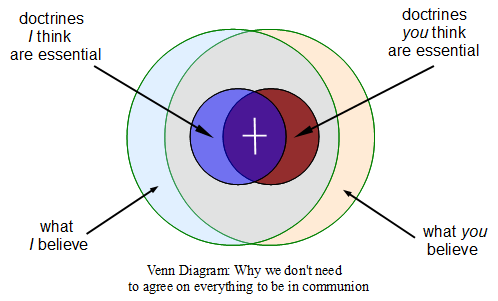
Note what happens here if we allow the little circles to expand until they become as large as the big circles.  In that case, we will come out of communion, by refusing to accept somebody else unless they are exactly like us.  This is schism, in which a failure of love leads to a rupture in the bonds of faith.

Although I wrote “believe” in this picture, the same thing applies when we talk about which behaviors are acceptable in a Christian community.  Here it is even easier, since we have more control over our behaviors than over our beliefs.  To have a functioning community, we need to be strict with ourselves, but more accepting when it comes to the conduct of others.

People are always alert to hypocrisy, situations where somebody says that X is required but doesn’t do X themselves.  You might think of this as a situation where the “small” circle is actually bigger than the “big” circle, and the person is condemned by their own standards.  But merely avoiding hypocrisy is not nearly enough.  If two people each allow themselves to do everything they personally think is OK, then unless they have identical beliefs, one will step outside the bounds set by the other.

“Do not judge, and you will not be judged.  Do not condemn, and you will not be condemned.  Forgive, and you will be forgiven.  Give, and it will be given to you.  A good measure, pressed down, shaken together and running over, will be poured into your lap.  For with the measure you use, it will be measured to you.”  (Luke 6:37-38)

IV. How to get other Christians to accept you

It’s fun to argue, and it may cause some individuals to move from one viewpoint to another, but I don’t think it’s where the most important work lies.  If you want to contribute to church unity, the way to do it is to serve.  The way to get other groups of Christians to recognize what you believe in, is not to fight them but to make yourself indispensable to them.

Think about St. Lewis’ writings.  He led millions to Christ, and to a deeper spirituality.  He chose to write primarily about those things which Christians have in common.  And the funny thing is, Christians of pretty much every kind all have him as their hero.  For example, the Eastern Orthodox have a tendency to think that Orthodoxy is the One True Church, and many of them think that those outside of it aren’t real Christians.  And yet an enormous number of them admire and respect St. Lewis, an Anglican.  Doesn’t matter if it’s inconsistent with their general views about the non-Orthodox, they’re forced to recognize him as a Christian, because he is just too darn useful to their spiritual lives to anathematize.

“When Christ ascended on high,
he took many captives
and gave gifts to his people.”

The communion of saints operates through the gifts we give to each other.  It has not been held back by denominational barriers.  I have heard hymns written by Protestants sung in Catholic Masses; I have seen books written by Catholic saints provide guidance for Protestants.  We are already one family, we just need to realize it.

So go and serve other groups of Christians.  Find out what they need, and then give it to them.  Make it so they can’t help but see that the Spirit of God is moving you.  (We are all quite willing to believe that the people who help our team are inspired from above.)  At the very least, we are always able to pray for each other.  Make the Lord’s priorities your priorities:

When Jesus had washed their feet and put on His robe, He reclined again and said to them, “Do you know what I have done for you?  You call Me Teacher and Lord. This is well said, for I am.  So if I, your Lord and Teacher, have washed your feet, you also ought to wash one another’s feet.  For I have given you an example that you also should do just as I have done for you.  I assure you: A slave is not greater than his master, and a messenger is not greater than the one who sent him.  If you know these things, you are blessed if you do them.” (John 13:12-17)